Ken Ammi reacts to Anthony Delgado’s reaction to Wes Huff on Enoch, Nephilim, and Demons

The article in question, Wes Huff on Enoch, Nephilim, and Demons is an Anthony reacts to Wes Huff’s comments article to I figure that I’ll follow up with Ken reacts to Anthony’s reaction to Wes Huff’s comments ;o)

His bio is:

Anthony Delgado is a pastor, author, and Bible teacher based in Southern California, with nearly two decades of experience in Christian leadership and biblical education. He studied Christian Reason at Sterling College and earned his MABTS from Knox Theological Seminary. Anthony approaches Scripture as one cohesive story of God’s redemption, weaving themes from Genesis to Revelation into a unified narrative of hope and renewal.

See my previous post Pastor Anthony Delgado on Giant Nephilim Clowns.

Wes Huff

…holds a BA in sociology from York University, a Masters of Theological Studies from Tyndale University, and is currently doing a PhD in New Testament at the University of Toronto’s Wycliffe College…is currently the Vice President for Apologetics Canada.

This pertains to, “Wes Huff’s comments from The Shawn Ryan Show”: since I’m reviewing a review I’m only really interested in adding some elucidating points.

One issue was, “ethics of technology and Watcher ‘secret knowledge’ (connecting modern tech questions to 1 Enoch 8 and Azazel’s teaching of warfare and seduction)” about which Delgado begins by noting:

…there’s more to first Enoch than I think Wes lets on…I think the evidence leads us to a greater confidence in some of this narrative…this Second Temple text.

Let’s start there since bottom line is that 1 Enoch is Bible contradicting folklore from centuries, if not millennia, after the Torah, see my book In Consideration of the Book(s) of Enoch.

There’s no indication that it contains any hitherto unknown facts nor newly revealed ones.

Yet, it’s being employed as a springboard wherefrom to discuss ethics of technology since it contains an elaborately detailed breakdown of which fallen Angel taught which bit of secret knowledge to humanity—apparently, demonically occult stuff such as, “taught women to beautify their eyes with colored makeup” and, “make swords, knives, shields, and breastplates to make war…about the metals of the earth and the art of metallurgy to make silver bracelets and ornaments…wear all kinds of costly stones.”

One of the funniest moments in all pseudepigrapha—perhaps the only funny one—is when 1 Enoch’s version of God tells the fallen Angels, “You have been in heaven, but all the mysteries had not yet been revealed to you, and you knew worthless ones” (4Q530 Frag. 2).

Delgado wrote, “In Genesis 6 you have the giants enter in, and they’re these mighty men, these mighty warriors, the gibborim.” Biblically contextually that would read as, “In Genesis 6 you have the Nephilim enter in, and they’re these mighty men, these mighty warriors, which is to what the Hebrew used of them, gibborim, refers.”

Key questions are: what’s the usage of the vague, generic, subjective, multi-usage and modern English word “giants” in English Bibles? What’s his usage? Do those two usages agree?

These questions are key since, for example, he wrote of, “the Nephilim and the Giants” which is also a case of jumping from the specific ancient Hebrew word Nephilim to the modern generically subjective English word giants.

Now, Wes Huff referenced that which I term the Gen 6 affair and noted, “The Greek translation of the Old Testament translates Nephilim as gigas, which is giants” yet, that only begs the questions: what’s his usage? 

The related word gigas, gigantes, gigantos all refer to the Greek mythological Earth false goddess Gaia so that, for example, gigantes means earth-born/born of Gaia. And I’m granting that there’s a linguistic difference between meanings/definitions and usages—for more, see my book Bible Encyclopedias and Dictionaries on Angels, Demons, Nephilim, and Giants: From 1851 to 2010.

Huff notes, “there’s both a kind of naturalistic explanation that the sons of God weren’t necessarily angels” yet, the original, traditional, and majority view among the earliest Jewish and Christians commentators, starting in BC days, was the Angel view as I proved in my book On the Genesis 6 Affair’s Sons of God: Angels or Not?: A Survey of Early Jewish and Christian Commentaries Including Notes on Giants and the Nephilim.

Job 38:7, as one example, shows us that, “sons of God” can refer to non-human beings (which the LXX has as Angeloi: plural of Angelos) since they, at the very least, witnessed the creation of the Earth.

Jude and 2 Peter 2 combined refer to a sin of Angels, place that sin to pre-flood days and correlate it to sexual sin which occurred after the Angels, “left their first estate,” after which they were incarcerated, and there’s only a one-time fall/sin of Angels in the Bible.

So, if they’re not referring to the Gen 6 affair, we’ve no idea to what sin they’re referring.

Anthony Delgado notes, “what’s very common in the West, it’s sometimes called the Sethite view” which is a late-comer of a view based on myth and prejudice.

He notes, “Now what I do like that Wes says is he says that Nephilim comes from the Hebrew naphil which means fallen ones. Now, some of you guys, if you’re Michael Heiser fans or something like that, which I am by the way as well, he was pretty adamant that there is not a relationship between naphil and Nephilim because he doesn’t want to make that about fallen humans.”

That Hebrew root is typically transliterated as naphal but what Heiser argued is that the root is actually the Aramaic naphiyla which, or so he claimed, means giant which, of course, begs the question: what’s his usage?

Well, he at least left us with this, “I don’t think the biblical giants were taller than unusually tall people of modern times (between 7-9 feet).”

Now, the J. Edward Wright Endowed Professor of Judaic Studies, who is J. Edward Wright, Ph.D. himself, and who is the Director of the Arizona Center for Judaic Studies at the University of Arizona notes, “The term traditionally translated as ‘giants’ in both the Greek Septuagint (γιγαντες) and now in English is נפילים nephilim, a term based on the root נפל npl meaning ‘fall.’ It has nothing to do with size” and specifies that this goes for both Hebrew and Aramaic as “The root npl in Aramaic also means fall and not giants” (private communique, July 2019).

Dr. Heiser was credentialed and experienced but not infallible, his Nephilology wasn’t altogether biblical, and he tended to create more problems than he solved—search online for these articles for examples:

Review of Amy Richter and Michael Heiser on four Enochian Watcher related women in Jesus’ genealogy

Rebuttal to Dr. Michael Heiser’s “All I Want for Christmas is Another Flawed Nephilim Rebuttal’”

I also included him in my book, The Scholarly Academic Nephilim and Giants: What do Scholarly Academics Say About Nephilim Giants?

Let’s face it, the common parlance usage of giant is something vaguely generic about subjectively unusual height of some unknown level above the parochial average (and yes, that is how useless the common parlance usage of that modern English word is).

Moreover, “The translators of the Greek text took it to mean giants. We see that again as early as like 300 BC that the Greek speaking Jews were translating this giants where it said Nephilim.” That’s too fast for my taste: it’s actually impossible that, “the Greek speaking Jews were translating this giants where it said Nephilim” and it’s also uber-myopic.

The Greek speaking Jews could not have translated giants since English didn’t exist yet, and they were writing in Greek—likewise with when he wrote, “(Genesis 6; LXX “giants”).” Rather, the Greek speaking Jews were rendered (didn’t even translate) this gigantes where it said Nephilim but that’s only a tiny fraction (literally speaking statistically) of the story—stand by for more on this.

The usage of the vague, generic, subjective, multi-usage and modern English word giants in English Bibles is that it merely renders Nephilim in 2 verses or Repha/im in 98% of all others and so never even hints at anything to do with any sort of height whatsoever. That is because those English versions follow what those Greek speaking Jews did with gigantes. Ergo, gigantes where it said Nephilim in only two verses.

Delgado wrote, “I don’t think First Enoch just appeared as some sort of bizarre fan fiction. No, it certainly had to have come out of a tradition of understanding.” That may very well be but, then again, a tradition of understanding still begins somewhere at some time so why not with 1 Enoch? In any case, it has Nephilim as being MILES tall which is great folklore but poor reality. Meanwhile, biblically, the dirty little secret is that since we’ve no reliable physical description of Nephilim then their height is a non-issue and that alone debunks 99% of un-biblical Nephilology—the modern branch of which is just un-biblical neo-theo sci-fi tall-tales.

There’s also the issue of:

Demons as the Spirits of the Nephalim

Wes Huff: This goes into like a long history of leading up to the New Testament where there’s a, you know, the demons kind of show up in the New Testament.

There really isn’t all that much said in the Old Testament about demons, but in some of this ancient Jewish literature that’s incorporated and found in the Dead Sea Scrolls, we have some of these discussions of things like, what are the demons?

Bottom line is that the claim that demons are the spirits of dead Nephilim is just folklore from centuries, if not millennia, after the Torah. For a biblical view, please see my article Demons Ex Machina: What are Demons?

Next up is:

…demons as disembodied spirits of the Nephilim/giants (a major Second Temple thread) with biblical touchpoints in the Rephaim passages (Job 26:5–6; Psalm 88:10; Isaiah 14:9)….

And so consider, for example, Job 26:5–6. Here it says the departed spirits tremble beneath the waters and all that inhabit them. Sheol is naked before God and Abaddon has no covering. Now that word departed spirits. There is the Hebrew word rephaim is the common Hebrew word for giant, it’s translated almost universally in the Greek text as gigantes, which is giant in English. And so it doesn’t make sense though, to read this, that the giants tremble beneath the waters because beneath the waters is speaking of like death, a place of death.

And so as they are dead, what are these rephaim here? Well, they’re the dead rephaim as really the history and how these are interpreted. So many people have said these are human ghosts. So again, what do you think giants and Nephilim are?

Well, if they’re just humans, then these are some kind of human ghosts or something like that, which I think isn’t too far off. Like no matter how you take the Sethite or the other view, you’re actually gonna come to a certain understanding of departed spirits as being demonic. But anyway, that’s another conversation. But you just have to see that there. And it’s not only the one place.

Psalm 88:10. Do you work wonders for the dead? Do giants, rephaim, departed spirits rise up to praise you?

This is actually a very complicated simple issue, or so it seems to me since there’s a madness to my method.

This comes down to that the root word rapha ranges in meaning from healing/healer to dead/death. Ergo, people read it—even if in the plural form of raphaim or the Rephaim—referring to the dead and apply it to the 100% human people group, the Rephaim tribe.

Recall that I noted to stand by regarding the 98% usage: earlier, it was, “Genesis 6 you have the giants…the Nephilim and the Giants…(Genesis 6; LXX ‘giants’)…Nephilim/giants,” etc. but now it’s, “rephaim is the common Hebrew word for giant” even though, “it’s translated almost universally in the Greek text as gigantes, which is giant in English” which is just a watered down vicious circular cycle of question begging.

So, it’s not, “giants tremble beneath the waters” but, “the dead tremble beneath the waters.”

As for, “what do you think giants and Nephilim are?” well, we can’t know until we’re told what they mean by giants.

But note that what many do is, again, to take the root rapha, apply it to the Rephaim tribe, actually incorporate Pagan mythology to it, and that results in the Rephaim having been some sort of living dead.

In Ugaritic texts, for example, recently deceased kings and heroes were referred to as kings and heroes yet, after they had been dead for some time, they were called rpʾum (a version of rephaim) and could be summoned to attend rituals, etc.—see my post Dead Kings and Rephaim The Patrons of the Ugaritic Dynasty.

And that’s all for my reaction to Delgado’s reaction to Huff—what’s your reaction to my reaction to his reaction to him?

See my various books here.

~~~~~~~~~~~~~~~~~~~~~~~

A plea: I have to pay for server usage and have made all content on this website free and always will. I support my family on one income and do research, writing, videos, etc. as a hobby.

If you can even spare $1.00 as a donation, please do so: it may not seem like much but if each person reading this would do so, even every now and then, it would add up and really, really help out.

Here is my donate/paypal page.

You can comment here and/or on my Twitter/X page, on my Facebook page, or any of my other social network sites all which are available here.
Pastor Anthony Delgado on Giant Nephilim Clowns

Pastor Anthony Delgado’s bio notes, “a pastor and author from Southern California with nearly two decades of experience in Christian leadership and Bible teaching. He studied Christian Reason at Sterling College and holds an MABTS from Knox Theological Seminary.”

He wrote a series of articles about Nephilim, giants, and clowns which are all issues that are right up my alley. See my previous post Ken Ammi reacts to Anthony Delgado’s reaction to Wes Huff on Enoch, Nephilim, and Demons.

We will first consider What Does the Bible Say About Nephilim? wherein he notes:

The Nephilim in Genesis 6

Genesis 6:1–4 describes a time when “the sons of God” came to human women and had children with them, producing the Nephilim. One common interpretation is that “sons of God” refers to angelic beings who took on human form and cohabited with women, resulting in an unusual and powerful hybrid race.

The original, traditional, and majority view among the earliest Jewish and Christians commentators, starting in BC days, was the Angel view as I proved in my book, On the Genesis 6 Affair’s Sons of God: Angels or Not?: A Survey of Early Jewish and Christian Commentaries Including Notes on Giants and the Nephilim.

However, there is no indication that, “angelic beings,” Angels, “took on human form.” Rather, Angels are always described as looking like human males, performing physical actions, and without indication that such is not their ontology—see my book, What Does the Bible Say About Angels? A Styled Angelology.

His first bit of, “Support for this view comes from” is, “The Book of 1 Enoch — An ancient Jewish text expanding on Genesis, explicitly stating that heavenly beings produced offspring with human women.” Note that ancient is a subjective term since that text is surely ancient to us yet, it is Bible contradicting folklore from centuries, if not millennia, after the Torah, see my book, In Consideration of the Book(s) of Enoch.

He added, “The Hebrew word ‘Nephilim’ — Possibly derived from nafal (‘to fall’), interpreted by some as ‘fallen ones,’ referring to fallen angels.” That Nephilim refers to fallen Angels does not even make a faint blip on the historical radar of who took which view: it is understood to refer to the unusual and powerful hybrid race produced by Angels mating with human women.

He notes, “Some understand ‘sons of God’ as referring to human rulers or descendants of Seth marrying outside their covenant community.” The former is a very early view, but is also one of the least historically notable ones. The latter is a late-comer based on myth and prejudice.

Pastor Anthony Delgado references, “Several difficulties arise when interpreting the Nephilim passages”:

“The Nature of Angels — Matthew 22:30 suggests angels do not marry, leading some to reject the idea of angelic-human offspring.”

Note his qualifying term in that he infers a suggestion. Well, there is no such implication in that verse (which he did not quote). Note that his is a generically all-encompassing statement, “angels do not marry.”

Yet, Jesus’ statement was very detailed, very nuanced, He employed qualifying terms, “the angels of God in heaven.” So, not all Angels at all times in all places but the loyal ones, “of God” and “in heaven” which is why those who did marry are considered sinners since they, “left their first estate,” as Jude put it, in order to do so.

The next difficulty is, “Chronological Questions — Genesis 6 places the Nephilim before the flood, yet Numbers 13:33 describes them after the flood, raising questions about continuity.”

The problem is that he is dealing in citations but citations only tell you were to find a statement and does not include key hermeneutical questions such as: who said it, why was it stated, was it accurate, what was the reaction to it, etc., etc., etc.

Thus, stating, “Numbers 13:33 describes them after the flood” is indeed, “raising questions about continuity” since what the pastor did not tell us is that he is appealing to one unreliable sentence from an unreliable evil report by some unreliable guys whom God rebuked: it was merely a fear-mongering, scare-tactic tall-tale.

Next up is, “Textual Ambiguity — The Bible’s sparse details leave room for multiple explanations” and yet, again, there has always been one main view.

Pastor Anthony Delgado next writes of, “Nephilim, Giants, and the Canaanite Context” which calls into question: What is the usage of the vague, generic, subjective, multi-usage and modern English word, “giants” in English Bibles? What is his usage? Do those two usages agree?

Those questions are specially important since, hint, biblically contextually, “Nephilim, Giants” means, “Nephilim, Nephilim.”

He goes back to Num 13:33 and notes that it, “records Israelite spies describing the inhabitants of Canaan as giants, calling them descendants of the Nephilim.” That is more specific, since he tells us what is recorded at the citation and yet, he misrepresented the narrative.

That verse is not about, “Israelite spies” in general, “describing the inhabitants of Canaan as giants, calling them descendants of the Nephilim.” Rather, there were 12 spies but that verse is what the unreliable ones whom God rebuked merely asserted—including something about whatever giants references.

He does note, “Some scholars suggest the spies exaggerated out of fear, while others see this as evidence that the Nephilim’s lineage persisted in some form. In either case, the association of the Nephilim with intimidating size and strength is consistent across biblical references.”

Indeed, and I quote scholars who suggest exaggeration (at the very least) in my book What Does the Bible Say About Giants and Nephilim? A Styled Giantology and Nephilology.

As for, “evidence that the Nephilim’s lineage persisted in some form” well, that is illogical, ill-bio-logical, and ill-theo-logical: he can only appeal to one single unreliable verse and such a view implies that God failed, missed a loophole, the flood was much of a waste, etc., etc., etc.

As for, “the association of the Nephilim with intimidating size and strength is consistent across biblical references”: there is literally zero indication of any such thing.

Note that we now appear to have a window in to his usage of giants since he referenced (alleged) intimidating size. Thus, the pastor’s usage of giants does not agree with the English Bibles’ usage since the usage of the vague, generic, subjective, multi-usage and modern English word giants in English Bibles is that it merely renders (does not even translate) Nephilim in 2 verses or Repha/im in 98% of all others and so never even hints at anything to do with any sort of height whatsoever.

Incidentally, the dirty little secret is that since we do not have reliable physical description of Nephilim then their height is a non-issue and that alone debunks 99% of un-biblical Nephilology—the modern branch of which is just un-biblical neo-theo sci-fi tall-tales.

He ends that article with, “Bible Verses About Nephilim”:

Genesis 6:1–2, “When man began to multiply on the face of the land and daughters were born to them, the sons of God saw that the daughters of man were attractive. And they took as their wives any they chose.”

Genesis 6:3, “Then the Lord said, ‘My Spirit shall not abide in man forever, for he is flesh: his days shall be 120 years.'”

Genesis 6:4, “The Nephilim were on the earth in those days, and also afterward, when the sons of God came in to the daughters of man and they bore children to them. These were the mighty men who were of old, the men of renown.”

Numbers 13:32, “So they brought to the people of Israel a bad report of the land that they had spied out, saying, ‘The land, through which we have gone to spy it out, is a land that devours its inhabitants, and all the people that we saw in it are of great height.'”

Numbers 13:33, “And there we saw the Nephilim (the sons of Anak, who come from the Nephilim), and we seemed to ourselves like grasshoppers, and so we seemed to them.”

Job 1:6, “Now there was a day when the sons of God came to present themselves before the Lord, and Satan also came among them.”

Job 38:7, “When the morning stars sang together and all the sons of God shouted for joy?”

Jude 1:6, “And the angels who did not stay within their own position of authority, but left their proper dwelling, he has kept in eternal chains under gloomy darkness until the judgment of the great day.”

2 Peter 2:4, “For if God did not spare angels when they sinned, but cast them into hell and committed them to chains of gloomy darkness to be kept until the judgment.”

Colossians 2:15, “He disarmed the rulers and authorities and put them to open shame, by triumphing over them in him.”

Recall that Pastor Anthony Delgado thinks that, “The Hebrew word ‘Nephilim’” is, “referring to fallen angels.”

In any case, that list only included two verses about Nephilim: the reliable record in Gen 6:4 and the unreliable tall-tale in Num 13:33—and that Jude references that which I term the Gen 6 affair.

Jude and 2 Peter 2 combined refer to a sin of Angels, place that sin to pre-flood days and correlate it to sexual sin which occurred after the Angels, “left their first estate,” after which they were incarcerated, and there is only a one-time fall/sin of Angels in the Bible. So, if they were not referring to the Gen 6 affair, we have no idea to what sin they are referring.

We next move on to the article Did giants literally exist according to the Bible? wherein he also does not elucidate his usage of the word giants.

He noted, “Giants in the Old Testament…giants as a reality woven into Israel’s story” and appeals to that, “Genesis 6:1–4 introduces the Nephilim, described as the offspring of ‘the sons of God’ and ‘the daughters of men.’” Thus, in this article, he rightly identifies Nephilim not as Angels but as their offspring.

He referred to giants, then to Nephilim and then back to giants which makes reading difficult since we have to keep track to what he may be referring as he jumps from the specific ancient Hebrew word Nephilim to the modern generically subjective English one giants.

He notes that Gen 6:4, “connects the appearance of giants to a spiritual rebellion in the heavenly realm.” He told us about giants in Gen 6 but there is nothing in that whole chapter—or whole book—about intimidating size of anyone, much less of Nephilim.

Of course, next up is, “in Numbers 13:33, Israel’s spies report that giants still dwelled in the land. Their exaggerated fear—‘we seemed like grasshoppers’—shows both the imposing stature of these beings and Israel’s lack of faith…their size…”

Again, that is not the generic, “Israel’s spies report” in fact, it is the second report in that chapter, the first of which is the factually accurate one—and it lists six people groups they saw in the land but does not mention Nephilim, “the descendants of Anak…The Amalekites…The Hittites, the Jebusites, and the Amorites…And the Canaanites.”

It is a mere assertion that, “exaggerated” still evidences, “imposing stature” since every indication is that their (supposed) imposing stature was the exaggeration. And that is because both sides of Nephilim’s parentage looked just like human beings and so subjective average size is implied.

Pastor Anthony Delgado then abruptly asserts, “Other passages mention related groups such as the Rephaim, Anakim, and Emim, tribes remembered for their unusual strength and stature (Deuteronomy 2–3). Goliath of Gath, defeated by David in 1 Samuel 17, stands as the most famous example.”

That those are, “related groups” is not only a mere assertion, it is another case of that which is illogical, ill-bio-logical, and ill-theo-logical. And, it is not even really a case of those, plural, since Emmim is just an a.k.a. for Rephaim and Anakim were like a clan of the Rephaim tribe.

As for, “unusual…stature” well, sure, Deut 2 tells us that they were, “tall” subjective to the average Israelite male who was 5.0-5.3 ft. in those days.

As for Goliath well, sure, he too was of subjectively of, “unusual…stature” since the Masoretic text has Goliath at just shy of 10 ft. Yet, the earlier LXX and the earlier Dead Sea Scrolls and the earlier Flavius Josephus all have him at just shy of 7 ft. so, that is the preponderance of the earliest data—even though the pastor did not tell us anything about Goliath’s height, especially within the context of evidencing his usage of giants.

He ends the article with, “Bible Verses about Giants”:

Genesis 6:4 – “The Nephilim were on the earth in those days…”

Numbers 13:33 – “We seemed like grasshoppers in our own sight.”

Deuteronomy 2:10–11 – “The Emim formerly lived there, a people great and many, and tall as the Anakim.”

Deuteronomy 3:11 – “Only Og the king of Bashan was left of the remnant of the Rephaim.”

Joshua 11:21–22 – “Joshua cut off the Anakim from the hill country…”

1 Samuel 17:4 – “There came out from the camp of the Philistines a champion named Goliath.”

2 Samuel 21:20 – “There was again war at Gath, where there was a man of great stature…”

Psalm 135:10–11 – “He struck down many nations and killed mighty kings—Sihon king of the Amorites, and Og king of Bashan.”

Amos 2:9 – “Yet it was I who destroyed the Amorite before them, whose height was like the height of the cedars.”

Colossians 2:15 – “He disarmed the rulers and authorities and put them to open shame.”

Let us review:

Genesis 6:4 – reliably about Nephilim but no physical description.

Numbers 13:33 – unreliably about Nephilim with an unreliable physical description.

Deuteronomy 2:10–11 – about Rephaim who were taller than 5.0-5.3ft.

Deuteronomy 3:11 – about one Repha for whom we do not have a physical description.

Joshua 11:21–22 – about Rephaim/Anakim.

1 Samuel 17:4 – about one just shy of 7ft. Repha.

2 Samuel 21:20 – about one Repha of subjectively, “great stature.”

Psalm 135:10–11 – About an Amorites and a Repha for whom we do not have a physical description.

Amos 2:9 – it reads, “the Amorite…whose height was like the height of the cedars and who was as strong as the oaks; I destroyed his fruit above and his roots beneath.” He was clearly just saying they were big and strong and not implying conducting a one-to-one ratio based mathematical calculation.

In fact, people who do measure cedars and claim Amorites were that tall never get around to a calculation correlating the strength of oaks—since they are only interested in tall-tales. Plus, if they take it that incoherently literal then they have to conclude that Amorites had fruits and roots growing right out of their bodies.

Colossians 2:15 – irrelevant to Pastor Delgado’s usage of giants.

Next up is the article Giants Reappeared After the Flood wherein he notes, “The reappearance of giants after the Flood” but since his usage is not biblical then he must mean the reappearance of personages who are generically subjectively taller than the parochial average by an unknown margin after the Flood.

Of course, that is a non-issue since if Adam was even one inch taller than Eve then there have always been people who were subjectively taller than other people.

Thus, we have to assume that, this time around, he is referring to Nephilim in particular.

He premises the article by noting, “While the Genesis account focuses on the Nephilim before the Flood, later biblical narratives describe giant clans in the land of Canaan—most notably the Anakim, Rephaim, and others—who opposed Israel during the conquest.” Note the linguistics goalpost moving, again, even within one single sentence, “Nephilim before the Flood, later biblical narratives describe giant clans in the land of Canaan.

As for, “Anakim, Rephaim, and others” we will see just how that is not the case.

But first, he noted:

The Bible does not explain exactly how giants reappeared, leading to various interpretations. Some suggest the Flood was regional rather than global, leaving pockets of giants alive. Others propose that similar supernatural events to those in Genesis 6:1–4 occurred again after the Flood.

Regardless of the mechanism, their reemergence is a reminder that the spiritual rebellion which began before the Flood persisted into Israel’s history.

See the ongoing problem? We were left having to guess as to what he was referring by, “how giants reappeared”?

The scope of the flood is irrelevant to Nephilology since they either did not make it past the flood because it was global or because they lived in the flooded region: either way, they did not make it past the flood in any way, shape, or form.

We are told five times who survived the flood but Nephilim are not in any of those statements (Genesis 7:7, 23; Hebrews 11:7; 1 Peter 3:20; and 2 Peter 2:5).

That, “similar supernatural events…occurred again after the Flood” is not only wholly unevidenced but, as with the local flood theory, they imply that God failed, missed a loophole, and the flood was much of a waste.

His, “Biblical Evidence for Post-Flood Giants” begins with, “Genesis 6:4 states, ‘The Nephilim were on the earth in those days, and also afterward,’ a phrase that hints at their later reappearance.” Indeed, when one cuts a verse—a sentence, a complete thought—in half (especially at the key point at which it was going to tell us to what days it is referring) then one can follow that up by merely opining about a subjective hint.

Yet, the complete verse/statement/thought is, “The Nephilim were on the earth in those days, and also afterward, when the sons of God came in to the daughters of man and they bore children to them. These were the mighty men who were of old, the men of renown.”

Thus, “those days” were when the sons and daughters first married, mated, and birthed (with the commencing timeline being given in v. 1 as, “When man began to multiply on the face of the land and daughters were born to them, the sons of God saw that the daughters of man were attractive. And they took as their wives any they chose”) and so, “afterward” meant just that, after they first did so (they kept doing so) yet, that is still all pre-flood.

His next stop is, “Numbers 13:33 explicitly connects the Anakim to the pre-Flood Nephilim: ‘We even saw the Nephilim there—the descendants of Anak come from the Nephilim.’” Here, he not only tells us that a citation, “explicitly connects” but he myopically relies on non-LXX versions since that version’s version of that verse does not even mention Anakim—unsure why he did not mention that.

Oddly, Pastor Delgado ends up rightly distinguishing, “The fearful report of the spies in Numbers 13:31–33 shows how giants could paralyze God’s people with unbelief. In contrast, Caleb and Joshua’s trust in God’s power points to the faith required to overcome” (emphasis added for emphasis) but fails to interact with the chapter’s (and chap 14’s) narrative to the point of rightly dividing God’s word.

He then lists how, “The Bible mentions several post-Flood giant peoples” at which point he seems to have, yet again, changed his usage from appearing to refer to Nephilim to now referring to generically subjectively taller than the parochial average by an unknown margin:

Anakim – Tall warriors living in Canaan (Deuteronomy 9:2).

Rephaim – A race of giants inhabiting various regions (Deuteronomy 2:10–11).

Emim and Zamzummim – Other giant groups dispossessed by Israel’s neighbors (Deuteronomy 2:20–21).

Og of Bashan – A giant king whose bed was over thirteen feet long (Deuteronomy 3:11).

All of those are about Rephaim and sure, they were taller than 5.0-5.3ft.

Just in case, as for Og: again, we do not have a physical description of him and merely assuming that his, “bed” tells us something about his personal size is a non-sequitur based on various assumptions. In fact, it was a ritual object, not something upon which he slept—see my book The King, Og of Bashan, is Dead: The Man, the Myth, the Legend—of a Nephilim Giant?

He then circles back to add details to, “Recognize the Possible Explanations for Their Return. Because the Flood narrative describes the destruction of all flesh except those in the ark, the reappearance of giants requires explanation.”

He notes that, “Common views include” that they were, “Survivors of a Regional Flood – Suggests the Flood’s scope was not global, allowing giant populations in other regions to survive” which, again, contradicts the Bible five times.

Or, “Repeated Angelic Rebellion – Proposes that events similar to Genesis 6 occurred again, producing a new generation of giants” which is just a fantasy story post-flood Nephilologists invented when they realized they had zero biblical data.

Also, “Symbolic or Legendary Continuity – Suggests that later giant accounts use the Nephilim as an archetype for formidable enemies” which may be fair enough in terms of that the unreliable guys whom God rebuked after their unfaithful disloyalty resulted in a tall-tale about post-flood Nephilim. Yet, if, “later giant accounts use the Nephilim as an archetype for formidable enemies” why is there only one single such example in the whole entire Bible?

Pastor Anthony Delgado gives up, in a manner of speaking, with, “the Bible does not settle the question” which is most certainly does: only 8 personages survived the flood, God did not fail, did not miss a loophole, the flood was not much of a waste, centuries post-flood some guys who contradicted Moses, Caleb, Joshua, God, and the rest of the whole entire Bible made up a fear-mongering, scare-tactic fantasy, “Don’t go in the woods!!!” style of tall-tale and were rebuked by God—end of biblical story.

For many more details, see my post Chapter sample: On the Post Flood Nephilim Proposal.

Thus, when Pastor Delgado tells us of, “The book of Joshua records that Israel encountered the Anakim during the conquest of Canaan” that is irrelevant to Nephilology.

And, “David faced Goliath” is irrelevant to Nephilology.

And, “David’s men later killed other giant warriors” is irrelevant to Nephilology.

And, “Each defeat of a giant” is irrelevant to Nephilology.

Rather, those are relevant to generically subjectively taller than the parochial average by an unknown margin generically subjectively taller than the parochial average by an unknown margin—and I am still quite unsure how that is any sort of issue.

This article ends with, “Bible Verses about Giants after the Flood”:

Genesis 6:4 – “The Nephilim were on the earth both in those days and afterward, when the sons of God came to the daughters of mankind, who bore children to them. They were the powerful men of old, the famous men.”

Numbers 13:33 – “We even saw the Nephilim there—the descendants of Anak come from the Nephilim. To ourselves we seemed like grasshoppers, and we must have seemed the same to them.”

Deuteronomy 2:10–11 – “The Emim, a great and numerous people, as tall as the Anakim, had previously lived there. They were also regarded as Rephaim, like the Anakim, though the Moabites called them Emim.”

Deuteronomy 2:20–21 – “This too was regarded as the land of the Rephaim. The Rephaim had previously lived there, though the Ammonites called them Zamzummim, a great and numerous people, tall as the Anakim. The LORD destroyed the Rephaim at the advance of the Ammonites, who drove them out and settled in their place.”

Deuteronomy 3:11 – “Only King Og of Bashan was left of the remnant of the Rephaim. His bed was made of iron. Isn’t it in Rabbah of the Ammonites? It is thirteen and a half feet long and six feet wide by a standard measure.”

Joshua 14:12 – “Now give me this hill country the LORD promised me on that day, because you heard then that the Anakim are there, as well as large fortified cities. Perhaps the LORD will be with me and I will drive them out as the LORD promised.”

1 Samuel 17:4 – “Then a champion named Goliath, from Gath, came out from the Philistine camp. He was nine feet, nine inches tall.”

1 Samuel 17:45 – “David said to the Philistine, ‘You come against me with a sword, spear, and javelin, but I come against you in the name of the LORD of Armies, the God of the ranks of Israel—you have defied him.’”

2 Samuel 21:20 – “At Gath there was another huge man who had six fingers on each hand and six toes on each foot—twenty-four in all. He, too, was descended from the giant.”

2 Samuel 21:22 – “These four were descended from the giant in Gath and were killed by David and his soldiers.”

Review:

Genesis 6:4 – about Nephilim for whom we have no reliable physical description and not about post-flood.

Numbers 13:33 – a non-LXX version of an unreliable fantasy tall-tale.

Deuteronomy 2:10–11 – subjectively tall Rephaim.

Deuteronomy 2:20–21 – subjectively tall Rephaim.

Deuteronomy 3:11 – about a man for whom we do not have a physical description and a ritual object.

Joshua 14:12 – subjectively tall Rephaim/Anakim.

1 Samuel 17:4 – a just shy of 7ft. Repha.

1 Samuel 17:45 – no reference to even being subjectively tall.

2 Samuel 21:20 – subjectively, “huge man” (note how Pastor Delgado changed from the version he previously quoted) with, “huge” being just as vague, generic, subjective, and multi-usage as, “tall”—and biblically contextually, “descended from the giant” means, “descended from the Repha.”

2 Samuel 21:22 – same as above.

Next up is the article The Spirits of Dead Giants Became Demons which I will go through very succinctly since it is premised on:

According to the ancient Jewish worldview preserved in works like 1 Enoch, the death of the giants—offspring of the rebellious Watchers and human women—did not end their destructive influence. While the Flood and other divine judgments removed them from the physical world, their spirits were believed to remain earthbound…they became wandering, unclean spirits—what we now call demons…This understanding, common in Second Temple Judaism…

Recall that ancient is a subjective term and that 1 Enoch is Bible contradicting folklore from the Second Temple Judaism which is 538 BC-70 CE.

In short then, that demons are the spirits of dead Nephilim is just folklore from centuries, if not millennia, after the Torah. For a biblical view, please see my article, Demons Ex Machina: What are Demons?

And we have come to a portion of the article A Biblical Symbology of Clowns: The Clown on My Wall. Initially, I noted, “Nephilim giants and clowns which are all issues that are right up my alley” since I have familiarized myself with over two millennia worth of relevant data that I used to write my dozen, or so, Nephilology books one of which is Did the Nephilim Look Like Clowns? A Review of Paul Stobbs’ Theory as well as A Worldview Review of Stephen King’s “It”: The Mystical, Mysterious, and Metaphysical in the Novel, Miniseries, and Movies.

He notes:

Clowns embody contradiction and inversion, acting as cultural symbols that expose the boundaries and hypocrisies of human systems through humor, discomfort, and absurdity.

Though often feared, their purpose is not malevolence but revelatory: clowns function as sacred fools or prophetic tricksters who disrupt social order to reveal truth.

Historically rooted in the role of the jester, the clown occupies the space between order and chaos, revealing hidden realities and confronting tyranny by returning overextended structures to a state of potential.

He elucidated:

Are Nephilim Clowns?

This question is clearly driven by the terror that people experience (because of whatever kind of trauma) related to clowns. The question could really take two forms:

Are Clowns Nephilim?

Are Nephilim Clowns?

The responses to these questions are not the same, though the answer to both is invariably ‘no.’

He then unpacks each:

Are Clowns Nephilim?

In Biblical Theology, the Nephilim are the giant offspring of the sons of God (Watchers, rebellious angels) and human women. These giants are depicted as tyrannical leaders of earthly tribes and kingdoms: Og of Bashan, Goliath of Gath, Anak the progenitor of the Anakites,…(Hercules?).

In the Hebrew folklore, specifically, the Enochic literature, the giants have ravenous appetites, ruling the people with an iron fist, demanding to feed, even on human flesh. They are in every way tyrants who order their societies around their own lusts, hungers, and thirsts.

Here he has it that, “Nephilim are the giant offspring” which biblically contextually means, “Nephilim are the Nephilim offspring” so he is watering down terminology by his misusage which is the only thing that allows him to correlate data points that have nothing to do with each other such as mashing Nephilim together with, “Og of Bashan, Goliath of Gath, Anak” and even, “(Hercules?).”

“In the Hebrew folklore” the sky’s the limit, see my article How Nephilim Absconded from the Tanakh and Invaded Folkloric Territory.

Interestingly, he notes, “their fathers, the fallen angels now chained in Tartarus” which is what ought to have alerted him that the, “similar supernatural events…occurred again after the Flood” is a non-issue. Again, Jude and 2 Peter 2 combined refer to a sin of Angels, place that sin to pre-flood days, etc. now, while they do not specify when they were incarcerated, since the flood was when God was cleaning house, as it were, just pre-flood or intra-flood would be the logical time when they were incarcerated.

He then notes, “A Case Study: You may ask how ‘evil clowns’ fit into this paradigm. Take Stephen King’s It, a horror novel about a group of children who are terrorized by a malevolent, shape-shifting entity that most often appears as a clown named Pennywise.” And the concept of trickster spirits has been around, by any other name, for millennia. Such is part of the dark side of clownery.

Thus, continuing:

Are Nephilim Clowns?

Nephilim can only be clowns in a Gnostic world. Gnosticism, though not a defined system of thought, tends to see the world as polarized between good and evil and ultimately is antimaterialist, seeing the ultimate reality of life, not about the physical universe, but about eternal spiritual realities.

And King’s It is a straight up Gnostic tale indeed.

As for Nephilim and clows well, the concept that clowns’ appearance (and clowns have varies very greatly from time to time and culture to culture) is premise on how Nephilim looked it an utterly incoherent fantasy.

In fact, as admitted by Stobbs, this all began when he had a flashback after years of using and abusing hardcore hallucinogenic drugs.

The claim that Nephilim looked like clowns is based on a miscomprehension of the relevant linguistics, reliance on faulty sources, folklore, and mere assertions.

His Nephilology is literally 100% un-biblical.

As for whether there are some aspects of some versions of some clows that can be correlated to Nephilim due to being contra God’s created order and such well, sure, yet, that is too generic—we might as well say that the dark side of clowns is based on Satan himself.

See my various books here.

~~~~~~~~~~~~~~~~~~~~~~~

A plea: I have to pay for server usage and have made all content on this website free and always will. I support my family on one income and do research, writing, videos, etc. as a hobby.

If you can even spare $1.00 as a donation, please do so: it may not seem like much but if each person reading this would do so, even every now and then, it would add up and really, really help out.

Here is my donate/paypal page.

You can comment here and/or on my Twitter/X page, on my Facebook page, or any of my other social network sites all which are available here.

Elijah Adebiyi’s long lost post: HOW DID GIANTS APPEAR IN SCRIPTURES AFTER THE FLOOD!

Well, it’s not long lost and was only found, really just preserved, by me. A certain Elijah Adebiyi posted HOW DID GIANTS APPEAR IN SCRIPTURES AFTER THE FLOOD! on Facebook, I proceeded to offer iron sharpening iron corrections of his post and of some comments by his readers and in the middle of that, I got a, “This content isn’t available right now” since he deleted it—when we seek to sharpen iron with iron, someone tends to get cut.

Yet, as I tend to do, I was keeping track of the post and comments by copying and pasting them on a Word doc so I have that which it contained.

Elijah’s post read:

First of all Let me Clarify One thing here!

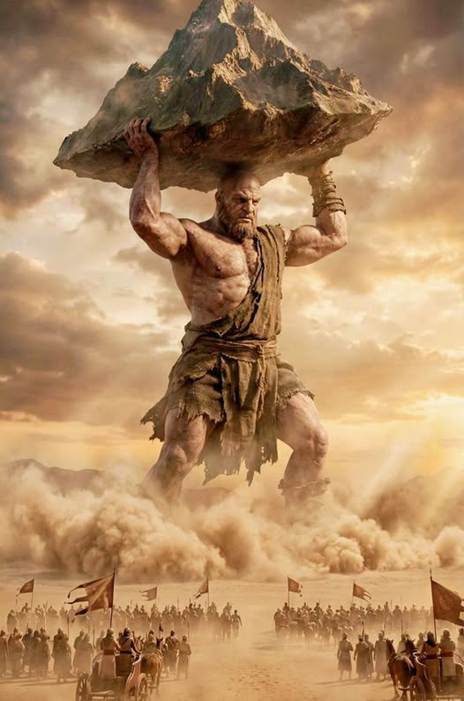
Look at this Image Below, How can Such a Giant be as a Result of Mere Genetical and Biological Mixups in the Blood?

And this Image is NOT CLOSE to How Giants are Actually gigantic in the days  of the Anakims.

This was how the Bible Described them;

Numbers 13:33

“And there we saw the giants, the sons of Anak, which come of the giants: and WE WERE IN OUR OWN SIGHT AS GRASSHOPPERS, and so we were in their sight”

Although they Brought an evil report, Yet the Reports were very FACTUAL!

These guys are Giants and the People are Like Grasshoppers.

Which means a single Giant in those Days Can Use Two fingers to Pick 2 to 5 people up and Throw them into their Throats

That’s Who Giants they were!

When Prophet Isaiah wanted to Describe the Inferiority of Grasshopper, He Compared them to the Greatness of God.

Isaiah 40:22

“It is he that sitteth upon the circle of the earth, and the inhabitants thereof are as grasshoppers…”

This Description which Isaiah Gave here was the Closest thing to How Giants Look like in those days.

This Cannot be Only Biological and Genetical Malfunction. There is Something More.

There is a Catalyst Somewhere Powering that Gigantism in their Systems.

I have Made a Post about the Nephilim and Told us that the Giants that Surfaced the Earth are NORMAL HUMANS but with a Nephilic Blood Corruption, Like an INFECTION through the Reproduction in their Family Bloodline.

Let me Begin from where we Sourced Giants in the Bible.

Genesis 6:4

“There were giants in the earth in those days; AND ALSO AFTER THAT, when the sons of God came in unto the daughters of men, and they bare children to them, the same became mighty men which were of old, men of renown”

Let’s Leave the Sons of God and Daughters of Men Now!

If you wanna Know about the Organic Origin of Nephilims, I will Paste it in the Comments section.

The Subject here is How did they Resurface in the Earth after the Flood.

The Bible Said in that Scripture above that

“There were Giants in the Earth in those days and ALSO AFTER THAT…”

Which means the Bible is Confirming that Giants Existed In those Days before the Flood,

And After the Flood, Giants Existed and that these giants are Traceable to the Giants Before the Flood!

Which means in that Context of that Scripture the Giants after the Flood are Indirectly or Somehow Connected to the Giant that were Destroyed in the flood.

So what is that connection?

Who Brought about the Connection?

How were they Reproduced?

I’m not Sharing anything from my Revelations or High Sounding Nonsense as we tag it!😅

I will quoting Scriptures and Comparing Scriptures with Scriptures.

Follow!!!

A certain Darra Dawn replied:

Thank you revealator/teacher.

As I read it’s as though in some sense I’m transported upon the energies there-in, and knowledge is increased/expanded. Such a Blessing.

Elijah Adebiyi replied:

Thanks for engaging Ma’am

Glory to the Father 🙌❤️

I, True Freethinker, replied with my main corrections—and didn’t get a, “Thanks for engaging” but got a deletion:

Asking “HOW DID GIANTS APPEAR IN SCRIPTURES AFTER THE FLOOD!” isn’t the primary question, the primary one is, “DID GIANTS APPEAR IN SCRIPTURES AFTER THE FLOOD!” no one can answer you until you first answer: What’s the usage of the vague, generic, subjective, multi-usage and modern English word “giants” in English Bibles? What’s your usage? Do those two usages agree? Without those answers, we either can’t know to what you’re referring or we have to work hard to attempt to guess.

As for, “this Image Below” it’s just a fantasy so what of it?

Well, it seems that by “giants” you mean something vaguely generic about subjectively unusual height of some unknown level above the parochial average (and yes, that is how useless the common parlance usage of that modern English word is).

If that’s the case then your usage doesn’t agree with the English Bibles’ since the usage of the vague, generic, subjective, multi-usage and modern English word giants in English Bibles is that it merely renders (doesn’t even translate) Nephilim in 2 verses or Repha/im in 98% of all others and so never even hints at anything to do with any sort of height whatsoever.

You misrepresented Num 13 when you said, “This was how the Bible Described them” since you failed to point out that you’re relying on:

1. One single unreliable sentence

2. From strictly non-LXX versions (since that version’s version of that verse doesn’t even mention Anakim)

3. Of an unreliable “evil report”

4. By 10 unreliable guys

5. Whom God rebuked—to death

6. Who made five mere assertions unbacked by even one single other verse in the whole Bible

7. Who contradicted Moses, Cable, Joshua, God, and the rest of the whole entire Bible

I could go on but see my post “Chapter sample: On the Post Flood Nephilim Proposal.”

You assert, “the Reports were very FACTUAL!” but the fact is what I noted in point 6: and if you disagree, you’ll have to provide evidence for all five of their assertions—even when they literally contradict the report of a good land flowing with milk and honey and claim that it eats up it’s inhabitants.

So, it’s only in a false fantasy tall-tale that, “These guys are Giants and the People are Like Grasshoppers.”

Notice that you ended up saying that “giants” were so big that they could sit upon the circle of the Earth.

You asserted, “Nephilim…are NORMAL HUMANS but with a Nephilic Blood Corruption” (whatever that means) but the original, traditional, and majority view among the earliest Jewish and Christians commentators, starting in BC days, was the Angel view as I proved in my book “On the Genesis 6 Affair’s Sons of God: Angels or Not?: A Survey of Early Jewish and Christian Commentaries Including Notes on Giants and the Nephilim.”

Again, you use “giants” to mean something about height but then quote Gen 6:4 which has no physical description of them. The dirty little secret is that since we’ve no reliable physical description of Nephilim then their height is a non-issue and that alone debunks 99% of un-biblical Nephilology—the modern branch of which is just un-biblical neo-theo sci-fi tall-tales. FYI: I’ve written some dozen research based Nephilology books.

Again, “The Subject here is” not, “How did they Resurface in the Earth after the Flood” but did they? The biblical answer is no since God didn’t fail, didn’t miss a loophole, the flood wasn’t much of a waste, etc.

Note that you asserted, “‘…ALSO AFTER THAT…’ Which means the Bible is Confirming that Giants Existed In those Days before the Flood” but you forgot that you actually quoted the whole verse just before that and it told us exactly to what days, and after what days, it was referring.

Well, it can’t mean anything about the flood since:

1) the flood’s not even mentioned for the very first time until a full 13 verses later.

2) the ONLY post-flood reference to Nephilim is from an “evil report” by 10 unreliable guys whom God rebuked.

3) God didn’t fail, He didn’t miss a loophole, the flood wasn’t much of a waste, etc.

Gen 6:4 states, “Nephilim were on the earth in those days, and also afterward, when the sons of God came in to the daughters of man and they bore children to them. These were the mighty men who were of old, the men of renown.”

The question becomes: when were those days?

Well, Gen 6:1 told us, “When man began to multiply on the face of the land and daughters were born to them, the sons of God saw that the daughters of man were attractive. And they took as their wives any they chose.”

The next question becomes: when was afterward?

Since it was after those days then it was simply after, “When man began to multiply on the face of the land and daughters were born to them…”

Thus, they began doing it then and they continued to do it but that’s all pre-flood.

As per my note about the 98% usage, please understand that when you read about “After the Flood, Giants Existed” you’re no longer reading about Nephilim, you’re reading about Rephaim.

Thus, there’s literally zero reliable indication that, “Context of that Scripture the Giants after the Flood are Indirectly or Somehow Connected to the Giant that were Destroyed in the flood.”

Abang Lawrence commented—keep in mind that no one had occasion to reply to me since it took mere minutes for the post to be deleted:

Let the bible interprete itself. The postflood giants were a product of the line of Ham. The only way that could have happened is that one or more of the wives of Noah’s sons was a carrier of pre-flood Nephilim DNA.

For reference on the concept of the spies being like grasshoppers in the sight of the giants, read the account of the size of King Og of Bashan for an idea of the height of post-flood giants. Og was around 13-14ft if you convert feom the Royal Standard Cubit to feet. Goliath was probably a bit shorter than Og.

True Freethinker

We can’t know what you mean by “The postflood giants were a product of the line of Ham” until you tell us: what’s the usage of the vague, generic, subjective, multi-usage and modern English word “giants” in English Bibles? What’s your usage? Do those two usages agree?

Considering you go on to write about Nephilim—jumping from one language to another only confuses things—then please note that the usage of the vague, generic, subjective, multi-usage and modern English word giants in English Bibles is that it merely renders (doesn’t even translate) Nephilim in 2 verses or Repha/im in 98% of all others and so never even hints at anything to do with any sort of height whatsoever.

When you write “The only way that could have happened is that one or more of the wives of Noah’s sons was a carrier of pre-flood Nephilim DNA” you presupposed there were such things as post-flood Nephilim but that implies that God failed and the flood was much of a waste since God missed the, “carrier of pre-flood Nephilim DNA” loophole.

You misrepresent Num 13 when you generically refer to, “the spies being like grasshoppers…” since there were 12 of them but you actually believe the 10 unreliable ones who presented an “evil report” and were rebuked my God.

There is no, “account of the size of King Og” you merely assert, “Og was around 13-14ft” but there’s no biblical statement about that: we don’t have a physical description of him.

As for Goliath, the Masoretic text has Goliath at just shy of 10 ft. Yet, the earlier LXX and the earlier Dead Sea Scrolls and the earlier Flavius Josephus all have him at just shy of 7 ft. (compared to the average Israelite male who was 5.0-5.3 ft. in those days) so that’s the preponderance of the earliest data.

Also, they are both referred to as Rephaim, not Nephilim, literally every time they’re mentioned.

You seem to be trying to understand this issue but are making some very basic but gigantic errors, my friend, I’ve familiarized myself with over two millennia worth of relevant data that I used to write my dozen, or so, Nephilology books.

I also have lots of videos on it.

And hundreds of articles on my website.

Nachi Igwe

Much misconception on this subject everywhere. There were no NEPHILIM after the flood. The “giants” after the flood are not the Nephilim that God extinguished by flood.

The Nephilim are returning in these last days through genetic engineering.

True Freethinker

Indeed, Num 13:33 is an unreliable “evil report” by 10 guys whom God rebuked and in 98% of the usages of “giants” in English Bibles it refers to Rephaim, not Nephilim. Also, there’s no indication of, “Nephilim are returning” and God didn’t miss that loophole so the flood wasn’t much of a waste.

Atobatele Biodun Jeremiah

From another perspective… don’t you think the Statement “We were in our own sight as grasshoppers…” Is a Simile (A figurative expression).

Though, this statement didn’t invalidate the Presence of the Giants in the land.

Elijah Adebiyi

13 to 15 feet high and 6-8 feet wide is not an Exergerration that Almost 3 to 4 times the high and width of an average Human

Imagine Standing before a Human who is 4 times Robust than You and 4 times Higher than You.

This is a size higher than a Street Pole😅

True Freethinker

Have you ever read Num chaps 13-14? You’re telling people to believe an unreliable sentence form non-LXX versions of an unreliable “evil report” by 10 unreliable guys whom God rebuked.

Celestial Wonder

I believe some giants with the corrupted blood are still around.

Heard reports of a Kandahar giant around Iraq found inside a cave that killed many of the Special Forces. Some witnesses say it was a terrible sight before they finally killed him and everything was kept under wraps which is why it’s difficult to confirm if it’s true or not.

Elijah Adebiyi

Probably!!!

Giants after the days of Joshua Lived in Secret and they Become Inferior and Scanty and Millennials Passed by.

If they Exist now, that’s what they Would do.

They Would Live in the Most Secret Place of the Earth.

True Freethinker

Elijah Adebiyi The Kandahar giant tall-tale is just an internet hoax based on some anonymous guys making vague claims about generic regions and sold to us by two guys who make a living by selling un-biblical tall-tales to Christians: LA Marzulli and the plagiarist and evolutionist Steven Quayle. And those who merely assert that it was a Nephil imply that God failed, missed a loophole, the flood was much of a waste, etc., etc., etc.

Godson Jay

I have a theory.

If God found Noah righteous, it makes sense to think he didn’t have any connections with the abnormalities (perversions) in those days. If He and his sons found favour in God’s eyes then it makes sense to think that’s probably why( not certainly why)

The genesis story tells us how those giants came into existence. Angels left their estate to take wives for themselves and their offsprings were giants.

If Angels could leave then( pre-flood) what stopped angels from leaving (post flood)?

True Freethinker

What “stopped angels from leaving (post flood)” is that as per Jude and 2 Peter 2 they were incarcerated.

Anthony Ukeje

How did the giants slept with the daughter of men,who are like an’t in there sight.

Spiceman Deejay

it’s the angels who slept with daughters of men and the product was giants.

True Freethinker

Anthony Ukeje The dirty little secret is that since we’ve no reliable physical description of Nephilim then their height is a non-issue and that alone debunks 99% of un-biblical Nephilology—the modern branch of which is just un-biblical neo-theo sci-fi tall-tales.

FYI: I’ve written some dozen, or so, Nephilology books.

I also have lots of videos on it.

And hundreds of articles on my website.

Rotimi Adamson Ade

The giants probably came from the line of the sons of Noah.

True Freethinker

I’m unsure how anyone can pretend to answer you until you first tell us: What’s the usage of the vague, generic, subjective, multi-usage and modern English word “giants” in English Bibles? What’s your usage? Do those two usages agree?

Palesa Ya Tlokoeng Khongoana

Overreacting giants didn’t exist after flood. We most check the book first. Old testament it was not written after flood it was written before the flood.

True Freethinker

What’s the usage of the vague, generic, subjective, multi-usage and modern English word “giants” in English Bibles? What’s your usage? Do those two usages agree?

Raymond Opeyemi Oluwadamilare Goodnews

The giants before the flood were half human and half-angel. Therefore, they didnt die in the flood. They resurfaced after the flood, seen as extraordinary men and later became demons (powerful beings that are not see with naked eyes but have ability to possess people).

True Freethinker

Raymond Opeyemi Oluwadamilare Goodnews So you seem to teach that God failed, missed that loophole, and the flood was much of a waste. Also, you contradicted the Bible five times since we’re told who survived but Nephilim aren’t on any of those lists (Genesis 7:7, 23; Hebrews 11:7; 1 Peter 3:20; and 2 Peter 2:5).): does that matter to you?

Michael Kunda

Those nephilines before the flood were different totally different from the giants after #1) the metaphor used in numbers that they looked like grasshoppers was exaggerations of things, yes they were of big stature but not to look like grasshoppers #2) Rahab was a prostitute who prostituted with those beings in Jericho and she was incorporated in Israel and in the lineage of Jesus.

True Freethinker

Indeed, the post is just typical pop-Nephilology fantasy tall-tales sold to Christians. I’ve written whole books debunking such stuff. [see “Nephilim and Giants: Believe It or Not!: Ancient and Neo-Theo-Sci-Fi Tall Tales.”

Also, “Nephilim and Giants as per Pop-Researchers: A Comprehensive Consideration of the claims of I.D.E. Thomas, Chuck Missler, Dante Fortson, Derek Gilbert, Brian Godawa, Patrick Heron, Thomas Horn, Ken Johnson, L.A. Marzulli, Josh Peck, CK Quarterman, Steve Quayle, Rob Skiba, Gary Wayne, Jim Wilhelmsen, et al.”]

David Njeru

The kolbrin Bible has a better description of life before the flood.but it’s not for the neives,

True Freethinker

As I noted in an article, “The Kolbrin Bible has a sorted history which the 21st Century Master Edition by Janice Manning (editor) and Marshall Masters (contributor) put as that it, ‘contains…historical and prophetic anthology…an ancient secular academic work; it offers alternate accounts of several stories from the Holy Bible and other wisdom texts.'”

Edward Katuka

The question here was that. Is the flood affected only middle East or all over the earth? This will lead us to know were Giants lives before and after the flood.

True Freethinker

Don’t follow Elijah’s lead by referring to the vague, generic, subjective, and multi-usage modern English word “giants.” The scope of the flood is irrelevant to Nephilology since they either didn’t make it past the flood because it was global or because they lived in the flooded region: either way, they didn’t make it past the flood in any way, shape, or form.

Lawrence John

The flood wasn’t global, plus they could have survived somehow those who escaped to high mountains

True Freethinker

So you claim that God missed that loophole so He failed and the flood was much of a waste then, right? Also, you contradicted the Bible five times since we’re told who survived the flood but Nephilim aren’t on any of the lists (Genesis 7:7, 23; Hebrews 11:7; 1 Peter 3:20; and 2 Peter 2:5): does that matter to you?

And that’s as far as the deleted non-starter went.

See my various books here.

~~~~~~~~~~~~~~~~~~~~~~~

A plea: I have to pay for server usage and have made all content on this website free and always will. I support my family on one income and do research, writing, videos, etc. as a hobby.

If you can even spare $1.00 as a donation, please do so: it may not seem like much but if each person reading this would do so, even every now and then, it would add up and really, really help out.

Here is my donate/paypal page.

You can comment here and/or on my Twitter/X page, on my Facebook page, or any of my other social network sites all which are available here.

On the claim that “Nephilim Giants in the Bible: Archaeological evidence sparks new discussion”

Greg Garrison, who, “covers religion nationally,” wrote an article titled Nephilim Giants in the Bible: Archaeological evidence sparks new discussion for the Alabama Media Group.

Biblically contextually, “Nephilim Giants” means, “Nephilim Nephilim” and that the article begins with an image of, “Goliath faces David” begs these key questions: what’s the usage of the vague, generic, subjective, multi-usage and modern English word “giants” in English Bibles? What’s Garrison’s usage? Do those two usages agree?

The premise is, “An article about biblical archaeology” which is that about which I wrote in my article Nephilim Giants Revealed in Ancient Egyptian Scroll—get excited and stuff!!!

He notes that the (old) news, “rekindled talk about the giants mentioned the in Bible” about which I say old since I wrote about the people group featured in the scroll and new articles, the Shasu, in my 2019 book What Does the Bible Say About Giants and Nephilim? A Styled Giantology and Nephilology. Thus, this isn’t in the least bit new: it’s just that a document was uncovered that mentions something that’s already well known to us who cover such issues form a research-based background.

He refers to, “most famous giant is Goliath…But Goliath wasn’t the only biblical reference to giants.”

Moreover:

“The Bible mentions the existence of giants in a number of key places,” according to Associates for Biblical Research. “The story of David’s confrontation with Goliath (I Samuel 17: 4) is but one example. Deuteronomy 3:11 tells us of Og, the King of Bashan. He was said to be the last of the Rephaim—a race of giants. Ishbi-Benob of II Samuel 21: 16 is another example. Giants and races of giants appear in numerous places throughout the Scriptures.”

Sadly, the ABR also employed that modern English term without defining it. So, we might as well get right to it since, let’s face it, this is about something vaguely generic about subjectively unusual height of some unknown level above the parochial average (and yes, that is how useless the common parlance usage of that modern English word is).

The usage of the vague, generic, subjective, multi-usage and modern English word giants in English Bibles is that it merely renders (doesn’t even translate) Nephilim in 2 verses or Repha/im in 98% of all others and so never even hints at anything to do with any sort of height whatsoever.

Thus, Garrison’s and the ABR’s usage doesn’t agree.

When modern English readers read of Goliath as a giant they’re really just reading of him being identified by his tribal affiliation: he was a Repha and so was Og and Ishbi-Benob.

Biblically contextually, “Rephaim—a race of giants” means, “Rephaim—a race of Rephaim” and, “Giants and races of giants” means, “Rephaim and races of Rephaim.”

These are linguistics issues but are fundamental to an understanding since most people read the modern English word giants, merely subjectively imagine the usage, and apply it subjectively to whatever they’re trying to sound exciting.

See my linguistics book Bible Encyclopedias and Dictionaries on Angels, Demons, Nephilim, and Giants: From 1851 to 2010.

In this case, “Shasu warriors, whose height from nose to foot varied from…a height of at least 6 feet, 8 inches tall, up to 8 feet, 6 inches tall” so basically, pro basketball player heights.

Greg Garrison noted:

The Book of Genesis, chapter 6:1-4, describes the Nephilim: “There were giants in the earth in those days; and also after that, when the sons of God came in unto the daughters of men, and they bare children to them, the same became mighty men which were of old, men of renown,” the King James Version says.

The Living Bible translation renders it as: “In those days, and even afterwards, when the evil beings from the spirit world were sexually involved with human women, their children became giants, of whom so many legends are told.”

The Hebrew word Nephilim is usually translated as giants or fallen ones, as in Numbers 13:33, which describes the Israelites encountering very large people:

“And there we saw the giants: and we were in our own sight as grasshoppers, and so we were in their sight,” the King James Version says.

“We saw there the Nephilim, the descendants of Anak, who are of the giants,” the Modern Language translation says. “Even to ourselves we looked like grasshoppers, and so we looked to them.”

This ranged from much ado about nothing to a misrepresentation.

With a mindset of giants as referring to something vaguely generic about subjectively unusual height of some unknown level above the parochial average, Gen 6 is irrelevant since it doesn’t physically describe Nephilim and reading something vaguely generic about subjectively unusual height of some unknown level above the parochial average into the modern English word giants is just a word-concept fallacy.

Linguistically technically, it’s not, “usually translated as giants” since that’s a mere rendering, not a translation, “fallen ones” is more of a translation.

It’s aggrandizing to generically write, “in Numbers 13:33, which describes the Israelites encountering very large people” since that was only 10 guys.

When appealing to that, he really needed to mention that he’s relying on:

  1. One single unreliable sentence
  2. From strictly non-LXX versions (since that version’s version of that verse doesn’t even mention Anakim)
  3. Of an unreliable “evil report”
  4. By 10 unreliable guys
  5. Whom God rebuked—to death
  6. Who made five mere assertions unbacked by even one single other verse in the whole Bible
  7. Who contradicted Moses, Cable, Joshua, God, and the rest of the whole entire Bible

I could go on but see my post Chapter sample: On the Post Flood Nephilim Proposal.

The dirty little secret is that since we’ve no reliable physical description of Nephilim then their height is a non-issue and that alone debunks 99% of un-biblical Nephilology—the modern branch of which is just un-biblical neo-theo sci-fi tall-tales.

Thus, much ado about nothing has produced much ado about much abo about nothing but such occurrences are always a good opportunity to clear up some myth-understandings.

See my various books here.

~~~~~~~~~~~~~~~~~~~~~~~

A plea: I have to pay for server usage and have made all content on this website free and always will. I support my family on one income and do research, writing, videos, etc. as a hobby.

If you can even spare $1.00 as a donation, please do so: it may not seem like much but if each person reading this would do so, even every now and then, it would add up and really, really help out.

Here is my donate/paypal page.

You can comment here and/or on my Twitter/X page, on my Facebook page, or any of my other social network sites all which are available here.

The Extrabiblical Librarian on the Nephilim Giants Related Days of Noah

A certain Sarah published an As in the Days of Noah Series of articles on the Extrabiblical Librarian site which was of interest to me since I have written the following contextually relevant books:

The Apocryphal Nephilim and Giants: Encountering Nephilim and Giants in Extra-Biblical Texts

In Consideration of the Book(s) of Enoch

The Paranormal in Early Jewish and Christian Commentaries: Over a Millennia’s Worth of Comments on Angels, Cherubim, Seraphim, Satan, the Devil, Demons, the Serpent and the Dragon

Sarah self-IDs as, “I love the Bible, Yahushua (Jesus), and His commands. I also have a strong passion for extra-biblical writings!”

First in the series is What Can We Learn about Angels from Extra-Biblical Books?

An intriguing statement in the intro is, “Yahushua (Jesus) equated His return to the days of Noah. In this series, we will investigate what extra-biblical books reveal about the days of Noah” which is intriguing since via texts such the Bible contradicting folklore in 1 Enoch from centuries, if not millennia, after the Torah, we get what may range from historical fiction to fraudulent hoax and from delusions of prophecy to much more including any mixture of these—which is the stuff of which pseudepigrapha, as well as some apocrypha, is made.

Sarah notes, “Angels are often called messengers” but it is more a matter of that the Hebrew מַּלְאָכִ/mal’āḵ means messenger—this was a mere linguistics note.

She added, “They are also known as sons of God in the Book of Job. (Job 1:6-7, 2:1-2, 38:7)” about which I will emphasize that Job 38:7, as one example, shows us that sons of God can refer to non-human beings (which the LXX has as ἄγγελοί/Angeloi: plural of Angelos) since they, at the very least, witnessed the creation of the Earth.

I will note that she quotes the Literal Standard Version of Jubilees 2:2 which refers to God creating, “all the spirits which serve before Him—the messengers” but that is a problematic and wrongly translated/rendered modern English category into which to put Angels since they are not spirits.

Biblically, Angels are always described as looking like human males, performing physical actions, and without indication that such is not their ontology—see my book What Does the Bible Say About Angels? A Styled Angelology.

Saran goes on to note, “1 Enoch, specifies three types of angels: cherubim, seraphim, and ophanim” yet, such a statement is actually quite common but it is a category error which violates the law of identity.

Angels, Cherubim, Seraphim, and Ophanim are four categories of being which are distinguished one from another in at least three ways: different job titles, different job functions, different morphologies.

The only types of Angels, if we may categorize them as such, would be The Angel of the LORD, the Archangel (Michael), and regular Angels (I suppose) with subcategories perhaps being able to be said to be guardian Angels, the Angel of death/destroying Angel, etc. if, that is, those are wholly roles and not styled additional duties as it were.

She adds, “Watchers are another type of angel” but its is more of another case of a linguistics issue since Watchers is really merely an a.k.a. for Malakim/Angels from the Second Temple Era (516 BC-70 AD: which is why it is used in 1 Enoch, for example).

Sarah wrote, “Another Watcher: Lucifer” but that takes us back to the category error since he is a Cherub (Ezek 28). Thus, when she continues with, “He became the first fallen watcher” he actually became the first, and perhaps only, fallen Cherub.

As for that fall, she notes it, “probably happened shortly after Creation. (1 John 3:8)” with that verse reading, “Whoever makes a practice of sinning is of the devil, for the devil has been sinning from the beginning. The reason the Son of God appeared was to destroy the works of the devil.” Indeed, the moment of his fall was during the Gen 3 timeline.

She further noted, “Lucifer’s name, meaning shining one, changed to Satan, meaning adversary or accuser. His form also changed, although he still possessed extreme intelligence.”

Well, Satan is not a name but is merely one of various manners in which to refer to him. For example, Rev chaps 12 and 20 refer to, “the great dragon…that ancient serpent, who is called the devil and Satan” There is also no indication that, “His form also changed” nor does Sarah elucidate that assertion.

We now come to the second article of the series which is titled The Sin of the Watchers.

She notes, “1 Enoch 15:6-7 teaches that angels were not intended to have wives and reproduce. Yahushua (Jesus) alluded to this in Matthew 22:30 and Mark 12:25. Elohim did not create female angels.”

That is quite correct—recall my statement regarding Angels looking just like human males.

Jesus specified that God’s Angels in heaven (two qualifiers) do not marry nor are they given in marriage.

She continued with, “But the watchers wanted wives. In the days of Jered (Enoch’s father and Noah’s great-great-grandfather), 200 watchers formed a coup. (1 Enoch 6:3-6) They disguised themselves as humans, chose wives, and had children.”

Gen 6 is vague in stating, “When man began to multiply on the face of the land and daughters were born to them, the sons of God saw that the daughters of man were attractive. And they took as their wives any they chose.”

The Enoch text specifies, “In the days of Jered” and also specifies, “200”—from wherever the author got those ideas, to include merely making them up.

As for, “disguised themselves as humans” well, that is neither biblical nor Enochical and also goes contra biblical Angelology: they did not need to disguise themselves as humans since they already, ontologically, look like humans.

This, of course, got us into the Angel view of that which I term the Gen 6 affair and that view was the original, traditional, and majority view among the earliest Jewish and Christians commentators, starting in BC days, as I proved in my book On the Genesis 6 Affair’s Sons of God: Angels or Not?: A Survey of Early Jewish and Christian Commentaries Including Notes on Giants and the Nephilim.

Sarah notes, “The fallen watchers’ children were not ordinary. They were giants. Many Bible translations call them by their Hebrew name Nephilim.”

That begs the key questions: what is the usage of the vague, generic, subjective, multi-usage and modern English word giants in English Bibles? What is her usage? Do those two usages agree?

She notes:

The fallen Watchers taught their wives, their children, and the other humans many wicked practices. (1 Enoch 7-8) They introduced the following sins:

Fornication

Abortion

Drugs

Sorcery

Astrology

Gene alteration

Drinking blood

Cannibalism

Weapon Production

War

I am quite unsure how she got Gene alteration out of 1 Enoch.

She noted, “The faithful watchers imprisoned the fallen in an abyss under the Earth (a.k.a. Sheol). There they await their eternal punishment on Judgment Day. (1 Enoch 10:11-16, Jubilees 5:6,10) The Apostles Peter and Jude referred to this.”

Sheol is actually where all human dead went pre-Jesus’ sacrifice—it is known simply as the grave. Yet, 2 Peter 2 specifies that they were incarcerated in Tartarus which is associated with the abyss in Greek mythology—and it is to that which we must term since biblically, the term Tartarus is a hapax legomenon so there is no biblical manner whereby to define it.

Based on 1 Enoch’s assertions and whatever other sources, Sarah claims, “Before Yahushua’s return, we will again see the evils that the Watchers taught. This includes war, abortion, GMOs, homosexuality, and the alteration of human DNA.”

The next segment is The Return of the Nephilim wherein she notes that Sirach 16:7 has it that, “‘He [the Lord] was not pacified toward the old giants, who fell away in the strength of their foolishness.’ (KJVA).”

That text, from the 2nd century BC, employs the term γιγαντων/gigantōn which was rendered as giants and which is a styled genitive plural form of the noun γίγας/gigas which has a linguistic relationship with γίγαντες/gigantes.

Those words ultimately spring from a reference to the Greek mythological Earth false goddess Gaia and refer to being Earth-born, born of Gaia.

Now, γιγαντων or γίγαντες or γίγας are used by the LXX/Septuagint to render, not even translate, Nephilim in 2 verses or Repha/im in 98% of all others—and so, just in case it is relevant to anyone’s interests, never even hints at anything to do with any sort of height whatsoever.

With the title as a premise, she notes that, “we’ll tack a deeper look at the Nephilim and their prophesied return.”

From the Gen 6 affair she derives that, “Nephilim were half human and half angelic, part mortal and part immortal. They were mighty, well-known men” and from elsewhere, she adds, “According to tradition, Nephilim were extremely intelligent and had tremendous physical abilities.”

From elsewhere still, she adds, “Remains of major Nephilim civilizations have been found in Peru and the Ohio Valley. Their skeletons have surfaced all over the world! They had enormous skulls and reached heights of anywhere from 8 to 36 feet. Some had 6 fingers and toes and even 2 sets of teeth.”

There is only one slight problem with those assertions: there is literally zero indication of any of it.

See, the reasoning is that we can know that, “major Nephilim civilizations have been found” due to having found, “Their skeletons” which feature, “enormous skulls…8 to 36 feet…6 fingers and toes and even 2 sets of teeth.”

Yet, the dirty little secret is that since we have no reliable physical description of Nephilim then we cannot know that we found their civilizations, nor their skeletons, nor that we can know that any height range identifies them, nor that they had even 2 sets of teeth and as for 6 fingers and toes well, we do not know that either and the only person in the whole Bible referred to as having extra digits was a Repha, not a Nephil (2 Sam 21).

Now, as for, “The Return of the Nephilim…their prophesied return,” Sarah wrote, “The Bible says all that breathed died during the Flood. (Genesis 7:21-23) This included the Nephilim” thus, logically—and bio-logically and theo-logically—that was the end of them in any way shape or form since God did not fail, did not miss a loophole, the flood was not much of a waste, etc., etc., etc. so that there cannot even be any sort of return of them.

Yet, she assures us:

Nephilim returned in Numbers 13:33 when the children of Israel spied out the land of Canaan.

Numbers 13:33 “We saw there [Canaan] the Nephilim, sons of Anaq, of the Nephilim. And we were like grasshoppers in our own eyes, and so we were in their eyes.” (TS2009)

The spies’ testimony presents the questions: What happened to the Nephilim during the Flood? And how did they return?

This is a typical misrepresentation of the concept and that verse has been popularized by pop-Nephilologists—who make a living by selling un-biblical tall-tales to Christians.

Note the oddity of writing in terms of, “returned in Numbers 13:33” since that is really telling us returned in a citation. Some key hermeneutical questions are: who said it, why was it said, was it accurate, what was the reaction to it, etc.

It was not, “when the children of Israel spied out the land” but when 12 men did so.

And the, “We” were the 10 unreliable, unfaithful, disloyal, contradictory, embellishers.

See, when one refers to Num 13:33 they need to mention that they are relying on:

  1. One single unreliable sentence
  2. From strictly non-LXX versions (since that version’s version of that verse does not even mention Anakim)
  3. Of an unreliable “evil report”
  4. By 10 unreliable guys
  5. Whom God rebuked—to death
  6. Who made five mere assertions unbacked by even one single other verse in the whole Bible
  7. Who contradicted Moses, Cable, Joshua, God, and the rest of the whole entire Bible

I could go on but see my post Chapter sample: On the Post Flood Nephilim Proposal.

Thus, it was not the generically vague, “spies’ testimony” but the evil report of the 10. Ergo, what that tells us about, “how did they return?” is nothing. The primary question is not, “how did they return?” but is rather, “did they return?” the biblical answer to which is: of course not since, again, God did not fail, etc., and there is literally zero reliable indication of it.

Sarah next moves from Gen 6:4 (the reliable record of Nephilim) and Num 13:33 (the unreliable scare-tactic, fear-mongering, “Don’t go in the woods!!!” style of tall-tale about them) to her premise, apocryphal pseudepigrapha:

Nephilim Spirits Became Demons

Although the watchers’ children died, the Nephilim were still active, immortal spirits. YHWH did not create these spirits. So, unlike man, Nephilim spirits did not return to YHWH. (Ecclesiastes 3:21)

Satan was given authority over 1/10 of these hybrid spirits. Like the Devil, they were forced to wander to and fro on the Earth. They sought hosts, preferably human hosts, and did their best to torture and mislead humanity. They became known as evil spirits or demons. (1 Enoch 15:8-12, Jubilees 10:1-9)

The spirits of the Nephilim are what we call demons.

Demons are the spirits of the deceased Nephilim.

That demons are the spirits of dead Nephilim is just folklore from centuries, if not millennia, after the Torah. For a biblical view, please see my article Demons Ex Machina: What are Demons?

The 1/10 stat is another detail that is merely asserted the Enoch text and Sarah added:

When Satan was given 1/10 of the demons, the other 9/10 were imprisoned in a place called “the pit of the deep.” In the Book of Revelation, John saw these spirits unleashed in the End Days.

Revelation 9:1 “The fifth messenger sounded, and I saw a star from the heaven which had fallen to the earth. And the key to the pit of the deep was given to him.” (TS2009)

This star is likely Satan. (See Isaiah 14:12-14)

Recall that Angels were incarcerated in Tartarus which is associated with the abyss, well, Rev 9 is about disembodied Angels (demons) reinhabiting their bodies as they emerge from the abyss.

Also, the star is specifically said to be, “the angel of the bottomless pit [abyss]” and, again, Satan is a Cherub, not an Angel.

I filled a chapter of my book Nephilim and Giants as per Pop-Researchers with examples of pop-Nephilologists misusing Jesus’ statement in Matthew 24:37 “For as were the days of Noah, so will be the coming of the Son of Man” (FYI: the subtitle of the book is A Comprehensive Consideration of the claims of I.D.E. Thomas, Chuck Missler, Dante Fortson, Derek Gilbert, Brian Godawa, Patrick Heron, Thomas Horn, Ken Johnson, L.A. Marzulli, Josh Peck, CK Quarterman, Steve Quayle, Rob Skiba, Gary Wayne, Jim Wilhelmsen, et al.)

Sadly, Sarah followed their MO by asserting, “The days before Yahushua’s (Jesus’) return, the End Days, will be days of the Nephilim” and yet, there is literally zero indication of any concept of any, “Return of the Nephilim” ever and no, “prophesied return.”

Not even the wildly imaginative 1 Enoch has physical post-flood Nephilim.

However, for support she quotes these texts:

Joel 2:1b-2 “Let all the inhabitants of the earth tremble, for the day of יהוה is coming, for it is near: a day of darkness and gloom, a day of clouds and thick darkness, like the morning clouds spread over the mountains – a people many and strong, the like of whom has never been, nor shall there ever be again after them, to the years of many generations.” (TS2009)

Jeremiah 30:7 “Oh! For great is that day, there is none like it. And it is the time of Ya‛aqoḇ’s [Jacob’s] distress, but he shall be saved out of it.” (TS2009)

Yet, she is committing a styled word-concept fallacy: she misread Rev 9 as referring to Nephilim and so misreads something about, “darkness and gloom…clouds and thick darkness…clouds” as being Nephilim, “people many and strong” yet, that is illogical, ill-biological, and ill-theological.

As is reading Nephilim into, “distress.”

No texts which can be forced to appear to predict a return of Nephilim are to be had because none exist: not even in apocrypha or pseudepigrapha.

And that brings us to the end of the series in which Sarah provided some interesting extra-biblical info of whatever level of factuality and yet, along with linguistic and conceptual missteps—to include non-existing prophecies.

See my various books here.

~~~~~~~~~~~~~~~~~~~~~~~

A plea: I have to pay for server usage and have made all content on this website free and always will. I support my family on one income and do research, writing, videos, etc. as a hobby.

If you can even spare $1.00 as a donation, please do so: it may not seem like much but if each person reading this would do so, even every now and then, it would add up and really, really help out.

Here is my donate/paypal page.

You can comment here and/or on my Twitter/X page, on my Facebook page, or any of my other social network sites all which are available here.

Nephilim Giants Revealed in Ancient Egyptian Scroll—get excited and stuff!!!

Nothing like much ado about nothing written by people who literally have no idea what they’re talking about but, hey, click-bait is chum to pop-Nephilologists (who manufacture and sell un-biblical tall-tales to Christians for a living.

First up is the Daily Mail article Long-lost Egyptian scroll fuels debate over real-life biblical giants by Rob Waugh who notes:

An ancient Egyptian papyrus held by the British Museum has been cited as possible evidence supporting some of the Bible’s most controversial claims about giants.

The 3,300-year-old document, known as Anastasi I, has been in the museum’s collection since 1839 and has recently resurfaced on the Associates for Biblical Research, renewing interest in its possible links to biblical accounts.

The papyrus describes encounters with the Shosu people, said to stand ‘four cubits or five cubits’ tall, up to eight feet in height.

By the way, it’s a, “3,300-year-old document…roughly the 13th century BCE” with BCE being anti-Christian propaganda for BC.

Unsure how that people group about whom I wrote in my 2019 book What Does the Bible Say About Giants and Nephilim?: A Styled Giantology and Nephilology is news in 2026—unless I was that ahead of this issue.

Now, when it comes to, “giants” some key questions are: What’s the usage of the vague, generic, subjective, multi-usage and modern English word “giants” in English Bibles? What’s any given user’s usage? Do those two usages agree?

In this case the very exciting term, giants!!!!!!!!!!!!!!!!!!!! means, “eight feet in height.” Well, for one we can know that there’s no agreement since the usage of the vague, generic, subjective, multi-usage and modern English word giants in English Bibles is that it merely renders (doesn’t even translate) Nephilim in 2 verses or Repha/im in 98% of all others and so never even hints at anything to do with any sort of height whatsoever.

So, the exciting sounding, “the Bible’s most controversial claims about giants” means, “the Bible’s most controversial claims about up to, at the highest range, eight feet in height.

Thus, “real-life biblical giants,” as per this article, were 8ft at the very tallest.

I’m unsure what that has to do with anything, actually.

We’re told that this, “provides rare non-biblical corroboration of Old Testament accounts of giants, which appear repeatedly beyond the familiar story of David and Goliath.” That’s convenient to assert when we’re not even told how tall Goliath was.

The Masoretic text has Goliath at just shy of 10 ft. Yet, the earlier LXX and the earlier Dead Sea Scrolls and the earlier Flavius Josephus all have him at just shy of 7 ft. (compared to the average Israelite male who was 5.0-5.3 ft. in those days) so that’s the preponderance of the earliest data.

We’re told:

Several passages describe entire races or tribes of exceptionally large people, some of whom were said to have terrified the Israelites.

In Genesis chapter 6, the Bible states, ‘There were giants in the earth in those days; and also after that, when the sons of God came in unto the daughters of men, and they bare children to them, the same became mighty men which were of old, men of renown.’

We’ll have to see how many entail, “Several” but did you read anything about, “exceptionally large” in that quote?—keep in mind that, “large” are just as vague, generic, subjective and multi-usage as, “giants” (as is, “exceptionally”).

Continuing:

The Hebrew word used in this passage, Nephilim, is commonly translated as either ‘giants’ or ‘fallen ones.’ According to biblical tradition, the Nephilim were wiped out in the Flood, though later texts describe their descendants appearing in future generations.

One such account appears in Numbers 13:33, which describes the Israelites encountering enormous people during their journey: ‘And there we saw the giants, the sons of Anak, which come of the giants: and we were in our own sight as grasshoppers, and so we were in their sight.’

Technically, “giants” isn’t a translation, it’s a rendering, “fallen ones” is a translation. Thus, what’s being done here is committing a word-concept fallacy whereby, “giants” is being arbitrarily read as 8ft tops—and with the lower range being what, exactly?

Well, we’re told that, “exceptional size” refers to a range of, “at least six feet eight inches to eight feet six inches” (note that they grew six inches, tops, with a few paragraphs). And that’s subjective to the average Israelite male who was 5.0-5.3 ft. in those days.

Note a fundamental level contradiction in post-flood Nephilology, “Nephilim were wiped out in the Flood” but the implication is that God must have failed, must have missed a loophole, and the flood much have been much of a waste since, after all, “later texts describe their descendants appearing in future generations.”

Let’s get one thing out of the way, the impressive sounding plural, “Several” and now plural, “texts” amount to exactly a mere two.

For some odd reason, we weren’t told that for the latter claim, exclusive reliance is being placed on:

  1. One single unreliable sentence
  2. From strictly non-LXX versions (since that version’s version of that verse doesn’t even mention Anakim)
  3. Of an unreliable “evil report”
  4. By 10 unreliable guys
  5. Whom God rebuked—to death
  6. Who made five mere assertions unbacked by even one single other verse in the whole Bible
  7. Who contradicted Moses, Cable, Joshua, God, and the rest of the whole entire Bible

I could go on but see my post Chapter sample: On the Post Flood Nephilim Proposal.

Thus, the reliably biblical view is, “Nephilim were wiped out in the Flood” period, end of story, full stop well, except that centuries post-flood some unreliable guys whom God rebuked made up a scare-tactic, fear-mongering, “Don’t go in the woods!!!” type of tall-tale and it’s been retold ever since.

I can only imagine that if ignorant people didn’t incoherently tie this into Nephilim then the news would have been oh so boring: HOT OFF THE PRESS, PEOPLE AROUND THE SIZE OF PRO BASKETBALL PLAYERS EXISTED AND STUFF!!!

Furthermore:

The Egyptian Execration Texts, which list enemies on clay vessels, reference ‘ly anaq,’ or ‘people of Anak,’ a name linked to giants mentioned in the Bible.

I noted, “incoherently tie this into Nephilim” since the dirty little secret is that since we’ve no reliable physical description of Nephilim then their height is a non-issue and that alone debunks 99% of un-biblical Nephilology—the modern branch of which is just un-biblical neo-theo sci-fi tall-tales.

FYI: I’ve written some dozen research-based Nephilology books.

As for Anakim, who were like a clan of the Rephaim tribe, we’re told that all Rephaim were, on average, “tall” (Deut 2)—which is just as vague, generic, subjective and multi-usage as, “large” and, “giants”—thus, taller than 5.0-5.3ft by some unknown margin.

We’re also told:

Another biblical figure often cited is Og, king of Bashan, described in Deuteronomy 3…

The Bible states:’ For only Og king of Bashan remained of the remnant of the giants. Indeed his bedstead was an iron bedstead. (Is it not in Rabbah of the people of Ammon?) Nine cubits is its length and four cubits its width, according to the standard cubit.’

That’s right, people who suffer from that which I term Gigorexia Nervosa (an obsession for seeing giants and just making them up where they’re nowhere to be seen) actually appeal to someone for whom we’ve no physical description as evidence of a giant.

And asserting we can know his height based on his “bed” is a non sequitur based on various mere assumptions. All indications are that it was a ritual object, not something on which he slept—see my book, The King, Og of Bashan, is Dead: The Man, the Myth, the Legend—of a Nephilim Giant?

We’re told, “Skeptics, including Dr Heiser, remain unconvinced. They note there is no archaeological evidence of giants, such as skeletal remains or oversized dwellings” even though he passed away in 2023.

Actually, what he did note some years ago is, “I don’t think the biblical giants were taller than unusually tall people of modern times (between 7-9 feet).”

Dr. Heiser was credentialed and experienced but not infallible, his Nephilology wasn’t altogether biblical, and he tended to create more problems than he solved—search online for these articles for examples:

Review of Amy Richter and Michael Heiser on four Enochian Watcher related women in Jesus’ genealogy

Rebuttal to Dr. Michael Heiser’s “All I Want for Christmas is Another Flawed Nephilim Rebuttal”

I also included him in my book, The Scholarly Academic Nephilim and Giants: What do Scholarly Academics Say About Nephilim Giants?

LAD Bible published an article by Anish Vij titled Ancient scroll could prove the existence of ‘biblical giants’, experts believe.

Key points:

…eight feet in height.

…Some experts think the text makes a reference to Og, known as the last survivor of the giant Rephaites [aka Rephaim] mentioned in Hebrew texts…

The ancient scroll could suggest that the Nephilim were real…

Researchers at the Armstrong Institute of Biblical Archaeology have also suggested that the text could be about the Shosu people and their size…

…at least six feet eight inches to eight feet six inches,” they explained.

Critics, instead, think the scroll could be accounting for military conflict rather than literal supernatural giants.

As for those who correlate Nephilim with Rephaim (and Anakim by extension) that would be a category error as well as being illogical, ill-bio-logical, and ill-theo-logical: Nephilim were strictly pre-flood hybrids, Rephaim were strictly post-flood humans, and there’s zero correlation between them.

AOL posted the article Resurfaced 3,300-year-old Egyptian document hints at biblical giants being real by Fabiana Buontempo, key points:

…Genesis chapter 6 of the Bible is about God’s response to the widespread human “wickedness” and corruptness, which was supposedly caused by Nephilim, powerful beings that were the sons of “fallen angels” and human women…

It was these sons who were described as giant [note being told they’re described as giants without defining that term] beings and referred to as “men of reknown” that caused widespread chaos which prompted God to cleanse the earth by “destroying all creatures under the sky” with “flood waters”…

…what is said in the Bible that giants existed, Numbers 13:33, a verse from the Old Testament, also hints at Israelites coming across these large figures [no hints and not generically “Israelites” by the mere 10 unreliable guys and as per non-LXX versions], “And there we saw the giants, the sons of Anak, which come of the giants: and we were in our own sight as grasshoppers, and so we were in their sight”…

…close to 8 feet tall.

…supersized humans…

Thus, it’s the same ol’ tactic: water down undefined terminology, correlate unrelated things, and, by golly, you got yourself a headline—now, CLICK, SHARE, SUBSCRIBE!!!!!!!!!!!

Oh, and, of course, there’s hundreds of such articles out there about this right now, and counting.

See my various books here.

~~~~~~~~~~~~~~~~~~~~~~~

A plea: I have to pay for server usage and have made all content on this website free and always will. I support my family on one income and do research, writing, videos, etc. as a hobby.

If you can even spare $1.00 as a donation, please do so: it may not seem like much but if each person reading this would do so, even every now and then, it would add up and really, really help out.

Here is my donate/paypal page.

You can comment here and/or on my Twitter/X page, on my Facebook page, or any of my other social network sites all which are available here.

Jaap Doedens on The Sons of God in Genesis 6:1-4: Analysis and History of Exegesis

Undergoing consideration is Jaap (J.J.T.) Doedens’ The Sons of God in Genesis 6:1-4: Analysis and History of Exegesis (Leiden and Boston: Brill, 2019).

Jaap Doedens notes:

Until recently [that being written in 2013 (then published by Brill in 2019)], conservative exegesis has perhaps too uncritically accepted the exegetical consensus from the time of church fathers of the fourth century onwards, that being that the “sons of God” in Genesis 6:1–4 are godfearing persons from the line of Seth, an exegesis also known as the Sethites-interpretation.

This position has been challenged in several ways by Jewish and Christian exegesis of an earlier period as well as by newer exegetical research…The earliest known exegetical solution identifies the “sons of God” in Gen 6:1–4 as angels.

Indeed, the original, traditional, and majority view among the earliest Jewish and Christians commentators, starting in BC days, was the Angel view as I proved in my book On the Genesis 6 Affair’s Sons of God: Angels or Not?: A Survey of Early Jewish and Christian Commentaries Including Notes on Giants and the Nephilim.

The Sethite view is a late-comer based on myth and prejudice.

Linguistically, Jaap Doedens wrote:

The verb נָפַל “to fall” can actually mean “to be born” or “to give birth to”, a meaning only attested in Isa 26:18:

“We were pregnant, we were in labour pains but it was as if we gave birth to wind, we did neither bring deliverance in earth, nor were inhabitants of the world born…”.

This etymology can also be brought in connection with Arabic nāfilat, “grand- child”. Based on these observations it is possible to interpret the נְּפִלִים as the ones who were born from the relationships between the “sons of God” and the “daughters of men”…

The etymological explanation as “fallen ones” perhaps also inspired the legend in pseudepigraphic literature about angels who fell from heaven and about their offspring, the giants, who fell in battle.

He seems to state, “the legend in pseudepigraphic literature”—200 BC-200 AD—since it really isn”t unitl that time, or shortly therebefore, that we get such things as commentaries and historical fiction and all such things which is the stuff of which the wild pseudepigraphic literature is made.

Reference to, “their offspring, the giants” begs these key questions: What’s the usage of the vague, generic, subjective, multi-usage and modern English word “giants” in English Bibles? What’s Doedens’ usage? Do those two usages agree?

He wrote:

In Gen 6:4, the word נְּפִלִים [Nephilim]is not explained, hence it seems evident that the contemporary reader knew what the term stood for, specifically because it is introduced by the definite article: the Nephilim. In Num 13:33, the words בְּנֵ֥י עֲנָ֖ק מִן־הַנְּפִלִ֑ים. [basically: Anakim come from Nephilim] may serve as an explanation of the word נְּפִלִים. If so, there are four possibilities to explain the phrase “the něpîlîm, sons of Anak from the něpīlîm”.

1) Only the expression “sons of Anak” conveys the idea of “giantness”, in this case, not all of the Nephilim are necessarily giant individuals, only some of them. The sentence could be paraphrased as “We saw the Nephilim, giants from among the Nephilim”.

2) Only the term “Nephilim” refers to “giantness”, which leads to a possible paraphrase of “We saw the giants, Anakites from among the giants”.

3) Both terms refer to “giantness”, the phrase could, then, be paraphrased as “We saw giants, gigantic giants”.

4) None of the terms has the connotation of “giantness”, therefore the phrase is to be paraphrased as “We saw the Nephilim, Anakites from among the Nephilim”. This last option is unlikely, the mention of the “tall men”, מִדּוֹת אַנְשֵׁי, in Num 13:32 and the content of Num 13:33 precluding this.

The analysis above implies that not necessarily all the נְּפִלִים are gigantic.

Nevertheless, there appears to be a strong connotation of the נְּפִלִים with tall stature. It, therefore, can be assumed that some reference to physical stature is implied in Gen 6:4 as well because, in reporting, the spies use, possibly deliberately, the epic נְּפִלִים to prompt fearful associations of menacing soldiers whom the Israelites will encounter as soon as they enter Canaan.

There are actually five and only the un-mentioned fifth is the biblically accurate view.

Note that anyone referring to Num 13:33 (and 99.99999% of those who discuss Nephilology will only appeal to that one single isolate verse) need to mention that they’re relying on:

1.       One single unreliable sentence

2.       From strictly non-LXX versions (since that version’s version of that verse doesn’t even mention Anakim)

3.       Of an unreliable “evil report”

4.       By 10 unreliable guys

5.       Whom God rebuked—to death

6.       Who made five mere assertions unbacked by even one single other verse in the whole Bible

7.       Who contradicted Moses, Cable, Joshua, God, and the rest of the whole entire Bible

I could go on but see my post Chapter sample: On the Post Flood Nephilim Proposal.

1) Since we don’t know what giant means, we also don’t konw what giantness means: that’s just a linguistics vicous circle. Yet, Doedens’ usage is pretty obvious and it’s something vaguely generic about subjectively unusual height of some unknown level above the parochial average (and yes, that is how useless the common parlance usage of that modern English word is).

Yet, the usage of the vague, generic, subjective, multi-usage and modern English word giants in English Bibles is that it merely renders (doesn’t even translate) Nephilim in 2 verses or Repha/im in 98% of all others and so never even hints at anything to do with any sort of height whatsoever.

Thus, his usage doens’t agree with the English Bible’s usage.

And so, “conveys the idea of ‘giantness’” either means, “conveys the idea of ‘Nephilimness’” or, more contextual to Anakim, “conveys the idea of ‘Rephaimness’” since they were like a clan of the Rephaim tribe (Deut 2) and not, “conveys the idea of something vaguely generic about subjectively unusual height of some unknown level above the parochial average.

As for his misusage there’s no indication of, “giant individuals, only some of them” since we don’t know that of any of them. Num 13:33 is the only physical description we have of them so the dirty little secret is that since we’ve no reliable physical description of Nephilim then their height is a non-issue and that alone debunks 99% of un-biblical Nephilology—the modern branch of which is just un-biblical neo-theo sci-fi tall-tales. That is the only biblical, “connotation of the נְּפִלִים with tall stature” sans wild folkloric tall-tales from centuries, if not millennia, after the Torah: see my paper How Nephilim Absconded from the Tanakh and Invaded Folkloric Territory.

2) “Only the term ‘Nephilim’ refers to ‘giantness’” biblically contextuall means, “Only the term ‘Nephilim’ refers to ‘Nephilimness.’” And the non-LXX versions’, “We saw the giants, Anakites from among the giants” was just a fantasy tall-tale of a fear-mongering scare-tactic in the style of, “Don’t go in the woods!!!” That anyone post-flood was/is related to Nephilim is illogical, ill-bio-logical, and ill-theo-logical. It implies that God failed, must have missed a loophole, and the flood was much of a waste.

3) If anything, the non-LXX reading would be, “We saw Nephilim, Rephaimic Nephilim” which is as incoherent as it seems.

4) Even the generic reference to, “tall men” or, “great stature” is just one of the five mere assertions they presented—and, of course, “tall” or, “great stature” is just as vague, generic, subjective, and multi-usage as giants, especially when the average Israelite male was 5.0-5.3 ft. in those days.

Thus, The analysis above implies that not necessarily anyone was something vaguely generic about subjectively unusual height of some unknown level above the parochial average—although some surely were since he’s referring to just being subjectively taller than someone else.

Thus, there’s literally zero reliable indication that we, “can be assumed that some reference to physical stature is implied in Gen 6:4” and concluding that based on a generic statement such as, “because, in reporting, the spies use, possibly deliberately, the epic” when, after all, they (the 10 and not, “the spies” in toto since there were 12 of them), “to prompt fearful…menacing.” That was a just a non-sequitur premised on misreading, misunderstanding, misintrepreting, and mispplying one non-LXX unreliable sentence form one unreliable evil report by 10 unreliable guys whom God rebuked.

Jaap Doedens kept on these theme by writing:

The word נְּפִלִים most probably refers to beings of a tall physical stature. This is further reinforced by the occurrence of the same expression in Num 13:33. In Num 13, ten of the twelve spies apparently mention the נְּפִלִים  not in order to specify but much more to terrify their listeners through the use of exaggeration. A hearkening back of primeval times in the word נְּפִלִים may have reinforced the frightening effect.

To date, etymology has not proved useful in the interpretation of the word נְּפִלִים. Unless new and better information is uncovered, using the translation “giants” can be justified. The text of Gen 6:4 specifies these giants as warriors (גִּבֹּרִים [actually just being a descriptive term for might/mighty]) of old and men of renown. They probably represent the offspring from the sexual intercourse of “sons of God” with “daughters of men”, although the text does not explicitly say this….

Unfortunately, only through Num 13:33 can the modern reader catch a glimpse of how the נְּפִלִים  were viewed. Because Num 13 undoubtedly ties the נְּפִלִים to beings of tall stature, this most probably is what has been understood in Gen 6:4 as well.

Based on these observations, a translation rendering “giants” gives at least some impression of what is meant.

Do you see how Num 13:33 becomes a worldview philosophy hermenutic? We again see that the conclusion, “The word נְּפִלִים most probably refers to beings of a tall physical stature” is exclusively based on a tall-tale and that’s the case even when it’s admitted that it was the case due seeknig, “to terrify.” Now, clearly, his view is that even though the 10 employed reference to Nephilim, “through the use of exaggeration” they were truthful in, “A hearkening back of primeval times.”

Yet, that would be an argument from silence since they could have been playing off of pre-existing non-historical tall-tales about Nephilim or made one up on the spot.

Now, there’s a deeper lingusitics issue which is not just that some vaguely assert that Nephilim means whatever giants means but that if it does (whatever it would mean to mean whatever it means) then that would or could be a word-concept fallacy. Example, I’ve been called a giant many, many, many times a 6.0ft. Or, we could say, “Elon Musk is a giant of high-tech” which doesn’t tell us anything about his personal size.

Thus, the actual, “using the translation ‘giants’ can be justified” as it was ever since it was first done, by noting that giants is merely a rendering of a rendering. The LXX renders Nephilim and also gibborim and also Rephaim all as giantes—actually meaning earth-born—and it was a terrible idea to render three very different words (different morphologies, differrent meanings, etc.) all with just one word yet, such is the linguistics history.

Thus, “The text of Gen 6:4 specifies these Nephilim as mighty.”

And so, “only through Num 13:33 can the modern reader catch a glimpse of how the נְּפִלִים  were viewed” begning who knows when so, that’s the issue. Yes, “Num 13 undoubtedly ties the נְּפִלִים to beings of tall stature” but it’s unreliable so it’s a non-issue, a non-tie and so there’s no indication that, “this most probably is what has been understood in Gen 6:4 as well.”

For more linguistics details, see my book Bible Encyclopedias and Dictionaries on Angels, Demons, Nephilim, and Giants: From 1851 to 2010.

As for giants and Jaap Doedens’s usage: 99.9999999999999999999999+1% of people writting/speaking about giants in terms of Nephilology do not ever bother elucidating their usage—and many use giants to mean more than one thing but don’t alert their readers/hearers. Rather, they leave it to the readers/hearers to attempt to discern what they mean by it in any given usage—and I can tell you from interacting with literally thousands of such readers/hearers that it never even crosses the minds of 99.9999999999999999999999+1% of them to even think about thinking about that. I’ve asked those key questions to hundreds of people who go on and on (and on and on [and on and on]) about giants and 99.9999999999999999999999+1% can’t even reply—three that did got it wrong and one got close to getting it right.

Doedens peppered his text with:

נְּפִלִים, traditionally translated as “giants”

נְּפִלִים, generally translated as “giants”

נְּפִלִים, a term traditionally translated as “giants”

giants (Nephilim)

the Septuagint [LXX] translates both נְּפִלִים and גִּבֹּרִים as οἱ γίγαντες “the giants”

The Septuagint’s rendering of the נְּפִלִים as giants may be based on Num 13:33

The Septuagint translates both terms as “the giants”

Note that biblically contextually, “giants (Nephilim)” means, “Nephilim (Nephilim).”

I already showed that, “οἱ γίγαντες ‘the giants’” is faulty, it should read, “οἱ γίγαντες ‘the earth-born.’”

And it’s sloppy to assert, “The Septuagint translates both terms as ‘the giants’” since those are English words but the LXX is in Greek.

Thus, it’s, “The Septuagint’s rendering of the נְּפִלִים as” earth-born, “may be based on Num 13:33” which doesn’t make it as exciting.

But given his usage, it’s more than, “may be” it is the case that anyone and everyone who asserts that Nephilim were even something vaguely generic about subjectively unusual height of some unknown level above the parochial average is doing so based on the one of the evil report’s sentences of latter folkloric tall-tales.

And note that Jaap Doedens bounces back and forth form generic misrepresentations of Num 13 and accurate ones. He writes of the spies as a generic unit, then specifies the fundamental difference between the 2 and the 10, and then back again such as when he wrote:

…in Num 13:33. From the context it is clear that the term here refers to tall people. The spies sent out by Moses, report upon their return about the fearfully tall people, in comparison to whom they felt like grasshoppers…The Anakim are mentioned in Deut 2:10–11.20–21; together with the Rephaim, they are both a tall people.

See, it wasn’t, “The spies” in general who, “report upon their return about the fearfully tall people, in comparison to whom they felt like grasshoppers” that was only the 10. I alread noted the Deut 2 issue which amounts to that Rephaim in general were taller than 5.0-5.3ft.—as unexciting as that fact may be.

He does likewise with the evil report itself, sometimes seeming to take it at face-factual-value and sometimes admitting that it’s a put on:

The modern reader is directed to realise that in Num 13:33 the term may be deliberately vague; the [10] spies have no intention of specifying but more of terrifying. They evoke a scene of encountering the נְּפִלִים as an excuse to decide not to take possession of the promised land.

In Num 13:28 only the Anakim are mentioned but in the final argument of 13:33 they are compared to the נְּפִלִים. These Anakim are not identical to the נְּפִלִים but the נְּפִלִים are presumably referred to as beings known from old tales.

Only the mention of this name by the [10] spies was already enough to rouse the imagination of their audience. Therefore, not much more can be said other than that the scarce textual evidence points towards נְּפִלִים as epic beings of tall stature, at least in Num 13:33.

Interestingly, when Moses relates that event in Deut 1, he mentions Anakim but not Nephilim: he was surely being practical, he was concerned about the read dangers on the ground, such as the notorious Anakim, and not about some fantasy tall-tale.

Lastly, note that Japp Doedens notes:

The story of Gen 6:1–4, then, provides a rationale for the flood through whose effect also these hybrid beings, originating from these mixed relationships, were eradicated from the earth.

See what I meant about, that anyone post-flood was/is related to Nephilim is illogical, ill-bio-logical, and ill-theo-logical. It implies that God failed, must have missed a loophole, and the flood was much of a waste?

Since, “The story of Gen 6:1–4, then, provides a rationale for the flood” so that Nephilim, “were eradicated from the earth” then any concept of any post-flood Nephilim ever, by any means, by any other name, is to be rejected.

Fallacious Nephilology damages theology proper.

See my various books here.

~~~~~~~~~~~~~~~~~~~~~~~

A plea: I have to pay for server usage and have made all content on this website free and always will. I support my family on one income and do research, writing, videos, etc. as a hobby.

If you can even spare $1.00 as a donation, please do so: it may not seem like much but if each person reading this would do so, even every now and then, it would add up and really, really help out.

Here is my donate/paypal page.

You can comment here and/or on my Twitter/X page, on my Facebook page, or any of my other social network sites all which are available here.

Prof. R.P. Nettelhorst on Angelology: Doctrine of Angels, Demons, and Satan

Undergoing consideration is Chapter Twelve: Angelology: Doctrine of Angels, Demons, and Satan from R.P. Nettelhorst’s book Does God Have a Long Nose?—he is a Professor of Bible at the Southern Baptist Quartz Hill Community Church.

Interesting, he beings the chapter by quoting Billy Graham to the affect that, “When I decided to preach a sermon on angels, I found practically nothing in my library” and what interested me about his take on these subjects is that I have written the following relevant books:

What Does the Bible Say About Giants and Nephilim? A Styled Giantology and Nephilology

What Does the Bible Say About Angels? A Styled Angelology

What Does the Bible Say About Demons? A Styled Demonology

What Does the Bible Say About the Devil Satan? A Styled Satanology

What Does the Bible Say About Various Paranormal Entities? A Styled Paranormology

What Does the Bible Say About Heaven and Hell? A Styled A Styled Superumology and Infernology

The Paranormal in Early Jewish and Christian Commentaries: Over a Millennia’s Worth of Comments on Angels, Cherubim, Seraphim, Satan, the Devil, Demons, the Serpent and the Dragon

He rightly notes, “the Bible gives us very limited information about angels,” et al.: this means that we are to take what precious little we are told very carefully and that if we must speculate, we must do so very close to the vest, as it were.

He notes:

The Hebrew word for angel is mala’ak; in meaning it is equivalent to the Greek word, angelos from which the English word is obviously derived. However, in both Hebrew and Greek, the term simply means “messenger” and was used for both God’s messengers as well as those of a king or ruler on Earth…

Three other terms are found in the Old Testament for angel. Seraphim (singular Seraph) simply means “flame”. It only shows up twice, both times in Isaiah, and both times in one chapter: Isaiah 6:2 and 6.

The second term is considerably more common, and is transliterated into English as “Cherub”; it is these angels that are described as particularly unusual to look at; Ezekiel 1:4-28 contains the most detailed description we have of them. Whether this is their normal appearance, it’s hard to say.

They reappear in Revelation in virtually the same form. They appear most frequently, though, as a decoration used in the temple…

The third term that is generally thought to refer to angels is found in only a handful of places. It is usually – though not always – translated as “the sons of God”.

The chapter is supposed to be about Angels, Demons, and Satan so that Seraphim and Cherubim do not belong therein since it is not a case of, “Three other terms…for angel” since, by definition, Seraphim and Cherubim are not Angels, they are Seraphim and Cherubim. Thus, that was a category error since these three differ in at least three ways: different job titles, different job functions, and different morphologies.

The sons of God issue is where that which I term the Gen 6 affair comes into play as Prof R.P. Nettelhorst wrote:

How to understand the term is a topic of great controversy, especially in Genesis 6:1-4, where the reader is told that the sons of God had sex with the daughters of men:

When men began to increase in number on the Earth and daughters were born to them, the sons of God saw that the daughters of men were beautiful, and they married any of them they chose.

Then Yahweh said, “My Spirit will not contend with man forever, for he is mortal; his days will be a hundred and twenty years.”

The Nephilim were on the Earth in those days – and also afterward – when the sons of God went to the daughters of men and had children by them. They were the heroes of old, men of renown.

He elucidates:

Three possible explanations for this incident have been proposed:

Theory One

1. The sons of God are the sons of Seth.

2. The daughters of men are the descendants of Cain.

3. The sin in view is the marriage of the holy to the unholy (see Deut. 7:1-6; Gen. 34:9; Josh. 23:12; 1 Kings 11:2; Ezra 9:14; and 2 Cor. 6:14-18).

4. The lines of evidence given to support this position are as follows: a) the concept of a holy line seems to have been established with the distinction made between the genealogy of Seth and that of Cain; and b) the sin of marriage of the holy to the unholy becomes a common theme throughout the Pentateuch.

5. But, there are some serious problems with this theory of two human lines:

a) the term “sons of God” cannot be demonstrated to mean “the line of Seth”, or a holy line of people, any place else in the Bible.

b) There is no evidence that the lines of Cain and Seth remained totally separate. The theory also fails to account for the many other children Adam and Eve had besides Seth and Cain (Gen. 5:4).

c) It cannot be demonstrated that God had begun working through only one line at this early period of history.

d) The term for “men” used in this passage is general, with no demonstrated special meaning. There would have to be some evidence elsewhere in the Bible in order to legitimately narrow its meaning here to “Cain” or “the unredeemed”.

e) Finally, and most damning, is the underlying false theological presupposition, that a line of people could be wholly wicked, with no possibility of redemption. This smacks of both racism and salvation by works – neither of which is a biblical concept.

I am unsure if it matters, but I am unsure why the Sethite view is Theory One since it is a late-comer—and based on myth and prejudice.

The original, traditional, and majority view among the earliest Jewish and Christians commentators, starting in BC days, was the Angel view as I proved in my book On the Genesis 6 Affair’s Sons of God: Angels or Not?: A Survey of Early Jewish and Christian Commentaries Including Notes on Giants and the Nephilim.

I qualified as myth and prejudice since there is no indication that the sons (note the all-encompassing plural) of Seth were holy and descendants of Cain were unholy.

Thus, while this view merely asserts such lines, there is no actual indication that biblically, “the concept of a holy line seems to have been established with the distinction made between the genealogy of Seth and that of Cain.”

Next up is:

Theory Two

1. The “sons of God” are dynastic rulers.

2. The “daughters of men” are commoners.

3. The sin in view is polygamy.

4. The evidence for this view is that magistrates or rulers

are often referred to as gods or the offspring of gods in the Ancient Near East (Note Ex. 21:6; 22:8-9; and Psalm 82:1, 6).

5. The problem with this second theory is twofold: one, kingship has not been expressed in any way in this passage or in the preceding, and two, Scripture does not consider kings to be the actual sons of a deity, nor does Scripture accept such designations as legitimate. One of the striking differences between the kings of Israel and the neighboring kings of other lands was that Israel’s rulers didn’t claim divinity.

While this is a very, very early theory, it was not popularized early on, but did not catch on, and suffer from that which was pointed out.

Lastly, (of the three that the Prof covers) is:

Theory Three

1. The “sons of God” are fallen angels.

2. The “daughters of men” are mortal women.

3. The sin in view is the marriage between supernatural and natural.

4. The evidence for this view is: a) “sons of God”, in all other Old Testament passages, means “angels” (see Job 1:6; 2:1; 38:7; Psalm 29:1; 89:7; Daniel 3:25); b) Jude 6-7, 1 Peter 3:19- 20, and 2 Peter 2:4-6 seem to refer to the incident as an interaction between fallen angels and people.

Notice that Jude 7 reports that “in a similar way” to what happened before the flood, the people of Sodom perverted themselves (they also desired sex with angels: Genesis 19:5); and finally c) Jesus in Matthew 22:30 says that angels do not marry; he doesn’t say they are incapable of sex; furthermore he is discussing the righteous angels, not the unrighteous demons (besides, the point of Christ’s argument is that people will not marry in heaven – he is not intent on discussing the sexual habits of the angels).

5. The problems with this third theory are, one, that it gives a somewhat mythological tone to the story, and two, that there had not been a previous mention of angels in the narrative.

Job 38:7, as one example, shows us that sons of God can refer to non-human beings (which the LXX has as Angeloi: plural of Angelos) since they, at the very least, witnessed the creation of the Earth.

Jude and 2 Peter 2 combined refer to a sin of Angels, place that sin to pre-flood days and correlate it to sexual sin which occurred after the Angels, “left their first estate,” after which they were incarcerated, and there’s only a one-time fall/sin of Angels in the Bible.

So, if they are not referring to the Gen 6 affair, we have no idea to what sin they are referring.

It is actually not the case that, “Jesus in Matthew 22:30 says that angels do not marry” so a more direct way to counter that objection is to note that His statement was very detailed, very nuanced, He employed qualifying terms in referring to, “the angels of God in heaven.”

So, not all Angels at all times in all places but the loyal ones, “of God” and, “in heaven” which is why those who did marry are considered sinners since they, “left their first estate,” as Jude put it, in order to do so.

As for, “discussing the righteous angels, not the unrighteous demons” well, the Gen 6 affair was about Angels, not demons: the latter did not even exist at the time (see my article Demons Ex Machina: What are Demons?) and demons cannot physically mate since, by definition, they are spirits while Angels are always described as looking like human males, performing physical actions, and without indication that such is not their ontology—see my book Angelology book.

As for, “gives a somewhat mythological tone”: it seems that key question is, “So what of it?” and to note that if it gives a somewhat mythological tone it would be because latter myth played off of the actual historical occurrence. Thus, it would be a case of that myth gives a somewhat historical/biblical tone.

And as for, “there had not been a previous mention of angels in the narrative” that is a non-objection since the very same thing could be said about any given character or event that is first mentioned when they are/it is first mentioned—such as when the serpent (Satan, the Cherub) is first mentioned.

As R.P. Nettelhorst put it, “there is a first time for everything.”

Of the Angel view, he concludes, “I believe, therefore, that theory three has the strongest arguments in its favor, and it seems the most natural reading of the text.”

He then notes:

Named Angels

Only two angels are mentioned by name in the Bible. Michael – whose name means “who is like God?” – is mentioned in Daniel 10:13, 21; 12:1, Jude 9, and Revelation 12:7. Gabriel, “soldier of God”, is mentioned in Daniel 8:16; 9:21, Luke 1:19 and 26.

Actually, another is, “the angel of the bottomless pit. His name in Hebrew is Abaddon, and in Greek he is called Apollyon” (Rev 9). And another possible one is, “a great star fell from heaven…The name of the star is Wormwood” (Rev 8) assuming that star refers to an Angel since Rev 1 notes, “stars are the angels” when contextually allowable.

As noted, Angels are always described as human males yet, Prof R.P. Nettelhorst notes, “they are predominantly male (there are a couple of references in Zechariah that appear to be feminine: see Zech. 5:5-10 and 6:4-5).”

The relevant portion is really only this, “Then the angel who talked with me came forward and said to me, ‘Lift your eyes…two women coming forward! The wind was in their wings. They had wings like the wings of a stork.’”

Angels are always described as human males which includes not having wings. Ergo, if they are not male and have winds, they are not Angels by definition. That Zech text is a wholly visionary experience so there is no indication that we are to take any of it as literally describing literal three dimensional characters. Conversely, the descriptions of Angels we get are actual literal three dimensional descriptions.

He then goes back to non-Angels which he categorizes as Angels, “angels are frightening, at least sometimes. Ezekiel gives us a description of the Cherubim in Ezekiel 1:4-28…their basic form is that of a human biped (1:5), but they have four faces (1:6) and four wings (1:6). Their feet look something like those of a calf (cloven hooves?) and are shiny, as if they are made of burnished bronze (1:7).”

To this, he appends, “When an angel appears to someone, often one of the first things he has to say is ‘do not be afraid’” but that is a non-sequitur based on a faulty premise. He argued that, “angels are frightening” ergo, “one of the first things he has to say is ‘do not be afraid.’” Yet, again, Cherubim are not Angels and the few times Angels do say do not be afraid the context is that a person was alone and suddenly, someone was there so they are startled—there is no indication that it pertained to the Angels appearance.

He notes, “angels most often take on human form – or have human form” the latter of which is the case. Those who insist that, “angels…take on human form” are first reading of Angels who look just like human males, are then merely assuming that Angels are spirits (typically based on one single poorly translated modern English word) and seeking to combine the two, they insert that angels…take on human form into the Bible which never even hints at any such thing.

Moving on to, “Where Did the Devil Come From?” his first reply is to move the goalpost from the Devil to, “Satan is first mentioned by ‘name’ in Job 1:6-7.” Now, chronologically that assumes that Job’s usage came first so that gets into the issue of when any given text that mentions Satan was written. And it was only a linguistics goalpost move since Rev chaps 12 and 20 do refer to, “the great dragon…that ancient serpent, who is called the devil and Satan.”

He adds, “The only other place that Satan is mentioned in the Old Testament is Zechariah 3:1-2” but, of course, that is only linguistic: the being is mentioned various other places, by any other name/title.

In fact, the Prof notes, “His actual first appearance in the Bible is generally assumed to be at the very beginning, in the form of a serpent, when he convinces Eve to doubt God’s goodness. If this serpent is indeed Satan (there is no explicit biblical indication that it is)…”

Well, Ezek 28 would certainly seem to imply or directly identify the serpent as such since it notes, “You were in Eden, the garden of God…You were an anointed guardian cherub…O guardian cherub”—for insightful details, see my chapter sample The Apocalypse of the Hidden Hand: The Bible’s teaching on the spiritual sovereign behind the human sovereign which along with my Satanology book, touches upon what Prof R.P. Nettelhorst wrote in his, “How Did the Devil Turn Bad?” section.

In section, “What Do Demons Do?” he noted:

Scripturally, one never finds demons taking possession of places, objects, books, or buildings. Instead, they associate themselves exclusively with people, except for one brief instance (Mark 5, Luke 8) when they took over a herd of pigs which promptly committed suicide en masse.

Consequently, I find it hard to take seriously those who claim to find evidence of demon activity based on certain “unwholesome” items in their homes. The only problem with “unwholesome” items is that they are unwholesome. Demons have nothing to do with that fact.

That is technically a bit tricky since while, “Scripturally, one never finds demons taking possession of…objects, books, or buildings” they may be able to be said to be taking possession of places since it certainly seems that they are what we might term territorial.

What it would mean that they are taking possession of places is that they are particularly active in such places. Different Pagan nations had different what I termed spiritual sovereigns.

We are told, “we do not wrestle against flesh and blood, but against the rulers, against the authorities, against the cosmic powers over this present darkness, against the spiritual forces of evil in the heavenly places” (Eph 6:12) and of, “thrones or dominions or rulers or authorities” (Col 1) which seem to imply having charge of different regions such, for example, that of the Archangel (about whom Jude noted the, “Archangel Michael”) since Daniel was told, “Michael, the great prince who has charge of your people” (Daniel 12).

And this is the point at which this review ends since it covered the most telling parts.

See my various books here.

~~~~~~~~~~~~~~~~~~~~~~~

A plea: I have to pay for server usage and have made all content on this website free and always will. I support my family on one income and do research, writing, videos, etc. as a hobby.

If you can even spare $1.00 as a donation, please do so: it may not seem like much but if each person reading this would do so, even every now and then, it would add up and really, really help out.

Here is my donate/paypal page.

You can comment here and/or on my Twitter/X page, on my Facebook page, or any of my other social network sites all which are available here.

Considering Troublesome Topic: HOW SHOULD WE INTERPRET NUMBERS 13:33?

A certain Paul (who’s bio notes, in part, “have been a pastor of two small congregations (in Iowa and Michigan) for a total of 12 ½ years, and a missionary in Honduras and Mexico for a total of 6 years. All of these years were with the Brethren in Christ denomination”) runs the Tough Bible Stuff site on which he posted an article titled Troublesome Topic: HOW SHOULD WE INTERPRET NUMBERS 13:33?

He quotes Num 13:33 thusly:

And there we saw the Nephilim (the sons of Anak were from the Nephilim), and we were in our own sight like grasshoppers, so we were in their sight.

At Nephilim he has a footnote which reads, “This word means ‘to bow down’. They bowed down to false gods, and they forced others to bow down to them.” That is rather odd and asks too much of the plural form of napha: fallen/feller/to cause to fall, etc.

​He proposes options for how to interpret this verse:

OPTION ONE:

I acknowledge that the most natural reading of Numbers 13:33 is that the Anakites came from, i.e. were descended from, the Nephilim, but that is impossible in a literal sense due to the world-wide flood coming between them. Thus, we must look for another solution by considering more options.

It’s myopic to write in terms of, “the most natural reading of Numbers 13:33” since that refers to reading one single, un-contextual, isolated verse.

Sure, “the most natural reading of Numbers 13:33 is that the Anakites came from, i.e. were descended from, the Nephilim” but the key hermeneutical questions are: who said it, why was it said, what was the reaction to it, was it accurate, etc.

Anyone who appeals to Num 13:33 for any reason (including for post-flood Nephilim, for Nephilim’s relationship with Anakim, for something to do with giants) must mention that they’re relying on:

1.       One single unreliable sentence

2.       From strictly non-LXX versions (since that version’s version of that verse doesn’t even mention Anakim)

3.       Of an unreliable “evil report”

4.       By 10 unreliable guys

5.       Whom God rebuked—to death

6.       Who made five mere assertions unbacked by even one single other verse in the whole Bible

7.       Who contradicted Moses, Cable, Joshua, God, and the rest of the whole entire Bible

I could go on but see my post Chapter sample: On the Post Flood Nephilim Proposal.

Thus, “the most natural reading of” of one single (non-LXX) verse is the 100% opposite of the most natural reading of the chapter’s narrative—continuing on into chap 14.

Indeed, “that is impossible in a literal sense due to the world-wide flood coming between them” and note that post-flood-Nephilologists always begin by throwing God and His Word under the bus. They imply that God failed, missed a loophole, the flood was much of a waste, etc., etc., etc.

And those who merely assert that Nephilim survived the flood contradict the Bible five times (Genesis 7:7, 23; Hebrews 11:7; 1 Peter 3:20; and 2 Peter 2:5).

All of them must invent fantasy tall-tales about just how Nephilim got past the flood, past God?

That is actually the biblical option: centuries post-flood 10 unreliable guys made up a fear-mongering, scare-tactic, “Don’t go in the woods!!!” style of tall-tale and were rebuked—post-flood Nephilologists side with the 10 guys whom God rebuked rather than with the God who rebuked them.

OPTION TWO:

The Nephilim were on the ark. We are told that only 8 people were on the ark. As part of Option Five I will come back to why I am confident that none of those 8 people was a Nephilim.

In fact, “We are told that only 8 people were on the ark” and that they (sans some animals and insects) were the only survivors: five times.

This option implies that God failed, missed a loophole, the flood was much of a waste, etc., etc., etc. by having they who were one of his main targets, as it were, being on a cruise—on a boat that God Himself, mind you, instructed to be built for surviving the flood.

OPTION THREE:

Some think that the flood was only a regional flood and therefore the Nephilim survived. This option denies what the Bible teaches, ignores the findings of Geology, and defies common sense.

The scope of the flood is irrelevant to Nephilology since they either didn’t make it past the flood because it was global or because they lived in the flooded region: either way, they didn’t make it past the flood in any way, shape, or form.

This option implies that God failed, missed a loophole, the flood was much of a waste, etc., etc., etc. by having the flood not flood enough.

OPTION FOUR:

The parenthetical statement was added later and should be discarded. It is not in the LXX. This leads us to believe it was not in the original and was probably added at a later date. Most Evangelicals, including myself, believe the original penning of the books of the Bible was inspired and without error, but a few problems have crept in since then due to human error.

I say a few problems because there are not very many considering the volume of the Bible and how it was written by about 40 different people over a period of time spanning about 1400 years. We should not lightly or quickly discard something from our Bible. It is our responsibility to look carefully at all the evidence and weigh the possible solutions to such problems.

In this case it is only the parenthetical statement that is problematic. The rest of the statements were obviously exaggerations made with the intent of causing fear. The doubting spies, all except Joshua and Caleb, were trying to spread fear among the people so they would all turn around and go back to Egypt.

They saw three giants, listed by name in verse 22, and yet they said that all the people were of “great size” (v 32). We must understand that everything they said was bigger than reality.

It’s the reference to Anakim that’s not in the LXX, not the whole verse: Brenton’s LXX, for example, reads, “And there we saw the giants; and we were before them as locusts, yea even so were we before them.”

Contextual to the issue of Nephilim and Anakim it’s a simple case: the 10 could have asserted anything about anyone, the point is that there’s literally zero indication of their assertion in the LXX or non-LXX versions.

As for, “three giants” key questions are: what’s the usage of the vague, generic, subjective, multi-usage and modern English word “giants” in English Bibles? What’s Paul’s usage? Do those two usages agree?

As for, “giants, listed by name in verse 22,” who were, “Ahiman, Sheshai, and Talmai, the descendants of Anak” that is all we are told about them, not even something as the vague, generic, subjective, multi-usage as that they were, “of ‘great size.’” In order to claim that, Paul had to quote v. 32 but that’s part of the unreliable evil report.

The only thing we’re contextually told about Anakim (who were like a clan of the Rephaim tribe) is that they were, on average, “tall” (Deut 2) which is subjective to the average Israelite male who was 5.0-5.3 ft. in those days.

OPTION FIVE:

The parenthetical statement simply means that there was some type of connection between the Anakites and the Nephilim. That connection does not need to be a direct, blood descendancy.

I am convinced that the Nephilim mentioned in Genesis 6:1-4 were not a race or family line, but a type of people, i.e. great big bullies. They usually possessed a combination of the following qualities, they were evil, large, ruthless, political geniuses, and great architects and builders. Some possessed most, but not all of those qualities.

Such a definition rules out the possibility that Noah or his wife, or one of his son’s wives, was a Nephilim, and had Nephilim genes. Therefore, the Nephilim did not come on the ark as a separate race of people because they were not a race or tribe. There was no specific DNA set for brutality, or political genius. Remember that the word Nephilim does not mean “giants”, but rather “to bow down”.

However, looking only at the physical aspect, the option for large size was still in the genes of Noah and his family. So there were Nephilim both before and after the flood who were feared for their size and strength which they used to dominate others.

The dirty little secret is that since we’ve no reliable physical description of Nephilim then their height is a non-issue and that alone debunks 99% of un-biblical Nephilology—the modern branch of which is just un-biblical neo-theo sci-fi tall-tales.

Thus, we can’t even say that Nephilim were, “big” or, “large” even though those terms are vague, generic, subjective, and multi-usage.

As for, “Nephilim…were not a race or family line” well, that which I term the Gen 6 affair is very clear about this. The term Nephilim isn’t just applied to anyone at all who was, “great big bullies…evil, large, ruthless, political geniuses, and great architects and builders” since they are only exclusively the result of, “the sons of God saw that the daughters of man were attractive. And they took as their wives any they chose…the sons of God came in to the daughters of man and they bore children to them.”

What, “rules out the possibility that Noah or his wife, or one of his son’s wives, was a Nephilim, and had Nephilim genes” isn’t a misguided subjective opinion but that God didn’t fail, didn’t miss a loophole, the flood wasn’t much of a waste, etc.: fallacious Nephilology damages theology proper.

​Therefore, the Nephilim did not come on the ark as a separate race of people because they were not a race or tribe. There was no specific DNA set for brutality, or political genius. Remember that the word Nephilim does not mean “giants”, but rather “to bow down”.

However, looking only at the physical aspect, the option for large size was still in the genes of Noah and his family. So there were Nephilim both before and after the flood who were feared for their size and strength which they used to dominate others.

OPTION SIX

The claim has been made that Genesis 6:1-4 describes the Nephilim as the product of angels that had sexual relations with human women. It is then suggested that something similar happened after the flood as well, but it was not recorded in the Bible.

I am convinced that it is wrong to interpret Gen 6:1-4 to mean angels came to earth and produced offspring from human women (see my translation and paraphrase of Gen 6:1-4). I see the idea of it happening second time as untenable

My preference is a combination of Options Four and Five. [Paul’s footnote, “In his book The Unseen Realm, pages 189-191, Michael Heiser fails to mention all the possible options for how to interpret this verse; he only mentions the most ridiculous options and the one he runs with is untenable in my opinion].

The Anakites were similar to the Nephilim in that they were big bad bullies. The connection that the doubting spies were making between the Anakites and the Nephilim was a real one, although not based on bloodline; both groups were big bad bullies.

There’s literally nothing in Gen 6:1-4 that suggests any such thing and, in fact, the 100% exact opposite is the case.

The Gen 6 affair doesn’t suggest that the flood was much of a waste, God must have missed the, “something similar happened after the flood as well” so that God failed.

In fact, the flood’s not mentioned for the very first time until a v. 17 so some cheat by reading ahead and then loop back to mash it into vss., 1-4, which know nothing of it.

Thus, “see the idea of it happening second time,” is, “untenable” but not due to, “it is wrong to interpret Gen 6:1-4 to mean angels came to earth and produced offspring from human women” which may be Paul’s subjective, “translation and paraphrase” but goes against the original, traditional, and majority view among the earliest Jewish and Christians commentators, starting in BC days, which was the Angel view as I proved in my book On the Genesis 6 Affair’s Sons of God: Angels or Not?: A Survey of Early Jewish and Christian Commentaries Including Notes on Giants and the Nephilim.

Job 38:7, as one example, shows us that, “sons of God” can refer to non-human beings (which the LXX has as Angeloi: plural of Angelos) since they, at the very least, witnessed the creation of the Earth.

Jude and 2 Peter 2 combined refer to a sin of Angels, place that sin to pre-flood days and correlate it to sexual sin which occurred after the Angels, “left their first estate,” after which they were incarcerated, and there’s only a one-time fall/sin of Angels in the Bible.

So, if they’re not referring to the Gen 6 affair, we’ve no idea to what sin they’re referring.

Thus, this comes down to, “The Anakites were similar to the Nephilim in that they were big bad bullies” they may have both been bullies and if by big he means something physical then that’s an insta-fail.

But if only non-LXX versions have one unreliable sentence from an unreliable evil report by 10 unreliable guys whom God rebuked—keep in mind that Paul formulated an entire cosmos, mythos, hermeneutic, worldview, philosophy upon that most untannable theology proper damaging verse—then why, pray tell, weren’t the Bibles​’ many, many, many, many, many big bad bullies correlated with Nephilim in any way, shape or form?

Clearly, Paul merely proposed a rescue device, and all he managed to rescue is one non-LXX versions’ unreliable sentence from an unreliable evil report by 10 unreliable guys whom God rebuked.

That’s a mighty gigantic price to pay for that most diminishing of returns.

 ​

See my various books here.

~~~~~~~~~~~~~~~~~~~~~~~

A plea: I have to pay for server usage and have made all content on this website free and always will. I support my family on one income and do research, writing, videos, etc. as a hobby.

If you can even spare $1.00 as a donation, please do so: it may not seem like much but if each person reading this would do so, even every now and then, it would add up and really, really help out.

Here is my donate/paypal page.

You can comment here and/or on my Twitter/X page, on my Facebook page, or any of my other social network sites all which are available here.

Regarding “Pennywise Isn’t Fiction: Stephen King’s IT Proves What the Bible Says About Fallen Angels and Nephilim”

 ​

Someone going by the pseudonym The Wise Wolf posted an article titled Pennywise Isn’t Fiction: Stephen King’s IT Proves What the Bible Says About Fallen Angels and Nephilim.

This was of interest to me since I wrote the relevant books A Worldview Review of Stephen King’s “It”: The Mystical, Mysterious, and Metaphysical in the Novel, Miniseries, and Movies and Did the Nephilim Look Like Clowns?: A Review of Paul Stobbs’ Theory.

The latter pertains to how the article begins (which will not mean much to those who are not stuck in very tight cyber rabbit holes so, stand by for elucidation), “Why your childhood terror of painted faces and red noses wasn’t irrational fear—it was genetic memory recognizing the predators who once ruled us as gods.”

Note the reference to, “childhood terror,” which is followed by referring to a circus scene about which it is noted, “Maybe you laughed. Maybe you screamed. Probably both” and how seeing Ronald McDonald, “I cried until I couldn’t breathe. The nightmares lasted years…clowns terrified me.” So, that is the option with which proponents of the view yet to be elucidated focus upon: myopically, they are emotively subject coulrophobic—fear clowns—which, as we have seen, is not depicted as myopically, emotively subjective personal reactions but rather, styled gnosticism in terms of having an innate special insight into the nature of realities of old, “But what if that visceral, unreasonable fear isn’t unreasonable at all? What if it’s genetic memory, coded into our DNA from the distant past when those painted faces and elongated features didn’t belong to entertainers but to something that hunted us?” and on it goes.

This, or so we are told, has to do with clowns (which is a generic term covering a very vast range of appearances), “portraits of entities that ruled as false gods, practiced blood magic, and devoured humans for sport…a predator wearing entertainment as camouflage.”

This, or so we are told, is that, “the occult origin of clowns and their direct connection to the Nephilim, the giant demon-human hybrids described in Genesis 6.”

The reference to, “giant” begs these key questions—especially since biblically contextually, “Nephilim, the giant” means, “Nephilim, the Nephilim”—what is the usage of the vague, generic, subjective, multi-usage and modern English giants in English Bibles? What is The Wise Wolf’s usage? Do those two usages agree?

As for, “demon-human,” the original, traditional, and majority view among the earliest Jewish and Christians commentators, starting in BC days, was the Angel view as I proved in my book On the Genesis 6 Affair’s Sons of God: Angels or Not?: A Survey of Early Jewish and Christian Commentaries Including Notes on Giants and the Nephilim. Thus, it is Angel-humans: demon’s did not even exist during that which I term the Gen 6 affair—see my article Demons Ex Machina: What are Demons?

Thus far, we have been told that Nephilim are to be correlated to, “red noses…grins stretching wider than mouths should go…dead eyes…white face…blood-red smile…elongated features,” etc.

Yet, cutting to the chase and a main point I made in the contra-Stobbs pro-biblical data book: the dirty little secret is that since we have no reliable physical description of Nephilim then their look (and their height) is a non-issue and that alone debunks 99% of un-biblical Nephilology—the modern branch of which is just un-biblical neo-theo sci-fi tall-tales.

Then there are these descriptors, “once ruled us as gods…that hunted us…entities that ruled as false gods, practiced blood magic, and devoured humans for sport…predator,” recall that we were told that their look and these descriptors are, “described in Genesis 6.”

Yet, as for, “giant demon-human hybrids described in Genesis 6” we cannot really know the former until Wolf defines the subjective usage and the latter has to do with confusing Angels with demons.

As for ruled, hunted, etc. that is being read into, “mighty men who were of old, the men of renown” (Gen 6:4b). I am unsure whence comes the, “practiced blood magic” assertion. I can only imagine that, “devoured humans” is based on 1 Enoch which is Bible contradicting folklore from centuries, if not millennia, after the Torah, see my book In Consideration of the Book(s) of Enoch.

When it comes to, “secret society rituals”: that would be a case of what people did with the historical record in Gen 6, and the folkloric tall-tales which followed (see my article How Nephilim Absconded from the Tanakh and Invaded Folkloric Territory) in terms of those who formed such societies chasing after that which 1 Enoch has as secrets which fallen Angels/Watchers taught to humanity.

One of the funniest lines in all pseudepigrapha—perhaps the only funny line in all pseudepigrapha—when 1 Enoch’s version of God has Him telling the fallen Angels/Watchers, “You have been in heaven, and though the hidden things had not yet been revealed to you, you know worthless mysteries.”

And it is the same sort of issue with, “modern entertainment” of various media.

Reference is then made to, “White face thick as plaster. Crimson hair. A red nose like a tumor. And that grin, stretching wider than any human mouth should open” in terms of, “[Joseph] Grimaldi in his clown costume” in 1806, “a Freemason named Charles Dibdin designed that getup fresh off the boat from India, where he’d spent months studying rakshasa demon masks in Hindu temples.”

For all of my criticism of Stobbs (self-proclaimed inventor of the, supposedly alleged, Nephilim correlation to clows), and there is a lot of critique—a lot—I have, from the start (which was in my article Is Paul Stobbs right? Did Nephilim Look Like Clowns?) noted that Stobbs should stick to occult cultural anthropology, as it were, pertaining to the correlation of the trickster spirit occultism, secret societies, and entertainment since he seems to do a good enough job with that data. Yet, he needs to drop the Nephilim angle—since there is no such angle—since when it comes to Nephilology he discredits himself (I followed up that article with Anatomy of the making of a modern-day myth: Nephilim looked like clowns).

The article goes on to provide more history of various key moments in what we may term modern clownery and then notes:

The Bible tells it straight in Genesis 6. The “sons of God” saw human women and took them as wives. The offspring were Nephilim, which translates to “the fallen ones.” Scripture calls them giants, mighty men of renown. God sent the Flood to wipe them out.

Except here’s Numbers 13:33, written after the waters receded: “We saw the Nephilim there.”

They survived. Joshua spent decades fighting giant clans in Canaan. David killed Goliath and his oversized brothers. The Old Testament reads like an extermination campaign that never quite finished the job.

The Book of Enoch fills in what Genesis leaves out. Two hundred fallen angels called Watchers descended to earth. They taught forbidden knowledge: sorcery, warfare, cosmetics, enchantments. The women who mated with them became “sirens,” half-human hybrids. Their children were something else entirely.

The Nephilim weren’t just tall. Their fathers were nachash saraph, “fiery flying serpents,” the term used in Numbers 21:6 and Isaiah 14:29. Not holy angels like Michael. Serpentine fallen beings. Their offspring inherited those traits: serpent-patterned skin, jaws that could unhinge, necks with reptilian frills. Dragon-human hybrids who ruled as kings and built civilizations.

When the Flood destroyed their bodies, their spirits got trapped in what Scripture calls “dry places.” Former rulers reduced to disembodied demons, hungering and thirsting with no way to satisfy those needs. That’s where we are now. The physical bodies mostly gone, destroyed by judgment. But the spirits remain, desperate for the worship and sensation they once enjoyed.

And some of them, the ones who inherited shapeshifting from their angel fathers, might still walk among us looking human.

This is the impressive sounding stuff of which Stobb’s un-biblical fantasy tall-tale folkloric stories are made—yes, even if biblical citations are included—so let us review.

Note the oddity of writing, “translates to ‘the fallen ones.’ Scripture calls them giants”: the root naphal translates to the fallen ones or fall/fallen/feller/to cause to fall, etc. and “Scripture calls them giants” should have read, “Only some modern English versions of scripture calls them giants” and that still begs my key question: what is the usage of the vague, generic, subjective, multi-usage and modern English word giants in English Bibles?

Note the contradiction in that, “God sent the Flood to wipe them out” yet, or so we are told, “here’s Numbers 13:33, written after the waters receded: ‘We saw the Nephilim there.’”
This implies that God failed, He must have missed a loophole, the flood was much of a waste, etc.

Now, “here’s Numbers 13:33” is mere a citation, it is pointing us to a location in a text and so it does not tell us who were the, “We” who, “saw.” Merely telling us where to find a statement and only quoting five modern English words fails to interact with narrative and key hermeneutical questions such as: who said it, why was it said, was it accurate, what was the reaction to it, etc.

To be blunt: anyone who ever appeals to Num 13:33 but does not mention the following facts needs to have it pointed out to them that they must mention the following facts.

They need to mention that they are relying on:

1.      One single unreliable sentence

2.      From strictly non-LXX versions (since that version’s version of that verse does not even mention Anakim: which is an issue in pop-Nephilology)

3.      Of an unreliable, “evil report”

4.      By 10 unreliable guys

5.      Whom God rebuked—to death

6.      Who made five mere assertions unbacked by even one single other verse in the whole Bible

7.      Who contradicted Moses, Cable, Joshua, God, and the rest of the whole entire Bible

I could go on but see my post Chapter sample: On the Post Flood Nephilim Proposal.

Stating, “They survived” contradicts the Bible five times (Genesis 7:7, 23; Hebrews 11:7; 1 Peter 3:20; and 2 Peter 2:5) and post-flood-Nephilologists must then invent un-biblical fantasy tall-tales about just how Nephilim made it past the flood, past God.

As for, “Joshua spent decades fighting giant clans in Canaan” there is literally zero indication of that: this is where the issue of Anakim comes into play—they were like a clan of the Rephaim tribe and Nephilim were strictly pre-flood hybrids, Rephaim were strictly post-flood humans, and there is zero correlation between them.

As for, “David killed Goliath” well, he is referred to as a Repha, not a Nephil, virtually every single time he is mentioned.

As for, “his oversized brothers,” only one of them is referred to as having been, “of great stature” which is just as vague, generic, subjective, multi-usage as giants.

Now, we are told in Deut 2 that, on average, Rephaim, to include Anakim, were, “tall” and that is just as vague, generic, subjective, multi-usage as giants and of great stature. Moreover, we know that is subjective to the average Israelite male who was 5.0-5.3 ft. in those days.

As for, “The Book of Enoch fills in what Genesis leaves out”: it fills in with what?With contradictions of the Bible, based on folklore, without indication that it contains any actually real history from pre-flood days.

Wolf tells us of, “fallen angels called Watchers” but it is actually just a case of that Watchers was just the Second Temple Era (516 BC-70 AD) aka for Angels/Malakim. So, the wild folklore goes, “The women who mated with them became ‘sirens,’ half-human hybrids.”

We are told, “The Nephilim weren’t just tall” so that seems to answer the question of Wolf’s usage: something vaguely generic about subjectively unusual height of some unknown level above the parochial average (and yes, that is how useless the common parlance usage of that modern English word is).

Thus, Wolf’s usage does not agree with the English Bibles’ usage since the usage of giants in English Bibles is that it merely renders (does not even translate) Nephilim in 2 verses or Repha/im in 98% of all others and so never even hints at anything to do with any sort of height whatsoever.

Wolf claims, “Their fathers were nachash saraph, ‘fiery flying serpents,’ the term used in Numbers 21:6 and Isaiah 14:29. Not holy angels like Michael. Serpentine fallen beings.”

I can 99.99999999% guarantee that the pedigree of this assertion is that pop-Nephilologist Gary Wayne (who debated me) teaches this fallacy, Paul Stobbs uncritically picked it up from him (he quotes and otherwise references Wayne many times in his book), and now the Wolf picked it up from Stobbs.

There is no indication that, “Their fathers were nachash saraph” rather, they are described as bene ha Elohim/sons of God. The issue is that Wayne/Stobbs teach that, “Seraphim Angels” fathered Nephilim but there is no indication of that and there is no indication of that since there is no such thing as Seraphim Angels: that is a category error that violates the law of identify since Seraphim are Seraphim and Angels are Angels. They differ from one another (as well as from Cherubim) at least in that they have different job titles, different job functions, and look different from one another.

Neither of those verses is about the Gen 6 affair nor about Angels nor about Seraphim.

Isaiah 14:29 reads, “Rejoice not, O Philistia, all of you, that the rod that struck you is broken, for from the serpent’s root will come forth an adder, and its fruit will be a flying fiery serpent.”

Num 21:6 reads, “Then the Lord sent fiery serpents among the people, and they bit the people, so that many people of Israel died.”

These are not referring to some sort of mashed up Seraphim-Angel beings but are telling us about serpents that are venomous: the fiery part referring to the burning sensation of their venomous bite and/or how their motion looks like a flame. As for flying, that seems to refer to how some serpents flatten their bodies so as to glide from tree to tree, etc.

There is no indication of, “Serpentine fallen beings”: the only description we have of actual Seraphim do not include any serpentine features but refers to, “six wings…face…feet…flew…one called to another…hand” (Isa 6).

What Wayne/Stobbs/Wolf have done, purposefully or not, is to take the root saraph for fiery/venomous/flame and un-contextually apply it to a pseudo version of Seraphim (see a whole chapter about Seraphim in my book What Does the Bible Say About Various Paranormal Entities? A Styled Paranormology).

Thus, there is below zero indication that Nephilim, “inherited those traits” especially since Seraphim and Angels have no traits such as, “serpent-patterned skin, jaws that could unhinge, necks with reptilian frills” whom Wolf also calls, “Dragon-human hybrids.”

This is the stuff of which un-biblical neo-theo sci-fi pop-Nephilology tall-tales are made.

As for, “the Flood destroyed their bodies, their spirits…reduced to disembodied demons,” that is just folklore from centuries, if not millennia, after the Torah.

As per my Demons Ex Machina article, yes, “spirits…disembodied demons” are, “hungering and thirsting…desperate for the worship and sensation they once enjoyed” but it is not that, “The physical bodies mostly gone, destroyed by judgment” since those demons are the disembodied spirits of Angels who are physically incarcerated in what 2 Peter 2 has as, “Tartarus.”

Angels are always described as looking like human males, performing physical actions, and without indication that such is not their ontology (see my book What Does the Bible Say About Angels? A Styled Angelology) that is how and why Angels and demons are the same beings yet, also differ.


As for, “shapeshifting from their angel fathers” well, there is literally zero indication that Angels, or Seraphim shapeshift so that is a non-issue.

The, “might still walk among us looking human” assertion is very, very dangerous since historically, many people have been serial and mass murdered due to claims that they were not fully human—or, not human at all. Such dangerously irresponsible fantasy tall-tales are so common amongst pop-Nephilologists that I filled a chapter titled, “Nephil Kampf” with examples in my book Nephilim and Giants as per Pop-Researchers: A Comprehensive Consideration of the claims of I.D.E. Thomas, Chuck Missler, Dante Fortson, Derek Gilbert, Brian Godawa, Patrick Heron, Thomas Horn, Ken Johnson, L.A. Marzulli, Josh Peck, CK Quarterman, Steve Quayle, Rob Skiba, Gary Wayne, Jim Wilhelmsen, et al.

Wolf then notes, “Pennywise was a shapeshifting, demonic clown from outer space that came to Earth to eat children.” Well, it is more complicated than that since the novel It is quite Gnostic. It has it that what is termed Another or Other is a styled unknown god, a deus absconditus, a theos agnosticos, the Gnostic god who is unknown and created what is described as a turtle and a spider but those are just term that humans can understand (hence, “It”), that is not what they are ontologically.

The spider entity eventually comes to Earth, eventually realizes that human blood is oh so much tastier when it is infused with the chemical byproducts of utter fear, and so takes whatever form it discerns will scare a person most: one of those forms is Pennywise, the Dancing Clown—this is touched upon when Wolf circles back to It.
That statement is followed up by Wolf directly with, “Fallen angels could shapeshift and came to Earth to rule and eat children” but those two mere assertions are just that: there is literally zero (reliable) indication of it.

Wolf then circles back to, “What They Actually Looked Like”:
Every culture that met the Nephilim described identical features. Deathly pale skin. Wild red hair. Glowing eyes that bulged from skulls. Six fingers, six toes. Elongated heads. And jaws that opened too wide.

That serpent jaw came from daddy. The nachash saraph passed down skin covered in psychedelic patterns like scales. Mouths that could dislocate to devour prey. Neck frills like certain lizards wear, which became the ruffled collars on Elizabethan nobles and clowns.

The red nose deserves attention. Rosacea is a genetic condition hitting pale-skinned people hardest. The Irish call it “the curse of the Celts.” Advanced rosacea causes rhinophyma: a large, bulbous, bright red nose. It’s not from drinking. It’s genetic.

The Nephilim, pale as death, would’ve developed this in extreme forms. That clown nose isn’t whimsy. It’s a birth defect preserved in costume.


Note that the statement, “Every culture that met the Nephilim described identical features” is premised on the mere hidden assumption that we can discern who is describing Nephilim and then building an argument on that mere assumption.

Yet, myopically subjectively picking out certain features make it easy to seek such descriptions and eisegetically conclude a non-sequitur that, “Every culture that met the Nephilim described identical” cherry-picked, “features.” Again, we have no reliable physical description of them and Wayne/Stobbs/Wolf get, “Six fingers, six toes” from one single description of one single man who was a Repha, not a Nephil (2 Sam 21:20).

Wolf clearly paraphrased this segment from Stobbs and two wrongs do not make a right (nor do three, if we include Gary Wayne whence Stobbs got it).


Having in place an utter fantasy assertion about how Nephilim looked, such pop-researchers myopically subjectively seek anything they can force-fit into their theory such as, “Medusa…wild red hair, pale skin, massive grin with tongue out, bulging eyes…Medusa was textbook Nephilim hybrid.”

Wolf adds, “Anak, Og of Bashan, Goliath’s brothers…They’re the ancient Nephilim” yet, they were Rephaim in general or Anakim of the Rephaim in particular.

Premised on assertions, fallacies, watering down categories, using vague terminology, and myopia, Wolf can only then conclude, “Same entities. Different names. Identical descriptions.”

And based on that (faulty) premise, Wolf goes on to write of, “The Aztec calendar shows a god with tongue sticking out, identical to Greek Gorgons and Chinese demons.” See how it works? One myopically chosen depiction of Medusa features, “tongue out” and, “tongue out” has something to do with, “textbook Nephilim” ergo, “Aztec calendar…god with tongue sticking out” equals Nephilim hybrid and yes, that is how flimsy such tall-tales are: they take solid data points but connect them via subjective worldview-philosophies such as pop-Nephilology.


Wolf goes on to write of, “giant legends. Nevada’s Lovelock Cave held red-haired giant remains.” Native American tales of White, red-haired, giants seem to be cultural memories of interacting with Viking—told via oral tradition for centuries: see my article Lovelock Cave Giants: lost or found?

Wolf then notes, “There’s one explanation: global pre-Flood civilization. The Nephilim ruled everywhere.” Indeed, but it is exclusively, “pre-Flood.” Wolf goes on to write, “Post-Flood survivors on every continent remembered” and surely they did: similarities amongst the most ancient cultures seem to be due to that pre-Tower of Babel, humanity lived in relative proximity and had a commonly held basic history which post-Tower of Babel, with time and telling (and re-re-re-re-telling), came to change in this or that point and came to be called myth and legend.

Wolf goes on to claim, “David Bowie spent his career looking like a Nephilim. Ziggy Stardust, androgynous alien, psychedelic patterns” but, again, there is no indication that Nephilim looked like androgynous alien with psychedelic patterns.

Wolf then circles back to: actually, pause to note that such a style of writing is very common to pop-Nephilologists, they will touch upon a subject, move away from it, come to back it, move away, come back, etc., etc., etc.


Wolf tells us:

They Never Left
Numbers 13:33 places Nephilim after the Flood. Joshua and David fought them for generations. Scripture never says they were eliminated. Just driven underground.

Fallacious Nephilology damages theology proper and Wolf concludes, “Numbers 13:33 places Nephilim after the Flood” ergo, “They Never Left” so what does that say about God and His Word?


As for, “Scripture never says they were eliminated” it is simple: they lived pre-flood, we are told five times who survived the flood but Nephilim are not on any of those lists, and there is literally zero indication of any sort of return of the Nephilim (which is just a pop-Nephilology fantasy) ergo, scripture has many ways of telling us they were eliminated.

Wolf circles back to, “Most exist as disembodied demons” circles back to, “Watchers could shapeshift. Their offspring inherited it” along with circling back to the dangerous mere assertion, “A shapeshifting Nephilim could pass as human while staying true underneath.”

Wolf even gives us a supposed clue as to how to track down these demonic atrocities mascaraing as human, “Elite bloodlines obsessively intermarry. ‘Blue bloods,’ RH negative types concentrated in ruling families. They’re not just maintaining wealth. They’re maintaining genetics” as if God flooded the Earth, in part, to be rid of Nephilim but missed the genetic loophole that Wolf was clever enough to figure out.

Wolf notes:

Most physical remnant…rule through secret societies maintaining rituals, through possession in entertainment and politics, through symbolism marking territory, through blood preserving genetic markers.

The goal?

Restore pre-Flood conditions. Matthew 24:37 warns: “As it was in the days of Noah, so shall it be at the coming of the Son of Man.”

New World Order is Old World Order. Nephilim kingdom restored. Open possession normalized. Transhumanism attempting forbidden mixing again.

Jesus’ words, His emphasis, His points, His context, were:

Just as it was in the days of Noah, so will it be in the days of the Son of Man. They were eating and drinking and marrying and being given in marriage, until the day when Noah entered the ark, and the flood came and destroyed them all.

But He kept speaking directly with:

Likewise, just as it was in the days of Lot—they were eating and drinking, buying and selling, planting and building, but on the day when Lot went out from Sodom, fire and sulfur rained from heaven and destroyed them all—so will it be on the day when the Son of Man is revealed (Luke 17).

Thus, this was about examples of being unaware/unconcerned about coming judgment.


The article ends with a heartfelt but ill-conceived gospel presentation to non-existent personages, “if you’re reading this and you know what you are, born into hybrid bloodlines you didn’t choose, you’re part human which means you have a soul…Renounce the false gods, accept Jesus Christ,” etc.

See my various books here.

~~~~~~~~~~~~~~~~~~~~~~~

A plea: I have to pay for server usage and have made all content on this website free and always will. I support my family on one income and do research, writing, videos, etc. as a hobby.

If you can even spare $1.00 as a donation, please do so: it may not seem like much but if each person reading this would do so, even every now and then, it would add up and really, really help out.

Here is my donate/paypal page.

You can comment here and/or on my Twitter/X page, on my Facebook page, or any of my other social network sites all which are available here.