Regarding Pennywise Isn’t Fiction: Stephen King’s IT Proves What the Bible Says About Fallen Angels and Nephilim

Someone going by the pseudonym The Wise Wolf posted an article titled Pennywise Isn’t Fiction: Stephen King’s IT Proves What the Bible Says About Fallen Angels and Nephilim.

This was of interest to me since I wrote the relevant books A Worldview Review of Stephen King’s “It”: The Mystical, Mysterious, and Metaphysical in the Novel, Miniseries, and Movies and Did the Nephilim Look Like Clowns?: A Review of Paul Stobbs’ Theory.

The latter pertains to how the article begins (which will not mean much to those who are not stuck in very tight cyber rabbit holes so, stand by for elucidation), “Why your childhood terror of painted faces and red noses wasn’t irrational fear—it was genetic memory recognizing the predators who once ruled us as gods.”

Note the reference to, “childhood terror,” which is followed by referring to a circus scene about which it is noted, “Maybe you laughed. Maybe you screamed. Probably both” and how seeing Ronald McDonald, “I cried until I couldn’t breathe. The nightmares lasted years…clowns terrified me.” So, that is the option with which proponents of the view yet to be elucidated focus upon: myopically, they are emotively subject coulrophobic—fear clowns—which, as we have seen, is not depicted as myopically, emotively subjective personal reactions but rather, styled gnosticism in terms of having an innate special insight into the nature of realities of old, “But what if that visceral, unreasonable fear isn’t unreasonable at all? What if it’s genetic memory, coded into our DNA from the distant past when those painted faces and elongated features didn’t belong to entertainers but to something that hunted us?” and on it goes.

This, or so we are told, has to do with clowns (which is a generic term covering a very vast range of appearances), “portraits of entities that ruled as false gods, practiced blood magic, and devoured humans for sport…a predator wearing entertainment as camouflage.”

This, or so we are told, is that, “the occult origin of clowns and their direct connection to the Nephilim, the giant demon-human hybrids described in Genesis 6.”

The reference to, “giant” begs these key questions—especially since biblically contextually, “Nephilim, the giant” means, “Nephilim, the Nephilim”—what is the usage of the vague, generic, subjective, multi-usage and modern English giants in English Bibles? What is The Wise Wolf’s usage? Do those two usages agree?

As for, “demon-human,” the original, traditional, and majority view among the earliest Jewish and Christians commentators, starting in BC days, was the Angel view as I proved in my book On the Genesis 6 Affair’s Sons of God: Angels or Not?: A Survey of Early Jewish and Christian Commentaries Including Notes on Giants and the Nephilim. Thus, it is Angel-humans: demon’s did not even exist during that which I term the Gen 6 affair—see my article Demons Ex Machina: What are Demons?

Thus far, we have been told that Nephilim are to be correlated to, “red noses…grins stretching wider than mouths should go…dead eyes…white face…blood-red smile…elongated features,” etc.

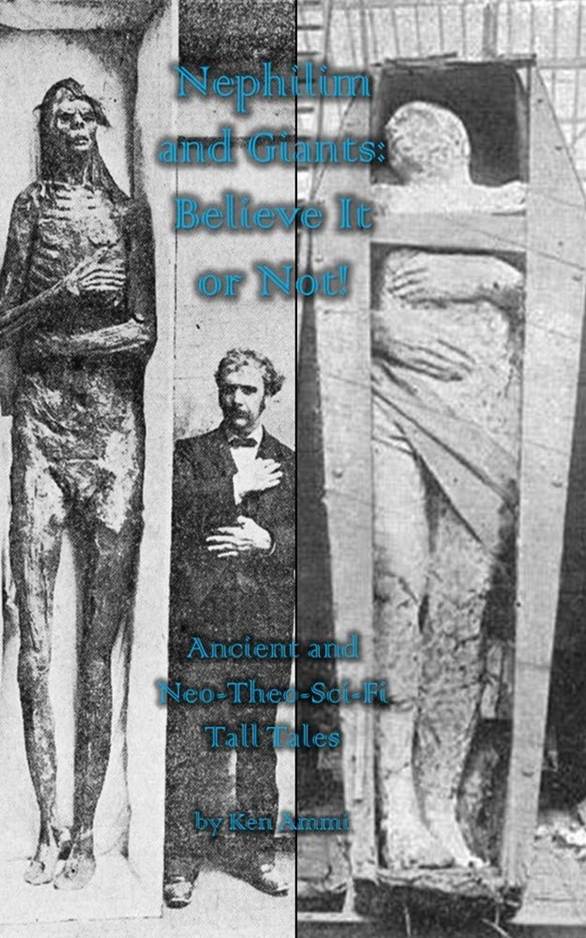
Yet, cutting to the chase and a main point I made in the contra-Stobbs pro-biblical data book: the dirty little secret is that since we have no reliable physical description of Nephilim then their look (and their height) is a non-issue and that alone debunks 99% of un-biblical Nephilology—the modern branch of which is just un-biblical neo-theo sci-fi tall-tales.

Then there are these descriptors, “once ruled us as gods…that hunted us…entities that ruled as false gods, practiced blood magic, and devoured humans for sport…predator,” recall that we were told that their look and these descriptors are, “described in Genesis 6.”

Yet, as for, “giant demon-human hybrids described in Genesis 6” we cannot really know the former until Wolf defines the subjective usage and the latter has to do with confusing Angels with demons.

As for ruled, hunted, etc. that is being read into, “mighty men who were of old, the men of renown” (Gen 6:4b). I am unsure whence comes the, “practiced blood magic” assertion. I can only imagine that, “devoured humans” is based on 1 Enoch which is Bible contradicting folklore from centuries, if not millennia, after the Torah, see my book In Consideration of the Book(s) of Enoch.

When it comes to, “secret society rituals”: that would be a case of what people did with the historical record in Gen 6, and the folkloric tall-tales which followed (see my article How Nephilim Absconded from the Tanakh and Invaded Folkloric Territory) in terms of those who formed such societies chasing after that which 1 Enoch has as secrets which fallen Angels/Watchers taught to humanity.

One of the funniest lines in all pseudepigrapha—perhaps the only funny line in all pseudepigrapha—when 1 Enoch’s version of God has Him telling the fallen Angels/Watchers, “You have been in heaven, and though the hidden things had not yet been revealed to you, you know worthless mysteries.”

And it is the same sort of issue with, “modern entertainment” of various media.

Reference is then made to, “White face thick as plaster. Crimson hair. A red nose like a tumor. And that grin, stretching wider than any human mouth should open” in terms of, “[Joseph] Grimaldi in his clown costume” in 1806, “a Freemason named Charles Dibdin designed that getup fresh off the boat from India, where he’d spent months studying rakshasa demon masks in Hindu temples.”

For all of my criticism of Stobbs (self-proclaimed inventor of the, supposedly alleged, Nephilim correlation to clows), and there is a lot of critique—a lot—I have, from the start (which was in my article Is Paul Stobbs right? Did Nephilim Look Like Clowns?) noted that Stobbs should stick to occult cultural anthropology, as it were, pertaining to the correlation of the trickster spirit occultism, secret societies, and entertainment since he seems to do a good enough job with that data. Yet, he needs to drop the Nephilim angle—since there is no such angle—since when it comes to Nephilology he discredits himself (I followed up that article with ​Anatomy of the making of a modern-day myth: Nephilim looked like clowns).

The article goes on to provide more history of various key moments in what we may term modern clownery and then notes:

The Bible tells it straight in Genesis 6. The “sons of God” saw human women and took them as wives. The offspring were Nephilim, which translates to “the fallen ones.” Scripture calls them giants, mighty men of renown. God sent the Flood to wipe them out.

Except here’s Numbers 13:33, written after the waters receded: “We saw the Nephilim there.”

They survived. Joshua spent decades fighting giant clans in Canaan. David killed Goliath and his oversized brothers. The Old Testament reads like an extermination campaign that never quite finished the job.

The Book of Enoch fills in what Genesis leaves out. Two hundred fallen angels called Watchers descended to earth. They taught forbidden knowledge: sorcery, warfare, cosmetics, enchantments. The women who mated with them became “sirens,” half-human hybrids. Their children were something else entirely.

The Nephilim weren’t just tall. Their fathers were nachash saraph, “fiery flying serpents,” the term used in Numbers 21:6 and Isaiah 14:29. Not holy angels like Michael. Serpentine fallen beings. Their offspring inherited those traits: serpent-patterned skin, jaws that could unhinge, necks with reptilian frills. Dragon-human hybrids who ruled as kings and built civilizations.

When the Flood destroyed their bodies, their spirits got trapped in what Scripture calls “dry places.” Former rulers reduced to disembodied demons, hungering and thirsting with no way to satisfy those needs. That’s where we are now. The physical bodies mostly gone, destroyed by judgment. But the spirits remain, desperate for the worship and sensation they once enjoyed.

And some of them, the ones who inherited shapeshifting from their angel fathers, might still walk among us looking human.

This is the impressive sounding stuff of which Stobb’s un-biblical fantasy tall-tale folkloric stories are made—yes, even if biblical citations are included—so let us review.

Note the oddity of writing, “translates to ‘the fallen ones.’ Scripture calls them giants”: the root naphal translates to the fallen ones or fall/fallen/feller/to cause to fall, etc. and “Scripture calls them giants” should have read, “Only some modern English versions of scripture calls them giants” and that still begs my key question: what is the usage of the vague, generic, subjective, multi-usage and modern English word giants in English Bibles?

Note the contradiction in that, “God sent the Flood to wipe them out” yet, or so we are told, “here’s Numbers 13:33, written after the waters receded: ‘We saw the Nephilim there.’”
This implies that God failed, He must have missed a loophole, the flood was much of a waste, etc.

Now, “here’s Numbers 13:33” is mere a citation, it is pointing us to a location in a text and so it does not tell us who were the, “We” who, “saw.” Merely telling us where to find a statement and only quoting five modern English words fails to interact with narrative and key hermeneutical questions such as: who said it, why was it said, was it accurate, what was the reaction to it, etc.

To be blunt: anyone who ever appeals to Num 13:33 but does not mention the following facts needs to have it pointed out to them that they must mention the following facts.

They need to mention that they are relying on:

  1. One single unreliable sentence
  2. From strictly non-LXX versions (since that version’s version of that verse does not even mention Anakim: which is an issue in pop-Nephilology)
  3. Of an unreliable, “evil report”
  4. By 10 unreliable guys
  5. Whom God rebuked—to death
  6. Who made five mere assertions unbacked by even one single other verse in the whole Bible
  7. Who contradicted Moses, Cable, Joshua, God, and the rest of the whole entire Bible

I could go on but see my post Chapter sample: On the Post Flood Nephilim Proposal.

Stating, “They survived” contradicts the Bible five times (Genesis 7:7, 23; Hebrews 11:7; 1 Peter 3:20; and 2 Peter 2:5) and post-flood-Nephilologists must then invent un-biblical fantasy tall-tales about just how Nephilim made it past the flood, past God.

As for, “Joshua spent decades fighting giant clans in Canaan” there is literally zero indication of that: this is where the issue of Anakim comes into play—they were like a clan of the Rephaim tribe and Nephilim were strictly pre-flood hybrids, Rephaim were strictly post-flood humans, and there is zero correlation between them.

As for, “David killed Goliath” well, he is referred to as a Repha, not a Nephil, virtually every single time he is mentioned.

As for, “his oversized brothers,” only one of them is referred to as having been, “of great stature” which is just as vague, generic, subjective, multi-usage as giants.

Now, we are told in Deut 2 that, on average, Rephaim, to include Anakim, were, “tall” and that is just as vague, generic, subjective, multi-usage as giants and of great stature. Moreover, we know that is subjective to the average Israelite male who was 5.0-5.3 ft. in those days.

As for, “The Book of Enoch fills in what Genesis leaves out”: it fills in with what?With contradictions of the Bible, based on folklore, without indication that it contains any actually real history from pre-flood days.

Wolf tells us of, “fallen angels called Watchers” but it is actually just a case of that Watchers was just the Second Temple Era (516 BC-70 AD) aka for Angels/Malakim. So, the wild folklore goes, “The women who mated with them became ‘sirens,’ half-human hybrids.”

We are told, “The Nephilim weren’t just tall” so that seems to answer the question of Wolf’s usage: something vaguely generic about subjectively unusual height of some unknown level above the parochial average (and yes, that is how useless the common parlance usage of that modern English word is).

Thus, Wolf’s usage does not agree with the English Bibles’ usage since the usage of giants in English Bibles is that it merely renders (does not even translate) Nephilim in 2 verses or Repha/im in 98% of all others and so never even hints at anything to do with any sort of height whatsoever.

Wolf claims, “Their fathers were nachash saraph, ‘fiery flying serpents,’ the term used in Numbers 21:6 and Isaiah 14:29. Not holy angels like Michael. Serpentine fallen beings.”

I can 99.99999999% guarantee that the pedigree of this assertion is that pop-Nephilologist Gary Wayne (who debated me) teaches this fallacy, Paul Stobbs uncritically picked it up from him (he quotes and otherwise references Wayne many times in his book), and now the Wolf picked it up from Stobbs.

There is no indication that, “Their fathers were nachash saraph” rather, they are described as bene ha Elohim/sons of God. The issue is that Wayne/Stobbs teach that, “Seraphim Angels” fathered Nephilim but there is no indication of that and there is no indication of that since there is no such thing as Seraphim Angels: that is a category error that violates the law of identify since Seraphim are Seraphim and Angels are Angels. They differ from one another (as well as from Cherubim) at least in that they have different job titles, different job functions, and look different from one another.

Neither of those verses is about the Gen 6 affair nor about Angels nor about Seraphim.

Isaiah 14:29 reads, “Rejoice not, O Philistia, all of you, that the rod that struck you is broken, for from the serpent’s root will come forth an adder, and its fruit will be a flying fiery serpent.”

Num 21:6 reads, “Then the Lord sent fiery serpents among the people, and they bit the people, so that many people of Israel died.”

These are not referring to some sort of mashed up Seraphim-Angel beings but are telling us about serpents that are venomous: the fiery part referring to the burning sensation of their venomous bite and/or how their motion looks like a flame. As for flying, that seems to refer to how some serpents flatten their bodies so as to glide from tree to tree, etc.

There is no indication of, “Serpentine fallen beings”: the only description we have of actual Seraphim do not include any serpentine features but refers to, “six wings…face…feet…flew…one called to another…hand” (Isa 6).

What Wayne/Stobbs/Wolf have done, purposefully or not, is to take the root saraph for fiery/venomous/flame and un-contextually apply it to a pseudo version of Seraphim (see a whole chapter about Seraphim in my book What Does the Bible Say About Various Paranormal Entities? A Styled Paranormology).

Thus, there is below zero indication that Nephilim, “inherited those traits” especially since Seraphim and Angels have no traits such as, “serpent-patterned skin, jaws that could unhinge, necks with reptilian frills” whom Wolf also calls, “Dragon-human hybrids.”

This is the stuff of which un-biblical neo-theo sci-fi pop-Nephilology tall-tales are made.

As for, “the Flood destroyed their bodies, their spirits…reduced to disembodied demons,” that is just folklore from centuries, if not millennia, after the Torah.

As per my Demons Ex Machina article, yes, “spirits…disembodied demons” are, “hungering and thirsting…desperate for the worship and sensation they once enjoyed” but it is not that, “The physical bodies mostly gone, destroyed by judgment” since those demons are the disembodied spirits of Angels who are physically incarcerated in what 2 Peter 2 has as, “Tartarus.”

Angels are always described as looking like human males, performing physical actions, and without indication that such is not their ontology (see my book What Does the Bible Say About Angels? A Styled Angelology) that is how and why Angels and demons are the same beings yet, also differ.


As for, “shapeshifting from their angel fathers” well, there is literally zero indication that Angels, or Seraphim shapeshift so that is a non-issue.

The, “might still walk among us looking human” assertion is very, very dangerous since historically, many people have been serial and mass murdered due to claims that they were not fully human—or, not human at all. Such dangerously irresponsible fantasy tall-tales are so common amongst pop-Nephilologists that I filled a chapter titled, “Nephil Kampf” with examples in my book Nephilim and Giants as per Pop-Researchers: A Comprehensive Consideration of the claims of I.D.E. Thomas, Chuck Missler, Dante Fortson, Derek Gilbert, Brian Godawa, Patrick Heron, Thomas Horn, Ken Johnson, L.A. Marzulli, Josh Peck, CK Quarterman, Steve Quayle, Rob Skiba, Gary Wayne, Jim Wilhelmsen, et al.

Wolf then notes, “Pennywise was a shapeshifting, demonic clown from outer space that came to Earth to eat children.” Well, it is more complicated than that since the novel It is quite Gnostic. It has it that what is termed Another or Other is a styled unknown god, a deus absconditus, a theos agnosticos, the Gnostic god who is unknown and created what is described as a turtle and a spider but those are just term that humans can understand (hence, “It”), that is not what they are ontologically.

The spider entity eventually comes to Earth, eventually realizes that human blood is oh so much tastier when it is infused with the chemical byproducts of utter fear, and so takes whatever form it discerns will scare a person most: one of those forms is Pennywise, the Dancing Clown—this is touched upon when Wolf circles back to It.
That statement is followed up by Wolf directly with, “Fallen angels could shapeshift and came to Earth to rule and eat children” but those two mere assertions are just that: there is literally zero (reliable) indication of it.

Wolf then circles back to, “What They Actually Looked Like”:
Every culture that met the Nephilim described identical features. Deathly pale skin. Wild red hair. Glowing eyes that bulged from skulls. Six fingers, six toes. Elongated heads. And jaws that opened too wide.

That serpent jaw came from daddy. The nachash saraph passed down skin covered in psychedelic patterns like scales. Mouths that could dislocate to devour prey. Neck frills like certain lizards wear, which became the ruffled collars on Elizabethan nobles and clowns.

The red nose deserves attention. Rosacea is a genetic condition hitting pale-skinned people hardest. The Irish call it “the curse of the Celts.” Advanced rosacea causes rhinophyma: a large, bulbous, bright red nose. It’s not from drinking. It’s genetic.

The Nephilim, pale as death, would’ve developed this in extreme forms. That clown nose isn’t whimsy. It’s a birth defect preserved in costume.


Note that the statement, “Every culture that met the Nephilim described identical features” is premised on the mere hidden assumption that we can discern who is describing Nephilim and then building an argument on that mere assumption.

Yet, myopically subjectively picking out certain features make it easy to seek such descriptions and eisegetically conclude a non-sequitur that, “Every culture that met the Nephilim described identical” cherry-picked, “features.” Again, we have no reliable physical description of them and Wayne/Stobbs/Wolf get, “Six fingers, six toes” from one single description of one single man who was a Repha, not a Nephil (2 Sam 21:20).

Wolf clearly paraphrased this segment from Stobbs and two wrongs do not make a right (nor do three, if we include Gary Wayne whence Stobbs got it).


Having in place an utter fantasy assertion about how Nephilim looked, such pop-researchers myopically subjectively seek anything they can force-fit into their theory such as, “Medusa…wild red hair, pale skin, massive grin with tongue out, bulging eyes…Medusa was textbook Nephilim hybrid.”

Wolf adds, “Anak, Og of Bashan, Goliath’s brothers…They’re the ancient Nephilim” yet, they were Rephaim in general or Anakim of the Rephaim in particular.

Premised on assertions, fallacies, watering down categories, using vague terminology, and myopia, Wolf can only then conclude, “Same entities. Different names. Identical descriptions.”

And based on that (faulty) premise, Wolf goes on to write of, “The Aztec calendar shows a god with tongue sticking out, identical to Greek Gorgons and Chinese demons.” See how it works? One myopically chosen depiction of Medusa features, “tongue out” and, “tongue out” has something to do with, “textbook Nephilim” ergo, “Aztec calendar…god with tongue sticking out” equals Nephilim hybrid and yes, that is how flimsy such tall-tales are: they take solid data points but connect them via subjective worldview-philosophies such as pop-Nephilology.


Wolf goes on to write of, “giant legends. Nevada’s Lovelock Cave held red-haired giant remains.” Native American tales of White, red-haired, giants seem to be cultural memories of interacting with Viking—told via oral tradition for centuries: see my article Lovelock Cave Giants: lost or found?

Wolf then notes, “There’s one explanation: global pre-Flood civilization. The Nephilim ruled everywhere.” Indeed, but it is exclusively, “pre-Flood.” Wolf goes on to write, “Post-Flood survivors on every continent remembered” and surely they did: similarities amongst the most ancient cultures seem to be due to that pre-Tower of Babel, humanity lived in relative proximity and had a commonly held basic history which post-Tower of Babel, with time and telling (and re-re-re-re-telling), came to change in this or that point and came to be called myth and legend.

Wolf goes on to claim, “David Bowie spent his career looking like a Nephilim. Ziggy Stardust, androgynous alien, psychedelic patterns” but, again, there is no indication that Nephilim looked like androgynous alien with psychedelic patterns.

Wolf then circles back to: actually, pause to note that such a style of writing is very common to pop-Nephilologists, they will touch upon a subject, move away from it, come to back it, move away, come back, etc., etc., etc.


Wolf tells us:

They Never Left
Numbers 13:33 places Nephilim after the Flood. Joshua and David fought them for generations. Scripture never says they were eliminated. Just driven underground.

Fallacious Nephilology damages theology proper and Wolf concludes, “Numbers 13:33 places Nephilim after the Flood” ergo, “They Never Left” so what does that say about God and His Word?


As for, “Scripture never says they were eliminated” it is simple: they lived pre-flood, we are told five times who survived the flood but Nephilim are not on any of those lists, and there is literally zero indication of any sort of return of the Nephilim (which is just a pop-Nephilology fantasy) ergo, scripture has many ways of telling us they were eliminated.

Wolf circles back to, “Most exist as disembodied demons” circles back to, “Watchers could shapeshift. Their offspring inherited it” along with circling back to the dangerous mere assertion, “A shapeshifting Nephilim could pass as human while staying true underneath.”

Wolf even gives us a supposed clue as to how to track down these demonic atrocities mascaraing as human, “Elite bloodlines obsessively intermarry. ‘Blue bloods,’ RH negative types concentrated in ruling families. They’re not just maintaining wealth. They’re maintaining genetics” as if God flooded the Earth, in part, to be rid of Nephilim but missed the genetic loophole that Wolf was clever enough to figure out.

Wolf notes:

Most physical remnant…rule through secret societies maintaining rituals, through possession in entertainment and politics, through symbolism marking territory, through blood preserving genetic markers.

The goal?

Restore pre-Flood conditions. Matthew 24:37 warns: “As it was in the days of Noah, so shall it be at the coming of the Son of Man.”

New World Order is Old World Order. Nephilim kingdom restored. Open possession normalized. Transhumanism attempting forbidden mixing again.

Jesus’ words, His emphasis, His points, His context, were:

Just as it was in the days of Noah, so will it be in the days of the Son of Man. They were eating and drinking and marrying and being given in marriage, until the day when Noah entered the ark, and the flood came and destroyed them all.

But He kept speaking directly with:

Likewise, just as it was in the days of Lot—they were eating and drinking, buying and selling, planting and building, but on the day when Lot went out from Sodom, fire and sulfur rained from heaven and destroyed them all—so will it be on the day when the Son of Man is revealed (Luke 17).

Thus, this was about examples of being unaware/unconcerned about coming judgment.


The article ends with a heartfelt but ill-conceived gospel presentation to non-existent personages, “if you’re reading this and you know what you are, born into hybrid bloodlines you didn’t choose, you’re part human which means you have a soul…Renounce the false gods, accept Jesus Christ,” etc.

See my various books here.

~~~~~~~~~~~~~~~~~~~~~~~

A plea: I have to pay for server usage and have made all content on this website free and always will. I support my family on one income and do research, writing, videos, etc. as a hobby.

If you can even spare $1.00 as a donation, please do so: it may not seem like much but if each person reading this would do so, even every now and then, it would add up and really, really help out.

Here is my donate/paypal page.

You can comment here and/or on my Twitter/X page, on my Facebook page, or any of my other social network sites all which are available here.
The Institute for Environmental Research and Education: Did God flood the earth because of the Nephilim?

The Institute for Environmental Research and Education posted an article titled Did God flood the earth because of the Nephilim? attributed to the IERE Team—the IERE’s mission statement includes, “We envision a world where everyday decisions integrate environmental facts and concerns as a matter of common sense” since, “Environmental issues have a direct effect on the financial well being of all people and organizations.”

The team rightly notes, “the presence of the Nephilim in Genesis is undeniably linked to the events leading up to the great flood…God flooded the earth because of the pervasive wickedness and corruption of humanity, of which the Nephilim were just one, albeit significant, manifestation” so that while, “The flood was a response to the totality of human depravity, not solely the existence of a specific group…God deemed it necessary to cleanse the earth” that one specific group came to a full end at the flood.

We’re told that what I term the Gen 6 affair, Genesis 6:1-4, “describes a time when ‘the sons of God’ (often interpreted as divine beings or descendants of Seth) intermarried with ‘the daughters of humans.’” Often is a subjective term and the fact is that the view is a late-comer of a view based on myth and prejudice. The original, traditional, and majority view among the earliest Jewish and Christians commentators, starting in BC days, was the Angel view as I proved in my book On the Genesis 6 Affair’s Sons of God: Angels or Not?: A Survey of Early Jewish and Christian Commentaries Including Notes on Giants and the Nephilim.

We’re told, “Some interpretations suggest they were fallen angels who rebelled against God and intermarried with human women. Others argue they were descendants of Seth, who remained faithful to God and intermarried with the descendants of Cain, who were not.” Note the implication that, actually, Sethites weren’t really faithful to God since they were such terrible sinners that their sin served as the premise for the flood: so, that’s rather odd.

The team notes, “The New Testament refers to the events of Genesis 6, particularly in 2 Peter 2:4-5 and Jude 1:6-7. These passages suggest that the ‘sons of God’ who sinned were indeed angelic beings…While these passages don’t explicitly mention the Nephilim.”

Jude and 2 Peter 2 combined refer to a sin of Angels, place that sin to pre-flood days and correlate it to sexual sin which occurred after the Angels, “left their first estate,” after which they were incarcerated, and there’s only a one-time fall/sin of Angels in the Bible.

So, if they’re not referring to the Gen 6 affair, we’ve no idea to what sin they’re referring.

The team asks of Nephilim, “Were they simply unusually tall and strong humans?” but why ask after their height is a mysteriously inserted point at this point.

It’s noted, “The Hebrew word ‘Nephilim’ is often translated as ‘giants’” which is telling us that it’s often translated as ___________ since that only begs the questions: what’s the usage of the vague, generic, subjective, multi-usage and modern English word “giants” in English Bibles? What’s the team’s usage? Do those two usages agree?

Bottom line is that giants isn’t a translation but is a rendering—of a rendering. Moden English Bibles that employ the term giants are rendering that from the LXX which rendered them as gigantes meaning earth-born. Yet, be aware that the LXX also, for some unknown reason(s), also rendered gibborim/might/mighty and Rephaim as gigantes. Moreover, the usage of the vague, generic, subjective, multi-usage and modern English word giants in English Bibles is that it merely renders (doesn’t even translate) Nephilim in 2 verses or Repha/im in 98% of all others and so never even hints at anything to do with any sort of height whatsoever.

For more linguistics details, see my book Bible Encyclopedias and Dictionaries on Angels, Demons, Nephilim, and Giants: From 1851 to 2010.

Continuing, “translated as ‘giants’ or ‘fallen ones’…Some scholars suggest it comes from the Hebrew word naphal, meaning ‘to fall.’”

Now, the team makes a very, very, very typical pop-Nephilology fundamental level error when they ask and review answers to:

If the flood wiped out all humanity except Noah’s family, how could the Nephilim still exist after the flood (Numbers 13:33)?

The Bible mentions “Nephilim” existing after the flood (Numbers 13:33). This has led to several explanations:

Different Lineage: These “Nephilim” might have been descendants of a separate incident involving the “sons of God” after the flood.

Figurative Language: The term “Nephilim” in Numbers 13:33 could be used figuratively to describe unusually tall and strong individuals, regardless of their actual lineage.

Partial Flood Theory: A less common theory suggests the flood was a regional event, not a global one, allowing for the survival of some pre-flood populations.

Note the generic nature of writing in terms of, “…exist after the flood (Numbers 13:33)…in Numbers 13:33…The Bible mentions” since those are assertions followed by a citation and a citation is only telling us where to find a statement. Key hermeneutical questions to ask are: who said it, why was it said, was it accurate, what was the reaction to it, etc.

Anyone who appeals to Num 13:33 really needs to mention that they’re relying on:

1.       One single unreliable sentence

2.       From strictly non-LXX versions (since that version’s version of that verse doesn’t even mention Anakim)

3.       Of an unreliable “evil report”

4.       By 10 unreliable guys

5.       Whom God rebuked—to death

6.       Who made five mere assertions unbacked by even one single other verse in the whole Bible

7.       Who contradicted Moses, Cable, Joshua, God, and the rest of the whole entire Bible

I could go on but see my post Chapter sample: On the Post Flood Nephilim Proposal.

Post-flood-Nephilologists always begin by throwing God and His Word under the bus. Yet, a survival of them past the flood

contradicts the Bible five times (Genesis 7:7, 23; Hebrews 11:7; 1 Peter 3:20; and 2 Peter 2:5) and any (un-biblical fantasy tall-tale) about a return of them both imply that God failed, missed a loophole, the flood was much of a waste, etc., etc., etc.

Then post-flood Nephilologists must invent un-biblical tall-tales about just how they made it past the flood, past God. 

Recall the statement, “the presence of the Nephilim in Genesis is undeniably linked to the events leading up to the great flood…The flood was a response to the totality of” humans and Nephilim, “depravity…God deemed it necessary to cleanse the earth.” Thus, if they survived or returned then, again, God failed.

So, let’s review:

“how could the Nephilim still exist after the flood” is the wrong primarily question, the right one is, “could the Nephilim still exist after the flood” the biblical answer to which is of course not: it’s logically, bio-logically, and theo-logically impossible.

As for, “The Bible mentions” well, we’re back to the issue of that what the, “Bible mentions” is that 10 guys whom God rebuked made up an unreliable, “evil report” so no one should believe it.

“Different Lineage” is a loophole and yet, there is no, “separate incident.”

If, “The term ‘Nephilim’ in Numbers 13:33 could be used figuratively” then why is it only used in one single post-flood verse? And note the reference to, “tall” again.

The scope of the flood is irrelevant to Nephilology since they either didn’t make it past the flood because it was global or because they lived in the flooded region: either way, they didn’t make it past the flood in any way, shape, or form.

Having been told of, “tall…giants…tall” the team asks, “How does the story of the Nephilim relate to other ancient myths and legends of giants?” but, again, we’ve no indication to what they’re referring by giants: although we can guess that their usage is something vaguely generic about subjectively unusual height of some unknown level above the parochial average (and yes, that is how useless the common parlance usage of that modern English word is).

But why correlate Nephilim to tall-giants? Num 13:33. Ergo, the dirty little secret is that since we’ve no reliable physical description of Nephilim then their height is a non-issue and that alone debunks 99% of un-biblical Nephilology—the modern branch of which is just un-biblical neo-theo sci-fi tall-tales.

In the end, the article was fair enough, especially from non-specialists, and yet, could use the bit of specificity and clean up that I’m herein pointing out.

See my various books here.

~~~~~~~~~~~~~~~~~~~~~~~

A plea: I have to pay for server usage and have made all content on this website free and always will. I support my family on one income and do research, writing, videos, etc. as a hobby.

If you can even spare $1.00 as a donation, please do so: it may not seem like much but if each person reading this would do so, even every now and then, it would add up and really, really help out.

Here is my donate/paypal page.

You can comment here and/or on my Twitter/X page, on my Facebook page, or any of my other social network sites all which are available here.

The AI Bible answers What do we know about the Nephilim [and Rephaim and Anakim]?

The AI Bible is described as, “a revolutionary platform that uses cutting-edge generative AI to transform timeless biblical stories into immersive, hyper-realistic experiences…reimagines how you connect with the Bible, delivering engaging, visually stunning, and thought-provoking content that resonates with today’s generation.” Yet, I have no idea if it is made to literally just spit out articles, in this case, based on keywords.

In any case, the article What do we know about the Nephilim? was posted/produced to it/by it and begins by moving the linguistics goalpost by stating, “The giants we tolerate today become the giants that rule us tomorrow” so that there was an abrupt jump from the specific ancient Hebrew word Nephilim to the modern generic English word giants.

This begs the following key questions: what is the usage of the vague, generic, subjective, multi-usage and modern English word giants in English Bibles? What’s the AI Bible’s usage? Do those two usages agree?

We will have to see if answers are forthcoming or if we will have to discern based on any hints.

We are told, “There were giants in those days. The Nephilim” which leads to this Q&A:

Who Are the Nephilim?

Genesis 6:1-4 introduces them without explanation, almost as if the original readers were expected to recognize the name: “The Nephilim were on the earth in those days… These were the mighty men of old, men of renown.”

They appear suddenly in Scripture’s narrative, and they vanish just as fast. Leaving nothing but questions scattered like footprints in wet earth…

Genesis speaks cryptically of “the sons of God” taking “the daughters of men.”

Whether you interpret “sons of God” as fallen angels, powerful human rulers, or something else entirely, the result is portrayed as crossing a boundary God never intended.

Something sacred was violated.

Something natural became unnatural.

2. Their presence is tied to corruption…Right after mentioning them, Scripture says: “The earth was filled with violence.” (Genesis 6:11)

For interested readers, I will note that the original, traditional, and majority view among the earliest Jewish and Christians commentators, starting in BC days, was the Angel view as I proved in my book On the Genesis 6 Affair’s Sons of God: Angels or Not?: A Survey of Early Jewish and Christian Commentaries Including Notes on Giants and the Nephilim.

Now, there is a bit of an explanation of that which I term the Gen 6 affair, “When man began to multiply on the face of the land and daughters were born to them, the sons of God saw that the daughters of man were attractive. And they took as their wives any they chose” so that, “The Nephilim were on the earth in those days, and also afterward, when the sons of God came in to the daughters of man and they bore children to them. These were the mighty men who were of old, the men of renown.”

As for, “they vanish just as fast,” I am unsure it was a pun intended but the reason that they were, “Leaving nothing but…footprints in wet earth” is that the last of them would have died in the flood.

We are told:

Centuries later, in Numbers 13:32-33, the Israelite spies return from Canaan trembling with fear: “We saw the descendants of Anak… from the Nephilim.”

Whether this is a literal or frightened exaggeration doesn’t really matter. What matters is what the Nephilim represented. They represented terror, chaos, and the overwhelming feeling of facing something far too big to overcome.

They were the monsters under Israel’s bed. They were the stories parents told to explain why evil felt so powerful, so entrenched, so giant.

That was a misrepresentation and missing that it is actually a hugely important theological issue.

It was not, “the Israelite spies” vaguely in general who said that: there were 12 of them so it must be noted that quoting just that one verse is relying on:

1.            One single unreliable sentence

2.            From strictly non-LXX versions (since that version’s version of that verse doesn’t even mention Anakim)

3.            Of an unreliable “evil report”

4.            By 10 unreliable guys (since Caleb and Josha did not side with them)

5.            Whom God rebuked—to death

6.            Who made five mere assertions unbacked by even one single other verse in the whole Bible

7.            Who contradicted Moses, Cable, Joshua, God, and the rest of the whole entire Bible

I could go on but see my post Chapter sample: On the Post Flood Nephilim Proposal.

It is not a case of, “literal or frightened exaggeration doesn’t really matter” since if it was literal then that implies that God failed, missed a loophole, the flood was much of a waste, etc., etc., etc. and then post-flood Nephilologists have to literally invent un-biblical fantasy stories about just how they made it past the flood, past God.

Fallacious Nephilology damages theology proper.

Thus, perhaps, “They were the monsters under Israel’s bed” due to pre-flood history being retold and growing with each telling since the flood or due to the 10 unreliable spies making up a fear-mongering, scare-tactic, “Don’t go in the woods!!!” style of tall-tale on the spot.

It is noted:

The Book of the Watchers (part of 1 Enoch) takes the phrase “sons of God” literally and runs with it. It describes heavenly beings, called ‘Watchers,’ descending to the earth and lusting after human women and taking them as wives.

They bear giant offspring: the Nephilim.

These giants consume everything in sight, then turn to violence and cannibalism.

The Watchers teach humanity forbidden knowledge like sorcery, weapon crafting, seductive charms, and astrology.

THE BOOK OF JUBILEES

An ancient Jewish commentary expands the tale even further. The Book of Jubilees says that when the giants died in the Flood, their disembodied spirits became the evil spirits that roam the world.

This became a major interpretive framework for Second Temple Judaism, explaining not just where demons came from, but why evil feels so relentless, so hungry, so inhuman.

1 Enoch and Jubilees are Bible contradicting folklore from centuries, if not millennia, after the Torah, see my books In Consideration of the Book(s) of Enoch and The Apocryphal Nephilim and Giants: Encountering Nephilim and Giants in Extra-Biblical Texts.

The dirty little secret is that since we’ve no reliable physical description of Nephilim then their height is a non-issue and that alone debunks 99% of un-biblical Nephilology—the modern branch of which is just un-biblical neo-theo sci-fi tall-tales.

Yet, 1 Enoch has them being MILES tall which is great folklore but poor reality.

At least 1 Enoch does not have physical post-flood Nephilim but Jubilees does: until the time of Noah’s grandsons.

As for that evil spirits/demons are the spirits of dead Nephilim indeed, that is just folklore from centuries, if not millennia, after the Torah. For a biblical view, please see my article Demons Ex Machina: What are Demons?

Sadly, the article include fantasy tall-tale images that are not in the least bit helpful to real, researched-based, biblical Nephilology.

Now, given the usage of giants and the essentially unanswered key questions, I thought to dig a bit deeper and found some, “AI Bible Devotionals” such as The Lore of Goliath which notes:

The Bible records multiple giant tribes scattered throughout the ancient Near East: the Nephilim in Genesis 6, the Anakim in Numbers 13, the Rephaim in Deuteronomy 2–3, and others like the Emim and Zamzummim…

This is why scholars across Jewish, Christian, and even secular traditions argue that Goliath was likely one of the last descendants of the Rephaim-Anakim lineage.

That is another instance of referencing giants without much of an elucidation.

In reality, that is a list of one since Emim and Zamzummim are just aka for Rephaim and Anakim were like a clan of that tribe (Deut 2)—and we know to ignore Numbers 13(:33).

And yes, “Goliath was…of the Rephaim-Anakim lineage.”

Devotional Rephaim: Giants or Ghosts?asks, “What if the most dangerous giants aren’t the ones standing in front of you… but the ones whispering behind you?” so that another generic usage of giants leads to a discussion of Rephaim.

We are told that, “Some were flesh-and-blood giants. They were massive warriors you could actually fight” but there is no indication of the former and the latter is premised on the vague, generic, subjective, multi-usage and modern English word massive.

What we are contextually told about them is that, on average, they were, “tall” (Deut 2) subjective to the average Israelite male who was 5.0-5.3 ft. in those days.

As for, “‘Og of Bashan’…impossibly large” well, we are not told about his personal size and assuming to know it based on his bed is a non-sequitur premised on various mere assumptions: indications are that it was a ritual object, not something upon which he slept—see my book The King, Og of Bashan, is Dead: The Man, the Myth, the Legend—of a Nephilim Giant?

The article next makes a very, very common error which is to apply one myopic definition/meaning of a root word and applying it to the 100% human people group:

Scripture also uses the word Rephaim in a darker register. In Job, the Psalms, and Isaiah, the Rephaim are described as ‘the shades.’ The departed dead. Ghostlike voices that linger long after death.

Not quite living. Not quite gone.

The Rephaim lived in two realms at once: as literal enemies occupying the land and as symbolic reminders of the past that haunts the imagination.

It is actually quite a bit less exciting than that: the root rapha ranges in meaning/definition from dead to healing/healer. Such is why exclusively referring to, “shades…departed dead. Ghostlike” is myopic.

We might as well say:

In some texts Rephaim are described as healers. The departed healers. Wellbeing voices that linger long after death.

Not quite living. Not quite gone.

The Rephaim lived in two realms at once: as literal healers occupying the land and as symbolic reminders of the past that heals the imagination.

Consider that God is a Repha or rapha since, after all, He is referred to as a healer, “I am the LORD, your healer” (YHVH Rapha, Exo 15:26). There is also an apocryphal Angel named Raphael which certainly does not mean God of death or Dead God but Healing God or God the healer and many more examples are found in the Bible.

Yet, the article’s aim is to depict Rephaim as, “spirits of old giants clung to the world after death,” etc.

Another devotional is The Anikim: Descendants of Giants (typically transliterated Anakim) which begins by referring to, “the giants that kept God’s people out of the Promised Land” so more giants.

We are told:

Before Israel ever swung a sword or marched around Jericho’s walls or the first trumpet sounded, Joshua sent spies to scout out the land.

These spies came back the color drained from their faces.

“We saw them…” they said, their voices trembling. “We seemed like grasshoppers compared to them.” (Numbers 13:33)

The Anakim.

The context was not, “marched around Jericho’s walls” and it was not Joshua who, “sent spies to scout out the land” he was one of those spies, it was Moses who sent them, and it was about entering Canaan for the first time after the exodus.

Again, it was not generically, “These spies” but 10 of the 12, Num 13:33 is unreliable, and the LXX does not mention the Anakim in that unreliable evil report verse.

Furthermore:

The Anakim appear in Scripture sporadically. According to the Bible, they were descendants of Anak (Deuteronomy 9:2), renowned for their size and ferocity.

They were also associated with the Nephilim tradition (Numbers 13:33), linking them to those ancient, mysterious giants.

They were occupants of the very land God had promised to His people.

Joshua later drove them out (Joshua 11:21), which reveals a crucial point:

When reading Genesis, we could argue that the Nephilim were a metaphor. Perhaps they weren’t actual giants or angel/human hybrids. The literary structure of Genesis 1-6 lends itself to some mixed interpretations. However, Joshua 11 tells us that these giants were, in fact, real!

These were flesh-and-blood giants whose presence exerted psychological, spiritual, and political pressure on Israel’s entire identity.

Indeed, “they were descendants of Anak” not Nephilim: that would be logically, bio-logically, and theo-logically impossible.

As for, “renowned for their size” again, they were subjectively taller than 5.0-5.3ft. The issue was their ferocity and they were notorious.

Thus, “associated with the Nephilim tradition (Numbers 13:33), linking them to those ancient, mysterious giants” is to buy into a fantasy tall-tale myopically based only on non-LXX versions.

Note that reliably speaking, “The literary structure of Genesis 1-6” has literally nothing whatsoever to do with, “Joshua 11 tells us that these giants were, in fact, real!” and we might as well get to answering those key questions.

The AI Bible’s usage seems to be something vaguely generic about subjectively unusual height of some unknown level above the parochial average (and yes, that is how useless the common parlance usage of that modern English word is).

The usage of the vague, generic, subjective, multi-usage and modern English word giants in English Bibles is that it merely renders (does not even translate) Nephilim in 2 verses or Repha/im in 98% of all others and so never even hints at anything to do with any sort of height whatsoever.

Thus, the AI Bible’s usage does not match the English Bibles’ usage.

It is noted that, “Jewish tradition, from Josephus to Septuagintal expansions, paints the Anakim with eerie, vivid color” yet, “Jewish tradition” can refer to anything written by any Jew during a span of millennia, Josephus wrote centuries after Anakim lived, and it fascinating that reference is made to, “Septuagintal expansions” since that refers to the LXX but nothing is said in the article about them missing from Num 13:33 in that version.

Interestingly, only in this devotional do we get accuracy about the Num 13 narrative as it specifies, “Ten of the twelve spies came back and said, essentially, ‘God may have promised us that land, but He clearly didn’t account for them.’”

Yet, that was not incorporated since we are told, “When the spies saw the Anakim towering over them, they revealed something about their own souls: ‘We seemed to ourselves like grasshoppers…’ (Numbers 13:33)” even though that statement was about (fantasy) Nephilim, not Anakim: even in non-LXX versions.

And so, whether AI literally means spit out by an innerwebs computer machine or people writing under the term AI or using AI in some or another way, the AI Bible leaves much to be desired in terms of the employment of vague terminology that is not defined which waters things down and makes connections that are not to be connected, mashing together categories (in terms of category errors), and oft being much less specific than is called for.

See my various books here.

~~~~~~~~~~~~~~~~~~~~~~~

A plea: I have to pay for server usage and have made all content on this website free and always will. I support my family on one income and do research, writing, videos, etc. as a hobby.

If you can even spare $1.00 as a donation, please do so: it may not seem like much but if each person reading this would do so, even every now and then, it would add up and really, really help out.

Here is my donate/paypal page.

You can comment here and/or on my Twitter/X page, on my Facebook page, or any of my other social network sites all which are available here.

Even X’s AI Grok can’t help Atheist

I chimed into the middle of a discussion on X when a certain Peter Scott-Morgan/@P_ScottMorgan replied thusly to someone:

The good book, you say?

Deuteronomy 20:17: “Completely destroy them—the Hittites, Amorites, Canaanites, Perizzites, Hivites and Jebusites—as the Lord your God has commanded you.”

Deuteronomy 7:1-2 “When the Lord your God brings you into the land you are entering to possess and drives out before you many nations—the Hittites, Girgashites, Amorites, Canaanites, Perizzites, Hivites and Jebusites, seven nations larger and stronger than you—and when the Lord your God has delivered them over to you and you have defeated them, then you must destroy them totally. Make no treaty with them, and show them no mercy.”

I, Messianic Jewish/@JewMessianic on X, replied

What, on your worldview, would be wrong with any of that: which I have to ask since you illogically began with a conclusion, an implication that there’s something wrong with it but didn’t get around to THE most important part.

Peter Scott-Morgan

What’s ‘wrong’ with it? It’s called ‘genocide’. Look it up.

Messianic Jewish

I didn’t ask what’s wrong with it, I asked, “What, on your worldview, would be wrong with any of that” notice the qualifying term “on your worldview.”

Peter Scott-Morgan (appealing to X’s AI Grok for help)

It’s irrelevant what my worldview is. The worldview of civilised beings is that genocide is wrong.

Hey @grok, can you inform this person what the sixth of the Ten Commandments is in the Torah please?

Grok @grok

The sixth commandment in the Torah (Exodus 20:13) is “You shall not murder” (לֹא תִּרְצָח, lo tirtzach in Hebrew). This is distinct from killing in contexts like war or justice, focusing on unlawful murder.

Peter Scott-Morgan @P_ScottMorgan

Thanks @grok.

So if someone commanded you to kill people outside of warfare or the justice system, would following that instruction be wrong?

Messianic Jewish

Grok obliterated you on the ethical difference between killing & murder.

Your worldview is THE issue since it’s upon it that you merely assert, “The worldview of civilised beings is that genocide is wrong” as if that’s premised on a universal imperative from your worldview.

Peter Scott-Morgan

Check again you silly zealot:

Quote

Grok @grok

Replying to @P_ScottMorgan @JewMessianic and 4 others

Yes, following such a command would be wrong, as it constitutes murder, which is prohibited under the Torah’s sixth commandment and aligns with broader ethical and legal principles against unlawful killing.

Messianic Jewish

Welcome to neo anti-intellectualism where it’s thus saith the infallible Grok.

Your worldview is THE issue since it’s upon it that you merely assert, “The worldview of civilised beings is that genocide is wrong” as if that’s premised on a universal imperative from your worldview.

Peter Scott-Morgan

Ok zealot.

Messianic Jewish

It’s ok to just say you realize you realized your worldview is a collapsed failure but that begs the question: why then, besides that it allows you to get away with everything, do you keep holding on to dogmatheism?

Peter Scott-Morgan

Dude – this was 2 months ago. Move on with your life.

Messianic Jewish

Is it a case of 2 more months and you’re still literally incapable of getting your worldview to take the very first systematic critical thinking step so you pull an agumentum ad chronologicum?

Does that mean that you’re no longer making the assertions you made to me?

That brought the discussion to an end as no more replies were forthcoming.

See my various books here.

~~~~~~~~~~~~~~~~~~~~~~~

A plea: I have to pay for server usage and have made all content on this website free and always will. I support my family on one income and do research, writing, videos, etc. as a hobby.

If you can even spare $1.00 as a donation, please do so: it may not seem like much but if each person reading this would do so, even every now and then, it would add up and really, really help out.

Here is my donate/paypal page.

You can comment here and/or on my Twitter/X page, on my Facebook page, or any of my other social network sites all which are available here.

​Considering the Mystery of Genesis 6 Interpreted by the Church Fathers

The Scriptamemo website is self-described as having the mission of, “Uncovering ancient truths through primary sources, scripture, and historical records.”

G. Paganelli published an article to it titled THE MYSTERY OF GENESIS 6 INTERPRETED BY THE CHURCH FATHERS which notes upfront:

My engagement with the Genesis 6 passage began through reading Dr. Michael Heiser’s exceptional work, The Unseen Realm. In this book, Dr. Heiser presents an in-depth theological and linguistic analysis of the text with remarkable clarity and scholarly precision. I highly recommend it to anyone seeking a deeper understanding of the supernatural worldview reflected in the Bible.

Well, we ought to take that with a grain of Dead Sea salt since Dr. Heiser was credentialed and experienced but not infallible, his Nephilology and demonology were not altogether biblical, and he tended to create more problems than he solved—search online for these articles for examples:

Review of Amy Richter and Michael Heiser on four Enochian Watcher related women in Jesus’ genealogy

Rebuttal to Dr. Michael Heiser’s “All I Want for Christmas is Another Flawed Nephilim Rebuttal”

I also included him in my book, The Scholarly Academic Nephilim and Giants: What do Scholarly Academics Say About Nephilim Giants?

The LXX/Septuagint is quoted, the key portions of which are, “sons of God having seen the daughters of men that they were beautiful, took to themselves wives of all whom they chose…giants were upon the earth in those days; and after that when the sons of God were wont to go in to the daughters of men, they bore children to them, those were the giants of old, the men of renown” (Lexham English Septuagint: A New Translation).

The Contemporary Torah (JPS, 2006) is quoted, “divine beings saw how pleasing the human women were and took wives from among those who delighted them…It was then, and later too, that the Nephilim appeared on earth—when divine beings cohabited with the human women, who bore them offspring. Such were the heroes of old, the men of renown.”

New International Version, “the sons of God saw that the daughters of humans were beautiful, and they married any of them they chose…Nephilim were on the earth in those days—and also afterward—when the sons of God went to the daughters of humans and had children by them. They were the heroes of old, men of renown.”

King James Version, “sons of God saw the daughters of men that they were fair; and they took them wives of all which they chose…There were giants in the earth in those days; and also after that, when the sons of God came in unto the daughters of men, and they bare children to them, the same became mighty men which were of old, men of renown.”

G. Paganelli notes:

According to the testimony of the Church Fathers, the Genesis 6 account reflects…spiritual beings transgressed divine boundaries by engaging in illicit relations with human women—a union explicitly forbidden by God.

Indeed, the original, traditional, and majority view among the earliest Jewish and Christians commentators, starting in BC days, was the Angel view as I proved in my book On the Genesis 6 Affair’s Sons of God: Angels or Not?: A Survey of Early Jewish and Christian Commentaries Including Notes on Giants and the Nephilim.

Moreover:

This union produced a race of hybrid beings, whose identity remains enigmatic throughout the biblical narrative. Referred to by various names such as the Nephilim, Gibborim, Rephaim, Anakim, these groups appear repeatedly throughout the Pentateuch and are frequently associated with great size, unnatural appearance, and opposition to Israel.

This category error that violates the law of identity will unfortunately act as a line of dominos with this fallen one affecting all which follow.

That, “race of hybrid beings” have nothing whatsoever to do with, “Rephaim, Anakim” Anakim were like a clan of the Rephaim tribe.

Nephilim were strictly pre-flood hybrids, Rephaim were strictly post-flood humans, and there’s zero correlation between them.

As for, “Gibborim” well, that is merely a descriptive term, the one under the English words, “heroes” or, “mighty” seen above. That term is applied variously to Nephilim (Gen 6:4), Nimrod (Gen 10:8), Angels (Psa 103:20), Boaz (Ruth 2:1), some of King David’s soldiers (1 Chron 11:11), even God Himself (Isa 9:6).

There is no such thing as a Gibborim people group like unto a tribe or some such thing.

Paganelli went on to write, “‘Gibborim’ (plural of gibbôr) means ‘mighty men’ or ‘heroes.’ In some contexts, it refers to valiant warriors, in others to negatively connoted beings (possibly hybrids, as in the days of Noah).”

Thus, perhaps we can say, “…Referred to by various names such as the Nephilim” who were one of many merely described as, “Gibborim” in terms of might.

As for, “Nephilim…frequently associated with great size, unnatural appearance” there is no indication of either of those: the dirty little secret is that since we have no reliable physical description of Nephilim then their height is a non-issue and that alone debunks 99% of un-biblical Nephilology—the modern branch of which is just un-biblical neo-theo sci-fi tall-tales.

As for, “Rephaim, Anakim…frequently associated with great size, unnatural appearance”: the only contextual thing we are told about them is that, on average, they were, “tall” (Deut 2) subjective to the average Israelite male who was 5.0-5.3 ft. in those days and that one of them had extra digits, “a man of great stature, who had six fingers on each hand, and six toes on each foot, twenty-four in number, and he also was descended from the giants [Repha]” (2 Sam 21).

Thus, when the author goes on to refer to, “Nephilim and their descendants” any Nephilim descendants would be Nephilim, by definition, and would only have existed pre-flood since they did not make it past the flood in any way, shape, or form nor by any other name.

G. Paganelli wrote:

The Rephaim are often described as a race of giants or spirits of the dead, sometimes identified with ancient populations destroyed by Israel. The term appears in both geographical and eschatological contexts.

Key questions are what is the usage of the vague, generic, subjective, multi-usage and modern English word, “giants” in English Bibles? What is Paganelli usage? Do those two usages agree?

See, biblically contextually, “The Rephaim are often described as a race of giants” means, “The Rephaim are often described as a race of Rephaim” so that is redundantly circular.

As for, “or spirits of the dead” well, that is a case of applying the root word to the human tribal people group, so it is a word-concept fallacy.

Same issue with the claim that Anakim were, “Descendants of Anak, described as giants” since that means, “Descendants of Anak, described as Rephaim.”

Paganelli wrote:

Numbers 13:28–33 – The ten spies report that the Anakim are so tall they seemed like grasshoppers: “We saw the Nephilim… the sons of Anak.”

The tall statement was about Nephilim: so, what about my dirty little secret claim?

Well, any time anyone references that, they must note that they are relying on:

  1. One single unreliable sentence (v. 33 being the key sentence)
  2. From strictly non-LXX versions (since that version’s version of that verse does not even mention Anakim)
  3. Of an unreliable “evil report”
  4. By 10 unreliable guys
  5. Whom God rebuked—to death
  6. Who made five mere assertions unbacked by even one single other verse in the whole Bible
  7. Who contradicted Moses, Cable, Joshua, God, and the rest of the whole entire Bible

I could go on but see my post Chapter sample: On the Post Flood Nephilim Proposal.

Paganelli also myopically wrote:

1 Samuel 17:4–7 – Goliath of Gath is described as over 2.7 meters tall, with heavy armor and a massive spear. He represents the Philistine challenge to Israel.

I said myopic since it was not pointed out that the Masoretic text has Goliath at just shy of 10 ft. Yet, the earlier LXX and the earlier Dead Sea Scrolls and the earlier Flavius Josephus all have him at just shy of 7 ft. (compared to the average Israelite male who was 5.0-5.3 ft. in those days) so that’s the preponderance of the earliest data.

Paganelli wrote a non-sequitur by noting:

Deuteronomy 3:1–11 – Giant king of Bashan, last of the Rephaim. Defeated by Moses. His immense stature is attested by his iron bed nine cubits long (about 4 meters).

To conclude, “His immense stature” as per, “attested by his iron bed” is to jump to a huge conclusion based on various mere assumptions. I am surprised that an admirer of Dr. Heiser neglected to point out that all indications are that the bed was a ritual object, not something upon which Og slept—see my book The King, Og of Bashan, is Dead: The Man, the Myth, the Legend—of a Nephilim Giant?

Emim and Zamzummim are also mentioned: those are just aka for Rephaim (Deut 2).

The article is interesting in that it extensively quotes some early sources commenting on the Gen 6 affair, as I term it, and I provided many, many more in my book.

Sadly, the application of those views in the article are marred by the category errors that violates the law of identity.

Consider the implications of fallacious Nephilology, it damages theology proper since now we have to conclude that God failed, He must have missed a loophole, the flood was much of a waste, and must invent un-biblical fantasy stories about just how Nephilim, by any supposed other name, made it past the flood, past God.

I posted the following comment to the article:

Friend, correlating “Nephilim, Gibborim, Rephaim, Anakim” is a category error that violates the law of identity.

Ok, Gibborim is merely a descriptive term so Nephilim were gibborim and so was Boaz, Gideon, Angels, God, etc.

But Anakim were like a clan of the Rephaim tribe and there’s no correlation between them and Nephilim: you only get Anakim connected to Nephilim from one unreliable sentence from non-LXX versions of one unreliable “evil report” (Num 13:33) by 10 unreliable guys whom God rebuked.

There are other issues such assertions about height: we don’t know Nephilim’s size, you were myopic about Goliath’s, and took a bad guess on Og’s.

scriptamemo@gmail.com

January 23, 2026 at 4:42 pm

Thank you for your comment. Here I give you the passages so you can go and check for yourself.

The Bible passage that connects the Anakim to the Nephilim :

Numbers 13:33

New International Version

33 We saw the Nephilim there (the descendants of Anak come from the Nephilim). We seemed like grasshoppers in our own eyes, and we looked the same to them.”

And the one linking the nephilim with Gibborim (which is an adjective that surely can be applied to a Giant).

The Bible identifies the nephilim with them so it’s not a matter of opinions:

Genesis 6:4 (ESV):

“The Nephilim were on the earth in those days—and also afterward—when the sons of God came in to the daughters of man and they bore children to them. These were the mighty men (gibborim) who were of old, the men of renown”.

I hope it helped. Thank you for visiting the page.

Reply

scriptamemo@gmail.com

January 23, 2026 at 5:40 pm

Also The Rephaim are the most mysterious of the 3 because we have less informations about them. I have a post here about a scholar work about the Rephaim here.It gives few options.

Reply

Ken Ammi

January 23, 2026 at 6:41 pm

Appreciate your replies, my friend, I’ve written some dozen research-based books on Nephilology issues.

When you say “The Bible passage that connects the Anakim to the Nephilim : Numbers 13:33” you needed to mention that you’re relying on:

1. One single unreliable sentence

2. From strictly non-LXX versions (since that version’s version of that verse doesn’t even mention Anakim)

3. Of an unreliable “evil report”

4. By 10 unreliable guys

5. Whom God rebuked—to death

6. Who made five mere assertions unbacked by even one single other verse in the whole Bible

7. Who contradicted Moses, Cable, Joshua, God, and the rest of the whole entire Bible

I could go on but see my post “Chapter sample: On the Post Flood Nephilim Proposal.”

Well, sure there’s, “linking the nephilim with Gibborim” since that just means Nephilim were referred to as mighty: it’s just that you made it sound as if Gibborim is a tribal people group or some such thing.

As for, “applied to a Giant” the key questions are: What’s the usage of the vague, generic, subjective, multi-usage and modern English word “giants” in English Bibles? What’s your usage? Do those two usages agree?

Actually, we have a LOT more info about Rephaim than we do about Nephilim: it’s a mere two verses about Nephilim vs. many about Rephaim—to include references to Anakim since they were like a clan of that tribe.

That brought the discussion to an end as no more replies were forthcoming.

See my various books here.

~~~~~~~~~~~~~~~~~~~~~~~

A plea: I have to pay for server usage and have made all content on this website free and always will. I support my family on one income and do research, writing, videos, etc. as a hobby.

If you can even spare $1.00 as a donation, please do so: it may not seem like much but if each person reading this would do so, even every now and then, it would add up and really, really help out.

Here is my donate/paypal page.

You can comment here and/or on my Twitter/X page, on my Facebook page, or any of my other social network sites all which are available here.

Was Canaan repopulated with Nephilim giants if they perished in the flood?

The question Why was the ancient land of Canaan repopulated with giants again after they had all biblically perished in the worldwide flood? was posted to the Quora site.

I, Ken Ammi, replied:

Since you refer to the flood then by “giants” you must be referring to Nephilim.

Well, there’s literally zero reliable indication that Canaan had any Nephilim in it.

That would imply that they somehow got past the flood, past a god who failed and who’s flood was much of a waste.

When you read about “giants” in your modern English Bible it merely renders (doesn’t even translate) Nephilim in 2 verses or Repha/im in 98% of all others and so never even hints at anything to do with any sort of height whatsoever.

So, that leaves the issue of Num 13:33 which is the one single sentence upon which all post-flood Nephilology is based. Yet, that’s just one unreliable sentence from one unreliable “evil report” by 10 unreliable guys whom God rebuked.

A certain Steven J. Thompson replied as follows directly to the questioner, not to me:

Originally Answered: Why was the ancient land of Cannon repopulated with giants again after they had all biblically perished in the worldwide flood?

Canaan, not Cannon. At least, I hope you mean Canaan, as I know nothing whatsoever about an ancient land of Cannon.

The Bible says less about “giants” than one might presume by perusing children’s Bible stories based on the KJV.

There is no reason, other than an inexplicable translators’ choice in the Septuagint (and later translations that followed it, such as the KJV) for assuming that the Nephilim — the heroes and conquerors of legends known to the authors of Genesis — were giants. Given that the text says that they were in the word “at that time, and later” implies that they were a generic class of “great (but not necessarily good) men,” there’s no reason to identify them as a race, ethnic group, or carriers of superhuman DNA.

Isaac Asimov in an essay offered an interesting viewpoint on the description of Canaan as populated by “giants” — it wasn’t a reference to size at all, but to technological level: the Israelites were chalcolithic (using a mix of stone and bronze weapons) nomadic herders while the Canaanites were an advanced bronze age civilization with real armies. The Israelites were facing a technologically and socially more sophisticated civilization, one that they seemed to have no more chance of overcoming that grasshoppers had of defeating men.

They may even have been a little taller (better fed, perhaps?), but they weren’t “giants” in a literal sense. So you don’t have a race of giants somehow surviving the Flood; you have a recovery or reinvention of armies with sophisticated weapons and ambitious leaders to command them.

Note that I am not here defending the idea of a literal worldwide flood, or even the idea that the Israelites invaded Canaan rather than originating there; I am simply noting that this particular difficulty is overrated.

My reply to that was:

You’re on the right track but it’s playing into the word games, a word-concept fallacy that plagues pop-Nephilology, to state, “There is no reason, other than an inexplicable translators’ choice in the Septuagint (and later translations that followed it, such as the KJV) for assuming that the Nephilim — the heroes and conquerors of legends known to the authors of Genesis — were giants.”

That’s because it still begs the question: what’s the English Bible’s usage of “giants.” You got close by referring to the LXX which rendered (didn’t translate) “Nephilim” as “gigantes” which means “earth-born.” KJV, et al., then rendered the rendering as “giants.”

Thus, neither “Nephilim” nor “gigantes” nor “giants” implies anything about any sort of size whatsoever. In fact, the LXX also rendered “gibborim” and “Rephaim” as “gigantes” and, for example, “gibborim” can’t imply anything about size since it’s a mere descriptive term for “might/mighty” and is applied to humans, Angels, God, etc.

In fact, in the LXX and the English Bibles that followed it, “giants” renders “Nephilim” in only two verses and “Rephaim” in 98% of all others.

The original questioner seems to be chasing that modern English word around an ancient Hebrew Bible and is uncontextually just mashing together every text in which it’s found—and 99% of people who answered don’t even bother asking what the questioner meant by “giants” and used that term themselves also without defining it: such is the stuff of which pop-Nephilology is made, utter ignorance pepper with misinfo and disinfo which make up un-biblical tall-tales sold to Christians.

So, there may not be “reason to identify them as a race, ethnic group” if we’re talking about all “giants” which would be “Nephilim” and the utterly unrelated “Rephaim.” But note that by referring to the flood, the questioner is referring to “Nephilim” and they were a “race, ethnic group” by definition since their unique parentage is told to us in Gen 6.

As for “at that time, and later” you can’t really tell us what it implies without including THE main piece of data that you left out: “later” than when?

As for “the description of Canaan as populated by ‘giants’ — it wasn’t a reference to size at all” which description?

1) If it’s the one in Num 13:33 it does, indeed, refer to size and Nephilim and yet, that’s just from one unreliable “evil report” by 10 guys whom God rebuked.

2) It it’s references to Rephaim then the only contextually relevant thing we’re told about them is that they were “tall” which is subjective to the average Israelite male who was 5.0-5.3ft in those days.

Indeed, “you don’t have a race of giants [Nephilim] somehow surviving the Flood.”

See my various books here.

~~~~~~~~~~~~~~~~~~~~~~~

A plea: I have to pay for server usage and have made all content on this website free and always will. I support my family on one income and do research, writing, videos, etc. as a hobby.

If you can even spare $1.00 as a donation, please do so: it may not seem like much but if each person reading this would do so, even every now and then, it would add up and really, really help out.

Here is my donate/paypal page.

You can comment here and/or on my Twitter/X page, on my Facebook page, or any of my other social network sites all which are available here.

On the claim that Nephilim Weren’t Literal Giants… They Were Pedophiles

On Reddit, a certain TheZeCarpenter posted The Nephilim Weren’t Literal Giants… They Were Pedophiles.

At least for me, I find that it’s virtually impossible to get any interaction going on Reddit: I post comments and 99% of the time no one replies—and I don’t just mean random comments but replies to posts and subsequent comments. I’m unsure if those discussing such issues are just functioning on the surface level and can’t handle peaking even one inch deeper or well, I don’t know.

In any case, this is the original post which I will follow with my reply which was ignored:

The thing biblical scholars haven’t been able to really solve is where the giants of the bible went. Why no skeletons?

We’ve all been taught to picture the Nephilim as literal mega‑giants. But what if “giant” wasn’t about physical size so much as relative size?

To a child, those men and women would be literal giants: towering physically over them. There isn’t a lot of stuff written about them, but consider what is written:

The Nephilim are:

– A small, ultra‑powerful class

– Linked to violence, exploitation, and corruption

– Operating above normal accountability

– Remembered as “men of renown,” not necessarily as good guys

In Numbers, Israel sends spies to go report on other lands. The spies come back to report the other lands are prosperous but there are “Nephilim” present. And what do they report? A group so powerful, so untouchable, that ordinary people feel insect‑level small in comparison. After this, Israel takes over many of these lands.

Replace “Israeli spies” with “Epistein” and “Nephilim” with “big men who seem like giants to the little kids they abuse” and you’ve got a modern description.

The Hebrew term often translated “Nephilim” is tied to a root meaning “to fall,” which is why many read it as “fallen ones,” but what if it’s actually signaling something like evil deeds that could be used as blackmail? Nephilim is commonly tied to the Hebrew root n‑p‑l, “to fall,” “fallen ones” and “those who cause others to fall.” Evil deeds that make them vulnerable but for their power.

Clearly I’m not a biblical scholar but something interesting to think about as all of this Epstein stuff is happening.

My reply:

We can’t know to what you’re referring by “The Nephilim Weren’t Literal Giants” unless or until you tell us: what’s the usage of the vague, generic, subjective, multi-usage and modern English word “giants” in English Bibles? What’s your usage? Do those two usages agree?

Biblically contextually, “The Nephilim Weren’t Literal Giants” would mean, “The Nephilim Weren’t Literal Nephilim” which would be incoherent.

I’m imagining that you’re committing a word-concept fallacy by merely assuming that, “giants” in the English Bibles that employ that term refers to well, something vaguely generic about subjectively unusual height of some unknown level above the parochial average (and yes, that is how useless the common parlance usage of that modern English word is).

Yet, the usage of the vague, generic, subjective, multi-usage and modern English word giants in English Bibles is that it merely renders (doesn’t even translate) Nephilim in 2 verses or Repha/im in 98% of all others and so never even hints at anything to do with any sort of height whatsoever.

So, you’re right in that “‘giant’ wasn’t about physical size so much” but it’s not even about, “relative size.”

You seem to be saying, “The thing biblical scholars haven’t been able to really solve is where the something vaguely generic about subjectively unusual height of some unknown level above the parochial average of the bible went.”

Well, since that’s all it means then there’s plenty of skeletons: if one skeleton is taller than another then there you have it.

Granted, “We’ve all been taught to picture the Nephilim as literal mega‑giants” but the dirty little secret is that since we’ve no reliable physical description of Nephilim then their height is a non-issue and that alone debunks 99% of un-biblical Nephilology—the modern branch of which is just un-biblical neo-theo sci-fi tall-tales. FYI: I’ve written some dozen research based Nephilology books, just search Amazon or other book sellers for “Ken Ammi.”

As for, “To a child…” indeed, issues of vague size different are all relative.

You misrepresented, “Numbers,” referring to chap 13 since it’s not generically, “sends spies…The spies” since there were 12 but you’re referring verse 33 and you needed to mention that you’re relying on:

1.       One single unreliable sentence

2.       From strictly non-LXX versions (since that version’s version of that verse doesn’t even mention Anakim)

3.       Of an unreliable “evil report”

4.       By 10 unreliable guys

5.       Whom God rebuked—to death

6.       Who made five mere assertions unbacked by even one single other verse in the whole Bible

7.       Who contradicted Moses, Cable, Joshua, God, and the rest of the whole entire Bible

I could go on but see my post Chapter sample: On the Post Flood Nephilim Proposal.

So, “there are ‘Nephilim’ present” was utterly false on many and every level.

As for, “Epstein stuff” there’s literally zero indication whatsoever that any of this has anything to do with that.

That brought the discussion to an end as no more replies were forthcoming.

See my various books here.

~~~~~~~~~~~~~~~~~~~~~~~

A plea: I have to pay for server usage and have made all content on this website free and always will. I support my family on one income and do research, writing, videos, etc. as a hobby.

If you can even spare $1.00 as a donation, please do so: it may not seem like much but if each person reading this would do so, even every now and then, it would add up and really, really help out.

Here is my donate/paypal page.

You can comment here and/or on my Twitter/X page, on my Facebook page, or any of my other social network sites all which are available here.

MythVision Podcast on ORIGINS of Giants BEFORE The Bible | Nephilim, Anakim & Rephaim

This pertains to the MythVision Podcast vid ORIGINS of Giants BEFORE The Bible | Nephilim, Anakim & Rephaim.

I’m going to treat the transcript as that which was posted by MythVision in general since my context is the data and not spending a lot of time breaking down who, in particular, that spoke during the podcast said what.

You know we’re in for it when MythVision blunders within mere seconds into the podcast. We’re told:

…Genesis 6[:1-4]…sons of God came down and took human…Nephilim are mentioned in several other passages sometimes associated with the races of giants occupy the promised land before the Israelites two groups in particular the Anakim and the Rephaim.

The term “several” is certainly a hyperbolically inaccurate manner in which to refer to literally merely only one single one: and not even one “passage” but one single sentence/verse.

Thus, as for “associated with the races” means one single such instance.

As for “giants,” the key questions are what’s the usage of the vague, generic, subjective, multi-usage and modern English word “giants” in English Bibles? What’s MythVision’s usage? Do those two usages agree?

As for “the Anakim and the Rephaim” note that Anakim were like a clan of the Rephaim tribe.

Biblically contextually “the races of giants…the Rephaim” would mean “the races of Rephaim…the Rephaim.”

That’s because the usage of the vague, generic, subjective, multi-usage and modern English word giants in English Bibles is that it merely renders (doesn’t even translate) Nephilim in 2 verses or Repha/im in 98% of all others.

Ergo, that never even hints at anything to do with any sort of height whatsoever. And yet, I’m guessing that such is how MythVision is using that term so their usage doesn’t agree with the usage in English Bibles.

Thus, it seems that their usage is something vaguely generic about subjectively unusual height of some unknown level above the parochial average (and yes, that is how useless the common parlance usage of that modern English word is).

The dirty little secret is that since we’ve no reliable physical description of Nephilim then their height is a non-issue and that alone debunks 99% of un-biblical Nephilology—the modern branch of which is just un-biblical neo-theo sci-fi tall-tales.

As for Rephaim/Anakim: the only contextually relevant thing we’re told about them is that, on average, they were “tall” (Deut 2) which is subjective to the average Israelite male who was 5.0-5.3 ft. in those days.

MythVision tells us:

…the apocalyptic Jewish book of First Enoch tells a similar story about angels called Watchers who long ago descended from heaven and took human wives who gave birth to Giants.

1 Enoch is Bible contradicting folklore from centuries, if not millennia, after the Torah, see my book In Consideration of the Book(s) of Enoch: it has Nephilim as being MILES tall which is great folklore but poor reality. For more on growing with time and telling, see my paper How Nephilim Absconded from the Tanakh and Invaded Folkloric Territory.

Focus is then put on the single sentence/verse I aforementioned:

Nephilim in Numbers 13

To understand Genesis 6 we first need to examine some other Bible passages that are influenced by similar traditions. One key story is found in Numbers 13, this chapter describes how Moses having led the Israelites out of Egypt dispatches 12 men to spy out the land of Canaan…in verse 22 the inhabitants of the

land observed by the spies include three individuals living in Hebron who are said to be descendants of Anak: nothing here suggests that these three men are physically unusual.

However, a few verses later after Caleb suggests invading the land the other spies protest this is their reason “the land that we have gone through as spies is a land that devours its inhabitants and all the people that we saw in it are of great size and there we saw the Nephilim, the sons of Anak come from the Nephilim, and to ourselves we seemed like grasshoppers and so we seemed to them.”

Here we are given the additional information that the inhabitants of Canaan are of great size and this seems to include a group called the Nephilim the statement that the sons of Anak come from the Nephilim is almost certainly a later insertion since it disrupts the text and is missing from the Greek.

Nephilim, whoever they were are, included among these giants.

We should remember however that Genesis 6 says nothing about the Nephilim having gigantic stature.

That’s a good assessment.

Again, biblically the “One key story” is the only (post-flood) one.

Indeed “12 men to spy out the land” and the 10 (since Joshua sided with Caleb) unfaithful, disloyal, unreliable, contradictory, embellishers made up a fantasy tall-tale.

Indeed, nothing physically unusual about Anakim: they were taller than 5.0-5.3ft. on average but we don’t even know by how much.

That “the land…devours its inhabitants” contradicts the original report upon their return which had it being a good land.

As for “all the people that we saw in it are of great size” there’s literally zero indication of that tall-tale.

When anyone merely appeals to Num 13:33 (as pop-Nephilologists love to do) they need to mention that they’re relying on:

1.       One single unreliable sentence

2.       From strictly non-LXX versions (since that version’s version of that verse doesn’t even mention Anakim “missing from the Greek”)

3.       Of an unreliable “evil report”

4.       By 10 unreliable guys

5.       Whom God rebuked—to death

6.       Who made five mere assertions unbacked by even one single other verse in the whole Bible

7.       Who contradicted Moses, Cable, Joshua, God, and the rest of the whole entire Bible

I could go on but see my post Chapter sample: On the Post Flood Nephilim Proposal.

Thus, the important qualifiers “this seems to” and “almost certainly a later insertion” so that “Nephilim, whoever they were are, included among these giants [whatever that means]” in one unreliable fantasy tall-tale.

Indeed, on MythVision’s usage, “We should remember however that Genesis 6 says nothing about the Nephilim having gigantic stature” and Num 13:33 is unreliable hence by statement about the dirty little secret.

Appeal is then made to my aforementioned Deut 2 in part to note that Rephaim were aka Emmim and Zuzim/Zamzummim and Anakim were like a clan. Incidentally, it note that one people group calls them Emmim and another Zuzim/Zamzummim so I theorize that Rephaim is what Israelites called them—and did so for polemical reasons—which calls into question: how, pray tell, did Rephaim/Emmim/Zuzim/Zamzummim refer to themselves?

MythVision noted, “giant race…King Og of Bashan…his bed, an iron bed…is nine cubit long and four cubit wide.”

Clearly, this is meant to jump from the size of a bed to the size of a man for whom we’ve no physical description. Yet, that’s a huge jump to a conclusion and one that’s based on various mere assumptions. In short, the “bed” was a ritual object, not something on which he slept—see my book The King, Og of Bashan, is Dead: The Man, the Myth, the Legend—of a Nephilim Giant?

It’s re-emphasized that the “associated with each other” are “the Nephilim the Anakim and the

Rephaim. These groups are portrayed in Numbers, Deuteronomy and Joshua” but there’s no indication of that: “associated with each other…in Numbers” Anakim are but only in one single non-LXX unreliable sentence. Rephaim, as a whole are not and neither Anakim in particular nor Rephaim in general in Deuteronomy nor Joshua.

We’re then told that in those three books “the ancient ruling elites of Canaan and sometimes but not always, they are depicted as giants” which causes problems since appeal is made to a useless modern English word that they’re biblically misusing.

MythVision goes on to note “The legend of the Rephaim predates the Bible, for they are mentioned numerous times in the tablets of ancient Ugarit where they are called the” what I will type as per a general transliteration which is rph. The point is that they “appear in legendary tales as great ancestors of old usually kings and heroes and renowned as warriors. The word was originally believed to come from a root that meant to heal but some scholars doubt this connection.”

I’ll bottom line this: the root, typically transliterated as rapha, ranges wildly in meaning/usage from heal/healer to dead/death. Thus, especially amongst pop-Nephilology circles (which sells un-biblical tall-tales to Christians) the depiction of Rephaim as some sort of living dead and underworld denizens is due to that in Ugaritic texts recently deceased kings and heroes are referred to as kings and heroes but after they had been dead for some time, they were referred to as rph, could be summoned from the grave/underworld to attend rituals, etc., see my article Dead Kings and Rephaim The Patrons of the Ugaritic Dynasty.

Thus, MythVision is mostly on point when noting a “dual meaning of Rephaim both as the ancient elite of Canaan and as spirits of the ancient dead is reflected by the Bible. In biblical narratives the Rephaim are always indigenous ethnic groups in Canaan but in poetic passages they are kings and heroes of old who now occupy the nether world called sheol” (emphasis added for emphasis).

Likewise “most scholars take the view that fallen means fallen in battle. Ezekiel 32 explicitly uses the term Nephilim” from the root naphal/fall/fallen/feller, etc. “to describe warriors of old as a positive contrast to the Egyptians they lay with the warriors. The Nephilim of old who descended to sheol.” Thus, here too the Nephilim half-people groups are equated with the underworld due to the root word being turned into a specific reference to the beings that resulted from what which I term the Gen 6 affair.

Biblically, they’re just a 100% human tribe and the root is sometimes used regarding the dead. So, in order to get paranormal Rephaim in the Bible, pop-Nephilologists have myopically opt for the dead/death meaning/usage of the root word and actually incorporate Pagan mythology in to biblical theology.

Now, this is why I noted that Rephaim seems like Israeli polemics since they were basically calling that tribe dead meat!

MythVision notes “legends of giants were prompted or encouraged by the discovery of whale and mastadon bones” about which you can see “Appendix: Review of Adrienne Mayor’s The First Fossil Hunters” in my book What Does the Bible Say About Giants and Nephilim? A Styled Giantology and Nephilology.

Reference is again made to glosses meant to “explain how the time of the Nephilim continues after the

flood” even though there’s no such time.

It’s noted “Genesis 6 never tells us when the sons of God stopped mating with women” but since as Jude and 2 Peter 2 tell us that those sons of God/Angels were incarcerated. Now, they don’t tell us when but since the flood was when God was cleaning house, as it were, then it would have been during the flood or before it.

And we will leave it at that since the latter portion deals with the aforementioned 1 Enoch.

See my various books here.

~~~~~~~~~~~~~~~~~~~~~~~

A plea: I have to pay for server usage and have made all content on this website free and always will. I support my family on one income and do research, writing, videos, etc. as a hobby.

If you can even spare $1.00 as a donation, please do so: it may not seem like much but if each person reading this would do so, even every now and then, it would add up and really, really help out.

Here is my donate/paypal page.

You can comment here and/or on my Twitter/X page, on my Facebook page, or any of my other social network sites all which are available here.

Angela Michelle Schultz answers What Is a Nephilim?

Angela Michelle Schultz wrote an article titled What Is a Nephilim? and begins by noting:

The term Nephilim, derived from the Greek word nephal, which means “to fall,” is mentioned twice in the bible; once before the flood in Genesis 6, then again in Numbers 13 after the flood.

That they are, “mentioned twice” is, purposefully or not, a very important qualifier—stand by.

She refers to, “what precisely a Nephilim is” and which coupled with the title, “What Is a Nephilim?” offers an opportunity for a technical point of linguistics: those statements should either be “what precisely ARE [or more precisely, were] Nephilim is…What Is ARE/WERE Nephilim?” or, “what precisely a Nephil is…What Is a Nephil?” since the, “im” ending makes a Hebrew word male plural but the English, “a” implies one.

For more, see my linguistics book Bible Encyclopedias and Dictionaries on Angels, Demons, Nephilim, and Giants: From 1851 to 2010.

Angela Michelle Schultz notes, “Some non-biblical views are that the Nephilim are space aliens” but they can’t be, on any view, since they were born on Earth.

She then outlines four perspectives, “dependent on how they view who the ‘sons of God’ are” which she begins by noting, “Since the King James Version uses that term, many associate them with mere giants” but she didn’t tell us what, “that term” is. Yet, regardless, we can’t know who associates them with “giants” without knowing what’s the usage of the vague, generic, subjective, multi-usage and modern English word “giants” in English Bibles? What’s her usage? Do those two usages agree?

Well, Angela Michelle Schultz does elucidate:

This translation was partly because Jerome’s early Latin translation used the term Gigantes. The Septuagint, the translation used around the time of Christ, also used the Greek word Gigantes. Therefore, it is safe to assume that Nephilim was abnormally large, regardless of your viewpoint.

Note that the missing data point makes her conclusion faulty since it’s based on a word-concept fallacy. She merely implies that Gigantes means whatever the subjective term, “abnormally large” really means.

The LXX came before the Latin and gigantes merely means earth-born. Thus, no reference to Nephilim in any language from any time implies anything about size.

In fact, the dirty little secret is that since we’ve no reliable physical description of Nephilim then their height is a non-issue and that alone debunks 99% of un-biblical Nephilology—the modern branch of which is just un-biblical neo-theo sci-fi tall-tales.

When pop-Nephilologists employ such watered down terminology, it allows them to do what Shultz did which is to make assumptions and then apply them: she noted that the word Nephilim came from to fall but centuries later, since gigantes/giants refers to whatever abnormally large means, she can then take the tactic of referring to anything that’s subjectively abnormally large and drag it into the pop-Nephilology black-hole.

Thus, Angela Michelle Schultz notes:

Although later claimed to have been a hoax, this giant/nephilim remains were found in San Diego. The Smithsonian bought it in 1895.

The image is one that I used for this book of mine:

The first perspective she covers is:

The Fallen Angels View is one of the most popular views. Many believe that sons of God refer to fallen angels since Job 1:6, 2:1, and 38:7 refer to angels as sons of God. Unfortunately, the exact wording is not used in each context, although the sentiment is the same…

Some also point to 2 Peter 2:4 as proof when it says, “the angels who sinned.” Although somewhat misleading, it does not state that those fallen angels had sexual relationships with women or procreated.

Jude 6 also points out angels “who did not keep their proper domain, but left their own abode.” Jude 7 compares them to Sodom and Gomorrah, where it states, “in a similar manner to these, having given themselves over to sexual immorality and gone after strange flesh.” Reading these back to back like that does show possible proof that the fallen angels had sexual immorality, but it does not implicitly say that…

One of the biggest criticisms of this theory is that angels, being spiritual beings, would not have DNA that could combine with a woman.

Nowhere in the Bible do fallen angels appear to men, nor does it state they have DNA like other living things on earth.

Some argue that if angels can appear to man, then so can fallen angels. Yet, being able to appear to men and reproduce with them are two different things altogether…

Another problem with this idea is that Jesus states no marriage in Heaven (Matthew 22:30), meaning there would not be procreation. So, angels would not need the equipment needed to procreate.

Let us review:

It’s more than, “one of the most popular views” since the original, traditional, and majority view among the earliest Jewish and Christians commentators, starting in BC days, was the Angel view as I proved in my book On the Genesis 6 Affair’s Sons of God: Angels or Not?: A Survey of Early Jewish and Christian Commentaries Including Notes on Giants and the Nephilim.

As for, “the exact wording is not used in each context” Job 38:7, as one example, shows us that, “sons of God” can refer to non-human beings (which the LXX has as Angeloi: plural of Angelos) since they, at the very least, witnessed the creation of the Earth.

Jude and 2 Peter 2 combined refer to a sin of Angels, place that sin to pre-flood days and correlate it to sexual sin which occurred after the Angels, “left their first estate,” after which they were incarcerated, and there’s only a one-time fall/sin of Angels in the Bible.

So, if they’re not referring to the Gen 6 affair, we’ve no idea to what sin they’re referring.

As for, “spiritual beings” why would it be that they, “would not have DNA” since humans can be spiritual but we have DNA? She seems to me making a typical error of swapping spirit for spiritual.

Angels are always described as looking like human males, performing physical actions, and without indication that such isn’t their ontology—see my book What Does the Bible Say About Angels? A Styled Angelology.

Thus, “Nowhere in the Bible do fallen angels appear to men” and yet, that would be their natural look.

As for, “would not have DNA that could combine with a woman…two different things altogether” again, Angels are always described as looking like human males, performing physical actions, and without indication that such isn’t their ontology.

Moreover, we were created. “a little lower” (Psa 8:5) than them, and we can reproduce with them so, by definition, we’re of the same basic kind.

That, “Jesus states no marriage in Heaven” is irrelevant since the Gen 6 affair’s marriages took place on Earth. Also, ideally, “there would not be procreation” without marriage but history proves that procreation is possible without marriage—yet, that’s still contextually irrelevant.

Yet, Angela Michelle Schultz makes is relevant by noting, “angels would not need the equipment needed to procreate” yet, we might as well as why God put the forbidden tree in the garden.

Jesus’s statement was also very detailed, very nuanced, He employed qualifying terms in referring to, “the angels of God in heaven.”

So, not all Angels at all times in all places but the loyal ones, “of God” and, “in heaven” which is why those who did marry are considered sinners since they, “left their first estate,” as Jude put it, in order to do so.

The next perspective is:

Sons of God: Men overtaken by fallen angels/demons

Nephilim: 100% human

Since Nephilim is derived from the verb “to fall,” this would seem to be a possible fit. A possible interpretation of fallen angels overtaking men would be that demons possessed them.

There are various problem with this view, beginning with writing in terms of, “fallen angels/demons” since, sure, demons are fallen Angels but they technically differ: see my article Demons Ex Machina: What are Demons?

There’s no indication that Angels, fallen Angels as during the Gen 6 affair or not, even could possess anyone since, again, they’re already embodied.

Demons can but they didn’t exist at the time—see my article.

She further notes:

Since possession happened before and after the Flood, this would allow Nephilim to reappear after the Flood. Yet, one question that arises with this theory is, why aren’t there Nephilim born today? During Christ’s time, there were demon possessions, yet no references to Nephilim.

It’s not, “Since” but merely assuming.

As for, “allow Nephilim to reappear after the Flood” the assumption is that since possessed humans post-flood have offspring then, by that definition, all such offspring are Nephilim.

The issue that that if there were ever any such things as post-flood Nephilim then God failed, He must have missed that loophole and flood was much of a waste, etc., etc., etc.

The next perspective is:

The Sethite view…

Sons of God: 100% human

Nephilim: 100% human

This viewpoint is probably the second most popular. Many feel that this definition of Nephilim fits the context best, specifically if you look at Genesis 5. There are different theories about who the humans referred to as sons of God might be. Some believe that they were kings or rulers. Some believe that Psalm 82:1-6 supports this. Psalm 82 also clears up confusion about demigods if you take this interpretation.

Others believe the humans referred to as sons of God were from the godly lineage from Adam to Seth, down to Noah. That lineage goes: Adam, Seth, Enosh, Kenan, Mahalalel, Jared, Enoch, Methuselah, Lamech, and finally Noah.

Since these godly men married ungodly women, their unions had fallen from God’s grace, and their offspring were termed Nephilim….

The one problem with this view is that they assume that Seth’s descendants were godly. Enoch and Noah were, but what about their siblings and the others in the line? After the flood, they were all descendants of Seth, yet Nephilim still occurred.

The Sethite view may be, “the second most popular” but it’s a late-comer based on myth and prejudice.

It has, “godly men” not being godly since they were such terrible sinners that their sin served as the premise for the flood.

Note how this time, Angela Michelle Schultz positively affirms, “Nephilim still occurred” or, she may have meant that such would be a logical (though really illogical, ill-bio-logical, and ill-theo-logical) conclusion of that view.

Psalm 82, that actually has God, The Almighty Elohim, telling lower elohim that they will die like men: one doesn’t have to tell men that they’ll die like men.

The last perspective is:

The Fallen Men View is very similar to the Sethite View and uses these definitions:

Sons of God: 100% human

Nephilim: 100% human

This view is different than the Sethite view because it does not assume that all Seth’s descendants were considered godly. It deems sons of God to be all godly men of the time in Seth’s line and outside of it. It also implies that not all in Seth’s line were godly.

This implies that godly men were taking wives who were not godly and thus falling away from God’s favor, which produced Nephilim. Unfortunately, this theory has the same problems as the Sethite view. Also, marriages now have one godly spouse and one that does not make Nephilim.

Seem there’s no further need to comment—this is more like a view that’s generic enough to seem passable.

She then adds:

When talking about Nephilim, it seems essential to discuss the book of Enoch. The first and most important thing to point out is that the Book of Enoch is not part of the Bible. It is not the inspired Word of God.

Instead, it is historical and may reveal historical elements. Many believe it was written by Enoch, who was in the lineage between Seth and Noah.

In short, 1 Enoch is Bible contradicting folklore from centuries, if not millennia, after the Torah, see my book In Consideration of the Book(s) of Enoch.

Lastly, I noted, “That they are, ‘mentioned twice’ is, purposefully or not, a very important qualifier” since, for example, I could name the first POTUS, George Washington, right now and even claim that I just saw him but that’s just a mention.

Likewise, Gen 6:4 is the reliable historical record of Nephilim and Num 13:33 is one unreliable sentence from one unreliable, “evil report” by 10 unreliable guys whom God rebuked.

See my various books here.

~~~~~~~~~~~~~~~~~~~~~~~

A plea: I have to pay for server usage and have made all content on this website free and always will. I support my family on one income and do research, writing, videos, etc. as a hobby.

If you can even spare $1.00 as a donation, please do so: it may not seem like much but if each person reading this would do so, even every now and then, it would add up and really, really help out.

Here is my donate/paypal page.

You can comment here and/or on my Twitter/X page, on my Facebook page, or any of my other social network sites all which are available here.

Destiny Image on Nephilim Spirit Prophecy: Stop This 1 Pattern Before It Opens a Door to Darkness

A certain Troy Black wrote an article titled Nephilim Spirit Prophecy: Stop This 1 Pattern Before It Opens a Door to Darkness for a site that self-IDs as, “Publishing cutting-edge prophetic messages to supernaturally empower the body of Christ…Destiny Image is a community of believers with a passion for equipping and encouraging you to live the prophetic, supernatural life you were created for!”

He began with, “…I heard the Holy Spirit say” and what he claims to have been told is, “The spirit of the Nephilim never left the earth. There’s a shadow of their effects at work all over—in any work that is born out of demonic influence” along with that, “The spirit of the Nephilim is the spirit of the shortcut mentality. It is a shortcut to freedom—a shortcut to God’s promise.”

Unfortunately, such a generic and subjective usage of the term spirit of the Nephilim allows for the watered-down concept of being, “shortcut mentality” to be applied to whatever one wants and so it ends up having no relation at all to Nephilim.

Troy Black wrote:

Genesis 6:4 (NASB) says about the giants, “The Nephilim were on the earth in those days, and also afterward….”

Presuming the before and after here speaks of the pre-flood and post-flood days, it’s not unlikely that the Nephilim, or some form of them, walked the earth after the great flood. Some scholars believe that Nimrod himself, who ruled the pre-Babylonian kingdom of Babel, was one of these giants.

I’m unsure why anyone would presume something uniblical within the context of elucidating the Bible.

When one cuts a thought, a sentence, a verse in half then well, sure, they can presume anything. He cut it just when it was telling us to what days it’s referring and the flood ain’t it.

What, “Genesis 6:4 (NASB) says” is, “The Nephilim were on the earth in those days, and also afterward, when the sons of God came in to the daughters of mankind, and they bore children to them. Those were the mighty men who were of old, men of renown.”

It can’t mean anything about the flood since:

1) the flood’s not even mentioned for the very first time until a full 13 verses later.

2) the ONLY post-flood reference to Nephilim is from an “evil report” by 10 unreliable guys whom God rebuked.

3) God didn’t fail, He didn’t miss a loophole, the flood wasn’t much of a waste, etc.

Gen 6:4 states, “Nephilim were on the earth in those days, and also afterward, when the sons of God came in to the daughters of man and they bore children to them. These were the mighty men who were of old, the men of renown.”

The question becomes: when were those days?

Well, Gen 6:1 told us, “When man began to multiply on the face of the land and daughters were born to them, the sons of God saw that the daughters of man were attractive. And they took as their wives any they chose.”

The next question becomes: when was afterward?

Since it was after those days then it was simply after, “When man began to multiply on the face of the land and daughters were born to them…”

Thus, they began doing it then and they continued to do it but that’s all pre-flood.

As for, “about the giants, ‘The Nephilim’” biblically contextually that means, “about the Nephilim, ‘The Nephilim’” so the key questions are What’s the usage of the vague, generic, subjective, multi-usage and modern English word “giants” in English Bibles? What’s Black’s usage? Do those two usages agree?

For now, let’s grant that he’s using giants to mean Nephilim thus, “Some scholars believe that Nimrod himself, who ruled the pre-Babylonian kingdom of Babel, was one of these giants.”

Well, I’m unsure who those unnamed, uncited, and unquoted scholars are but it’s literally logically, bio-logically, and theo-logically impossible that he was a Nephil.

Actually, I may have a clue as to who they are since I wrote the book The Scholarly Academic Nephilim and Giants: What do Scholarly Academics Say About Nephilim Giants?

Yet, Troy Black argues his case:

Several factors point to Nimrod potentially being of Nephilim blood. First, both Nimrod and the Nephilim are described using the Hebrew word gibborim, meaning “mighty men.” Second, Micah 5:6 associates “the land of Nimrod” with the land of Assyria, which later became a vassal state of Babylon. Third, the historian Josephus, an extra-biblical source, described Nimrod as desiring to get revenge on God for destroying his forefathers through the flood.

The, “using the Hebrew word gibborim” is a non-starter since it’s word-concept fallacy and myopic. In order to inform, rather than assert, he would have to have written, “Several factors point to Nimrod, Angels, Gideon, Boaz, some of David’s soldiers, and even God Himself potentially being of Nephilim blood. First, both , Angels, Gideon, Boaz, some of David’s soldiers, and even God Himself and the Nephilim are described using the Hebrew word gibborim.”

See, it does not work when we bring in all relevant facts: Nephilim (Gen 6:4), Nimrod (Gen 10:8), Angels (Psa 103:20), Boaz (Ruth 2:1), some of King David’s soldiers (1 Chron 11:11), God Himself (Isa 9:6), etc.

Unsure what the land of Nimrod/Assyria/Babylon has to do with Nephilim—and Black didn’t elucidate.

The last attempt is to appeal to Josephus (37-100 AD) who complied info from who knows where and at what level of reliability, “an extra-biblical source” which are unnamed, uncited, and unquoted—see my book The Apocryphal Nephilim and Giants: Encountering Nephilim and Giants in Extra-Biblical Texts.

As for, “his forefathers” even if we grant that, why merely assume that his pre-flood forefathers had to be Nephilim?

In fact, we know exactly who his pre-flood forefathers were:

Adam

Seth

Enosh

Kenan

Mahalalel

Jared

Enoch

Methuselah

Lamech

Noah

Ham

Ham

Cush

Nimrod

(Gen chaps 5 and 10)

There’s no indication whatsoever, anywhere, that anyone in that line was a Nephil.

Troy Black added:

Another biblical link between Nimrod and the Nephilim can be uncovered in Numbers 13 when the Israelite spies return from spying out the Promised Land after their first journey through the wilderness.

So they reported to him and said, “We came into the land where you sent us, and it certainly does flow with milk and honey, and this is its fruit. Nevertheless, the people who live in the land are strong, and the cities are fortified and very large. And indeed, we saw the descendants of Anak there! Amalek is living in the land of the Negev, the Hittites, the Jebusites, and the Amorites are living in the hill country, and the Canaanites are living by the sea and by the side of the Jordan” (Numbers 13:27-29 NASB).

The Israelites observe the descendants of Anak living in the land of Canaan. The Canaanites came from Canaan, son of Ham. Ham was Nimrod’s grandfather (see Genesis 10:8).

That’s a misrepresentation since it wasn’t, “the Israelite spies” in general but 10 of them.

So, it was the 10 who reported and he needed to mention that he’s relying on:

  1. One single unreliable sentence
  2. From strictly non-LXX versions (since that version’s version of that verse doesn’t even mention Anakim)
  3. Of an unreliable “evil report”
  4. By 10 unreliable guys
  5. Whom God rebuked—to death
  6. Who made five mere assertions unbacked by even one single other verse in the whole Bible
  7. Who contradicted Moses, Cable, Joshua, God, and the rest of the whole entire Bible

I could go on but see my post Chapter sample: On the Post Flood Nephilim Proposal.

Sure, Anakim were there and so were Amalekites, Hittites, Jebusites, Amorites, and Canaanites (Num 13). In fact, in Deut 1 when Moses relates the Num 13 events, he only focuses on Anakim since they were notorious and the real dangers on the ground, he didn’t even bother mentioning Nephilim: he was too practical to bother about some fantasy tall-tale.

So, of course since there’s nowhere from which to draw, in order to support, “the direct connection between the sons of Anak and the Nephilim” appeal is made to one unreliable sentence from non-LXX versions of one unreliable evil report by 10 unreliable guys whom God rebuked.

Also, due to that evil report merely asserting, “all the people whom we saw in it are people of great stature, Troy Black merely uncritically repeats, “Not only were all the people inhabiting the promised land apparently large in stature” for which there’s no backing data and, of course, “verse 33 [in non-LXX versions] directly relates the Anakim with the Nephilim.”

He adds, “Whether this means they were directly descended from the Nephilim, or whether it means they had a similar origin story, it does not much matter.”

It matters tremendously since fallacious Nephilology damages theology proper: if Anakim were related to Nephilim then post-flood Nephilologists need to invent un-biblical fantasy tall-tales as to how they made it past the god who failed to be rid of them via the flood, the flood which was much of a waste.

Moreover, he wrote, “it does not much matter. Either way, they were both giant” regarding, “their physical” yet, we’ve no reliable physical description of Nephilim and the only contextually relevant thing we’re told about Anakim is that they were, “tall” (Deut 2) which was subjective to the average Israelite male who was 5.0-5.3 ft. in those days.

He then goes back to, “What was the prophetic word I heard about the Nephilim?” which was, “The spirit of the Nephilim never left the earth…the spirit of the shortcut mentality” and such vaguery allows him to claim, “Nimrod was able to build many cities…his giant-like nature” and goes on to apply the spirit of the Nephilim even to pre-Nephilim times, “Adam and Eve being tempted by the serpent in the Garden of Eden.”

And on he goes offering supposed examples, “Abraham and Sarah…The Israelites…The devil…Babylon the Great” and on it goes.

This is tantamount to endless sermonizing references to giants in the and preaching about defeating the giants in your life: it may make for good preaching but waters down the premise.

See my various books here.

~~~~~~~~~~~~~~~~~~~~~~~

A plea: I have to pay for server usage and have made all content on this website free and always will. I support my family on one income and do research, writing, videos, etc. as a hobby.

If you can even spare $1.00 as a donation, please do so: it may not seem like much but if each person reading this would do so, even every now and then, it would add up and really, really help out.

Here is my donate/paypal page.

You can comment here and/or on my Twitter/X page, on my Facebook page, or any of my other social network sites all which are available here.