Mauro Biglino is, as per his bios, an ancient languages scholar, translator of Masoretic biblical Hebrew, who hold to a literal reinterpretation of the Bible.
His article Giants in the Bible refers to, “figures with gigantic appearances” so that his subjective usage of the vague, generic, subjective, multi-usage and modern English word giants appears to be something vaguely generic about subjectively unusual height of some unknown level above the parochial average (and yes, that is how useless the common parlance usage of that modern English word is).
That, however, does not agree with the usage of that word in English Bibles since that usage is that it merely renders (does not even translate) Nephilim in 2 verses or Repha/im in 98% of all others and so never even hints at anything to do with any sort of height whatsoever.
Interestingly, he begins his article on his usage of Giants in the Bible by referring to, “Nimrod and the genealogical anomaly…the text defines him as gibbòr, meaning powerful, strong, the same term that in other passages will be used to refer to giants or gibborìm.”
That is, “the same term that in other passages will be used to refer to giants or gibborìm” and, I will add, Nephilim (Gen 6:4), Angels (Psa 103:20), Boaz (Ruth 2:1), some of King David’s soldiers (1 Chron 11:11), even God Himself (Isa 9:6) since, indeed, gibbor is a merely descriptive term and so it is widely applicable.
He then moves on to, “The sons of the Elohim and the Gibborim” in terms of, “Who were these gibborim mentioned in the Bible and whom we find connected to the figures of giants?”
Well, these gibborim were whoever was powerful, strong (typically translated as mighty) so he seems to be asking who were and what connects powerful/strong/mighty to vaguely generic subjectively unusually taller, by some unknown level, above the parochial average.
But from a list of Nephilim, Nimrod, Angels, Boaz, some of King David’s soldiers, and God, to list some examples, we have no indication that any of those were gigantic.
The question is actually: how do Nephilim, Nimrod, Angels, Boaz, some of King David’s soldiers, and God correlate to whoever was gigantic?
Yet, the question is really: how does being powerful/strong/mighty correlate to being gigantic—history is full of examples of powerful/strong/mighty people who we not in the least bit gigantic.
Mauro Biglino quotes that which I term the Gen 6 affair thusly, “‘the sons of Elohim saw that the daughters of men were beautiful, and they took them as wives… and they bore children’…I keep Elohim in the plural because translating it as ‘sons of God’ alters the original meaning of the term. These stories describe unions between the Elohim and Adamite women” (first ellipses in original).
Yet, the Hebrew is bene ha Elohim is sons of Elohim/sons of God so it was not, “Elohim and Adamite” but rather, bene/sons of Elohim/God and Adamites.
He follows directly with, “in Greek myths: the gods united with mortal women, giving birth to half-blood heroes such as Heracles, credited with exceptional stature” but that is abruptly stated since he has not told us about anyone who is gigantic or of exceptional stature—which is just as vague, generic, subjective, multi-usage as giants.
His conclusion is, “Hercules was probably one of these anomalous beings, let’s say one of these giants. The Bible tells us about these giants.” He assures us that, “It mentions them often” and notes, “for example in the two passages where it says that they had six fingers on each limb, 24 fingers in total, according to the biblical author…they had six fingers, these giants had six fingers on each hand, six toes on each foot.”
That is not the case, he turned one single reference to one single person into a plural, “these…they…they…these” and the two passages are just iterations of the same story.
The ESV for 2 Samuel 21:20 reads thusly, “there was again war at Gath, where there was a man of great stature, who had six fingers on each hand, and six toes on each foot, twenty-four in number, and he also was descended from the giants.”
Note that, “great stature” is just as vague, generic, subjective, multi-usage as giants and exceptional stature and that giants in this text is merely rendering Repha: it is describing his tribal affiliation, not his height.
Mauro Biglino then writes of, “Giants and fears in the Land of Canaan”:
The theme of giants returns forcefully in Numbers 13, when Moses sends twelve scouts to observe the land of Canaan, which they intended to conquer by force of arms. Returning from their mission, they report: ” We saw the giants, descendants of Anak, of the race of giants; in our eyes we seemed like locusts, and so we must have seemed to them” (Numbers 13:33).
This is not a numerical comparison (there were only twelve scouts) but a comparison of physical proportions: in front of such imposing beings, the men felt as tiny and powerless as insects.
In the end, these explorers advised Moses’ men not to go against these characters, and because of their warning, which went against the instructions of Yahweh and Moses himself, most of them were killed.
This is a misrepresentation of the narrative since, “there were…twelve scouts” which he combined into v. 33 by asserting, “twelve scouts…their…they report” but he skipped over that there are two reports in the narrative and a bifurcation amongst the scouts.
A report is presented about a good land, fortified cities, and the six strong people groups whom the scouts saw.
Then loyal and faithful Caleb and Joshua encourage that what God commanded ought to be done but the disloyal and unfaithful other 10 discourage, “advised Moses’ men not to go against these characters.”
When their first attempt does not work, they take their scare-tactic, fear-mongering, “Don’t go in the woods!!!” style of tall-tale up quite a few notches by presenting an, “evil report” which consists of five mere assertions that are unsupported by even one single verse in the whole Bible.
Anyone who presents Num 13:33 (especially as a single, stand alone, un-contextual verse) as support for something vaguely generic about subjectively unusual height of some unknown level above the parochial average (or in favor of post-flood Nephilim or for Nephilim being related to Anakim) needs to mention that they are relying on:
1. One single unreliable sentence
2. From strictly non-LXX versions (since that version’s version of that verse does not even mention Anakim)
3. Of an unreliable “evil report”
4. By 10 unreliable guys
5. Whom God rebuked—to death
6. Who made five mere assertions unbacked by even one single other verse in the whole Bible
7. Who contradicted Moses, Cable, Joshua, God, and the rest of the whole entire Bible
Thus, this comes down to that 10 unreliable guys whom God rebuked, presented one (non-LXX) unreliable sentence wherein they merely asserted that they saw Nephilim (which was an artificial insertion into the original, reliable, report which had listed whom they saw) and the Israelite congregation believed them.
Mauro Biglino next wrote about, “Polydactyly and Og’s bed” which is a subsection which he begins by circling back to, “curious anatomical details about these frightening beings” note the plural these, “In 2 Samuel 21:20 and 1 Chronicles 20:6, we read, as mentioned above, of giants” note the plural giants, “with six fingers on each hand and foot, twenty-four fingers in all.”
He adds, “In Deuteronomy 3:11, Og, king of Bashan, is mentioned, who was also a giant. The text states that ‘his bed was made of iron… nine cubits long and four cubits wide,’ or about 4.1 × 1.8 meters. Here too, these are very concrete data, not symbols.”
Actually, “Og…was also a” Repha, is what the text is telling us. But what of Biglino’s un-biblical usage of giant with regards to his bed? Note that his bed is appealed to since we do not have a physical description of Og (at least, not until utterly wild folkloric tall-tales from millennia after his time).
And yet, concluding that we can conclude something about his personal size based on the size of his bed is a non-sequitur based on various mere assumptions: indications are that it was a ritual object, not something on which he slept—see my book The King, Og of Bashan, is Dead: The Man, the Myth, the Legend—of a Nephilim Giant?
Yet, even if he slept on it: he was not a regular guy, he was a king who lived the lifestyles of the rich and (in)famous! If you measured my bed sure, you would get a good estimation of my height but you would also conclude that I am some five times wider than I actually am.
What we are contextually told about Rephaim is that, in general, they were, “tall” (Deut 2) which is subjective to the average Israelite male who was 5.0-5.3 ft. in those days.
He then comes to, “The rabbinic interpretation” which means what (within Rabbinic Judaism) any given Rabbi may have said at any time during a span of millennia.
We are told, “The teacher Abrāhām ibn ‘Ezrā” 1093-1167 AD, “explains that the Nephilim take their name from the Hebrew verb nafal (‘to fall, to descend’), because ‘at the sight of them, the heart fell.’ So they were so real and so frightening that those who saw them felt faint. This is an interesting note” and is a very, very, very late dated note likely merely based on a subjective view of to what fall/descend may refer.
A more typical view is that they are referred to as such since they were in part responsible for one of the falls of humanity—the one that resulted in the flood.
It also seems to have been a polemical point. It is doubtful that if you lived pre-flood, met a Nephil, and asked about it, the reply would be, “I’m a Nephil, of the Nephilim.” Rather, since many Pagan cultures revered their versions of such pre-flood characters, Israelites were pointing out that their heroes were fallen.
Mauro Biglino then writes of, “The Book of Enoch and the sex of angels”:
An apocryphal but central text is the Book of Enoch, canonical for Coptic Christians. In the section called The Watchers, we read that “the angels, sons of heaven, descended upon Mount Hermon, swore together, and took wives from among the daughters of men; they conceived and bore giants” (1 Enoch:6,7).
Some translations specify that they descended “in the days of Yared,” a name derived from the verb yarad, “to descend,” which fossilizes the memory of a “great descent.” These angels, as Tertullian also recalls, had concrete sexual desires: in this regard, women at that time, especially if they had long hair, had to veil themselves for protection. This is not metaphorical language: it is, once again, narrative chronicle.
That 1 Enoch is in the Ethiopian canon does not make that one canon uniquely correct but rather, uniquely incorrect since 1 Enoch is Bible contradicting folklore from millennia after the Torah (see my book In Consideration of the Book(s) of Enoch) in fact, that cannon also contains a text titled The Life of Adam and Eve which claims that when God created Adam, God commanded the Angels to worship Adam.
It seems to pinpoint Mount Hermon since a few centuries BC, which is from when 1 Enoch dates, Pagans revered that mount so it was another case of polemics.
As for, “bore giants”: it has Nephilim as being MILES tall which is great folklore but poor reality (I provide calculations in my book since the measurement is done in elles).
The Jewish historian Giuseppe Flavio [aka Flavius Josephus], in Antiquities of the Jews (1st century AD), recounts that the Israelites conquered Hebron, where there remained “a race of giants who, because of their large stature and different appearance, were a horrible sight.” . He then adds: “Even today, their bones are still on display, unlike anything known.”
Giuseppe Flavio writes for the Romans and does not question the existence of giants. He tells us about bones that were visible in his time, in the same way that the Bible recounts that Og’s bed was still preserved.
From that very, very late dated source (millennia after the Torah) we can only conclude that Flavio retold what had been retold—and tall-tales grow with time and telling (and retelling and re-re-re-re-retelling.
As for, “bones are still on display…Og’s bed was still preserved” those are things he tells us: he does not even say that he personally saw them. Yet, even if he had seen bones: he was not a qualified anatomist and would not have been able to discern the difference between the relatively large bones of whales, dinos, pachyderm, etc.—see, “Appendix: Review of Adrienne Mayor’s The First Fossil Hunters” of my book What Does the Bible Say About Giants and Nephilim? A Styled Giantology and Nephilology.
We are then circled back to etymology:
The term Nephilim: fallen ones, miscarriages, or Orion?
The term Nephilim has also sparked centuries of debate. Some derive it from the Hebrew root n-f-l (“to fall, to descend”), with possible moral or concrete meanings. Others, such as the scholar Heiser, link it to an Aramaic origin: the singular nephila refers to the constellation of Orion. It is no coincidence that the Septuagint translates the term without hesitation as γίγαντες.
Some exegetical strands even speak of “selective abortions”: when the Elohim united with the Adamites, they are said to have given birth mainly to females and aborted males, as if they already knew prenatal analysis techniques. It is a hypothesis that, if given the consideration it deserves, opens up surprising scenarios.
As for Michael Heiser’s view, the J. Edward Wright Endowed Professor of Judaic Studies, who is J. Edward Wright, Ph.D. himself, and who is the Director of the Arizona Center for Judaic Studies at the University of Arizona notes, “The term traditionally translated as ‘giants’ in both the Greek Septuagint (γιγαντες) and now in English is נפילים nephilim, a term based on the root נפל npl meaning ‘fall.’ It has nothing to do with size” and specifies that this goes for both Hebrew and Aramaic as “The root npl in Aramaic also means fall and not giants” (private communique, July 2019).
Note that being told, “the Septuagint translates the term without hesitation as γίγαντες” begs the question of what γίγαντες means. Well, gigantes means earth-born as in born of the Greek Earth false goddess Gaia—see my linguistics book Bible Encyclopedias and Dictionaries on Angels, Demons, Nephilim, and Giants: From 1851 to 2010.
Mauro Biglino’s conclusion section notes:
Genesis, Numbers, Deuteronomy, the Book of Enoch, rabbinic traditions, and Giuseppe Flavio: different sources, but all converging on one fact, the memory of gigantic beings who lived among men. They are described as powerful, frightening, often enemies of Israel and the armies of Yahweh…This is why I choose to read the Bible literally, without theological filters.
To review his evidence for giants, gigantic appearances, exceptional stature:
Nephilim: no reliable physical description.
Nimrod: no physical description.
Og: no physical description.
One man of subjectively, “great stature” so, taller than 5.0-5.3ft.
A plea: I have to pay for server usage and have made all content on this website free and always will. I support my family on one income and do research, writing, videos, etc. as a hobby.
If you can even spare $1.00 as a donation, please do so: it may not seem like much but if each person reading this would do so, even every now and then, it would add up and really, really help out.
Hereinafter is a review of that which Rev. Dr. Stephen De Young wrote regarding Nephilim, Giant, Angels, and Demons in his book The Religion of the APOSTLES: Orthodox Christianity in the First Century.
Rev. Dr. Fr. De Young is an Orthodox Priest of the Archangel Gabriel Church who, “holds a Master of Divinity degree from Westminster Theological Seminary, a Master of Arts from the University of Balamand, and a Ph.D. in Biblical Studies from Amridge University.”
Chap. Giants on the Earth begins with reference to Nephilim. The first reference to giants is a reference to, “the giant Goliath” and yet, in sadly typical form for authors writing on Nephilology related issues, that word is never defined. That is to say, we readers are left to do the task of discerning the answers to these key questions: what is the usage of the vague, generic, subjective, multi-usage and modern English word giants in English Bibles? What is De Young’ usage? Do those two usages agree?
He notes, “the rediscovery of the original ancient context of Genesis 6:1–4 has led to a fascination with the subject of the ‘Nephilim,’ who were borne of sexual immorality involving angelic beings and human women.”
The original, traditional, and majority view among the earliest Jewish and Christians commentators, starting in BC days, was the Angel view as I proved in my book, On the Genesis 6 Affair’s Sons of God: Angels or Not?: A Survey of Early Jewish and Christian Commentaries Including Notes on Giants and the Nephilim.
Yet, at, “sexual immorality involving angelic beings and human women” he footnotes, “This took place in a ritual context in which a king, seen as divine, would engage sexually with a temple prostitute. Within the ritual, one or the other party would be seen to be embodying a particular pagan god. This resulted in the next generation of kings and ‘mighty men’ with two divine and one human parent.”
Of course, we do not have indication that such was the case pre-flood nor is there any hint of any such thing within that which I term the Gen 6 affair: however, this will come into play centuries post-flood with regards to a particular bed—stand by.
Stephen De Young also noted, “In some quarters, this has been developed into full-fledged conspiracy theories regarding these Nephilim still existing in our world today. Those fascinated by crypto-archaeology produce doctored photos of what they hold to be gigantic human skeletons, the remains of these people. This near obsession has exploded as a reaction to a reading of Genesis and later texts.”
Indeed, this is that which I term pop-Nephilology which is un-biblical tall-tales sold to Christians.
My books specifically focused on that cottage industry are Nephilim and Giants: Believe It or Not!: Ancient and Neo-Theo-Sci-Fi Tall Tales and Nephilim and Giants as per Pop-Researchers: A Comprehensive Consideration of the claims of I.D.E. Thomas, Chuck Missler, Dante Fortson, Derek Gilbert, Brian Godawa, Patrick Heron, Thomas Horn, Ken Johnson, L.A. Marzulli, Josh Peck, CK Quarterman, Steve Quayle, Rob Skiba, Gary Wayne, Jim Wilhelmsen, et al.
As a side note, at this point, De Young wrote, “The devil, however, was not the only angelic being who fell into sin. The same fate befell similar creatures in the days of Noah (Gen. 6:1–2; 2 Pet. 2:4; Jude 6).” Granting that perhaps he is employing the term angelic being in a generic manner, he had previously cited Isa 14 and Ezek 28 regarding the Devil’s fall. Thus, he could have easily been more accurate in specifying that he is a Cherub, not an Angel: and De Young actually spelled that out, “The devil is identified as a ‘guardian cherub’ (28:14)” later on. Ergo, the creatures in the days of Noah may be similar in that they too fell, but those were Angels, not Cherubim.
Yet, he added, “While Satan is often reckoned as having been an archangel” without telling us what often enumerates not reckoned by whom nor where abouts, “ranks of angels are not various species but rather offices held or roles performed” which is fair enough. Yet, Angels differ from Cherubim and Seraphim, for that matter, in at least that they have different job titles, different job functions, and different morphologies, see my books What Does the Bible Say About Angels? A Styled Angelology and What Does the Bible Say About the Devil Satan? A Styled Satanology and What Does the Bible Say About Various Paranormal Entities? A Styled Paranormology.
We come to those key questions at the point at which he wrote, “The word Nephilim, sometimes left untranslated in English translations of 6:4, refers to ‘giants.’” Do you discern the missing data point? If, “Nephilim…refers to ‘giants’” then that only begs the question: to what does giants refer? I can think of at least six usages.
He elucidates:
Some have sought its origin in the Hebrew word naphal, arguing for a translation of “fallen ones,” connected to the fall of the angelic beings involved.
The verb, however, would be the wrong conjugation and would be something closer to “those fallen on.” Some have advanced that translation, arguing that it is referring to the fact that the descendants of these being were attacked and slain by Israel.
One certain thing is that it is literally impossible that, “it is referring to the fact that the descendants of these being were attacked and slain by Israel” since Israel only existed post-flood but Nephilim only existed pre-flood.
Stephen De Young notes that, “All this is seen” without telling us by whom, “to be special pleading, however, in light of the fact that the Aramaic word nephilin means ‘giants.’” Do you discern the missing data point? If, “the Aramaic word nephilin means ‘giants’” then that only begs the question: to what does giants refer?
These are typical giantology and Nephilology linguistics vicious circles—see my linguistics book Bible Encyclopedias and Dictionaries on Angels, Demons, Nephilim, and Giants: From 1851 to 2010.
He wrote, “nephilin” since the Aramaic male plural ending of a word is in, while it is Nephilim in Hebrew since the Hebrew male plural ending is im.
Yet, the issue is not just the Aramaic word nephilin but its root. You see, the Hebrew word naphal is the root word which leads to a reading of fallen ones. Yet, some who argue for whatever giants means claim that the Aramaic root naphiyla is what means giants.
Yet, note that the J. Edward Wright Endowed Professor of Judaic Studies, who is J. Edward Wright, Ph.D. himself, and who is the Director of the Arizona Center for Judaic Studies at the University of Arizona notes, “The term traditionally translated as ‘giants’ in both the Greek Septuagint (γιγαντες) and now in English is נפילים nephilim, a term based on the root נפל npl meaning ‘fall.’ It has nothing to do with size” and specifies that this goes for both Hebrew and Aramaic as “The root npl in Aramaic also means fall and not giants” (private communique between us, July 2019).
As for the Septuagint/LXX, De Young told us, “the Aramaic word nephilin means ‘giants.’ This is certainly the understanding taken by the Septuagint translators, who rendered the word gigantes.” Do you discern the missing data point? He did not tell us what gigantes (γιγαντες) means, he only implied it means giants (and still has not told us what that means): it means earth-born.
Yet, we now come as close as we will get to answering those key questions:
Like the English “giant,” this is often a reference to physical size, but it is important to note that it can also be used to describe a tyrant or what we in modern times would call a bully or a thug.
Its usage is similar to the phrase “strong man,” an English idiom for a dictator, though not necessarily a statement about a person’s physical stature. It includes both size and demeanor.
By placing this word in parallel in the text with a reference to the gibborim, the mighty men, the heroes, the men of great renown, Genesis 6 recasts these figures from ancient traditions in the Near East as something darker, more wicked, and more brutal.
Fair enough, “‘giant’…often,” not always such as when used metaphorically (so and so is a giant of industry), “a reference to physical size” which is really useless since, in that case, it merely refers to someone who is vaguely tall by some generic level above the subjective parochial average.
That it can also, “describe a tyrant…bully or a thug,” etc. is precisely the reason why authors need to define their usage—and we still do not know De Young’s usage.
Pop-Nephilologists seem to, consciously or not, avoid defining their usage since it allows them to water things down and ergo, tie together data points that do not actually correlate.
Stephen De Young continues:
Later Second Temple Jewish literature such as 1 Enoch and the Book of the Giants discovered among the Dead Sea Scrolls at Qumran preserve the ancient Babylonian traditions that formed the background for the genealogies and narratives of Genesis 4—6. In Babylonian tradition, there was a group of seven gods called the apkallu.
In king lists tracing the succession of dynasties, each of the six kings who reigned before the Flood was listed with the name of the apkallu who served as his advisor.
These gods were considered by the Mesopotamians to have communicated various advances of technology, art, and culture to humanity through these kings, which is what enabled them to rule.
Since delving into that in detail would go beyond my scope for this review, I will direct interested readers to my books The Apocryphal Nephilim and Giants: Encountering Nephilim and Giants in Extra-Biblical Texts and In Consideration of the Book(s) of Enoch regarding, “Later Second Temple Jewish literature.”
As for, “a group of seven gods called the apkallu” that is too generic a statement since there are mythological varieties as to who they were, when they lived, what they did, etc. See the appendix dealing with that issue in my book What Does the Bible Say About Giants and Nephilim? A Styled Giantology and Nephilology.
Furthermore:
As Genesis 6 communicates, these “giants” were present on the earth not only in the time of the Flood of Noah but also after (Gen. 6:4). They continue to appear in the early history of Israel as recounted in the latter part of the Torah, the Book of Joshua, and Samuel in the form of multiple tribes.
Just as at the time of the Flood, these demonically wicked “heroes” of the nations were under God’s judgment, and it would be Israel that served as the means by which that judgment was brought to bear. Israel would expressly be sent by God to annihilate the giants, and only the giants, as a distinction was made between these and Canaanite foreigners per se.
Likely the most famous of these giants in Israel’s early history is Og, the king of Bashan. The narrative of the Og’s defeat is decidedly spare, representing only five verses (Num. 21:31–35), and recounted in eleven verses in Deuteronomy (3:1–11), much of this consisting of descriptions of the land rather than the battle against Og. Deuteronomy 3:11 identifies Og as a giant and describes his gigantic iron bed.
It is not just the size of the bed that is suggestive of Og being one of the Nephilim, but also that this bed matches the dimensions and description of a ritual bed found in excavations of the ziggurat at Etemenanki, which was used for pagan sexual rituals. Deuteronomy, then, indicates by this that Og was the product of demonic fornication.
There is no indication that, “Genesis 6 communicates…also after (Gen. 6:4)” and citing without elucidating is of no assistance.
He told us, “They continue to appear in the early history of Israel as recounted in the latter part of the Torah, the Book of Joshua, and Samuel in the form of multiple tribes” yet, there is literally zero reliable indication of that whatsoever.
We will see that the one and only place in the whole entire Bible besides the pre-flood Gen 6 affair wherein Nephilim are recorded is one single sentence, “in the latter part of the Torah” but that is unreliable and they are never mentioned in, “the Book of Joshua, and Samuel” in any way, shape, or form.
Ponder this, De Young told us, “at the time of the Flood, these demonically wicked ‘heroes’ of the nations were under God’s judgment.”
He also wrote:
The interpretation of these few verses in Genesis leading into the Flood of Noah seems to be primarily a subject of literary curiosity. Understanding this text and the traditions that lie behind it, however, is critical to understanding later narratives…
…divine wrath had expressed itself in the form of a flood; that surrounding that event had been a part-human, part-divine race of giant tyrants…
Genesis 4—9 describes the sinful corruption of humanity at the instigation of demonic powers, culminating in the Flood in the days of Noah…
Saint Jude (1:7–8) compared the attempted crimes of the men of Sodom to the sin of the rebellious angels before the Flood in Genesis 6:1–2…
The Flood was not enacted out of divine peevishness or rage, but rather out of Yahweh’s desire to purify His creation
from the corruption brought about by both fallen spiritual powers
and fallen humanity…
Genesis 4—9 describes the sinful corruption of humanity at the instigation of demonic powers, culminating in the Flood…
The prophecy in Genesis 5 makes it clear that God was using the Flood of Noah to save the created world from the sin of human beings…
This is a very, very important logical, bio-logical, and theo-logical point so let us review, “at the time of the Flood…under God’s judgment…divine wrath had expressed itself in the form of a flood…sinful corruption…culminating in the Flood…rebellious angels before the Flood…Yahweh’s desire to purify…sinful corruption…culminating in the Flood…God was using the Flood of Noah to save…”
Now, how could that be the case if there were post-flood Nephilim? That is a fundamental level contradiction and damages theology proper as well since it implies that it was, “Yahweh’s desire” but God failed, missed a loophole, the flood was much of a waste, etc., etc., etc.
The mere assertion of post-flood Nephilim also forces post-flood Nephilologists to literally merely invent un-biblical fantasy stories about just how Nephilim made it past the flood, past God, past His desire—and all such tall-tales imply that God failed, missed a loophole, the flood was much of a waste, etc., etc., etc.
Stephen De Young implies that since God failed, He had to get mere humans to do what He could not do, “it would be Israel that served as the means by which that judgment was brought to bear” for which there is also zero reliable indication—more to come on this point.
But be careful when reading English since De Young has jumped from the vague, generic, subjective, multi-usage and modern English word giants to the specific ancient Hebrew word Nephilim and back again. Thus, we readers have to do the work of discerning to what he might be referring with any given usage.
It is also a fallacious modus operandi that strictly English readers will chase the vague, generic, subjective, multi-usage and modern English word giants around an ancient Hebrew Bible and thus, correlate data points that have no viably cogent relation.
Now, given the various usages of giants which he has proposed, he tells us that, “the most famous of these giants” is Og, for whom we do not have a physical description, at least not until millennia after his time, in wild folkloric tall-tales, see my related paper How Nephilim Absconded from the Tanakh and Invaded Folkloric Territory.
It is unclear whether when De Young wrote, “Og as a giant” he meant, “Og as vaguely taller by some generic level above the subjective parochial average” or what the Hebrew Bible is actually telling us which is, “Og as a Repha” since that is the Hebrew behind what De Young reads, and writes, as giant: it is identifying his tribal affiliation, he is of the Rephaim tribe, and not identifying his size—De Young even wrote of, “‘Rephaim,’ which in this context pertained to a line of kings who were ethnic Rephaites.”
Recall that I noted, “Of course, we do not have indication that such was the case pre-flood nor is there any hint of any such thing within that which I term the Gen 6 affair: however, this will come into play centuries post-flood with regards to a particular bed—stand by.”
Well, you may now sit since this is when that comes into play since, indeed, indications are that the bed was not something upon which Og slept but was a ritual object.
Note that Stephen De Young merely assumes Og’s size from the size of his bed but then does away with that assumption since he noted that it, “was used for pagan sexual rituals” and even then, he thinks that it denotes, “Og was the product of demonic fornication.”
In short (pun intended) concluding something about Og’s size based on that bed is a non-sequitur based on various mere assumptions, see my book The King, Og of Bashan, is Dead: The Man, the Myth, the Legend—of a Nephilim Giant?
As for, “demonic fornication” there is no indication that any such thing is possible since, by definition, demons are disembodied thus, they cannot fornicate physically and we have no indication that there is any way to impregnate human women via symbolic fornication nor via demonically possessed human king/priests who, somehow, produced not fully human beings.
For any who may be thinking that this point debunks the Angel view of the Gen 6 affair, note that the view that Angels are spirits is largely based on one poorly translated English word and that the fact is that Angels are always described as looking like human males, performing physical actions, and without indication that such is not their ontology, see my book, What Does the Bible Say About Angels? A Styled Angelology.
De Young noted, “confirmed by St. Paul (1 Cor. 15:40–41), angelic beings have bodies, albeit bodies of an entirely different sort than the earthly, terrestrial bodies of humans.”
Just in case, I will note that Angels are always described as looking like human males, performing physical actions, and without indication that such isn’t their ontology. We were created “a little lower” (Psa 8:5) than them, and we can reproduce with them so, by definition, we’re of the same basic “kind.”
Note that De Young merely asserted that the size of the bed is part of what, “is suggestive of Og being one of the Nephilim” without telling us how the size of a bed or even Og’s imaginary size correlates to Nephilim.
Again, Og was a Repha and we are told that about him every time that he is mentioned. Nephilim were strictly pre-flood hybrids, Rephaim were strictly post-flood humans, and there’s zero correlation between them.
Something about a bed being part of what, “is suggestive of Og being one of the Nephilim” leads Stephen De Young to write, “Og and his people were completely eradicated from the land because of his origins” for which there is literally zero indication.
At this point, he wrote that the defeat of Rephaim, “is cited later in the Old Testament as a particularly triumphant moment in the history of Israel (see Ps. 135/134 and 136/135, sung as the Polyeleos in the Orthodox Church; and Amos 2:9).”
Amos referred to Amorites and we will not delve into how they are correlated to Rephaim, let us grant it.
Just in case, let us note that Amos 2:9 says, “the Amorite…whose height was like the height of the cedars and who was as strong as the oaks; I destroyed his fruit above and his roots beneath.”
He was clearly just saying they were big and strong and not implying conducting a one-to-one ratio based mathematical calculation.
In fact, people who do measure cedars and claim Amorites were that tall never get around to a calculation correlating the strength of oaks—since they are only interested in tall-tales.
Plus, if they take it that incoherently literal then they have to conclude that Amorites had fruits and roots growing right out of their bodies.
De Young notes that linguistically, “Rephaim seems to be derived from an Ugaritic root, rph, which refers to ancient (dead) kings in several funerary and religious texts. It signifies that Og is therefore presented not only as a giant but as the last of a race of these kings who were extinguished once Og and all his sons were slain.”
That is myopic since rph or the Hebrew root rapha ranges wildly in meaning/definition or usage from dead to heal: for example, “I am the LORD, your healer” (Ex 15:26): רָפָא/rāp̄ā’. Also, an Angel from apocrypha is named Raphael: God the healer, healing God, etc.
So, it is a case of, “Og is therefore presented” never, “as a giant” if referring to vaguely tall by some generic level above the subjective parochial average but Pagan mythology is oft incorporated into biblical theology when Rephaim are said to have been some sort of demonic living dead.
This happens due to that in Ugaritic texts recently deceased kings and heroes are referred to as kings and heroes but after they had been dead for some time, they were referred to as rph, could be summoned from the grave/underworld to attend rituals, etc., see my article Dead Kings and Rephaim The Patrons of the Ugaritic Dynasty.
Thus, when De Yong tells us, “In many other passages, the Rephaim are described as the denizens of Sheol or Hades (see Prov. 2:18; 9:18; 21:16; Job 26:5–6)” that is misapplying the root reference to the dead and turning it into the 100% human Rephaim tribe as being, “denizens of Sheol or Hades.”
He further wrote, “The other major biblical clan group of giants is the Anakim, sometimes called the ‘Sons of Anak’ in English translations.” Biblically contextually, “clan group of giants” means, “clan group of Rephaim” since Anakim were like a clan of that tribe (Deut 2).
He adds:
In Numbers 13, twelve spies were sent to scout out the land as the people of Israel drew near to Canaan. The spies returned and reported that they had seen the “Anakim” in the land, in the south, near Hebron, and that the Anakim were Nephilim (Num. 13:22, 28, 33).
This news caused most of the spies, and the majority of the people, to refuse to enter the land for fear of the Anakim. This rebellion was punished by forty years of wandering in the wilderness.
Deuteronomy identifies the Anakim as related to the Rephaim and with a third group of giants whom the Moabites referred to as the Emim, or “feared ones” (Deut. 2:10–11).
Note the category error, “Anakim were Nephilim” but also, “Anakim…related to the Rephaim.”
It is a misrepresentation of the narrative to generically assert, “twelve spies were sent to scout out the land as the people of Israel drew near to Canaan. The spies returned and reported that they had seen the ‘Anakim’ in the land, in the south, near Hebron, and that the Anakim were Nephilim.”
For some reason, he mashed together all of the spies and both of the reports in Num 13. All spies went and returned, a report was presented that was factually accepted as is, yet a division then occurs with the loyal, reliable, and faithful Caleb and Joshua up against the ten disloyal, unreliable, unfaithful, contradictory, and embellishers.
It was those ten, whom God rebuked, who presented an, “evil report” wherein they made five mere assertions unbacked by even one single other verse in the whole Bible and they contradicted Moses, Caleb, Joshua, God, and the rest of the whole entire Bible—see my post Chapter sample: On the Post Flood Nephilim Proposal.
For some odd reason, De Young also did not mention that he only gets Anakim were Nephilim from non-LXX versions since that version’s version of that verse lacks any reference to Anakim.
Thus, it was a case of, “This” fear-mongering, scare-tactic don’t go in the woods style of tall-tale was not what, “caused most of the spies…to refuse to enter the land for fear of the Anakim” it was for fear of fantasy Nephilim and was a story concocted by the ten.
The legit reason for concern was the very specifically six people groups noted to have been seen in the land within the reliable, as is, report, “the descendants of Anak…The Amalekites…The Hittites, the Jebusites, and the Amorites…And the Canaanites.”
What the ten did is to embellish that by artificially inserting Nephilim and ubiquitous above the average height into the mix when they sought to take their fear-mongering scare-tactic up a gigantic notch.
Indeed, “Anakim…related to the Rephaim” not Nephilim. As for, “a third group of giants whom the Moabites referred to as the Emim” the very text he cites tells us that Emmim was a mere aka for Rephaim. Thus, they were not, “a third group” and, “of giants” biblically contextually means, “of Rephaim” or rather, “were Rephaim.”
Stephen De Young goes back to an already touched upon issue:
Throughout the narratives of the conquest beginning in Numbers and Deuteronomy and continuing in Joshua, it has been noted that, in some cities and locations, God commanded complete and total destruction of the residents.
In others, the people in the land were merely dispossessed and their land given by God to Israel.
A careful reading of the text reveals that those places where total destruction was mandated were the places in which the Anakim dwelt, while those where the Anakim have not been cited were spared total annihilation.
This is made especially clear by the summary of Joshua’s conquest in Joshua 11, which culminates with the statement that the mission was accomplished because Joshua had cut off all the Anakim from the land and had devoted their cities to destruction (v. 21).
We are told in verse 22 that the only Anakim who survived judgment at the hands of Israel had done so by fleeing to three Philistine cities: Gaza, Gath, and Ashdod.
Goliath, the giant slain by the Prophet David, came to oppose Israel from Gath (1 Sam. 17), marking him out as one of these surviving Anakim.
The issue here is that De Young is misreading Anakim as Nephilim due to his reliance upon one unreliable non-LXX sentence from one unreliable evil report by ten unreliable guys whom God rebuked.
Thus, he thinks that, “total destruction was mandated” due to Nephilim, by any other name. The fact is that God told us many times why He commanded such things but never said a single word about Nephilim, by any other name, see a whole chapter on that issue alone in my book What Does the Bible Say About Giants and Nephilim? A Styled Giantology and Nephilology.
Thus, as De Young continues to build his narrative about Anakim, it will be misguided.
As you well know by now, “Goliath, the giant” biblically contextually means, “Goliath, the Repha.”
Indeed, it was, “against His spiritual enemies, demonic powers that had come to dominate the region of Canaan and the Transjordan” and (mid)guided the actions, such as human sacrifice, of those people groups who were given opportunity to repent (sometimes centuries) but they did not.
Stephen De Young notes of Cherubim that, “These creatures were, in Babylonian understandings, sphynx-like spiritual beings who protected the thrones of the gods” and that:
In Egyptian thought, the parallel creature was a seraph (plural seraphim). Seraph was the Egyptian word for serpent.
Consequently, seraphim were serpentine beings who protected the royal throne. The Pharaonic headdress, which resembles a cobra’s hood and features a cobra protruding from the brow of that head- dress, is a representation of a seraph.
Thus, the identification of the devil as a serpent in Genesis 3 and a cherub in Ezekiel 28 are actually commensurate with each other.
In Greek translation, made after the return from Babylon, the translators chose a word from Babylonian mythology used to describe the primordial gods, “dragon,” and used it to replace the Egyptian-influenced “serpent” imagery. The devil as a dragon is an identification then picked up by St. John in the Book of Revelation.
It may be that, “seraphim were serpentine beings” as per, “In Egyptian thought” but not biblically: the only text that specifically references them is Isa 6 and it does not note any serpentine features, “Each had six wings…face…feet…hand[s].”
Yet, De Young adds, “the identification of the devil as a serpent in Genesis 3 and a cherub in Ezekiel 28 are actually commensurate with each other” but not with anything to do with Seraphim.
And, “the identification of the devil as a serpent” is not an, “the identification of the devil as a serpent” but a mere aka since Rev chaps. 12 and 20 reference, “the great dragon was thrown down, that ancient serpent, who is called the devil and Satan” so it was not a physical description but a characterization. And so, when De Young wrote, “In a confusion of terms that has a long history, the devil and Satan are generally considered to be the same demonic being” he needs to take that up with Rev chaps. 12 and 20.
Stephen De Young wrote, “The giants of the Old Testament, who owe their existence to demonic sexual immorality, are described as having angelic ‘parents.’” At this point, we are back to not knowing to what he is referring by giants. I might as well make this point now: De Young’s usage of giants seems to change with every usage so it is difficult to pinpoint.
The usage of the vague, generic, subjective, multi-usage and modern English word giants in English Bibles is that it merely renders (does not even translate) Nephilim in 2 verses or Repha/im in 98% of all others and so, just in case, it never even hints at anything to do with any sort of height whatsoever.
There is also the ongoing issue of, “demonic sexual immorality” sliding into, “angelic ‘parents’” which is a category error: demons did not even yet exist during the Gen 6 timeline, see my article Demons Ex Machina: What are Demons?
De Young references, “The line of Cain’s descendants brings about innovations in culture and technology but culminates in the kingly figure of Lamech, who hymns his own greatness and superiority to God in a song sung to his two wives (4:23–24).”
That seems quite hyperbolic:
“innovations in culture and technology”: I suppose that anyone not living in Eden and its garden would be innovating, by definition. “Cain’s descendants…innovations…and technology” are recorded in Gen 4 as, “dwell in tents and have livestock…play the lyre and pipe…forger of all instruments of bronze and iron.”
About those, De Young notes, “Cain’s descendants produce these cultural and technological innovations because they are receiving these secrets from angelic beings.”
Subjectively, I would be quite disappointed if an Angel appeared to me with the secrets of creation but only taught me how to make a tent.
One of the funniest moments in all pseudepigrapha—perhaps the only funny moment in pseudepigrapha—is when the Bible contradicting folklore from centuries, if not millennia, after the Torah, in 1 Enoch has that story’s version of God telling the fallen Watchers (Angels), “You have been in heaven, but all the mysteries had not yet been revealed to you, and you knew the worthless ones” (XVI:1, see my book, In Consideration of the Book(s) of Enoch).
I am quite unsure whence came the characterization of, “the kingly figure of Lamech.”
As for, “hymns his own greatness” and especially, “superiority to God” I am unsure how De Young concluded that from, “I have killed a man for wounding me, a young man for striking me. If Cain’s revenge is sevenfold, then Lamech’s is seventy-sevenfold”: if anything, the one case of murder (for which killing would be an ethically poor translation) and one case of what may be killing in self-defense, he may be said to be hymning his superiority to Cain since he multiplied what was said of Cain, “sevenfold.”
Continuing:
Second Peter 2:4 reads, “For God did not pardon angels when they sinned but rather threw them into Tartarus and committed them to chains of gloomy darkness to be kept until the judgment.”
Here St. Peter makes plain the connection between these wicked angels and the Titans of Greco-Roman religion through reference to Tartarus in addition to paralleling the language of 1 Enoch and other related literature.
In his list of examples, St. Peter places this example immediately before the Flood. Saint Jude, likewise, refers to the angels who did not remain in their original estate and are now kept in eternal chains beneath gloomy darkness until the Day of Judgment (v. 6). Saint Jude parallels this with those of Sodom who chased after “strange flesh,” seeking to fornicate with the two angels sent to Lot’s home (v. 7).
Revelation 9 presents part of the final judgment as the abyss is opened, with smoke rising from it as from a furnace, and demonic beings emerge there- from (9:1–3).
Well said. In my book What Does the Bible Say About Demons? A Styled Demonology, I trace all of the symbolism in the Rev 9 event so as to show that it does, indeed, refer to the fallen Angels being let loose from the Tartarus-Abyss.
De Young notes:
Ancient Judaism understood the great heroes and kings of the surrounding pagan nations as being not heroes but giants, tyrants, thugs, and bullies. They understood the proposed mixture of human and divine parentage of these heroes as being their origin in demonic fornication for which the offending spirits were punished and the progeny of which were eradicated by God.
It was therefore natural for their religious outlook to similarly interpret the phenomenon of demons, that they were the disembodied spirits of dead giants [here referring to Nephilim]. This understanding is reflected in a variety of Second Temple sources, such as 1 Enoch 15:8–9.
“Ancient” is a subjective term and so, “Ancient Judaism” can refer to a range of centuries if not millennia after the Torah. Such is from when such folklore came yet, again, for a biblical view, please see my article, Demons Ex Machina: What are Demons?
And that will bring the review to a conclusion: overall, we got a mixture of undefined, watered down terminology along with missteps in attempting to connect un-connected and un-connectable, data points along with logically, bio-logically, and theo-logically problematic assertions and implications, along with category errors and well, he never does get around to telling us just how Nephilim made it past the flood, past God.
A plea: I have to pay for server usage and have made all content on this website free and always will. I support my family on one income and do research, writing, videos, etc. as a hobby.
If you can even spare $1.00 as a donation, please do so: it may not seem like much but if each person reading this would do so, even every now and then, it would add up and really, really help out.
The Book of Mormon Evidence’s site tagline is, “The United States is the promised land foretold in the Book of Mormon.”
Its about section notes:
FIRM Foundation – Mission Statement
The FIRM Foundation (Foundation for Indigenous Research and Mormonism) is an organization dedicated to showing forth evidence for the Book of Mormon in order to provide LDS Church members with well-researched information enabling them to powerfully and respectfully defend its historicity and thus its truthfulness – with the ultimate goal of bringing people unto Christ.
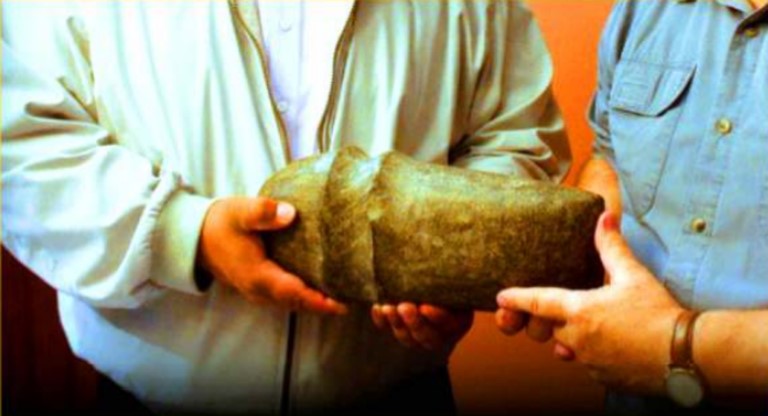
It begins with this image, the citation to which is, “A very large stone ax* was recently found in the state of New York by a man from the Seneca Nation. It weighs 20 pounds and must have been used by ‘a large and mighty man.’ (Photo courtesy of Wayne N. May).”
That it’s an ax and was thus used by a large and mighty man are assumptions—example: it could have been attached to a structure which was engineered to maximize force via a pulley system.
Regardless, it’s of import that reference was made to, “a large and mighty man” since the first paragraph notes, “The Nephilim…are large and strong; the word Nephilim is loosely translated as giants in some translations of the Hebrew Bible but left untranslated in others. Jewish explanations interpret them as fallen angels.” That seems like a copy and paste job from AI (virtually every neo-pop-article about Nephilim begins with virtually those exact words.
The immediate questions that come to mind are: what’s the usage of the vague, generic, subjective, multi-usage and modern English word “giants” in English Bibles? What’s Nelson’s usage? Do those two usages agree?
It’s not a case of, “are large” since they are nothing, they haven’t been anything since the flood so that assertion should have read, “were large.”
Yet, that’s an assertion so we will have to see if we’re told just how it is that they were even, “large”—which is just as vague, generic, subjective, and multi-usage as giants.
As for, “loosely translated as giants” that’s a fair enough qualification: it’s technically a rendering.
Asserting, “Jewish explanations interpret them as fallen angels” is generic, uncited, and unquoted and, “Jewish explanations” can range millennia.
It’s a virtually historically unknown view that Nephilim were fallen Angels. Rather, they were offspring of fallen Angels.
Wikipedia is appealed to for the statement, “The main reference to them is in Genesis, but the passage is ambiguous and the identity of the Nephilim is disputed.”
We’re told, “According to Bible Hub” etymology, the root, “nephel” refers to, “Miscarriage, stillborn…Word Origin: [from [Strong’s Exhaustive Concordance number] H5307 (נָפַל – fall)] 1. something fallen, i.e. an abortion untimely birth…naphal; something fallen, i.e. An abortion — untimely birth.”
It’s then asserted:
According to the Book of Numbers 13:33, they later inhabited Canaan at the time of the Israelite conquest of Canaan. A similar or identical biblical Hebrew term, read as “Nephilim” by some scholars, or as the word “fallen” by others, appears in the Book of Ezekiel 32:27.[3][4]”—I’m as unsure to what, “[3][4]” as I am about the asterisk above.
For some unknown reason, Rian Nelson stated, “According to the Book of Numbers 13:33” without telling us that he’s actually referring us to one single unreliable sentence from one single unreliable, “evil report” by some unreliable guys whom God rebuked. They contradicted Moses, Caleb, Joshua, God, and the rest of the whole entire Bible. And that’s only mentioning a few problems with that sentence, see my post Chapter sample: On the Post Flood Nephilim Proposal.
If, “they later inhabited Canaan at the time of the Israelite conquest” then God failed, missed a loophole, the flood was much of a waste, etc., etc., etc.
As for Ezekiel 32:27, that reads, “And they do not lie with the mighty, the fallen from among the uncircumcised, who went down to Sheol with their weapons of war, whose swords were laid under their heads, and whose iniquities are upon their bones; for the terror of the mighty men was in the land of the living.”
The issue is that Ezekiel employs the term נָפַל/nāp̄al in the generic sense of having fallen.
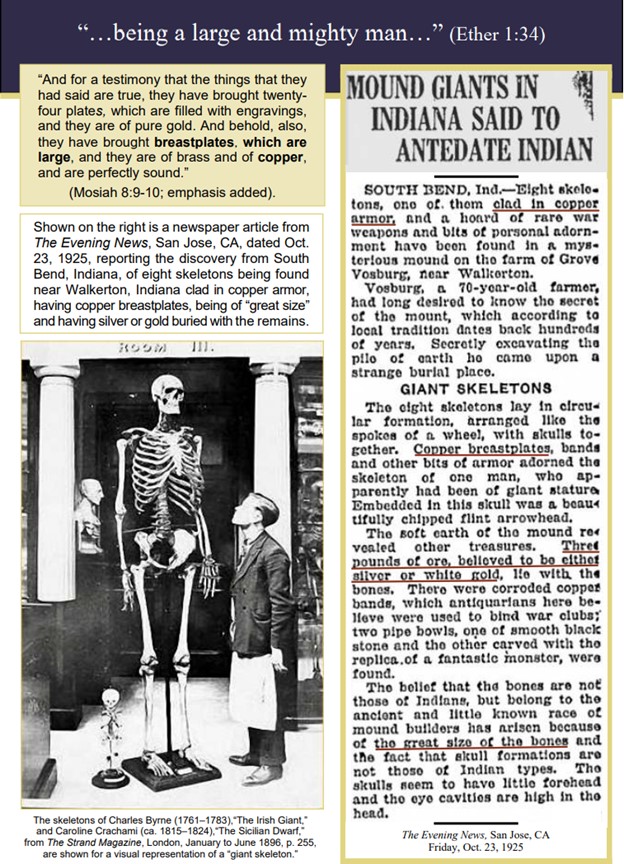
That is followed by a screenshot of, “Annotated Book of Mormon page 459.”
In my book Nephilim and Giants: Believe It or Not!: Ancient and Neo-Theo-Sci-Fi Tall Tales I filled a whole chapter with examples of such newspaper reports. Newspapers reports are generally no more than that reporter X noted that so and so claimed so and so, end of story. Thus, most are highly suspect—especially when a non-expert says they found a bone but can’t actually identify if it’s human, whale, dinosaur, pachyderm, etc.
Now, we next get an answer to Rian Nelson’s use of giants since there is a section titled just that, “Giants” and states, “Unusually large, tall persons” thus, his usage doesn’t agree with the English Bible’s usage since in English Bibles it merely renders (doesn’t even translate) Nephilim in 2 verses or Repha/im in 98% of all others and so never even hints at anything to do with any sort of height whatsoever.
We’re then told, “Unusually large, tall persons…are mentioned both before the Flood (Gen. 6:4…” which is not the case since that chapter doesn’t say a single word about any size at all: he’s just misreading large/tall into the term giants.
He also cited a Mormon book titled Moses at 8:18 which also doesn’t say anything about large/tall, “And in those days there were giants on the earth, and they sought Noah to take away his life; but the Lord was with Noah, and the power of the Lord was upon him.”
Reading the multi-usage modern English word giants and merely assuming large/tall is a word-concept fallacy and it’s folly to chase a modern English word around an ancient Hebrew Bible.
Now, the statement is actually, “Unusually large, tall persons…are mentioned both before the Flood (Gen. 6:4) and after (Num. 13:33; Deut. 2:10–11, 20; 3:11–13; 9:2; Josh. 15:8; 18:16).
Let us review:
“Unusually large, tall persons…Gen. 6:4” not so.
“Unusually large, tall persons…Num. 13:33” an unreliable tall-tale.
“Unusually large, tall persons…Deut. 2:10–11, 20,” the text reads, “(The Emim formerly lived there, a people great and many, and tall as the Anakim. 11 Like the Anakim they are also counted as Rephaim, but the Moabites call them Emim…It is also counted as a land of Rephaim. Rephaim formerly lived there—but the Ammonites call them Zamzummim—[adding v. 21a] a people great and many, and tall as the Anakim.” Thus, this is where the subjective nature of, “tall,” “giants,” “huge, etc. comes into play since, sure, that refers to, “tall” but that’s subjective to the average Israelite male who was 5.0-5.3 ft. in those days.
“Unusually large, tall persons…3:11–13; 9:2” which reads, “(For only Og the king of Bashan was left of the remnant of the Rephaim. Behold, his bed was a bed of iron. Is it not in Rabbah of the Ammonites? Nine cubits was its length, and four cubits its breadth, according to the common cubit.) When we took possession of this land at that time, I gave to the Reubenites and the Gadites the territory beginning at Aroer, which is on the edge of the Valley of the Arnon, and half the hill country of Gilead with its cities. The rest of Gilead, and all Bashan, the kingdom of Og, that is, all the region of Argob, I gave to the half-tribe of Manasseh. (All that portion of Bashan is called the land of Rephaim…a people great and tall, the sons of the Anakim, whom you know, and of whom you have heard it said, ‘Who can stand before the sons of Anak?’” Thus, Og for whom we’ve no physical description and well, nothing else: as for his, “bed” the implications is that we can derive his height from it but that’s an non sequitur based on various assumptions—see my book The King, Og of Bashan, is Dead: The Man, the Myth, the Legend—of a Nephilim Giant?
“Unusually large, tall persons…Josh. 15:8; 18:16” which reads, “Then the boundary goes up by the Valley of the Son of Hinnom at the southern shoulder of the Jebusite (that is, Jerusalem). And the boundary goes up to the top of the mountain that lies over against the Valley of Hinnom, on the west, at the northern end of the Valley of Rephaim…Then the boundary goes down to the border of the mountain that overlooks the Valley of the Son of Hinnom, which is at the north end of the Valley of Rephaim. And it then goes down the Valley of Hinnom, south of the shoulder of the Jebusites, and downward to En-rogel.” Apparently, the point was that Rephaim, on average, were subjectively taller than 5.0-5.3ft.
See, “Unusually large, tall persons” merely means just that: some vague level of height above the parochial average.
Raphah of Gath was said to be the father of several giants of whom Goliath was one (1 Sam. 17:4–7; 2 Sam. 21:16–22; 1 Chr. 20:6). A 12-fingered, 12-toed giant is also mentioned as one of the sons. The giants in Palestine were also known as Anakims, Emims, and Zamzummims.
Biblically contextually, “Raphah of Gath was said to be the father of several giants” means, “Raphah of Gath was said to be the father of several Raphaim.” For some reason, Rian Nelson didn’t tell us that the Masoretic text has Goliath at just shy of 10 ft. Yet, the earlier LXX and the earlier Dead Sea Scrolls and the earlier Flavius Josephus all have him at just shy of 7 ft. so, that’s the preponderance of the earliest data.
Indeed, the “12-fingered, 12-toed” Repha is the only person in the Bible described as such. And we already saw that, “The giants in Palestine were also known as Anakims, Emims, and Zamzummims” means, “The” Rephaim, “in Palestine,” Cannan or Israel, “were also known as,” their clan, “Anakims” and their a.k.a.s, “Emims, and Zamzummims.”
He notes that some, “Christians say the Nephilim are the Fallen Angels or Spirits” but historically, that’s a virtually unknown view.
He adds, “I am confident that spirits, or those who have not come to this earth to receive a body, cannot have sexual relationships with those who have a physical body,” Yet, there’s no indication that any spirits came to Earth to receive a body: that’s Mormon add-ons.
He added, “Nephel in Hebrew means stillborn or abortion. Nephilim may have not been a race of people, but an ideology and a set of practices that some people after the Flood returned to which included abortion and other sexual depravities” and yet, the context of the Gen 6 affair’s narrative is that they were physical offspring of physical copulation after marriage which came after attraction.
He then notes that he will provide, “quotes below from members of our Church are most likely to be correct” beginning with the section title, “JOSEPH SMITH DIDN’T BELIEVE IN WATCHERS” which begins with a quote about, “the rise of the” whatever is meant by, “giant race” for which Gen 6 is quoted regarding, “giants (Nephilim).”
It’s noted that, “two main schools of exegesis have formed” one being, “disobedient angels (sometimes called Watchers)…producing a race of giants” and, “the pious race descended from Seth, who sinned by marrying descendants of Cain, who would have been pagans.” Thus, the pious weren’t pious since they were such terrible sinners that their sin served as the premise for the flood. And, that Sethites were pious and Cainites Pagans is a myth based on prejudice.
It’s noted, “The first explanation is definitely the cool one. I would have thought that Joseph Smith would have been all over fallen angels, with his emphasis on the corporeality of divine beings. But it turns out that Joseph didn’t believe in Watchers” which is a clue about his level of accuracy since he rejected the original, traditional, and majority view among the earliest Jewish and Christians commentators, starting in BC days.
It’s at this point that Rian Nelson informs us he’s been quoting Hugh Nibley (Professor Emeritus of Ancient Scripture at Brigham Young University) who also noted, “Seth…carry on his [Adam’s] work…that line of successors in the priesthood, etc.
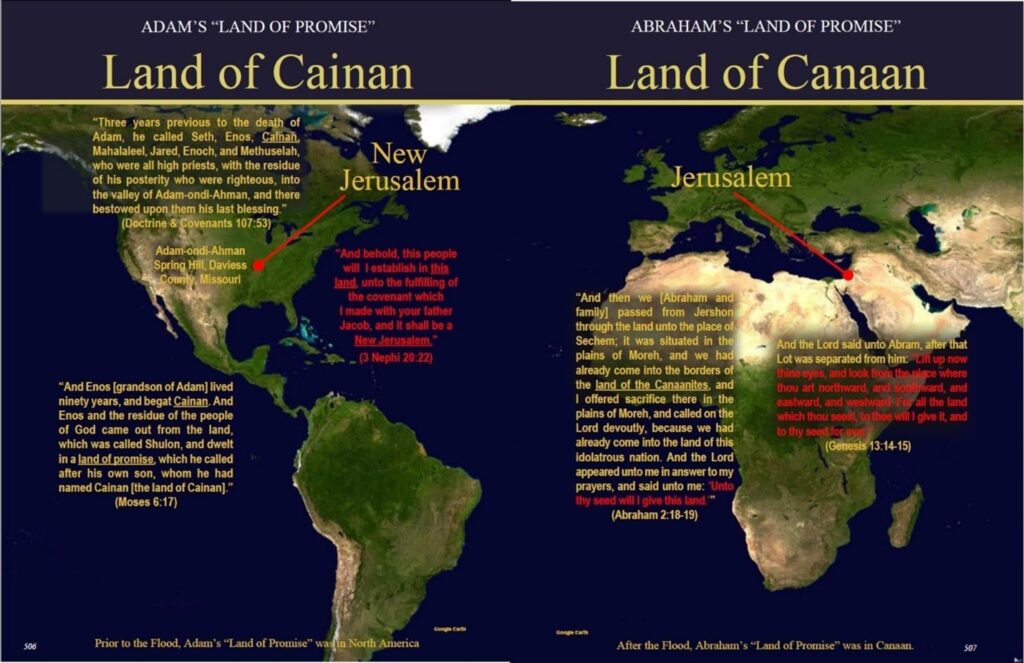
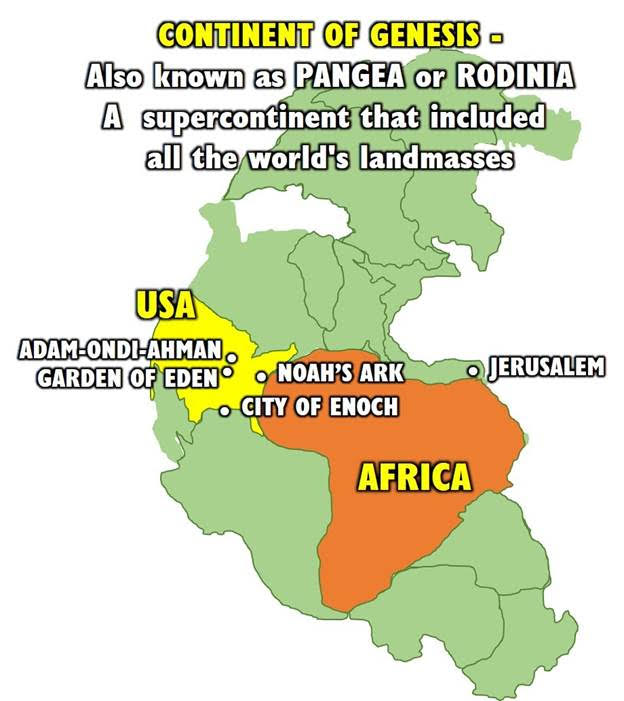
Next, this map is provided about how Sethies lived in the US of A and Cainites across the pond—well, it’s noted, “…the earth had no division between the old and new world. There was no Atlantic Ocean”: the statement before the map is, “Cainites Lived Near Jerusalem. Sethites Lived Near Eden which was near the Garden of Eden.”
Hugh Nibley asserted, “Cainites dedicated to following Satan, who…devoted themselves to all the pleasures of the flesh and all manner of immorality” even though there’s literally zero indication of that. And, “Sethites…were faithful to the divine law” well, except when they weren’t.
It’s noted, “In apocryphal Enoch stories we are told…special heavenly messengers…were sent down to earth…but…yielded to temptation…They are variously designated as the Watchers, Fallen Angels, Sons of God, Nephilim, or Rephaim, and are sometimes confused with their offspring, the Giants.” I’m unsure who variously designated them as such but that’s a category error since Watchers is just an a.k.a. for Angels which is sometimes an a.k.a. for Sons of God with Nephilim being their offspring, Rephaim being utterly unrelated and Giants referring to Nephilim (2% of the time) or Rephaim (98%) of the time merely linguistically.
We’re told, “While the sons of God have been identified with both angels and the Watchers, the Greek Enoch does not identify the Watchers with Satan’s hosts who fell from heaven from the beginning—they are another crowd.” Yet, there’s no such thing as, “Satan’s hosts who fell from heaven from the beginning” since Angels fell during the Gen 6 timeline, “When man began to multiply on the face of the land and daughters were born to them.”
Now we’re told:
“It is the Joseph Smith Enoch which gives the most convincing solution: the beings who fell were not angels but men who had become sons of God. From the beginning, it tells us, mortal men could qualify as “sons of God,” beginning with Adam. Moses 6:68
How? By believing and entering the covenant. Moses 7:1 Thus when “Noah and his sons hearkened unto the Lord, and gave heed … they were called the sons of God.” Moses 8:13
In short, the sons of God are those who accept and live by the law of God. When “the sons of men” (as Enoch calls them) broke their covenant, they still insisted on that exalted title: “Behold, we are the sons of God; have we not taken unto ourselves the daughters of men?” Moses 8:21 (Hugh Nibley, “A Strange Thing in the Land: The Return of the Book of Enoch, Part 8,” Ensign, Dec 1976, 73)
It’s as already noted then, “Joseph Smith Enoch” which seems to be a typo, “gives the most convincing solution” which is that those who were, “believing and entering the covenant…who accept and live by the law of God…” weren’t really believing, nor really entering the covenant nor really did accept nor live by the law of God since they, “broke their covenant.”
It’s then noted that Joseph Fielding Smith (tenth Mormonism president) referred to the original, traditional, and majority view among the earliest view as a, “foolish notion” resulting from, “lack of proper information” even though Job 38:7, as one example, shows us that, “sons of God” can refer to non-human beings (which the LXX has as “Angeloi”: plural of “Angelos”) since they, at the very least, witnessed the creation of the Earth.
Jude and 2 Peter 2 combined refer to a sin of Angels, place that sin to pre-flood days and correlate it to sexual sin which occurred after the Angels, “left their first estate,” after which they were incarcerated, and there’s only a one-time fall/sin of Angels in the Bible.
So, if they’re not referring to the Gen 6 affair, we’ve no idea to what sin they’re referring.
Smith referred to Mormonism’s founder Joseph Smith’s view as, “the inspired interpretation given to the Prophet” (cited as, “(Answers to Gospel Questions, 5 vols. [Salt Lake City: Deseret Book Co., 1957-1966], 1: 136.)).”
Moreover, “in sermons in the Journal of Discourses…by Charles W. Penrose, “heirs to the Priesthood….obeyed the holy covenants…received the word of the Lord…were consecrated to the Almighty” but really weren’t and didn’t.
Rian Nelson notes that in, “the FirmFoundationExpo post on Facebook…Mason Wheeler…responded ‘The roots of the Hebrew word ‘nephilim’, and of the Greek ‘gigantes’, both of which get translated in the Bible as ‘giants,’ have nothing to do with large size, or angels. On the contrary, ‘gigantes’ refers to people ‘of the Earth.’ And ‘nephilim’ is related to words meaning ‘mighty’ and, strangely enough, ‘abortion.’”
Well, naphal and gigantes are technically rendered as giants and indeed, “have nothing to do with large size, or angels.” I can see how it’s noted that, “‘gigantes’ refers to people ‘of the Earth’” since it literally means earth-born (as in born of Gaia: the Greek Earth false goddess). Yet, it’s not “‘nephilim’ is related to words meaning ‘mighty’” since that’s gibborim (he may have been thinking of elohim) and as for abortion well, that certainly wouldn’t be literal since they were born and grew up into mighty men.
Now, besides more than highly questionable qualifications, teachings, and actions, I pondered why OG Smith would oppose the original, traditional, and majority view and we may have gotten a hint a the tale end of the article. Perhaps it was a pragmatic move in that, “Extrabiblical sources tell us that Joseph Smith was right when he said the antediluvian “sons of God” were fallen Priesthood leaders, not fallen angels” I suppose, if, “Extrabiblical sources” refers to assertions from the 1800 AD.
More to the point, if they were humans, “This understanding also explains how they could survive the Flood and have ‘giants’ in the land of Canaan for Joshua’s scouting team to find.”
Do you see what just happened here? By chasing a generic modern English word around a specific ancient Hebrew Bible, we ended up with Smith seeming to solve a problem which is actually a non-issue.
Since, “‘giants’ in the land of Canaan for Joshua’s scouting team to find” is too vague an assertion so I’ll elucidate in both directions that it can take us:
If it’s, “‘Rephaim’ in the land of Canaan for Joshua’s scouting team to find” then certainly, there were Rephaim there but they have literally nothing to do with pre-flood days and thus, nothing to do with the flood, so no reason to invent tall-tales about their survival. Nephilim were strictly pre-flood hybrids, Rephaim were strictly post-flood humans, and there’s zero correlation between them.
If it’s, “‘Nephilim’ in the land of Canaan for Joshua’s scouting team to find” then he’s actually referring to that one single unreliable sentence from an unreliable, “evil report” by unreliable guys whom God rebuked so it’s a double non-issue.
He further notes, “Nephilim was not a race of people, but an ideology and a set of practices that some people after the Flood returned to” but if that’s the case then why are Nephilim only referred to one single time post-flood (and, in a most unreliable manner)?
Mason Wheeler claimed to get such ideas from Jonah Barnes’ book The Lost Gems of Genesis so now you know to avoid that book—unless you want to write a debunking critique.
Thus, overall, we got an article based on faulty linguistics and some faulty sources which results in that which I term pop-Nephilology which consists of un-biblical tall-tales.
A plea: I have to pay for server usage and have made all content on this website free and always will. I support my family on one income and do research, writing, videos, etc. as a hobby.
If you can even spare $1.00 as a donation, please do so: it may not seem like much but if each person reading this would do so, even every now and then, it would add up and really, really help out.
Judd H. Burton, Ph.D. in History-focus in history of religions, Early Christianity & Greco Roman religions, MA Anthropology & History, and a BA in History, wrote INTERVIEW WITH THE GIANT: Ethnohistorical Notes on the Nephilim. On and off, he references what he wrote as a paper and an essay and it seems to be a combination of various papers and essays that were combined.
Quite on point, Burton begins thusly:
“Giants? Like, people of large stature, or….?” queried a well-meaning colleague.
“Giants—like gigantic, sentient hominids” I replied. “Where’s the evidence?”
“All around us. Where would you like me to begin?”
That was a case of so close and yet, so far since the colleague asked a fundamental question that most Nephilologists do not ask and do not answer. And Burton half answers it since at least we know that he is referring to sentient hominids but to say, “Giants—like gigantic” begs the question since using a form of a word to define the word in question is circular.
I will couple the question with a question contextual to his biblical interests: what is the usage of the vague, generic, subjective, multi-usage and modern English word “giants” in English Bibles? What is Burton’s usage? Do those two usages agree?
Typically, Nephilologists do not answer such key questions and leave it to their readers to do the hard work of attempting to discern their usage at any given usage. Not answering such questions also, consciously or not, allows the Nephilologists to water down the term and use it to refer to various things, which is inconsistent.
This review’s focus will specifically be how he ties whatever he may mean by, “GIANT” to, “Nephilim.”
Due to being familiar with neo-pop-Nephilology, when he wrote, “Giants certainly do not fit neatly into the evolutionary scheme of human history…the very subject flies in the face of evolutionary biology and the accepted paradigm of human history” it is clear that his usage is something vaguely generic about subjectively unusual height at some unspecified level above the parochial average (yes, that is how useless most common parlance usages are). He may also mean that a traditional view of Nephilim as half-human and half-Angel hybrids also, “do not fit neatly into…flies in the face of” such a view of biological history.
Since he references, “physical evidence” it would appear that he is emphasizing the first inference.
CHAPTER 1
He begins by quoting that which I term the Gen 6 affair thusly:
“The Nephilim were on the earth in those days–and also afterward–when the sons of God went to the daughters of men and had children by them. They were the heroes of old, men of renown.”—Genesis 6:4
He defines, “ethnohistory: the reconstruction of a vanished or vanishing people’s history…we must treat mythology as ethnography and history, as accounts of culture, rather than mere fancy.”
And we get another hint as his usage, “giants. They are colossal” with both terms being vague, generic, subjective, and multi-usage but the useless usage has been established.
We can now answer the third question, lest along the way he switches usages, since that does not agree with the English Bibles’ usage since the usage of the vague, generic, subjective, multi-usage and modern English word giants in English Bibles is that it merely renders (does not even translate) Nephilim in 2 verses or Repha/im in 98% of all others and so never even hints at anything to do with any sort of height whatsoever.
Judd Burton notes:
The Biblical narrative is generally one of the more prominent sources containing elements of gigantic culture. From Genesis chapter six, one learns that the race of giants, the Nephilim, is the product of sexual unions between rebellious angels known as the Grigori, or “Watchers.”
If you are wondering where, “From Genesis chapter six, one learns” of, “Grigori, or ‘Watchers’” well, he adds, “Textual evidence for the Grigori and Nephilim exists, but it is not contemporary and represents much later traditions” with much referring to millennia after the Torah since for, “Grigori, or ‘Watchers’” he is relying on 1 Enoch from mere centuries BC—that text is Bible contradicting folklore, see my book, In Consideration of the Book(s) of Enoch and also see my The Apocryphal Nephilim and Giants: Encountering Nephilim and Giants in Extra-Biblical Texts. Overall, within his 170 page texts, he references, quotes, and cites 1 Enoch 92 times (40 times more than he appeals to Genesis and 73 times more than Numbers).
He further notes, “They are the documents with which we have to work, however, and do provide necessary clues” and yet, “with which we have to work” toward what end? Historical accuracy or discerning the folklore du jour?
Surely, he would reply that it is both since the folklore du jour can inform our view of history—which is a questionable claim in itself.
Judd Burton notes, “Joe Taylor, curator of the Mount Blanco Fossil Museum in Crosbyton, Texas has in his collection a replica of a hominid femur (whose morphology does not match non-human species) based on an actual find in southeastern Turkey.” He cites, “Joe Taylor, ‘Story Behind the Giant Human Femur Sculpture.”[1]
I posted a video clip of Taylor elucidating that despite making its rounds amongst pop-Nephilologists as a giant bone it is a sculpture that he based on being told about a newsletter he never saw that tells of what someone merely asserted that they were told.
Judd Burton notes that, “As noted, the field of ethnohistory will be increasingly important in the study of the Grigori and the Nephilim” and explains why he appealed to folklore from millennia after the Torah since, “Oral tradition, music, folklore, myth, ecology, art, and archaeology all contribute to the process of reconstructing a given ethnicity’s history.”
Judd Burton wrote:
1 Enoch is clear on the angelic nature of the Watchers, that they are the possessors of science, magic, and knowledge. Their offspring—created by the taboo union with human females—were the gigantic Nephilim, whose culture seems characterized more by dominance, oppression, and violence, rather than the exchange of knowledge.
And it would still be nice to get closer to what he is referring by, “gigantic Nephilim”—which biblically contextually means, “Nephilistic Nephilim.”
One problem with his usage of giants is the watering down effect since he notes that Nephilim, “legacies exist in the religious traditions of the Near East, in myth, in oral tradition, and indeed in the lore and myth of the entire world” and yet, that is a conclusion based on anything that contains references to giants as per his usage and secondarily, something about hybrids—and with the artificially flavored icing on the gigantic cake being something about giant hybrids.
One difficulty in reading backward in history/literature is referring to, “the culture of giants…In extrabiblical sources, such as The Book of Enoch, one can find the very work of transforming hunter- gatherers and proto-farmers into a more sophisticated society. The fallen angels waste no time in developing a scheme to influence man for their own ends.”
Yet, the chronology and cultural context is that either the Essenes or proto-Essenes who withdrew from sophisticated society would have been motivated to tell tall-tales about why such society is corrupt and so why withdrawing from it is a crucial ethos.
It is similar to why 1 Enoch pinpoints something that Gen 6 does not: precisely where the Angels fell when they touched down on Earth. That was Mt. Hermon which was revered by Pagans a few centuries BC so, why not besmirch it by concocting such a claim about it?
And, indeed, within a few more paragraphs and right on schedule, Judd Burton references, “my own work on the religions of the Mount Hermon region in Israel, I have taken several detours in order to work out certain historical problems. Many of these have led me to material on the Watchers and the Nephilim.”
He notes, “what follows is a collection of ethnohistorical sketches, which I have stitched together along a topical line.”
Importantly, he sought to, “serve as an introduction to the subject of the Nephilim for those who are unfamiliar with so mysterious a topic” so that such an intro must be as accurate and speculation free as possible.
CHAPTER 2
This chapter also begins with the Gen 6 affair:
Genesis 6:4 states “The Nephilim were on the earth in those days –and also afterwards– when the sons of God went to the daughters of men and had children by them. They were the heroes of old, men of renown.”
The Nephilim were a race of giants that were produced by the sexual union of the sons of God (presumably fallen angels) and the daughters of men.
I am unsure whence he got the, “–” or why he employed them: perhaps we will find out.
Now, if you are wondering, besides his ongoing mere assertions, what would make us think that, “Nephilim were a race of giants” as per his (mis) usage then consider his follow-up—and keep in mind that biblically contextually, “Nephilim were a race of giants” means, “Nephilim were a race of Nephilim.”
Judd Burton added:
Translated from the Hebrew texts, “Nephilim” means “fallen ones,” at least this is one of the more popular translations. They were renowned for their strength, prowess, and a great capacity for sinfulness.
Despite the prevailing idea in academia, the above translation gives us no clue as to how the Nephilim are giants (as indicated in Numbers 13).
Apparently, when he makes statements such as, “Nephilim were a race of giants” he was not claiming that the word Nephilim means his usage of giants since, “‘Nephilim’ means ‘fallen ones.’” And he told us whence he got such an idea about Nephilim, “Nephilim are giants (as indicated in Numbers 13)” which is a hugely gigantic problem—stand by (on the shoulders of giants).
He told us, “‘Nephilim’ means ‘fallen ones’” and/but followed directly with, “Morphologically the Hebrew construct is similar to Aramaic analogs. In such framework, the word literally means ‘giants.’” Yet, that is question begging since if, “the word literally means ‘giants’” then, pray tell, what does giants mean? Well, we know that what he means is, “the word literally means something vaguely generic about subjectively unusual height at some unspecified level above the parochial average.”
If, “‘Nephilim’ means ‘fallen ones’” and that is, “similar to Aramaic analogs” then how can the former mean fallen ones but the latter giants?
Without first looking, I knew to whom he would appeal and indeed, his citation is, “Michael S. Heiser, ‘The Meaning of the Word Nephilim: Fact vs. Fantasy.”[3]
Yet, this is a style battle of the giant scholars since, for example, the J. Edward Wright Endowed Professor of Judaic Studies, who is J. Edward Wright, Ph.D. himself, and who is the Director of the Arizona Center for Judaic Studies at the University of Arizona notes, “The term traditionally translated as ‘giants’ in both the Greek Septuagint (γιγαντες) and now in English is נפילים nephilim, a term based on the root נפל npl meaning ‘fall.’ It has nothing to do with size” and specifies that this goes for both Hebrew and Aramaic as “The root npl in Aramaic also means fall and not giants” (Private communique, July 2019).
So, based on Heiser’s definition, Burton will have to admit that there are giants in the National Basketball Association and that would make all talk of giants a bit less excitingly mysterious.
Yet, he adds:
Further clarification occurs in the Sept[u]agint, the Greek translation of Hebrew scriptures. The Hellenized Jews knew the perfect Greek analog for the Nephilim of Genesis 6, in this case the word γίγαντες (gigantes), literally meaning “giants,” and who consequently had a divine parent and a human parent.
Ever wonder how and why so many very different words mean giants? In this case, it is simply not the case that, “γίγαντες (gigantes), literally meaning ‘giants’” since it means earth-born—and that he cannot really assert, “literally meaning ‘giants’” having never actually defined his usage (but leaving it to us to discern it).
He re-re-reiterates, “The Nephilim were gigantic in stature” evidence for which is yet to be elucidated.
Judd Burton next gets into linguistics—see my book Bible Encyclopedias and Dictionaries on Angels, Demons, Nephilim, and Giants: From 1851 to 2010:
The diverse kinds of these giants are cited in several passages. They are variously referred to as Emim, or “Terrors” (Gen. 14:5; Deut. 2:10), Rephaim, or “Weakeners” or “Dead Ones” (2 Sam. 23:13; 1 Chron. 11:15), Gibborim, or “Giant Heroes” (Job 16:4), Zamzummim, or “Achievers” (Deut. 2:10), Anakim, or “Long-necked” (Deut. 2:10; Josh. 11:22, 14:15), and Awwim or “Devastators” and “Serpents.”
My experience has been that what he stated parenthetically is generally subjectively picked from a list of meaning options.
Now, based on the assertion, “Nephilim were gigantic” followed with, “diverse kinds of these giants” we can only conclude that he means, “diverse kinds of these Nephilim”—see the sort of work we readers have to do in order to make up for vague writing?
In any case, granting it, none of those citations even hint at a possibility that any of those were nor had anything whatsoever to do with Nephilim at all.
He also seems unaware that Emim, Rephaim, Zamzummim, and Anakim are a list of one, in essence, since what Deut 2 tells us is that Zamzummim and Emim are mere a.k.a.s for Rephaim and Anakim were like a clan of that tribe.
To assert, “Gibborim, or ‘Giant Heroes,’” especially given his misusage of giants is linguistically incoherent since its unfounded and myopic.
Firstly, Job 16:4 reads thusly, “I also could speak as you do, if you were in my place; I could join words together against you and shake my head at you” (ESV).
Secondly, gibborim is a generic term for might/mighty in general: it is applied to Nephilim (Genesis 6:4), Nimrod (Genesis 10:8), Angels (Psalm 103:20), Boaz (Ruth 2:1), some of King David’s soldiers (1 Chronicles 11:11), even God Himself (Isaiah 9:6), etc. And we have literally zero indication that Nephilim, Nimrod, Angels, Boaz, some of King David’s soldiers or God were Burton’s usage of giants.
Now, another case of so close and yet, so far is when he wrote:
Other giants are mentioned in these texts as well, such as Goliath (2 Sam. 21:19), a giant with twelve fingers and twelve toes who is mentioned as one of the Rephaim (2 Sam. 21:20), and a tall Egyptian (1 Chron. 11:23).
Again, what he claimed is that other vaguely generic about subjectively unusual height at some unspecified level above the parochial average are mentioned in these texts:
Goliath, about whom he went on to write that he was, “over nine feet tall [six cubits and a span].” For some odd reason, he did not mention that the Masoretic text has Goliath at just shy of 10 ft. (six cubits and a span).Yet, the earlier Septuagint/LXX and the earlier Dead Sea Scrolls and the earlier Flavius Josephus all have him at just shy of 7 ft. (four cubits and a span and that is compared to the average Israelite male who was 5.0-5.3 ft. in those days) so that is the preponderance of the earliest data.
Due to how he writes, it is tricky to claim, “a giant with twelve fingers and twelve toes who is mentioned as one of the Rephaim” since biblically contextually, that reads as, “a Repha with twelve fingers and twelve toes who is mentioned as one of the Rephaim” which is redundantly circular.
Yet, he surely wrote his usage of giant due to that the text says, “a man of great stature” which is just as vague, generic, subjective, and multi-usage as giants and colossal.
Incidentally, that this one single Repha is the only person in the whole Bible to be described as having extra digits has illogically and ill-bio-logically led many Nephilologists to commit a category error by merely asserting that one Repha having such a feature means that extra digits was a Nephilim trait—see my book Nephilim and Giants: Believe It or Not!: Ancient and Neo-Theo-Sci-Fi Tall Tales.
As for, “a tall Egyptian” he is the tallest specified person in the Bible at 7.5ft.
We then get to the aforementioned, “Nephilim are giants (as indicated in Numbers 13)” as Judd Burton wrote:
The passage of Numbers 13:26-33 recounts the Nephilim of Canaan that Joshua and the other Hebrew spies saw.
Furthermore, according to Judaic lore, a certain one of the Nephilim, Arba, built a city, Kiriath Arba, which was named for its builder and is now known as Hebron.
He misrepresented Num chap 13 since there is no indication that, “Joshua and the other Hebrew spies saw” them.
Rather, there are twelve spies in that chapter and two reports. An original report is stated and factually accepted as is. Then Caleb encourages the Israelites (with Joshua siding with him). Then the remaining 10 discourage. Then we are told that the 10 went on to present a דִּבָּה/dibâ/bad/evil report that consists of five mere assertions unbacked by even one single other verse in the whole Bible.
The 10 were unfaithful, disloyal, contradictory, embellishers who were rebuked by God so there are many—textual, logical, bio-logical, and theo-logical—reasons to utterly reject their mere assertions—see my post Chapter sample: On the Post Flood Nephilim Proposal.
As for, “Judaic lore” well, that can refer to anything written within a timespan of a few centuries BC to the present day. Abra was Anak’s (after whom Anakim are named) dad and there is literally zero indication that there was or even could be any relation between him and Nephilim.
Jos 14:15, 15:13 notes, “Hebron formerly was Kiriath-arba. (Arba was the greatest man among the Anakim)….Kiriath-arba, that is, Hebron (Arba was the father of Anak)” and what Burton and/or Judaic lore did is to artificially insert, “a certain one of the Nephilim.”
Now, as an FYI, Burton writes so generically that he mixes and mashes together the Torah and folklore from millennia after it as if they carry the same level of authority and without making the distractions clear.
For example:
Genesis 6:5 alludes to the corruption that the Nephilim had caused amongst humans and themselves: “The Lord saw how great man’s wickedness on the earth had become…”
Their evil rebellion had incurred both the wrath and grief of God. God instructed the angel Gabriel to ignite a civil war among the Nephilim. He also chose Enoch, a righteous man, to inform the fallen angels of the judgment pronounced on them and their children.
God did not allow the fallen angels any peace, for they could not lift their eyes to heaven and were later to be chained. The end of the antediluvian Nephilim came about in the war incited by Gabriel, in which the giants eventually reducing their numbers greatly.
Read Genesis 6:5 and it only states the quoted section, the supposed alludes to part is not in the least bit even hinted at being allusions. Again, he is getting that from 1 Enoch according to which, “The end of the antediluvian Nephilim came about in the war” and note that even within one sentence Burton jumped from the specific ancient Hebrew word Nephilim to the modern English one giants.
Note that his qualifier, “The end of the antediluvian Nephilim” is surely employed since based on one single unreliable verse from an unreliable evil report by unreliable guys whom God rebuked, he merely asserts post-flood (post-war) Nephilim.
He added:
The Nephilim are known to have survived into historical times following the flood, given the above references in the Old Testament. They asserted their strength over humanity in pockets, and became great city-builders and tyrants.
Some giants became mercenaries, as in the case of Goliath. In general, the giants organized themselves into tribes and clans in order to preserve their culture and maintain their stance against whatever plan Yahweh might have for the Hebrews.
Giants such as Og…From the Levant the giants diffused into other parts of the globe, their numbers growing increasingly smaller with each migration.
Despite the loss of their physical bodies, there is reason to believe that the giants’ spirits continued to exist. In this state, they were (and are) demonic entities.
Like other sentient creatures, they have an eternal spirit at their essence. Therefore, the Nephilim and related tribes of giants never really ceased to exist, only their physicality was lost.
In order words, God sent a flood which was to be rid of them, et al., or a war to be rid of them but either way, God failed, He must have missed a loophole, and the flood/war was much of a waste since they just came right back to do it all again—fallacious Nephilology damages theology proper.
Actually, not even 1 Enoch has physical post-flood Nephilim at all, just like the Bible—Jubilees does, until the time of Noah’s grandsons, via someone finding a recipe for fresh, hot out of the oven, home-made Nephilim.
I am unsure why he is so vague about it, if, “Nephilim are known to have survived into historical times following the flood” why not tell us just how they got past the flood, past God?—and why not tell us known to have by whom and how so?
As for, “given the above references in the Old Testament” there are no such reliable, plural, references and only one, singular, unreliable sentence.
Recall that, “giants…Goliath” really means, “Repha just shy of 7ft.”
Likewise, “Giants such as Og” means, “Rephaim such as Og” and we do not have a physical description of him—as is typical writing in Nephilology circles, Burton touches upon a subject, moves on, circles back to touch upon it again, moves on, circles back, etc., so more will be said about Og to come.
Note also that when one merely asserts giant, colossal, etc., then one will be asked for current evidence which is why one will conveniently merely assert, “loss of their physical bodies” so that post-flood Nephilim were there and were giant, colossal but somehow, for some reason, are no more.
As for, “giants’ spirits continued to exist…demonic entities” not surprisingly, that is just folklore from millennia after the Torah. For a biblical view, please see my article, Demons Ex Machina: What are Demons?
Thus, biblically, “Nephilim and related tribes of giants never really ceased to exist, only their physicality was lost” is to be accurately rewritten as, “Nephilim had no related tribes of whatever giants means and 100% really ceased to exist at the flood, and their physicality was lost since they were all dead—and likely ended up in sheol.”
CHAPTER 3
He notes:
Part of understanding children is understanding the parents. Genetic traits and inculturation manifest in the child and therefore, tell us something of the parent. The same may be said of the Nephilim and their parentage, and we learn a great deal about them by studying their parents, the Grigori, or “Watchers.”
By the last statement, we know we are about to get folklore. As for, “Genetic traits” that is a dangerous road which is a slippery slope particularly in pop-Nephilology. Succinctly stated, pop-Nephilologists merely assert things such as that Nephilim were giants, had extra digits, lived post-flood, etc. Thus, if they see someone who is subjectively unusually tall and/or suffers from a simple genetic mutations that results in building extra digits they can merely asset, “Nephilim!!!!”
And such is very dangerous since historically, asserting that some people are not fully human has led to humanitarian disasters—see the, “Nephil Kampf” chapter of my book Nephilim and Giants as per Pop-Researchers: A Comprehensive Consideration of the claims of I.D.E. Thomas, Chuck Missler, Dante Fortson, Derek Gilbert, Brian Godawa, Patrick Heron, Thomas Horn, Ken Johnson, L.A. Marzulli, Josh Peck, CK Quarterman, Steve Quayle, Rob Skiba, Gary Wayne, Jim Wilhelmsen, et al.
Judd Burton then focuses on the 1 Enoch tall-tale about that, “Azazel was one of the chiefs—he was one of the original fallen angels” about which I will say, in short, that millennia after the Torah, someone took the word azazel/עֲזָאזֵל from the scapegoat in Lev chap 16 and turn it into a fantastical tale about a fallen Angel.
And while Judd Burton is aware, “Azazel is most often associated with goats, in particular, the scapegoat in Jewish atonement sacrifice” he wants it to be more, “The very name ‘Azazel’ reveals more about the nature of the god of the razor”—about which he wrote, “sword and sorcery, the god of the razor”—since, “Azazel is most often associated with goats…” and, “to Azazel, the scapegoat, for all sins.”
See, he quotes a particular version, “As the passage went ‘a goat for Azazel’” and so, “The connection between Azazel and the goat is further preserved in the Levitical tradition of Azazel” when what is being contextually told to us is a goat for being a scapegoat.
Note that in the midst of his very heavy reliance upon 1 Enoch he actually asserted, “Enoch himself records” with reference to that text. There is literally zero indication that the text is from any time prior to a few centuries BC, there is no indication prior to that of anything written by Enoch, and the Old Testament refers to 33 so called lost books but does not say a single word about anything by Enoch. Yet, he also wrote of, “The author of 1 Enoch” so it is another case of we readers having to discern to what he is referring with at given time.
CHAPTER 4
Succinctly stated, based on 1 Enoch about Watchers teaching occultism, “Quite frankly, the first witches were the mothers of the Nephilim, the giants.”
Granted, it may very well be that such Angels taught such things—even if we do not have such specific data such as what 1 Enoch claims about specifically which named Watcher taught what.
And the most hilarious moment in all pseudepigrapha is when that text has that texts’ version of God saying to the fallen Watchers, “You have been in heaven, but all the mysteries had not yet been revealed to you, and you knew worthless ones” (4Q530 Frag. 2).
CHAPTER 5
This chapter is titled, “VAMPIRE ZERO: ON THE ORIGINS AND PRETERNATURAL EPIDEMIOLOGY OF VAMPIRISM” and notes, “vampirism” was in:
…the antediluvian…the first vampires were giants, namely the Nephilim of Biblical tradition…monstrous Nephilim, gigantic creatures…The most familiar passage recounting the general wickedness of the Nephilim is surely Genesis chapter six…
But since there is clearly nothing useful in Gen 6:
The Book of Enoch, an apocalyptic text of the Jewish Pseudepigrapha, provides additional details, and reveals the truly vampiric nature of the Nephilim. The key to their behavior is the consumption of what did not belong to them.
Barely out of the womb, they began to appropriate the produce of humankind. As the first slave masters, they drained humanity of its precious resources. However, the antediluvian world seems similar to our own in that its resources were not inexhaustible.
The Nephilim thus began to seek other means of sustenance. In their greed, the Nephilim turned against humans, and “devoured mankind,” developing a taste for human flesh and blood.
There defilement was not an end, however. We may rightly infer that factions developed amongst them as resources became scarcer, and humanity’s situation grimmer.
The Nephilim, true to their violent nature, fought each other and turned to cannibalism, feasting on one another’s flesh. The Book of Enoch states that they began to “devour one another’s flesh, and drink the blood.”
And blood remains a part of the Nephilim’s story throughout their tenure on earth. When their bloodlust comes to the attention of the Archangels however, their time becomes short.
As with giants, we had to discern that his usage of, “VAMPIRE…VAMPIRISM” is, “consumption of what did not belong to them…appropriate…produce…slave masters…precious resources…devoured…taste for human flesh and blood…fought each…cannibalism.”
He goes on to refer to—1 Enoch’s version of—Nephilim as, “colossal blood suckers”—FYI: that text has them being 3,000 ells tall, which is MILES tall: great folklore, poor reality.
Now, previously, the claim was, “The end of the antediluvian Nephilim came about in the war” but now it is, “The Nephilim were sentenced to die in the deluge with which God would destroy the surface of the earth”—and yet, recall that Judd Burton also teaches physical post-flood Nephilim.
Having offered such an all-encompassing watered down definition of vampirism, he notes, “As the first carriers [of vampirism], the Nephilim had one angelic parent, and one human parent, thereby rendering the disease a composition whose elements would seem to be mutually exclusive.”
Of these Draculim, he notes, “God himself prohibited its consumption in Leviticus, which certainly adds to the cursed and corrupted nature of vampirism” which is only an aspect of how he defined it and besides, again, the only indication of blood drinking/consuming Nephilim if from folklore from millennia after the Torah.
He added, “Nephilim took blood that did not belong to them, in vampiric behavior, so the vampire exacts the same toll from its victim…We can conceivably extend the taking of blood to the draining of the life force, or life essence” so the blood is watered down to what some term psychic vampirism.
And then back to, “Nephilim were bent on draining humanity of its resources…eat their own kind and humans, and drink their blood, the literal draining of life force took place.”
He then wrote, “In world mythology, giants are often symbols of chaos. They are creatures made out of the most primordial of materials. The Nephilim of Genesis and 1 Enoch seem to fit into this niche as well” well, only when Angelic and human flesh can be categorized as, “most primordial of materials” which is rather odd.
He now circles to:
The word used for Nephilim in the Septuagint is “gigantes,” the genitive form of “gigas,” meaning “giant” and interestingly “born of the earth.”
God created the world out of the void— chaos, or the lack of order—and this would seem to be in keeping with ideas connecting giants and chaos. They exist in a type of anti-reality, or anti-logic, where morality either does not matter or is completely reversed.
Gigas is in reference to the Greek earth false goddess Gaia which is why gigantes refers to earth-born, as in born of Gaia and yet, he asserted, “‘gigas,’ meaning ‘giant.’”
I am quite unsure how, “God created the world out of the void— chaos, or the lack of order” and Nephilim not being born until, “When man began to multiply on the face of the land and daughters were born to them” results in, “void— chaos, or the lack of order…chaos…anti-reality, or anti-logic,” etc.
Now, by the time he tells us, “The Assyrians and Babylonians…believed very strongly in the existence of vampires in general, and certainly in a gigantic species” we no longer know what it means to say, “vampires in general” since it can refer to so many things.
He actually uses vagaries to his advantage since it allows him to write:
Nephilitic affliction of vampirism is not altogether subject to the laws of physics…vampirism is, at its root, demonic…the ultimate cause stems from direct demonic influence. Furthermore, while the Nephilim were physically destroyed, their spirits persisted as demonic entities. We also have further evidence that there were additional unions between demons and human females to produce additional giants known by other names in the Old Testament, such as the Annakim and the Rephaim.
Thus, he jumped from an assertion about Nephilim that was apparently unknown until a few centuries BC along with an assertion about demons that was apparently unknown until a few centuries BC along with something for which there is literally zero indication whatsoever which is, “additional unions between demons and human females to produce…Annakim and the Rephaim.”
Firstly, the Gen 6 affair was not about, “demons and human females” but about sons of God/Angels/Watchers and human females: in fact, if Nephilim became demons, how were they the result of demons and humans in the first place? Thus, that is also an anachronistic error. He claims that demons created demons which implies a circular infinite regress since they would have had to pre-exist their own existence in order to create themselves.
For that assertion, he actually cited, “For Anakim see Deuteronomy 1-2, Joshua 11,14, 15; for Rephaim see Joshua 15, 2 Samuel 5, 1 Chronicles 11” and you can feel free to do so but you will waste your time since none of those texts, nor any biblical text, reliably has Rephaim or Rephaim-Anakim being the result of unions between demons, or Angels, and human females.
Yet, he later wrote, “Numbers 13: 32b-33 states: ‘All the people we saw there are of great size. We saw the Nephilim there (the descendants of Anak come from the Nephilim). We seemed like grasshoppers in our own eyes, and we looked the same to them.’”
For some reason, he never got around to telling us that he is relying on:
1. One single sentence
2. From strictly non-LXX versions (since the LXX does not even mention Anakim in that version’s version of that sentence)
3. Of an evil report
4. By 10 unreliable guys
5. Whom God rebuked—to death
6. Who made five mere assertions unbacked by even one single other verse in the whole Bible
7. Who contradicted Moses, Cable, Joshua, God, and the rest of the whole entire Bible
I could go on but, again, see my post, Chapter sample: On the Post Flood Nephilim Proposal.
So, in typical post-flood Nephilology fashion, he uncritically picked up one single un-contextual sentence without interacting with the narrative, ran with it, and applied it. It is a case of taking a text out of context to make a pretext for a prooftext.
It is also that which I term an expandio ad absurdum fallacy since he claimed that such was the case for all Rephaim so that he myopically quoted a non-LXX version of a tall-tale about the Anakim clan and arbitrarily expand it to all in the Rephaim tribe.
For some reason, Judd Burton added, “we know from 1 Enoch that the Watchers and Nephilim also did unspeakable things to the animal kingdom” but they are speakable since 1 Enoch 7:5 tells us that they, “began to sin against birds, and beasts, and reptiles, and fish” within the context of, “consumed all the acquisitions of men. And when men could no longer sustain them, the giants turned against them and devoured mankind. And they, and to devour one another’s flesh, and drink the blood.” Thus, the unspeakable was eating: and it was a sin since that was pre-flood when God had not yet allowed the consumption of animals.
He then adds even more to what can be meant by vampirism which waters the blood down all the more:
…in 1 Enoch 15…giants…shall be called evil spirits…the spirits of the giants afflict, oppress, destroy, attack, do battle, and work destruction on the earth, and cause trouble: they take no food…
Indeed, a very profile for vampires and vampirism is present in this passage…“afflict” and “oppress,” amongst other things…a description of the vampire “affliction”—a disease born of both natural and supernatural causes.
He concluded, “the vampire spirit…indwelling or influencing demon seeks after the precious life force, as it did while in physical form as the Nephilim” and yet, biblically, “the vampire spirit” if we need refer to it as such, “indwelling or influencing demon seeks after the precious life force, as it did while in physical form as the” fallen Angels.
CHAPTER 6
Interestingly, he notes that in, “The Bible…we have accounts of battles, cities” to include hand-to-hand combat and many pre-exodus people being told who lived in and around Cannan but there is not a single reliable word about Nephilim anywhere, ever—which was one of the points in my chapter sample post.
Attempt to keep up with this statement:
One of the most enigmatic aspects of the Bible is its mention of a race of giants and its various ethnic branches. The author of Genesis is the first to mention the giants—Nephilim…
God sent the deluge to utterly destroy them. While they were destroyed in the flood, the very spirits of the Nephilim seemed to have survived, for we find mention of them later in the Bible.
Another case of jumping from vague modern English to specific ancient Hebrew.
An assertion of, “ethnic branches” of which we have not been told of a single one—given his misuse of giants.
Now, “God sent the deluge to utterly destroy” Nephilim since, “they were destroyed in the flood” and only, “the very spirits of the Nephilim seemed to have survived” since, “we find mention of them later in the Bible” in one unreliable sentence which has them as physical beings, not spirits—go figure.
Yet, in order to argue in favor of post-flood non-physical Nephilim spirits who are physical, Judd Burton argues:
Indeed Genesis 6:4 says that “the Nephilim were on the earth in those days,” signifying the pre-flood world, and continues with a qualifying phrase “and also afterward,” with the connotation of after the flood.
One can infer that additional unions between fallen angels (demons, if you will) and women occurred, and that the giants themselves mated and produced these tribes of their kind.
The Bible keeps an ethnological record of giant groups encountered by the Patriarchs and the later Hebrews.
Though the conquest of Canaan was a military operation, authors nonetheless relate considerable cultural information on the giants, who were apparently wide-spread in the Levant at the time.
Note that while Gen 6:4 is within the chronological context of the pre-flood times, there is no indication of, “‘in those days,’ signifying the pre-flood world” and especially not, “‘afterward,’ with the connotation of after the flood” since that is a fallacious framing.
Granted, it is very easy to assert that if one first cuts that verse in half and then artificially inserts assertions into it.
Yet, it cannot mean anything about the flood since:
1) the flood is not even mentioned for the very first time until a full 13 vss. later so he is reading ahead and is then looping back to 13 vss. earlier.
2) the only post-flood reference to Nephilim is from an evil report by 10 unreliable guys whom God rebuked so he is reading ahead to Num chap 13 and is then looping back two whole books.
3) God did not fail, He did not miss a loophole, the flood was not much of a waste, etc.
Gen 6:4 states:
Nephilim were on the earth in those days, and also afterward, when the sons of God came in to the daughters of man and they bore children to them. These were the mighty men who were of old, the men of renown.
The question becomes: when were those days?
Well, Gen 6:1 told us when it was:
When man began to multiply on the face of the land and daughters were born to them, the sons of God saw that the daughters of man were attractive. And they took as their wives any they chose.
The next question becomes: when was afterward?
Since it was after those days then it was simply after, “When man began to multiply on the face of the land and daughters were born to them…”
Thus, they began doing it then and they continued to do it but that is all pre-flood.
Thus, his was a faulty inference based on fallacious hermeneutics.
Now, as for—and note the move to the vague modern word—“giant groups” he wrote:
They are the Nephilim, the Anakim, the Rephaim, the Emim, the Gibborim, the Zamzummim, and the Awwim (though we know precious little of Awwim, or Avvites).
Wherever these peoples merit mention in canon and non-canonical scripture, they are cited with great awe and terror, and so we may conclude that these peoples were brutal and war-like.
The Nephilim appear to be the oldest established of these tribes, as evinced by Genesis 6:4 and its antediluvian provenience.
The passage suggests that a closely related group of giants, the Gibborim, existed then as well. There is some controversy regarding the Gibborim as a separate tribe of giants.
The name itself means “mighty ones,” and is often translated into Greek as “giants.” (gigantes).
To re-review: Rephaim were a.k.a. Zamzummim and a.k.a. Emmim and Anakim were like their clan.
There is literally zero correlation between Rephaim or Avvim and Nephilim.
Question: if, “we know precious little of Awwim, or Avvites” do we know they have any relation to Nephilim? If so, I would imagine that he would have quoted and cited that data yet, it does not exist.
Granted, “these peoples were brutal and war-like” but that does not necessitate any correlation to Nephilim—especially when there is literally zero reliable indication of it and the cost for that tall-tale is damaged theology proper.
He circled back to gibborim, this time qualifying, “controversy” and yet, the controversy is not, “regarding the Gibborim as a separate tribe of giants” but that such is a pure fantasy—unless, that is, he want to assert that Boaz, some of David’s soldiers, Giddeon, and God, mind you, were/are giants. He had a moment of clarity with, “The name itself means ‘mighty ones,’” thought it is not a name. And as for, “is often translated into Greek as ‘giants.’ (gigantes)” well, I would need to know to what often statistically refers, where abouts and by whom.
The issue is that, for some odd reason, the LXX translators/renderers rendered Nephilim and also gibborim and also Rephaim all as gigantes which was a terrible idea: why render three very different word with very different morphologies and very different meanings with just one single word?
He then circles back, yet again, to, “The book of 1 Enoch also relates more details regarding the nature of the Nephilim…usurped humanity and squandered all its resources…turned on one another, and resorted to cannibalism,” etc., etc., etc.
It is also noted again that, “God judged their kind and destroyed them in a flood” or war, or whatever it is convenient to say at any given time and, “We do, however, have some Jewish traditions of one such giant surviving: Og. Og is a unique case, for he promised Noah that he would repent if he might be spared. He thusly clung to the ark in the flood.”
Indeed, we have a literally incoherent anachronistic category error based on folklore about Og from millennia after the Torah. Firstly, he was not born until centuries post-flood. Secondly, Rephaim, of whom he was one, did not exist until centuries post-flood. Thirdly, we are told five times who survived the flood but Og is not on any of those lists (Genesis 7:7, 23; Hebrews 11:7; 1 Peter 3:20; and 2 Peter 2:5). Fourthly, Noah would have not assisted in his surviving the flood. For more details, see my book The King, Og of Bashan, is Dead: The Man, the Myth, the Legend—of a Nephilim Giant?
Judd Burton notes:
The most prominent tribe of giants in the Biblical narrative is that of the Rephaim, and indeed, they seem to be the main race of giants…first mentioned in Genesis 14:5, as part of a coalition of giant tribes…
Rephaim translates as “the dead ones,” or “the weakeners,” which links their kind to the underworld, and also belies their ability to instill fear, though its vernacular usage demonstrates that in general, Rephaim meant “giant.”
Interestingly, according to Deuteronomy 2:10-11, the Repahim [sic.] seem to be one of the major tribes of which other groups or clans of giants, such as the Anakim and the Emim, are a part…
Do you see how circling works: a vague statement is made that creates problems and misinforms, then a few sobering details are added that the reader is hopefully discerning enough to compare and incorporate into what was previously asserted, then more, and more.
Accurate rewrite, “The most prominent tribe of Rephaim in the Biblical narrative is that of the Rephaim, and indeed, they seem to be the main race of Rephaim…first mentioned in Genesis 14:5, as part of a coalition of Rephaim tribes…” which, of course, reads repetitively redundantly.
As for, “Rephaim…links their kind to the underworld” is actually based on a myopic basic level linguistics error and Pagan mythology. The root word rapha ranges in meaning from dead to healing. Pagan mythology, such as in Ugaritic texts, have it that recently deceased kings and heroes were referred to as kings and heroes yet, after they had been dead for some time, they were called rpʾum (a version of rephaim) and could be summoned to attend rituals, etc.—see my post Dead Kings and Rephaim The Patrons of the Ugaritic Dynasty.[5]
The problem is that some myopically cherry pick one of the meanings of the root, apply Pagan mythology, and apply that to the 100% human Rephaim people group/tribe.
Now, how anything that he wrote concludes, “its vernacular usage demonstrates that in general, Rephaim meant ‘giant’” is certainly mysterious—and note, or so we are told, just how many very different words in different languages all mean giants.
And note the moment of clarity regarding, “Repahim seem to be one of the major tribes of which other groups or clans of giants, such as the Anakim and the Emim, are a part” which is a bit off but much more accurate than anything he has thus far said about them.
Judd Burton noted:
…exact measurements for Og’s size, or rather that of his bed, and as such, a general reference for the size of giants in that time: “His bed [or likely, sarcophagus] was made of iron and was more than thirteen feet long and six feet wide [nine cubits by four cubits].
This seems like that which I term Gigorexia Nervosa (an obsessive desire to see giants and just making them up where they are nowhere to be found) since we have no physical description of Og (at least not until wild folklore from millennia after the Torah) so appeal is made to his bed.
Now, if it was a sarcophagus it is a simple fact that a sarcophagus is larger than the person it contains, by definition.
For example, King Tutankhamun’s sarcophagus is circa 9ft.x5ft.x6ft. but he was 5.6ft. A giant sarcophagus was found in Egypt and yet, it did not contain a giant but rather, it was made to hold three corpses.
Yet, indications are that the bed was not something upon which Og slept but was a ritual object—see my book about him for details.
At this point, he actually quotes some of what he initially needed to know and tell his readers, about Rephaim from Deut 2, “Rephaites, who used to live there; but the Ammonites called them Zamzummites.”
He then circles back to, “a huge man with six fingers on each hand and six toes on each foot” which is the singular statement that he, for some odd reason, turns into, “They” plural, “appear” to him subjectively, “to have had six fingers on each hand, and six toes on each foot.”
Judd Burton then circles back to:
The only direct reference to the Nephilim after Genesis is found in Numbers 13:33, and introduces another tribe of giants, the Anakim. This passage is an account of the twelve spies and their expedition into Canaan. Upon entering Canaan, the spies observe giants in their cities, amongst them the Nephilim.
As Numbers 13:32b-33 states: “All the people we saw there are of great size. We saw the Nephilim there (the descendants of Anak come from the Nephilim). We seemed like grasshoppers in our own eyes, and we looked the same to them.”
It is clear that they were of great stature and powerful. From the spies’ report, we can also conclude that the Nephilim were overlords and progenitors of not only the Anakim, but were also overlords of the people of the land, ruling from fortified cities.
As we have seen, such is his teaching of Num chap 13: there were 12 spies, they reported, the report is infallible. He has again failed to distinguish the 2 from the 10, the one report from the other, that he is relying on non-LXX versions, etc., etc., etc.
Anyone who writes in terms of, “Numbers 13: 32b-33 states” and follows with, “Therefore” is merely providing a citation without interacting with the narrative and is jumping to conclusions.
He added, “In the same passage, another of the tribes is mentioned in conjunction with the Nephilim” but there is only the one, the Anakim, and that is only as per non-LXX versions and besides, it is logically, bio-logically, and theo-logically impossible.
Interestingly, for all of this talk of giants, he notes, “Anakim, which means ‘long-necked’” which seems to be a stretch since it seems to only refer to neck yet, let us grant it: perhaps oversized necks is what made them taller (Deut 2) than 5.0-5.3ft.
He continued, “the Hebrew spies conduct reconnaissance in Hebron, a city built by and named for the giant Arba according to Joshua 14:15 (‘Hebron used to be called Kiriath Arba after Arba, who was the greatest man among the Anakites.’)…the spies learn of three prominent giants living in the city who are descendants of the giant forefather Anak.”
Again, biblically contextually, an accurate rewrite is, “the Hebrew spies conduct reconnaissance in Hebron, a city built by and named for the Repha Arba… Rephaim living in the city…”
Beyond the fact that the only report on which he relies is not supported by even one single other verse, he confidently merely asserts and concludes, “Therefore, we may conclude, as the text states, that the spies collected accurate data on the culture of the regional giants.”
Yet, since he loops in circles, we again have to hope that discerning readers are able to ignore what he has already told them multiple times and keep up with the new details that he peppers as he circles. I suspect that such is a result of what I noted up-front which was that his publication, “seems to be a combination of various papers and essays that were combined” and it would have been better to combine what he stated on any given subject into coherent sections/chapters rather than just basically dragging and dropping them into one text since it created a lot of extra work for the reader.
If cogently edited, his 170-page text could have been reduced to 50 pages—if even that.
For example, only now does he note:
It is significant that in the Numbers 13 passage, when the spies report back to Moses, they do indeed relay their intelligence, and when conferring the cultural data begin with the Anakim: “But the people who live there are powerful, and the cities are fortified and very large. We even saw descendants of Anak there. The Amalekites live in the Negev; the Hittites, Jebusites and Amorites live in the hill country; and the Canaanites live near the sea and along the Jordan.”
Another statement in this passage seems to hearken back to the bloodthirsty and violent nature of the giants in the pre-flood world: “The land we explored devours those living in it. All the people we saw there are of great size.” The giants therefore held true to their nature even in the post-flood world.
By failing to read the narrative for context, he blurred the lines by mashing two very, very different reports into one with the former quote coming from the first, reliable, factually accepted as is report and the latter coming from the second, unreliable, facts-free report. And by failing to distinguish them, he seems to not discern that the latter contradicts and embellishes the former.
Next, he notes, “The first chapter of Deuteronomy contains another account of the spies in Canaan” which is Moses’ relating that event, “It echoes the passage in Numbers, affirming that the giants were strong and built large, walled cities” which is utterly not the case since Moses did not write one single word about Nephilim: it seems he was too practical, he was concerned about real threats on the ground, like Anakim, but not some fear-mongering, scare-tactic, “Don’t go in the woods!!!” style of tall-tale.
Based on his fallacious notion of Anakim and his reliance on fantastical folklore from 1 Enoch, which does not even mention Anakim, Judd Burton unfortunately takes a turn into full blown pop-Nephilology neo-theo-sci-fi tall-tales.
He wrote, “One must keep in mind that the giants consumed a great amount of produce, according to their habits. Recall their greed in the pre-flood world, and their consumption of human society’s goods” which is about the folkloric version of Nephilim.
He then moves the goalpost (without realizing it since he actually relies on the unreliable):
The Anakim seemed to have resolved this issue, at least in part, thanks to a combination of sound agriculture and genetic engineering, no doubt knowledge inherited from their Watcher forebears.
Numbers 13:23 relates that when the twelve spies reach the Valley of Eshcol, near Beersheeba, they cut a cluster of grapes so large that it takes two of the spies to carry it on a pole.
The Anakim therefore seem to have been capable bonanza farmers, with the ability to sustain themselves, while surely enlisting the help of their human subjects.
Now, that is vague enough that the average reader may have missed it—since is it much ado about nothing at all—but especially since he began the text by offering, “Thanks to…L.A. Marzulli, Rob Skiba…Derek and Sharon Gilbert, Dante Fortson” and cites Patrick Heron, it is crystal clear that he is heavily relying on some of the top pop-Nephilologists who make/made a living by selling un-biblical tall-tales to Christians.
Having written a whole chapter on this issue alone in my book Nephilim and Giants: Believe It or Not!: Ancient and Neo-Theo-Sci-Fi Tall Tales, I know that he thinks that, “genetic engineering” resulted in, “a cluster of grapes so large” rather than reading for context and realizing that such was the case simply due to how bountiful the land was flowing with milk and honey.
Also, he just quoted the six people groups who were actually seen in the land so, why myopically obsess about the non-LXX’s version of Anakim? And if we can viably conclude genetic engineering based on one single statement about one single cluster then, pray tell, why are there no likewise statements about anything else such as, “pomegranates and figs” which, “they also brought” but were apparently not gigantic? One can only suppose that their GMO program was just getting off of the ground.
He then circles to, “Other giants certainly existed in the Biblical world…what we might call, lesser tribes, or clans, and they are generally associated with the Rephaim. The main reference for these giants is Genesis 14:5” which is just about Rephaim, “In the fourteenth year Chedorlaomer and the kings who were with him came and defeated the Rephaim in Ashteroth-karnaim, the Zuzim in Ham, the Emim in Shaveh-kiriathaim.”
That leads to a circle within a circle regarding, “Zuzim, or Zamzummim…Emim,” etc.
He notes, “cultural traits of the tribes of giants” but time and again we have seen that such was made up by him via one modern English word that he misuses and unreliable folklore. And right on schedule, he follows that with, “From available texts, primarily the Old Testament, and the Book of Enoch…”
And on it goes with, “Nephilim were the first of these giants…Nephilim and Gibborim…races of giants…Rephaim…Og…giants…Rephaim…Anakim, Zumim, and the Emim.”
He then circles to, “giants…Nephilim and Gibborim…races of giants…Rephaim…Og…giants…Rephaim…Anakim, Zumim, and the Emim…were originally produced by the sexual union of angels and human females” which is exclusively accurate of Nephilim.
And he refers to, “Their…size” for which the reliable data is that some were subjectively taller than 5.0-5.3ft. And he circled to, “genetic expression in such creatures…morphological traits included extra digits on each hand and foot” for which he gave us one single example—and that was of one Repha. He also reiterated, “mating between demons and human females.”
On and on go the re-re-re-reiterations, “their high metabolism…cannibalism…drinking of blood…vampires…such giants as Og and Goliath…giants…giants…giant…giants…giant…giant…giant…giants…giants…Gibborim…Og, Goliath…giants” and that was from just a few paragraphs.
He ends up referring to that, “The religion of the giant was the cult of the self: in other words, they worshipped themselves” and decides that, “The pharaohs of Egypt…The Greeks…the Roman Imperial cult” were examples of such. Now, while there is literally zero indication that there were ever post-flood Nephilim, demons are the spirits of fallen Angels—again, see Demons Ex Machina: What are Demons?—and so it could very well be that such influence is what inspires such cults—which would actually be something the Angels learned from Satan who’s original rebellion was to seek to usurp God (Isa 14 and Ezek 28).
Yet, Judd Burton’s un-biblical view is, “The Bible tells us that God sent a deluge to punish the giants and a humanity perverted by their influence. When they reemerge after the flood” and he still has not told us just how that happened—each post-flood Nephilologists just makes up a theology proper damaging un-biblical fantasy tall-tale about that or, they just ignore that utterly fundamental issue.
At this point, he asserts, “what has inaccurately been interpreted as ethnic cleansing on the part of Yahweh, God directs the conquest of Canaan under Joshua. The vast majority of cities and kingdoms the Israelites put the sword were giant-held.”
But while God told us many times why he commanded such things, He never said one single word about Nephilim nor Burton’s version of giants—I wrote a whole chapter just about that assertion in my book What Does the Bible Say About Giants and Nephilim? A Styled Giantology and Nephilology that is titled, “Herem: Were Post-Flood Nephilim Dedicated to Destruction?”
CHAPTER 7
He notes, “giants, or as the Bible calls them, Nephilim” but that is linguistically anachronistic since Hebrew came first so it is a case of, “as the Bible calls them, Nephilim and millennia later they were called giants as per vague, generic, subjective, and multi-usage English based on the Greek for earth-born.”
He specifies of Nephilim, “Some of them, it would seem, even survived the great deluge” so we, at least, got a qualified it would seem way that God failed and indeed, it seemingly made the flood much of a waste—even if we still do not know what it was that God seemed to have missed. And yet, what Judd Burton has now done is that for his love of fantasy post-flood Nephilim he not only damages theology proper but has contradicted the Bible five times (Genesis 7:7, 23; Hebrews 11:7; 1 Peter 3:20; and 2 Peter 2:5) via it would seem. One may wonder why God took the trouble to inspire the five times over recording of who survived the flood but five times over neglected to mention the most notable of the survivors: the Nephilim.
He circles back to, “…cropping up in later millennia under various other names, such as the Old Testament’s Rephaim and Anakim” for which he circles back to, “For Rephaim see Deuteronomy 3, Joshua 15, 2 Samuel 5, 1 Chronicles 11, 1 Chronicles 14; for Anakim see Deuteronomy 1, 2, and 9, Numbers 13, and Joshua 11” which, again, do not even hint at any such thing.
And, of course, he circles back to, “extrabiblical sources, such as The Book of Enoch.”
He asserts, “Nimrod, is often regarded as a giant, this notion owing to the Hebrew…traditions…Nimrod is also credited with having built the Tower of Babel.”
But, “Nimrod, is often regarded as a giant” by whom and why? Likewise with, “credited with having built the Tower of Babel” by whom and why?
What he has done is to muddy the linguistic flood waters.
Firstly, “Hebrew and indeed, Greek Septuagint traditions” can refer to anything written at any time with any level of reliability or lack thereof.
Secondly, he cited, “The word used in the Greek is ‘gigas’ (γίγας), which is the nominative form of this word, meaning ‘giant’” which we have already seen is a confused assertion—and recall that he, himself, already told us, “called giants as per vague, generic, subjective, and multi-usage English based on the Greek for earth-born.”
Thirdly, he seems unaware of already covered ground in terms of that Nimrod was regarded as a gibbor which is exactly what he is called in Gen 10 about how he was a regular guy who became a, “mighty hunter, before the LORD” (mind you—yet, pop-Nephilologists turn that into against the LORD) so it is just an issue of the LXX employing gigas for gibbor/mighty.
Circling back to Numbers, he again adds details that he ought to have provided many chapters ago, the first time he mentioned that book’s key chap 13, “the spies Moses sent into Canaan on the eve of its conquest were all terrified save Joshua and Caleb” so now, he has finally informed us that the 12 divided into 10 and 2. Yet, he still fails to interact with the narrative and mashes them all together, “They related that they were as ‘grasshoppers’ compared to these enormous men.”
He then circles to generic, “Jewish tradition” from an unknown time which, “tells us that one giant, Arba, built the great fortified city of Hebron” for that, he end-noted Joshua 14:15 but, of course, it states nothing about his misuse of giant, “Another giant, Og, who allegedly had survived the great flood” which we already saw is rife with fallacies—it reads, “Now the name of Hebron formerly was Kiriath-arba. (Arba was the greatest man among the Anakim.) And the land had rest from war.”
He notes, “Moving away from the Near East leaves one with no fewer examples of giant-founded societies…German mythology relates to us that the walls of Asgard were built by a frost giant to separate the realm of the gods from that of the frost giants, known as Niflheim (which is phonetically similar to Nephilim).”
English readers may think that it is meaningful that—only when transliterated into English— Niflheim seems to look and sound like (“phonetically similar”) Nephilim yet, that is a form of a word-concept fallacy. And, in fact, Niflheim is not a word that refers to giants but to a location: a world or home of mist.
CHAPTER 8
Judd Burton then circles back to Nimrod. Now, having told us, in his round about manner, that he was a Nephil, he now tells us, “He is none other than the great grandson of Noah, whose son Ham was his grandfather. Hence, Nimrod is descended from distinguished pedigree insofar as Noah and his family survived the deluge.” It seems that the assertion is that Nimrod’s pedigree was distinguished in that it contained Nephilim. And yet, there is no indication of that and it would cause problems for, “insofar as Noah and his family survived the deluge” but Nephilim did not.
This leads him to circle back to, “he became a ‘mighty one’” and, in this case, provides the detail I had to mention the last time around, “in Hebrew ‘Gibbor.” And yet, he mentions it with an end goal in mind which is that the term, “is of great interest” in terms of, “a transformation he underwent” which, again, biblically was being a regular guy who became a gibbor hunter and became even more of a gibbor by founding what became empires.
Yet, to Judd Burton:
Two pieces of evidence seem to corroborate the notion that Nimrod was a Nephilim. One is the phrasing of Genesis 10:8 in the Septuagint. Nimrod is described has having “began to be a giant upon the earth.” The Greek word “gigas”—“giant”—is very plainly used in this verse.
Herein lies the beauty of the Septuagint and the Hellenized rabbis who transcribed it: they knew the exact Greek wording to convey specific Hebrew meanings and idioms to the larger Mediterranean and later Western audiences.
We know by now that he will mention that the key word means earth-born but it is not as conveniently useful to his tall-tale weaving as merely asserting that it means his usage of giant.
Again, we have no idea why, “the Hellenized rabbis who transcribed it” did something as odd as rendering three words with one word.
The second comes from a regionally proximate language, Aramaic. It has to do with Nimrod’s relation ship with Orion, upon which I will continue in later paragraphs. In ancient Aram, the constellation Orion was known to them as “Nephila,” suggesting that Orion was a Nephilim himself.
Recall that jumping to Aramaic will not assist him since, just as in Hebrew, it too refers to fall/fallen/feller/to cause to fall, etc.
Moreover, he asserts:
…“a mighty hunter before the Lord,” could also carry the connotation of “a Gibbor in rebellion before the Lord”…
What sort of GIbbor [sic.] he may have been is left open to the kinds of chimerical possibilities we know are allowed for the forms of Nephilim. It would seem that few could contest him, so it may have been that he was of great stature and strength in body, but also in mind.
Since we have no physical description of Nimrod and are not told how he wielded his might, we certainly have no data upon which to conclude, “few could contest him” since, “he was of great stature”: history is saturated with mighty men who founded immensely powerful empires but themselves ranged from average to puny in physical prowess.
As for, “chimerical possibilities” and the tall-tale about, “allowed for the forms of Nephilim” that is part of what happens when one relies on folklore and pop-Nephilology.
He adds, “If Nimrod had become a sort of Nephilim the logical conclusion is that he had gathered those like-minded persons—other Nephilim and kings—to his banner in an attempt to invade heaven” thus, that is a non issue since that is a big IF and, in fact, is an impossibility.
He then tells us, “The Book of Jasher is a veritable treasure trove of anthropological data on Nimrod” all of which is utterly irrelevant since the fact is that the text is just a modern day hoaxed fraud—see my book The Apocryphal Nephilim and Giants: Encountering Nephilim and Giants in Extra-Biblical Texts.
He then goes beyond a modern fantasy story to an ancient one:
The Book of Giants from the Dead Sea Scrolls contains a fragmented account of an antediluvian giant named Gilgamesh…it would seem a strange placement for Nimrod, since it is before the flood. However, the spirit of Gilgamesh could easily have existed before the flood, and could have possessed Nimrod…Perhaps then, Nimrod and Gilgamesh are—as some have asserted—one and the same.
That it is, “The Book of Giants from the Dead Sea Scrolls” means that it is folklore from a few centuries BC—and I reviewed it as well in my book about Nephilim related apocrypha.
I am quite unsure how, “it would seem a strange placement for Nimrod, since it is before the flood” when he seemed enthusiastic about a pre-flood Og. His assertion seems to be that a dead Nephil named Gilgamesh could have possessed Nimrod which, as we have seen, is not a viable option. Yet, he opts for the view that, “Nimrod was obviously a man known by many names, many guises.”
Moreover:
On April 29, 2003, the BBC News announced in an article that the Tomb of Gilgamesh was now believed to have been discovered by a team of German archaeologists. The team had uncovered none other than the city of Uruk (Biblical Erech), and a tomb whose traits matched those ascribed to Gilgamesh in The Epic of Gilgamesh.
Is it coincidence that the American invasion of Iraq began a month earlier? I have since heard from sources which I am not currently at liberty to divulge—God-fearing people close to the operation—that the tomb was indeed Gilgamesh. Further, that Gilgamesh’ immense body was in “a remarkable state of preservation.”
Note the jump from, “believed to have been” and, “ascribed to” coupled with a conspiracy theory about, “the American invasion of Iraq” backed by unnamed, unquoted, and uncited, alleged, “God-fearing people…I believe my sources” so that settles it. So, they told him about, “Gilgamesh’ immense body.” The BBC report notes (I will add emphasis for emphasis):
Gilgamesh tomb believed found
Archaeologists in Iraq believe they may have found the lost tomb of King Gilgamesh…a German-led expedition has discovered what is thought to be the entire city of Uruk…”I don’t want to say definitely it was the grave of King Gilgamesh, but it looks very similar to that described in the epic,” Jorg Fassbinder, of the Bavarian department of Historical Monuments in Munich, told the BBC World Service’s Science in Action programme…[6]
Not a word about a body nor its size—I know, I know, I can hear it now: COVER UP!!!!
Based on essentially what anyone ever asserted about Nimrod, Judd Burton’s take away is:
Nimrod…was a great hunter, he rebelled against God, became a giant, instituted the first great kingdom of Asia, tried to usurp God, and set himself up as a god man among humanity.
However, evil and long-lived as he was, he was not invincible, as he died at the hands of the Hebrew Esau.
From these evidences we can see that Nimrod is a figure to be considered in the history of the Nephilim, and that ample anthropological data exist to assist that analysis. Usurper—rebel—giant—antichrist: this was Nimrod.
CHAPTER 9
This whole chapter is about Og and so we will just pick out the already merely asserted un-biblical tall-tales and see if he adds any new assertions:
Nephilim were builders of cities and rulers of great kingdoms. One giant in particular…is none other than Og…giant…Og’s story begins in the pre- flood world, after the fall of the angels. He was a member of the generations of giants prior to the flood. We know this from references to Og in the Old Testament. Deuteronomy 3:11 states that “only Og was left of the remnant of the Rephaim.” This being the case, some or one of the Rephaim must have survived the flood, for the passage implies the continuance of a tribe of giants…As for the giant surviving the flood, there is a Jewish legend of Og weathering the deluge by clinging to the ark…As one of the antediluvian giants, Og’s father may very well have been a Watcher, a fallen angel.
Clearly, that is 100% pure un-biblical fantasy folkloric tall-tale telling.
We get another example of his modus operandi of quoting anything written by anyone at any time in any place of any genre, accepting it all as being of equal levels of authority, watering it all down, mashing it together, and assuring us that he is presenting us with facts.
He wrote, “Another possibility comes to us from the Book of Giants” again (and again) folklore form a few centuries BC (millennia after the Torah), “in which another Giant, Ogias, is depicted slaying a dragon. Ohia (Ogias) is also mentioned in the Babylonian Talmud (Nida, Ch. 9)” from circa 500 AD (mind you), “which states ‘Sihon and Og were brothers, as they were the sons of Ohia [Ogias] the son of Semjaza (Semyaza)” who is a key fallen Angel/Watcher from the 1 Enoch folklore.
To him, this means, “Og would then be the grandson of Samjaza (as such, perhaps Azazel), and would have been of gigantic parentage” based on one single unreliable sentence, folklore, incoherent anachronism, etc., etc., etc.
Circling back to his first tall-tale, “Once judgment fell on the Nephilim, however, Og seemed remorseful, as did other giants.”
He circles back to, “In stature, Og was of great size, as the text of the Bible again demonstrates” which we know is not the case in the least bit as we do not have any such demonstration in the Bible (nor anywhere besides wild and wildly late-dated folklore).
He then jumps from Og’s, “bed” to that it really, “was most likely a megalithic sarcophagus” and this time, adds, “dolmens and megaliths” which I covered in my book about Og.
Lastly, he could not leave us with telling us, “the Bible and other texts of Jewish tradition, such as 1 Enoch, remain important repositories of information about Og and the giants.”
CHAPTER 10
This whole chapter is about Goliath and so we will just pick out the already merely asserted un-biblical tall-tales and see if he adds any new assertions.
He notes, “Goliath is typically the giant people most associate with the Biblical narrative” and reiterates, “I’ve already established Goliath as a Rephaim” but to him, that means Nephilim, by any other name so he is correct and incorrect at once.
Moreover, “he was a giant…Satan tried to use Goliath to literally kill off the bloodline of the messiah through David.”
CHAPTER 11
Again based on his fallacious usage of giants, he premises this chapter upon, “One of the enduring questions in giant research” which pertains to, “after David defeats the Rephaim Goliath, what happens to the giants of the Levant?”:
Obviously, there numbers are greatly reduced hereafter because the last mention of a giant [Repha] in the Biblical text is 2 Samuel 21, in which David and his men were killing off the last of the Philistine giants [Rephaim], in this case, brothers of Goliath and other inhabitants of Gath. There are no direct references hereafter in the Old Testament, but there are cultural phenomena that occur in the Mediterranean world which suggest where surviving giants [Rephaim] may have gone.
Judd Burton notes, “Clearly, some kind of diaspora occurred” which will serve as a springboard for him to chase his version of giants wherever he may find them—Gigorexia Nervosa at work.
Thus, he chases his version to, “the Celtic and Norse worlds…Mesopotamia into the Indian Ocean and the Pacific world”:
Our story begins in the middle of the Hebrew conquest of Canaan (anytime between c. 1400-1200 B.C.), which began with Joshua and continued into the period of the Judges. This ongoing campaign destroyed a substantial number of giants…[to] increase their chances of destroying the bloodline of the Messiah. After the defeat of Goliath and the other Rephaim…drop off the radar in the Near East…escaping giants…
CHAPTER 12
Judd Burton notes:
According to the Book of Enoch, the summit of Mt. Hermon was the location where the fallen angels first touched the earth upon their expulsion from heaven: “And they were in all two hundred; who descended in the days of Jared on the summit of Mount Hermon”…
The products of these unions were the Nephilim, the giants mentioned in Genesis, and elsewhere in the Old Testament [one single unreliable sentence]…Nephilim, both before the flood and after the flood appear to be attempts to pollute the bloodline that would produce the messiah…plans of the Nephilim, for they reestablish themselves in Canaan, soon after the flood.
When the conquest occurs, the Hebrews must fight a substantial number of Nephilim and other giants in order to take the land, but the Hebrews nonetheless intermarry with Canaanites and presumably, humans of at least partial giant blood.
In other words, the giants of the Levant waged a eugenics war against the Hebrews, with hopes of perpetuating their own line and destroying—or at least diluting—that of messiah.
If we take such an un-biblical fantasy tall-tale seriously then we must conclude that God failed and Nephilim were successful in perpetuating their own line and destroying—or at least diluting—that of messiah since Jesus’ genealogy includes people who were from supposedly Nephilim and other giants.
He then circles back to, “Azazel, who is sometimes conflated with Semyaza, was a leader of the rebellious angels…most often associated with goats, in particular, the scapegoat in Jewish atonement sacrifice” as if an incarcerated Angel, as per Jude and 2 Peter 2, had anything to do with Jewish atonement sacrifice, “One goat was given to Yahweh and another to Azazel, the scapegoat for all sins” as if it was part of the Godly, priestly, sacrificial atonement system to offer sacrifices to a fallen Angel.
He then circles back to, “Og…of the Rephaites. His bed was more than thirteen feet long and six feet wide” so he quoted that correctly and correctly commented, “Og is here described as one of the last of the Rephaim” after telling us, “Goliath, the last giant champion”—perhaps Og, the king, was not a chap.
Yet, he then mixes and mashes linguistics again, “Rephaim were a species of giants” and worse still, “descended from the pre-flood stock, who were renowned for their evil and great size” if great size refers to taller than 5.0-5.3ft.
Yet, he prefers, “reaching heights of up to fifteen feet according to Jewish lore and tradition” (emphasis added for emphasis) for which he cites The Book of Jubilees 29:9-11 which, just like 1 Enoch, is Bible contradicting folklore from centuries, if not millennia, after the Torah.
Those vss. read:
But before they used to call the land of Gilead the land of the Rephaim; for it was the land of the Rephaim, and the Rephaim were born (there), giants whose height was ten, nine, eight down to seven cubits.
And their habitation was from the land of the children of Ammon to Mount Hermon, and the seats of their kingdom were Karnaim and Ashtaroth, and Edrei, and Misur, and Beon.
And the Lord destroyed them because of the evil of their deeds; for they were very malignant, and the Amorites dwelt in their stead, wicked and sinful, and there is no people to-day which has wrought to the full all their sins, and they have no longer length of life on the earth.
And The Zohar about which he tells us, “though a much later document” indeed, from the 1300 AD so circa five millennia after the Torah, “actually relates that ‘After the deluge the souls of the antediluvians incarnated in five different races or nations, viz., the Nephilim (fallen or degraded), Giborim (mighty ones), Anakim (tall ones), Rephaim (the giants), and Amalekim (Amalekites)” which is incoherent—not surprising as it is coming from the premier text of Rabbinic Judaism’s mysticism.
This time, he wrote, “If we are to believe that the Talmud is based on older oral traditions of the Jews, then Og, survived the flood by clinging to the ark” yet, this is when a styled ethnographer need to consult with a fact-checker since he would have been told, “Even if we are to believe that the Talmud is based on older oral traditions of the Jews, then there is still literally zero reliable, logical, bio-logical, theo-logical indication that Og, survived the flood by clinging to the ark since that is an incoherently anachronistic un-biblical fantasy tall-tale of a category error.”
CHAPTER 13
Judd Burton wrote, “The bulk of passages recounting the Nephilim are found in the Old Testament” referring to one reliable sentence and one unreliable sentence, “and Jewish Apocryphal literature” which is folklore from millennia after the Torah.
Oddly, he wrote, “If Jesus saw fit to mention the antediluvian world and the evil of the Watchers and Nephilim, and the New Testament authors and early Christian writers deemed the topic worthy of attention, perhaps we ought to as well.” Well, that is a big IFsince there is no indication that Jesus said anything about, “the evil of the Watchers and Nephilim.”
Yet, he thinks that Jesus did via linguistics machinations regarding where late-dated folklore asserts the fallen Angels touched down on Earth, that Mt. Hermon is in the region of Caesarea Philippi and so what Jesus did and said there must, or so we are told, have pertained to, “the evil of the Watchers and Nephilim.”
He also asserts, “Caesarea Philippi is at the foot of Mount Hermon…it was also in this region that the Nephilim first arose” yet, I am quite unsure how post-flood Caesarea Philippi and Mt. Hermon could be so very specifically associated with any pre-flood region.
He then turns to another favorite of pop-Nephilology propaganda:
…Jesus utters a statement… “As it was in the days of Noah, so it will be at the coming of the Son of Man.” At first glance this statement seems cryptic and ill-placed, however, it is far from being totally veiled. Jesus could have chosen any number of examples to demonstrate the surprise and shock humanity felt at the onset of God’s judgment…
However he selectetd [sic.] Noah’s era, and that means the antediluvian world. We have gleaned already that the world in Noah’s day was vile, that it had been turned to wickedness by the Watchers and the Nephilim. The Nephilim were indeed “upon the earth.” And so Jesus relates to us that when the world is coming to an end, the wickedness that marked the end of the antediluvian world would return, which includes both the Watchers and the Nephilim.
Jesus must have thought that it was important to frame the apocalyptic events within the context of the pre-flood world and its destruction, in order to prepare the believers who would be living at that time—it was one of the signs.
The apostles maintained belief in the Watchers and the Nephilim. If we examine the works of the authors of the New Testament, we do indeed find references to the world of the Watchers and the Nephilim.
In short, if Jesus meant any of that He certainly could have said something of it. What Burton is doing is disregarding what Jesus actually said and artificially inserting things He did not say into the statements that He did make.
Jesus’ words, His emphasis, His points, His context, were:
Just as it was in the days of Noah, so will it be in the days of the Son of Man. They were eating and drinking and marrying and being given in marriage, until the day when Noah entered the ark, and the flood came and destroyed them all.
But He kept speaking directly with:
Likewise, just as it was in the days of Lot—they were eating and drinking, buying and selling, planting and building, but on the day when Lot went out from Sodom, fire and sulfur rained from heaven and destroyed them all—so will it be on the day when the Son of Man is revealed (Luke 17).
Thus, this was about examples of being unaware/unconcerned about coming judgment.
And note that pop-Nephilologists do not go on and on about the days of Lot even though Jesus referenced them.
Moreover, “1 Enoch…the Book of Enoch…the Book of Enoch…the Book of Enoch…the Book of Enoch and the Book of Jubilees…the Book of Enoch…the Book of Enoch.”
One of those references was to note, “Irenaeus most certainly accepted the Book of Enoch as canon” which goes to show that a mere very few barely a faint blip on the radar of the early church committed that error: I chronicled who took which view from BC to early AD days in my book On the Genesis 6 Affair’s Sons of God: Angels or Not?: A Survey of Early Jewish and Christian Commentaries Including Notes on Giants and the Nephilim.
Judd Buron then merely and generically asserts:
The triumph of orthodoxy ostensibly heralded the end, or at least a reduced influence, of Jewish apocalyptic tradition on Christian thought. With the Council of Nicaea in 325 and the evolution of the Biblical canon, texts giving accounts of the Watchers and Nephilim, such as the Book of Enoch, were seen as irrelevant and in some cases, heretical.
If that was the case, then why is Genesis still in the Bible?
CHAPTER 14
In this chapter, he decided to switch from 1 Enoch’s term Watcher to the 2 Enoch’s term Grigori (that text is in Slavonic and dates to the 1st century AD) further exampling lack of cohesive consistency.
In this chap, he focuses on, “the gamut of opinions regarding angelic beings and their offspring. Such specialists typically fall into three categories which he outlines as, “first…Nephilim were descendents of Seth or other humans, and may or may not believe in the existence of angels. The second believe that the Nephilim and the Grigori existed, but that they were simply a more advanced race, human or otherwise. The third and final major cabal, believes that the Grigrori [sic.] exist and that they mated with human females to produce a race of giants known as the Nephilim.”
The Sethite view is a late-comer based on myth and prejudice—again, see my book On the Genesis 6 Affair’s Sons of God: Angels or Not?
Technically, Nephilim and the Grigori can be viewed as, “a more advanced race” yet, such a view does not actually make as much as a fait blip on the history of views radar.
And we know that the third cabal would have to answer what their usage is of giants.
SUGGESTED BIBLIOGRAPHY
Not surprisingly, his list begins thusly:
Primary
1 Enoch
Charles, R. H. (trans.) The Book of Jubilees. London: Society for Promoting Christian Knowledge, 1917.
Interestingly, at least to me, a secondary recommendation is Charles DeLoach, Giants: A Reference Guide From History, The Bible, and Recorded Legen (Lanham, Maryland: Rowman and Littlefield, 1995). That is of interest since in my book Nephilim and Giants as per Pop-Researchers I included pop-Nephilologist Steve Quayle and proved that he plagiarized entire sections/chapters from DeLoach which only made things worse for Quayle since DeLoach taught the same sort of fallacious Nephiology that Quayle and Burton, teach.
Also, Burton appealed to the aforementioned Dr. Michael Heiser thirteen times and while he was credentialed and experienced, his Nephilology was problematic and so in that regard, he tended to create more problems than he solved. See these articles for examples:
I also included him in my book, The Scholarly Academic Nephilim and Giants: What do Scholarly Academics Say About Nephilim Giants?
APPENDIX A: A CONCISE DEMONOLOGY
Interestingly he notes, “Theology is the obvious foundation of demonology” and it is a shame that he did not write, “Theology is the obvious foundation of Nephilology” since putting God and His Word first would have alleviated him from un-biblical fantasy tall-tales about post-flood Nephilim—that and sound hermeneutics that are not premised on one unreliable sentence.
Subsection are titled, “Characteristics of the Demon” and, “A Biographical Sketch of the Arch-Demon” a shortcut to which is my paper A Demonic Overview: What are Demons and what are they like? (The Christian Parapsychologist Journal, New Series Vol 2 No 7, 2022) since his view is tainted by folklore about dead Nephilim.
He wrote:
A demon, first and foremost, is a fallen angel. It is one of the angelic host who threw his support in with Satan, in his attempt to execute a coup in Heaven. For their treachery and betrayal, God cast them out of heaven. By some estimates, the number of demons that Satan took with him was roughly a third of the angelic population.
In my paper Demons Ex Machina: What are Demons?[7] I actually elucidated a biblical theory as to the how of, “A demon, first and foremost, is a fallen angel,” the mechanism of how that can even be the case.
As for, “a coup in Heaven” granting we have precious little information about this—as is the case with all of which I term Systematic Biblical Paranormology—there is no indication of a, past tense, coup. What Rev 12 tells us is, “the great dragon…that ancient serpent, who is called the devil and Satan” who, “with…His tail swept down a third of the stars of heaven and cast them to the earth” with Rev 1 having told us that, “stars are the angels” when the context calls for it.
For the Angels, it may have been no more than about that, “saw that the daughters of man were attractive” and got a Satanic nudge.
Such is also whence comes the more than, “some estimates” number of a third.”
And, of course, it was not, “demons that Satan took with him was roughly a third of the angelic population” but, “Angels that Satan took with him was roughly a third of the angelic population.”
As for the coup, that would be more accurately stated of the post-Jesus’ ascension, “war…in heaven” after which, “the dragon and his angels…was defeated, and there was no longer any place for them in heaven. And the great dragon was thrown down…and his angels were thrown down with him.”
That is when, “God cast them out of heaven” and it seems to not have happened as of yet (as of 2025 AD when I am writing this).
Judd Burton wrote, “the phenomenon of demonization is as old as humanity, and demons themselves, as old as the creation of angels” but how can that be the case, even on his own view:
His view: demons are the spirits of dead Nephilim so it cannot be, “as old as…the creation of angels” since it was after their creation, by definition, that they fell/sinned during the Gen 6 timeline.
Biblical view: demons are the spirits of fallen/sinful Angels so it cannot be, “as old as…the creation of angels” due to the same chronological issue just noted.
He notes, “we cannot chart the primeval history of these creatures” but we have dots on the timeline: they were created, fell/sinned, “When man began to multiply on the face of the land and daughters were born to them”—subsequently, they were incarcerated in Tartarus (2 Peter 2), will be released (Rev 9): will fight and lose a war (Rev 12), and will be once again incarcerated, that time in eternal fire (Matt 25:41).
He wrote, “Examples of demonic appearances include Satan as the tempter of Job, Satan who incites David to commit murder” yet, those are not cases of, “demonic appearances” since that was Satan but he is not a demon in part due to that he is not an Angel but is a Cherub (Ezek 28)—nor a spirit of a dead Nephil so, that does not even work on Burton’s view.
Interestingly, he notes, “Later developments in Jewish demonology reflect outside cultural influences” and it is a shame that he did not write, “Since later developments in Jewish demonology reflect outside cultural influences we ought to reject the folklore about demons being dead Nephilim.”
He added, “‘sons of God’ (angels, fallen in this case) mated with the ‘daughters of men,’ which produced a race of semi-demons…Nephilim perished in the flood, but their souls continued to roam the earth as another race of demons.”
Again, “semi-demons” is inconsistent since they were semi-Angel and, “Nephilim perished in the flood, but their souls continued” is inconsistent with his teaching of physical post-flood Nephilim.
Conclusions
This is the conclusion of appendix A and is basically a mini-sermon which is great for what it is but not in keeping with the focus of my review.
APPENDIX B
This appendix is just a map and since it is based on his Nephilology, it is not a real map.
APPENDIX C
Same issue as with the previous map.
APPENDIX D SELECTED EXCERPTS FROM KEY TEXTS GENESIS 6
Herein, he quotes vss. 1-22 followed by, “THE BOOK OF ENOCH” from which he quotes chaps 6-10, 13.
He also quotes a literal fairy tale/legend:
“THE GIANT OF THE FLOOD”
From Gertrude Landa’s Jewish Fairy Tales andLegends (New York: Bloch, 1919)
This is a retelling of the legend of Og’s survival of the deluge.
That story includes, “‘I wonder,’ he [Noah] said to himself, ‘how I shall obtain a unicorn…’”
He then quotes Jude vss. 1-25.
Then Justin Martyr about whom you can read a chapter in my On the Genesis 6 Affair’s Sons of God: Angels or Not? book and likewise with Origen.
In the end, it is rather unfortunate that from a combo of essays and papers we did not get Ph.D., MA, BA level Nephilology but ended up with pop-Nephilology based on a series of fallacies.
A plea: I have to pay for server usage and have made all content on this website free and always will. I support my family on one income and do research, writing, videos, etc. as a hobby.
If you can even spare $1.00 as a donation, please do so: it may not seem like much but if each person reading this would do so, even every now and then, it would add up and really, really help out.
D. Gene Williams, Jr., PhD, of Defend the Word Ministries related to North Pointe Church is a, “Trinity School of the Bible and Theological Seminary, Alumnus.”
The abstract notes, “The Nephilim, enigmatic figures mentioned in Genesis 6:1–4 and Numbers 13:33, have long sparked theological and scholarly debate regarding their identity and significance in biblical narratives” with the plural narratives being those two verses.
He notes, “The discussion is framed around two primary interpretative views: the supernatural perspective, which sees the Nephilim as the hybrid offspring of angelic beings and humans, and the Sethite view, which identifies them as the result of intermarriage between the godly line of Seth and the ungodly line of Cain.”
It is also noted, “The paper also examines references to the Nephilim in the New Testament” which is surely a unique claim.
“THE TWO MAIN INTERPRETATIVE VIEWS” subsection elucidates:
The Supernatural View: “Sons of God” as Angelic Beings
Scriptural Basis:
The phrase “sons of God” (bene ha’elohim) appears elsewhere in the Old Testament, particularly in Job 1:6 and 2:1, where it unambiguously refers to angelic beings. This lends credence to the interpretation that the “sons of God” in Genesis 6 are also supernatural entities.
I would put it thusly, “The Paranormal View: “Sons of God” as Angels” since that was the original, traditional, and majority view among the earliest Jewish and Christians commentators, starting in BC days, was the “Angel view” as I proved in my book, On the Genesis 6 Affair’s Sons of God: Angels or Not?: A Survey of Early Jewish and Christian Commentaries Including Notes on Giants and the Nephilim.
Also, because technically, the only super natural being is God since He alone wholly transcends nature, His creation, from eternity.
A better citation of Job would be that Job 38:7, as one example, shows us that, sons of God can refer to non-human beings (which the LXX has as Angeloi: plural of Angelos) since they, at the very least, witnessed the creation of the Earth.
The end of the, “supernatural entities” sentence included a citation of Dr. Michael Heiser’s book The Unseen Realm (pp. 102-104) which is good and bad news. Overall, William’s article cites Heiser 29 times. The good is that Heiser was a credentialed and experienced ancient languages scholar. The bad is that his Nephilology was not wholly biblical and he tended to create more problems than he solved—see these articles for examples:
I also included him in my book, The Scholarly Academic Nephilim and Giants: What do Scholarly Academics Say About Nephilim Giants?
It is also noted, “Jude 6 and 2 Peter 2:4 reference rebellious angels, often tied to the Genesis 6 narrative in Jewish and Christian tradition, strengthening this view.”
Indeed, Jude and 2 Peter 2 combined refer to a sin of Angels, place that sin to pre-flood days and correlate it to sexual sin which occurred after the Angels, “left their first estate,” after which they were incarcerated, and there is only a one-time fall/sin of Angels in the Bible. So, if the Gen 6 affair (as I term it) was not that sin then no one knows to what Jude and Peter were referring.
We are also told, “The Book of Enoch, an influential Second Temple text, explicitly describes the ‘Watchers’ (angelic beings) descending to earth, marrying human women, and producing hybrid offspring—the Nephilim. Other ancient Jewish sources, such as the Book of Jubilees and the Genesis Apocryphon, elaborate on this narrative, portraying the Nephilim as giant offspring and emphasizing their role in increasing wickedness on earth.”
Certainly, they, “explicitly describe” and, “elaborate” but those are folkloric tall-tales from centuries, if not millennia, after the Torah and oft contradict the Bible—see my books In Consideration of the Book(s) of Enoch and The Apocryphal Nephilim and Giants: Encountering Nephilim and Giants in Extra-Biblical Texts.
As for, “giant offspring” we will have to see if D. Gene Williams, Jr. provides us answers to these key questions: What is the usage of the vague, generic, subjective, multi-usage and modern English word “giants” in English Bibles? What is his usage? Do those two usages agree?
We seem to get a hint at his usage when he follows directly with, “The supernatural view identifies the Nephilim as the literal offspring of the union between angelic beings and human women, resulting in beings of extraordinary power, stature, and influence” if by stature he is referring to height and we get more than a hint, it is quite blunt, when he continues by referring to, “Nephilim’s…association with physical gigantism (Numbers 13:33).”
We might as well deal with this now: the usage of the vague, generic, subjective, multi-usage and modern English word giants in English Bibles is that it merely renders (does not even translate) Nephilim in 2 verses or Repha/im in 98% of all others and so never even hints at anything to do with any sort of height whatsoever.
Williams, Jr. usage is something generic about vague height at some unknown level above the subjective parochial average—which would be a usage that is as useless as it sounds.
Thus, Williams, Jr. usage does not agree with the English Bibles’ usage.
As for, gigantism in Numbers, we will burn that bridge when we get to it.
The other reviewed view is:
The Sethite View : “Sons of God” as the Godly Line of Seth
In this view, the “sons of God” are understood as the descendants of Seth, the godly line from which worship of Yahweh continued. The “daughters of humans” are interpreted as the descendants of Cain, representing moral corruption and rebellion against God.
Intermarriage Leading to Moral Decline:
The union between the godly line of Seth and the ungodly line of Cain resulted in spiritual compromise and widespread sin. This mixing of righteous and unrighteous lineages mirrors other biblical warnings about intermarriage with unbelievers (e.g., Deuteronomy 7:3–4, 2 Corinthians 6:14).
The Sethite view is a late comer based on myth and prejudice. For example, there was no such thing as, “the godly line” nor, “descendants of Cain, representing moral corruption and rebellion against God” nor, “righteous and unrighteous lineages.”
Moreover, this view implies that the godly line were not godly after all since they were such terrible sinners that their sin served as the premise for the flood: so, that is rather odd.
When it comes to the, “IDENTITY OF THE NEPHILIM” Williams, Jr. notes:
Etymology of the Term “Nephilim”: Hebrew Root npl ( ָנַפל): Two Views
“To Fall” (Naphal)
The term Nephilim is widely understood to derive from the Hebrew root npl (נפל), meaning “to fall.” In this interpretation, Nephilim is a passive form in the qatil pattern, rendering the meaning “fallen ones.” This view aligns with the idea of beings who have fallen morally or spiritually, possibly rebellious angels cast down from heaven or humans symbolizing corruption and decline. Scriptural usage of npl elsewhere supports this connotation, often denoting physical or moral descent (e.g., Genesis 4:6; Isaiah 14:12).
“Giant” (Aramaic Naphila)
Michael Heiser and others suggest Nephilim could derive from the Aramaic word naphila, which translates to “giant.” This interpretation ties the Nephilim to extraordinary physical stature and strength. The Septuagint (LXX) supports this perspective by translating Nephilim as gigantes (“giants”). However, critics argue this term reflects later interpretative traditions rather than the original meaning of the Hebrew text. The reliance on naphila is contested due to its absence in pre- biblical texts and its speculative link to Hebrew usage.
Note how what we are left with regarding naphila (also transliterated as naphiyla) is a circle since, “translates to ‘giant’…Septuagint (LXX)…translating Nephilim as gigantes (‘giants’)” still only begs the question what does giants mean, what is its usage?
If naphila means giants what does that mean?
If gigantes means giants what does that mean?
Well, the J. Edward Wright Endowed Professor of Judaic Studies, who is J. Edward Wright, Ph.D. himself, and who is the Director of the Arizona Center for Judaic Studies at the University of Arizona notes, “The term traditionally translated as ‘giants’ in both the Greek Septuagint (γιγαντες) and now in English is נפילים nephilim, a term based on the root נפל npl meaning ‘fall.’ It has nothing to do with size” and specifies that this goes for both Hebrew and Aramaic as, “The root npl in Aramaic also means fall and not giants” (Private communique, July 2019).
And, gigantes actually means earth-born.
Thus, to re-write, “Nephilim could derive from the Aramaic word naphila, which translates to ‘fall.’ This interpretation ties the Nephilim to extraordinary physical stature and strength. The Septuagint (LXX) supports this perspective by translating Nephilim as gigantes (‘earth-born’).”
Moreover, D. Gene Williams, Jr. noted, “The connection to naphila as ‘giant’ is compelling in light of the Septuagint but remains uncertain due to the absence of direct evidence linking it to early Hebrew tradition.”
He moves on to:
The Nephilim are introduced in a narrative describing the union of the “sons of God” and the “daughters of humans.” The text identifies the Nephilim as “heroes of old, men of renown.” The ambiguity in this passage leaves room for interpretation regarding whether the Nephilim were offspring of these unions or coexistent figures in the antediluvian world.
Well, there is no room left since the Gen 6 affair narrative’s contextual focus is the sons of God and daughters of men: their attraction, their marriage, and their offspring. Thus, it would violate that narrative’s contextual focus to artificially insert a mere passing reference to some unrelated Nephilim guys who just happened to be around at the time, are mentioned for no apparent reason, and about whom nothing more is said in relation to the narrative’s contextual focus.
He then comments:
Numbers 13:33
Here, the Nephilim are mentioned as the ancestors of the Anakim, described as giants who instilled fear in the Israelite spies. The spies’ report emphasizes their immense size and the Israelites’ perceived inferiority, describing themselves as “grasshoppers” in comparison.
Characteristics and Depictions in the Biblical Text
“Heroes of Old, Men of Renown” (Genesis 6:4)
The Nephilim are portrayed as figures of great fame and power, possibly legendary rulers, warriors, or demigods. Their “renown” implies a status that set them apart from ordinary humans. This description aligns with ancient Near Eastern traditions of semi-divine heroes, such as those in Mesopotamian mythology, while maintaining a distinct theological focus on human corruption.
Giants in Numbers 13:33
The spies’ description of the Nephilim as giants associates them with physical enormity and an intimidating presence. While the term gigantes in the Septuagint reinforces this view, some argue it reflects an exaggerated fear narrative rather than an objective description. The connection to the Anakim further supports the idea of the Nephilim as a race of giants, continuing their legacy in post-Flood contexts.
The term ְנִפיִלים (Nephilim) has been the subject of extensive lexical, contextual, and theological analysis. Major lexicons, dictionaries, and ancient translations overwhelmingly favor the interpretation of Nephilim as “giants,” posing significant challenges to the Sethite view, which traditionally downplays their extraordinary nature.
Let us unpack these hugely problematic assertions.
Williams, Jr. has watered down and mashed together two sets of spies and two reports into one. It was not, “fear in the Israelite spies” nor, “The spies’ report” since there were 12 spies but the ones who exhibited “fear” were, “the” 10, “Israelite spies” who were unreliable, unfaithful, disloyal, contradictory, embellishers and they are the ones who presented the second report in that chapter, “The” 10, “spies’” evil, “report” which consists of five assertions that are unbacked by even one single over verse in the whole Bible.
Thus, unreliable guys in an unreliable sentence in an unreliable report are the ones quoted in Num 13:33 so the, “Here” is their evil report where, “Nephilim are mentioned as the ancestors of the Anakim” and yet, that is myopic since, for some reason, Williams, Jr. did not mention that such is only as per non-LXX versions of that evil report since the LXX does not mention Anakim there.
As for, “described as giants who instilled fear in the Israelite spies” well, contextually, what instilled fear in the 10 Israelite spies was the prospect of facing six strong people groups living in large and well-fortified cities.
The original, reliable, accepted as is, report listed whom they actually saw, “the descendants of Anak…Amalekites…Hittites…Jebusites…Amorites…And the Canaanites” not a word about Nephilim.
And as for, “described as giants” to which Williams, Jr. generically adds, “The spies’ report emphasizes their immense size” the original, reliable, accepted as is, report emphasized strength, not size, and in their initial discouragement, the 10 agreed that it was about strength, “the people who dwell in the land are strong…Caleb quieted the people before Moses and said, ‘Let us go up at once and occupy it, for we are well able to overcome it.’ Then the men who had gone up with him said, ‘We are not able to go up against the people, for they are stronger than we are.’”
It is then that we are told that they, the 10, presented an evil/bad report and they took it up a notch by merely asserting they saw Nephilim and something about height.
And note that, “immense size” is just as vague, generic, subjective, and multi-usage as, “giant.”
Moreover, Williams, Jr. wrote:
Giants in Numbers 13:33
The spies’ description of the Nephilim as giants associates them with physical enormity and an intimidating presence. While the term gigantes in the Septuagint reinforces this view, some argue it reflects an exaggerated fear narrative rather than an objective description. The connection to the Anakim further supports the idea of the Nephilim as a race of giants, continuing their legacy in post-Flood contexts.
The term ְנִפיִלים (Nephilim) has been the subject of extensive lexical, contextual, and theological analysis. Major lexicons, dictionaries, and ancient translations overwhelmingly favor the interpretation of Nephilim as “giants,” posing significant challenges to the Sethite view, which traditionally downplays their extraordinary nature.
Again, it was not generically, “The spies’ description” so that is misleading, it was the 10.
Biblically contextually, “Nephilim as giants” means, “Nephilim as Nephilim.”
And, “physical enormity” is just as vague, generic, subjective, and multi-usage as, “immense size,” and “giant.”
As we noted, “the term gigantes in the Septuagint” only directly tells us that they were earth-born.
Also, there is no reliable, “connection to the Anakim.”
While the Sethite view is fallacious, Williams, Jr. does not make a good argument against it via, “the interpretation of Nephilim as ‘giants,’ posing significant challenges to the Sethite view” since his statement is actually, “the interpretation of Nephilim as ‘some unknown level above the subjective parochial average,’ posing significant challenges to the Sethite view” which it does not since the dirty little secret is that since we have no reliable physical description of Nephilim then their height is a non-issue and that alone debunks 99% of un-biblical Nephilology—the modern branch of which is just un-biblical neo-theo sci-fi tall-tales.
The only physical description we have of them is, “we seemed to ourselves like grasshoppers, and so we seemed to them” and that is from one unreliable sentence from an unreliable evil report by unreliable guys whom God rebuked.
Now, “the idea of the Nephilim as a race of giants, continuing their legacy in post-Flood” is a logically, bio-logically, and theo-logically incoherent view that damages theology proper.
D. Gene Williams, Jr. very specifically pointed out, “Nephilim, as products of this [Angelic] rebellion, symbolize the corruption and disorder introduced into creation, contributing to the moral decay that necessitated the Flood. It emphasizes God’s judgment…The Flood as Divine Judgment…The judgment of the Flood (Genesis 6:5–8) is presented as a direct response to the corruption caused by this supernatural-human interaction” (emphasis added for emphasis).
Thus, it was Nephilim (in part) who, “necessitated the Flood” as that was, “God’s judgment” which was the, “judgment of the Flood” as, “a direct response.”
And yet, he just taught, “Nephilim…post-Flood” which clearly implies that God failed, missed a loophole, the flood was much of a waste, etc., etc., etc.
He will also have to artificially invent some sort of un-biblical fantasy tall-tale story about how they got past the flood, past God.
So, the implications are that Nephilim, “necessitated the Flood” but it did not work, that was, “God’s judgment…judgment of the Flood” but it was much of a waste, it was, “a direct response” but God failed.
Williams, Jr. then circles back to linguistics:
LEXICAL EVIDENCE SUPPORTING “GIANTS”
Key Lexicons:
Lexham Research Lexicon (2020): Defines Nephilim as “giants,” reinforcing their connection to larger-than-life figures in Genesis 6:4 and Numbers 13:33.
Brown-Driver-Briggs (BDB) Lexicon (1977): BDB aligns with the Septuagint in interpreting Nephilim as “giants.” While it mentions a possible derivation from the root נפל (npl) (“to fall”), this is deemed “dubious” and secondary to contextual evidence of physical stature and renown.
Gesenius’ Hebrew and Chaldee Lexicon (2003): Critiques the “fallen ones” interpretation, favoring “giants” or “those who fall upon” (attackers). Gesenius emphasizes the extraordinary stature and renown of Nephilim, consistent with Numbers 13:33.
Hebrew and Aramaic Lexicon of the Old Testament (HALOT, 1994–2000): HALOT emphasizes “giants” as the primary meaning, closely tied to the biblical descriptions of the Nephilim as renowned, physically imposing figures.
Horst Seebass, Theological Dictionary of the Old Testament (1998): Explores the root נפל and its usage, noting the possibility of connections to “falling,” but focuses on the term’s contextual meaning as referring to figures of renown and imposing stature.
The Lexham Analytical Lexicon of the Hebrew Bible (2017): Highlights “giants” as the dominant interpretation, grounded in biblical context and later Jewish traditions.
Wörterbuch Zum Alten Testament (2009): Concurs with major lexicons, defining Nephilim as “giants” without linking them to moral or spiritual fallenness.
Concise and Classical Dictionaries
The Dictionary of Classical Hebrew (1993–2011): Identifies Nephilim as “giants,” consistent with ancient translations and emphasizing their imposing physicality.
The Concise Dictionary of Classical Hebrew (2009): Similarly defines Nephilim as “giants,” underscoring their renown in biblical accounts.
James Swanson, Dictionary of Biblical Languages (1997): Defines Nephilim as a “renowned race of giants,” noting the theological debate but emphasizing their physicality.
Walter A. Elwell and Philip Wesley Comfort, Tyndale Bible Dictionary (2001): Describes the Nephilim as giants, emphasizing their supernatural associations and their significance in Genesis 6:4.
James Hastings, Dictionary of the Bible (1909): Notes the Nephilim as figures of immense physical stature, whose legendary reputation aligns with the translation “giants.”
M. G. Easton, Illustrated Bible Dictionary (1893): Supports the traditional understanding of Nephilim as giants, drawing on the Septuagint and biblical context.
Theological and Interpretative Resources
P. W. Coxon, Dictionary of Deities and Demons in the Bible (1999): Provides a detailed analysis, tying the Nephilim to semi-divine giants and mythological figures common in Ancient Near Eastern traditions. This source emphasizes their extraordinary nature and their association with divine rebellion in Second Temple texts.
William B. Nelson Jr., Eerdmans Dictionary of the Bible (2000): Highlights the Nephilim as giants and ties them to their portrayal in Second Temple literature, where they are seen as symbols of divine-human boundary transgression
Ancient Translations Reinforcing the Supernatural View
Septuagint (LXX): Translates Nephilim as γίγαντες (gigantes), emphasizing their physical stature and mythological resonance as “giants.”
Jerome’s Latin Vulgate: Translates Nephilim as gigantes meaning giants.“gigantes autem erant super terram in diebus illis postquam enim ingressi sunt filii Dei ad filias hominum illaeque genuerunt isti sunt potentes a saeculo viri famosi “
Years ago, I filled my book Bible Encyclopedias and Dictionaries on Angels, Demons, Nephilim, and Giants: From 1851 to 2010 with such sources and many more. Thus, I can very easily spot the glaring errors: I will focus on two:
“giants” generically as, “larger-than-life” due to, “Numbers 13:33.”
“giants” generically as, “physical stature.”
“giants” generically as, “extraordinary stature” due to, “Numbers 13:33.”
“giants” generically as, “physically imposing.”
“falling” generically as, “imposing stature.”
“giants” due to, “biblical context” without elucidation, “and later Jewish traditions” from folklore from millennia after the Torah.
“giants” generically as the Latin, “gigantes” which is merely picking up the Greek.
So, from those sources, we got generic terminology and reliance on an evil report and late-dated folklore.
One cannot just read those sources, one must dissect them: how are they using giants and why are they using it in the manner in which they are using it?
Yet, Williams, Jr.’s take away is, “This reflects an interpretive tradition emphasizing the Nephilim as extraordinary figures in both size and renown” which is unwarranted.
He again emphasizes, “While Neofiti” referring to one of the Targumim (this one is from the 1st-4th centuries AD), “uses ‘sons of the judges’ instead of ‘sons of God,’ it retains the concept of giants, aligning with the Septuagint’s γίγαντες (gigantes)” which is not helpful since that merely means, “aligning with the Septuagint’s” earth-born.
For some unknown reason, the LXX employs gigantes to render Nephilim and gibborim and Rephaim and it was a tragically bad idea to render three very different words of very different morphologies and very different meaning with just one single word.
And we know that gibborim has nothing to do with at some unknown level above the subjective parochial average because it is merely a descriptive term for might/mighty and we know that it does not imply anything about size since Nephilim are referred to as gibborim (Genesis 6:4), sure, but so are Nimrod (Genesis 10:8), Angels (Psalm 103:20), Boaz (Ruth 2:1), some of King David’s soldiers (1 Chronicles 11:11), even God Himself (Isaiah 9:6).
Williams, Jr. makes reference to 1Enoch which has Nephilim being MILES tall, which is great folklore but poor reality.
Dead Sea Scrolls, “References…Nephilim (e.g., in the Book of Giants) emphasize their extraordinary stature” as per late-dated folklore.
Also, “Texts like the Book of Jubilees and Genesis Apocryphon echo 1 Enoch’s themes” and are also late-dated folklore.
At least not even 1 Enoch has physical post-flood Nephilim but Jubilees has a post-flood Nephilim return due to someone finding a recipe for fresh, hot out of the oven home-made Nephilim.
D. Gene Williams, Jr. then circles back to the Sethite view and again argues poorly against it, “The Sethite view faces considerable tension when confronted with the overwhelming evidence for Nephilim as” his misuse of the term, “giants” referring to, “extraordinary size and renown” for which he cites, “(Genesis 6:4; Numbers 13:33)” from which he can only get extraordinary size from the unreliable evil report.
He likewise fails by arguing for, “Nephilim’s gigantism” which, “aligns with their mythological portrayal in Second Temple literature” which is as relevant as that extraordinary size-Nephilim’s gigantism aligns with neo-pop-Nephilology.
He writes of, “Nephilim…hybrid giants…Nephilim as giants…Nephilim are best understood as ‘giants’” and circles back to:
The Nephilim Before and After the Flood…
Nephilim, described as…contributing to the justification for the global judgment of the Flood…The narrative explicitly connects the escalation of wickedness, including the actions surrounding the Nephilim, with God’s decision to bring the Flood as an act of divine justice (Genesis 6:7)…a cataclysmic response…
Post-Flood Mentions
The Nephilim and the Canaanite Giants (Numbers 13:33):
After the Flood, the Nephilim reappear in the report of the Israelite spies, who claim to have seen them in Canaan alongside the Anakim. They describe the Nephilim as giants, saying, “We seemed to ourselves like grasshoppers, and so we seemed to them” (Numbers 13:33, ESV).
To, “necessitated the Flood…God’s judgment…judgment of the Flood…a direct response” we can now add, “global judgment of the Flood…God’s decision to bring the Flood” and yet, “After the Flood, the Nephilim reappear” but note the interesting qualifying term that I suspect was not conscious, “in the report of the [10] Israelite spies, who claim to have seen them.”
They did not appear on the ground, in real life, but only in a report which was a mere claim. Indeed, I can report that I claim to have seen the first POTUS George Washington, but he did not appear on the ground, in real life.
Note how myopic giant seekers get that the claim was, “claim to have seen them in Canaan alongside the Anakim” without noting Amalekites, Hittites, Jebusites, Amorites nor even Canaanites.
Williams, Jr. went on to claim, “Other post-Flood groups, such as the Rephaim, Anakim, and Zamzummim, are described in the Bible as giants…These groups are sometimes associated with the Nephilim, either as their descendants or as part of a recurring archetype of rebellious and threatening figures.”
By, “sometimes” he can only mean in one single sentence (and much, much, much latter dated folklore). He does not seem to realize that a list consisting of, “Rephaim, Anakim, and Zamzummim” is a list of one since Rephaim were aka Zamzummim (or Zuzim) and, again, Anakim were like a clan of that tribe.
D. Gene Williams, Jr. re-reiterates, “The Anakim, in particular, are explicitly linked to the Nephilim in Numbers 13:33, suggesting a thematic or genealogical connection” for which he cites The Book of Enoch, 7:1–9 which reads as follows—he cited the R.H. Charles version but it only has 6 verse in chap 7:
1. And all the others together with them took unto themselves wives, and each chose for himself one, and they began to go in unto them and to defile themselves with them, and they taught them charms and enchantments, and the cutting of roots, and made them acquainted with plants.
2. And they became pregnant, and they bare great giants, whose height was three thousand ells: 3. Who consumed all the acquisitions of men. And when men could no longer sustain them, 4. the giants turned against them and devoured mankind. 5. And they began to sin against birds, and beasts, and reptiles, and fish, and to devour one another’s flesh, and drink the blood. 6. Then the earth laid accusation against the lawless ones.
Besides fixating on the word giants in the manner of a word-concept fallacy, there is no indication whatsoever of, “Anakim…explicitly linked to the Nephilim” even in terms of a, “thematic or genealogical connection” in 1 Enoch.
Since Williams, Jr. circles to certain topics over and over, he then goes back to the flood and notes that one of the, “Interpretative Challenges” is, “Were the Nephilim Wiped Out or Did They Persist?”
He notes, “Proponents argue that the reappearance of the Nephilim could indicate a second incursion of angelic beings after the Flood, continuing their rebellion.”
Of course:
1. there is literally zero indication of any such thing.
2. just as with any post-flood Nephilim assertion, it implies that God failed, missed a loophole, the flood was much of a waste, etc., etc., etc.
3. Jude and 2 Peter 2 combined refer to a sin of Angels, place that sin to pre-flood days and correlate it to sexual sin which occurred after the Angels, “left their first estate,” after which they were incarcerated, and there is only a one-time fall/sin of Angels in the Bible.
He also notes, “Alternatively, the term ‘Nephilim’ may have been used symbolically to describe later giants or mighty warriors reminiscent of the pre-Flood figures” which debunks itself since if that was the case, why is there only one single usage of that word post-flood (and an utterly unreliable usage at that)?
Recall the unique claim that, “The paper also examines references to the Nephilim in the New Testament” which is surely a unique claim.”
Well, the only thing that was noted about that is:
While the Nephilim narrative highlights the escalation of wickedness and the need for divine judgment, the Bible also presents a redemptive plan culminating in Jesus Christ. This plan includes reclaiming the nations disinherited at Babel, a theme powerfully symbolized in Jesus’ sending of the seventy disciples…
I discern that Williams is paraphrasing Heiser and so he thinks that in the NT unclean spirits/demons by any other name, were spirits of dead Nephilim and yet, that is just folklore from centuries, if not millennia, after the Torah. For a biblical view, please see my article, “Demons Ex Machina: What are Demons?”
D. Gene Williams, Jr. goes on to note, “The universality of giant myths and legends across cultures provides a compelling argument for the global impact of the Nephilim or similar beings.” The problem with this is that he, at least in part, will be identifying and correlating such myths and legends by whether they mention his misuse of the term giants so that is a word-concept fallacy.
He then notes, “Megalithic Structures” which he thinks were Nephilim related due to his fallacious Nephilology: it is a form of a non-sequitur that concludes that large things must have been built for and by large people.
He even went so far down the incoherence rabbit hole that he mentioned, “Afghanistan’s Kandahar Giant” about which he, at least qualifies, “The alleged” with reference to:
…encounter with a red-haired, six-fingered giant during Operation Enduring Freedom in 2002 presents a modern parallel to biblical descriptions. The military’s reported retrieval and concealment of the giant’s body echo the suppression of giant lore in mainstream narratives, fueling speculation about their continued existence.
Note that, “reported retrieval and concealment” in reality, refers to an internet hoax based on some anonymous guys making vague claims about generic regions and sold to us by two guys who make a living by selling un-biblical tall-tales to Christians: LA Marzulli and the plagiarist and evolutionist Steven Quayle. Not surprisingly, Williams, Jr. cites Quayle’s largely plagiarized book for that tall-tale, “Genesis 6 Giants” see my proof of his plagiarism in my book Nephilim and Giants as per Pop-Researchers: A Comprehensive Consideration of the claims of I.D.E. Thomas, Chuck Missler, Dante Fortson, Derek Gilbert, Brian Godawa, Patrick Heron, Thomas Horn, Ken Johnson, L.A. Marzulli, Josh Peck, CK Quarterman, Steve Quayle, Rob Skiba, Gary Wayne, Jim Wilhelmsen, et al.
He then asserts, “Jinn and Biblical Parallels” namely, “Islamic accounts of jinn, described as shape-shifting entities capable of interbreeding with humans, bear striking resemblance to the Genesis account of fallen angels” and yet, there is literally zero indication of shape-shifting Angels.
He then circles back to, “Megalithic Structures” and then to, “the depiction of a mysterious ‘handbag’ held by figures in Sumerian, Mayan, and Indonesian art” because, apparently, it is odd that throughout history, things have been carried in bags.
Yes, D. Gene Williams, Jr. asserts, “These symbols, although not explicitly explained, appear to represent tools or knowledge carried by beings who interacted with humanity” he is assuming they are symbols and not actual handbags and that they represent tools or knowledge. Well, perhaps they are symbols and symbolize just that yet, Williams, Jr. employs that so as to tie into folklore, “resonating with the idea of fallen angels sharing forbidden wisdom, as described in apocryphal texts like 1 Enoch and hinted at in Genesis 6” even though Gen 6 hints at no such thing.
He then moves on to, “Biblical Giants in North America…biblical giants, possibly linked to the Nephilim, may have existed in North America” which is biblically impossible since there was no North America in pre-flood days.
He specifies, “The Paiute tribe speaks of a race of red-haired giants…the Paiutes trapped the giants in Lovelock Cave, Nevada, where they were burned or suffocated. Early excavations in the cave uncovered numerous artifacts and bones, some of which were reportedly of unusually large size” with, “unusually” and, “large” being as just as vague, generic, subjective, and multi-usage as, “physical enormity,” “immense size,” and “giant.”
Such folklore is likely Native cultural memories of interacting with Vikings: red-haired giants. For details, see Lovelock Cave Giants: lost or found?
D. Gene Williams, Jr. then writes of, “Biblical Parallels and Theological Implications”:
Deuteronomy 2:20–21:
References the Zamzummim, a race of giants who were destroyed by God to make way for the descendants of Lot. Similar descriptions of the Anakim and Rephaim suggest the presence of giants across the ancient world.95
Genesis 6:4 and Global Giants:
The biblical account of the Nephilim implies a global dispersion of giants, making it plausible for such beings to have left a footprint in the Americas [Heiser, The Unseen Realm, 134–136].
Once again, for his Deut 2 related statement, he cited, “Charles, ed., The Book of Enoch, 6:1–7” which does not even hint at any such thing.
As for Deut 2, again, it correlates Anakim and Emim with Rephaim/Zamzummim so that a re-write is, “References the Zamzummim, a race of Rephaim who were destroyed by God to make way for the descendants of Lot. Similar descriptions of the Anakim and Rephaim suggest the presence of Rephaim across the ancient world.”
As for, Gen 6:4, it can only be about, “Global Giants…a global dispersion” in the pre-flood world.
Therefrom, D. Gene Williams, Jr. notes, “giants in pre-Columbian America” specifically, “THE NEPHILIM GIANTS OF PATAGONIA” based on his concept of something generic about vague height at some unknown level above the subjective parochial average regarding, “Nephilim or similar beings” (similar in the manner of something generic about vague height at some unknown level above the subjective parochial average).
This leads to circling back to Gen 6, Num 13, and 2 Sam 21 regarding, “giants with abnormal physical traits, such as six fingers and toes, parallel descriptions of exceptional beings from biblical texts” about which we must convert his plurals into singulars, “giants” to giant/Repha, “beings” to being/human since this was about one single person, one Repha.
Williams, Jr. then turns to, “THE TALMUD AND THE RETURN OF THE NEPHILIM BEFORE THE MESSIAH”: Talmud, he is specifically referring to the Talmud Bavli/Babylonian Talmud which was codified between 300-500 AD—and about which a shortcut is my book The Apocryphal Nephilim and Giants: Encountering Nephilim and Giants in Extra-Biblical Texts.
He notes, “Midrashic Accounts of Og and the Flood” which date to even later, more recently, than the Talmudim and is, by the nature and context of Midrashim, sermonizing homilies with no indication of containing historical accuracy. In this case, so the folkloric tall-tales go, the Repha Og anachronistically lived pre-flood, was very, very, very large, survived the flood by hanging onto the side of the ark, being fed by Noah, etc., etc., etc.—see my book The King, Og of Bashan, is Dead: The Man, the Myth, the Legend—of a Nephilim Giant?
In the, “Biblical Allusions to the Return of Giants” section, he goes even further into pop-Nephilology territory in that he merely reiterates more of the hip, fad tall-tales:
Scriptural references provide a foundation for the belief in the reappearance of Nephilim in the end times:
Genesis 6:4 and the Days of Noah:
Genesis 6:4 describes the Nephilim as existing both before and after the Flood, framing their presence as a recurring phenomenon. This cyclical manifestation of rebellion parallels the eschatological conditions mentioned in the New Testament.
Jesus compares the days before His return to the days of Noah, stating: “As it was in the days of Noah, so it will be at the coming of the Son of Man” (Matthew 24:37; Luke 17:26, ESV).
The days of Noah were marked by the Nephilim’s presence, suggesting a parallel in the eschatological future.
Based exclusively on one unreliable sentence from an unreliable evil report by 10 unreliable guys whom God rebuked, he asserts, “Nephilim…existing…after the Flood.” Yet, he actually claimed, “Genesis 6:4 describes the Nephilim as existing both before and after the Flood” yet, it does no such thing.
Now, if, “The days of Noah were marked by the Nephilim…” is why, “Jesus compares the days before His return to the days of Noah” did Jesus even hint at implying any such thing?
Jesus’ words, His emphasis, His points, His context, were:
Just as it was in the days of Noah, so will it be in the days of the Son of Man. They were eating and drinking and marrying and being given in marriage, until the day when Noah entered the ark, and the flood came and destroyed them all.
But He kept speaking directly with:
Likewise, just as it was in the days of Lot—they were eating and drinking, buying and selling, planting and building, but on the day when Lot went out from Sodom, fire and sulfur rained from heaven and destroyed them all—so will it be on the day when the Son of Man is revealed (Luke 17).
Thus, this was about examples of being unaware/unconcerned about coming judgment.
Just because, “The days of Noah were marked by the Nephilim’s presence” does not mean that they, and everything else that was occurring in those days, must therefore, by definitional necessity, are even as much as a mere suggested in any such eschatological future.
He added:
Isaiah 13:3 (Septuagint):
The Septuagint translation states: “Giants are coming to fulfill my wrath.” This prophecy could imply a divine judgment involving the reemergence of giants as instruments of God’s eschatological plans.
Indeed, that is about, “fulfill[ing] my [God’s] wrath…a divine judgment” but not of, “giants” but rather, of humans.
Since Williams, Jr. is chasing around the vague, generic, subjective, and multi-usage and modern English word giants, he fails to note that what Isaiah wrote is that gibborim were doing such: God’s mighty ones—not Nephilim—“gibborim are coming to fulfill my wrath.”
Another favorite pop-Nephilology talking point is what D. Gene Williams, Jr. puts as:
Daniel 2:43 and “Mingling with the Seed of Men”:
In describing the final empire, Daniel writes:
“They will mingle with the seed of men, but they will not adhere to one another.”
This enigmatic phrase evokes Genesis 6:4, where fallen angels mated with human women, producing the Nephilim. Some interpretations see this as a prophecy of similar events in the end times.
In short, Daniel was referring to two human people groups that would intermarry but not engage in commerce—I included a whole chapter on those few words in Daniel in my book What Does the Bible Say About Giants and Nephilim? A Styled Giantology and Nephilology. There is no context in the sentences around that, nor the paragraph surrounding them, nor the entire book that allows for the pop-Nephilology misreading, misunderstanding, misinterpretation, and misapplication: it is a case of taking a text out of context to make a pretext for a prooftext.
Another example of pop-Nephiloloists’ eisegesis is when he wrote and quoted:
Nephilim and Eschatological Fear
The reappearance of the Nephilim is often associated with fearsome events in the end times:
Men’s Hearts Failing from Fear (Luke 21:26):
“Men’s hearts failing them from fear and the expectation of those things which are coming on the earth.”
This passage hints at unprecedented terror during the tribulation, potentially linked to supernatural beings like the Nephilim.
That generic statement was turned into, “The reappearance of the Nephilim” without precedence.
Perhaps we ought to take heed of what Jesus noted in that very context, in that very chapter, “when you hear of wars and tumults, do not be terrified” rather than spinning tall-tales about giants.
Jesus noted:
Nation will rise against nation, and kingdom against kingdom. There will be great earthquakes, and in various places famines and pestilences. And there will be terrors and great signs from heaven.
But before all this they will lay their hands on you and persecute you, delivering you up to the synagogues and prisons, and you will be brought before kings and governors for my name’s sake…
You will be delivered up even by parents and brothers and relatives and friends, and some of you they will put to death. You will be hated by all for my name’s sake…
But when you see Jerusalem surrounded by armies, then know that its desolation has come near…there will be great distress upon the earth and wrath against this people. They will fall by the edge of the sword and be led captive among all nations, and Jerusalem will be trampled underfoot by the Gentiles, until the times of the Gentiles are fulfilled.
And there will be signs in sun and moon and stars, and on the earth distress of nations in perplexity because of the roaring of the sea and the waves, people fainting with fear and with foreboding of what is coming on the world.
For the powers of the heavens will be shaken. And then they will see the Son of Man coming in a cloud with power and great glory…
Was any of that giants related or was any such thing even hinted at in any way? I trow not.
Now, “This passage hints at unprecedented terror during the tribulation, potentially linked to supernatural beings like the Nephilim” was a statement cited as, “[Graham] Hancock, Fingerprints of the Gods, 212–215” with Hancock having the following as his ultimate goal:
I think that all three of the world’s monotheistic faiths, whether it’s Christianity, Judaism, or Islam, have been responsible for just a vast amount of misery in the world.
And I think that we’re not going to move on as a human race unless we actually move on from that time, where we don’t accept that something is true just because our parents or some guy with a beard tells us that it’s true, where we look for direct experience of the spirit and the divine. This is the problem with all of those big religions, I don’t care whether Christians, Muslims, or Jews, you know, is that they are hierarchies, they’re bureaucracies, they’re power structures, and they do not offer a direct experience.
That’s why all of them persecute the use of psychedelics. They don’t want people to have direct contact with the divine (a timestamped clip of that statement can be found in the video, “How Joe Rogan Was Fooled by Graham Hancock,” World of Antiquity, Apr 30, 2024: https://youtu.be/IeIj_rNYhCU?t=2730).
Of course, pop-Nephilologists do not travel down this off-yellow brick road of their own making for nothing, they seek to end up with an assertion of, “The mingling of iron and clay in Daniel 2 has been interpreted as a metaphor for hybrid beings—possibly Nephilim—playing a role in the Antichrist’s dominion.”
That somehow leads him to circle back to, “During Operation Enduring Freedom, a U.S. Special Forces team allegedly encountered a 13-foot-tall, red-haired giant in the Kandahar region” for some odd unreasonable reason.
That follows directly with circling back to, “six fingers…additional fingers and toes.”
Then circling back to, “Islamic texts describe jinn as shape-shifting entities.”
And such is a styled pop-Nephilology tactic: make a statement, circle back to reiterate, circle back again, and again, and again which gives the appearance of providing a lot of data when it is merely reiterations in the style of the cheap debater’s trick of elephant hurling.
An appendix has Williams, Jr., providing this fantasy illustration:
He comments, “This evocative illustration portrays the Nephilim in an apocalyptic Middle Eastern setting, wreaking havoc amidst ancient ruins” the reply to which ought to be: what of it? Every indication is that it is 100% fantasy.
A plea: I have to pay for server usage and have made all content on this website free and always will. I support my family on one income and do research, writing, videos, etc. as a hobby.
If you can even spare $1.00 as a donation, please do so: it may not seem like much but if each person reading this would do so, even every now and then, it would add up and really, really help out.
Anurag Rao, self-described as, “have spent the last ten years studying the Bible, Gnosticism, Greek mythology, Declassified texts, Apocalyptic prophecies, Hidden History, Numerology, Esoteric texts, Self-help books and Ethics,” wrote an article titled The Nephilim in the Bible: Unraveling One of Scripture’s Greatest Mysteries.
Rao noted:
The Nephilim appear in just two direct passages in the Bible, making their brief mentions all the more intriguing.
Genesis 6:1-4: The Primary Passage
The most detailed reference occurs in Genesis 6:1-4, which describes events before the great flood: “When human beings began to increase in number on the earth and daughters were born to them, the sons of God saw that the daughters of humans were beautiful, and they married any of them they chose… The Nephilim were on the earth in those days—and also afterward—when the sons of God went to the daughters of humans and had children by them. They were the heroes of old, men of renown.”
Numbers 13:33: The Spies’ Report
The second reference appears in Numbers 13:33, when the Israelite spies report back from Canaan: “We saw the Nephilim there (the descendants of Anak come from the Nephilim). We seemed like grasshoppers in our own eyes, and we looked the same to them.”
It’s too generic to write of, “The Spies’ Report…the Israelite spies report” since there are two reports in Num chaps 13 and there were 12 spies but the quoted report was labeled an, “evil report” and was by 10 of the 12: the 10 unreliable ones whom God rebuked.
Rao reviews, “Major Interpretations of the Nephilim” beginning with:
The Angelic Interpretation
This view holds that the “sons of God” mentioned in Genesis 6 were angels who descended to earth and took human wives. Their offspring, the Nephilim, were supernatural hybrids possessing both divine and human characteristics. This interpretation finds support in ancient Jewish literature, including the Book of Enoch, and was popular among early church fathers.
Indeed, see my booksOn the Genesis 6 Affair’s Sons of God: Angels or Not?: A Survey of Early Jewish and Christian Commentaries Including Notes on Giants and the Nephilim and The Apocryphal Nephilim and Giants: Encountering Nephilim and Giants in Extra-Biblical Texts to include In Consideration of the Book(s) of Enoch.
Next is:
The Sethite Interpretation
Many Christian theologians favor this interpretation, which identifies the “sons of God” as descendants of Seth (Adam’s righteous son) who intermarried with the “daughters of men” (descendants of Cain). According to this view, the Nephilim were simply the offspring of these mixed marriages, notable for their physical stature and moral corruption rather than supernatural origin.
The case is, “Many Christian theologians” from centuries into AD days—mostly influenced by Augustine of Hippo.
This late comer of a view is based on myth and prejudice.
As for, “Nephilim…notable for their physical stature”: the dirty little secret is that since we’ve no reliable physical description of Nephilim then their height is a non-issue and that alone debunks 99% of un-biblical Nephilology—the modern branch of which is just un-biblical neo-theo sci-fi tall-tales.
There’s also:
The Ruler Interpretation
Some modern scholars suggest that “sons of God” refers to powerful rulers or nobles who took multiple wives, and the Nephilim were their offspring—mighty warriors or leaders who became legendary figures in ancient times.
This one seems like a too generic way out of the paranormal implications of the Angel view.
It also means that the only reason why there haven’t been such floods all along after Noah’s is because God, for some unknown reason, said He wouldn’t do it again after mere humans continuously practice polygamy.
Rao then notes:
The Nephilim and the Great Flood
The timing of the Nephilim’s mention in Genesis 6, immediately before the account of Noah’s flood, has led many to connect their presence with God’s decision to judge the earth. Some interpretations suggest that the corruption introduced by the Nephilim was a primary factor in God’s judgment, while others see them merely as part of the general wickedness of that era.
The phrase “and also afterward” in Genesis 6:4 raises questions about whether some Nephilim survived the flood or if similar beings appeared again later in history.
Logically, bio-logically, and theo-logically there was never nor could there ever have been, “Nephilim and the Great Flood” since God didn’t fail, didn’t miss a loophole, the flood wasn’t much of a waste, etc., etc., etc.
If, “corruption introduced by the Nephilim was a primary factor in God’s judgment” then God wouldn’t just let it all happen all over again post-flood.
As for, “merely as part of the general wickedness of that era”: same difference.
It actually can’t be that, “‘and also afterward’ in Genesis 6:4 raises questions about whether some Nephilim survived the flood” for the theological reason and also since those three English words are part of this complete thought, “Nephilim were on the earth in those days—and also afterward—when the sons of God went to the daughters of humans and had children by them.”
V. 1 tell us the general timeline, “When man began to multiply on the face of the land and daughters were born to them, the sons of God saw that the daughters of man were attractive. And they took as their wives any they chose” so it’s pointing us backward in time.
And if someone wants to grant that along with a but then it then points us forward but only up until the flood.
There’s no indication of, “similar beings appeared.”
We’re then told:
Connection to the Giants of Canaan
The reference to Nephilim in Numbers 13:33 creates a puzzling continuity issue. If the Nephilim existed before the flood and the flood destroyed all life except Noah’s family, how could they still exist during the Israelites’ wilderness wanderings? This has led to several theories, including the possibility that the spies were using “Nephilim” as a general term for giants, or that similar supernatural events occurred after the flood.
It’s actually not at all, “a puzzling continuity issue” since there’s no reliable indication that, “Nephilim…still exist during the Israelites’ wilderness wanderings.”
And, again, it wasn’t generically, “the spies.”
What we’re dealing with is:
One single sentence
From an “evil report”
By 10 unreliable guys
Whom God rebuked—to death
Who made five mere assertions unbacked by even one single other verse in the whole Bible
Who contradicted Moses, Cable, Joshua, God, and the rest of the whole entire Bible
Rao then notes, “Understanding the Nephilim requires considering the ancient Near Eastern context in which these texts were written” and refers to, “Similar stories of divine beings mating with humans appear in various ancient mythologies, including Mesopotamian and Greek traditions.”
See my book The Apocryphal Nephilim and Giants: Encountering Nephilim and Giants in Extra-Biblical Texts.
A plea: I have to pay for server usage and have made all content on this website free and always will. I support my family on one income and do research, writing, videos, etc. as a hobby.
If you can even spare $1.00 as a donation, please do so: it may not seem like much but if each person reading this would do so, even every now and then, it would add up and really, really help out.
The Christian Resource Center of New Hampshire posted an article, in the form of a PDF, titled Fallen Angels and The Days of Noah so I will be focusing on that aspect of it.
It notes, “Genesis [6] tells us about a group of angels (referred to as ‘the sons of God’ in the Old Testament) that saw how beautiful human women were so they left their first estate [Jude] in the spiritual realm and came to earth in order to commit a horrible sin of adultery between angels and humans.”
Well, it wasn’t adultery since they got married—yet, it may be that spiritual adultery against God was meant.
Moreover, “These are the ‘Fallen Angels’. These angels are also referred to as the ‘Watchers’” to which I will add: millennia later, during the Second Temple Era (516 BC-70 AD).
It’s noted that the Gen 6 affair, as I term it, “resulted in ‘Super Men’ and giants referred to as ‘Nephilim’…super powerful spirit/flesh abominations.”
I’m unsure if what’s meant by “Super Men’ and giants” is the claim that two categories of being where the results or whether Nephilim are being referred to as both.
Regardless, this begs the questions: what’s the usage of the vague, generic, subjective, multi-usage and modern English word “giants” in English Bibles? What’s the Christian Resource Center of New Hampshire usage? Do those two usages agree?
As for, “spirit/flesh” there’s no indication of that. I’m assuming that’s an assertion based on fallacious Angelology so I will note that Angels are always described as looking like human males, performing physical actions, and without indication that such isn’t their ontology. See my book, What Does the Bible Say About Angels? A Styled Angelology.
We’re told of, “‘fallen angels’ (these are different than Satan’s demons” yet, there’s no indication of that since there’s only a one-time fall/sin of Angels in the Bible and demons are those very fallen Angels, please see my article, Demons Ex Machina: What are Demons?
Next to be mentioned is, “The Book of Enoch” actually referring to 1 Enoch—whence they got the term Watchers—about which it’s noted, “The Book of Enoch, which was preserved by the Ethiopian Christian Church and recently also found among the Dead Sea Scrolls in Qumran, tells us much more information about these ‘Fallen Angels’ and what took place.”
That 1 Enoch is in the Ethiopian canon doesn’t make that one canon uniquely correct but rather, uniquely incorrect since 1 Enoch is Bible contradicting folklore from millennia after the Torah (see my book, In Consideration of the Book(s) of Enoch) in fact, that cannon also contains a text titled, “The Life of Adam and Eve” which claims that when God created Adam, God commanded the Angels to worship Adam.
The Dead Sea Scrolls consist of biblical texts but also community rules as well as apocalyptic literature and various other genre.
Thus, 1 Enoch, “tells us much more” something, “about these ‘Fallen Angels’ and what took place” which seems to consist of folklore from, again, centuries, if not millennia, after the Torah.
We’re also told, “the Book of Enoch and it is quoted in the book of Jude” and Paul quotes Greek poets so, what of it?
Yet, we’re told that late-dated Bible contradicting folklore is one of the, “‘Deuterocanonical’ books [which] are used as an ‘expert witness’ by the Holy Spirit.
Next up is a section meant to, “dispel some of the misunderstandings that have arisen” such as, “The belief that the term ‘sons of God’ refers to a so called ‘godly line of Seth’ and the term ‘daughters of men’ refers to the so called ‘ungodly line of Cain’” which is a late-comer of a view based on myth and prejudice.
It’s noted, “There is nothing ‘godly’ about the line of Seth other than Jesus Christ Himself. Everyone else in that line was a sinner just like all the rest of humanity.” And while I do hold that myth and prejudice has been built around Sethites, godly doesn’t just refer to the 100% perfectly sinless 100% of the time.
Recall what I noted, “As for, ‘spirit/flesh’ there’s no indication of that” and that, “Angels are always described as looking like human males.” Well, it’s next noted, “the ‘sons of God’ referred to angels who were male only” and, “MISUNDERSTANDING #2 – Angels are only spirit beings and cannot have sexual intercourse with human beings (flesh).”
Yet, that’s followed up with, “It is true that angels are spirit beings” for which there’s no indication, “however, in certain cases, they can definitely take human form” for which there’s no indication.
We’re then told, “there are as many as 9 classes of angels” for which there’s no indication, “mentioned in the Bible including Seraphim, Cherubim, Archangels, and Angels.”
This is just a category error that violates the law of identity. If one of the, “classes” of Angels consists of Angels then that’s circularly redundant. Also, Seraphim and Cherubim don’t belong amongst classes of Angels since they’re not Angels by definition—and I’m quite unsure what the other supposed other five classes are supposed to be. Only Archangels and Angels are to be categorized as Angels—and it seems there’s only one Archangel, Michael, by definition: he’s the arche.
We’re told, “At least one and possibly more classes of angel are capable of taking on the fleshly form of humans” but, again, there’s no indication of that.
Yet, that’s a very popular un-biblical man-made tradition and the articles seeks to support it thusly, “when Jesus came to Abraham with 2 other ‘men’ who were actually a type of angel. These angels had the full appearance of human men.” Note the disconnect from the biblical teaching which causes the artificial insertion of an un-biblical man-made tradition: one merely presupposes that Angles are spirits, one reads how that (time and again) they’re always described as man/men, one merely artificially inserts that they take on the fleshly form of humans.
The biblical view is as I have noted it: Angels are of a fleshly of their own sort that looks just like human males—with additional capabilities.
Thus, merely asserting something no biblical text ever says is proposing a solution to a problem that was caused by un-biblical man-made traditions.
Another misunderstanding is based on that Jesus said, “in the resurrection they neither marry nor are given in marriage, but are like angels of God in heaven.”
Another misunderstanding is based on that Jesus said, “in the resurrection they neither marry nor are given in marriage, but are like angels of God in heaven” (Matt 2).
The article leaves it at, “Jesus definitely said that the angels in heaven do not marry and are not given into marriage. The story is centered on marriage only and specifically states that there are NO children involved. Jesus answered their question as it was stated and only addressed the marriage issue.”
I’m unsure how, “The story…specifically states that there are NO children involved” but okay. The point is that Jesus was not referring to all Angels at all times in all places but the loyal ones, “‘of God” and “in heaven” which is why those who did marry are considered sinners since they, “left their first estate,” as Jude put it, in order to do so.
We then come to why the article presupposes that Angels are spirits, “Christ also suffered once for sins, the just for the unjust, that He might bring us to God, being put to death in the flesh but made alive by the Spirit, by whom also He went and preached to the spirits in prison, who formerly were disobedient, when once the Divine longsuffering waited in the days of Noah, while the ark was being prepared, in which a few, that is, eight souls, were saved through water” (1 Peter 3:18-20).
Now, this is pretty tricky on various levels.
The article notes, “the ‘spirits’ (fallen angels) which were disobedient in Noah’s day” yet, Gen 6 begins with, “When man began to multiply on the face of the land and daughters were born to them, the sons of God saw that the daughters of man were attractive. And they took as their wives any they chose.” So, the question becomes: when was that? Well, it’s somewhat vague so it may have been as early as when Adam and Eve’s children first started having children which was centuries before, “Noah’s day.”
Those spirits could also refer to the fallen humanity of which only those in the ark survived.
Now, even if we grant that it refers to Angels, it’s hermeneutically inappropriate to topple every single description of Angels due to one single word: that would be a word-concept fallacy. If that’s the case, then an appropriate conclusion would be that since in any language any one thing can be referred to in various ways then we’d have one single place in the (Greek) NT where Angels are referred to as spirits and leave it at that: it’d be a strictly linguistics issue—for such issues, see my book Bible Encyclopedias and Dictionaries on Angels, Demons, Nephilim, and Giants: From 1851 to 2010.
2 Peter 2:4 is quoted thusly, “God did not spare the angels who sinned, but cast them down to hell…” and this comment is made, “God cast them in to Hell (the prison mentioned in 1st Peter above)” but the Greek term is, “Tartarus.”
Last, the following photo was included and labeled as, “Egyptian Depiction of Nephilim” without any elucidation of that mere assertion.
I’ve no idea how pharaoh Akhenaten, and fam, has anything to do with Nephilim—nor how they possible could.
See, the article noted, “one of the main causes why God needed to flood the earth and kill all living things” and the article quoted Gen 6:5-13 some key aspects of which are, “the LORD said, ‘I will destroy man whom I have created from the face of the earth, both man and beast, creeping thing and birds of the air…Noah [his wife, their three sons and their sons’ wives] found grace in the eyes of the LORD…God said to Noah, ‘The end of all flesh has come before Me, for the earth is filled with violence through them; and behold, I will destroy them with the earth.”
So, since Egyptians, including Akhenaten, didn’t exist until centuries post-flood how could they possibly have anything to do with Nephilim since Nephilim didn’t make it past the flood in any way, shape, or form? Post-flood Nephilim are logically, bio-logically, and theo-logically impossible since, at the very least, God didn’t fail, didn’t miss a loophole, the flood wasn’t much of a waste, etc., etc., etc.
A plea: I have to pay for server usage and have made all content on this website free and always will. I support my family on one income and do research, writing, videos, etc. as a hobby.
If you can even spare $1.00 as a donation, please do so: it may not seem like much but if each person reading this would do so, even every now and then, it would add up and really, really help out.
Since we’re not only told of, “GIANTS” but it’s claimed that the Bible descriptions them, we’ll have to keep an eye out for what’s the usage of the vague, generic, subjective, multi-usage and modern English word “giants” in English Bibles? What’s Smith usage? Do those two usages agree?
He notes, “we find several mentions of giant men. Of course, the most famous of these was Goliath” and refers to, “the tallest man on record was an Illinois man, Robert Pershing Wadlow, who grew to a size of 8’11”.”
Thus, his usage is something vague to do with generically being taller than the subjective parochial average.
Thus, his usage doesn’t agree with the usage in modern English Bibles since therein, word giants merely renders (doesn’t even translate) Nephilim in 2 verses or Repha/im in 98% of all others and so never even hints at anything to do with any sort of height whatsoever.
This fundamental linguistics error inevitably causes focus on the wrong issue and leads to English readers chasing a vague, generic, subjective, multi-usage and modern English word around an ancient Hebrew Bible and thereby, connecting things that aren’t viably connectable.
Dean Smith also uses the term, “extraordinary size” which is just as vague, generic, subjective, and multi-usage as giants.
He also writes in terms of, “a race(s) of giants known as the Nephilim” which, as we have just seen, biblically contextually means, “a race(s) of Nephilim known as the Nephilim” which is circularly redundant. He quotes Gen 6:4 thusly, “The Nephilim were on the earth in those days—and also afterward—when the sons of God went to the daughters of humans and had children by them. They were the heroes of old, men of renown.”
He comments, “some believe that the Nephilim were actually the offspring of the marriages between the sons of god (fallen angels) and the daughters of men. But a closer read of the verse seems to suggest that the Nephilim were already in existence when the sons of God and daughters of men started having children.”
The Gen 6 affair narrative’s contextual focus is the sons of God and daughters of men: their attraction, their marriage, and their offspring. Thus, it would violate that narrative’s contextual focus to artificially insert a mere passing reference to some unrelated Nephilim guys who just happened to be around at the time, are mentioned for no apparent reason, and about whom nothing more is said in relation to the narrative’s contextual focus.
He notes, “We know from the Biblical record and other Hebraic writings, such as the Book of Enoch, that the Nephilim were a race of giants” so Nephilim were a race of Nephilim and we learned that by, “Hebraic writings” he’s including 1 Enoch which is Bible contradicting folklore from centuries, if not millennia, after the Torah, see my book, In Consideration of the Book(s) of Enoch.
Now, misusing giants to refer to some generically vague thing about subjective size, he tells us:
The existence of these giants is confirmed again when the Israel spies reported seeing giants in Canaan. In their fear, the 10 spies exaggerated the difference, stating the Hebrews looked like grasshoppers compared to the Anak: 33 And there we saw the Nephilim (the sons of Anak, who come from the Nephilim), and we seemed to ourselves like grasshoppers, and so we seemed to them.” (Numbers 13:33 ESV) Nevertheless, they identified them as a race of giants and instinctively connected them to the Nephilim. This denotes a typical pop-Nephilology use, abuse, and misuse of a verse by misreading, misunderstanding, misinterpreting, misapplying and taking a text out of context to make a pretext for a prooftext.
So, “The existence of these” referring to subjectively oversized Nephilim, “is confirmed again when the Israel spies reported…” but he’s only referring to the second report in Num 13, the “evil report.”
Indeed, it was, “the 10 spies” out of 12: the unreliable ones.
And he myopically refers to, “looked like grasshoppers compared to the Anak” when the version he quoted is about, “looked like grasshoppers compared to the Nephilim.” He also didn’t tell us that he’s relying on:
One single sentence
From strictly non-LXX versions—the LXX doesn’t mention Anakim in that verse
Of an “evil report”
By 10 unreliable guys
Whom God rebuked—to death
Who made five mere assertions unbacked by even one single other verse in the whole Bible
Who contradicted Moses, Cable, Joshua, God, and the rest of the whole entire Bible
Thus, he has it that Anakim were, “a race of giants and instinctively connected them to the Nephilim” but 1. the only thing we’re contextually told about Anakim is that they were subjectively, “tall” (Deut 2) subjective to the average Israelite male who was 5.0-5.3 ft. in those days and 2. Nephilim were strictly pre-flood hybrids, Anakim were strictly post-flood humans, and there’s zero correlation between them.
He then uses that tragically fallacious assertion to conclude, “Goliath was not a one off, as he had brothers who were also giants and the Bible again connects Goliath’s family to a group called the Rapha (2 Samuel 21:18-22), and as well, Bashan’s King Og was a giant who was said to be the last of a group called the Rephaim (Deuteronomy 3:11).” Yes, but he missed his own point: that should have alerted him that when he’s reading about post-flood, “giants” in his English Bible it’s merely rendering to the people group Rephaim (sans Num 13:33), the tribe, not anything to do with height. Nephilim were strictly pre-flood hybrids, Rephaim were strictly post-flood humans, and there’s zero correlation between them.
Also based on his fallacies, Dean Smith asserts, “a race of giants” were, “broken apart into different family groups” but he’s chasing references to height—I actually think he’s chasing Nephilim since that seems to be his subplot hidden assumption: if that’s the case then what makes him imply that God failed, that He missed a loophole, that the flood was much of a waste, etc., etc., etc.? Just how did Nephilim get past the flood, past God?
He continues with, “Professor Lee Berger…a paleo anthropologist from the University of the Witwatersrand in Johannesburg, South Africa…talked about a race of giants who lived on the earth about 300,000 years ago.” Berger is quoted thusly, “They are huge. That’s so big we can’t even calculate how big this individual was. You would need an NBA basketball player to get someone of that height. Someone like this would have been something like over seven feet tall.” See the uselessness of terms such as, “giants…extraordinary size…huge…big”? In this case, “we can’t even calculate how big this individual was” was calculated and it’s merely, “over seven feet tall.”
Overhyped and underdelivered in one single sentence.
He’s also quoted as referring to, “enormous….GIANTS…extreme giantism…huge…tall” since, “These were people routinely over seven feet tall.” But for Dean Smith that level of hyperbolic incoherence amounts to, “For thousands of year, the Bible has been mocked for telling us that there was a race of giant men, and it wasn’t until the 20th century that evolutionists finally discovered that the Bible was right.” Yet, this was just another case of poorly researched pop-Nephilology —the modern branch of which is just un-biblical neo-theo sci-fi tall-tales. FYI: I’ve written some dozen research based Nephilology books and posted dozens of vids on my YT channel, besides the hundreds of articles posted here on my website.
A plea: I have to pay for server usage and have made all content on this website free and always will. I support my family on one income and do research, writing, videos, etc. as a hobby.
If you can even spare $1.00 as a donation, please do so: it may not seem like much but if each person reading this would do so, even every now and then, it would add up and really, really help out.
Sons of Godis the titled of a posting on a site that notes of Pastor Drew Worthen that, “The Lord later called Drew to a twelve and a half year pastorate centered on Biblical exegesis with practical applications” of which that posting is one example.
He begins by noting that, “If you’ve done any reading on the subject of who the ‘sons of God’ are in Genesis 6 and the book of Job” a view of them is that it refers to, “fallen angels who had sexual relations with the daughters of men in a marriage relationship with the express purpose of ruining the seed of humanity so as to ruin the possibility of the promised seed of the Messiah” with the latter part being fair enough, perhaps, but is an assumption.
Yet, he notes that, “to arrive at this conclusion, one must assume that Moses understood, along with his first audience, that the phrase in question defines angels. But again, if we exegete the passage in question there is no direct evidence that Moses understood this to mean angels.”
He states that, “We would have to read this back into the passage which is not exegesis but eisegesis…the immediate passage as it stands, does not define whether they are angels or someone else. The larger context must be brought to bear to arrive at what the Holy Spirit was conveying through this phrase.”
Indeed, and there is no rule of hermeneutics that demands that only the immediate passage be considered and, in fact, quite the opposite is the case: context expands from what we would call sentences/verse, to chapters, to books, to the whole Bible.
Pastor Worthen notes that he will review, “the view that it refers to angels. Another view contends that the ‘sons of God’ in Genesis 6 are equated with powerful human rulers who dominated the known world and through their influence corrupted the morals of the seed of Seth, possibly through polygamy, which led to the downfall of humanity.”
Interestingly, he notes:
While it is true that the word of God is not devoid of allusions to the culture of the day in which the Spirit of God moved men to write the very words of God for the edification of His people, we must be careful not to let the lens of the culture be the primary focus through which God is communicating His word to His people.
Good point and yet, we must we must be careful not to neglect that it could very well be that such cultures du jour were borrowing, and corrupting, the word of God: examples are that Moses, Daniel, et al., were powerful and influential men living in Pagan cultures and could have influenced them, such as Daniel having been, “the king gave Daniel high honors and many great gifts, and made him ruler over the whole province of Babylon and chief prefect over all the wise men of Babylon” (Dan 2). Pastor Worthen notes the likes of this point, “I certainly acknowledge that there are many places in the word of God where the pagan culture of that day is brought to bear on those who penned the very word of God. Paul at Athens comes to mind or Daniel in exile while in Babylon” although he thinks, “that influence didn’t trump their theology and the language used to communicate that theology in a way that depended upon any one particular culture to advance their ideas.”
He notes that he will review views of the Gen 6 affair (as I term it), “position that the sons of God are a privileged or powerful group “ and, “the ‘sons of God = angels’ position” and, “that the ‘sons of God’ were the ‘godly’ descendants of Seth who eventually intermarried with the ungodly seed of Cain” and a, “view that I will argue is closer to the view of the sons of God being the descendants of Seth, but with a distinction that is not emphasized enough, which I believe differentiates between a ‘godly’ seed and a ‘covenant’ seed, both of which are not always equal.”
Now, his write up is 151 pages (how he has it formatted) so I will be focusing on those points at which he tackles these views directly.
He begins with the latter by noting that God’s, “unilateral covenant with Adam…was the basis upon which God would identify His people…he was given the responsibility to carry the name of God in faithfulness. After Adam’s rebellion God…enacted a new covenant with the promise of being reconciled back to God and the hope of the curse being lifted through the seed of the woman, the promised Messiah. This new covenant with Adam and Eve is identified with a seed, the seed of the woman, the son of Adam, the son of God” as per, “Genesis 3:15 And I will put enmity Between you and the woman, And between your seed and her seed; He shall bruise you on the head, And you shall bruise him on the heel.”
Pastor Drew Worthen notes, “This is the covenant war of two seeds” about which I will note that those seeds are they who commit Godly action vs. those who do not (and with the, singular, seed of the woman ultimately being Jesus) which is great news since it means that those who do not can repent.
As for, “first mention of the phrase, ‘sons of God’ in Genesis 6:2,” he reiterates, “we must place it in some sort of context as Moses would have understood it” and adds, “Interestingly enough there is a plethora of biblical information that Moses, through the inspiration of the Holy Spirit, has given us leading up to the context of our passage in question that paves the way for a proper Theological interpretation.”
Very well yet, that does not mean that we know what Moses knew, especially in the light of that he too was provided data, “through the inspiration of the Holy Spirit”—after all, Moses was the first person in history to download data from a cloud to a tablet.
Pastor Worthen again complains, “For those who hold to the view that the sons of God in this passage are angels, one is forced to move forward from the point of Genesis 6 and reflect backward from other biblical revelation to arrive at that conclusion” but such is how literally every single doctrine is complied.
He comes to the point of noting, “an image bearer carries with it a covenantal responsibility to the one whose image you represent. The seed of Adam necessarily represents that covenant that God had with Adam. Cain and his seed broke with that covenant and therefore bore the image of the father of lies.”
While we can go as far as saying that, “Cain went away from the presence of the Lord and settled in the land of Nod” which may very well be spiritually but contextually is physically since he moved away from Eden—and that was after God protected him, “‘If anyone kills Cain, vengeance shall be taken on him sevenfold.’ And the Lord put a mark on Cain, lest any who found him should attack him.”
Yet, there is literally zero indication that, that one action by Cain resulted in that not only Cain but, “his seed” in toto not only, “broke with that covenant” but, “bore the image of the father of lies”—one thing we can say of Cain’s descendants is that they were disabled (get it, disAbled).
That non sequitur of an argument from silence is a typical part of the Sethite view which is a late comer of a view that is based on myth and prejudice—such as the mere assertion we just reviewed.
The other side of the equation is that, “Seth, is distinguished as having both the image and likeness of Adam” which seems to mean that he looked more like Adam than Abel or Cain did while Pastor Drew Worthen thinks, “The language ‘image and likeness of Adam’ is the same covenantal language God used regarding Adam on the sixth day of creation as the Lord laid out for Adam the terms of his existence within the framework of the covenant that God made with him” since Adam, and Eve, were, “God created man in his own image, in the image of God”—not likeness (Gen 1).
I he has a subsection titled, “Seed of the Serpent” he notes, “Cain’s seed…is the image of his father, the devil.” Now, we have one on the record sin for Cain: murder. Pastor Worthen then quotes, “Cain kills his brother Abel, and a few generations later,” mind you, “comes Lamech. Genesis 4:23-24 Lamech said to his wives, ‘Adah and Zillah, Listen to my voice, You wives of Lamech, Give heed to my speech, For I have killed a man for wounding me; And a boy for striking me; If Cain is avenged sevenfold, Then Lamech seventy-sevenfold.’”
Thus, we have one on the record sin for Lamech (assuming that polygamy was a sin back then) or maybe two is, that is, “killed a man for wounding me” was not justified self-defense.
Thus, overall, we have 2 or maybe as many as 3 on the record sin for Cain’s entire lineage.
Now, what of Sethies? Well, he notes, “In contrast, at the end of chapter 4, we see the introduction of the seed of the woman. Genesis 4:26 To Seth, to him also a son was born; and he called his name Enosh. Then men began to call upon the name of the LORD.”
His take on the generic reference to that, “men” (his or the version he is quoting’s italics) seemingly in general, “began to call upon the name of the LORD” actually very specifically refers to that while, “This translation almost makes it sound as if men did not call upon the name of the Lord until sometime after Enosh was born…the phrase is really identifying men from the time of Seth through Enosh, and beyond, as continuing to call upon the name of the Lord, as we know that Abel and Adam had already been doing.”
But then again, how do we know that? One issue is just what does, “call upon the name of the Lord” mean? We have two on the record conversations between Adam and God, with the latter being at the Lord’s impetus and we do not have a record of Able having any discussion with God but we know that, “Abel…brought of the firstborn of his flock and of their fat portions. And the LORD had regard for Abel and his offering,” (Gen 4).
Pastor Worthen actually thinks that, “A better translation is found in the ESV. Genesis 4:26 To Seth also a son was born, and he called his name Enosh. At that time people began to call upon the name of the LORD.” Yet, he takes an equally vague, “people” to very, very specifically mean that only, “the group identified with the covenant promises passed on to Seth and Enosh, called upon the name of the Lord…those identified with a particular family line, those born to Seth and Enosh, who are distinguished from the family of Cain.”
After quoting that the singular individual, “Cain went out from the presence of the LORD” Pastor Worthen generalizes that stamen, into, “Cain’s line is one that is identified with moving away from God, not calling upon the name of the Lord” (emphasis added for emphasis).
Let us now get to how this relates to the Gen 6 affair (as I term it), “Chapter 5 identifies this people of God, the sons of God, in a covenant son-ship relationship to the Creator, and then chapter 6 shows the covenant people marrying into both seeds as they come into the daughters of men” thus, this view has it that, after all, people of God, the sons of God, in a covenant son-ship relationship to the Creator were not really people of God, the sons of God, in a covenant son-ship relationship to the Creator since they were such terrible sinners that their sin served as the premise for the flood. He puts it as, “the seed of Seth, real people, who betray the covenantal community by taking women from the seed of Cain.”
He then quotes Gen 6 (he quotes a version he cites as, “NAU”), “Now it came about, when men began to multiply on the face of the land, and daughters were born to them, that the sons of God saw that the daughters of men were beautiful; and they took wives for themselves, whomever they chose.”
He asks and answers, “who are the men who began to multiply on the face of the land? Well, chapters 4 and 5 identifies these people. They were the seed of Cain and the seed of Seth as daughters were being born to the two seeds.” Yet, chapter 5 identifies these people the seed of Cain and the seed of Seth and also the seed of, “other sons and daughters” (Gen 5) whom Adam and Eve had.
Yet, directly after telling us, “men who began to multiply…were the seed of Cain and the seed of Seth” he tells us, “this phrase in Gen.6:1, ‘men began to multiply on the face of the land’ identifies all peoples of the earth.”
When he gets to Gen 6:3, “Then the LORD said, ‘My Spirit shall not strive with man forever, because he also is flesh; nevertheless his days shall be one hundred and twenty years’” he notes, “an activity on the part of God that is directed toward man who is also identified as flesh, not flesh/angel.” Yet, at least in English: humans, Angels, Nephilim, and God are all referred to as man/men. And yet, it is a styled non-issue since of course the Bible’s main focus is always humanity: our creation, fall, redemption and how anything else, including actions by Satan, Angels, God, etc., affect us.
He asks, “did the angels/demons/sons of God, who supposedly married the daughters of men, die in the flood as well, or were they simply inhabiting the bodies of real people, in which case the sons of God were not really angels but demon possessed people?” Well, that is a false trichotomy: they did not die in the flood, nor do Angels ever possess anyone, nor did demons even exist yet.
Jude and 2 Peter 2 combined refer to a sin of Angels, place that sin to pre-flood days and correlate it to sexual sin which occurred after the Angels, “left their first estate,” after which they were incarcerated (in Tartarus as Peter puts it), and there’s only a one-time fall/sin of Angels in the Bible. So, if the Gen 6 affair was not that sin then, pray tell, what and when was it? We would have no data about that and no one could know to what Jude and Peter were referring.
Pastor Drew Worthen further argumentatively asks, “But if these sons of God/angels were real angels and they too died in the flood, along with all flesh, can we assume that they took on flesh, became incarnate, and presumably relinquished their former status as angels, albeit fallen angels, who are spirits according the writer of Hebrews?”
There is no indication that any Angel takes on flesh and, in fact, they could not since Angels are always described as looking like human males, performing physical actions, and without indication that such is not their ontology—see my book, What Does the Bible Say About Angels? A Styled Angelology.
Thus, they do not and cannot take on that which they already possess. But then, “if these sons of God/angels were real angels and they too died in the flood, along with all flesh” no, because there are two (or three) exceptions to what is being referred to as, “all flesh”: 1. Noah, his wife, their three sons, and their wives, 2. Angels, and the possible 3. (depending on how one understands flesh) are the animals on the ark and some sea-dwellers.
As for, “angels, who are spirits according the writer of Hebrews” that is based on how the modern English version he is reading wrongly mistranslated one word in one sentence.
Heb 1 quotes and plays off of Psalm 104:4 and there is a reason why there are English versions that have, “winds” rather than, “spirits” in the Psalm (with which translations of Heb 1 should be consistent) and that is that the whole context of the Psalm consists of constant references to and correlations to natural phenomena so, therein, what surely Pastor Worthen’s version has as, “maketh his angels spirits” (as the KJV has it) some 44 English versions have as that He makes them winds.
Ergo, it should be, “angels, who are winds according the writer of Hebrews.”
Pastor Worthen then asks, “Can an angel die a physical death and for that matter can an angel pass on ‘angel DNA’to ‘human DNA’to the daughters of men so as to create a hybrid being made up of angel and human?”
It seems that Angel, “die a physical death” in that they are removed from the physical 3D existence that is commonly experienced by humans, lose their bodies, etc. and yet, they too will experience a styled form or resurrection—again, see my article about demons for details.
Yes, they can, “pass on ‘angel DNA’to ‘human DNA’” or rather, combined with human DNA since, again, Angels are described as looking just like human males and performing physical actions and without any indication that such is not their ontology so, why would they only be missing key features of the human make up, what makes up our anatomy.
He also asks, “And what about all creatures producing after their ‘kind’” well, again (and again) Angels are always described as looking like human males, performing physical actions, and without indication that such is not their ontology and we were created, “a little lower” (Psa 8:5) than them, and we can reproduce with them so, by definition, we are of the same basic kind.
He asks, “what about…Christ’s statement that angels in heaven do not marry, and thus do not have sexual relations with women?” this is the only one thus far that he attempts to deal with, with anything more than an assertion in the form of styled gotcha questions. He notes, “some proponents of ‘sons of God = angels’ state that Jesus was only identifying angels ‘in heaven’ not fallen angels who evidently were capable of having sexual relations with women in marriage relationships” indeed, and note that he did not quote Jesus’ words.
Jesus’ statement was very detailed, very nuanced, He employed qualifying terms, “the angels of God in heaven.” So, not all Angels at all times in all places but the loyal ones, “of God” and, “in heaven” which is why those who did marry are considered sinners since they, “left their first estate,” as Jude put it, in order to do so.
Yet, Pastor Worthen claims that actually reading what Jesus said and applying it, “begs the question, where in Genesis 6 does it explicitly or even implicitly state that these sons of God are identified as fallen angels, especially in light of the fact that these are supposedly the same sons of God identified in Job who are apparently good angels, as they are distinguished from Satan and were apparently present at the creation of the universe as” the sons of God shouted for joy”?”
There are a few ways to answer, “where in Genesis 6 does it explicitly or even implicitly state that these sons of God are identified as fallen angels”:
1. a hidden assumption is some sort of implied universal imperative that Gen 6 must, “explicitly or even implicitly state that these sons of God are identified as fallen angels” but there is no linguistic requirement that it do any such thing.
There is no universal imperative that what he wrote in English as, “angels” can only ever be referred to as, “angels”: such as when he just referred to Malakim as angels—who are also referred to as אִישׁ/’îš/ish/men (Gen 18) and /אֱלֹהִים/’ĕlōhîm (Psalm 82 wherein the lower elohim are told by the Elohim who rules over them, “like men you shall die” and men do not need to be told that they will die like men), etc.
Every language allows for any one thing to be referred to in more than one way and for any one word or term or phrase to be used in more than one way.
Job 38:7, as one example, shows us that sons of God can refer to non-human beings (which the Septuagint/LXX has as Angeloi, plural of Angelos) since they, at the very least, witnessed the creation of the Earth.
2. a distinction is drawn between sons who are of God and daughters who are of men and his preferred view has it that only exclusively male (supposed) people of God, the sons of God, in a covenant son-ship relationship to the Creator married only exclusively femalenon-people of God, the non-daughters of God, not in a covenant son/daughter-ship relationship to the Creator. Why were there not any attractive (alleged) female people of God, the sons of God, in a covenant son-ship relationship to the Creator nor attractive male non-s?
Well, the Angel view explains why there was such a clear distinction: Angels are male, they copulated with human females.
3. again, the original, traditional, and majority view among the earliest Jewish and Christians commentators, starting in BC days, was the Angel view.
4. again, there is the Jude and 2 Peter 2 combo issue and that one-time fall/sin of Angels.
On point 3., Pastor Drew Worthen notes, “these are supposedly the same sons of God identified in Job who are apparently good angels, as they are distinguished from Satan and were apparently present at the creation of the universe as ‘the sons of God shouted for joy”?
It would seem that indeed, in Job chaps 1, 2, and 38 sons of God are good Angels and that term is used in Gen 6 to identify that reference is being made to Angels but they are never referred to as sons of God after they sinned.
As for, “distinguished from Satan” well, that is because he is not an Angel, he is a Cherub (Ezek 18) and also because by the Job chaps 1-2 timeline, he was already fallen.
He then focuses on Nephilim, “Genesis 6:4 The Nephilim were on the earth in those days, and also afterward, when the sons of God came in to the daughters of men, and they bore children to them. Those were the mighty men who were of old, men of renown.”
He notes, “The name Nephilim is sometimes translated giants, but the passage actually identifies who these people were. These were mighty men or men of renown with emphasis on the designation ‘men.’”
On a technical linguistics level, it is a case of that Nephilim is sometimes rendered giants which only begs these questions: what is the usage of the vague, generic, subjective, multi-usage and modern English word giants in English Bibles? What is any given user’s usage (such as Pastor Worthen, those who render Nephilim as such, etc.)? Do those two usages agree?
As for, “people…men” well, this is another case of linguistics, terminology, and they were half-(hu)man.”
Pastor Drew Worthen opines, “Nephilim are introduced as almost a sub-group of the seed of the serpent” which, again, is mythical prejudice as is that Cainite women, “influenced in an ungodly way.”
He notes, “In the midst of this crossing over of seeds, the Nephilim, or men of renown, were also on the earth in those days at the same time many of the sons of God married into the seed of the serpent.”
He implies that Nephilim have no relation to those marriages. The Gen 6 affair narrative’s contextual focus is the sons of God and daughters of men: their attraction, their marriage, and their offspring. Thus, it would violate that narrative’s contextual focus to artificially insert a mere passing reference to some unrelated Nephilim guys who just happened to be around at the time, are mentioned for no apparent reason, and about whom nothing more is said in relation to the narrative’s contextual focus.
He adds, “it is apparent that the Nephilim, (men of renown), continued to have a powerful presence right up to the judgment of water by God as the text makes clear. ‘The Nephilim were on the earth in those days, and also afterward…’ It has been argued from this last statement that the Nephilim were on the earth both before and after the flood. And of course, we know that a reference is made after the flood identifying the Nephilim.”
So, it is a case of, “right up to the judgment of water” or, “after the flood” as some have argued.
Now, that there is, “reference…after the flood identifying the Nephilim” is an interesting manner in which to put it—stand by.
He quotes, Numbers 13:32-33 So they gave out to the sons of Israel a bad report of the land which they had spied out, saying, ‘The land through which we have gone, in spying it out, is a land that devours its inhabitants; and all the people whom we saw in it are men of great size. There also we saw the Nephilim (the sons of Anak are part of the Nephilim); and we became like grasshoppers in our own sight, and so we were in their sight.’”
This causes him to ask and argue, “If the Nephilim were the product of angels having sexual relations with the daughters of men before the flood, resulting in a direct correlation to God’s judgment, it does raise the issue of how this same phenomenon can take place at the end of the age through a fiery global judgment, (with no mention of angels contributing to the destruction of the world in the second judgment from God), as Jesus Christ makes reference to only men as being guilty of sin, in Matthew 24, resulting in this fiery judgment.”
Granting, “Nephilim were the product of angels having sexual relations with the daughters of men” there is still no indication, “this same phenomenon can take place at the end of the age” in any way—and note that he merely asserted that.
Note that he quoted, “they gave” without telling us who they were. But, at least he did quote the part about how they presented, “a bad report.”
Well, the they were 10 unreliable guys whom presented an unreliable report and were rebuked by God. That report contained five mere assertions that are unbacked by even one single other sentence in the whole Bible and they contradicted Moses, Caleb, Joshua, God, and the rest of the entire Bible—see my post Chapter sample: On the Post Flood Nephilim Proposal.
The reason why, “reference…after the flood…” was interesting manner in which to put it is that a reference does not necessarily mean anything more that just that. I can reference the first POTUS George Washington right now but that does not mean he is alive. Likewise, the 10 guys merely asserted having seen them but that is a literal logical, bio-logical, and theo-logical impossibility since God didn’t fail, didn’t miss a loophole, the flood wasn’t much of a waste, etc., etc., etc.
Pastor Drew Worthen notes, “man along with animals, creeping things, and birds of the sky are all part of this global judgment that we see in Gen.6:7. Conspicuously missing are angels disguised as ‘sons of God’, aka – demons. The reason? Demons have their own final judgment called the Lake of Fire whom they will share with fallen resurrected humans, called the second death.”
This is a more complex statement than it may appear:
1. he presupposes that the sons of God are not Angels and so concludes they are, “Conspicuously missing” so the presupposed deck is stacked.
2. the term “angels disguised as ‘sons of God’, aka – demons” is rather odd: they were sons of God and later became demons.
3. technically, demons will re-become Angels and eventually (after the whole ruckus that begins at Rev 9) off into, “eternal fire prepared for the devil and his angels” (Mat 25).
Pastor Drew Worthen claims, “our Lord Jesus in Mat.24:38 gives no indication other than that human beings, (not even limited to a special class of humans, i.e., men of renown), were marrying and giving in marriage up until the flood, which was the normal practice among human beings including those identified with the seed of the covenant, (sons of God).” Yet, he can only say that after rejecting the Angel view since Jesus spoke generally about, “marrying and giving in marriage” and even if we grant that His reference was specifically to human marriages, that does not mean that Angel/human marriages did not take place but only that Jesus was referring to human ones due to His context regarding, “that day and hour…the coming of the Son of Man…two men will be in the field; one will be taken and one left. Two women will be grinding at the mill; one will be taken and one left. Therefore, stay awake…you also must be ready, for the Son of Man is coming at an hour you do not expect.”
Thus, we cannot take a text focused on humanity and about the effects that the second coming will have on humanity and point out that it does not refer to non-humanity.
Consider a more detailed record of what Jesus said and note that Jesus’ words, His emphasis, His points, His context, were:
Just as it was in the days of Noah, so will it be in the days of the Son of Man. They were eating and drinking and marrying and being given in marriage, until the day when Noah entered the ark, and the flood came and destroyed them all.
But He kept speaking directly with:
Likewise, just as it was in the days of Lot—they were eating and drinking, buying and selling, planting and building, but on the day when Lot went out from Sodom, fire and sulfur rained from heaven and destroyed them all—so will it be on the day when the Son of Man is revealed (Luke 17).
Thus, this was about examples of being unaware/unconcerned about coming judgment.
And so, what Pastor Worthen did was to take a text, the emphasis of which is the second coming and attempted to turn it into one about the pre-flood judgment. He argued, “Jesus could have cleared up this mystery of angels/demons cohabitating with daughters of men…resulting in a global flood. But there is no hint from Jesus that anyone other than human beings are responsible for such a judgment” but this is to ignore Jude and 2 Peter 2, at the very least—on top of that Jesus was not exegeting Gen 6 but was appealing to it for one application to His teaching about the second coming.
Now, we have already see that he tends towards writing in terms of the categorically inaccurate term, “angels/demons” and he next wrote that, “The argument that the phrase ‘sons of God’ must mean demons having sexual relations, through the covenant of marriage with women, makes no sense in light of what Christ clearly says.”
Quite right, it makes no sense and virtually no one historically has held to that aberrant version of the Angel view.
But note the odd qualifier, “demons having sexual relations, through the covenant of marriage” well, Angels at least did get married but it was still elicit since they are not, “given in marriage” and so took it upon themselves. Thus, there was no such thing as demons having sexual relations, through the covenant of marriage nor even Angels having sexual relations, through the covenant of marriage since marriage was not for them.
As Pastor Worthen puts it, “And this also raises questions regarding the covenant of marriage which was instituted by God on day six, and was reserved for who? Not demons and women” or Angels and women—indeed.
Likewise when he notes, “Angels having sexual relations with women do not equal one flesh that could be identified as marriage, as is clearly seen in Genesis 6.” Indeed, that was part of the whole problem, part of why they are considered sinners.
He makes good points but misapplies them.
Next, he notes of the term sons of God, “let me show how this phrase and other similar phrases are used” and focuses on how, “for clarity it is important to understand that the N.T. is the fulfillment of the Old and what is intimated in the Old is revealed more fully in the New” and so he jumps millennia of time and into another langue to quote usages of that term in the New Testament. Yet, all that gets him is that he asks, “if the sons of God are always associated with the covenant people of God, the seed of the woman, how is it that an unholy angel could possibly be associated with the name that is only designated with those who belong to God?”
But we can just as easily as: if the sons of God are always associated with the covenant people of God, the seed of the woman, how is it that unholy people could possibly be associated with the name that is only designated with those who belong to God?
As for how it can apply to Angels, I already noted that it does so to identify then but never again, post-sin/fall.
He then admits, “The actual phrase, ‘sons of God,’ as some theologians identify it with angels” which he lists as Gen 6:2, 4, Job chaps 1, 2 and 38(to which we could add Ps 82, etc.)
He also notes, “There are a couple of N.T. passages in the letters from Jude and Peter that some use in connection with Genesis 6 to make their argument for angels cohabitating with women” referring to Jude and 2 Peter 2 but he complains, “in these NT passages, they are identified as angels, not sons of God,” which is linguistically irrelevant, “But because they are identified as angels many reason backward to Genesis and Job and place the two together to explain the same thing.”
And yet, he reasoned backward to apply the New Testament Greek usage of sons of God into the millennias previous Hebrew bene he Elohim/sons of God. Recall that he has noted, “The larger context must be brought to bear to arrive at what the Holy Spirit was conveying…”
Pastor Drew Worthen wrote, “Therefore, according to this reasoning, if angels left their first domain and sinned by having sexual intercourse with women and also marrying them, (which is not stated in either Jude or 2Peter), this can only be adduced by forcing Genesis back into these two NT passages.”
Yet, according to this reasoning, since Angels left their first domain and sinned by having sexual intercourse with women and also marrying them, (which is the logical and chrono-logical conclusion of Jude or 2Peter), this can only be adduced by having, “The larger context must be brought to bear” since Jude and Peter were referring us back to Genesis.
For support, Pastor Drew Worthen turns to an article by Thomas A. Howe, “in the Practical Hermeneutics column of the Christian Research Journal, volume 27, number 3 (2004)” who is quoted thusly:
Other commentators appeal to Jude 6–7 to support their contention that the “sons of God” were unfallen or heavenly angels who then fell because they had sexual relations with female humans. They argue that Jude compared the prideful fallen angels to the sexually immoral people of Sodom and Gomorrah.
The problem with this assertion is that it assumes what it must prove. Proponents of this argument use their interpretation of Genesis 6 to understand Jude, and then use their understanding of Jude to support their interpretation of Genesis 6. This is circular reasoning.
So, since Worthen and Howe reject the Angel view can we say that to support their contention that the “sons of God” were not unfallen or heavenly angels who then fell because they had sexual relations with female humans. They argue that Jude did not compare the prideful fallen angels to the sexually immoral people of Sodom and Gomorrah. The problem with this assertion is that it assumes what it must prove. Proponents of this argument use their interpretation of Genesis 6 to understand Jude, and then use their understanding of Jude to support their interpretation of Genesis 6. This is circular reasoning.
In any case, the reason to take Jude as doing just that, correlating the two, is that he did just that, “the angels who did not stay within their own position of authority, but left their proper dwelling, he has kept in eternal chains under gloomy darkness until the judgment of the great day—just as Sodom and Gomorrah and the surrounding cities, which likewise indulged in sexual immorality and pursued unnatural desire.”
Yet, Pastor Worthen reiterates his view and thus, deepens its problem which, again, is that besides the admitted, “places…where the phrase ‘sons of God’ is used” of Angels, in the Greek of millennia later, it is in reference to, “one group called human beings who are in covenant with God by faith or in covenant by association with that group of faith” who were not in covenant with God by faith or in covenant by association with that group of faith.
He then circles back to critiquing the Angel view by focusing on, “Dr. Jonathan Sarfati (also a contributor to Creation Ministries International), in his book entitled, ‘The Genesis Account’” wherein he supposedly, “unfortunately draws this…conclusion” since, “He says this regarding Job 38:4-7: ‘The Hebrew phrase for sons of God is bnei elohim. This means ‘angels’ in the Old Testament—indeed, the NIV renders this phrase ‘angels’, and the LXX has angeloi.”(pg.77).”
He complains that, “Dr. Sarfati’s premise is that every time the exact phrase, ‘sons of God’ is used in the Old Testament it necessarily means angels. At this point in the book no exegesis or hermeneutical evidence is given to arrive at that conclusion…Later in his book (chapter 16; again with the absence of any exegesis of Genesis 6 or Job), he will use what he believes are other corroborating verses to support his position.”
And then he concludes, “the Hebrew word for angel in every other portion of the O.T uses the word malak” but they are also generally and generically referred to as man/men/אִישׁ/’îš.
Interestingly, he also notes, “when the NIV and the LXX uses the word angel in those portions, (Job 1:6; 2:1; 38:7), it becomes an interpretation, or commentary, not a literal translation” but then again, those versions reply on the Masoretic which is more recent than the LXX.
He makes the point upon which I touched earlier which is that, “one would be hard pressed to conclude that anyone identified as a son or child of God, be they angel or man, necessarily means an enemy of God” so he is at least conscious, at some level, that it is a non-issue, not a point against the Angel view.
He admits, “what is apparent is that the sons of God, identified with Seth, would not be demonstrating godly lives at the time they went into those daughters of men, identified with Cain” (recall that they are both identified as such only as per his assertions) so that, again, the sons of God, identified with Angels, would not be demonstrating godly lives at the time they went into those daughters of men, identified as fully human women in general.
He then goes back to the merely asserted, “the line of unbeliever’s whose seed is identified with Cain…a generally ungodly people…follow after other gods…that ungodly seed.”
He comes to the point of asserting, “when we are told in Gen.6:4 that the sons of God came into the daughters of men, whatever else one might believe about angels, and if in fact these are angels, then angels in that verse would be declared by God to be in a favorable, or a My Angels covenant relationship with Him at that point.”
I am quite unsure how, “that verse would be declared by God to be in a favorable, or a My Angels covenant relationship with Him at that point” since it is part of the premise for the flood—plus, Jude’s and Peter’s statements.
Pastor Worthen argues that is sons of God, “are necessarily saying that God’s chosen angels in Gen.6:2, (not demons)…This means that after this act, My Angels, (sons of God), became Not My Angels, (demons). Now, if this is the case, then Satan continues to bring God’s chosen angels into his kingdom, (which undermines the biblical truth of God choosing unto life), so logically, God’s chosen angels, (‘sons of God’), still have the opportunity to turn against God until the final day,” which is wholly a non-sequitur of an assertion.
He then focuses on the Job chapters and notes, “the Hebrew phrase, bnei Elohim. It is not a phrase specifically denoting angels. It is the phrase, as we have been arguing, that is associated or identified with God’s covenant people and community” but that is just arguing to argue since God’s covenant people and community do not predate the Earth—as my previous point about Job 38:7.
He had asked us to, “apply a proper exegesis to those passages” but, at this point, he narrows his focus on, “The Hebrew word for angel is malak and therefore it must be implied that it defines a son of God as an angel in the context of Job.”
This is a case of a word-concept fallacy: he is bypassing the clearly obvious context and is moving the goalpost to a single word. Let us grant that Malakim are not mentioned in Job: what of it? The bene ha Elohim can still refer to Malakim, by any other name.
Call that my comment was not specifically that they are Malakim but was more nuanced in that they can be, “can refer to non-human beings.”
I certainly take them to be Angels but am careful enough to take it as far as the context will allow and no further, I only take it farther when I go into the application of it all—the greater context level of application.
But demanding that, “Job were making the case that these who are designated sons of God are in fact angels, then malak would certainly be an appropriate word to use” is to impose upon Job’s author a pseudo-rule not applicable to any language in history since, again, “Every language allows for any one thing to be referred to in more than one way and for any one word or term or phrase to be used in more than one way.”
He notes, “I believe the NIV and the LXX versions of the bible insert the word angels into these 3 passages in Job” which is true but the issue is whether it was viably done or not.
At this point, he is clearly in arguing to argue mode which will not allow him to just accept what texts state outright nor imply. He also creates problems that he then seeks to solve and so seems to himself to have a better grasp of the issue.
Yet, quite the opposite is the case since, for example, he argues, “It is assumed that” the Job chaps 1-2 texts are about, “angels coming before God and Satan joining them in the process, in heaven…it is true that angels surround the throne of God and worship the Lord and are sent…But this is assuming that only angels can present themselves before the Lord and that this can only happen in heaven.”
But how could that possibly be since, again, Satan is not an Angel thus, this was a non-issue/non-argument.
Yet, Pastor Worthen continues by offering, “two other options both of which can utilize the phrase ‘sons of God’ as being human beings in both a heavenly setting and an earthly setting” which are:
1. “the less plausible of the two options that Job is addressing…human beings who have died and whose spirits are issued into the presence of God.” He thinks that, “one particular human being who was shown to be fully alive after death and who was in the presence of the Lord” is to be derived from God telling Cain, “The voice of your brother’s blood is crying to Me from the ground” (Genesis 4:10).
Somehow, that, “Abel’s spirit was with the Lord and that he was presenting himself before the Lord expressing himself in a way where the Lord could hear his cries?
Yet, Able did not observe the creation of the Earth.
2. “human beings, designated sons of God, who are on the earth as they present themselves before the Lord.”
Yet, human beings such as Able did not observe the creation of the Earth.
He writes, “If these are righteous angels and we are using this portion of Scripture to support the idea that Genesis 6 is also describing the sons of God as angels, then we are back again to the problem of righteous angels acting wickedly toward the daughters of men by cohabitating with them, where some also use Jude as a proof text for this act, which forces these righteous angels to leave their proper abode as God judges them.”
These are already dealt with non-issues: it is about when righteous angels acted wickedly so were no longer thereafter righteous just like his view has it that, “If these are righteous humans and we are using this portion of Scripture to support the idea that Genesis 6 is also describing the sons of God as humans, then we are back again to the problem of righteous humans acting wickedly toward the daughters of men by cohabitating with them…”
He also argues, “So, once again, we are back to righteous angels being able to lose their righteous standing long after the initial angelic rebellion of those who followed Satan, prior to him tempting Adam and Eve in the Garden of Eden.”
Note the artificial insertion of the qualifier, “long after.” For one, long is a subjective term and for two, there is only a one-time sin/fall/rebellion of Angels so there is no such thing as, “lose their righteous standing” long or one day, “after the initial angelic rebellion of those who followed Satan” since there is no indication of a, “prior to him tempting Adam and Eve in the Garden of Eden” sin/fall/rebellion for either of them.
Again, Satan’s sin/fall/rebellion timeline is within the Gen 3 range and the sin/fall/rebellion of Angels is within the Gen 6 range.
That there was some primordial, pre-Adam and Eve or even pre-universe or even pre-Earth, sin/fall/rebellion of Satan is un-biblical man-made tradition.
For some odd reason, he cycles and circles: he has already addressed this more then once but ends up getting to the point of writing, “I would now like to address the notion of angels being designated sons of God who present themselves before the Lord in the book of Job” and goes at it once again.
Eventually, he comes to that, “to exegete verse 7 [of Job 38] it must be done within the context of the entire passage which has the creation of the universe as its foundational premise” and is, “inextricably linked to chapters 38-41 where the Lord admonishes Job with the reality that God is bigger than anything that Job may be experiencing in the earth” such that he did not witness its creation but bene ha Elohim did.
Pastor Worthen notes, “God is using language that explains His creation using architectural characteristics that humans would utilize in construction, along with other anthropomorphisms” of which Job was unaware since, again, he did not witness it.
Oddly, he quotes and comments, “Job 38:8 8 Or who enclosed the sea with doors When, bursting forth, it went out from the womb; The sea obviously is not enclosed with doors any more than the waters burst forth from the womb of a woman.”
Yet, the sea is enclosed with the doors of the shores around the world which is why the planet is not covered in water and water most certainly does proceed forth from the womb—ever hear a pregnant woman saying, “My water just broke”?
And yet, of course Job contains metaphor and symbolism but that still leaves us with the issue of the witnessing of the creation of the Earth since of course Job contains mundanely literal statements as well.
So, perhaps we can say that when God claims to have created everything, that is a metaphorical symbol and did not really happen. Well, of course Pastor Worthen would not come to that conclusion and yet, he does come to the conclusion that Job 38:7 does not say what it means nor means what it says even though the creation of the Earth is the premise upon which all of the other references to the Earth’s contents are based.
Yet, since Pastor Worthen’s goal is to do away with the Job 38:7 bene ha Elohim being Angels, he only notices one side of the metaphor and symbolism versus mundanely literal statements since it is not as much a dichotomy but that both are being played upon.
He notes, “The sea does not have a bolt and doors to keep it in its place…Snow and hail is not deposited in storehouses….Ice and frost are not delivered as in childbirth,” etc. yet, the verse on which he bases those statement state, for example, “Have you entered the storehouses of the snow, Or have you seen the storehouses of the hail…”
Snow is mundanely literal and storehouses is not so it is a combo statement.
Yet, he argues, “these are not angels witnessing God’s handiwork prior to man being created on day 6.”
He does note, “I like the idea of angels being special witnesses to the handiwork of God, despite the fact that the word angels is not used in that passage.”
He then opines, “The Scriptures don’t tell us anywhere as to when the angels were created, though it is certainly inferred that it must have been somewhere within that six day period as on the seventh day the Lord ceased His special creative work, of which angels were necessarily a part.” Thus, he has managed to remove them from the first verses of Gen 1 via a subjective, “must have been” and so he removes from possibility that they witnessed the creation of the Earth—based on a mere assertion of a qualifying term.
He opts for watering down the reference to the Earth so universe, “it is certainly possible that angels were created before man and before the end of the creative process as they rejoiced over the universe being spoken into existence by God.”
The end result conclusion of his desperate attempt to not allow Angels to be referenced in Job 38:7, by any other name, is, “The jury may still be out on Job 38:7, but if we are coming to the table to use the phrase, ‘sons of God’ as a pretext for defining this phrase in all of the OT as being equated with angels, then it is going after a bridge too far in my estimation.” But the bridge too far is of his own making since the Angel view claim is not necessarily that, “this phrase in all of the OT as being equated with angels” even if some individuals make that claim.
So, it seems that the jury he has consulted, even of his own peers, are still out.
His overall, “Conclusion” section notes, “To move from human beings being condemned by God because of Adam’s rebellion, (albeit through the temptation of a rebellious angel), and following the history of the promised seed of hope given to Eve, and then to drop into that context a completely novel idea not previously, or afterward, identified anywhere in the word of God, (namely, angels having sexual and marital relations with women), is simply inconsistent with any meaningful exegesis.”
Yet, we could just as easily argue that he is moving from human beings being condemned by God because of Adam’s rebellion to a completely novel idea not previously identified which would be the insertion of the temptation of a rebellious Cherub, any mention of the Cherub, is simply inconsistent with any meaningful exegesis. The appearance of the serpent in Gen 3 is just as un-contextual as the appearance of the sons of God in Gen 6. And such is just common to any and all story telling: there are just those ex machina moments at which a new character is introduced ex nihilo for the very first time and without precedence.
He notes, “the phrase, ‘sons of God’ in Genesis 6 and the book of Job. The actual words used cannot give you a clear definition that ‘sons of God’ in those passages are angels” and yet, the immediate plus greater plus cultural and historical contexts combined paint that picture for us and doing so creates no problems with any actual text.
A plea: I have to pay for server usage and have made all content on this website free and always will. I support my family on one income and do research, writing, videos, etc. as a hobby.
If you can even spare $1.00 as a donation, please do so: it may not seem like much but if each person reading this would do so, even every now and then, it would add up and really, really help out.
Isaac Hunter, “a writer of supernatural suspense novels,” posted a podcast including many appreciated notes titled What are Nephilim?
He notes that it’s based on, “research I’m doing to finish off my dissertation for the Doctor of Theology program I recently completed.”
He seeks to elucidate, “peculiar references in the Bible made about Nephilim. What are these ‘beings?’ Where did they come from? Where did they go? Did the New Testament writers know about them? If so, what was their view? Are the Nephilim still among us even today?” and offers to, “jump in and see if we can cut through the controversy……” and provides a URL to, “The Whole Sorted Story” which leads to a YouTube page that states, “The playlist does not exist.”
He quotes the Gen 6 affair, as I term it, thusly: Now it came to pass, when men began to multiply on the face of the earth, and daughters were born to them, that the sons of God saw the daughters of men, that they were beautiful; and they took wives for themselves of all whom they chose….There were giants on the earth in those days, and also afterward, when the sons of God came in to the daughters of men and they bore children to them. Those were the mighty men who were of old, men of renown. Since he opted for a modern English version that reads, “giants” he notes, “There were giants on the earth then (and after)” and, “The giants were the product…” and, “giants were known as ‘the mighty men of old, men of renown,” and, “Giants = nephilim (γίγαντες LXX),” and, “Giants occurs 3 times in the OT: Ge 6:2; Nu 13:33.”
Since he jumped from the specific ancient Hebrew word Nephilim to the modern generically subjective English one giants we have to attempt to figure out what’s the usage of the vague, generic, subjective, multi-usage and modern English word giants in English Bibles? What’s his usage? Do those two usages agree?
He told us, “Giants = nephilim” so he must be merely rendering (not even translating) the word Nephilim with the word giants without any other implications nor hidden assumptions.
As for, γίγαντες, that transliterates as gigantes and means earth-born—for more details, see my linguistics book Bible Encyclopedias and Dictionaries on Angels, Demons, Nephilim, and Giants: From 1851 to 2010.
I’m unsure to what he’s referring by, “Giants occurs 3 times in the OT” since it occurs a lot more than that. So, he’s either reading a very odd version (which he didn’t cite) or he’s unaware of that fact. In fact, the usage of the vague, generic, subjective, multi-usage and modern English word giants in English Bibles is that it merely renders (doesn’t even translate) Nephilim in 2 verses or Repha/im in 98% of all others and so never even hints at anything to do with any sort of height whatsoever.
Interestingly, he noted, “you should always use multiple translations and a broad spectrum of study tools.”
He then notes, “two points of opposition to the angelic view of Genesis 6:2.”
One is, “1. Angels are spiritual beings and thus cannot procreate or even exist on the earthly plane…Paul makes it clear, angels have bodies (1 Co 15:40)…” indeed, Angels are always described as looking like human males, performing physical actions, and without indication that such isn’t their ontology. See my book, What Does the Bible Say About Angels? A Styled Angelology.
The second is, “Jesus stated in Ma 22:30 and Mark 12:25 that angels are not able to procreate….the issue is, Jesus never said that angels ‘couldn’t’ procreate. He simply states they don’t. And, mind you, he says the angels in heaven: Matthew 22:30; Mark 12:24-25 ‘..in the resurrection they neither marry nor are given in marriage, but are like angels of God in heaven.’” Well said, not all Angels at all times in all places but the loyal ones, “of God” and “in heaven” which is why those who did marry are considered sinners since they, “left their first estate,” as Jude put it, in order to do so.
He also notes, “Arguments Against Jude and Peter” about which I will succinctly note that Jude and 2 Peter 2 combined refer to a sin of Angels, place that sin to pre-flood days and correlate it to sexual sin which occurred after the Angels, “left their first estate,” after which they were incarcerated, and there’s only a one-time fall/sin of Angels in the Bible.
So, if the Gen 6 affair wasn’t that sin the, pray tell, what was it? As for, “what about these Nephilim?” he notes, “The Genesis 6:2, 4 account states everything we need to know about these creatures…They were giant compared to average sized men” but Gen 6 doesn’t even hint at any such thing at all. He notes, “it stands to reason that these hybrid creatures were killed in Noah’s flood” indeed.
So then, “How did they show up in Numbers 13:33?” He generically wrote, “This is the account when the spies were sent in to scout out the promised land and they returned with stories of giants that made them look like grasshoppers in comparison.”
Let’s add some key details, “This is the account when the” 10 of the 12, “spies were sent in to scout out the promised land and” the 10 unreliable ones, ,”returned with stories of” Nephilim, “that made them look like grasshoppers in comparison” which they stated within an, “evil report” for which they were rebuked by God—they’re report, which comes after the first, reliable, report, consists of five mere assertions and they contradicted Moses, Caleb, Joshua, God, and the rest of the whole entire Bible: for more details, see my post Chapter sample: On the Post Flood Nephilim Proposal.
As per Isaac Hunter, the issue is, “if the nephilim were wiped out back in the flood, how is there yet still nephilim all these generations later?” and he offers 4 options but leaves out the biblical answer.
“1. There are ancient writings that say Noah was a nephilim or that his wife bore a child to one of the angels”: “ancient” is a subjective term since, sure, that’s ancient to us but it still comes from millennia after the Torah which is even more ancient still. That, “Noah was a Nephilim,” it’d actually be the singular Nephil, is logically, bio-logically, and theo-logically impossible since God didn’t fail, didn’t miss a loophole, the flood wasn’t much of a waste, etc., etc., etc. And that, “his wife bore a child to one of the angels” is equally folkloric, Bible contradicting, and theology proper damaging. “2. There is another account that one of the nephilim survived the flood by riding on the outside of the ark.” There’s actually no such thing. He’s referring to another late-dated folkloric tall-tale from millennia after the Torah which is about Og, the Repha (not Nephil), which implies that God failed, missed a loophole, the flood was much of a waste, etc., etc., etc. and contradicts the Bible five times (Genesis 7:7, 23; Hebrews 11:7; 1 Peter 3:20; and 2 Peter 2:5) since we’re told who survived the flood but Nephilim are never listed (and Rephaim didn’t even exist yet: Nephilim were strictly pre-flood hybrids, Rephaim were strictly post-flood humans, and there’s zero correlation between them).
“3. It has been assumed that what happened in Genesis 6:2, 4 (sexual relations between angels and humans) occurred again after the flood.” Any and all un-biblical post-flood Nephilim tall-tales throwing God and His Word under the bus by implying that He failed, missed a loophole, the flood was much of a waste, etc., etc., etc. There’s not only literally zero indication of any such thing but the sinful Angels (recall the one-time sin of Angels) were incarcerated (Jude and 2 Peter 2). “4. Somehow their DNA were supernaturally preserved by Satan” which also contradicts the Bible five times and implies that Satan got one over on God which made the flood much of a waste. The biblical answer is that the last of Nephilim drowned in the flood, they didn’t make it past the flood in any way, shape, or form, but centuries post-flood 10 unreliable guys made up a fantasy tall-tale about them: without that one sentence they stated there’d be not even a reason for inventing theology proper damaging fantasy tall-tales about post-flood Nephilim—without siding with guys whom God rebuked rather than with the God who rebuked them, post-flood Nephilologists literally have nothing on which to go. Isaac Hunter actually wrote:
All we can be certain of is the Genesis 6:2, 4 account states emphatically, “There were giants on the earth in those days, and also afterward, when the sons of God came in to the daughters of men and they bore children to them.” 1. Giants were on the earth immediately after this account, and also afterward. However they got around the judgment of the flood, they got around it. 2. Both the first instance and the second instance were the result of procreation between the “sons of God” and the daughters of men. Note that he actually asserted, “Giants were on the earth immediately after this account, and also afterward…the judgment of the flood.”
Yet, Gen 6:4 doesn’t say a single word about, “the judgment of the flood”: the flood’s not even mentioned for the very first time until a full 13 verses later.
And he asserted, “Giants were on the earth immediately after…the judgment of the flood” after having quoted where Gen 6:4 tells us to what days it’s referring, “those days, and also afterward, when the sons of God came in to the daughters of men and they bore children to them.”
When was that?
Well, Gen 6 begins by telling us, “When man began to multiply on the face of the land and daughters were born to them” (ESV) which could have been as early as when Adam and Eve’s children first began having children with each other.
Thus, let’s fix up his sentence, “Giants were on the earth immediately after this account, and also afterward of when man began to multiply on the face of the land and daughters were born to them” which is all pre-flood.
And note that he asserted, “they got around, they got around it” so the flood was much of a waste, etc. As for, “Both…were the result of procreation between the ‘sons of God’ and the daughters of men” there’s literally zero indication of that—if for no other reason that procreation between the sons of God and the daughters of men doesn’t result in fantasy tall-tales.
Based on relying on one single sentence from an unreliable evil report by unreliable guys whom God rebuked, Isaac Hunter asserts, “It is speculated that these hybrid creatures, not quite as divine as their fathers (the sons of God), and yet still radically different than their mothers” but the dirty little secret is that since we’ve no reliable physical description of Nephilim then their height is a non-issue and that alone debunks 99% of un-biblical Nephilology—the modern branch of which is just un-biblical neo-theo sci-fi tall-tales.
Yet, since Angels are always described as looking like human males and human women look like human woman then since both sides of Nephilim parentage look like humans: why wouldn’t they?
He adds, “when they died in the flood…some have concluded that these disembodied spirits (what we would actually think of as ethereal beings) roam the earth as what the Bible describes as demons.”
Well, that does away with physical post-flood Nephilim and yet, that demons are the spirits of dead Nephilim is just folklore from centuries, if not millennia, after the Torah. For a biblical view, please see my article, Demons Ex Machina: What are Demons?
He notes, “Demons are not mentioned or referenced in the OT. They are not brought up until Jesus’ ministry” but he needs to search for OT terms such as shed/im, et al., which may appear as spirits in the version he’s using. He seeks to critique the later-comer, “Sethite view” (which is based on myth and prejudice) by countering that, “Why would giants be produced from the procreation of a mortal man and mortal woman?” which is a terribly reply since it’s based on not agreeing with the English Bibles’ usage of giants. Another counter is, “Where did demons come from?” which is more on point and yet, not a per his reliance on late-dated folklore. And, “Who are the angels Jude and Peter speak of? If they are the angels who fell with Satan and are now demons, why did some of them get imprisoned while others are left roaming free on the earth as ethereal, unclean spirits?” indeed, Jude and 2 Peter 2 refers to the Angels and not only some of the Angels. Isaac Hunter closes by referring us to, “Michael Heiser’s books and various academic articles” yet, Dr. Heiser was credentialed and experienced but not infallible, his Nephilology wasn’t biblical, and he tended to create more problems than he solved—search online for these articles for examples:
I also included him in my book, The Scholarly Academic Nephilim and Giants: What do Scholarly Academics Say About Nephilim Giants?
He ends with, “I’m much more interested in” issues such as, “Are angels an amalgam of distinct creative events (races of beings) or are they of one lot, with the same DNA and essense?…There cherubim and seriphim; will there also be humaphim added to the mix?”
By definition, as per the law of identity, Angels are Angels and if anything the, “amalgam” would be that they look like human males.
As for, “cherubim and seriphim” (typically Seraphim) they are two different categories of being.
Humans, Angels, Cherubim, and Seraphim have certain things in common but it’s only Angels who produced half-Angel and half-human beings since they’re most like us.
A plea: I have to pay for server usage and have made all content on this website free and always will. I support my family on one income and do research, writing, videos, etc. as a hobby.
If you can even spare $1.00 as a donation, please do so: it may not seem like much but if each person reading this would do so, even every now and then, it would add up and really, really help out.