Atheistic Empiricism or Irrational Induction?

The following was written by a guest blogger.

~~~~~~~~~~~~~~~~

Really I’ll try not to hog the blog, after just one more. The empiricism thing needs to be addressed, so here goes.

The Atheist’s claim that Atheism is an “empirical decision” is incorrect. Here’s why. There are very few if any literate people in the western cultures who have not heard of the concept of a deity. Now suppose we find a pocket of truly reclusive folks who have not ever been introduced to the concept. These folks might be considered a-theistic, assuming they do not worship a deity on their own. Now, take these folks and tell them about the idea of a deity. At that point the decision is forced to be made: accept or reject. The decision to become an Atheist is one of rejection, pure and simple. If one knows about the deity, one can’t just “be without”; either one accepts it, or one rejects it.

And the decision basis absolutely cannot be empirical, unless one changes the meaning of the word, empirical. Empiricism might be taken in a classical sense to mean sensory input. In this sense, if I stick my finger in a flame I can ascertain first hand that flames are hot. If I do it several times I can extrapolate that all flames are hot, and this is induction at work. Inductive logic is part of empiricism, but not all, because it has limitations that can be fatal.

Induction is subject to the “black swan issue”, which is this: “Every swan I see is white, therefore all swans are white”. But this is not true because I have not yet observed black swans, which do in fact exist. Similarly, I cannot say that “Fred does not exist, because I have never seen one”. Nor can one say that “this thing you describe does not exist, because I have not seen it”.

If “empiricism” is taken to be the modern form, then it means that experiments are devised that will both isolate and induce the hypothesized effect that is desired; the experiments will be conducted under controlled conditions, and the results analyzed objectively; the results will be screened using peer review; and other experimenters will attempt to replicate the entire thing. Plus it must be falsifiable, or it is just a tautology.

It is doubtful that any Atheist has used this procedure to eliminate the possibility of the existence of a deity. When an Atheist claims empiricism, what he generally seems to actually mean is that he, personally, sees no material evidence of a deity, and therefore the odds against are overwhelmingly against such an existence. But this of course is merely the induction talking, and the logical flaw is obvious_ except to the Atheist, it appears.

One might think that if 88% of the population claims knowledge that Fred does exist, then the denier might reconsider. But it doesn’t work that way with Atheism, because Atheism is based on denial and emotional issues, not on classical logic.

The college freshman daughter of an acquaintance recently told him that she had looked through the telescope all over outer space, and saw no god; therefore he does not exist. This is a crashingly poor piece of thinking. One does not see the carpenter when looking at a house, nor the engineer when looking at a cell phone, nor the biochemist when looking at an aspirin.

It appears that the study of science these days does not address the issue of the limitations of science. When an Atheist says that philosophical materialism is a subset of voluntary materialism, something is just very wrong. So I will point out again: empiricism voluntarily restricts itself to material subjects because that is what it can measure; it cannot measure non-material items (I’m going slow here on purpose_). This restriction is self-imposed due to inability to measure, not because there is nothing there. Empiricism says nothing, NOTHING about the existence or non-existence of entities outside its material purview.

On the other hand, Philosophical Materialism is the philosophy that nothing exists that is not material. This is not an subset of voluntary materialism, it is an unwarranted extension, a gratuitous extrapolation beyond the boundaries of empiricism. As I showed before, it collapses immediately into self-contradiction and paradox; it is false. Except of course to the Atheist, who doesn’t use such restrictive, absolute, logical constructs.

Atheists use logic that is inverted. Because there is no grounding, no absolute basis for their thoughts, then their thoughts are free to be selected in favor of the perpetuation of their worldview dogma. In other words, it is the opposite of rational, it is rationalized.

Quentin Smith – The Gratuitous Fallacy, part V of V

Atheism Makes Evil Worse:
Sadly, Quentin Smith concludes this section of the statements we have been considering by delving into juvenile mockery:

“Now the theist might respond that there may be some greater good we don’t know about. But notice the theist says, ‘here may be some greater good we don’t know about.’ ell sure there may be some greater good we don’t know about.Anything is possible.It is possible there is an elephant stomping through my house.It is possible that Elvis Presley is alive and is doing the twist on the dark side of the moon.But the fact that something is possible does not show it is the least bit probable. So the fact that it is possible that God exists does not show it is the least bit probable that there is a God who created these unknown greater goods.

So if someone asks me to accept on faith that there is all these greater goods which explains all evil in the world and therefore that God exists, I respond that I’ll accept that on faith if you accept on faith that Elvis Presley is now swiveling his hips on the moon.”

This is not only mockery but logically fallacious. As in my three anecdotes above, it is self-evident to us all, or obvious to us all, or as David Hume would say “uniform experience,” that quite often apparently gratuitous evil has some purpose that we were unaware of at the time of the evil occurrence. However, there is no self-evidence-obvious-uniform-experience of Elvis Presley swiveling his hips on the moon-in fact, Quentin Smith could fund a moon landing to ascertain precisely if Elvis is moon-swiveling.

Thus, we have seen that Quentin Smith overstates his case and that all and any of us can attest to the fact that evil can have meaning/purpose even if we do not know what it is, even if we have to wait for years in order to find out what the purpose was.

quentinsmith-part5-2362538
Yet, I would very much like to grant Quentin Smith’s argument as an intellectual exercise. Let us grant that we have become convinced by Quentin Smith’s argument and come to accept the fact that God does not exist (his apparent definition of “atheism”). Now what?

I immediately realize that evil still occurs.

I also realize that atheism guarantees that there is no possible greater purpose. Except, perhaps, as a very good thing for evolution. For example, Sam Harris argues that rape played a beneficial evolutionary function-see Sam Harris: The Rape Comments.

In the case of evil perpetrated by human beings, I realize that it is not quite accurate to state that atheism guarantees that there is no possible greater purpose. This is; because atheism guarantees that the evildoer enjoyed their evildoing and if they did not get caught then they simply got away with it.

Therefore, I realize that atheism not only does not do anything about evil but actually makes evil worse.

Thus, the fact of evil in the world is one of the very best reasons for rejecting atheism.

~~~~~~~~~~~~~~~~~~~~~~~~

A plea: I have to pay for server usage and have made all content on this website free and always will. I support my family on one income and do research, writing, videos, etc. as a hobby. If you can even spare $1.00 as a donation, please do so: it may not seem like much but if each person reading this would do so, even every now and then, it would add up and really, really help. Here is my donate/paypal page.

Due to robo-spaming, I had to close the comment sections. However, you can comment on my Facebook page and/or on my Google+ page. You can also use the “Share / Save” button below this post.

‹ Quentin Smith – The Gratuitous Fallacy, part IV of V up

Dan Barker – Scriptural Misinterpretations and Misapplications, part 7 of 14

Child Sacrifice: Sanctioned and “the right thing to do”?
Please pardon my references to having already written responses to various atheist critiques of the Bible and Christianity but their criticisms are not exactly original but appear to be virtually plagiarized. Prof. Richard Dawkins has commented on the following text and I have responded to it in detail in my essay Planting God More Firmly on His Throne. Thus, once again I must state that Dan Barker makes a statement which Prof. Richard Dawkins has also made in the following statement:

“After Jephthah was victorious in battle, what sacrifice did he burn on the altar, as he had vowed to the Lord?…His virgin daughter.-Another example of family values from the ‘Good Book.’ Jephthah’s nameless daughter is burned as a sacrifice in order to appease the wrath and flatter the vanity of God, who tacitly accepts and never denounces this horrible practice.
‘And Jephthah vowed a vow unto the Lord, and said, If thou shalt without fail deliver the children of Ammon into mine hands, then it shall be, that whatsoever cometh forth of the doors of my house to meet me, when I return in peace from the children of Ammon, shall surely be the Lord’s, and I will offer it up for a burnt offering…And Jephthah came to Mizpeh unto his house, and behold, his daughter came out to meet him with timbrels and with dances: and she was his only child;…And it came to pass at the end of two months, that she returned unto her father, who did with her according to his vow which he had vowed.’ (Judges 11:30-39)
The bible sanctions child sacrifice here. Notice how everyone assumed the correctness of Jephthah’s actions: there is no denunciation of this pointless murder from God, or from anyone in Jephthah’s community, or from the biblical writers. It was the right thing to do.
The ultimate child sacrifice, of course, is the story of Jesus being put to death to appease the wrath of his offended father. Ruth Green, author of The Born Again Skeptic’s Guide to the Bible, puts it this way: ‘If the concept of a father who plots to have his own son put to death is presented to children as beautiful and worthy of society’s admiration, what types of human behavior can be presented to them as reprehensible?
The biblical god often requested and accepted human sacrifice: ‘And he [God] said [to Abraham], Take now thy son, thine only son Isaac, whom thou lovest, and get thee into the land of Moriah; and offer him there for a burnt offering upon one of the mountains which I will tell thee of.’ (Genesis 22:2) ‘For thou shalt not delay to offer the first of thy ripe fruits, and of thy liquors; the firstborn of thy sons shalt thou give unto me.’ (Exodus 22:29) ‘But the king [David] took the two sons of Rizpah…and the five sons of Michal…and he delivered them into the hands of the Gibeonites, and they hanged them in the hill before the Lord: and they fell all seven together, and were put to death in the days of harvest…And after that God was intreated for the land.’ (II Samuel 21:8-14) ‘We are sanctified through the offering of the body of Jesus Christ…But this man, after he had offered one sacrifice for sins forever, sat down on the right hand of God.’ (Hebrews 10:10-12)1

abrahamandisaac-9629514Dan Barker appears quite desperate to make his point and he is forced to engage in circuitous argumentation and conveniently selected token portions of texts. How many of the things that he claims are actually stated in the token verses (some are even partial verses)? Keeping in mind that we are not discussing what we personally believe, think or feel but are questioning Dan Barker’s accuracy. With that in mind, please note the following:

Nowhere does the text state that she “is burned as a sacrifice.”Nowhere does the text state that she “is burned as a sacrifice in order to appease the wrath and flatter the vanity of God.”Nowhere does the text state that God “tacitly accepts…this horrible practice.”Nowhere does the text state that God “never denounces this horrible practice.”Nowhere does the Bible sanction “child sacrifice.”Nowhere does the text state that “everyone assumed the correctness of Jephthah’s actions.”Nowhere does the text state that “there is no denunciation of this.”Nowhere does the text state that “this pointless murder” is “from God.”Nowhere does the text state that “there is no denunciation…from anyone in Jephthah’s community.”Nowhere does the text state that “there is no denunciation_from the biblical writers.”

Nowhere does the text state that “It was the right thing to do.”

Once again, since I have written a detailed account of this text, in its entirety, elsewhere I will provide succinct comments to my claims that the text does not state Dan Barker’s above listed claims.

——Let us combine a few: nowhere does the text state that she “is burned as a sacrifice in order to appease the wrath and flatter the vanity of God.” Nor that “everyone assumed the correctness of Jephthah’s actions.” Nor that “there is no denunciation of this.” Nor that “this pointless murder,” is “from God.” Nor that “It was the right thing to do.”
Plainly and simply, Dan Barker’s statements in this case are fallacious inferences and the text states no such things. We will comment further on some of these claims below.

——Nowhere does the text state that she “is burned as a sacrifice.”
The text seems clear enough right? After all it does state, “Jephthah vowed a vow…and I will offer it up for a burnt offering…And Jephthah…did with her according to his vow which he had vowed.” He does appear to have sacrificed her-even though the minutia of the Torah’s law not once allowed for human/child sacrifice and what kosher high priest would allow such a thing. Note that the “and” in the vow “be the LORD’s, and I will offer it” consists of the Hebrew construct made up of two conjunctions for “either/or.” Therefore, the vow reads as Robert Young has it in his strictly literal translation (Young’s Literal Translation), “it hath been to Jehovah, or I have offered up for it – a burnt-offering.” Clearly, if we do not choose and pick but consider the greater context of the Torah we know that if it was a clean animal he would have offered it as a burnt-offering and if a human then they would be consecrated to the LORD. This would be done by the daughter being sent, with her consent (v. 37 “Let this thing be done for me”), to serve in the sanctuary.

——Let us now combine a couple: nowhere does the text state that God “tacitly accepts and never denounces this horrible practice” and nowhere does the Bible sanction “child sacrifice.”Quite the opposite, the Bible states:

“When the Lord your God cuts off from before you the nations which you go to dispossess, and you displace them and dwell in their land, take heed to yourself that you are not ensnared to follow them, after they are destroyed from before you, and that you do not inquire after their gods, saying, ‘How did these nations serve their gods? I also will do likewise.’ You shall not worship the Lord your God in that way; for every abomination to the Lord which He hates they have done to their gods; for they burn even their sons and daughters in the fire to their gods” (Deuteronomy 12:29-30).
“And you shall not let any of your seed pass through the fire to Molech, neither shall you profane the name of your God. I am the LORD” (Leviticus 18:21).

The Bible states that God commands that He not be worshipped by child sacrifice as was the common practice of many nations, “pass through the fire to Molech” meant to literally burn your very own children to death as worship of the false god Molech.

——Let us again combine a couple: nowhere does the text state that “there is no denunciation…from anyone in Jephthah’s community” nor “from the biblical writers.”For reasons known only to himself, Dan Barker did not bother quoting one verse further than what he cited i.e., Judges 11:40. Actually, Dan Barker ended his quote at the first half of verse 39 or 39a. Verses 39b-40 state,

“And she knew no man. And it is a custom in Israel, that the daughters of Israel went yearly to tell again of the daughter of Jephthah the Gileadite, four days in a year.”

Dan Barker claimed that “there is no denunciation…from anyone in Jephthah’s community” but this is not because there is not any denunciation but because Dan Barker chose to overlook verses 39b-40. There are two ways to consider this text, both of which refute Dan Barker’s faulty inferences.If we take the view that she was sacrificed: he is wrong in stating that “there is no denunciation…from anyone in Jephthah’s community” because Jephthah’s actions gave rise to an annual event the point of which was to consider his actions the cause of mourning. By extension, Dan Barker is also wrong in claiming that “there is no denunciation…from the biblical writers” since it is the Biblical writers who ensured that this event would be remembered to the point that over three millennia later we are still remembering Jephath’s daughter and his actions.

The other option comes from our consideration of Young’s Literal Translation which renders verse 40 as reading thusly, “And it was an ordinance in Israel that the daughters of Israel went from year to year to the daughter of Jephthah, that they might comfort her for four days in a year.” The daughters of Israel meet with her on an annual basis in order to comfort her in her childless state which is why this event comes across as such a lamentable-to a Jewish woman, having no children was quite lamentable.

But we are not done yet. Dan Barker quotes what is surely an unbiased scholarly text: The Born Again Skeptic’s Guide to the Bible, or as they say in common parlance, “Not!” The comment quoted demonstrates that Ruth Green is another in the long list of unscholarly pseudo-elucidators.

Regarding the point about Abraham being asked to sacrifice Isaac (see Planting God More Firmly on His Throne) Dan Barker quoted Genesis 22:2 but he may want to mention verse 12 where Abraham is stopped by a messenger from God. It is simply tragic that people such as Dan Barker utilize Genesis 22 in order to make the exact opposite point that the text is making. A god asking his adherents to sacrifice their very own children was a normal part of the worship systems de jour. Amongst other things, the God of the Bible makes this request of Abraham in order to make it clear, as it has been clear to Jews, Christians and even Muslims, that the God of the Bible (and the Biblical influence on the Qur’an) not only does not accept but, as we saw above, denounces and condemns child sacrifice.

Dan Barker’s referenced Exodus 22:29 yet, this text states nothing about child sacrifice but speaks volumes about his modus operandi. He makes a claim, then quotes half of a verse or even a whole verse, and then tells you that he has just justified his claim. The statement: “the firstborn of thy sons shalt thou give unto me” clearly refers to sanctification such as the greater context of the book of Exodus states in 13:2, where God states “Sanctify all the first-born to Me.” Moreover, Exodus 34:19b-20a make this even clearer, “_the firstling of an ass you shall redeem with a lamb…All the first-born of your sons you shall redeem.” Dan Barker appears to be so desperate to prove his fallacious point that he reads “the firstborn of thy sons shalt thou give unto me” and turns it, un-biblically, un-historically and unreasonably, into “child sacrifice.”

Regarding 2nd Samuel 21:8-14 nowhere are children mentioned (sons and daughters are not necessarily children). The topic of the chapter is that Saul and his “bloody house” had killed certain Gibeonites. The issue is a complex interaction of ancient customs and treaties amongst nations and individuals. It was the Gibeonites who hanged them even though David may be said to have been complicit in honoring a pact of sorts.

Lastly, we see the utter cynicism and pessimism of Dan Barker’s atheism in his citation of Hebrews 10. Is it any wonder that the Bible states, “For the Jews ask for a sign, and the Greeks seek after wisdom; but we preach Christ crucified, to the Jews a stumbling block, and to the Greeks foolishness” (1st Corinthians 1:22-23). Even here Dan Barker is wrong since he was referencing alleged “child scarifies” but Jesus died at the age of 33.

~~~~~~~~~~~~~~~~~~~~~~~~

A plea: I have to pay for server usage and have made all content on this website free and always will. I support my family on one income and do research, writing, videos, etc. as a hobby. If you can even spare $1.00 as a donation, please do so: it may not seem like much but if each person reading this would do so, even every now and then, it would add up and really, really help. Here is my donate/paypal page.

Due to robo-spaming, I had to close the comment sections. However, you can comment on my Facebook page and/or on my Google+ page. You can also use the “Share / Save” button below this post.

Dan Barker – Scriptural Misinterpretations and Misapplications, part 9 of 14

Filial Misanthropy?

In another instance of agreement with Richard Dawkins, Dan Barker wrote:

“According to Jesus, how should Christian disciples treat their parents?…Parents should be hated. -More family values from the ‘Good Book.’ ‘If any man come to me, and hate not his father, and mother, and wife, and children, and brethren, and sisters, yea, and his own life also, he cannot be my disciple.’ (Luke 14:26)1

He then points out that in Greek the word translated as “hate” means “hate” and goes on to write:

The concept of devaluing your family is reflected by Matthew: ‘And a man’s foes shall be they of his own household. He that loveth father or mother more than me is not worthy of me: and he that loveth son or daughter more than me is not worthy of me.’ (Matthew 10:37-38) Why not love your family first? This sounds like something an uneasy dictator would say.
Parents should be ignored-‘Let the dead bury the dead’-because when you are born again, God becomes your true parent.” [underlining in original]

We may have stumbled across another fallacy to the tune of the assumption of: thou shall do what the etymology commands. Studying the original Hebrew or Greek words is important and also researching the origins of words, the root words. However, that may not necessarily tell us anything about what the text is stating, how the word is being used. This is because a careful researcher considers that the important thing is-usage. I may use a term that means something very particular but by applying the term hyperbolically, symbiotically, metaphorically, etc. I could give the term varied meaning. If I wrote, “It was raining cats and dogs” it may be the case that 2,000 years from now someone like Dan Barker would read my words and write, “True to the superstitious ignorance of the time, an author of two millennia ago actually believed that felines and canines fell out of the sky, simply preposterous!”

Jesus’ statements are surely hyperbolic: as much as you love your father, mother, wife, children, brethren, sisters and, note this one, your own life they are to seem as hate in comparison to your love of Jesus. This is not simply a diminution of our love for our family but an exaltation of our love of Jesus. Moreover, this is not merely a fancy excuse at my embarrassment at Jesus’ words. Another important aspect of being a careful researcher is asking how Jesus’ words were understood at the time and, in this case, how did His followers treat their families?

jesuswithchildren-7164496

In Matthew 20:20 the mother of two of the apostles, James and John, makes an appearance with them.
In Mark 7:9-13 Jesus taught the following:

Do you do well to set aside the commandment of God, so that you may keep your own tradition? For Moses said, ‘Honor your father and your mother.’ And, ‘Whoever curses father or mother, let him die the death.’ But you say, If a man shall say to his father or mother, Corban! (that is, A gift to God, whatever you may profit by me) and you no longer allow him to do anything toward his father or mother, making the Word of God of no effect through your tradition which you have delivered. And you do many such things.

Jesus speaks out against the traditions of men that, in this case, were concocted to benefit the religious leaders but neglect the parents of the giver of corban. In Mark 1:30-31 Jesus goes with Simon/Peter in order to visit and heal his mother-in-law. In 1st Corinthians 9:5 Paul makes reference to the apostle’s authority to lead about, taking along or traveling with a sister or wife as the apostles are known to do. In John 19:26-27 as Jesus is dying on the cross He ensures that His mother will be cared for by asking John to take her into his home.

They, and subsequent Christians, utilized basic common sense and discernment in understanding what Jesus actually meant and were not simply out to play gotcha!

Dan Barker has committed the same fallacy in writing, “Jesus did talk gruesomely about plucking out eyes and cutting off hands (Matthew 5:29 [also see Mark 9:43-47]).”2 But again, it is very easy to see the way that even those closest to Jesus understood His words-how many apostles, disciple and good old fashioned Christians have gouged their own eyes out? How many chopped off their own hands and feet? Zero would be a fair guess. Same point as above, we can see how they understood the teaching-they discerned rationally and common sensibly. What we must do is to employ the contexts of history, culture, grammar, etc.

As for “Parents should be ignored,” Dan Barker does not bother providing a citation to his conveniently partial quote “Let the dead bury the dead.” The text in question is Luke 9:57-62 (also Matthew 8:19-22):

Now it happened as they journeyed on the road, that someone said to Him, ‘Lord, I will follow You wherever You go.’ And Jesus said to him, ‘Foxes have holes and birds of the air have nests, but the Son of Man has nowhere to lay His head.’ Then He said to another, ‘Follow Me.’ But he said, ‘Lord, let me first go and bury my father.’ Jesus said to him, ‘Let the dead bury their own dead, but you go and preach the kingdom of God.’ And another also said, ‘Lord, I will follow You, but let me first go and bid them farewell who are at my house.’ But Jesus said to him, ‘No one, having put his hand to the plow, and looking back, is fit for the kingdom of God.’

The issue is the making of excuse, “Sure, I’ll get around to it but first I have to do…” Jesus appears to be testing their sincerity. Was that person really saying, “Oh, wait! I just remembered that I left my father’s corpse laying around and forgot to bury him. Let me go do that and I’ll be right back.” Rather, “let me first go and bury my father” was idiomatic for “I will wait (however many years) until my father passes away and then I will (eventually) get around to following you.” The person claimed to want to follow Jesus but makes excuses the moment that Jesus takes him up on his offer. Dan Barker’s statement “…because when you are born again, God becomes your true parent” is a pure fabrication.

Dan Barker – Scriptural Misinterpretations and Misapplications, part 3 of 14

Babylon’s Raze
Dan Barker and many New Atheist attempt to demonstrate that the Bible is an immoral work from which we subjectively glean what scant good morals are found within it, they claim that we pick and choose. Dan Barker makes reference to Psalm 137 but quotes only the text which states, “Happy the one who takes and dashes your little ones against the rock!”

With that he assumes that he has demonstrated what macabre books the Bible is since, at least in his mind, it commands us to dashes little ones against the rocks. He also appears to think that this statement is a commandment for all people in all times and all places.

Dan Barker is committing a fallacy that is surprisingly and sadly very common amongst his brand of New Atheist pseudo-skeptics. So much so is this true that we have had to write on this matter with regards to Sam Harris (Sam Harris’ Mythunderstandings particularly the “Back Talking” section) and Prof. Richard Dawkins (Planting God More Firmly on His Throne).

The primary fallacy is quite simple to both identify and to correct. I do not seek to denigrate the intellectual prowess of the New Atheists. Yet, it must be pointed out that the fact that they so often commit such fallacies forces one to consider why they are doing so. Are they purposefully doing so or are they so outside of their field of knowledge that they simply cannot handle the process of reading a text for what it is without eisegetically injecting their emotionally spiked personal prejudices? While they quite often besmirch their opponent’s thoughts and motivation, we cannot do the same. We cannot know, unless they freely admit it, whether they are purposefully deceptive propagandists or simply not as erudite as we may think. The only thing that we can do is to consider their statements and, as the Bible praises the Bereans for doing whenever Paul preached to them, “see if those things were so” (Acts 17:11).

But what is the primary fallacy which is so simple to correct? They appear to function on the faulty premise that just because the Bible states something it is tantamount to an endorsement. In other words, the Bible describes and prescribes.
For example, the Ten Commandments clearly prescribe, “Thou shall_Thou shall not_” On the other hand, statements such as was made by the devil to Jesus were clearly not something that Jesus should do and clearly not for us to do, “Then the Devil took Him up into the holy city and set Him upon a pinnacle of the Temple. And he said to Him, If you are the Son of God, cast yourself down” (Matthew 4:5-5). Judaism and Christianity have never believed that everything written in the Bible is a prescription. New Atheists ought to reclaim their dignity and cease from constantly putting forth such unscholarly and un-commonsensical concepts. To besmirch the Bible for having printed within it pages, “Happy the one who takes and dashes your little ones against the rock!” Is tantamount to besmirching a newspaper for reporting rape and murder or, as is more precise in this case, for reporting the thoughts and feelings or someone thinking to themselves, “I hope that you are overthrown.”

Let us read the whole text of Psalm 137 which consists of 9 verses. Keep in mind that the important thing to do here is to just read what the text states and not consider what Dan Barker tell you it means nor what we think as we read along-what does the text state?

atheismandbabylon-1980475

“By the rivers of Babylon,There we sat down, yea, we weptWhen we remembered Zion.We hung our harpsUpon the willows in the midst of it.For there those who carried us away captive asked of us a song,And those who plundered us requested mirth,Saying, ‘Sing us one of the songs of Zion!’How shall we sing the LORD’s songIn a foreign land?If I forget you, O Jerusalem,Let my right hand forget its skill!If I do not remember you,Let my tongue cling to the roof of my mouth–If I do not exalt JerusalemAbove my chief joy.Remember, O LORD, against the sons of EdomThe day of Jerusalem,Who said, ‘Raze it, raze it,To its very foundation!’O daughter of Babylon, who are to be destroyed,Happy the one who repays you as you have served us!Happy the one who takes and dashes

Your little ones against the rock!”

Ultimately, what we have here are the thoughts and emotions of people who have just been utterly crushed under the iron rod of brutally oppressive aggressors. For many of us living in first world cultures where there is an overabundance of food, money, healthcare and freedom it is very difficult to empathize with people in those circumstances. Imagine that someone is utilizing wireless-high-speed-internet service on their laptop computers while sitting in the temperature controlled comfort of a coffee house sipping their double-mocha-latte with whipped cream and cinnamon sprinkled on the top when they run across references to Psalm 137 (and usually an un-contextual citation of verse 9 alone). Can such circumstances as those portrayed in the Psalm even be imagined? Even seeing images of war and oppression in the news broadcast on a daily basis I find it very difficult to even begin to image the realities on the ground and in the minds and hearts of those experiencing them.
atheismandbabylon-4582640
With that in mind, let us consider what the Psalm is and is not stating.

“By the rivers of Babylon,There we sat down, yea, we wept

When we remembered Zion.”

We are introduced to the Psalm with an understanding that it is not God speaking to men but it is men who are speaking, “we sat_we wept_we remembered” and ultimately, we wrote. Why were Jews at by the rivers of Babylon? Because they had been forcefully taken captive. They find themselves overcome with sorrow for their true and former home-Zion. “Zion” being a mountain in Jerusalem and a term that is sometimes indicative of Jerusalem as a whole.

“We hung our harps
Upon the willows in the midst of it.”

We hung our harps sound like our common idiom, “We hung it up.” In other words, in the midst of Babylon, we were done for-our harps which had brought us songs of praise and merriment were hung up as useless things.

“For there those who carried us away captive asked of us a song,
And those who plundered us requested mirth,”

Not only were they taken captive, having had their city and Temple destroyed, but now in the depths of their sorrow and despair their oppressors are taunting them by asking them to liven it up and sing happy songs to them-they demand entertainment.

“Saying, ‘Sing us one of the songs of Zion!’How shall we sing the LORD’s song

In a foreign land?”

They do not merely request to be entertained with happy songs though, they request songs of the glory of Zion. They are asking the captives to recall the joys of Zion after having seen it destroyed and after imagining that they would likely die in captivity having never again seeing Zion. This verse denotes Judaism’s concerns for geography, religion and culture-how can we sing the LORD’s song about Zion in a Gentile pagan land and after being brutally devastated?

“If I forget you, O Jerusalem,Let my right hand forget its skill!If I do not remember you,Let my tongue cling to the roof of my mouth-If I do not exalt Jerusalem

Above my chief joy.”

While captive outside of Jerusalem the Psalmist would prefer to lose his ability to perform music than to forget the land for which he weeps and from which he has been taken by force.

“Remember, O LORD, against the sons of EdomThe day of Jerusalem,Who said, ‘Raze it, raze it,

To its very foundation!'”

This is not a command from God but is what men are requesting of God, a prayer of enmity (an imprecatory Psalm). Keep in mind that God is not bound to answer anything that we ask in prayer if we pray amiss (James 4:3). What is being asked is that the actions of the Edomites be recalled. Apparently, while the Babylonians were attacking Jerusalem the Edomites were encouraging them, cheering them on, to raze the city. To “raze” means to subvert from the foundation, overthrow, destroy, demolish, erase, efface, obliterate, extirpate.

“O daughter of Babylon, who are to be destroyed,Happy the one who repays you as you have served us!Happy the one who takes and dashes

Your little ones against the rock!”

The Psalmist is now addressing Babylon itself: the daughter of Babylon-its inhabitants and descendants. This is the human heart speaking. The heart of men who had not merely taken captive but had endures witnessing their cities and Temple being destroyed and their countrymen, friends and families murdered. The statement is an accentuation of a desire to see the overthrow of the oppressors. It is in the common manner of brutal destruction and captivation that the Babylonians had conquered the then known world. The Psalmist is stating that whoever manages to overthrow the mighty Babylon will be happy in accomplishing their victory. That little ones will be taken and dashed against stones is idiomatic of the final cessation of a brutal regime by eliminating any future generations that may continue oppression and destruction. Note that “The people of Ammon_ripped open the women with child in Gilead, that they might enlarge their territory” (Amos 1:13). Even if it is meant quite literally that little ones will be murdered in this way there is no particular prescription to be found. The point is clear and has already been stated: whoever causes Babylon to fall will be happy that they have done so and so, apparently, will be those whom the Babylonians had razed in the past.

There appears to be another issue. I claimed that what the Psalm stated were the thoughts and emotions of men. Yet, Judaism and Christianity claim that the Bible, including Psalm 137, is divinely inspired. “There you have it,” I can imagine the skeptic stating, “God commands little one to be dashed against the rock.” Yes, the Bible, including Psalm 137, is divinely inspired yet, the point is the same. In this case, it is the thoughts of men that God wants us to understand. The Bible is extremely honest in presenting a full orbed view of humanity which includes pointing out the flaws and shortcomings of the Bibles heroes.

~~~~~~~~~~~~~~~~~~~~~~~~

A plea: I have to pay for server usage and have made all content on this website free and always will. I support my family on one income and do research, writing, videos, etc. as a hobby. If you can even spare $1.00 as a donation, please do so: it may not seem like much but if each person reading this would do so, even every now and then, it would add up and really, really help. Here is my donate/paypal page.

Due to robo-spaming, I had to close the comment sections. However, you can comment on my Facebook page and/or on my Google+ page. You can also use the “Share / Save” button below this post.
The Quadripartite Equine Riders, part 11 of 11

On Jihad and AbortionHaving written on Prof. Richard Dawkins’ untenable correlation between Islamic terrorists and “Christian” abortion “doctor” murderers I was particularly interested in the following statement by Sam Harris:

“It seems to me we fail to enlist the friends we have on this subject, when we balance this. I mean, it’s a tactic, it’s a media tactic, and in some sense it’s almost an ontological commitment of atheism to say that all faith claims are in some sense equivalent. You know, the media says that Muslims have their extremists and we have our extremists. We have jihadists in the Middle-East and we have_”

Prof. Richard Dawkins interrupts for a moment to state, “There’s an imbalance there, yeah.”

Sam Harris continues:

“people who kill abortion doctors, and it’s just not a real equation. I mean, with the mayhem that’s going on under the aegis of Islam, it just cannot be compared to the fact that we have, you know people who, a decade, kill abortionists. And so I think my commitment _ I mean, this is one of the problems I have with the concept of atheism is that I just think it hobbles us in this discourse where we have to seem to kind of spread the light of criticism equally in all directions at all moment. And I think we could, on any specific question, have a majority of religious people agree with us_it seems to me once we focus on particulars, we have a real strength of numbers, and yet when we stand back from the ramparts of atheism and say it’s all bogus, we lose 90 percent of our neighbors.”

This is where the scribe of the transcript of the discussion had a difficult time hearing the word “abortion.” It was transcribed as “kill (inaudible) doctors” but was clearly “kill abortion doctors.” Moreover, there is not a “(?missing word),” Sam Harris paused between “people who” and “a decade.”
I know exactly what he is referring to because I have done the research. In my essay On Abortion, Tadpoles, Rape, Cows, Murder and Sheep (I also posted a succinct version entitled The Dawkins Correlation) I provided some statistics with regards to Prof. Richard Dawkins’ correlation, his was a mere assertion since he did not provide any statistics.I wonder what Prof. Richard Dawkins was thinking as he heard Sam Harris made the point that it is “not a real equation.” For that matter, I wonder if Sam Harris is, or at that point was, aware that Prof. Richard Dawkins had made that into an equation. The reason that it is wholly fallacious, and perhaps the reason for the pause mentioned above, is that “Christians” (if they may be referred to as such) have murdered 7 abortion “doctors” in three decades in both the USA and Canada combined.

atheism, Christopher Hitchens, Daniel Dennett, Richard Dawkins, Sam Harris

Considering the point made above about the fallacy of saying “that all faith claims are in some sense equivalent” it is no less than fascinating that Christopher Hitchens states,

“they’re all equally rotten, false, dishonest, corrupt, humourless and dangerous.”

At least he does not discriminate.
atheism, Christopher Hitchens, Daniel Dennett, Richard Dawkins, Sam Harris
In the end, the four rode into the sunset to get some shuteye and live to fight another day.

atheismisdeaddotblogspotdotcom-9305420

~~~~~~~~~~~~~~~~~~~~~~~~

A plea: I have to pay for server usage and have made all content on this website free and always will. I support my family on one income and do research, writing, videos, etc. as a hobby. If you can even spare $1.00 as a donation, please do so: it may not seem like much but if each person reading this would do so, even every now and then, it would add up and really, really help. Here is my donate/paypal page.

Due to robo-spaming, I had to close the comment sections. However, you can comment on my Facebook page and/or on my Google+ page. You can also use the “Share / Save” button below this post.

Scientific Cenobites, part 8 of 9

Alfred Russell Wallace, co-conceiver with Charles Darwin of the theory of natural selection:

“‘I fully accept Mr. Darwin’s conclusion as to the essential identity of man’s bodily structure with that of the higher mammalian, and his descent from some ancestral form common to man and the anthropoid apes,’1 he conceded. However, man’s intellectual powers and moral sense, among other things, he said, ‘could not have been developed by variation and natural selection alone, and_, therefore, some other influence, law, or agency is required to account for them.’2 Darwin was naturally upset by what Wallace called ‘my little heresy,’ and he wrote to Wallace in 1869 lamenting, ‘I hope you have not murdered too completely your own and my child.'”3

“any theory of human evolution must explain how it was that an apelike ancestor, equipped with powerful jaws and long, daggerlike canine teeth and able to turn at speed on four limbs became transformed into a slow, bipedal animal whose natural means of defense were at best puny. Add to this the powers of intellect, speech, and morality, upon which we ‘stand raised as upon a mountain top,’ as Huxley put it, and one has the complete challenge to evolutionary theory.”4

Atheism and scienceDonald Johanson making reference to Richard Leakey:

“‘There has been a controversy that has been going on now for nearly three years between Richard and myself, and it specifically focuses on the family tree,’ says Johanson. ‘We presented our family tree, let’s see, it must have been in January 1979, and very shortly thereafter I know that Richard and others, but specifically Richard, had said that it does not fit the evidence of the fossil record.'”5

Richard Leakey and Donald Johanson, “would like to see a lot more fossils discovered.”6

Sir Arthur Keith, “In all these journeys into ancient times and to primitive people there is one adage, an article of Darwinian faith, which we must bear in mind. Nature is jealous of her species building. Progress-or what is the same thing, Evolution-is her religion; the production of new species is her form of worship. She is up to every trick in this game she plays with living things.”7

Anthropologist David Pilbeam, “virtually all our theories about human origins were relatively unconstrained by fossil data_The theories are_fossil-free or in some cases even fossil-proof.”8

“What is the role and status of our own species, Homo sapiens, in nature and the cosmos?’9 This, suggests Stephen Jay Gould, of Harvard University, is the ‘cardinal question of intellectual history.'”10

Atheism and scienceAgnostic Astronomer Robert Jastrow wrote:

“Theologians generally are delighted with the proof that the Universe had a beginning, but astronomers are curiously upset. Their reactions provide an interesting demonstration of the response of the scientific mind-supposedly a very objective mind-when evidence uncovered by science itself leads to a conflict with the articles of faith in our profession. It turns out that the scientist behaves the way the rest of us do when our beliefs are in conflict with the evidence. We become irritated, we pretend the conflict does not exist, or we paper it over with meaningless phrases.”11

Regarding the scientific discovery that proves that the universe had a beginning, or moment of creation, Jastrow wrote:

“For the scientist who has lived by his faith in the power of reason, the story ends like a bad dream. He has scaled the mountains of ignorance; he is about to conquer the highest peak; as he pulls himself over the final rock, he is greeted by a band of theologians who have been sitting there for centuries.”12

Atheism and scienceIn relation to the shocking and upsetting discovery that the universe had a beginning, as postulated in the Big Bang theory, Jastrow points out the following:

“some prominent scientists began to feel the same irritation over the expanding Universe that Einstein had expressed earlier. Eddington [English astronomer Arthur Eddington] wrote in 1931, ‘I have no axe to grind in this discussion,’ but ‘the notion of a beginning is repugnant to me_I simply do not believe that the present order of things started off with a bang_

the expanding Universe is preposterous_incredible_it leaves me cold.’ The German chemist, Walter Nernst, wrote, ‘To deny the infinite duration of time would be to betray the very foundation of science.’ More recently, Phillip Morrison of MIT said in a BBC film on cosmology, ‘I find it hard to accept the Big Bang theory; I would like to reject it.’ And Allan Sandage of Palomar Observatory, who established the uniformity of the expansion of the Universe out to nearly ten billion light years, said, ‘It is such a strange conclusion_it cannot really be true’_

Einstein wrote, ‘The scientist is possessed by the sense of universal causation.’ This religious faith of the scientist is violated by the discovery that the world had a beginning under conditions in which the known laws of physics are not valid, and as a product of forces or circumstances we cannot discover. When that happens, the scientist has lost control. If he really examined the implications, he would be traumatized.”13

Atheism and scienceMoreover, he states:

“_the astronomical evidence leads to a biblical view of the origin of the world. The details differ, but the essential elements in the astronomical and biblical accounts of Genesis are the same: the chain of events leading to man commenced suddenly and sharply at a definite moment in time, in a flash of light and energy. Some scientists are unhappy with the idea that the world began in this way. Until recently many of my colleagues preferred the Steady State theory, which holds that the Universe had no beginning and is eternal. But the latest evidence makes is almost certain that the Big Bang really did occur.”14

Roger Lewin, Reports on the 1980 Conference on Macroevolution held in Chicago’s Field Museum of Natural History:

“Clashes of personality and academic sniping created palpable tension in an atmosphere that was fraught with genuine intellectual ferment_The central question of the Chicago conference was whether the mechanisms underlying microevolution can be extrapolated to explain the phenomena of macroevolution. At the risk of doing violence to the positions of some of the people at the meeting, the answer can be given as a clear, No_according to most paleontologists the principle feature of individual species within the fossil record is stasis, not change.
No one questions that, overall, the record reflects a steady increase in the diversity and complexity of species, with the origin of new species and the extinction of established ones punctuating the passage of time. But the crucial issue is that, for the most part, the fossils do not document a smooth transition from old morphologies to new ones. ‘For millions of years species remain unchanged in the fossil record,’ said Stephen Jay Gould, of Harvard, ‘and they then abruptly disappear, to be replaced by something that is substantially different but clearly related.’ The absence of transitional forms between established species has traditionally been explained as a fault of an imperfect record, an argument first advanced by Charles Darwin_

According to the traditional position, therefore, if sedimentation and fossilization did indeed encapsulate a complete record of prehistory, then it would reveal the postulated transitional organisms. But it isn’t and it doesn’t. This ancient lament was intoned by some at the Chicago meeting: ‘I take a dim view of the fossil record as a source of data,’ observed Everett Olson, the paleontologist from UCLA. But such views were challenged as being defeatest [sic]. ‘I’m tired of hearing about the imperfections of the fossil record,’ said John Sepkoski of the University of Chicago; ‘I’m more interested in hearing about the imperfections of our questions about the record.’ ‘The record is not so woefully incomplete,’ offered Steven Stanley of Johns Hopkins University; ‘you can reconstruct long sections by combining data from several areas.’
Olson confessed himself to be ‘cheered by such optimism about the fossil record,’ and he listened receptively to Gould’s suggestion that the gaps in the record are more real than apparent. ‘Certainly the record is poor,’ admitted Gould, ‘but the jerkiness you see is not the result of gaps, it is the consequence of the jerky mode of evolutionary change.’ To the evident frustration of many people at the meeting, a large proportion of the contributions were characterized more by description and assertion than by the presentation of data.”15

Atheism and scienceNote that the sort of subjectivism that we have demonstrated here is not solely limited to the realm of anthropology, paleoanthropology, biology, morphology, cosmology, macro-evolution, Darwinism and atheism. The field of medicine is likewise subject to subjectivity, as reported by Newsweek magazines book review of Dr. Jerome Groopman’s book How Doctors Think (4-23-07, p. 50):

“The number of ways in which a doctor can screw up make for uncomfortable reading: ‘satisfaction of search,’ the tendency to stop considering alternative explanations once you arrive at a plausible hypothesis; ‘diagnosis momentum,’ the unconscious suppression of evidence that conflicts with an existing theory; ‘commission bias,’ the preference for action for its own sake. Groopman has particular disdain for snap judgments and intuitive leaps not supported by rigorous logic.”

Dr. Marcia Angell wrote the following in “Drug Companies and Doctors: A Story of Corruption,” The New York Review of Books, January 15, 2009 AD. She is a physician and longtime Editor in Chief of the New England Medical Journal:

It is simply no longer possible to believe much of the clinical research that is published, or to rely on the judgment of trusted physicians or authoritative medical guidelines. I take no pleasure in this conclusion, which I reached slowly and reluctantly over my two decades as an editor of the New England Journal of Medicine.

‹ Scientific Cenobites, part 7 of 8 up Scientific Cenobites, part 9 of 9 ›

Christopher Hitchens – Theological Fallacies and Miscomprehensions, part II of III

Optional or Imposed Soter?:
Now, to the issue of the “optional.” The issue is salvation and the concept of it being voluntary and entirely optional. Christopher Hitchens stated that God “doesn’t offer one,” a solution, “because no one’s demanded it.” Yet, the fact is that billions of people, regardless of chronology, geography or theology have “demanded” or more accurately cried out for, prayed for, longed for assistance, forgiveness and salvation.

Next the argument becomes very contrived in claiming that “There’s no problem that has so far been identified in the human species that demands a human sacrifice,” the problem here being Christopher Hitchens’ confused concept of “human sacrifice.”

We are then told “it’s imposed upon you – I’m doing this because the prophets said I would and I’m going to have the boy tortured to death in public to fulfill ancient screeds of bronze age Judaism.” This is where the conflict between Dr. Alister McGrath’s claim that it is voluntary and entirely optional conflicts with Christopher Hitchens’ claim that it is imposed.

But let us first note that Christopher Hitchens has it backwards: God did not do it because the prophets said He would. Rather, the prophets said that God would do it because God told them ahead of time that He would.

Back to the concept of imposition versus option:
Christopher Hitchens considers it imposed because “I don’t want it. I don’t need it. I don’t feel better for it.” Yet, this is somewhat tantamount to a very backwards third-world country person who is very, very ill with a disease being given first-world country medicine and instantly stating, “I don’t want it. I don’t need it. I don’t feel better for it.” The doctor may very well say, “You may not want it because you think that you do not need it and do not feel better for it but the problem is that you do not realize that you need it and you have not given the medicine enough time to work through your system. When it does, you will feel better and then come to realize that you did need it and that you did want it.”

It is like someone who sees that you are about to cross a street but you do not see a semi-truck coming down the street at a high rate of speed. The person knocks you out of the way while falling to the street and getting killed by the truck. And then you reaction is to say, “Hey, that was imposed! I didn’t want it. I didn’t need it and I don’t feel better for it.”

But the bottom line to the voluntary and entirely optional versus imposition conflict is that Christopher Hitchens considers the option to be strictly one sided or not offering equally attractive options. Thus, he concludes that it is imposed. Why, “because then,” if you reject God’s offer of salvation, “you’re going to be cast into eternal fire.”

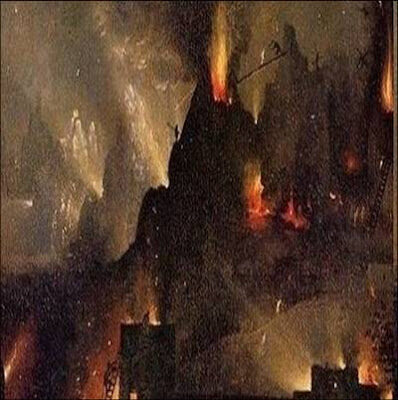
hieronymusbosch-helli-6104662
This is obviously a very, very difficult issue but I do not state, “obviously” or “difficult” for the reasons that you may think. The difficulty is that some people’s ideas of what hell is all about are influenced by creepy medieval paintings and fire and brimstone preaching; whose concept of hell is about as antiquated as the concept of abiogenesis. In my essays On Hell and Why Would Your Lord Send You to Hell? I detailed this issue; here I will succinctly state that the bottom line is this:
Hell appears to be described as eternal fire due to metaphoric and contemporaneous references to the Valley of Gehenna where refuse was constantly being burned. However, since hell is also described as a place of darkness the flames cannot be literal fire.

hieronymusbosch-hellii-5608976Christopher Hitchens has spent a large portion of his life expressing his hatred towards the God of the Bible, he is a self-professed “antitheist.” If Christopher Hitchens dies and finds that there is a God and that God is the God of the Bible it would be hellish for him to be dragged into heaven to spend eternity with the God whom he hates. It would be unjust of God to force someone like that to be incarcerated in heaven eternally enduring His presence. Thus, God allows those who hate Him to have their heart’s deepest desire: to be done with Him once and for all.

Thus, there is a place where they can choose to go and be away from God forever.1

Quentin Smith – The Gratuitous Fallacy, part III of V

Theism By Proxy:Now to Quentin Smith’s by proxy theistic answer:

“So how do theists respond to arguments like this? They say there is a reason for evil, but it is a mystery. Well, let me tell you this: I’m actually one hundred feet tall even though I only appear to be six feet tall. You ask me for proof of this. I have a simply [sic] answer: it’s a mystery. Just accept my word for it on faith. And that’s just the logic theists use in their discussions of evil.”

quentinsmith-part3-1344550
Let us pause here for a moment. The fact is that the “problem of evil” fails due to the very fact that if God has a reason, let us even say any reason, for allowing evil then evil is not gratuitous and has a greater purpose. This would not even logically require us to produce the reason and so it may be termed a “mystery” and one that may someday be revealed. As for atheism: it guarantees that evil has no purpose-more on this in part IV. As to his height: height is something that can be measured since it is a physical property.

Quentin Smith continues:

“In fact, there’s a strict disproof of theism that uses the ordinary logic of induction we employ in our everyday lives. If we have evidence that something exists, we say it probably exists. If we see dark clouds approaching, we say it will probably rain. But if we no evidence for something [sic], we admit that it’s merely possible that it exists, even though it probably does not exist. If God exists, a being who is all-powerful and perfectly good, then this being must somehow ensure our world is perfectly good.”

Let us pause here in order to mention that the Bible states that God did create a perfectly good world and it was one in which the free will to do evil was allowed and yet this is not the end of the story but beginning of the story of redemption back to a perfectly good world.Let us consider the fact that there is evil in the world and note that:If there is free will: evil is inevitable.If there is no free will: evil is inevitable.

Therefore, evil is inevitable.

Quentin Smith continues:

“The only way He can do this is to make all of the apparent evils we see in the world into means to a greater good. For example, the pain of a vaccination is in itself bad, but is a means to a greater good. Thus, if God exists, we must have evidence that all of the evils we see are means to a greater good. But even theists admit there is no evidence. That is why they must resort to talking about the mysterious ways in which God works. There’s no evidence at all, for example, that twenty million people dying from Spanish influenza is for a greater good. The conclusion follows that God probably does not exist.”

Before Quentin Smith again offers the theistic answer by proxy let us note that he answered his own riddle. He has uncovered the mystery. If God exists we must have evidence that all of the evils we see are means to a greater good.
I would contend with the claim that we must know “all.” If someone claims that there is no gold in China I do not have to search all of China since if I go to China and find one little piece of gold on one square inch of ground then I have disproved the claim that there is no gold in China. Quentin Smith himself provides proof that there is purpose to what I term “apparent evil” by pointing out that “the pain of a vaccination is in itself bad, but is a means to a greater good.” This will be elaborated in the next part.

Expelled from Religulous

Inevitably, whenever I point out the most fascinating portions of the movie “Expelled” I receive the same response.

If for no other reason, Expelled is worth seeing because time and time again we see the same thing:

When the atheists are given the floor they sound so very erudite and self-assured yet, when they are simply asked one little question, “How do you know?” they fall apart and the facade of scientific respectability and or logical viability gives way to a stumbling, fumbling person who is forced to admit “I don’t know.” Inevitably, the response is that these heroes of science and atheism cannot possibly be as lacking in evidence and logic as they appear. Thus, these instances are always brushed off as selecting editing of the interviews, purposeful manipulation of the videos in order to make it appear as if their proclamations are as unfounded as they appear.

Firstly, when someone asks “How do you know?” and the person admits that they do not, it is pretty clear and not edited. Secondly, this argument from erudite-elite-stunned-silent-embarrassment is a concoction that is meant to excuse ignorance since no one has produced the original interviews and demonstrated how they were self-servingly parsed.

Expelled has been criticized from every possible vantage point from claims of misrepresentation, to selective editing, to whether the use of John Lennon’s atheist anthem Image constituted copyright infringement.

religulous-3103797

I wrote an article about Bill Maher’s movie Religulous before it even opened. Since the readers of Atheism is Dead (True Freethinker’s predesossor) seemed privy to Expelled‘s every sin I asked them for the dirt, the dirty laundry, on Religulous, I wanted to know it all.

The response?

You guessed it, pure silence, not one single particle of dirt. Thus, either Bill Maher and Religulous are pure as the wind driven snow or some of my atheist friends are precisely what I perceived them to be: mere pseudo-skeptics (I requested info at this post Bill Maher’s Cinematic Endeavor).

In this regard, it may be of interest to note what Nathan Schneider reported in his article Agnostic Machinery:

Dean Hamer of American University stated that Bill Maher,”‘really kept on pushing me to say that science proves religion is wrong,’ Hamer recalls. ‘And I kept on trying to push back and say, ‘Science proves that people have an innate desire for religion.” The interview lasted about an hour and a half, Hamer tells us, yet only a two-second clip from their conversation made the final cut_Andrew Newberg, the University of Pennsylvania neurologist known for his research on religious experience. In the film he and Maher walk and talk at New York City’s Grand Central Station. Most of their conversation is muted to make way for Maher’s voiceovers, but we do hear Newberg trying to tone Maher down a bit. ‘How we define what is crazy or not crazy about religions is ultimately up to how we define ‘crazy,” Newberg explains_Although Newberg does not regret being in the film, he admits he’s disappointed that Maher didn’t take his findings more to heart. ‘I think it’s a little difficult to write off everybody who has ever been religious as being delusional or psychotic,’ he says. ‘I don’t think the data really supports that’_

But in order to keep the battle lines between believers and nonbelievers clear, Bill Maher’s Religulous chose to ignore, as Hamer puts it, ‘the basic human biology of why religion is important.'”

Does this seem relevant to anyone? Will anyone make anything of it or look further into the issue involved, anyone? Will a website crop up picking apart every detail related to Religulous, anyone? Anyone?

~~~~~~~~~~~~~~~~~~~~~~~~

A plea: I have to pay for server usage and have made all content on this website free and always will. I support my family on one income and do research, writing, videos, etc. as a hobby. If you can even spare $1.00 as a donation, please do so: it may not seem like much but if each person reading this would do so, even every now and then, it would add up and really, really help. Here is my donate/paypal page.

Due to robo-spaming, I had to close the comment sections. However, you can comment on my Facebook page and/or on my Google+ page. You can also use the “Share / Save” button below this post.