Discussing Atheist Jaclyn Glenn’s 10 Shocking Myths About Atheism – DEBUNKED

Such is the title of a YouTube video and a certain @irrelevant_noob was kind enough to time-stamp the supposed myths that were allegedly debunked:

0:26 1. Atheism is a belief system

1:39 2. Atheists have no morals

2:00 3. Atheists think that everything is random

4:07 4. Atheism makes people feel like life is meaningless, and may even lead to Nihilism

4:37 5. Atheists are unhappy people

6:29 6. Atheists hate God

7:25 7. Atheism is just another religion

8:16 8. Atheists can’t explain miracles

8:43 9. Atheists are closed-minded

9:07 10. Atheists don’t exist

I, @user-oq9hn7qk4j, replied

Atheism is a belief system: indeed, even Richard Dawkins references an Atheistic world-view since Atheism is a core and infects all which it touches so it becomes a “belief system.”

Atheists have no morals: all they have is morals since morals refers to the mores which are mere descriptions of whatever accidentally existing apes just so happen to be doing.

Atheists think that everything is random: “everything” in terms of that everything is a byproduct of an accident so that, for example, even if an individual Atheist makes a decision, that decision is just the byproduct of an accidental mixture of accidental chemicals within an accidentally existing brain functioning as per the accidental laws of accidental physics.

“Atheism makes people feel like life is meaningless, and may even lead to Nihilism”: indeed, such is why Atheists adhere to the consoling delusion of subjective meaning in an objectively meaningless existence.

“Atheists are unhappy people”: I guess happy is as happy does so, what does that even mean?

“Atheists hate God”: well, of course, just listen to them for five minutes.

“Atheism is just another religion”: indeed, according to some Atheists such as Micheal Newdow.

“Atheists can’t explain miracles”: well, they could explain actual ones as the work of God but there are many levels of, sorts of, explanations.

“Atheists are closed-minded”: individual Atheist may not be but their dogmatheism is thought restricting by definition.

“Atheists don’t exist”: well, they exist but have to work hard at it.

@ChixieMary commented

My life as an atheist is exponentially better than my life as a Christian.

“Better” is entirely subjective.

My life is better by my own experiences. That’s all that matters.

My life, is not spent being miserable, depressed, suicidal or mired in self loathing and hypocrisy.

That’s “better” .

Atheism only speaks to not be leaving in any gods, nothing else.

We all make meaning and purpose in our lives. We all have capacities to judge what is better for ourselves and for the people around us with standards that we choose.

We don’t have to have them imposed upon us from an ancient book of fables or a group of authoritarians.

@user-oq9hn7qk4j

Perfectly said, “‘Better’ is entirely subjective” on your world-view so you just make up stuff, slap the label “better” on it and then emotively subjectively merely authoritatively assert, “My life is better” which collapses your entire point.

So, when you come to merely asserting, “That’s ‘better'” I have to tap you on the shoulder and remind you that, “Better’ is entirely subjective.”

As for, “Atheism only speaks to not be leaving in any gods, nothing else” well, that’s tragically jejune since it’s a world-view–as Richard Dawkins has noted.

I also see you’ve taken on one of Atheisms’ consoling delusions: the delusion of subjective meaning in an objectively meaningless existence. But isn’t it that case that “meaning” is entirely subjective? Well, sure since you asserted, “We all make meaning and purpose in our lives.”

Indeed, on your view, “We all have capacities to judge what is better for ourselves and for the people around us with standards that we choose” and so Joseph Stalin made that emotively subjective judgment and those Atheist like him decided to wipe out some 200,000,000 people in mere decades–and on Atheism, there’s literally nothing wrong with that and, in fact, it was a good thing since it rid us of less fit people and feed up lots of resources for the more fit.

“ancient book”: genetic fallacy. Is there anything wrong with committing logical fallacies, on your world-view?

“of fables”: merely asserted positive affirmation.

 a group of authoritarians”: but on your world-view, that group (which group?) judged what is better for themselves and for the people around them and since all is subjective then you disqualified yourself from complaining about it since you debunked yourself.

That brought the discussion to an end as no more replies were forthcoming.

See my various books here.

~~~~~~~~~~~~~~~~~~~~~~~

A plea: I have to pay for server usage and have made all content on this website free and always will. I support my family on one income and do research, writing, videos, etc. as a hobby.

If you can even spare $1.00 as a donation, please do so: it may not seem like much but if each person reading this would do so, even every now and then, it would add up and really, really help out.

Here is my donate/paypal page.

You can comment here and/or on my Twitter/X page, on my Facebook page, or any of my other social network sites all which are available here.
Hope Bolinger answers Who Was Anak and Did He Spawn Giants?

I am reviewing Hope Bolinger’s (“an acquisitions editor…author of almost 30 books…”) Christianity.com article Who Was Anak and Did He Spawn Giants? due to the portion of a longer discussion I had with a certain William Uchtman which follows, since he asserted, “Numbers 13:33 mentions King Anak/Arak, a cruel king who is said to be a descendant of the Nephilim, and ancestor of the Anakim who go to war with the Israelites.”

I replied, “There’s no such thing as, ‘King Anak/Arak’ anywhere. ‘said’ by whom ‘to be a descendant of the Nephilim’?”

William replied, “Maybe the name was edited out of whatever version of the Bible you’ve read. The name IS mentioned in several books on Biblical history.”

I, in turn, noted, “Cool, in that case: just quote and cite the book, chapter, and verse(s) and the version.”

He replied, “Here’s a link with all the history on Anak. Who Was Anak and Did He Spawn Giants?”

I commented, “So, you asserted but you don’t know. And now, even though I wrote a whole chapter about Anakim and another whole chapter about Rephaim in my book ‘What Does the Bible Say About Giants and Nephilim? A Styled Giantology and Nephilology’ I have to read an article because you can’t back your assertions. I’ve familiarized myself with over two millennia worth of relevant data that I used to write my dozen or so Nephilology books but whenever someone realizes they can’t support their assertions they think the answer is to do one internet search and tell me to go read an article or watch a video.”

William Uchtman relied, “Can you please be more specific? You’re not explaining anything. You’re doing a commercial for your book.”

I noted, “That’s a tragically unfriendly thing to say to someone who has interacted with you on three threads: makes me think I’m wasting my time. I’ve already noted various times that you believe what you do about Anakim based on:

one single sentence from an ‘evil report.’

one single sentence by unfaithful, disloyal, unreliable guys.

Guys whom God rebuked.

Who merely made assertions unbacked by even one single other verse in the entire Bible.

Guys who contradicted Moses, Caleb, Joshua, God, and the rest of the whole Bible.

You’re only looking at exclusively non-LXX versions of that one single sentence.

Do you want me to keep going?”

And while that discussion is ongoing, I will tackle his go-to source of info—which, BTW, does not affirm a, “King Anak/Arak” since not such personage is known to history.

The first question she asks, and answers, is, “Who Was Anak and Did He Spawn Giants?” due to the wording of the question and the wording on the answer which includes, “it appears he fathered giants,” the key questions are:

What’s the usage of the vague, generic, subjective, multi-usage and modern English word “giants” in English Bibles?

What’s Bolinger’s usage of the vague, generic, subjective, multi-usage and modern English word “giants”?

Do those two usages agree?

We will have to see if she gives us enough data to discern those answers along the way.

She dives into the answer by also asking, “Did he have something to do with the Nephilim—the demon-human hybrids that appeared before (and maybe after) the time of the flood?” Well, it wasn’t, “demon-human” but, “Angel-human and never after the flood: since God didn’t fail and the flood wasn’t much of a waste.

She notes, “Anak…was a descendant of a man named Arba (Joshua 15:13)…Anak…was considered a ‘great man,’” such that the Anakim clan of the Rephaim tribe were named after him. Hope Bolinger notes that he wasn’t, “great…by moral standards. Most likely, he was considered great for his appearance—his physical prowess.” Yet, three’s no indication of any of those things since, as she goes on to say, “We’re not given many explicit details about him.”

The key questions are key because, for example, when she follows directly with, “We know many giants descended from Anak (we get this detail from passages such as Deuteronomy 2:19-21 and Numbers 13:1-2)” that reads as, “We know many _________ descended from Anak.”

I discern that by, “giants” she means something vaguely generic about subjectively unusual height: which is not helpful since it’s unspecific and only begs questions. If that’s the case, then the answer to the third question is, “No.” That’s because the usage of the word “giants” in English Bibles is that it merely renders (doesn’t even translate) “Nephilim” in 2 verses or “Repha/im” in 98% of all others and so never even hints at anything to do with any sort of height whatsoever.

Deuteronomy 2 tells us that Rephaim had some a.k.a.s such as Emim and Zamzummim and that, on average, they were, “tall.” Yet, of course, that’s just as vague, generic, subjective, and multi-usage as the modern English word “giants.” And it’s subjective to the average Israelite male who was 5.0-5.3 ft. in those days.

Numbers 13:1-2 notes, “The Lord spoke to Moses, saying, ‘Send men to spy out the land of Canaan, which I am giving to the people of Israel. From each tribe of their fathers you shall send a man, every one a chief among them’” so I’m unsure what relevance that has—at least at this point.

Hope Bolinger notes, “We know before Anak was born, ‘the sons of God went to the daughters of humans and had children by them’ (Genesis 6:4)” indeed, many centuries before.

She refers to, “giants called the Nephilim” but biblically contextually, that means, “Nephilim called the Nephilim” and she follows directly with, “We also know that God wiped out most of humanity through the flood, presumably killing off the original race of giants.” So, she’s jumping from the specific ancient Hebrew term, “Nephilim” to the vague, generic, subjective, multi-usage modern English word “giants” which makes things more confusing and hard to follow. Yet, we know by now that she’s just misusing the English word.

As for, “presumably” well, since biblically contextually those, “giants” were Nephilim then they 100% didn’t make it past the flood—in any way, shape, or form—since God didn’t fail and the flood wasn’t much of a waste.

Now, she refers to, “other giants, such as Goliath, appearing on the scene after the flood” but since by, “giants” she means something about unusual height then since she hasn’t written a single word about why we should think that Nephilim were even subjectively unusually tall so there’s nothing to which to add, “other.”

She wrote that Goliath, “was ‘six cubits and a span’ (1 Samuel 17:4), somewhere six and a half feet tall and 10 feet tall—we can imagine the Anakim could boast tall statures.” Yet, she didn’t inform us that it’s a myopic statement since the Masoretic text has him at just shy of 10 ft. Yet, the earlier LXX and the earlier Dead Sea Scrolls and the earlier Flavius Josephus all have him at just shy of 7 ft. (compared to the average Israelite male who was 5.0-5.3 ft. in those days) so that’s the preponderance of the earliest data. So, “we can imagine the Anakim could boast tall statures” taller than 5.0-5.3 ft.

She notes that Anak, “Fathered a Race of War-like People (Deuteronomy 9:2)” about which I will say, sure. Yet, Hope Bulinger wrote that, “Numbers 1[3]:33 says that Anak’s race was descended from the Nephilim, which may explain why they were big.” Well, “big” is just as vague, generic, subjective, and multi-usage as, “giants” and we’ve still no reason to think that Nephilim were even whatever, “big” means.

She didn’t elucidate that she’s directing us to an “evil report” by 10 unreliable guys whom God rebuked. They just made up a fear-mongering scare-tactic tall-tale that’s unsupported by even one single other verse in the whole entire Bible. And, if she, for some odd reason, actually believes guys whom God rebuked then she needs to tell us how Nephilim made it past the flood, past God, which made the flood much of a waste. Moreover, she also didn’t tell her readers that the key fragment of the unreliable verse upon which she’s relying can only come from non-LXX versions since the LXX lacks any reference to Anakim in that verse.

She speculates, “Given that the Numbers passage” which is utterly unreliable, “describes Anak’s people as descended from the Nephilim, we may wonder how Anak connects to this race of giants spawned by demons” again, Angels, “Perhaps after the original Nephilim died in the flood, demons got involved in human affairs again and bred more giants.” Well, there’s zero indication of any such thing, the Angels who did that pre-flood were locked away (Jude and 2 Peter 2) and there’s only a one-time fall of Angels in the Bible, God didn’t miss that loophole, etc.

Hope Bolinger actually wrote, “Scripture isn’t clear on whether Anak was born before or after the flood” but Anakim didn’t exist until centuries post-flood and we know the names of all of the males who survived the flood and Anak isn’t one of them and she hits this point, “it’s hard to imagine how he could have descendants if he died in the flood, given that he wasn’t one of Noah’s sons (Shem, Ham, Japeth) who was in the ark” so why even speculate in that dead-end direction?

Yet, she just shifts the speculation in another direction, “Anak was probably born after the flood, perhaps fathered by demons trying to breed more Nephilim with sons of Canaan” for which there’s literally zero indication whatsoever. Again, we don’t even know if Anak was personally even a jerk—even if his descendants were trouble.

She firmly asserts, “By the time Joshua and the Israelites arrived in Canaan, some Nephilim were still around (Numbers 13:33-34)” and, “The Israelite spies stated that next to the Nephilim, they felt like grasshoppers (Numbers 13:34)…Nephilim (and presumably their descendants like the Anakim) were huge.” Note that for those assertions she could only rely on that one infamous sentence: without it, we have no post-flood Nephilim nor, “huge” (just as vague, generic, subjective, and multi-usage as, “big,” “tall” and, “giants”).

And note the vague manner in which that’s misrepresented: recall the verse about, “Send men to spy out the land of Canaan” well, there were 12 of them but she wrote an all-encompassing term, “The Israelite spies” rather than specifying that she’s actually appealing to the 10 unreliable ones.

She notes, “Since demons,” Angels, “fathering children with humans would go against God’s holy order of creation, it would make sense that the Nephilim and Anakim had to be destroyed. This happened years later, in the Promised Land” but that’s an anachronistic category error since the last of Nephilim were destroyed in the flood and centuries later the utterly unrelated Anakim were destroyed for different reasons.

Hope Bolinger goes on to circle back to Goliath and notes he, “was tall. To the point where no one—but a shepherd boy from Israel—would fight him” but that’s myopic since the text also specified that he was a, “champion.” She also notes, “He seems to have many giant characteristics” which she seems to conclude based on, “Gath…the city was huge…built for huge people…a tall breed of people” with, “huge…tall” being vague, generic, subjective, and multi-usage.

She also circles back to the flood in the conclusion wherein she noted, “Satan…tried to make human-demon hybrids…When God wiped them out, he decided to start over with the line of Anak” for which there’s literally zero indication—except, perhaps, one single non-LXX version’s worth of one line from an evil report by unreliable guys whom God rebuked.

Bottom line is that by employing vaguely generic terminology, not defining terms, misusing terms, and failing to elucidate the complexities of certain issues by being myopic (purposefully or due to lack of awareness) we can certainly concoct fascinating tall-tales and speculate in various directions. Yet, such is why modern, especially pop, Nephology is the unreliable and un-biblical thing which it currently is.

See my various books here.

~~~~~~~~~~~~~~~~~~~~~~~

A plea: I have to pay for server usage and have made all content on this website free and always will. I support my family on one income and do research, writing, videos, etc. as a hobby.

If you can even spare $1.00 as a donation, please do so: it may not seem like much but if each person reading this would do so, even every now and then, it would add up and really, really help out.

Here is my donate/paypal page.

You can comment here and/or on my Twitter/X page, on my Facebook page, or any of my other social network sites all which are available here.
Review of Nephilim: Who are the giants of the Bible, Jewish lore?

Aaron Reich wrote an article titled Nephilim: Who are the giants of the Bible, Jewish lore?

Since he beings by asserting, “Nephilim are giants” we need to be on the lookout for whether, in one way or another, he will answer these key questions:

What’s the usage of the vague, generic, subjective, multi-usage and modern English word “giants” in English Bibles?

What’s Reich’s usage of the vague, generic, subjective, multi-usage and modern English word “giants”?

Do those two usages agree?

Reich oddly claims that they, “appears in three locations in the Bible…Genesis…Numbers and…Ezekiel.” Most sources list the first two so let’s work our way through them.

First, “The Nephilim were on the earth in those days, and also afterward, when the sons of the nobles would come to the daughters of man, and they would bear for them; they are the mighty men, who were of old, the men of renown” since, “in Genesis 6:2, it says the following verse: ‘That the sons of the nobles saw the daughters of man when they were beautifying themselves, and they took for themselves wives from whomever they chose.’

Reich notes, “the phrase ‘sons of the nobles’ is a translation of ‘bnei elohim,’ which can be translated as ‘sons of God’” yet, “According to the biblical commentator Rashi, the phrase refers to the sons of princes and judges” while, “Others have posited that the sons of God were angels who had children with humans.”

Rashi—Rabbi Shlomo ben Yitzchaki or Salomon son of Isaac—lived  1040-1105 AD which is after centuries of commentary upon that text. The original, traditional, and majority view among the earliest Jewish and Christians commentators, starting in BC days, was the “Angel view” as I proved in my book, On the Genesis 6 Affair’s Sons of God: Angels or Not? A Survey of Early Jewish and Christian Commentaries Including Notes on Giants and the Nephilim.

The princes or judges or nobles view is actually one of the earliest ones but was held by about 1% of the sources. That claim is that it pertained to polygamy—which would have apparently become too rampant since Lamech was a polygamist but no flood resulted from that.

Reich notes, “this theory is especially popular among Christians, it is present in Judaism too, specifically in the Midrash[im]…in the Talmud [Bavli], in Nidah 61a and Yoma 67b.”

As a side note, he notes, “Satan is but another angel” but he’s actually a Cherub (Ezek 28:14).

Continuing, “The next mention of Nephilim in the Bible is in the Book of Numbers, regarding the tale of the spies…‘They spread an [evil] report about the land which they had scouted, telling the children of Israel, ‘The land we passed through to explore is a land that consumes its inhabitants, and all the people we saw in it are men of stature. There we saw the giants, the sons of Anak, descended from the giants. In our eyes, we seemed like grasshoppers, and so we were in their eyes” (brackets by Reich).

Let’s slow down a sec since reference was made to, “the spies…They” but 12 spies were dispatched but it was the 10 unfaithful, disloyal, unreliable ones who presented that within the evil report and were rebuked by God: there’s literally no reason to believe their mere assertions—see my post Chapter sample: On the Post Flood Nephilim Proposal.

He notes, “the word ‘Nephilim’ translated as giant” but technically that’s a rendering, not a translation. In fact, he noted, “Rashi says that the word Nephilim is actually derived from the word ‘naflu,’” typically transliterated as naphal, “itself a root of the verb ‘to fall.’” Aaron Reich notes, “The inconsistency regarding the translation of this word is a recurring issue here” and it is, it’s a HUGE issue which leads to all sort of assertions and problems such as word-concept fallacies.

Now, he points out, “Here, the verse identifies the giants as the sons of Anak” and note that he’s surely consulting a Masoretic version while the LXX version lacks any reference to Anakim in that text. Bottom line is that since there’s never been any such thing as post-flood Nephilim, in any way, shape, or form, then no one post-flood could have come from them, be in any way related to them, etc., and that’s because God didn’t fail, didn’t miss a loophole, the flood wasn’t much of a waste, etc.

Reich concludes, “The question of angelic descent isn’t really an issue here” since Nephilim weren’t really there and Anakim aren’t related to them and, “In this case, these Nephilim seem to simply be giants” but we still don’t know to what the word, “giants” refers.

We then come to, “the Book of Ezekiel…‘But they will not lie with the mighty men, [for they are] inferior to the uncircumcised who descended to the Grave with their weapons, and they laid their swords under their heads and their iniquities were upon their bones, for the destruction of the mighty was in the land of the living’…the phrase ‘mighty men’ in Hebrew is either ‘Gibborim noflim’ or ‘Gibborim Nephilim.’”

Well, it’s more like naphal gibborim as in a mere reference to once mighty men who have fallen, dead which is actually Aaron Reich’s point, “If the case is the former, which seems likely, then it simply means ‘fallen heroes’ or ‘fallen warriors.’”

Regarding, “other giants in the Bible” I would ask, “other” besides whom? He notes, “aside from the Anakim, there were also the Repha’im…though whether they are physical giants or ghosts or deified ancestors is another debate altogether…Amorites…the Bible describes them as massive, gigantic figures…Among specific giants in the Bible, however, two stand tall above the rest: Og and Goliath…”

Let’s unpack that:

It would appear that by, “giants” Reich means something vague generic about subjectively unusual height. Thus, the answer to the third key question is, “no” since that’s not the English Bible’s usage since therein, it merely renders (doesn’t even translate) “Nephilim” in 2 verses or “Repha/im” in 98% of all others and so never even hints at anything to do with any sort of height whatsoever.

Now, since the only physical description we have of Nephilim is from an unreliable evil report then we’ve no reliable physical description of them.

Anakim were a clan of the Rephaim tribe and, on average, they were, “tall” yet, “tall” is just as vague, generic, subjective, multi-usage as the word “giants.” So, they were, “tall” subjective to the average Israelite male who was 5.0-5.3 ft. in those days.

As for being ghosts well, that’s just based on (un-contextual) linguistics and Pagan mythology. The root rapha ranges in meaning and usage from healing to dead. Ugaritic literature has it that when kings or heroes died, they were referred to as kings and heroes. Yet, when they had been dead for some time they were called Rephaim and could be summoned form the grave to attend rituals, etc.—see Dead Kings and Rephaim The Patrons of the Ugaritic Dynasty. Biblically, they are a 100% alive people group.

As for, “Amorites…as massive, gigantic figures” well, that’s based on one single sentence, “Amorite…whose height was like the height of the cedars.” Yet, we can’t just take that one statement and run with it. Amos when on to directly quote God as stating, “I destroyed his fruit above and his roots beneath” but I’ve yet to encounter anyone who thinks that Amorites had literal fruits and roots growing out of their bodies. Amos was just telling us they were big and strong.

As for Goliath, sure, the Masoretic text has him at just shy of 10 ft. Yet, the earlier LXX and the earlier Dead Sea Scrolls and the earlier Flavius Josephus all have him at just shy of 7 ft. As Reich put it, “oldest texts, including the Dead Sea Scrolls and the writing of Josephus, and are at a much more conservative estimate.”

When it comes to Og, we’ve no biblical physical description of him at all. Yet, as Aaron Reich notes, “Midrashic and rabbinic commentaries” from millennia later, “describe him in greater detail….Og was a survivor of the biblical Flood, either being too tall for the Flood or clinging to Noah’s Ark” even though he wasn’t even born until centuries post-flood and he was a Repha, not a Nephil. Also, “Og picked up a massive mountain to throw at the Israelites” and on and on goes that folklore about him—see my book The King, Og of Bashan, is Dead: The Man, the Myth, the Legend—of a Nephilim Giant?

He then notes, “giants in…apocrypha, such as the Book of Enoch, Book of Jubilees and so on” about which you can consult my books The Apocryphal Nephilim and Giants: Encountering Nephilim and Giants in Extra-Biblical Texts and In Consideration of the Book(s) of Enoch.

Bottom line is that there’s no indication that such are anything but folklore from centuries, if not millennia, after the Torah: see my article How Nephilim Absconded from the Tanakh and Invaded Folkloric Territory.

Aaron Reich closes with, “these texts are still apocryphal and have not been accepted in the Jewish canon…Dead Sea Scrolls are believed to be the work of the Essenes, a known Jewish mystic sect that not all Jews took much stock in. As such, the validity of any of them as legitimate Jewish religious writing is the subject of debate.”

Overall, having produces a ridiculous amount of output, in various formats (article, books, and videos) as what I style myself, a Systematic Biblical Paranormologists, with much of that output being on Nephilology, I must say that Reich’s article is much better than 99% of what’s out there: it has some shortcomings but he overall hit various key points and included various very important qualifiers.

See my various books here.

~~~~~~~~~~~~~~~~~~~~~~~

A plea: I have to pay for server usage and have made all content on this website free and always will. I support my family on one income and do research, writing, videos, etc. as a hobby.

If you can even spare $1.00 as a donation, please do so: it may not seem like much but if each person reading this would do so, even every now and then, it would add up and really, really help out.

Here is my donate/paypal page.

You can comment here and/or on my Twitter/X page, on my Facebook page, or any of my other social network sites all which are available here.

Reviewing Leroy Birney’s Journal of the Evangelical Theological Society paper “An Exegetical Study of Genesis 6:1-4”

Undergoing review is a paper by Leroy Birney, M.A., M.Div., titled, “An Exegetical Study of Genesis 6:1-4,” Journal of the Evangelical Theological Society, Vol: JETS 13:1 (Winter 1970).

He quotes the Gen 6 affair text, as I term it, first verse thusly, “And it came to pass when mankind began to become too numerous upon the face of the land and daughters were born to them that sons of God saw daughters of mankind that they were fair.”

Leroy Birney notes, “Those who take the term bene ha Elohim, ‘sons of god,’ to mean the chosen portion of mankind, the Sethites, usually consider ‘daughters of men’ by contrast to be the unbelieving Cainite women.”

That’s known as the Sethite view and is a late-comber of a view based on myth, prejudice, and which only creates more problems than it solves (so, more than zero).

And you can surely see whey since well, consider the qualifying term used of each lineage, “chosen portion…Sethites…unbelieving Cainite” and he further asserts, “godly Sethite lineage…ungodly Cainite…godly line…godly line” of Sethites, “degeneracy of the line of Cain” vs., “righteous family” of Sethites.

To give you an idea of how they attempt to support a view that is so foreign to any text, note that, “Sethite line appears as a distinct entity in the context of this portion of Genesis ( as angels do not).” Yet, what could be a more distinct entity than Angels? Yet, the point is that a sudden appearance of Angels in the text seems out of context. Yet, by definition, any one or thing that makes a sudden appearance into the text is a distinct entity.

Gen 1 is about God and His creation but then, “man…male and female” are distinct entities.

Gen 2 is about Adam and Eve but then, “the serpent” is a distinct entity.

Gen 3 is about Adam, Eve, and the serpent but then the Cherubim are distinct entities—well, only sort of since the serpent was really the Cherub Satan.

And so, distinct entities in Gen 6 is actually in keeping with hermeneutics, with reading comprehension since such is how chronological texts are written, after all: someone/something does not appear in a text until it does—with or without special introduction.

Note that Leroy Birney’s argumentation is, “It is in the context of the Sethite line that it says, ‘began men” in general, actually, “to call upon the name of Jehovah’ (Gen. 4:25-26), and Enoch who ‘walked with God’ (Gen. 5:24) was in the line of Seth. Then, ‘Quite naturally the title ‘sons of God’ can be taken as another specification of the discrimination already established’” exclusively Sethites—because, “men” did that and one was uniquely related to God.

Yet, while we’re supposed to think that, “the ‘sons of god’ are” especially Godly, “Sethite men” well then, they weren’t so especially Godly after all since, “we see a progression of corruption leading to the Flood.” Yet, it’s blamed on, “the degeneracy of the line of Cain in chap. 4” which is a chapter that only lists one or two sins by one single member of that line, Lamech—plus, add on one sin by Cain—so that’s utterly ungracious to condemn an entire line based on two or three, on record, sins.

We’re then told, “only Noah’s family, of all the line of Seth, was saved” but we’ve no genealogies for any of the four, “saved” women so that’s an unsupportable assertion.

We’re told, “says [Meredith G.] Kline of his view that the ‘sons of god’ are dynastic rulers in the Cainite line. On this view, Genesis 6:1-4 is seen to pick up the themes of city-building, tyranny, and polygamy found in the description of Cain’s line in chapter 4.” So, apparently, building a city is as sinful as tyranny, of which there’s none in that chap and polygamy, for which we only have one example therein.

Thus, by hyperbolizing the Sethites (before throwing them under the bus) and Canites, the theory has the former as a, “righteous family” and, “Cainite tyrants as represented by Lamech in Genesis 4:19-24” even though his, so called, tyranny is described in those verses as:

19 And Lamech took two wives. The name of the one was Adah, and the name of the other Zillah. 20 Adah bore Jabal; he was the father of those who dwell in tents and have livestock. 21 His brother’s name was Jubal; he was the father of all those who play the lyre and pipe. 22 Zillah also bore Tubal-cain; he was the forger of all instruments of bronze and iron. The sister of Tubal-cain was Naamah.

23 Lamech said to his wives:

“Adah and Zillah, hear my voice; you wives of Lamech, listen to what I say: I have killed a man for wounding me, a young man for striking me. 24 If Cain’s revenge is sevenfold, then Lamech’s is seventy-sevenfold.”

So, “took two wives” counts as one sin. Perhaps to, “dwell in tents and have livestock…play the lyre and pipe…forger of all instruments of bronze and iron” was pure evil, I don’t know.

And, “wounding me…striking me” means it may have been self-defense.

So, I unsure how any of that equals tyranny.

Leroy Birney then notes, “The view that the ‘sons of God’ means angels has been held by many” since the original, traditional, and majority view among the earliest Jewish and Christians commentators, starting in BC days, was the “Angel view” as I proved in my book, On the Genesis 6 Affair’s Sons of God: Angels or Not? A Survey of Early Jewish and Christian Commentaries Including Notes on Giants and the Nephilim.

He then wrote, “The pseudopigraphal Book of Enoch, compiled during the last two centuries B.C. says that 200 angels in heaven saw the beautiful daughters of men, lusted after them, and took them for wives with the result that they became pregnant and bore great giants” about which the key questions are:

What’s the usage of the vague, generic, subjective, multi-usage and modern English word “giants” in English Bibles?

What’s Birney’s and 1 Enoch’s usage of the vague, generic, subjective, multi-usage and modern English word “giants”?

Do those two usages agree?

In 1 Enoch the term Nephilim is rendered by such as “giants” and they are described as being MILES tall: great folklore, but poor reality form that Bible contradicting folklore from centuries, if not millennia, after the Torah, see my book, “In Consideration of the Book(s) of Enoch.”

Leroy Birney elucidates:

Two lines of support are adduced. One is the assertion that the books of II Peter and Jude accept the story in the Book of Enoch, and the other is that the usage of the term “sons of god” in the Bible favors this meaning.

II Peter 2:4 says, “But if God spared not the angels when they sinned….”

Jude 6-7 says, “The angels that kept not their own principality, but left their proper habitation, he hath kept in everlasting bonds under darkness unto the judgment of the great day. Even as Sodom and Gomorrah, and the cities about them, having in like manner with these given themselves over to fornication… “

[Franz] Delitzsch says. that this supports Enoch’s sinning angel interpretation of Genesis 6:1-4, “for toutois, [“with these”] ver. 7, refers back to angels.”

Keil however notes concerning the passage in Jude, “There is nothing here about marriages with the daughters of men or the begetting of children, even if we refer the word toutois [“with these”] … in verse 7 to the angels mentioned in verse 6,” because Jude speaks of fornication while Genesis 6 speaks of actual marriage…

Yet, that’s myopic since Jude’s emphasis was, “just as Sodom and Gomorrah and the surrounding cities, which likewise indulged in sexual immorality and pursued unnatural desire” and the Gen 6 affair pertains to, “sexual immorality” since it wasn’t meant to be and so it was a case of, “unnatural desire” by definition: fornication or copulation.

He continued thusly:

Actually, toutois, “with these,” can better be referred back to Sodom and Gomorrah, or to the inhabitants in them.

Concerning the passage in Peter, Keil says, “Peter is merely speaking of sinning angels in general whom God did not spare, and not of any particular sin on the part of a small number of angels. Besides, the Bible does not speak of more than one defection by angels, and that took place before the fall of man, since Satan tempted man in Eden.

Indeed, Peter doesn’t specify, “any particular sin” but places it pre-flood, “God did not spare angels when they sinned” and then, “but preserved Noah” then references, “a flood upon the world” then, “Sodom and Gomorrah” then, “rescued righteous Lot” along with a reference to, “the sensual conduct of the wicked.”

Indeed, “the Bible does not speak of more than one defection by angels” and Jude and Peter combined place their sin to pre-flood days and correlate it to sexual sin.

As for, “the Bible does not speak of” a, “defection by angels…that took place before the fall of man” that’s because their defection took place during the Gen 6 timeline. As for, “since Satan tempted man in Eden” well, he’s not an Angel, he’s a Cherub and his defection took place during the Gen 3 timeline.

Leroy Birney went on to write of, “the chief objections to interpreting ‘sons of god’ as angels” as including, “the whole conception of sexual life, as connected with God or angels, is absolutely foreign to Hebrew thought…there is no analogy in the Bible for the idea of inter-marriage of angels and men…Keil notes that there is no other reference to angels in the context and that Christ specifically stated that angels cannot marry (Matt. 22:30, Mark 12:25, cf. Luke 20:34-35)” so that, “The lack of any analogy in Scripture for the idea of angels having sexual functions or being able to cross-breed with the human race makes that interpretation of Genesis 6:1-4 untenable.”

It’s tricky to generically reference, “Hebrew thought” since we know not if that refers to the time of Abraham, Moses, et al., all the way until the advent of Rabbinic Judaism many millennia later.

I’m unsure why that there’s no analogy is some point against it: why should there be. Also, such inter-marriages are non-issues post-flood since, again, those Angels were incarcerated and there’s only a one-time sinful fall of Angels in the Bible.

To merely assert that, “Christ specifically stated that angels cannot marry” followed by unquoted citations is a great way to make a point but it invalid. See, “angels cannot marry” is a very specific and all-encompassing statement. Note that in Matt 22:30 Jesus was more specific and included qualifying terms, “in the resurrection they neither marry nor are given in marriage, but are like angels in heaven.”

See, it’s not, “angels” in general, “cannot marry” but is specifically about, “angels in heaven,” “in the resurrection” ergo, the loyal ones. Such is why those who did marry are considered sinners, having, “left their first estate” in order to do so, as Jude put it.

We’re also told, “Perhaps an even greater objection to the view that ‘sons of god’ means angels is that the judgment fell upon men alone, and it is the ‘sons of god’ who were the initiators of the wrong.”

That is too myopic an assertion since 1) “the judgment fell upon men” and humans, Angels, and Nephilim are all referred to as man/men, 2) “the judgment fell upon” Nephilim since they didn’t make it past the flood, and 3) “the judgment fell upon” Angels as per Jude and Peter, “the angels who did not stay within their own position of authority, but left their proper dwelling, he has kept in eternal chains under gloomy darkness until the judgment of the great day” and, “God did not spare angels when they sinned, but cast them into hell [Tartarus] and committed them to chains of gloomy darkness to be kept until the judgment.”

Leroy Birney reviews, “the interpretation that the ‘sons of god’ were angels must be considered untenable because it is not supported by II Peter or Jude, it is contrary to the Biblical view of the nature of angels, and the punishment for their crime fell upon men rather than upon angels” yet, as we have seen, what’s untenable are all of those objections.

He then moves on more directly to the Nephilim, quoting, “The nephilim were in the earth in those days and also after ·that the sons of god went in to daughters of mankind and they bore to them those the mighty ones which were of old, men of renown” and noting, “There is a difference of opinion over whether the nephilim were contemporary with the marriages or were the product of the marriages…they were already in the earth when these marriages took place….There is no suggestion of genetic connection between the nephilim and the marriages concerned.”

Yet, there ought not to be any difference since the Gen 6 affair narrative’s contextual focus is the sons of God and daughters of men: their attraction, their marriage, and their offspring. Thus, it would violate that narrative’s contextual focus to artificially insert a mere passing reference to some unrelated Nephilim guys who just happened to be around at the time, are mentioned for no apparent reason, and about whom nothing more is said in relation to the narrative’s contextual focus.

We’re told that Kline wrote, “This reference to the conjugal act and to child-bearing finds justification only if he is describing the origin of the Nephilim-Gibborim” which is exactly what it’s describing.

It’s noted, “A disadvantage is that it leaves only 120 years for the nephilim to have gained such renown.” I’m unsure why a century plus two decades is, “only.” Gen 6:1’s timeline is, “When man began to multiply on the face of the land and daughters were born to them” is when “the sons of God saw that the daughters of man were attractive. And they took as their wives any they chose.”

When that was isn’t specified (could have been as early as when Adam and Eve’s children began having children) but it is thereafter that, “Then the Lord said, ‘My Spirit shall not abide in man forever, for he is flesh: his days shall be 120 years.’” We also don’t know how long a timespan traversed between, “When man began to multiply…” and, “Then…” but the issue is that if the flood took place at the 120 mark then, “man began to multiply…” only 120 years prior to that yet, the genealogies in Gen chaps 4-5 won’t allow for such short a timespan.

Thus, on point, Leroy Birney opines, “it is prob ably better to accept the interpretation that the nephilim were in the earth throughout this period of corruption, not just during the last 120 years.”

I would imagine that it’s due to a peculiar version that he was consulting that he wrote, “The word ‘nephilim’ occurs only here and in Numbers 13:33. In Numbers it is used of the Anakim, who were of great stature.”

Well, 1) that’s from an “evil report” by 10 unreliable guys whom God rebuked so there’s zero reason to believe them, 2) it’s Nephilim is used of Nephilim therein, “we saw the Nephilim (the sons of Anak, who come from the Nephilim)” thus, the incoherent (illogical, ill-biological, and ill-theological) assertion was that Anakim are related to Nephilim—yet, not in real life, of course, and not in the LXX version which lacks reference to Anakim), and 3) “great stature” is attributed to Nephilim, “we saw the Nephilim (the sons of Anak, who come from the Nephilim), and we seemed to ourselves like grasshoppers, and so we seemed to them” but since that’s the only physical description we have of Nephilim then we’ve no reliable physical description of them and the only relevant thing we’re told about Anakim is that they were, “tall” (Deut 2) subjective to the average Israelite male who was 5.0-5.3 ft. in those days.

See my various books here.

~~~~~~~~~~~~~~~~~~~~~~~

A plea: I have to pay for server usage and have made all content on this website free and always will. I support my family on one income and do research, writing, videos, etc. as a hobby.

If you can even spare $1.00 as a donation, please do so: it may not seem like much but if each person reading this would do so, even every now and then, it would add up and really, really help out.

Here is my donate/paypal page.

You can comment here and/or on my Twitter/X page, on my Facebook page, or any of my other social network sites all which are available here.

Douglas Van Dorn on “Why Nephilim Doesn’t Mean ‘Fallen Ones’”

The Kingdoms Unveiled YouTube channel posted a vid by the subject tile. Since I’ve written about Douglas Van Dorn in my posts Review of Paul “Dr. Reluctant” Henebury’s review of Douglas Van Dorn’s book “Giants: Sons of the Gods” and My review of Zachary Garris’ review of Douglas Van Dorn’s book “Giants Sons of the Gods”, I thought to review it.

The vid’s info section reads, “The term ‘Nephilim’ is often translated as ‘fallen ones.’ Is this correct? Jon and Doug delve into why that translation is so common and why it is the wrong interpretation. Showcasing evidence from scripture that the ‘Nephilim’ are truly giant beings with unholy origins.”

I don’t know who Jon is, especially since the channel doesn’t seem to say and also, since I just copied and pasted the transcript from YouTube, I will just refer to the statements made by them in general since it would just take too much time to re-watch the vid and divide every statement amongst who, specifically, made it.

They begin by referring to “the Nephilim, the Giants” so we will have to see if they elucidate the following key questions:

The key questions are:

What’s the usage of the vague, generic, subjective, multi-usage and modern English word “giants” in English Bibles?

What’s Jon and Douglas Van Dorn’s usage of the vague, generic, subjective, multi-usage and modern English word “giants”?

Do those two usages agree?

They notes, “a lot of arguments are made saying, really, the Nephilim just mean the ‘fallen ones.’” Well, technically it’s that the Hebrew root “naphal” means fallen/to fall/feller/to cause to fall, etc. The claim is that, “it doesn’t work, not only in the narrative but for the rest of scripture.”

They note and quote, “Genesis 6:4 ‘the Nephilim were on the earth in those days, and also afterward, when the sons of God came into the daughters of man and they bore children to them. These were the mighty men who were of old, the men of renown.’”

They specify, “three words that are going on here in the Hebrew and two of them are what really matters for us here: Nephilim and mighty men.”

They take a moment to note, “people will say, ‘Oh, that means ‘fallen ones’…people get the

thought that the Nephilim are actually fallen Angels.” Well, they were the offspring of those Angels.

See, “the sons of God came into the daughters of man and they bore children to them” and so the Nephilim were on the earth due to that so that they were, “the mighty men who were of old, the men of renown.” The Gen 6 affair narrative’s contextual focus is the sons of God and daughters of men: their attraction, their marriage, and their offspring. Thus, it would violate that narrative’s contextual focus to artificially insert a mere passing reference to some unrelated Nephilim guys who just happened to be around at the time, are mentioned for no apparent reason, and about whom nothing more is said in relation to the narrative’s contextual focus.

Now, we come to a key issue when they note, “Nephilim are,” should be were, “what mythology calls the demigods so our Hercules, Achilles, Perseus, any of those kinds of guys.” Well, they could only be those specific guys if they lived pre-flood since Nephilim didn’t make it past, of course.

They next note, “the word Nephilim only appears one other place in the whole Bible and that’s in Numbers 13” now note that the narrative there is post-flood so what about what I just noted about Nephilim? Well, they note, “that’s the story where the spies go into the land of Israel and they come back with a ‘bad report,’ 10 of them, and they tell Moses, they say, ‘look, we went in there and we’re not able to defeat these tribes because we’re like grasshoppers in their sight,’ and then it talks about how gigantic and tall they are so that’s a contextual clue here that that we’ll also talk about when we get to Deuteronomy.”

Just to clarify, 12 spies were sent but it was the 10 unreliable ones who presented a bad/evil report and were rebuked by God. Within that report, they actually made five mere assertions that aren’t backed by even one single over sentence in the whole Bible. I know Jon and Douglas Van Dorn were conversationally paraphrasing but I will quote it for the sake of accuracy, “We are not able to go up against the people, for they are stronger than we are” but since merely referring to strength wasn’t enough, they took their fear-mongering scare-tactic up a few notches, all the way to 11, “So they brought to the people of Israel a bad report of the land that they had spied out, saying, ‘The land, through which we have gone to spy it out, is a land that devours its inhabitants” which flatly contradicts the original, reliable report by reliable guys (Joshua and Caleb) which noted, “the land to which you sent us. It flows with milk and honey, and this is its fruit,” and following, “and all the people that we saw in it are of great height. And there we saw the Nephilim (the sons of Anak, who come from the Nephilim), and we seemed to ourselves like grasshoppers, and so we seemed to them” and note that the reference to Anakim is missing from the LXX version.

So, since this is the one and only physical description of Nephilim, even if just their height, but it’s from an unreliable report by unreliable guys whom God rebuked then we’ve no reliable physical description of Nephilim—and that alone debunks 100% of un-biblical Nephilology, particularly modern pop-Nephilology.

For example, Gary Wayne is one of the top-pop-Nephilologists and has been teaching for decades that Nephilim were, “giants” by which he means very, very tall. Yet, one little question from me forced him to admit, “we don’t know how big Nephilim were…we don’t know how tall that they were” (sic.) and yet, he then affirmed that he will keep referring to them as “giants”: what sense does it make to refer to the height of someone whose height you don’t know?

So, there’s literally zero indication of, “gigantic and tall,” and, “monstrously huge,” as they go on to assert—keeping in mind that those terms are all vague, generic, subjective, and multi-usage.

Now, since the only post-flood reference to Nephilim is unreliable then all that follows from that unreliable source is unreliable. Now, they note, “creatures…not normal entities, the entire world was afraid of them” well, that might have been the case, in a manner of speaking, if folklore about them was being told post-flood—if not then the bad/evil report started such folklore.

They then speculate that the 10 spies were, “exaggerating…but they weren’t exaggerating to the point where these were 7 foot people versus 5 foot people or even worse with Goliath: the Septuagint height, he’s 6.9 and King Saul is 6.6.” Well, no version has Saul’s height but since we’re told he was a head and shoulder above the average Israelite (male, presumably) and that was 5.0-5.3ft. then they added over a foot. Now, one of my reasons for writing this is to correct various errors in an iron sharpening iron manner. Yet, it’s interesting that they certainly come off as if they know that of which they speak, because they do in part, yet they miss some utterly fundamental issues and make missteps along the way.

So yes, it’s well researched of them to note that what I will in greater detail note as that the Masoretic text has him at just shy of 10 ft. Yet, the earlier LXX and the earlier Dead Sea Scrolls and the earlier Flavius Josephus all have him at just shy of 7ft. so that’s the preponderance of the earliest data. I’m unsure why they mentioned Saul but some say that the taller range must be accurate because the shorter one places him to close to Saul’s height.

Yet, that’s an example of having one’s head stuck in a little box of thinking giantly and ignoring that the narrative about Goliath isn’t just about his height but specifies that he was, “champion” so it’s not just about pulling out the ol’ measuring tape and being done with it.

They then go back to the bad/evil report and make a common objection to the demonstrable fact that it’s utterly unreliable form beginning to end (see my Chapter sample: On the Post Flood Nephilim Proposal) by stating, “Joshua doesn’t correct them, he doesn’t say, ‘What are you talking about? There’s no Giants in the land. You guys are nuts. We can take it.’ He doesn’t say that.” Now, I’m glad that they followed up with, “that’s might be…an argument from silence” and there’s no might about it. See, the premise, the hidden assumption, is that it’s some sort of moderated debate and we have the full manuscript but that portion of the narrative ends at the end of the bad/evil report and the next thing we know about the 10 is that they are rebuked by God—to death.

So, we don’t need Joshua, nor Caleb, to tell us that God didn’t fail, the flood wasn’t much of a waste, those guys contradicted Moses, Joshua, Caleb, God, and the rest of the whole entire Bible, etc. since we can discern that for ourselves and do so quite easily.

For some odd linguistics reason, they note that in Num 13:33, “even though it doesn’t say Giants, necessarily, although we come back to this in Genesis 6” it does say that that they’re Giants, here they’re of great height.”

But that’s linguistically incoherent. We should never chase the English word around a Hebrew Bible. Also, note how they jump from the specific ancient Hebrew word Nephilim to the vague, generic, subjective, multi-usage and modern English word giants which makes it very hard to follow.

So, I might as well answer the key questions at this point:

What’s the usage of the vague, generic, subjective, multi-usage and modern English word “giants” in English Bibles?

It merely renders (doesn’t even translate) “Nephilim” in 2 verses or “Repha/im” in 98% of all others and so never even hints at anything to do with any sort of height whatsoever.

What’s their usage of the vague, generic, subjective, multi-usage and modern English word “giants”?

Something about subjectively unusual height.

Do those two usages agree?

No.

Now, whatever version they’re quoting renders Nephilim as Giants so it’s mysterious why they asserted that Num 13:33, “doesn’t say Giants” since it does. Moreover, they think that Giants is referring to height so they refer back to Genesis 6 where, “it does say that that they’re Giants” but doesn’t provide a physical description, it’s also merely rendering Nephilim.

And, incidentally, even if one imagines that Nephilim means giant and giant means subjectively unusually tall if we jump to the conclusion that they were subjectively unusually tall based on one word then that’s a word-concept fallacy. For example, my wife has called me a giant many, many, many times but I’m just 6.0ft. Also, I can think of 5-6 usages of the term giants (and usage can vary even more than meanings/definitions).

They also make an odd statement (maybe based on an odd version) that, “it says,” keeping in mind that, “it” are 10 unreliable guys whom God rebuked and they’ll appeal to what they said from a non-LXX version, “that they are actually the sons of Anak…a guy who appears later in the Pentateuch.” Indeed, we know that Anakim were named after Anak who was Abra’s son: we have zero indication that any of them had anything to do with Nephilim. Nephilim were strictly pre-flood hybrids, Anakim (and they were a clan of the Rephaim tribe) were strictly post-flood humans, and there’s zero correlation between them.

They then get into linguistics (and I wrote the book on that, Bible Encyclopedias and Dictionaries on Angels, Demons, Nephilim, and Giants: From 1851 to 2010) since in Num 13:33, “the word Nephilim appears two times but the thing is it’s not spelled the same way in Hebrew…one…has the extra yod, or y, there’s no way to account for how you get that spelling with the verb,” the Hebrew root word, “naphal…there’s only one way that you can actually account for it, which is that it’s actually an Aramaic word that means a giant.”

Let’s assume that the root of Nephilim is actually the Aramaic naphiyla and that, “means a giant” well, that only begs the question: what does giant mean? See, it’s circular. Now, this is where it becomes a battle of the scholars since Dr. Michael Heiser argued for the Aramaic root and asserted it means giant but what did he mean by that? Well, he told us, “I don’t think the biblical giants were taller than unusually tall people of modern times (between 7-9 feet).”

Yet, The J. Edward Wright Endowed Professor of Judaic Studies, who is J. Edward Wright, Ph.D. himself, and who is the Director of the Arizona Center for Judaic Studies at the University of Arizona notes, “The term traditionally translated as ‘giants’ in both the Greek Septuagint (γιγαντες) and now in English is נפילים nephilim, a term based on the root נפל npl meaning ‘fall.’ It has nothing to do with size” and specifies that this goes for both Hebrew and Aramaic as “The root npl in Aramaic also means fall and not giants.”[1]

But still, we don’t really need scholars to ensure we don’t commit word-concept fallacies and accept an impossible to defend report.

Then “back to Genesis 6, what you would see is that there’s a translation of the Old Testament that

would call the Septuagint, this is the Greek translation of the Hebrew and it was done about 200 years before Jesus…and they actually chose the word gigantes to translate,” technically just render, “Nephilim and the word gigantes is very well known in Greek mythology because it means a giant.” Again, what does, “giant” mean? And why insert Greek mythology into the Hebrew scripture? What they failed to note is that gigantes means earth-born (as in born of the false Earth goddess Gaia). What the Greeks though about it or even what the Jews doing the translating/rendering centuries after the Torah is also irrelevant, actually, to the original meaning of the original text in the original Hebrew.

At this point, they take stock, “you have confirmation in two different ways the word does not actually mean the fallen ones or to fall” and yet, they admit, “although I do think that there’s a probably a word play going on there.” Well, neither of those are confirmations: both are circular and the second was asserted without telling us the actual meaning.

Now, the declare, “they’re Giants and…so now all of a sudden, when you see this, you have to ask yourself how is it that sons of God coming to daughters of men produces Giants.” The answer is simple: given their misusage of that term, there’s zero reliable indication that it does and only one unreliable sentence’s worth of indication that it does.

They also note, “the word mighty men is the word gibborm and the Septuagint actually translates that as giants as well. So it actually translates two different Hebrew words with one Greek word. Very interesting that the next time that word appears is with Nimrod and it says, ‘became a mighty man on the earth’ or, became a giant. And Nimrod, through all the scholarly work that’s been done on who he is, is almost always associated with one of the demigods of the ancient world. Somebody like Gilgamesh or Orion or Hercules, it just depends on who you’re reading, but the point is that that even he, through the word gigantes, is connected back, somehow, to these Nephilim.”

See what I mean about word-concept fallacies? Now we have God failing and the flood being much of a waste, with a fundamental feature left un-elucidated being just how that happened, base on one single Greek rendering of one single Hebrew word from centuries after the Torah.

Let’s review:

1) “the word mighty men is the word gibborm and the Septuagint actually translates that as giants as well” well, no, the Septuagint is Greek to it renders gibborim as gigantes not the English giants.

2) “So it actually translates two different Hebrew words with one Greek word” well, no, it renders three Hebrew words with one Greek word: Nephilim, gibborim, and Rephaim. And it was a terrible idea to render three very different words with three very different meanings and three very different morphologies with just one word.

3) “…Nimrod and it says, ‘became a mighty man on the earth’ or, became a” what it says is that he was a regular guy who became mighty, “Nimrod; he was the first on earth to be a mighty man [gibbor]. He was a mighty [gibbor] hunter before the Lord. Therefore it is said, ‘Like Nimrod a mighty hunter before the Lord.’” They would surely prefer the KJV, “Nimrod: he began to be a mighty one” but it matter not due to what I’ve noted and what I’ll note in the next point.

4) Yes, many play name-games with Nimrod if (and that’s a big IF), “the word gigantes, is connected back, somehow, to these Nephilim” then we have the God/flood problem and also that gibbor is supposed to connect him but apparently not so we had to wait for the Greek and then commit a word-concept fallacy.

If gibbor means connected to Nephilim then Gideon, some of David’s soldiers, Boaz, oh, and God are all connected to Nephilim since they’re all referred to as such. If gigantes means connected to Nephilim Rephaim are connected to them but they weren’t and also, it’s another circle since gigantes also renders gibborim so it’s the same issue.

This is another good sounding point, “a lot of times when the New Testament writers are quoting the Old [Testament] they’re using the Septuagint…I think it’s more than more than 50% of the time…they

are making translation and they’re also making interpretation…you have the Aramaic translation and you have the Septuagint Greek translation and they’re both translating it not as fallen ones…they’re both translating it going these are giants.” That was good sounding but we have seen is much ado about nothing, it’s just a big circle, and it’s based on various linguistic and logical errors.

See my various books here.

[1] Private communique, July 2019

~~~~~~~~~~~~~~~~~~~~~~~

A plea: I have to pay for server usage and have made all content on this website free and always will. I support my family on one income and do research, writing, videos, etc. as a hobby.

If you can even spare $1.00 as a donation, please do so: it may not seem like much but if each person reading this would do so, even every now and then, it would add up and really, really help out.

Here is my donate/paypal page.

You can comment here and/or on my Twitter/X page, on my Facebook page, or any of my other social network sites all which are available here.

The Lucifer Project on Nephilim in the Bible

I was directed to The Lucifer Project during a discussion wherein someone appealed to historical evidence for Nephilim. Thus, I decided to herein review that website’s post on Nephilim and then the evidence.

The site is by a certain Jon who is described as, “the brilliant mind behind the riveting The Lucifer Project series. With a masterful blend of suspense, science fiction, and philosophical depth…a breathtaking journey into the realms of morality, technology, and the human psyche” so part of the issue is that it seems to present what are supposed to be facts which are then gleaned from so as to produce fiction.

I have found that virtually 100% of modern pop-Nephilologists inevitably end up producing fictional works. It’s clear that they do so since what they are producing as supposed biblical teaching is, in reality, what I term un-biblical neo-theo scif-fi tall-tales already so it’s not a stretch to then go into full blown admitted fiction.

Now, let’s see if The Lucifer Project falls into that category or not.

The Nephilim in the Bible section notes quotes Gen 6:1-2, 4 thusly, “Now it came to pass, when men began to multiply on the face of the earth, and daughters were born to them, that the sons of God saw the daughters of men, that they were beautiful; and they took wives for themselves of all whom they chose…There were giants on the earth in those days, and also afterward, when the sons of God came into the daughters of men and they bore children to them. Those were the mighty men who were old, men of renown.”

The comment is, “angels took human women for wives, had sexual relations with them, and had children with them? And those children were mighty giants? Yup. That’s exactly what the Bible says.”

Linguistically, it’s noted, “that word translated in English as giant, is actually the Hebrew word Nephil, or more commonly, Nephilim” which is just a singular term followed by the plural male version.

It’s asserted, “It means a giant” which begs these key questions:

What’s the usage of the vague, generic, subjective, multi-usage and modern English word “giants” in English Bibles?

What’s Jon’s usage of the vague, generic, subjective, multi-usage and modern English word “giants”?

Do those two usages agree?

For some unknown reason, Jon artificially inserted that Angels, “took on physical form (the Bible is clear angels can do that) and had their way with women” but there’s actually zero indication of any such thing anywhere in the Bible (which may be why he couldn’t quote or cite anything). Rather, Angels are always described as looking like human males, performing physical actions, and without indication that such isn’t their ontology. See my book, What Does the Bible Say About Angels? A Styled Angelology.

He notes, “angels and women copulated, producing giants” at which time you have to hold off about what that means since he hasn’t told us.

Jon then notes, “The ancient church certainly had no problem with this. The Septuagint…The Jewish historian Josephus,” etc. to which I will add that indeed, the original, traditional, and majority view among the earliest Jewish and Christians commentators, starting in BC days, was the “Angel view” as I proved in my book, “On the Genesis 6 Affair’s Sons of God: Angels or Not? A Survey of Early Jewish and Christian Commentaries Including Notes on Giants and the Nephilim.”

Now, his quote of Josephus may answer the second key question for us since it includes, “giants, who had bodies so large” (vertically or horizontally—or both?). But if by, “giants” Jon refers to subjectively unusual height then the answer to the third key question is, “No.”

That’s because the answer to the first key question is that the usage of the vague, generic, subjective, multi-usage and modern English word “giants” in English Bibles is that it merely renders (doesn’t even translate) “Nephilim” in 2 verses or “Repha/im” in 98% of all others and so never even hints at anything to do with any sort of height whatsoever. Besides, we’ve no reliable physical description of them anyhow.

Jon then asked, “Remember David & Goliath? Yup, Nephilim offspring” but there’s literally zero reliable indication of that and whenever he’s referred to as a, “giant” in the version that Jon’s reading, he’s being referred to as a Repha, not a Nephil.

Yet, he argues, “The Anakims from Deuteronomy: ‘the people are greater and taller than we; the cities are great and fortified up to the heaven’ … or the Emims, ‘a people great, and many, and tall, as the Anakims; which also were accounted giants.’ … how about Numbers, ‘and there we saw the giants, the sons of Anak, which come of the giants.’—all of these were either Nephilim or their offspring. The Bible is full of giants and now we know where they came from” (ellipses in original).

There’s actually a lot to unpack here and we need to start at the end:

“Numbers, ‘and there we saw the giants, the sons of Anak, which come of the giants” is a tragically misguided manner in which to refer to that statement. He cites an entire book, he quotes one sentence, and asserts, “The Bible is full of giants.” Yet, he neglected to cite that he’s quoting 13:33 and neglected to note that he’s quoting an, “evil report” and neglected to note that he’s quoting 10 unreliable guys and neglected to note that they were rebuked by God. Their mere tall-tale creates the problem of just how Nephilim got past the flood, past God, and made the flood much of a waste by a God who failed.

When Jon cites the entire book of Deuteronomy, and neglected to note that he’s quoting Moses relating the Num 13 event and that which the evil report (in non-LXX versions) incoherently correlates Nephilim with Anakim, Moses utterly ignores Nephilim and only comments on Anakim: he’s too practical, he’s concerned about the real dangers on the ground and not about some tall-tale.

It appears that Jon isn’t aware that Emim and Anakim were all Rephaim: Emim (and Zamzummim) is just an a.k.a. for Rephaim and Anakim were a clan of that tribe (see Deut 2).

As for, that Rephaim, in general, were, “tall” well, that’s just as vague, generic, subjective, multi-usage as, “giants” and only means they were “tall” subjective to the average Israelite male who was 5.0-5.3 ft. in those days.

And even then, note the hyperbolic nature of some of the statement within that context, “cities…fortified up to the heaven.”

Of course, the only indication that Jon gave us for supporting the assertion, “all of these were either Nephilim or their offspring” is one single (uncited and un-elucidated) sentence from an evil report (only from non-LXX versions) by 10 unreliable guys whom God rebuked.

Ergo, the generic assertion, “The Bible is full of giants” only refers to Nephilim (twice) and Rephaim (98% of all other times) and never even hints at anything about size whatsoever. So to further merely assert, “now we know where they came from” is to really say that Nephilim were strictly pre-flood hybrids, Rephaim were strictly post-flood humans, and there’s zero correlation between them.

But as for the how of getting past the flood, Jon wrote, “some might counter, ‘Yeah, but they would have all died in Noah’s Flood.’ That’s actually correct, and a great catch! However…” and the however is followed by, “let’s reread Genesis 6:4” again, “There were giants on the earth in those days, and also afterward, when the sons of God came into the daughters of men and they bore children to them. Those were the mighty men who were old, men of renown.”

You surely noted nothing in that verse that’s relevant. Well, Jon assures us, “Those three words, ‘and also afterward’, are clearly relating to Noah’s Flood.” No, he didn’t bother telling us why anyone should think that a verse that doesn’t say a single word about the flood is, “clearly” relating to it.

It also doesn’t tell us just how they managed, how God failed, how the flood was much of a waste, etc., etc., etc.

Well, it can’t mean anything about the flood since:

1) the flood’s not even mentioned for the very first time until a full 13 verses later.

2) the ONLY post-flood reference to Nephilim is from an “evil report” by 10 unreliable guys whom God rebuked.

3) God didn’t fail, He didn’t miss a loophole, the flood wasn’t much of a waste, etc.

Gen 6:4 states, “Nephilim were on the earth in those days, and also afterward, when the sons of God came in to the daughters of man and they bore children to them. These were the mighty men who were of old, the men of renown.”

The question becomes: when were those days?

Well, Gen 6:1 told us, “When man began to multiply on the face of the land and daughters were born to them, the sons of God saw that the daughters of man were attractive. And they took as their wives any they chose.”

The next question becomes: when was afterward?

Since it was after those days then it was simply after, “When man began to multiply on the face of the land and daughters were born to them…”

Thus, the began doing it then and they continued to do it but that’s all pre-flood.

Yet, Jon merely paraphrases an un-biblical tall-tale that someone invented MILLENNIA after the Torah, “after the Flood they” Angels, “did it all over again. Yikes!” but that’s a mere assertion for which there’s zero indication. Plus, there’s no need to even invent that un-biblical story since, again, the only reason to manipulate God’s Word to that end is one single non-LXX sentence from an evil report by 10 unreliable guys whom God rebuked.

Jon ends with, “So what happened to the Nephilim? Why don’t we have fossil records? How about the angels that did this … what happened to them?”

Thus, we will move on to the post Physical Evidence of Nephilim.

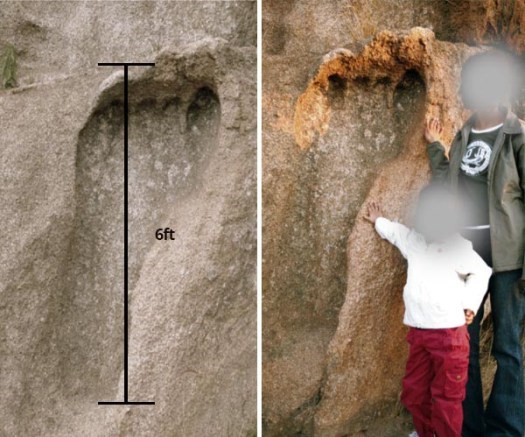
His first bit of evidence of Nephilim is a non-Nephil, “In South Africa today, you can visit this rock known as Goliath’s Footprint.” Of course, that’s just a name slapped on it by someone at some time. The alleged, “Footprint” is, “Ranging from 4’ to 6’ in length (depending on where you want to take your measurements).” Well, not that it matters but the Masoretic text has him at just shy of 10 ft. Yet, the earlier LXX and the earlier Dead Sea Scrolls and the earlier Flavius Josephus all have him at just shy of 7 ft.–compared to the average Israelite male who, again, was 5.0-5.3 ft. in those days.

the-lucifer-project-on-nephilim-in-the-bible-1-9920140

Jon notes, “Normal people know this is a footprint!” but there are a few issues to consider:

1) if it’s a footprint then where are the very many likewise footprints leading to it and away from it?

2) what is natural to the rock formation is below the toes: note the smooth natural nature of the outline. The toes were clearly carved, note the sharp rough edges left behind by chiseling.

But let’s grant that it’s a footprint: of what is it? Jon merely asserts Nephilim and seals with deal with an asserted, “that’s one interesting piece of evidence.”

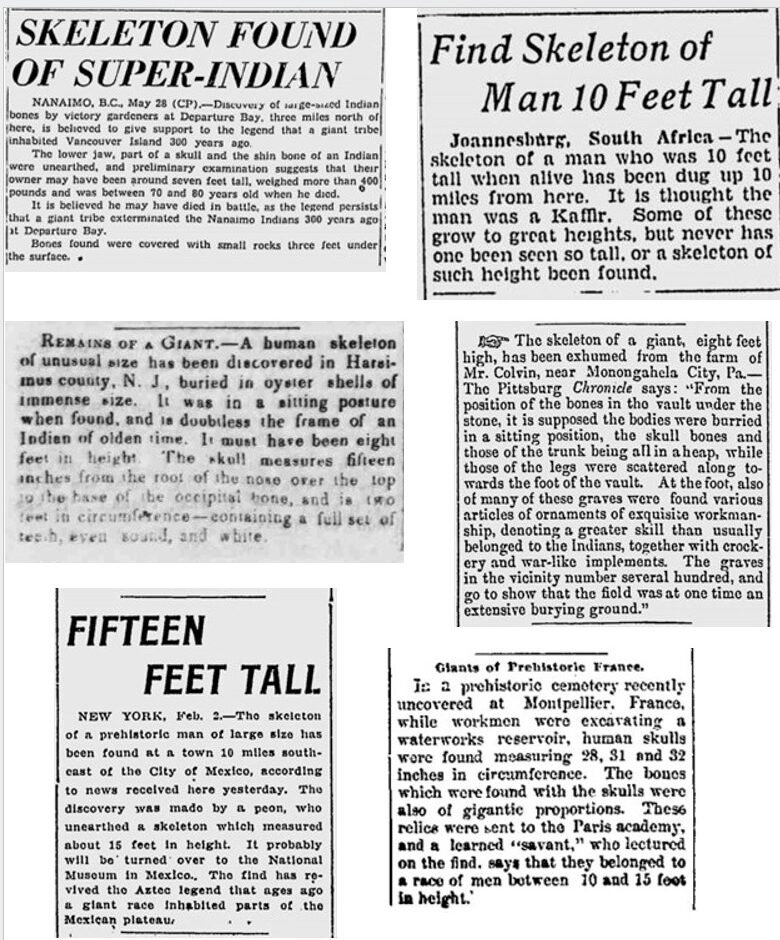
He then moves to, “where things get a little conspiracy’esque” including, “a treasure trove of fraudulent Nephilim stories and photos.” He examples, “an 1800’s farm where the landowner eventually fessed up to burying a fake Nephilim skeleton he had made of clay and concrete, etc (But hey, he had made a lot of money in the ruse).” I’m unaware that the term Nephilim was never used.

That aside, or so Jon tells us, he, “began finding newspaper articles that, at least on the surface, seemed legit” and provided these screenshots:

the-lucifer-project-on-nephilim-in-the-bible-2-9722336

Well, I filled an entire chapter of my book Nephilim and Giants: Believe It or Not!: Ancient and Neo-Theo-Sci-Fi Tall Tales with such examples. Let’s be aware of and keep a few things in mind:

1) the one and only reason that Jon gave us for even imagining that any of that has anything to do with Nephilim is one single sentence from an evil report by 10 unreliable guys whom God rebuked.

2) fake-news isn’t new and it’s a non sequitur that merely assume that if it’s in the newspaper then it must be true. Yet, Jon wrote, “I believe these particular articles are very much the real thing” and yet, our belief or lack thereof doesn’t dictate what is or isn’t factual.

3) by definition, newspaper reports are succinct and lack follow up. Most of these are: farmer Joe said he found a skeleton but it got washed away—or some such thing. So, we have to believe the report and have to believe that farmer Joe’s non-anatomist opinion that it was a giant person is enough to conclude that it wasn’t a whale, dinosaur, pachyderm, etc.

4) those that I was able to follow up on did turn out to be such animals—and no, merely asserting, “COVERUP!!!!!!!!!!!!!!” isn’t enough.

5) as an example of such, “giants” note the article about, “around seven feet tall” so, NBA level. Even then one about 15 ft, “man” it’s referred to as such and measured as such based on what someone said.

6) Jon himself told us that right around this time, “a lot of money” was to be made from such assertions.

Need I go on?

But let’s grant that all of those are humanoid skeletons: of what is it? Subjectively unusually tall people have always existed.

At this point, Jon merely asserts, “Nephilim heights (most are in the 7’ to 8’ range)” with zero indication as to whence he got such a very specific range—or any at all.

At this point, Jon merely asserts, “Nephilim heights (most are in the 7’ to 8’ range)” with zero indication as to whence he got such a very specific range—or any at all.

He then elephant hurls about, “discoveries were made in France, Russia, Mexico, Ireland, or the United States to name just a few” and lobs a, “If all of these were fake” as if listing the names of countries means something.

Now, his point is, “many are buried in mounds with shells, and often they are found in strange burial positions (bound sitting upright is common). And these themes hold true whether the discoveries were made in France, Russia, Mexico, Ireland, or the United States to name just a few. If all of these were fake, it would have been quite a global effort to keep their stories the same over at least the last 200 years.”

May we not then say the same about that if all of these were real, it would have been quite a global effort to cover up their stories, and not just stories but evidence (also meaning shutting up 100% of any and every person involved in them), over at least the last 200 years. Again, “THEY,” whoever they many be (insert your favorite villain), “have that power!!!!!!!!!” isn’t enough. Jon soberly notes, “We just don’t know…I have fun speculating on this. But the reality is we just don’t know … and probably never will.”

And I still don’t know what an alleged skeleton of an alleged man who was allegedly 15 ft have to do with Nephilim that were allegedly 8-9ft.

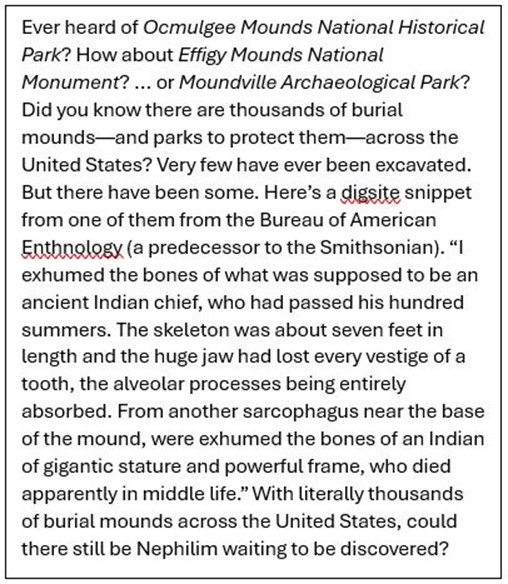
Jon then affirms, “this personal account I stumbled onto” by an unnamed person and from an unmentioned source, “years ago…wraps everything up nicely.”

the-lucifer-project-on-nephilim-in-the-bible-3-7897899

So, it’s very nice to read about a skeleton that was, “about seven feet” and whatever the vague, generic, subjective, multi-usage and modern English word “gigantic” means—and don’t forget to arbitrarily slap the term Nephilim into it ‘cause well, why not?

Likewise, Jon tells us of, “I think it was in Oklahoma, but my memory is fuzzy” where there was an unnamed, “museum” where he saw whatever is meant by the vague, generic, subjective, multi-usage and modern English word “giant” skeleton. So, he remembered it that was based on childhood memories, he had, “moved out of state” and at some unknown time in his adulthood, “went to see that exhibit one last time. But once he got there, it was gone. He went to the curator and asked about it, but the man looked at him cross-eyed. There never had been any giant there.”

So, was it a massive coverup or a child seeing a skeleton that either was, “giant” or just remembering it that way do to his own diminutive stature, spiked with all sorts of childhood tall-tales, was it even human-oid, etc., etc., etc.?

This is how it’s done: make vaguely generic assertions based on mere assertions, use that to merely read into contextually disconnected supposed data points, and come to conclusions that are then asserted. I mean, Jon went from actually believing any and all relevant (or irrelevant) old newspaper reports to, “regions and years of all the US-based Nephilim articles” (emphasis added for emphasis).

So by merely asserting Nephilim were 8-9ft tall without a shred of justification, he can merely assert that anyone in that height range is a Nephil and that’s how the neo-Nephilim shuffle is done.

I can only pray that Jon will reconsider what he’s posting on the WORLD WIDE web for all to see.

See my various books here.

~~~~~~~~~~~~~~~~~~~~~~~

A plea: I have to pay for server usage and have made all content on this website free and always will. I support my family on one income and do research, writing, videos, etc. as a hobby.

If you can even spare $1.00 as a donation, please do so: it may not seem like much but if each person reading this would do so, even every now and then, it would add up and really, really help out.

Here is my donate/paypal page.

You can comment here and/or on my Twitter/X page, on my Facebook page, or any of my other social network sites all which are available here.

On Fabrice Iram’s book “ANGELS NEVER HAD SEX WITH WOMEN TO PRODUCE THE NEPHILIMS [HUMAN-DEMON HYBRIDS]”

Since I love people, especially brothers, who seek interaction, especially on polemical issues, I deeply appreciated that Fabrice Iram reached out to tell me, “Just came across your website review of the video I posted of Dr Abel Damina teaching on Genesis 6. I would love to converse with you and send you a free book I wrote on that subject. Great grace abounds to you in all things” the video review to which he referred is here.

He was kind enough to send the book which is, bluntly, titled, “ANGELS NEVER HAD SEX WITH WOMEN TO PRODUCE THE NEPHILIMS [HUMAN-DEMON HYBRIDS]” and I also love it when people are blunt. The book describes him as, “Evt. Fabrice Iram is a Canadian Based Preacher and a Social Media Personality.”

I found that I agreed with a lot of what he wrote and yet, must say that I find that he made a few fundamental key errors that result in some erroneous conclusions.

I appreciated that Fabrice Iram wrote things such as, “REMEMBER TO OPEN YOUR BIBLE WHEN READING…because something scriptures were not put down. It’s important that you read every single verse from your Bible” (the book contains a little bit of broken English—so does my website since English is not his nor my first language). He emphasizes that his book “is loaded with Scriptural references and basis so that we do not read our opinions into the Bible” and points out, “Many have a lazy approach to study the Bible in context.”

He quotes:
“‘Now it came to pass, when men began to multiply on the face of the earth, and daughters were born to them, that the sons of God saw the daughters of men, that they were beautiful; and they took wives for themselves of all whom they chose. There were giants on the earth in those days, and also afterwards, when the sons of God came into the daughters of men, and they bore children to them. Those were the mighty men who were of old, men of renown’ (Genesis 6:1-2; Genesis 6:4).”

He noted, “Genesis 6:4 is one of the most controversial passages in the Bible” and that it is a “difficult section.”

Fabrice Iram comments, “Some have taught that this refers to fallen angels interbreeding with human women to produce half-demon giants.”
Here we have our first problem. He moved from “angels” to “demon”: “fallen angels…half-demon.” He tends to correlate these but then also distinguished between them—and recall that his book title includes the term “HUMAN-DEMON HYBRIDS.”
Since I can only speak for myself: I will note that my Bible-based theory is that fallen Angels were incarcerated bodily after the Genesis 6 affair, as I term it, and that their spirits roam the Earth as demos. Thus, Angels have a body of their own sort of flesh but demons are spirit. I know that my new friend will take issue with most of what I just noted but I will iron some of it out herein—for my theory, see my book and the succinct version in my article Demons Ex Machina: What Are Demons?

Referring to the Angel view, Fabrice Iram notes:
“The first possibility offered here is not really a possibility at all, even though angels are referred to as ‘sons of God’ in Job 38:7 because God is their ‘Father’ through creation…‘sons of God.’…is sometimes used to refer to angels (Job 1:6; 21:1 [he surely means “2:1”]; Psa. 29:1)…Gen 6:4…when people read this, they firstly jump to the book of Job to support their opinion that ‘sons of God’ refers to angels.”

He rightly notes, “if we conclude that Job called angels sons of God therefore wherever we see sons of God it mean angels! Now, that would be a gross error because” yet, I am unaware of anyone who would do that.

Fabrice Iram also rightly notes, “One must demonstrate from the context of the passages in Genesis and Job that ‘sons of God’ means the same thing in both passages and not simply assume this is the case because the words are the same…‘sons of God’ in Genesis 6 doesn’t have to mean fallen angels just because that’s what it means in Job 1:6…Most advocates of the view that the sons of God point to Job 1:6 and 2:1 to support their claim that ‘sons of God’ refers to angels. They argue that since it refers to angels in Job, then it also refers to angels in Genesis 6” (and yes, his book is very repetitive).

So, “angels are referred to as ‘sons of God’ in Job 38:7” but that does not automatically mean that the Genesis 6:4, which is fair enough.
Yet, he goes on to claim, “If you read carefully the book of Job, you will realize that the sons of God does not refer to angels…the book of Job alone cannot establish that the ‘sons of God’ were ‘angels’ and it did not suggest so.”

Now, I appeal to Job chaps. 1, 2, and 38 for support in identifying who the “sons of God” are in Genesis 6 but I cannot claim that Job was specifically referring to Angels since he never refers to them as much—even if the Septuagint/LXX for Job 1:6, 2:1 and 38:7 have ἄγγελοι/Angels.
However, from Job 38:7, most specifically, we can affirm that those “sons of God” are not human since they at least witnessed the creation of the Earth.
Thus, context permitting, “sons of God” can mean (can, not necessarily does) refer to non-human beings.
Iram also cited Psalm 29:1 for support that “‘sons of God’…is sometimes used to refer to angels” which reads, “Give unto the LORD, O ye mighty, give unto the LORD glory and strength” with the oddity in the rendering is that “ye mighty” is from the Hebrew “ben ‘El” much like the “sons of God” in Genesis 6:2, 4 is from “ben ‘Elohim” and much like Psalm 82:6 “ben ‘Elyon.”
Yet, he claims, “The same idea, of God as the Father and Israel as His son, is found in Deuteronomy 32:5,6. A similar phrase is found in Psalm 82:6 which reads, ‘I said, You are gods, and all of you are sons of the Most High.’”
Simply stated, whether “sons of God” refer to humans or not is ultimately elucidated by the context in which the term is found.

Fabrice Iram notes, “Angels are spirit beings (Hebrews 1:7 ‘In speaking of the angels he says, ‘He makes his angels spirits’’), not fleshly creatures. They neither marry nor sexually reproduce.”

That “Angels are spirit beings” is a common misconception and some translations do not help clear up that misconception.
Now, Hebrews 1:7 is actually quoting Psalm 104:4 so we need to determine how that Psalm should read. To make a long interpretation short, the Psalm makes constantly ongoing correlations to natural phenomena and so when it gets to v. 4, what Iram is reading “He makes his angels spirits” it should read (as many versions have it, actually[fn]https://www.biblegateway.com/verse/en/Psalm%20104:4[/fn]) that “He makes his angels winds.” Thus, Hebrews 1:7 (and v. 13 which plays off of it) should also read winds. It just to happens that in both Hebrew and Greek the words ruach and pneuma can refer to spirit or wind/breath.

Thus, Psalm 104:4 (quoted in Hebrew 1:7 and noted in 1:13) is whence Iram is getting that Angels are “spirit” and as he note, “Any doctrine must be established by more than one witness” and he really only has one (since the other two are based on the one).
In any case, we will see what else we are told about Angels since this will not turn out to just be about one verse.

Fabrice Iram writes, “Heb 1:5 ‘God never said to any of his angels, ‘You are my Son. Today I have become your Father.’ And God never said to any of his angels, ‘I will be his Father, and he will be my Son.’” Yet, that is only one verse from an entire statement. The context is that God never called Angels His sons within the context of that Jesus is the one and only uniquely begotten authoritative Son of God—that is what Hebrews chap. 1 is all about and not about labels.

Thus, his argument is that since Angels are “spirits” then “They neither marry nor sexually reproduce” to which he appeal to Luke 20:34-36 for support, “Jesus replied, ‘The people of this age marry and are given in marriage. But those who are considered worthy of taking part in the age to come and in the resurrection from the dead will neither marry nor be given in marriage, and they can no longer die; for they are like the angels).”
Note that this has to do with “the age to come” and that “they can no longer die” which is the way they are said to be “like the angels.”
As for the focus on marriage and reproduction, the parallel text to Luke are even more specific, “in the resurrection they neither marry, nor are given in marriage, but are as the angels of God in heaven” (Matthew 22:30). Thus, Jesus not just speaking of Angels but about “angels of God in heaven”: the loyal ones. This is why those who did marry are considered sinners, having “left their first estate” as Jude put it.

You see, the issue for Fabrice Iram is that “Jesus explained that spirits are not able to manifest themselves materially” and appeals to Luke 24:39, “a spirit does not have flesh and bones.”

Thus, I am unsure what point he was making but, in any case, from Genesis chap. 18 we learn of three “men” who visit Abraham and form chap. 19 we learn that two of them were Angels. These Angels were not only described as “men” but ate and drank as men.
Fabrice Iram wrote:
“I have had many ask me why then they ate food in the Bible! I would say that angels have no stomach otherwise after they eat they must go to the toilet. Angels do not need food because they never feel hungry! Think about that! Angels know what they do with that food but am convinced they have no stomachs! Nor saliva! Nor anus!”

Perhaps, “Angels do not need food” but they still ate—much like a lot of people overeat because they eat even when they do not need food. Yet, his assertions are irrelevant because we have instances of Angels eating in the Bible. But what about Angels going to the toilet, again not that it matters since we have evidence that they eat (or, can eat): well, their bodies are not fallen so that may be an indication that their bodies would efficiently process every single calories, macronutrient, etc. with not waste products being a byproduct.

Now, every single time the Bible describes Angels, it describes them as man/men, as looking just like human males. From this, we can logically and theo-logically conclude that such is the way the look ontologically, in their created nature and essence: they look like us and we were made a “little lower than the angels” (Psalm 8:5 and Hebrews 2:7).
Reading one word in one verse, “spirit,” leads to denying the many, many times they are described as looking like us, and leads to having to invent unbiblical claims about how they take on temporary bodies or only appear to be embodied, etc.

He refers to “the assumption of interaction between heavenly Beings and earthly beings” and that “The problem arises when people say that Angels can appear as a man and be able to reproduce.” This is why I agree on some issues and disagree on others since I too disagree “when people say that Angels can appear as a man” if by that they mean that they normally do not look that way.

Fabrice Iram argues, “no angel has ever existed in these 3 dimensions” but then writes, “Angels can appear in the form of man (exactly like him outwardly) and speak, run, etc…however, they cannot have the likeness and appearance of man.”
I am unsure what the difference is between “appear in the form of man” and “have the likeness and appearance of man” except that he seems to think that when they “appear in the form of man” it is either an illusion or a an empty shell (meaning no organs, blood, etc.) yet, we know they “have the likeness and appearance of man” since they walk on the ground, eat, hold swords, etc.

He wrote, “Angels can appear in the form of a man…When you meet them you can think they are flesh, bones and blood” so if when you meet them you can think they are flesh, bones and blood because they look, feel and do thing in keeping with being flesh, bones and blood then why claim they are not what they seem? Well, as we saw already, because of one word, “spirit,” that was wrongly translated in some versions.

For example, he goes on to write:
“If angels can reproduce with humans, then they have blood, brain, muscles, heart, stomach, sperms…and once they have these, they are subject to pain and death. Etc. which is impossible. They are spirits as Heb 1:7 says and Jesus said that a Spirit has no flesh and bones in Luke 24:39 despite that they can appear as humans. Angels remain spirits eternally…they cannot decide to be humans just like humans stay humans forever despite that one day our bodies will be glorified in immortality.”

Since they look just like human males and we are made a little lower than then then why assume that is merely outward? Why assume they are missing key features that we have?
Why assume that if “they have these, they are subject to pain and death” I know not. Adam and Eve had them pre-fall and were only subject to pain and death after the fall (at least the death part).
Thus, Angels stay Angels forever despite that some of them fell and some never lost their glorified state, their glorified bodies—which is what makes them different from us.

In fact, he claims, “Angels cannot have lust” but why not? The fallen ones, “saw the daughters of men that they were fair” and even Paul tells us, “For this cause ought the woman to have power on her head because of the angels…if a woman have long hair, it is a glory to her” (1 Corinthians 11:10, 15).
While this is somewhat enigmatic, he seems to realize that Angels can be attracted to human women. Now, there is no indication that anymore Angels fell or will fall post-flood but that does not mean that it is acceptable to allure them anymore than it is acceptable for a human woman to allure me because I am already married. In other words, even in 100% human to 100% human interactions there are times when allurement is not acceptable.
Interestingly, Fabrice Iram wrote, “I know you know it well that in our day angels will not fall from heaven to pursue a woman to enjoy sexual relations!” and I do, I agree: yet, we agree for different reasons.

Now, note something interesting:
“It is known that the physical elements cannot affect Spiritual beings…spirits cannot die and be buried. I do not know if the angels have the breath of life but I can assume so!…Angels…don’t have sex organs to be aroused and have a desire for sexual pleasure! Secondly, they have no ability to create for themselves a fleshly body, only God can!…Only one Spiritual being became a full human being since creation with all capacities and abilities that man has.”

Note that he writes “Spiritual” and “spirits” and “Spiritual” yet, spirit and spiritual are very different. Spirits have no flesh or bone (in and of themselves) but humans can be spiritual and we do have flesh and bone (we even have spirits, embodies ones: which is why I distinguished spirits in and of themselves). So, Angels are not spirits but can be said to be spiritual.
I also agree that “they have no ability to create for themselves a fleshly body” but, again, we agree for different reasons: “they have no ability to create for themselves a fleshly body” and do not need to since an unfallen-glorified fleshly body is what they always inhabited, that is how they were created.

He notes that the Angel view, “would violate the principle made clear in Genesis 1:24 ‘…And God said, ‘Let the earth bring forth living creatures according to their kinds: livestock, land crawlers, and beasts of the earth according to their kinds.’ And it was so.’ that each living kind reproduces only ‘according to its kind.’”
Yet, since Angels look like human males, are called man/men, and can mate and reproduce with us that just means that we are of the same kind.

And so, when he writes, “we see demons in Scripture only possessing individuals or appearing as ghostly apparitions” I would not put it that way but fair enough: yet, these are demons, not fallen Angels. In fact, demons did not exist until after the fallen Angels were incarcerated. It was Angels who mated with women, not demons.
Again, when he writes, “those who hold consistently to a Biblical worldview must reject the notion that women and demons can engage in sexual relations” I can agree since he is writing about “demons.”

Likewise, Fabrice Iram wrote:
“If the fallen angels were able to impregnate females, then even today, demons should be impregnating women.
Let us listen to Jesus:
Lk 17:26-30 ‘Just as it was in the days of Noah, so also will it be in the days of the Son of Man. People were eating, drinking, marrying, and being given in marriage up to the day Noah entered the ark. Then the flood came and destroyed them all. It was the same in the days of Lot.
People were eating and drinking, buying and selling, planting and building. But the day Lot left Sodom, fire and sulfur rained down from heaven and destroyed them all. It will be just like this on the day the Son of Man is revealed.’”

Again, note shifting from “angels” to “demons.”
Now, when it comes to the text he quoted, I was very glad he did so since I am constantly telling people that Jesus likening His return to the days of Noah has nothing to do with Nephilim especially since He said the same about the days of Lot—which had nothing to do with Nephilim.
Yet, he quoted it to argue “Jesus did not say ‘people and the fallen angels/angels’ NO! He even mentioned that the marriage in Gen 6 was between humans, not humans and angels.”
Thus, humans were marrying humans, etc., which was surely the case. Yet, Jesus’ context was to offer examples of people going about business as usual being unaware of unconcerned with coming judgment.

He tells us, “my friend told me this ‘Before Jesus will come again, Angels will sleep with our sisters again and produce giants because Jesus said as it was in the days of Noah so shall it be before the Son Of Man comes back.’”
There is only one problem with that: there is no indication of any such thing in the whole Bible.

Fabrice Iram wrote:
The proponents of the concept that Angels slept with women have a serious problem! If they say that Angels can take up the body of a male human, which they say they did, then we have a serious problem! Ask yourself this: Why is it that the angels impregnated our women? Why didn’t some angels themselves get pregnant? Because, if they can take up any fleshly body, then am positive they can take up the body of a woman! And they can get pregnant too? If they can create themselves, any fleshly body then what will stop them from creating themselves a female’s body?”

Again, “that Angels can take up the body of a male human” is not my view and Angels did not get pregnant because, apparently, there are only male Angels.
It is a good point that “if they can take up any fleshly body, then am positive they can take up the body of a woman!” but that is part of the problem with beginning with a faulty premise, one tends to come to faulty conclusions.

He is also correct when he notes, “demons are nonsexual, nonphysical beings and, as such, are incapable of having sexual relations and producing physical offspring” yet, when he follows with “If demons could have sex with women in ancient times, we would have no assurance they could not do so in modern times” he, again, is failing to distinguish between demons and fallen Angels.
He also wrote, “a Biblical worldview does allow for fallen angels to possess unsaved human beings” which his quite true.
He also wrote, “Angels rebelled individually, are judged individually, and are offered no plan of redemption in Scripture” but every indication is that Angels rebelled together and were judged together: there is only a one time fall of Angels in the Bible and if Genesis 6 is not the record of it then, pray tell, what is?

Fabrice Iram states that those who hold to “THE TYRANT VIEW…smuggle this” into the text, “They assume that the demon-possessed men produced the giants. However, a demon-possessed man cannot produce a superhuman” and I agree.

His “far more reasonable” elucidation is:
“Genesis 4 gives the story of Cain and Abel and follows with the genealogical descent from Cain. Genesis 5 is called ‘the book of the genealogy of Adam’ (Genesis 5:1). It starts with Gods creation of Adam and how Adams line continued through Seth…
Genesis 6, we see ‘the sons of God’ (men of Seth’s godly line in this explanation) intermarrying with ‘the daughters of Men’ (women of Cains ungodly line). There is also another sensible…
I believe the better interpretation is that ‘sons of God’ simply refers to the godly descendants of Seth, and ‘daughters of men’ to the ungodly descendants of Cain. Their cohabitation caused humanity to fall into such utter depravity that God said; ‘‘I will wipe mankind, whom I have created, from the face of the earth — men and animals, and creatures that move along the ground, and birds of the air — for I am grieved that I have made them.’ But Noah found favour in the eyes of the Lord.’ (Genesis 6:7-8)…”

Let us be careful about what is subjectively “reasonable” and “sensible” because something can be reasonable and sensible and mistaken.

Yes, Genesis chaps. 4-5 gives genealogical descents and 6 tells us what happens to all peoples.

I have often noted that the claim that there was a holy line of Seth and a wicked line of Cain is a myth. Yet, Fabrice Iram attempts to make the point:
“Cain’s line is recounted in Genesis 4, and this line displays proliferating wickedness, capped by Lamech, who was the first polygamist (v. 19) and who rejoiced in murderous, vengeful use of the sword (Vv. 23– 24). By contrast, the line of Seth, which is traced in Genesis 5, displays righteousness. This line includes Enoch, who ‘walked with God, and … was not, for God took him’ (v. 24). In the line of Seth was born Noah, who was ‘a righteous man, blameless in his generation’ (6:9). Thus, we see two lines, one obeying God and the other willfully disobeying Him…two lines, one godly and one wicked…
Seths descendants…‘began to call upon the name of the Lord’ (4:26), ‘walked with God’ (5:24), and ‘found favor in the eyes of The Lord’ (6:8)…
Cain is driven out from the presence of God…primary characterization of Cain’s line is that they were becoming increasingly separated from God…
If Seth is likened to Abel then it means he walked in the paths of righteousness as Abel did. Heb 11:4 ‘…Abel…was righteous…
Noah, Enoch, and others from his line were describe as righteous! Abraham was also of the genealogy of Seth and he is the father of the Jews who were called sons of God in Deut 32. So, Seth’s children were the sons of God because they were obedient to the Word of God.”

I am afraid that I am not prepare to praise an entire line of people no condemn another due to some good examples from the one and two examples of bad from the other.
In fact, Fabrice Iram will force himself to end up claiming that the holy, righteous, good, loyal, Godly line of Seth was no such thing after all since they became utterly corrupt.

Fabrice Iram also wrote:
“Israel, is identified by God as ‘My son, My first-born.’ These sons of God were about to enter the Promised Land, which was populated with people who were not part of the Abrahamic covenant. God warned Israel not to take foreign wives (Deut. 7:3 ‘Do not intermarry with them. Do not give your daughters to their sons or take their daughters for your sons’). This would become a recurring problem for Israel…
Genesis 6 could simply be speaking about the intermarriage of those who manifested a pattern of obedience to God in their lives and those who were pagans in their orientation. In other words, this text likely describes marriages between believers and unbelievers.”

He has to argue this because he takes the Sethite view, Sethites “were about to enter the Promised Land” but it was “populated with people who were not part of the Abrahamic covenant” and so “God warned Israel not to take foreign wives” and tells us “Moses used this story in Genesis 6 to warn Israel not to abandon Gods instruction” yet, Deuteronomy record a time long, long, long after the Genesis 6 timeline (and before Genesis 6 since, again, the mating referenced therein began whenever it was that “men began to multiply on the face of the earth, and daughters were born unto them”).

Thus, when he notes, “Moses warned the Jews never to marry outside their nation. why? because the other nations would lead them away towards God and turn them to evil” that was much later in history.

Thus, there is no indication that Sethites marrying Cainties was forbidden.
Again, it is accurate that “Nephilims were destroyed by the Flood” but that this is “proof that the Nephilims were merely human beings” is inaccurate: they did not make it past the flood which is why the one and only reference to Nephilim post-flood was within an “evil report” and God rebuked the spies who presented it.

He then, quotes, “Deut 2:19-21…Deut 3:10-11…1 Sam 17:4-7” which are all about Rephaim, not Nephilim. In fact, he wrote, “Nephilim and giants still appeared after the flood.[Num 13:33, Deu 2:11]” (brackets in original) but Deuteronomy 2:11 reads, “Which also were accounted giants, as the Anakims; but the Moabites called them Emims” with “giants” rendering “Rephaim.”

Fabrice Iram
“Deut 32:7-8 ‘Remember the days of old; consider the years long past. Ask your father, and he will tell you, your elders, and they will inform you. When the Most High gave the nations their inheritance, when He divided the sons of man, He set the boundaries of the peoples according to the number of the sons of God.’
The ‘sons of God’ here refers to Israel. It does not refer to angels. However, some Greek translations have put it this way ‘according to the number of the Angels of God;’ an arbitrary departure from the original text, in accommodation, probably, to the later Jewish notion of each nation having its guardian angel…According to the number of the children of Israel…he reserved for Israel, as the people of his choice…so as to reserve a sufficient place for the great numbers of the people of Israel….the other nations.”

Well, each nation having its guardian Angel does not seem to be a “later Jewish notion” since, for example, the Angel Gabriel battled it out with the “Prince of Persia” which seems to refer to an entity much like the different between the king and prince of Tyre, Babylon, Egypt, etc. and much like the Archangel Michael is a prince over Daniel’s people—see my article The Apocalypse of the Hidden Hand: The Bible’s teaching on the spiritual sovereign behind the human sovereign.

One question is: when did the Most High give the nations their inheritance. I am uncertain but we know “when He divided the sons of man” which was at the Tower of Babel event—when “sons of God” could not have meant “the children of Israel” since neither Israel/Jacob, not his children existed yet. And if “inheritance” has something to do with who ruled the nations then the people of Israel never ruled any nation but their own.

Fabrice Iram notes that in Genesis 6, “human beings were clearly the problem here— not angels. God says amid the verses of Genesis 6 quoted above, ‘My Spirit shall not strive with man forever’ (Genesis 6:3) and ‘I will destroy man whom I have created from the face of the earth’ (Genesis 6:7).”
One issue is that, again, Angels are called man/men so that their offspring are also man/men and yet, since the Bible’s focus is humanity—our origin, fall, and redemption—its focus always and quickly returns to us no matter what subject is being addressed. Thus, the premise for the corruption if the Genesis 6 affair and “man” is judged as a result.

Yet, he claims, “the ‘giants’ mentioned must have been human also—descendants of Adam and Eve” well, they were half-human and so half-descendants of Adam and Eve.

Fabrice Iram wrote:
“The wickedness was of man, not man and angels…The Lord regretted that he made man not that he made man and angels…verse 7: ‘every man, beast, crawling creature and birds of the air’. God vows to destroy those things which were taking part in that wickedness but interestingly, God never mentioned Angels which meant they were never involved.”

Indeed, the text focuses on us but Jude and 2 Peter 2 refer to a sin of Angels and there is only a one time fall/sin of Angels in the whole Bible.
Jude wrote:
“…the angels which kept not their first estate, but left their own habitation, he hath reserved in everlasting chains under darkness unto the judgment of the great day. Even as Sodom and Gomorrha, and the cities about them in like manner, giving themselves over to fornication, and going after strange flesh…”

Peter wrote (v.4):
“God spared not the angels that sinned, but cast them down to hell [Tartarus], and delivered them into chains of darkness, to be reserved unto judgment.”

Fabrice Iram quoted, “2 Peter 2:5 ‘if He did not spare the ancient world when He brought the flood on its ungodly people, but preserved Noah, a preacher of righteousness, among the eight;’” and commented, “Peter didn’t say the ungodliness was produced by angels and humans” but, again, he had noted the sin of Angels just before this and note that it is chronological: sin of Angels followed by the flood thus, the Genesis 6 timeline.

He wrote, “God is righteous and shows no favoritism. If it be so, why does he vow to destroy only men, animals, and plants in Gen 6:5-7,1317,23 but segregates angels out? It is because the angels NEVER HAD SEXUAL INTERCOURSE WITH WOMEN.”
Well, there is no requirement that God reveal everything involved with every situation every time. Jude and Peter revealed that God “segregates angels out.”

He notes:
“…the word is used of people of giant stature later in Num 13:33 ‘We saw the Nephilim there (the descendants of Anak come from the Nephilim). We seemed like grasshoppers in our own eyes, and we looked the same to them’…the very powerful, and possibly very tall, people of Genesis 6 were destroyed in the Flood.
But there would be other giants following the Flood, who were descended, just as everyone else in the post-Flood world, from Noah—again, not angels COMPARE Deut 2:20-21 ‘That too was regarded as the land of the Rephaim, who used to live there, though the Ammonites called them Zamzummites. They were a people great and many, as tall as the Anakites. But the LORD destroyed them from before the Ammonites, who drove them out and settled in their place’…
Deut 3:11 ‘Og king of Bashan was the last of the Rephaites. His bed was decorated with iron and was more than nine cubits long and four cubits wide. It is still in Rabbah of the Ammonites’…
Goliath…was more than nine feet tall (1 Samuel 17:4). But he was still just a man (1 Samuel 17:24-25; 1 Samuel 17:33) not some human-demonic hybrid. ‘The Nephilim were on the earth in those days — and also afterward — when the sons of God went to the daughters of men and had children by them. They were the heroes of old, men of renown.’”

The point is that “the very powerful, and possibly very tall, people of Genesis 6 were destroyed in the Flood” and yet, post-flood “word is used of people of giant stature later in Num 13:33.”
Well, I am glad he said “possibly very tall” since they “were destroyed in the Flood” and Numbers 13:33 is just recording an “evil report”: Nephilim were not there, the unfaithful and disloyal spies just claimed that they saw them as a fear-mongering scare-tactic.

But when Fabrice Iram states, “there would be other giants following the Flood” he is switching from the specific Hebrew term “Nephilim” to the undefined, subjective, generic, and vague English word “giants.”
Sure, some versions render Nephilim as giants but they also render Rephaim as giants and that just causes confusion. For example, the post-flood “giant” are Rephaim and so have no relation to Nephilim.
He is arguing that Nephilim were 100% human which is why he traces them to Noah.

Deuteronomy 2:20-21 is about Rephaim aka Zamzummites (who were subjectively “tall” compared to Israelites, male of whom averaged 5.0-5.3 ft.) and Anakites who were a subgroup of Rephaim.
King Og was also a Repha as was Goliath. While we do not know Og’s height, there is a discrepancy regarding Goliath’s height: early manuscripts such as the LXX, Dead Sea Scrolls, and also Flavius Josephus have him being just shy of 7 ft. while latter Masoretic manuscripts have him at just why of 10 ft.
So yes, of both Og and Goliath it is right to say “he was still just a man.”

Yet, when Fabrice Iram quotes, “in those days — and also afterward” he seems to think this has to do with the flood and that is explains why 100% human Nephilim and thus, 100% giants are mentioned pre and post-flood.
Yet, those days refers to “when the sons of God came in unto the daughters of men, and they bare children to them” which was “when men began to multiply on the face of the earth, and daughters were born unto them” so that after those days is simply after they first did so—yet, still pre-flood.

Fabrice Iram also argued:
“The Nephilims/Giants existed before the ‘sons of God’ issue came into view. This means they existed before Genesis 6!
‘The Nephilim were on the earth in those days’ which days is it referring to? V1 ‘And it came to pass, when men began to multiply on the face of the earth, and daughters were born unto them,’ In these days when men began to multiply, the Nephilim were already present before the ‘sons of God’ married the ‘daughters of man.’”

Likely due to somewhat clunky English renderings, it may see that “Nephilim were already present” yet, that would make the reading even more clunky since it would not make sense for a narrative to relate a series of interrelated events that is interrupted by “Nephilim were on the earth…” without anything being elucidated about them. They were there and? So? What of it? Just a mention and nothing else said about the within the context in which they are mentioned? Thus, the text is better—contextually—understood to mean Nephilim were there as a result of when the sons of God came in unto the daughters of men.

Fabrice Iram wrote:
My regular readers know that I constantly tell people who claim that the flood was meant to (at least part of the reason for it was) to be rid of Nephilim but that there were post-flood Nephilim that they are implying that God failed.
Thus, I was please to see that Fabrice Iram argued much the same in arguing, “So, do we say that God failed to phase out the Nephilims? Did other Angels from heaven fall again and enjoy sexual pleasure with women to produce the re-appearance of the Nephilims?” some claim that Angels did do it all again but that is not biblical.

He continues, “Or maybe God that day was asleep when some of his angels came secretly on earth and impregnated our women and returned into heaven unnoticed??? How do you explain this re-appearance? Many people would say that one of the surviving people with Noah in the ark had already the gene inherited from the Nephilims which is not true! Why? Because God is all-knowing! How could that go undetected? God could have told Noah not to accept such into the boat! There is no way God could have winked at that!” AMEN!!!
That is another unbiblical tall tale that some people invented because they actually believe rebuked spies.

Fabrice Iram referred to “The assumption in this interpretation of Genesis 6 is that ‘the sons of God’ refers to angelic beings” and goes on to write in terms of “Assumption…assumed…assumption…assumption…assume…assumption…assume,” etc., etc., etc.
Now, speaking for myself: I assume no such things, my views are the result of much, much (much) research.

He also tells us “The doctrine of angels getting women pregnant is a doctrine of devils and seducing spirits” and that “It is of a pagan nature” so we should “Get rid of that little pagan doctrine of devils.”

If that is the case then virtually the entire early church, for centuries, was following a doctrine of devils and seducing spirits since it is a simply verifiable fact that the original, traditional, and majority view among the earliest Jews and Christians who commented on this was the Angel view: from BC days until well beyond the 500 AD—see my book On the Genesis 6 Affair’s Sons of God: Angels or Not? A survey of early Jewish and Christian commentaries including
notes on giants and the Nephilim
.

As for being “of a pagan nature,” he may want to consider how Pagans tend to copy but corrupt. Before the Tower of Babel event humanity lived in relative proximity to each other and knew commonly known and share history. When humanity was dispersed though the Earth that history eventually came to be changed on this or that point and came to be called myth and legend. Thus, it would seem that Pagans were playing off of ancient memories of true history.

He also wrote:
“Angels have absolutely no ability to create themselves a human fleshly body and partake in his nature. FULLSTOP! The problem today, Believers don’t believe what Jesus said. He said angels are incapable of sexual activity yet someone will reject that!”

Again, there is no indication that Jesus “He said angels are incapable of sexual activity.”

Fabrice Iram wrote:
“I am open to correction if you find any scriptures apart from Job (which am confident too that it never referred to angels)…Clearly, angels are never called sons of God in the scriptures! I said, I am open to correction if you bring a verse apart from the Book of Job…another verse or three apart from Job…If you cannot find another author to support the issue, then it cannot be taken. Or it has a different meaning…sons of God refers to men, not angels. And I said that unless you bring another book in the Bible that support the book of Job to establish the testimony, it is not valid. The book of Job did not say the sons of God were angels.”

Again, Job seems to refer to Angels but I can only go as far as firmly arguing that it refer to some sort of non-human beings—just like the “morning stars” to which 38:7 refers.
Recall that he, himself, noted of Psalm 29:1 that “‘sons of God’…is sometimes used to refer to angels” and I added Psalm 82:6.
We also have Jude and Peter clearly commenting on the Genesis 6 affair so that this goes beyond asking about verses that read “sons” followed by the term “of” followed by the term “God.”

Now, having argued in favor of the Sethite view—as a line of holy people who committed the such an Earth-shattering sin that it caused the flood—Fabrice Iram proposes “THE BILLION DOLLAR ANSWER” which is found in Luke 3 which “gives us the genealogy of the [spiritual] sons of Christ. From verses 23-35 is a list of men who existed after the flood. Let us look at the men who were alive before the flood of Noah” (brackets added) and his point is that they are all Sethites.
Now, I would argue that Cain’s genealogy is wholly other, in a manner of speaking, since he absconded from Adam and Eve, started his own family elsewhere, etc.
In any case, he concludes, “it only gives us the genealogy of Adam through Seth which were those who manifested a pattern of obedience towards God” and “John 3:10 ‘In this the children of God are manifest, and the children of the devil: whosoever doeth not righteousness is not of God, neither he that loveth not his brother’” so that “The children of God[sons of God] do righteousness. Those who do righteousness are called ‘sons of God’. The lineage of Seth was that of righteous generation until to Jesus” (brackets in original).

But, he then writes about what I just noted:
“Adam’s Obedient Line began to desire women from Cain’s line and they began to intermingle and intermarry them. This was the corruption that yielded wickedness in those days because the children of Cain diverted the children of God from the true God to idols and evil ways and yield disobedience towards the Gospel which resulted in…destruction.”

So for one, “Adam’s Obedient Line” was not so obedient after all (and, by the way, there is no biblical indication that “the children of Cain diverted the children of God from the true God to idols”).
Moreover, there are Goyim/Gentiles from Pagan nations in Jesus’ genealogy so that attempting to claim a pure line of Sethites leading to Jesus is a faulty claim.

Lastly, I was glad to see that he wrote a subsection titled, “SHOULD WE RELY ON THE BOOK OF ENOCH OR APOCRYPHAL BOOKS?” wherein he notes, “I also preached from them even today, I still have the notes I used to take” but that “During my time studying apocryphal books, I realized that they heavily contradicted the Bible and what Jesus and the Apostles taught.”
I also agree with that and have a whole chapter about how it contradicts the Bible in my book In Consideration of the Book(s) of Enoch.

Overall, I appreciate Fabrice Iram’s motivations, spirit, and heart. Yet, it is clear that he has made some errors on fundamental issues which lead him to come to tome erroneous conclusions.

See my various books here.

~~~~~~~~~~~~~~~~~~~~~~~

A plea: I have to pay for server usage and have made all content on this website free and always will. I support my family on one income and do research, writing, videos, etc. as a hobby.

If you can even spare $1.00 as a donation, please do so: it may not seem like much but if each person reading this would do so, even every now and then, it would add up and really, really help out.

Here is my donate/paypal page.

You can comment here and/or on my Twitter/X page, on my Facebook page, or any of my other social network sites all which are available here.

Critique of Jordan Cooper’s Critique of Michael Heiser’s Interpretation of Nephilim

Ordained Lutheran pastor, Professor of Systematic Theology, Executive Director of Just and Sinner, and the President of the American Lutheran Theological Seminary Dr. Jordan B Cooper posted a video titled A Critique of Heiser’s Interpretation of the Nephilim which is undergoing review herein.

He has, “points of pushback” against his initial, in passing, reference to Heiser, one of which is, “that I did use the term demon in reference to the lower elohim whereas Michael Heiser restricts the term demon most particularly to those spirits of the Nephilim who are without homes so and they are looking for homes which is part of why demonic possession occurs.”

Since I wrote the paper Demons Ex Machina: What are Demons? I will succinctly state:

1) Heiser took that view due to picking up folklore from centuries, if not millennia, after the Torah, running with it, and applying it (namely the pseudepigraphic texts Jubilees and 1 Enoch (which is Bible contradicting folklore, see my book, In Consideration of the Book(s) of Enoch) and man-made Rabbinic traditions which followed therefrom).

2) My Bible-based elucidation is that demon is in reference to the physically incarcerated sinful Angels (Jude and 2 Peter 2) most particularly to their disembodied spirits who are without homes so and they are looking for homes which is part of why demonic possession occurs. That they are dead Nephilim was a good try but there is a more all-encompassing case to be made that they are the sinful Angels, in that round-about manner.

3) What Heiser further did is to make what I term a strictly linguistic argument by noting that 1 Enoch calls disembodied Nephilim spirits unclean spirits (or Jubilees’ unclean demons depending on translations), specifically, and so whenever we see the term unclean spirits in the New Testament we must read that as references to such. Yet, it is a strictly linguistic argument since it is detached from the context of the New Testament—which came along centuries after 1 Enoch (and Jubilees).

In linguistics, the usages (plural) of terms tends to me more relevant that the meanings (plural) or definitions (plural). Look up the etymology, definitions and meaning of the word bad but that will not tell you the usage of it within the Michael Jackson song Bad.

Cooper notes that Heiser, “uses a more restrictive sense of the word Angel because he believes Angel is more of a job description: he says the Seraphim, for example, are not Angels.” Well, Seraphim are not Angels because Seraphim are Seraphim and Angels are Angels. Some will dismiss that commonsense bifurcation by merely asserting that Seraphim are a kind of Angel but there is zero indication of any such thing and that is merely a man-made tradition.

Angels, Seraphim, and Cherubim are different categories of being:

1) they have different job titles, 2) they have different job functions, and 3) they have different morphologies.

To mash them all together is tantamount to claiming that bovines are a kind of human since both live on Earth, both have legs, both breath air, etc., etc., etc. It is a category error that violates the law of identity. See my books, What Does the Bible Say About Angels? A Styled Angelology and What Does the Bible Say About Various Paranormal Entities? A Styled Paranormology.

Now, let us focus on when Cooper focuses on Heiser’s focus on Nephilim.

He notes, “your whole theology of who the demons are is now” referring to now having laid out Heiser’s view (and using demons to refer to unclean spirits), “dependent largely upon, I would say, a questionable interpretation of this,” Genesis 6:1-4, “text and” now referring to the Angel view, “it’s not the interpretation that I take and I don’t think it’s the best way to interpret this text.”

Here I will merely note that the original, traditional, and majority view among the earliest Jewish and Christians commentators, starting in BC days, was the “Angel view” as I proved in my book On the Genesis 6 Affair’s Sons of God: Angels or Not? A Survey of Early Jewish and Christian Commentaries Including Notes on Giants and the Nephilim.

Cooper elucidates:

Genesis 6 verse 1, “Now it came to pass, when men began to multiply on the face of the earth and daughters were born to them, that the sons of God [בְנֵי־הָאֱלֹהִים] saw the daughters of men that they were beautiful and they took wives for themselves of all whom they chose” and that’s kind of it. Like, if we have a little bit of description later, then goes on to say, “There were giants on earth in those days and afterwards, when the sons of God came into the daughters of man and they bore children to them. These were the mighty men who were of old the men of renown.”

So, these figures that we call the Nephilim, that’s kind of the whole description that we get. Now, we can look at some other texts we can look outside of the Old Testament and look at some ancient Eastern texts and we look at Second Temple Jewish literature, the Enochic literature, which certainly does interpret this in that way, I think there’s no doubt about that.

Pardon the ongoing commercials but having written some dozen Nephilology books, and others on related topics, I have published on virtually all things that are being referenced. Thus, regarding, “texts we can look outside of the Old Testament…ancient Eastern texts…Second Temple Jewish literature,” see my books The Apocryphal Nephilim and Giants: Encountering Nephilim and Giants in Extra-Biblical Texts as well as On the Genesis 6 Affair’s Sons of God: Angels or Not?: A Survey of Early Jewish and Christian Commentaries Including Notes on Giants and the Nephilim and The Paranormal in Early Jewish and Christian Commentaries: Over a Millennia’s Worth of Comments on Angels, Cherubim, Seraphim, Satan, the Devil, Demons, the Serpent and the Dragon.

Cooper continues by noting, “But in terms of the what’s actually said in the text of the Book of Genesis, it is very little, there is very little there” indeed, which makes it all the more important that we handle the little we are told very carefully.

Moreover:

So, what do we see? That there are sons of God, daughters of men, sons of God see the daughters of men, that are beautiful, they’re taking them as wives and then they have children and these children are the Nephilim…So, the question then is: who are the sons of God and who are the daughters of men?

We actually have a number of interpretations of both parts of that so, Heiser’s interpretation is going to be the more supernatural one.

He notes, “there are a couple different ways that it could be interpreted supernaturally. One is that the sons of God are what we usually would think of as demons, being a kind of disembodied spirits, or that these are the fallen Angels. In this approach, they are disembodied and these disembodied spirits can somehow have sexual relations.” Well, biblically, it is not, nor can it be, the case that if it is demons or fallen Angels, proper (before incarceration), both denote disembodied spirits since Angels are not disembodied spirits rather, Angels are always described as looking like human males, performing physical actions, and without indication that such is not their ontology.

For this reason, we know it cannot be the case that is outline by, “another view that says that there are spirits that are in these people so they’re kind of these divine human entities” as in that they were humans that were possessed since Angels cannot and do not possess humans and demons did not exist until the sinful Angels were incarcerated (by the way, Jude and Peter both tell us they were incarcerated but do not specify when yet, since the flood was when God was cleaning house, as it were, then that would have been the logical time).

Furthermore, Cooper notes:

…it doesn’t seem to be the case that procreation is possible for a spirit entity so we have, for example, Jesus talking about how the spirits in heaven, the Angels in heaven, they do not marry are not given in marriage. Now, it’s not explicit, He doesn’t say, by the way, they also can’t take physical form and have sex but, you know, sex and procreation kind of go together.

He really is not on point by continuing to assert that Angels, proper, are spirits. As for, Jesus, he got close to the point since Jesus was not, “talking about…the spirits in heaven” but about, as Cooper went on to say, “the Angels in heaven, they do not marry are not given in marriage” and that was Jesus’ qualifying term, “in heaven” ergo, the loyal ones, which is why those who did marry are considered sinners (having sinned a sin correlated to sexual sin by Jude) having, “left their first estate” in order to do so, as Jude put it.

As per above, it is not just a case of, “they also can’t take physical form” but that they would not because they cannot because they are already in human form, ontologically: Angels are always described as looking like human males, we were created, “a little lower” (Psalm 8:5) than them, and we can reproduce with them so, by definition, we are of the same basic “kind” and why, by the way, would they only be missing the key features of the male anatomy?

Yet, based on his un-biblical Angelology, Cooper wrongly concludes:

…it seems to be the most logical explanation, with what we see Jesus [stating: or, Cooper’s odd handling of what Jesus stated] that they probably don’t have the ability to reproduce and we know that the creation of the Angels, or the Angelic spirits, at least in a traditional sense.

So, all is that these spirits are all created at once, they don’t procreate like humans do that, you know, we procreate and make more. That’s part of the call of Adam, the unique call of Adam.

The Angels, instead, we’re all created in a state of innocence and then some of them make the choice to follow the devil. Others don’t make that choice near confirmed in righteousness.

That’s, at least, a traditional interpretation, okay, that’s my view, that’s the traditional systematic theological approach from Roman Catholic [and] Reformed Lutheran traditions.

So, now we see whence, in reality, this came from, “a,” one of, mind you, “traditional interpretation” referring to, “Roman Catholic [and] Reformed Lutheran traditions.” Thus, he referred to their late-dated man-made tradition as per the, “systematic theological approach” that derives therefrom, but as a systematic biblical paranormologist, I have been able to show how such traditions are not biblical.

Also, indeed, “these [non] spirits are all created at once, they” were not supposed to, “procreate like humans do” and they did not technically, “make more” since Angels did not make more Angels but made half-Angels and half-humans—they cannot make more 100% Angels since it seems that all Angels are male.

Moreover, Cooper goes on to say:

…Let’s look at some of Heiser’s reasons for…[opposing] the Sethite view…he says this has been the dominant Christian position since the late 4th century AD. In this approach, the sons of God…are merely human beings men from the line of Seth: Adam and Eve’s son, who was born after Cain murdered Abel.

Presumably, these four hidden verses describe, or, for, I don’t know why I said, ‘hidden’ it doesn’t say that, I don’t know what’s in my head, these four, these four verses [the Genesis 6 affair, as I term it, 6:1-4] describe, I don’t know, forbid an intermarriage between the Godly men of Seth’s lineage, or the sons of God, and the ungodly women of Cain’s line, for the daughters of humankind.

In this reading, everyone who lived on Earth ultimately came from these two lines and both of them lines descended from Adam and Eve’s children, both of their lines, or those lines. In this way, the bible distinguished the Godly from the ungodly.

Let us cut to the chase: the Sethite view is a late-comer of a view based on myth, prejudice, and which only creates more problems than it solves (so, more than zero). It is ungraceful, ungodly, and un-biblical to condemn an entire lineage, bloodline, genealogy as being ungodly based on one single sin committed by one member of that family (Cain) and two sins by another (Lamech). Likewise with the Sethites, why should we praise them as being Godly based on that some of them were Godly?

As Cooper put it, “from Augustine’s perspective, the sons of God who are mentioned in Genesis 6 are those who are coming from the line of Seth: they follow the faith of Seth…they’re doing things in faith…whereas those from the line of Cain are not operating in faith.”

Besides, on this views, the Sethites were clearly not so Godly after all since, after all, they were such terrible sinners that their sin served as the premise for the flood—besides which, it is merely presumed that there was any sort of, “forbid an intermarriage between the [supposedly] Godly men…and the [allegedly] ungodly women” even if centuries later, that was a command.

One may also ponder why only exclusively male Sethies with only exclusively female Cainites. Well, the Angel view elucidates why there’s such a gender binary distinction.

One more note on this point as Cooper went on to say that Heiser, “says the fourth century” is when the Sethite view took off, “he’s really talking about Augustine and it is true that there are a number of interpretations of this text in the pre-Augustinian era. So, when we’re talking about before Augustine’s City of God…”

It is actually hyperbolic to flatly assert, “there are a number of interpretations of this text in the pre-Augustinian era” since, again, t he original, traditional, and majority view was the Angel view and no other view, some mere two others, come even anywhere close to it—which I noted flatly as in laying them out on the same level—I actually began my book On the Genesis 6 Affair’s Sons of God: Angels or Not? with a chart of who took which view which makes this point very simple to verify.

Interestingly enough, if we play arm-chair psychologist with Augustine we seem to discern why he opted against the original, traditional, and majority view. He converted to Christianity from the Gnostic Manichean cult and sought to rid himself of all things Manichean. Ergo, since Mani held to the Angel view, Augustine would not.

Cooper notes, “there is a divergence among the fathers on whether there’s a natural explanation for this or whether there’s a supernatural explanation for this. Now, what Augustine does is he makes the Sethite argument…” this goes to show what a wide range of time Cooper appeals to since by, “the fathers” he is spanning, at least, from Clement of Rome (35-99 AD) to Augustine (396-430 AD) and still, it is hyperbolic to assert a, “divergence” even if, as he puts it, “from Augustine onward that interpretation does become the predominant interpretation.”

Cooper notes, “the next born son, who is Seth, so after Abel is killed as seemingly the kind of godly promised one, God then provides Adam and Eve with Seth as the godly child” yet, that gives the wrong impression, since it is Sethite-view-biased because, after all, “Adam knew Eve his wife, and she conceived and bore Cain, saying, ‘I have gotten a man with the help of the Lord’” (Gen 4:1). Thus, “those like Cain…are not sons of God” which is only accurate when only fixating on the one single sin of Cain’s about which we know.

He then focuses on

…where’s the Sethite view coming from, what is Heiser’s critique of this?

Okay well, he goes on to say…“part of the rationale for this view comes from Genesis 4:26 where, depending on the translation, we read that either Seth or humankind began to call on the name of the Lord. The line of Seth was to remain pure and separate from evil lineages. The marriage of Genesis 6:1-4 erased the separation and incurred the wrath of God in the flood.”

So, there’s supposed to be a separation those who call on the Lord and those who don’t

call on the Lord. Those who call on the Lord are those who are the related to Seth and those who don’t are related to Cain.

“Exposing the deficiencies of the Sethite view isn’t difficult, the position is deeply flawed”…

First point, “Genesis 4:26 never says that the only people who called on the name of the Lord were men from Seth’s lineage,” he goes on to say, “that idea is imposed on the text.”

All right, is that idea imposed on the text? Now, I was kind of shocked when I read this, I was actually a little surprised at how bad I thought his argumentation was on this point. So—I’ll say, in other points you know I think he makes a good case—here, I just don’t think this is this he’s really dealing with the reason why people come up with the Seth interpretation.

Augustine doesn’t have this interpretation based on nothing, he doesn’t just come up with this and say oh, yeah, I think Seth’s line was righteous and Cain’s wasn’t. He does get this from the text two ways, he gets it from the text. One is this, I think this is really important, is the question of what is the context in which the Book of Genesis is written and what is the purpose of the Book of Genesis.

Since he is now taking a bird’s eye view of the entire book, it is not surprising that that admits, “I recognize that we’re probably gonna have different answers to that question and our different answers to that question are going to guide how we interpret the text” besides that it will also, if not primarily, be based on the context of any given discussion since an anthropological answer will differ from a historical or scientific one or a linguistics one, etc.

Thus, Cooper will attempt to fill in the Sethite view’s gaps by picking out those bits of data that will appear to fill the myth and prejudice upon which it is based.

After 178 words, he gets to his answer:

If Moses is writing Genesis, and he is writing it in the context of the people of God being redeemed from the Egyptians, and the people of God really needing to have an identity, the people of Israel had been now been taken out by God through the power of, through the means of Moses, they’re in the wilderness, they’re wandering the wilderness for 40 years before they enter the promised land. So, the text is trying to define for them some really important key questions…

And we will jump ahead after his sermonizing so as to get to the point:

…some illustrations throughout the narratives of how they’re living in a certain way or not living in a certain way would fit into some patterns that we see even back here [Gen chaps 4-6]. So, what is the biggest danger that is repeated over and over and over again to the people of Israel when they are they’re about to enter into the promised land?

They are supposed to wipe out the Canaanites, they’re not supposed to live with the Canaanites: for what reason? Well, they’re repeatedly told that they are not to marry foreign women and then adopt their gods because they are going to fall into Pagan polytheism, they are going to worship the gods of those who they marry and that’s going to be the downfall of the nation of Israel. They’re going to fall into idolatry and it’s going to be through marriage.

If that’s the background it makes perfect sense contextually that Moses is going to include a story at the very beginning to say when everything got really bad and things got so bad that God sent, you know, this flood to wipe everything out, you know, what led to that is the intermarriage of those who were children of God with those who were of the other line, right, those who are separated from them those who are those who follow the Devil, that’s what led to the flood.

I suppose we are going to have to keep a keen eye on just where and when Gen chaps 4-6 (or anywhere else in the entire book or the whole of the Torah or the entire Tanakh) has Cainites as, “foreign” since they would have been offspring of siblings, and practitioners of, “Pagan polytheism…who follow the Devil.”

Thus, to Cooper, “the Sethite view comes…from the context of Moses delivering it to the people of Israel and what would be most relevant to them and why is this detail being included” based on, keep in mind, “If that’s the background” then, “it makes perfect sense.”

And yet, even grating that background, that motivation, there’s still the matter of that the key features are missing.

Cooper then immediately jumps to:

Second part of this, where Heiser says that there’s, again, he says [partly quoting and partly paraphrasing], “This is the antithesis of exegesis, there’s nothing in the text that that talks at all about Seth’s lineage just being, like, the holy lineage and Cain’s lineage being not the holy one.”

Again, the entire point of this is God, is Moses is [based on “If,” you will recall] giving this to the people of Israel who are people of one specific lineage they are an ethnic lineage of Abraham.

and they are not to intermarry very specifically with people of other lineages because those other lineages are following false gods.

He directly stated, “so there’s a set up between one lineage and another in the context in which Moses is giving these words, it’s understood there, I think, to the first readers” but the question remains: why think that Cainites were, “following false gods”: “Pagan polytheism…who follow the Devil”?

He continues thusly:

But it’s not just that, but it’s in the text itself, because what we have, you know, right after we have, okay, we’ve got Cain and Able right, we’ve got the murder of Abel, immediately after the murder of Abel in Genesis 4 verse 16, Cain went out from the presence of the Lord.

So, we have this imagery, and this is an imagery of sin and evil, and uncleanness, that there is a departure from God’s presence. So, Cain, after his evil, he is protected, we have the establishment of civil law that there are civil punishments the death penalty, essentially is what’s established here, but then he’s out of the presence of the Lord.

Who else is out of the presence of the Lord? His whole line.

That was a bit too quick so note how the protection came about, who protected Cain, “the Lord said to him, ‘…If anyone kills Cain, vengeance shall be taken on him sevenfold.’ And the Lord put a mark on Cain, lest any who found him should attack him” and then, “Then Cain went away from the,” apparently physically manifested, “presence of the Lord and settled in the land of Nod, east of Eden.”

It is incoherent to assert that since, “Cain went away from the presence of the Lord,” with the Lord’s special protection upon his very flesh ergo, anyone born in Nod was theologically and ethically, “following false gods…Pagan polytheism…who follow the Devil”: that is the whole point about the level of prejudice upon which the Sethite view is premised.

An interestingly related point is that some personages in both lineages share the same names but rather than seeing that as a point of commonality, Cooper manipulates that towards his mythical ends since Cain, “has a wife, she conceived and bore Enoch and then, apart from the presence of the Lord, Enoch built a city [it was actually Cain] and I think it also was significant that we have, in the line of Seth, another Enoch: we’ve got, like, baddie Enoch and goody Enoch.” Thus, he just literally invented that prejudicial story and worse yet, he thinks he is offering up defeaters for Heiser’s view and critique of the Sethite view.

But in Cooper’s mind since, “Cain establishes the first city outside of the presence of God” it is tantamount to the land of the damned by definition and his evidence includes that one guy committed two sins—period full stop—since as I already noted, “through his genealogy we get Lamech” who, “takes for himself, in verse 19, two wives” and, “killed a man for wounding me even a young man for hurting me.”

So, again, we have a grand total of two men sinning once in the former case and twice in the latter case (assuming, “wounding me…hurting me” does not imply self-defense) and that is enough for Cooper to merely assert, “we have a genealogy of Cain, and the entire genealogy of Cain is around disobedience” which is simply unsupportable and shows the desperation of the Sethite view’s fundamental—as well as tragically ungraceful—faulty premise.

And he, himself, exposes this weakness even whilst seeking to support it by continuing by noting, “the whole point is Cain disobeyed God, he’s kicked out of the presence of God, then he’s got a bunch of kids which leads to Lamech who’s even worse than Cain. So, of course there’s a whole, like, genealogy of this, this line is bad.”

He might as well argue that Sethites were, “following false gods…Pagan polytheism…who follow the Devil” since, after all, Adam disobeyed God, he’s kicked out of the presence of God, then he’s got a bunch of kids which leads to that only Noah is uniquely righteous in his generation so, of course there’s a whole, like, genealogy of this, this line is bad with one noted exception.

Gen 3 notes, “the Lord God sent him” Adam, and also Eve by implication, “out from the garden of Eden…He drove out the man…he placed the cherubim and a flaming sword that turned every way to guard the way.” Cooper noted, “Adam’s punishment is being removed from the [metaphorical] temple, the temple the place where God’s presence is so he’s exiled.”

Ergo, we may argue that since the parents of all living were driven away from the presence of God and can point to sins by their offspring then all lineages are practitioners of, “Pagan polytheism…who follow the Devil” since all lineages came from them.

But wait, there’s more! Cooper continues with, “we’ve got this this evil line, Lamech becomes this embodiment of the seed of the serpent and so we’ve got the two seeds right there in the beginning of Genesis 3.” God help us if someone who is on record sinning once or twice is condemned as, “evil” and the, “embodiment of the seed of the serpent.”

So, to Cooper, any reference to, “seed” or any place wherein he can insert the word, “seed” correlate. Thus, “Israel is already thinking about seeds because of they’re thinking who are we uniquely and how are we not to be of the seed of the Canaanites…seeds of the serpent and the seed of the woman…seed being played out and Adam and Eve have two seeds one is good one is bad,” etc. Yet, in the case of the Canaanites, we have many statement to example the utter corruption of their culture as a whole (and continuing on like that for centuries) and we have one sin by Cain recorded but not one single word that calls for the hyper-hyperbolic incrimination of, “entire genealogy…whole, like, genealogy…evil line” who were, “following false gods…Pagan polytheism…who follow the Devil.”

Now, back to one of Heiser’s points, Cooper seeks to counter it by dancing around it, “‘Abel…to him also a son was born and he named him Enosh, then men began to call in the name of the Lord.’ So, you see, it doesn’t, it’s not just oh yeah, Seth called the name of the Lord, it’s, there’s a whole line of people that’s doing evil and then there’s a whole line of people from Seth that’s not doing evil, that’s doing the opposite calling on the name of the Lord.”

Interestingly, another of the Sethite view’s premise is that Sethites and Cainites interacted but when it comes to that, “men began to call in the name of the Lord” it is merely asserted that, “men” are only, solely, exclusively, only Sethites.

And, of course, let us not forget that another premise of the Sethite view is that Sethies were doing evil, that is the entire point, since they were so very evil that their evil served as the premise for the flood.

Cooper continues by arguing based on, “one might say” and, “maybe” stating, “Enoch walked with God 300 years and had sons and daughters. So, he’s walking with God and then he has sons and daughters. One might say that he was a son of god and maybe his sons were as well.”

Likewise, “there’s a good Lamech along with the bad Lamech and as, and this Lamech is the one who’s the father of Noah, by the way, okay? So, he’s the righteous one, the righteous line: we have only bad people singled out in Cain’s line and being out of the presence of God, in Seth’s line we have the people that are singled out are like Enoch who walks with God and who is such a picture of righteousness that he just departs straight into heaven and then through that line comes Noah.”

It is almost as if Cooper thinks that being righteous or not is based on lineage and yet, both lineages from Adam and Eve, both of whom sinned—and, again, the entire point of the story is that Sethites were not so righteous after all.

Thus, after making a case for which there is no data and force-fitting the data that we do have by hyperbolic means, Cooper is flummoxed, “I, honestly, I think, I don’t know how Heiser can come to this conclusion honestly, or portray this honestly, for him to just say it’s not supported by anything in the text, it’s the antithesis of exegesis…to just say oh, there’s nothing in the text that means that at all it’s so dismissive and just not honest with what the text says.” And yet, Cooper had to exaggerate the little bits of data he thought supported his view so as to come to a conclusion that he thinks is cogent ergo, there’s nothing in the text that means that at all.

Another of Heiser’s points is that, “there is no command in the text regarding marriages or any prohibition against marrying certain persons, there are no Jews and Gentiles at this time, and here’s where he’s got kind of a very wooden interpretation of the text” by appealing directly to it, by the way which is why Cooper was forced to fast-forward for many centuries post-flood to come up with commands against intermarriages.

Now, granted, one may say that there are also no command in the text regarding prohibitions against marrying Angels and yet, that would have been the point of the text, to emphasize that such occurred and it was condemnable.

Sure, we could then say that there are no command in the text regarding prohibitions against Sethites (only exclusively males, recall) marrying Cainites (only exclusively females, recall) and yet, that would have been the point of the text, to emphasize that such occurred and it was condemnable which may be fair enough but it all goes back to the fundamental, premise level, failure of the Sethite view: there’s no there, there.

He then goes back to, “If it’s true that the context is Moses is talking to the people specifically about how they are to be set apart…” and reiterates his tale until he gets to another of Heiser’s objections, “Nothing in genesis 6:1-4, or anywhere else in the Bible, identifies people who come from Seth’s lineage with the descriptive phrase sons of God. That connection is purely an assumption through which the story is filtered by those who hold the Sethite view.”

Cooper replies via a circumlocution, “The argument that’s going to be made for this interpretation is the particular phrase sons of God is used here and then in the Book of Job…[wherein] it is pretty clear that there are these kind of supernatural Angelic figures.” The most direct route to this would be Job 38:7 which shows us that sons of God (בְּנֵי אֱלֹהִים/ben Elyon) can refer to non-human beings (which the LXX has as ἄγγελοί/Angeloi, plural of Angelos).

He attempts to deal with this by appealing to, “different author, different context” referring to Genesis and Job. Ergo, “just because a phrase can be used in a certain way doesn’t mean it’s restricted to that use” which is an effective defeater for an argument no one has ever made. It is not a case of, a phrase can be used in a certain way so it’s restricted to that use but rather, a phrase can be used in a certain way so that use is being identified and applied—particularly due to the strictly male sons of God and the strictly female daughters of men.

That is an issue that comes up after he then trails off, as I will term it, about how, “the whole story of Adam is that Adam is a son of God” which pertains to another usage and/or application of that phrase which is a non-issue since it is undisputed and undisputable.

The next quote from Heiser is, “A close reading of genesis 6:1-4 makes it clear that the contrast is being created between two classes of individuals: one human and then one divine: sons of man [Cooper misstated what should have been “of God”] being a divine beings. When speaking of how humanity was multiplying on earth the text mentions only daughters quote, ‘the daughters are born unto them’ the point is not literally that every birth in the history of the earth after Cain and Abel resulted in a girl.”

Just as Cooper took umbrage at what he considered to be Heiser’s jejune critiques of the Sethite view, we here begin to see that Cooper does likewise with the Angel view as he, in a scatted manner, refers to, “the hypothesis that this these are supernatural beings is, well, it’s, it’s because now we have these kind of demonic entities, whatever they are, impregnating human women so that human women who can bear fourth children, are bearing, these, I don’t know, these, these, you know, monstrous things that are part human part man or, sorry, part human apart Elohim, or whatever, um, divine in some way.”

Well, it is not, “demonic entities, whatever they are” but Angels and not, “monstrous things” but, “men” (since humans, Angels, and Nephilim are all referred to as man/men).

At this point, he again traipses centuries, and even many millennia, into the future rather than sticking to the very exclusive statements in the text. He notes, “it specifically mentions daughters because that’s exactly going to be the temptation of the people of Israel, it’s going to be men marrying women” which implies that women marry men, “it’s going to be men marrying women who are Pagans” without indication Cainite women were Pagans, “and you know like this is even true today.” No one denies the inherent problems with marriages between (actual) believers and (actual) unbelievers so this is another non-issue.

He concludes, “it’s the man are enticed by these beautiful women and since they’re enticed by the beautiful women they can fall into the idolatry of the women” even though there is no indication that Cainite women were idolaters—he merely keeps inserting prejudicial mythology into the texts even if and when centuries later, “that’s what’s going on with the Israelites.”

Heiser is then quoted thusly “The Sethite hypothesis collapses under the weight of its own incoherence” about which Cooper asserts, “It’s just not true” after having had to make much ado about nothing and weaving anachronistic tall-tales. It is almost as if Cooper is saying that Moses made up stories, ethical tales, and called them history.

Interestingly, Cooper notes, “there are plenty of reasons to argue for the validity of the Sethite hypothesis” from the text (as he misreads it) and the history (which is questionable in terms of what Cooper might think Moses might have done), etc.

He also notes, “influences on me in terms of Old Testament theology…the most influential figures in my own my own views are Meredith Klein…and Augustine…my top…influences.” As for Klein’s view, Cooper notes, “I don’t agree with Klein’s interpretation here” and we have seen that Augustine had psychological reasons for opting against the original, traditional, and majority view.

In short, Klein’s view is that the Gen 6 affair, as I term it, is, “about human kingship…other ancient Eastern literature…most ancient cultures” viewed, “the leader is a son of the, of a divine being.”

Now, what is interesting here is that previously it was, “different author, different context,” but now, it is still, “different author, different context” from Genesis to, “other ancient Eastern literature…ancient cultures” among whom he lists Rome: be weary of the term “ancient” since ancient Rome is ancient to us, but it still came along millennia post-flood, post the Gen 6 affair timeline) but is now acceptable.

Klein’s view, as Cooper relays it is, “this is likely a kind of polygamous thing…sons of God is a phrase that refers to leaders which, it is a phrase that means, that at least in some instances in the ancient near Eastern literature.”

Before it was, “just because a phrase can be used in a certain way” within the canon, “doesn’t mean it’s restricted to that use” but now it is, just because a phrase can be used in a certain way, by other ancient Eastern literature by ancient cultures, means it’s restricted to that use—but not really since Cooper makes Klein’s point but also rejects it.

Yet, in order to also incorporate this into his own view, Cooper take the opportunity to exaggerate about bad Lamech, “this this kind of makes sense with what happens with Lamech…with Lamech we see this evil guy and he’s kind of a ruler, he’s got this lust for power, he’s like wanting revenge seven times, what Cain did, he founds a city: so Lamech is set up as this evil ruler figure and part of that usurping that authority is that he takes multiple women.”

Well, that is accurate when multiple means two, we have no indication that he built a city, nor that he was a ruler, nor lusted for power, and evil since he sinned once or twice (on record).

Let us also note that Cooper states, “I’m not convinced that, that would be the case either also Psalm 82…there is an argument to be made that the sons of the Most High that are mentioned there are actually kings” followed by the apparently obligatory, “depending on which interpretation of that text you take…there’s a debate about it…that’s a debatable text…Jesus interpretation…read some commentary on that,” etc.

The issue is that the Psalm refers to וּבְנֵי עֶלְיוֹן/ben Elyon (which is a form of בְנֵי הָאֱלֹהִים/bene ha Elohim in Gen 6 and Job 38).

Yet, this gets complicated due to what I elucidated via a paper the tile of which speaks for itself, The Apocalypse of the Hidden Hand: The Bible’s teaching on the spiritual sovereign behind the human sovereign. Thus, it may not be a simple case of either or Angel/demon or King but both and the former empowering the latter.

In short, Cooper has not done anything to weaken the Angel view nor Heiser’s critique of the Sethite view but has done a lot to expose the weak framework upon which the Sethite view is based.

See my various books here.

~~~~~~~~~~~~~~~~~~~~~~~

A plea: I have to pay for server usage and have made all content on this website free and always will. I support my family on one income and do research, writing, videos, etc. as a hobby.

If you can even spare $1.00 as a donation, please do so: it may not seem like much but if each person reading this would do so, even every now and then, it would add up and really, really help out.

Here is my donate/paypal page.

You can comment here and/or on my Twitter/X page, on my Facebook page, or any of my other social network sites all which are available here.

Atheist utterly loses their mind for the love of their evolution religion

The following discussion took place due to the video Darwinian Evolution’s Occult, Pagan, New Age Roots.

A certain walkergarya commented
Old world primates have a unique version of color vision with a unique mutation of the genes that control the development of the cones that sense the different wavelengths of light. Most mammals see the high frequency light, the blues to green and the middle, greens to yellow. About 40 million years ago the ancestor to old world primates had a gene duplication of the gene that develops the cones in the retina for greens and yellow and then there was a mutation of the duplicated gene that made the resultant cones sensitive to light at the red end of the visible spectrum. ONLY primates have this gene, we have it because we too are primates and this is a direct example of mutations adding new complexity to the genome and by tracing these genes we can trace our genetic heritage.

I, Ken Ammi, replied
Mutations do not add, they duplicate or keep from manifesting.

walkergarya
Wrong again. Most animals do not see in full color. The gene that allows humans to see yellows, blues and reds is only found in one group of animals, primates of which we are a member species. Some 40 million years ago a gene duplication mutation occured doubling the OPN1MW gene sensitive to the yellow/green section of the light spectrum and a later mutation of this resulted in the OPN1LW gene that enables primates having this to see the color red. This mutation is unique to primates and as a primate, we too have this form of color vision.
Nylon-Eating Bacteria and Evolutionary Progress | The …
https://www.icr.org › article › nylon-eating-bacteria-evolutionary-progress
Aug 25, 2008 – Many supporters of evolutionary theory have claimed that nylon-eating bacteria strongly demonstrate the kind of evolution that can create new …

Ken Ammi
“again”? Anyhow, you are sidestepping the point I made so at this point I will ask how does your worldview provide you 1) a premise for truth, logic or ethics, 2) for holding to these and 3) for demanding that others do likewise?

walkergarya
Truth is beneficial because only true data is useful.
If you ask me for directions to the grocery store, only proper directions get you there.
If I lie to you, that is wasting your time and energy and I cannot expect you to be helpful to me in the future.
Logic has it’s only basis in philosophy, there are no fundamentals of logic in your bible or dogma, they are entirely separate from religion.
Morality and ethics are the social guidelines that we use to co-exist in our society. I will move a child’s bicycle off the road but will not steal it. I will try not to infringe on others while doing what I want.
As your bible only really deals with what pisses off your imaginary god, it really does not deal with how to get along with other people. Oh and no book that allows for slavery can be a guide to moral behavior.

Ken Ammi
I am glad I asked because you do not have premises upon which to make any of the statements you have made.
For example, I asked, how does your worldview provide you 1) a premise for truth…” and you sidestepped that fundamental issue and opted to begin with a conclusion, again. That you assert that “Truth is beneficial” due to pragmatic reason is not the issue, the issue is whence comes truth on your worldview and, of course, why is adhering to (what on your worldview is accidental) truth an imperative?
Although, you see to attempt to butters your pragmatism by stating that “only true data is useful” but you are again beginning with the conclusion that we should adhere to that which is useful and this is also pragmatic but also inaccurate on your worldview.
If nothing caused nothing or an eternal uncaused first cause piece of matter to explode for no reason and made everything without meaning—then throw in a bunch of accidents that result in life, brains, you, your thoughts, etc.—then untrue data is as useful as true data because in terms of Darwinian survival mechanisms, since life (which came about accidentally) only cares about survival (for some accidental reason) then one could survive by ascertaining empirical truth or being utterly deluded and it matters not via which you survive.
I asked “how does your worldview provide you 1) a premise for…logic…” and you merely moved the goalpost to philosophy so, fine then, the question becomes how does your worldview provide you a premise for philosophy.
You also merely committed a tu quoque logical fallacy by referring to the “bible or dogma.”
I asked “how does your worldview provide you 1) a premise for…ethics…” and you mashed “Morality and ethics” together and sidestepped the question and opted to provide a dictionary style pragmatic definition of “are the social guidelines that we use to co-exist in our society.” And you pulled another tu quoque and also demonstrated a shocking lack of basic level knowledge of the Bible.
I also asked about “2) for holding to these and 3) for demanding that others do likewise?” regarding truth, logic, and ethics and you sidestepped those as well.
Thus, when you refer to that the Bible “allows for slavery” you merely imply condemnation of that, you merely assert that condemnation on your own self-appointed authority, and you failed to provide your worldview’s premise for condemning it.

Walkergarya (note that this person begins to fragment my statements so as to reply
I am glad I asked because you do not have premises upon which to make any of the statements you have made.

For example, I asked, how does your worldview provide you 1) a premise for truth…” and you sidestepped that fundamental issue and opted to begin with a conclusion, again. That you assert that “Truth is beneficial” due to pragmatic reason is not the issue, the issue is whence comes truth on your worldview and, of course, why is adhering to (what on your worldview is accidental) truth an imperative?

If nothing caused nothing or an eternal uncaused first cause piece of matter to explode for no reason and made everything without meaning—

I asked “how does your worldview provide you 1) a premise for…logic…” and you merely moved the goalpost to philosophy so, fine then, the question becomes how does your worldview provide you a premise for philosophy.
You also merely committed a tu quoque logical fallacy by referring to the “bible or dogma.”

I asked “how does your worldview provide you 1) a premise for…ethics…” and you mashed “Morality and ethics” together and sidestepped the question and opted to provide a dictionary style pragmatic definition of “are the social guidelines that we use to co-exist in our society.” And you pulled another tu quoque and also demonstrated a shocking lack of basic level knowledge of the Bible.

Thus, when you refer to that the Bible “allows for slavery” you merely imply condemnation of that, you merely assert that condemnation on your own self-appointed authority, and you failed to provide your worldview’s premise for condemning it.

Ken Ammi
Friend, are you pro-life?
Now, let us dig into your worldview so that you can see that your supposed premise is no such thing. According to your worldview your “thinking” is accidental, is based on an accidental brain, house within an accidental body, sitting atop an accidental plant, orbiting an accidental sun, in an accidental solar system, in an accidental galaxy, within an accidental universe, and you “think” that your “thinking” is accurately representing an accidental reality/accidental truth. Yet, even if it is: so what? Your worldview has no imperative for accurately discerning reality/truth.
If anything, quite the opposite is the case: if, as many Atheists how demanded, our purpose if to survive (for some accidental non-reason) and reproduce (for some accidental non-reason) then we can do that without regards to reality or truth. After all, most humans have been theist, they have lived just fine, they have been the majority, you subjectively “think” that theism is delusion and yet, so what? It is clearly the most successful Darwinian survival mechanism which has ever been accidented—so why are you attempting to damage people’s ability to survive?
Thus, when someone who believes that they are an ape is pounding their chest at me I hope you will forgive me for not being impressed.
Thus, if you are a consistent “thinker,” which you cannot be on your worldview, you would conclude that the truth, logic and ethics about which I have been asking you are as accidental as you supposed ability to accidentally discern them. But you will not go there because you want you’re your being a mere animal cake and want to eat making demands of others too.
For example, you say “Truth is beneficial” (apparently not to you) but you leave out telling me why that is any sort of premise so that even if it is beneficial to an accentual ape: so what?
Also, I have been referring to ethics and you keep referring to morality so you are moving the goalpost since on a technical level, they are very different.
It is fascinating that you call “nothing caused nothing or an eternal uncaused first cause piece of matter to explode for no reason and made everything without meaning” a “screwed up” “description of Big Bang Cosmology” but you do not even attempt to say why (as per your MO) thus, I will categorize that as another of your emotive reactions.
You then demand that if I “have no clue what you are talking about you should keep your mouth shut…” but you have no premise upon which to demand that I do anything—again, not impressed with your mere chest pounding.
Indeed, “Our understanding of logic has been developed by philosophers” which, as usual, means that you are missing the point: they develop our understanding of something that already existed, that we did not create so whence came it? Like you said, “They did not invent any of it, it was discovered” but you stop there. As per your worldview: it came about by accident as did philosopher’s ability to understand it. So again, you painted yourself into a corner by lacking an imperative, you have yet again not moved from “is” to “ought.”
Now, if you want to discuss slavery I would encourage you to first provide a premise for truth, logic and ethics, then understand the difference between ethics and morality, then understand that the vague English term “slavery” has been used for many things including indentured servitude, then tell me what is wrong with one ape enslaving another, etc., etc., etc.
So when you say “in my world view, all people should be equal before the law and for opportunity” there is utterly nothing in your worldview that would justify that, nothing that would make is a “should,” and is mere speciesism.

walkergarya
Friend,

you are beginning with a conclusion

and are ignoring that creationism, biblical theology, is that upon which the scientific method was established.
<BULL[****]. Science is based on evidence, not the bull[****] dogma of your death cult and dogma. >
Now, in order to keep from jumping to conclusions: how does your worldview provide you 1) a premise for truth,

logic

or ethics,

2) for holding to these and

3) for demanding that others do likewise?

Now, you may answer the same questions.
how does your worldview provide you 1) a premise for truth, logic or ethics, 2) for holding to these and 3) for demanding that others do likewise?

Ken Ammi
Please mind your manners.
Indeed, we do not know each other but that is slowly changing.
I appreciate you admitting that “you are beginning with a conclusion” since your worldview fails to provide you a premise for anything so that you are forced to do so—the only problem is that, that utterly discredits you from the get go.
Ironically, you wrote, “The road to truth is paved with evidence NOT assertions” but since you admit to beginning with conclusions then that is a mere assertion and you hypocritically contradicted yourself. This is key since you are not facing the fact that “The road to truth is paved with evidence NOT assertions” is pure assertion and I have been begging you to back up and begin at the beginning. The problem is that cannot do so because you will have to admit that your beginning is that nothing accidentally caused nothing (or an eternal uncaused first cause something) to accidentally explode for no reason and made everything without meaning which, somehow, leads to you making demands.
That “Positive claims require positive evidence” may be true, but on your worldview is it is simply another mere jump to a conclusion of an assertion.
That “Extraordinary claims require extraordinary evidence” has the same problems but additionally, it is preposterous: there is no standard of measurement called extraordinariness and besides, extraordinary claims require adequate evidence.
That “claims asserted without evidence may be dismissed without evidence” may be true, but on your worldview is it is simply another mere jump to a conclusion of an assertion.
Ironically, you begin with a conclusion again in stating “Science is based on evidence” since you are ignoring that there is a premise for science and beside, you moved the goalpost: I referred to the historical facts about “the scientific method” and you referred to “Science.”
You refer to BS “dogma” as a jump to conclusion mere assertion and refer to “your death cult” without a premise to condemn death cults.
Now, you seem unaware of what is meant by premise since you merely provided something like dictionary definitions instead. For example, I ask for your worldview’s premise for truth and you claim “true is established by EVIDENCE AND TESTING YOUR CONCLUSIONS AGAINST THAT EVIDENCE” but that is not the point the point is how did truth come about in the first place and your worldview’s answer, for which you have no evidence, is that truth came about by accident.
Then then ironically claim “ASSERTIONS FROM AUTHORITY ARE WORTH NOTHING AND THAT IS ALL YOUR BIBLE IS” which is a mere assertion.
And I discern that you are finally getting the point since when I ask about your worldview’s premise for logic, all you can say is “Logic simply is.” Now this is a problem for you on many levels including that, indeed, your worldview’s answer is that logic came about by accident. The other problem is that your worldview utterly fails to go from “is” to “ought” so that even if “Logic simply is” you cannot tell me how or why logic is an imperative. For example, that poison ivy “is” does not mean that I “ought” to put it in my salad.
You assert “There is nothing about logic in your bible so you cannot claim any authority on logic from that” which is not only a conclusion without an argument but is a classic case of missing the point, not understanding the issue and being literally ignorant of the Bible’s contents, please see: https://truefreethinker.com/?s=PZ+Myers

Walkergarya
Please mind your manners. You are not my friend? Well, we will have to change that. You condemn those who “misrepresent history and…science” but that is a jump to a conclusion: what is your premise? Do you really thing that the three words “It does not” equates a “substantive reply”? No wonder you believe in evolution—of course, we will have to see what you mean by “evolution” as well as to which of the iterations of that worldview-philosophy you adhere. You say “The ToE is a SCIENTIFIC THEORY THAT STANDS ON EVIDENCE” but you do not tell us why that matters nor what such evidence is.

Ken Ammi
Please mind your manners. You are not my friend? Well, we will have to change that.

You condemn those who “misrepresent history and…science”

but that is a jump to a conclusion: what is your premise?

Do you really thing that the three words “It does not” equates a “substantive reply”? No wonder you believe in evolution—of course, we will have to see what you mean by “evolution” as well as to which of the iterations of that worldview-philosophy you adhere.

You say “The ToE is a SCIENTIFIC THEORY THAT STANDS ON EVIDENCE” but you do not tell us why that matters nor what such evidence is.
a money saving deal):
Pop-Atheist Bible Expositors featuring Richard Dawkins, Christopher Hitchens, Sam Harris, Dan Barker and Neil deGrasse Tyson.
Reasons for Being an Atheist: A Comprehensive Guide
From Zeitgeist to Poltergeist: A Consideration of Richard Dawkins’ Polemics Regarding Christianity, Atheism, Communism, Nazism and Evolution
The Wild and Wacky World of Atheist Bus Ads and Billboard

See my various books here.

~~~~~~~~~~~~~~~~~~~~~~~

A plea: I have to pay for server usage and have made all content on this website free and always will. I support my family on one income and do research, writing, videos, etc. as a hobby.

If you can even spare $1.00 as a donation, please do so: it may not seem like much but if each person reading this would do so, even every now and then, it would add up and really, really help out.

Here is my donate/paypal page.

You can comment here and/or on my Twitter/X page, on my Facebook page, or any of my other social network sites all which are available here.

When a Catholic Attempted to Convert Me

The following discussion took place when a Catholic attempted to set me straight about my critiques of Catholicism—many of which I detail in my book In Consideration of Catholic Doctrines, Traditions and Dogmas.

My new Catholic friend began with:
I read your article about this Marian sanctuary and the pastor Fr. Anthony
Bus being demonic, felt inspired to briefly weigh in.

I came to Christ 4 years ago, yet also perceiving the Catholic Marian devotion as demonic. Paintings depict her with strong occultist overtones, and in general, it reeked of idolatry. However, I’ve since done a 180, becoming devoutly Latin-Mass Catholic, and have done the Marian consecration (and a separate one to St. Joseph!) myself.

I was leery at first because (gulp) it does sound bad! But only superficially. In reality, I consecrated myself to Jesus *through* Mary.
Jesus is Lord; my King, my Redeemer, my God. Yet Jesus came through Mary, did He not? He could have arrived like Adam, without parents, yet He chose to submit Himself to a mom and dad as part of a family. The former actually supplying His Flesh and Blood! Meditate on those points, and ask the Holy Spirit’s guidance. Furthermore, picture the Nativity. God arrived as an adorable, helpless Baby, one reason being, so we more easily love Him and approach Him with no fear! But do you just go pick up a baby? No, you always always always go “through” the mother.

Then there’s the apparitions, esp. LaSallette, Knock, FATIMA (!!!), and Akita. She’s been predicting our current dire state of affairs for centuries.
(Look up Our Lady of Good Help from Quito, Ecuador 400 years ago, prophesying the sexual revolution to the precise decade!) The great apostasy, Satan’s infiltration into the Church, communism’s global takeover, and most important of all, the COMING CHASTISEMENTS that will see most of humanity killed!
Fatima, Fatima, Fatima, and Akita especially. You must know the messages from Heaven. Didn’t the prophet Amos say that God does nothing without revealing it to His prophets? Think that’s not true today? Mary is the Queen of Prophets!

If you can open your mind to it, it’s easy to accept Jesus’s second coming will be like His first: THROUGH MARY. She’s been appearing all over the world, helping us prepare. Lastly, we need the Eucharist; do you think it’s an accident God put his warning to those who reject this command at John 6:66?

When I replied, he, in turn, replied by copying and pasting my reply and parsing it with his commentary added thus, I will post his reply since it contains mine within it so that you can see both.
I will underline his comments to my reply for the sake of distinctions.

He began with:
Thank you for your thoughtful email. My responses are below in red. I threw a lot at you, more than even most Catholics can handle or care to believe to be honest, so I’d be glad to clarify anything too….unclear.

Here is the reply:
Good day,
I pray I find you and yours well.
Thank you so very much for your fascinating story.

May I note that “consecrated myself to Jesus *through* Mary” is exactly the sort of thing that one would never get from the Bible, which is why it required centuries of development via the claims of apparitions, visions, etc.?

You’re right there, there’s little to no support for this notion in the Bible. Yet does St. Paul not tell us to hold fast to Sacred Scripture and Tradition? The latter in fact came first, for if Jesus wanted us to be People of the Book (like Muslims), He would’ve written a book. Instead, he founded a Church, on Peter, and Peter alone, the sole bearer of the keys to heavenly Jerusalem, which harkens to the Davidic kingdom per Isaiah 22:19-21 “I will thrust you from your office and you will be cast down from your station and on that day I will call my servant Eliakim, the son of Hilkiah, and I will clothe him with your robe and will bind your girdle on him and will commit your authority to his hand, and he shall be a father to the inhabitants of Jerusalem and to the House of Judah; and I will place on his shoulder the key of the House of David. He shall open and none shall shut, and he shall shut and none shall open. He will become a throne of honor to his father’s house.” Our Lord in Matthew clearly references this, and the onlooking apostles certainly would’ve thought to themselves “Whoa baby…Jesus just made Simon His #2 man!” Here’s a quote where even Martin Luther acknowledges as much: “Why are you searching heavenward in search of my keys? Do you not understand, Jesus said, ‘I gave them to Peter. They are indeed the keys of heaven, but they are not found in heaven for I left them on earth.'” This is Jesus talking, “‘Peter’s mouth is my mouth, his tongue is my key case, his keys are my keys. They are an office (…) They are a power, a command given by God through Christ to all of Christendom for the retaining and remitting of the sins of men.'” –> Luther, however, insisted no succession was handed down after Peter’s death, but I’ll let you square that one with the quote from Isaiah and the sensibility of terminating such an important authoritative office within a single lifetime. My point in all this, since I know this doesn’t touch on Mary at all, is to prove the divine authority of the Catholic Church. Once established, Her teachings such as on the role of Mary can then be seen to be inerrant considering Her mission and mandate came from Christ Himself (Who can neither deceive nor be deceived).

That “Jesus came through Mary” and so we should come “to Jesus *through* Mary” is a category error: Jesus came into the world though Mary but you are telling the world to come to Jesus, for salvation, through Mary—again, something about which no one knew nothing nor could have even imagined until centuries past from the time of Jesus, His Apostles, the disciples, the early church leaders, etc., etc., etc.

We’re basically a bunch of Johns: either the Baptist, whereby Mary brings Jesus to us (as when the former was in Elizabeth’s womb), or the Evangelist, whereby Mary brings us to Jesus. She’s ever at the foot of the Cross interceding for us. Surely you don’t think Jesus was only giving Mary as Mother to John? For a wise man once said, he who will not have Mary as his Mother will not have Jesus as his Brother!

(also, who do you think is at Jesus’s right and left in heaven? You know it’s not Peter, James or John… hint: who was at His right and left when He was born?)

When you “Meditate on those points, and ask the Holy Spirit’s guidance” you must do as the Bible tells us and judge that guidance by the Bible. Thus, the Holy Spirit is not the one who guided you to take such actions.

That “She’s been predicting our current dire state of affairs for centuries”—and, by the way, you refer to “she” as Mary even though you have no idea if that is the true Mary appearing—is irrelevant if “she” is guiding people away from the one true God and pointing to herself as the one via which we are to get saved in the manner of to Jesus through Mary since the biblical model is to God the Father through Jesus directly—see Deuteronomy chap 18 for how to test a supposed prophet and also Hebrews 4:16.

Her last word uttered in the Bible is, “Do whatever He tells you”. One of her first was, “Behold the handmaid of the Lord: Be it done unto me according to Thy Word.” Sounds like she knows both who she is and Who God Is. She’s like the moon: always facing us, yet always pointing to the Son. Not emitting her own Light, but perfectly reflecting God’s, guiding us lost ships home to port. Interceding. I’d at least read the message of Fatima if you haven’t.

(BTW, I had it wrong in my earlier email…her Quito, Ecuador title, by which in 1610 she predicted the total moral collapse and loss of innocence amongst children after the 1960s, is Our Lady of Good Success. Remember that even angels don’t know the future, per Isaiah 41:23: “Show the things that are to come hereafter, and we shall know that ye are gods”, thus this cannot have been from Satan but from God Alone)

I can open my mind plenty but do so along with opening the Bible—and the two should match.

I assure you they do! She’s the New Ark, the God-bearer, the Daughter of the Father, Mother of the Son, and Spouse of the Holy Spirit. Thus do the words of King Solomon in 1 Kings 2:20 aptly apply to Mary from her Divine Son: “Make your request, my mother, for I will not refuse you.” I also of course go to Jesus directly with petitions, but believe me, many many times have I only gotten help when I asked for Mary’s intercession. (and I’ll leave out Joseph and the other saints to stay on target ;o))

Are you claiming that since “Jesus’s second coming will be like His first: THROUGH MARY” that she will appear in the flesh pregnant and will give birth?

No, but she will prepare the world in the sense of how she already is doing so. Hence in just the last 150 years she’s appeared at Fatima in Portugal (1917), Kibeho in Rwanda (1980s, warning of their then-upcoming genocide, detailing in advance how it happened), Zeitoun in Egypt (seen by over 1 million people (!!) in the 1970s), Knock in Ireland (late 1800s), Lasalette in France (mid 1800s, crying; very sad when a mother lets her children see her sobbing), Champion in Wisconsin (late 1800s), Akita in Japan (1970s –> this is essentially the 3rd secret of Fatima, which the Vatican suppressed, if you understand what that means…here in the 70s, Our Lady said the sins of humanity have reached their peak and God’s chastisement will come soon, entailing “fire falling from the sky” that will most likely kill the majority of humanity alongside other cataclysms. The stigmatist seer from Akita, Sr. Agnes Sasagawa, who’s still alive, came out of hiding after 40 years, just months prior to the Corona shutdown/current globalist takeover to say “the time is near” and to “pray a repentant rosary”.)

When it comes to the Eucharist: at what point do you begin when you seek to understand it? Centuries after the time of Jesus and starting from John 6:55? Perhaps try v. 63 “The words I have spoken to you are spirit.” Better yet, begin at the beginning with the Passover meal, without that you have no historical, cultural, nor symbolic context and are just picking up the ball midway through the game and are off and running with it without understanding the rules by which to play.

I’ll pray for you brother! Our Lord, the Word Incarnate was very clear, and myriad documents from the 1st century onward attest to the literal reception of His words. When God says “Let there be light”, there’s light. When God says “This is my body” and “This is my blood”, there’s His Body and Blood. He’s present in His priests, who say the words of consecration, and thus He’s present on every Catholic altar everyday. Hence the Catholic Church has been a saint-making factory churning out Mother Teresa’s and unparalleled miracle workers for 2000 years. There’s no Buddhist St. John Vianney; no Muslim St. Pio of Pietrelcina; and no Protestant St. Joan of Arc. The reason is the Eucharist. I can assure you I never would’ve overcome a 20 year porn & masturbation addiction without It! God Bless!

Shalom!

Continuing on, I noted:
Friend, Paul does not ever say “Sacred Scripture and Tradition” and when you look for what he actually said, pay attention to what he actually said and do not pretend he said something he did not say.

2 Thessalonians 2:15 “Therefore, brethren, stand fast; and hold the traditions which you have learned, whether by word, or by our epistle.” Plain as day to me. Now, I don’t know what Bible you use, which again brings up the main issue, authority. I believe protestants followed the perfidious Jews and their “new” Old Testament of 90AD, from their Council of Jamnia, that jettisoned books like 1 & 2 Maccabees (which ironically preserved Hannukah for our de-grafted elder brethren), Tobit, Judith, Wisdom, and others, to differentiate themselves from this “new Christian sect”. Small problem: Jesus’s own set of Scriptures contained these books! In any case, Jesus founded the Church, and the Church wrote and codified the Bible and remains the sole God-ordained instrument for interpretation. Thus did Our Lord make universal what the Jews clung (and still cling) onto as tribal, thus did Christianity catholicize Judaism.

But even though there is tradition you cannot just use that word/concept as a manner in which to claim whatever you want, of course, you cannot claim that what no one seems to have claimed until centuries or millennia after the time of Jesus must have come from the original traditions.
Try this: please quote me even one single word of oral tradition spoken my any apostle—anything not found in the Bible.

Okay… St. Ignatius of Antioch, a disciple of St. John the Evangelist, became Bishop of Antioch in about 98AD. He said “[heretics] abstain from the Eucharist and from prayer, because they do not confess that the Eucharist is the Flesh of our Savior Jesus Christ, Flesh which suffered for our sins and which the Father, in his goodness, raised up again. They who deny the gift of God are perishing in their disputes.” He spent years alongside the writer of the most sophisticated and mystical books of the Bible, and was also thought to have done the same with St. Peter. Might he know better what the apostles said in real life? Right from the first century you have the Eucharist as the Body, Blood, Soul and Divinity of Jesus. As every apostolic church also has (Greek and Russian “Orthodox”, Coptic, etc). Do you think it makes sense that for 1500 years, as Christianity spread to nearly every continent via the Catholic Church, the 16th century revolutionaries who looted monasteries, decapitated saints, raped nuns, and joined Jews in creating the trans-Atlantic slave trade and modern usurious banking, paving the way for the Maonic revolutions and the modern era that is marked by a global Luciferian conspiracy literally dominating the world…. do you seriously think this is when we finally figured it all out?? Or did Jesus pick the right guys at the outset, who passed on the correct teachings, and 1.5 thousand years laters it got corrupted by schismatics and brazen hell-bound heretics?

Jesus founded His church on the petra nor on Petros.

Jesus spoke Aramaic, a cruder language than Koine Greek; Cephas means “Rock” and nothing else, as in English…not “pebble” nor “stone” nor “boulder”.

And if “the onlooking apostles certainly would’ve thought to themselves ‘Whoa baby…Jesus just made Simon His #2 man!’” then what did they think when Jesus followed up with replying this to a statement made by Peter, “Get behind Me, satan! You are an offense to Me, for you are not mindful of the things of God, but the things of men” (Matthew 16: 23).
Peter was “a fellow elder” (1st Peter 5:1).

I find great humor in this sequence of dialogue, personally, for how unpredictable Our Lord is. But do you interpret it to mean Peter is not the head of the disciples? Again, who’s the authority on correct interpretation?

So you are saying that “the divine authority of the Catholic Church” comes from the New Testament but how do you know that the New Testament is giving the (Roman) Catholic Church divine authority?

No, the New Testament came from the Catholic Church. The latter having been teaching and establishing churches for about half a century before John even wrote Revelations. And the Council of Nicea is the only reason your Bible doesn’t have uninspired books like the Gospels of Thomas, Mary, and other Gnostic deceptions. Who determines what’s inspired?

“Johns: either the Baptist, whereby Mary brings Jesus to us (as when the former was in Elizabeth’s womb), or the Evangelist, whereby Mary brings us to Jesus” are incoherent statements.

Mary carried Jesus in her womb to John the Baptist, who leapt in Elizabeth’s womb, recalling King David dancing before the Ark of the Covenant (2 Samuel 6:14). At the end of Jesus’s life Mary “carried” John the Evangelist to Jesus at the Cross. I’m not really making a point here, was more just fruit from a meditation I had on how “we’re all just a bunch of Johns”, noting the symmetry: Mary either bringing Jesus to us or us to Jesus…

Why would Jesus being “giving Mary” to us?

Why did He make you or me? Because He’s awesome. She also undid Eve’s curse by her “yes” to God, so it makes sense to me that, as Eve’s the physical mother of the dead, Mary’s the spiritual mother of the living.

At Jesus’ left in heaven is God the Father since Jesus is at His right hand but we are not told who, if anyone, is at Jesus’ right. And I have no idea what you mean by that someone “was at His right and left when He was born.”

Mary and Joseph were to the right and left of the Manger, and so are they in Heaven. Just think: They’re the only two people God literally obeyed. Again, I recommend meditating on this point, on Jesus as a 4 year old, or a 10 year old responding to Joseph when the latter says “bring me that handsaw”. And seriously, can there be any doubt that Baby Jesus, the Word Incarnate, gazed upon Mary and uttered as His first word: “Mama”? He certainly would not be offended if you did the same!

Indeed, Mary tells us to do whatever Jesus tells us but Jesus never even hints the same of her: even when He had at least two golden opportunities to do so.
“Who is My mother and who are My brothers?” And He stretched out His hand toward His disciples and said, “Here are My mother and My brothers! For whoever does the will of My Father in heaven is My brother and sister and mother.”
“My mother and My brothers are these who hear the word of God and do it.”

Yes that’s true, but it doesn’t refute my other points though.

Indeed, she knows both who she is, someone saved by grace, and who God is.

How do you know that Our Lady of Good Success (and all of the others you claim) was the real Mary? Also, you refer to that “even angels don’t know the future” so you seem to be ignoring the Bible’s tests about prophecy.

Same reason I know Jesus is God: I look at the data and conclude this is true. What’s the alternative? Satan? She unveils Satan’s greatest moment of power, telling us exactly how to avoid it, the message ignored by even (especially!!) the Vatican. A house divided amongst itself cannot stand, so it makes far more sense that these warnings come from Heaven than Hell. (I earnestly suggest reading about Our Lady of Fatima: we are living in “those times”, and they’re going to get significantly worse — Our Lady of Akita is the most recent follow-up)

“She’s the New Ark” whatever that means.

As Jesus is the New Adam, Mary is the New Eve, and also the Ark of the New Covenant. If the first Ark was of purest gold and finest acacia wood etc, how much more perfect and worthy in Almighty God’s Sight is the vessel that carried His Only-Begotten Son?

“the God-bearer” indeed.

“the Daughter of the Father” as are all saved women.

“Mother of the Son” mother of Jesus.

Are you saying Mary only gave birth to Jesus’s human nature, implying He was not God while in the womb? If so, this is Nestorianism, a heresy condemned by the Council of Ephesus in 431AD.

“Spouse of the Holy Spirit” I suppose someone might put it that way.

Would God not put it that way? Hence she’s one with the Holy Spirit, hence all grace flows through her whether or not we’re aware of it. Honestly, I was worried at first about loving Mary too much, but then realized I’ll never love her as much as Jesus does.

You claim “the words of King Solomon in 1 Kings 2:20 aptly apply to Mary from her Divine Son” well, I certainly hope that is not the case: have you ever read that text of did you take a text out of context to make a pretext for a prooftext? Keep reading all the way to three verses later, “King Solomon swore by the Lord, saying, ‘May God do so to me, and more also, if Adonijah has not spoken this word against his own life! Now therefore, as the Lord lives, who has confirmed me and set me on the throne of David my father, and who has established a house for me, as He promised, Adonijah shall be put to death today!’”

Scripture and typology are multivalent, not one-to-one. Hence, the episode involving Abraham’s sacrifice of Isaac prefigures God the Father sacrificing Jesus, yet of course in the end Abraham didn’t go through with killing Isaac, so is that to say what came prior therefore doesn’t point to Our Lord’s sacrifice? You’re straining at a gnat here; Solomon, being the son of David, who had like a thousand wives but only one mother, whose throne sat beside his, is a very obvious forerunner to Christ, and so it’s not hard to see these words as referring to the Heavenly Queen Mum’s position of influence with Our Lord.

Since Mary is dead, how is it that you pray to her since, for one, there are two forms of prayer in the Bible—prayer to God and prayer to false gods—and how does she hear you and also anyone else who is praying to her—do you claim she is omnipresent and/or omniscient?

She’s more alive in Heaven than we are on Earth. To deny she’s alive is to deny that Jesus really spoke with Moses and Elijah in Mark 9:4. Re: intercessory prayer, examples abound where God helps people because some holy one prayed on their behalf, see Moses (Exodus 32:7-14), Job (Job 42:8), and many times through the prophets. Mary hears me because she’s “oned” to God, more than any other creature in fact (there are many daughters of God, but only one true mother and spouse). Satan despises Mary because she took his spot as creature numero uno in Heaven: Satan was #1 by nature (now cast to the bottom of hell), Mary’s #1 by grace, elevated above all angels who are by nature vastly superior to her. She crushes Satan’s head and he knows it, that’s why he loves corrupting women in general and instilling disdain for the Virgin Mary in particular. (note: if your Bible says “he will crush your head” in Gen 3:15, again, whose Bible is properly translated? But I submit: Satan knows God is God, and thus, as it were, wouldn’t mind so much being vanquished by the Supreme Lord of Lords who made him out of nothing in the first place; it’s infinitely more humiliating for a lowly human woman to crush a Seraph’s skull than the all-powerful Creator.)

And since Jesus told us to not pray repetitive prayers then when someone tells you to pray the rosary (which is actually a very watered down version of what supposed Mary supposedly original demanded) then your reply should be, “No, I will obey Jesus.”

You got me there; I certainly do say dozens of Hail Mary’s everyday. But recall the admonition was against vain repetitions, which implies there’s such a thing as not vain repetitious prayer. Though I sometimes wonder which category I’m in ;o)

So, in other words, you utterly ignore the millennia of my Jewish traditions about the Passover meal and you begin with “This is my body” and “This is my blood” and turn it into whatever you want: pray tell, what cup did He say that about and what bread?

I think I’ve proven my point by now. God doesn’t want us to quibble. He wants us to become saints. A saint is one who lives a life of heroic virtue, and the Church was instituted to facilitate and even enable it. Mary, the sacraments, the saints, the incense, all of it aims to help us know God more, love God more, and serve God more in this life, so we can be happy with Him in the next. That’s it. For me, I go to Mass everyday, offering the four-fold sacrifice of praise, atonement, thanksgiving, and petition to the Almighty Father through the re-presentation of Christ’s one-time sacrifice on Calvary in the Eucharist, begging God’s mercy for sin, resolving to root out defects and cultivate virtues, consecrating every conversation and every morning, afternoon, evening, and night to God for the salvation of myself and all those I pray for. I cry at the thought that Mary had to walk away from the tomb alone, no husband and now no Jesus, sleeping alone that first night, notwithstanding her hope of the Resurrection. Can this possibly displease God? If I die and Jesus sentences me to Hell for all this, I’ll go with my head held high because, sheesh, I certainly can’t feel bad for having done my absolute best to know, love, and serve God each and every day!

Why would Jesus be “present on every Catholic altar everyday?

Jesus is mystically present through his Priests when they utter His own words during Mass, thus when they say “This is my body”, Jesus is really there. He whom Heaven & Earth can’t hold encloses Himself within me everyday. Jesus meek and humble of heart, make our hearts like unto thine!

Perhaps we could say that “the Catholic Church has been a saint-making factory churning out Mother Teresa’s and unparalleled miracle workers for 2000 years” but you will surely admit that such is utterly myopic since it has also, with its own official approval and protection, utterly perverted villains for 2000 years—that is a lot more than “20 year porn…addiction” but yes, God blessed you with liberation.

Tragically yes, the Catholic Church is arguably the most corrupt institution ever. Like Christ: human and divine, but unlike Christ, not infallibly human. Pope Paul VI said in the 70s that the smoke of Satan has entered the Vatican…the pedophile coverups, the banking ties to Rothschilds, believe me it’s probably worse than we can imagine! And yet…. the gates of hell shall not prevail!

Pax et bonum!!

This time, he followed before, I could reply, with:
Brother in Christ, whoever turns out to be “right”, let us remember St. Augustine’s words: humility makes men into angels, and pride makes angels into demons.
The crux of it all is the issue of authority — who did God intend to interpret the Bible? 2 Peter 3:15-16 tells us how difficult Paul’s letters are to understand, and how many people twist them away from their intended meaning. That’s where heresy (Greek for error) enters in. There was a mathematician named Ivan Panin who decoded Bible numerics, illustrating the divine origin by this unfathomable heptadic structure (Greek letter symbols had proper number values, like Hebrew). But he said certain passages, like a section from Mark, I can’t remember which, caused the structure to break down, thus he says it’s not inspired and tossed it out, and many (Chuck Missler among them) followed Panin, essentially making him the authority on what’s inspired. I was taken in by these two guys for months actually, learning a ton from Missler truth be told, but ultimately, I had to resolve who’s the authority, Ivan Panin? Chuck Missler? Myself? Methodists? Evangelicals? Or the oldest institution in the world, that traces its origin straight back to Jesus? Which makes the most sense? — Further responses in red below. Blessings to you and yours!

Here is my reply:
This is clearly turning into a trading of essays and is already getting unmanageable so I would be willing to forego all that which follows and opt for a discussion of whether accepting Catholic dogma is required for salvation.

Now, you are merely assuming that Paul wrote one thing to them but orally taught something different: that is a mere assertion.
Paul wrote “But we are bound to give thanks to God always for you, brethren beloved by the Lord, because God from the beginning chose you FOR SALVATION through sanctification by the Spirit and belief in the truth, to which He called you by OUR GOSPEL, for the obtaining of the glory of our Lord Jesus Christ. Therefore, brethren, stand fast and hold the traditions which you were taught, whether by word or our epistle.”
Ergo, he taught them the gospel in writing and word of mouth.
Recall that I wrote “please quote me even one single word of oral tradition spoken my any apostle—anything not found in the Bible” and you just ranted in reply but were unable to provide even one single word.

If you have info proving different cannons pre and post Jamnia I would like to see it as well as “Jesus’s own set of Scriptures.”
That the “the Church wrote and codified the Bible” seems to ignore millennia’s worth of us Jews writing and codifying it.

Peter wrote of himself as “a fellow elder,” if you disagree due to later “tradition” then take it up with him.

The Council of Nicea had nothing to do with the cannon.
You noted “The crux of it all is the issue of authority” I asked “So you are saying that ‘the divine authority of the Catholic Church’ comes from the New Testament but how do you know that the New Testament is giving the (Roman) Catholic Church divine authority?” and you failed to reply to that.

I am glad you are not really making a point about “we’re all just a bunch of Johns” since what you wrote about is Catholic-word-salad just like your statements about Eve and Mary.

How do you know that “Mary and Joseph were to the right and left of the Manger” and especially that “so are they in Heaven”?

Those supposed apparitions of alleged Mary constantly demand adherence to “Mary” and so that is not from God even is that spirit panders every now and then. I earnestly suggest reading my site wherein I consider many such supposed Mary apparitions. You are again failing to note the Bible’s test for a prophet: a false prophet may say true things that come to pass but that is not enough if their ultimate message is to go after other gods—such as the faux Mary that Catholicism manipulated to be almost exactly like Jesus.

It is not Nestorianism to affirm that Jesus human nature was birthed through Mary but He has forever lived and was divine prior to His Earthly birth—Jesus became a human-male-man at conception, He did not become God at conception since He always is God.

I see what you mean about 1 Kings 2:20, you will take it out context to make people think it states something it does not and then drop it when such is pointed out to you.

You make a category error about “Since Mary is dead” since we know very well that there is Earthly live and eternal life. God forbad communication with the dead, Mary is dead, ergo, communicating with her is necromancy. The intercessory prayer examples you provide are offered by people who are alive on the Earth at the time so you cannot just teach people to violate God’s word by avoiding inconvenient facts.
I have no idea what “Mary hears me because she’s ‘oned’ to God” means but Mary is blessed among women, not above all women and men and Angels, etc.
And yes, I am aware of the Catholic manipulation of Gen 3:15.
By the way, Satan is a Cherub, not a Seraph.

Regarding repetitive prayers: please read Jesus’ words rather than the words of those who want you to violate them, His point is that the repetition is what makes it vain since God hears you, “when you pray, you shall not be like the hypocrites…when you pray, do not use vain repetitions as the heathen do. For THEY THINK THAT THEY WILL BE HEARD FOR THEIR MANY WORDS. Therefore do not be like them. For your Father knows the things you have need of before you ask Him.”
Such is why of the many, many, many, many prayers recorded in the Bible there is not one single repetitive one.
Also, you ignored the point about that you do not even bother praying the real rosary supposedly brought to Earth from heaven by Mary herself, you pray a watered-down version—right?

You utterly ignored my point about how “you utterly ignore the millennia of my Jewish traditions about the Passover meal and you begin with ‘This is my body’ and ‘This is my blood’ and turn it into whatever you want” and avoided answering “pray tell, what cup did He say that about and what bread?”

I often experience people attempting to read emotions into my black and white texts and can only assure you that I appreciate our discussion.

He replied:
I was going to address some of your points but you’re right, it’s pretty much just issuing our own/ fly-swatting the other’s beliefs. Our positions are clear by now so it would probably be a waste of each time.

Regarding whether accepting Catholic dogma is required for salvation, short answer, no it’s not. Catholic teaching allows for baptism by desire, which means someone on Madagascar who’s never heard of Jesus wouldn’t just be doomed automatically, as many protestants believe. Thus, “baptism by desire” can include someone earnestly pursuing the Truth of God and upright natural law-abiding living. Thus does 2nd century’s St. Justin Martyr consider Socrates as a proto-Christian, in the sense that he obviously can’t be faulted for not knowing Jesus, yet his pursuit of Truth may have allowed for his being granted the grace of justification by God and grafted into the Mystical Body of Christ. There’s also what we call a perfect act of contrition: someone, often on their deathbed, granted a grace from God to hold true sorrow for their sins filled with pure love for God that would remit original sin. How common these are is anyone’s guess, but I’d say “not terribly”, and the main point is we can’t earn such salvation for ourselves; as a grace, it’s a free gift from God. Yet Catholics believe we actually can merit such a grace for another person. (hence we’re always “offering it up”, which is actually the main thrust of my existence at this present point considering the hell-bound nature of most of my loved ones; see Collosians 1:24, “Now I rejoice in my sufferings for your sake, and in my flesh I complete what is lacking in Christ’s afflictions for the sake of his body, that is, the Church.”)

That said, for anyone not living on a desert island, who has heard of Jesus and the Catholic Church, and rejected one or both, such a one will be judged for this. Jesus didn’t mince his words when He said if you deny me down here, “I’ll deny you before My Father”. We probably agree on that. And Christ extended it to the Catholic Church (“…those who deny you deny Me…”), which is the Mystical Body of Jesus, and also His Bride, born from the Cross from the outpouring of Blood and Water from His Sacred Side (just as Eve was born from the side of Adam). The Blood and Water symbolize the grace and mercy that flow through the Sacraments into our souls.

The Eucharist is Heaven on Earth, the literal continuation of the Incarnation of Our Lord, thus, ignoring or even spurning the Eucharist is indistinguishable from centurions buffeting and spitting on Our Lord during His Passion, or even someone just walking by indifferently. This is one reason why I believe most protestants, and even most Catholics, will go to hell. Which does accord with the sense of when Our Lord said to enter the narrow gate for few are they who find it, while many enter the gate the leads to destruction. (you want some sobering reading, check this out) I also find most protestants to be quite stiff-necked and prideful, and entirely stone-hearted toward the Glorious and Immaculate Mother of God. The Blessed Virgin Mary is, as you reluctantly conceded, the spouse of the Third Person of the Most Holy Trinity. Thus, considering how “two become one flesh”, the Virgin Mary is the created incarnation of the Holy Spirit. To deny this syllogism requires a degree of obstinacy, mental gymnastics, or both, none of which bespeak spiritual childlikeness or purity of heart, which are requisite for seeing God.

Also, I don’t know if you believe “once saved always saved”, but the simple sense of “you must persevere to the end” and “work out your salvation with fear and trembling” certainly sounds like it’s a battle til the bitter end. A concession as well: looks like you’re right about the evil one being a Cherub, per Ezekiel I think. I thought he was the most beautiful and powerful of the highest choir, meaning numero uno creature by nature, but I guess I was wrong.

Lastly, just a plain fact albeit unrelated to salvation: the Catholic Church shepherded the West’s conversion from paganism to Christ; protestantism shepherded the reversion from Christ back to paganism.

I appreciate the discussion as well; it’s rare to not have devolved by this point. Satan creates and thrives on division so apparently we’re thwarting his efforts!

My reply:
I too am tempted to comment upon your every statement but wish to focus on two issues.

The difference between Catholic doctrine and Catholic dogma is that dogma must be believed and you may want to say that it must be believed by the faithful Catholic who is aware of it or whatever qualifying terms you want to use to water down the historical significance of what dogma has meant.
At this point you seem to be implying that there are many ways of salvation: at least a few for those who have never heard but would have believed if they would have known, one for Catholic who are unaware of dogmas, another for Catholics who are aware of it, etc. Is that fair enough?

As for the Eucharist: as long as you keep ignoring whence it came, ignoring the millennia old historical context (and I am mean millennials before the time of Jesus much less the traditions that had developed by His time) you will keep wrongly thinking that no one knew anything about anything until He said this is my body and blood and you are off and running from there–never looking back. The Last Supper was a Passover meal and if you know nothing about that then you know nothing or what He meant, to what He was actually referring, etc.

His next reply was:
I can’t and don’t deny a jot nor a tittle of Catholic dogma. There’s one way to be saved: in Jesus Christ, by being cleansed of original sin through baptism, and persevering in the state of grace til death. This cleansing happens through the sacrament of baptism, with proper form and matter (the words of Our Lord + water), and if the state of grace is lost through mortal sin, the sacrament of penance restores it to the soul.

However, while we are bound by the sacraments, God is not. Thus God can plunge/immerse souls (Greek baptizo) into the life of Christ in ways known only to Himself. I don’t know how God does this, nor do I even think about it, because it’s God prerogative. His ways are infinitely above mine. The alternative is that Socrates and ancient Logos-seeking natural law-abiding aborigines of Australia are just doomed to hell, regardless how they exercised their free will. Does that really make sense to you? My prerogative is to preach the Gospel to every creature and try to draw souls to Christ.

I’m not exactly sure what you mean about the Eucharist. There’s a book on the subject that might go into what you mean called “Jesus and the Jewish Roots of the Eucharist”.

That said, the Last Supper wasn’t a Passover meal; it was the fulfillment of the Passover meal. It was what the Passover meal pointed to, just like sacrificial lambs and goats and oxen and Isaac pointed to Jesus, and the Old Law of Moses pointed to and was fulfilled by the New Law of Love. The important thing about the Feast of Passover is it entailed not just sacrificing but also consuming the victim. Do you eat the Lamb of God? If not, you’re not actually taking part in the New Passover, which is the Sacrifice of Calvary. Jesus in John 6 and Paul in 1 Corinthians 10 & 11 are crystal clear that we are actually meant to consume Christ’s Body and Blood. Deniers do mental gymnastics and actually implicitly accuse the Truth Incarnate of being a deceiving liar, for the plain sense of His Words shakes the belief of many of His disciples to leave him (John 6:66ers), and the rest of us, no matter how difficult the teaching, know Jesus has the words of eternal life and simply believe. This includes the apostles, Christians from the first and second centuries, and me. You bring up historical context: did you know you have more evidence of what I’m saying even in the Lord’s Prayer? Matthew and Luke don’t say “give us this day our daily bread”. They say give us our “epiousios bread”. They literally created a new word here, used nowhere else in ancient Greek literature, which means super-essential or supernatural. (hemera is Koine Greek for “daily”, and is used elsewhere in the New Testament, yet conspicuously not here….)

I hope you at least open your mind to it and investigate further. It’ll benefit your soul far more greatly than researching aliens and the paranormal!

My reply:
You seem to be bypassing the fact that the Vatican teaches that dogma must be believed for salvation.

Jesus identified the bread and a specific cup during the Passover meal which was then called the last or Lord’s supper: that is why you cannot just begin with Jesus’ statements and run with them since that would be to ignore what He was referring to–in as far as we can historically and culturally and grammatically reconstruct it, He did not just grab any ol’ piece of bread nor any cup that was laying around.

I am a Messianic Jews so of course I partake in communion–even if the Vatican came along later and claimed that only they possessed it–as if that matters to you since you claim non-Christians can be saved also with no regard for the Vatican nor Jesus.

I already noted that you conveniently avoided that in John 6:63 Jesus specified, “It is the spirit that gives life, the flesh has nothing to offer. The words I have spoken to you are spirit and they are life.”
In 1 Corinthians 11:25 Paul specified “the cup AFTER supper” which is why the historical, cultural, and grammatical context is key since without it you have no idea why it was the cup “after” supper.

You will not do well to not tell someone who was born in a Catholic majority country, and lives in a Catholic majority city, and married into a Catholic family, and worked in a Catholic church, and has had many discussion with Catholic, and has read Catholic books, and has listened to lectures by Catholics, and had moderated debates with Catholics, and wrote a book about Catholicism to “investigate further.”
Also, you might be unaware that issue of “aliens and the paranormal” are very culturally relevant, now more than ever, and if you want to ignore what is going on around you–including ignoring the supernatural, are you kidding–and just tell the culture, “Who cares about any of that? All of you can be saved without regard to the Vatican and knowing Jesus directly” then well, seems like you would be becoming less relevant by the day. Jesus engaged His culture, the Apostles did also, so did the disciples, so do I.

His next reply reads:
Well now you’re just ejecting from the discourse, to the point of pretending I didn’t already prove certain points previously.

“The Vatican” doesn’t teach anything. The Universal (Greek: katholikos) Church of Jesus Christ does. The Church, a full three centuries before “tHe vAtIcAn” existed with any relevance, taught that what appears to the senses to be bread and wine is actually the Body, Blood, Soul, and Divinity of Jesus. I already proved this. You reject the truth because your will precedes your intellect, thus your confirmation bias (which I believe is demonically influenced) blinds you to facts and truth.

Everything you’re saying about Jesus’s “specific cup” is sand in the eyes and prevarication: either I’m right and the Apostles and their disciples did correctly teach His Teaching from the first century unbroken to the present, or you’re right and He chose the wrong people — who immediately fell into error, yet whose legacy miraculously built the greatest civilization this planet will ever see while spreading the Gospel across the seven seas — and it was Protestants who figured it all out 1500 years later, while sacking monasteries, decapitating priests, and conspiring with Jews to bring us such blessings as modern usurious banking and the trans-Atlantic slave trade, and later conspiring with anti-Christic Masons (and also Jews) to bring us this glorious Era of the Masonic Republic that’s rapidly approaching Revelations-grade Satanic global dictatorship. Those with eyes to see, see.

(Also, you need a priesthood to turn bread and wine into the Body and Blood. That’s why there’s no protestant Eucharistic Miracles [http://www.therealpresence.org/eucharst/mir/lanciano.html].)

I’ll grant the paranormal is interesting, but it’s not important. What matters is for you to save your own and your family’s souls, you simply need to be Catholic. You’re not an aborigine so you will be judged for what you heard and rejected. Think about this: from your point of view I myself am probably going to heaven (= I’ve surrendered my life entirely to Jesus); from my point of view, you’re probably going to hell. Pascal’s wager can be broadened to show that my position is vastly wiser than yours.

I’ll leave you with this short essay, in honor of yesterday’s Feast of the Assumption of the Glorious and Immaculate Ever-Virgin Mother of God, Mary, Queen of Heaven. I’ll pray for the Lord to grant you a heart that listens and a soul that sees the Truth:

https://www.barnhardt.biz/2013/11/23/the-one-about-the-science-of-the-immaculate-conception-and-assumption-of-the-blessed-virgin-mary/

My reply:
“Vatican” is common parlance and I am surprised you even decided to pick on semantics since you are clearly of the Vatican II denomination of Catholicism.

Indeed, you did prove that “The Church…taught that what appears to the senses to be bread and wine is actually the Body, Blood, Soul, and Divinity of Jesus” but that does not mean it is true and you have simply ignored what Jesus said about it in John 6.
And please do not play mind reader. I already told you why I reject it and you also ignore the issue that you do not know why it is specified that Jesus took the cup “after the meal” which surely means nothing to you but means A LOT to us Jews so when you call it “sand in the eyes and prevarication” that is not only shockingly offensive in that you merely dismiss us Jews who came before you but are clearly adamant about not informing yourself of facts so please lay off of your anti-Protestant polemics since you are charging one and a half millennia ahead in time while I am asking you to go in the other direction and consider that which came before the time of Jesus and gives substance to what He stated.

Yet, as for what “the Apostles and their disciples” taught: recall that your whole entire claim is that the Catholic church took it upon itself to claim that it has the exclusive authority to infallibly interpret the Bible and it knows this because it supposedly infallibly interpreted the Bible as stating that the Catholic church has the exclusive authority to infallibly interpret the Bible.

The next step is your claim that only the Catholic church has the secret oral traditional teachings of the Apostles. I requested even one single word of a teaching of an Apostle outside of the New Testament and you failed to provide it—but that is not just a personal fault of yours, the issue is that you bought into a lie: no such thing exists.

Then you want to tell me about how the Catholic church alone has the eucharist, infallible this, Mary that, etc. but you then throw all of that away as irrelevant when I ask you about the necessity of believing in dogma for salvation—which I am sure you know is a supposed infallible teaching of Catholicism—and you decide that anyone can be saved. Thus, Catholicism is unnecessary. But then you utterly contradict yourself by telling me that “What matters is for you to save your own and your family’s souls, you simply need to be Catholic.”

And after failing time and again you actually want to claim that from your point of view I am probably going to hell which is a perfect example of why I must keep rejecting your point of view.

So where are we:
Your claim to Catholicism’s infallible ability to infallibly interpret the Bible is a fallacy, circular logic.

Your claim that Catholicism has oral teachings of the Apostles is an empty, un-evidenced, facts-free assertion.

You refuse to admit the fact about Catholic dogma.

You imply that it is better to be unaware of Catholicism than to be aware of it and question it and reject it.

You ignore what Jesus said in John 6—because it is inconvenient?

You ignore specific details about references to the cup—because it is inconvenient?

His reply was:
I’ll take the bait on the subject of the Vatican. It’s truly a tragedy, and a travesty, but there’s no “Vatican II denomination”. It was simply Satan’s masterstroke, being, destroying the faith in the mind’s of the faithful while leaving the actual dogma, ergo the faith itself, unscathed. Hence, the Church still teaches contraception to be intrinsically evil, yet the majority of “Catholics” practice contraception, disregarding it, and so on and so forth. (another: the majority of “Catholics” will vote for Biden!!!!) Did “cafeteria Catholics” always exist? I don’t know, but they certainly outnumber the truly faithful, part of which I consider myself to be. (for what it’s worth, I primarily attend the pre-Vat 2 Latin Mass, earning the title “traditionalist” to some, whereas I just call myself a “basic orthodox Catholic practicing the faith how it was done for nearly 2,000 years”; the Novus Ordo Mass is still valid, however, albeit with sacrileges abounding in most parishes)

Your other points all fall (and fall down) under the aforementioned banner, “who has the authority to interpret Scripture?” What difference does it make what pre-Christ Jews did? Does it make “Thou art Peter” any less clear and authoritative, nor the near-universal acceptance of the Pope by early Christians? I know you mentally tap-danced around it, but it’s still clear. He literally renamed the guy Rock, and built His Church upon not them but him.

Furthermore, I produced a record from the first century written by an elder/presbyter/priest or whatever term suits you, who knew Peter and John and hence was familiar with the teaching from Our Lord’s Lips to their ears. This man Ignatius of Antioch authoritatively taught about the Real Presence of the Body and Blood of Christ in the Eucharist, as well as indicating heretics who denied the Real Presence already existed. It’s fairly reasonable to think that he got this teaching from Peter & John, who got it directly from Our Lord. You can handwave that away as “secret oral traditional teaching”, but what does Occam’s razor say? That Ignatius of Antioch made it up? Or he was mistaken ala “Wait what did John say again as he was penning the Apocalypse… something about the Eucharist and someone’s presence…. Jesus’s presence? or maybe it was ‘presents’…. wait, should Christmas be December 25th or January 6th?…” The simplest answer is Ignatius passed on what he received from Peter & John who passed on what they received from Jesus. The not-simplest answer is it all got figured out 1,500 years later.

Do you pray to know, love, and serve Our Lord more and more each day, and to be nearer to Him, and to surrender yourself entirely to be His? If you do, I may be an answer to your prayers, as God’s instrument telling you how to do just that. Sacraments + mental prayer + simple childlike innocence and obedience (the “pure heart” from the Sermon on the Mount that Jesus said is required to see God), this is the recipe for sainthood.

This next reply of mine was the end of this discussion since he no longer replied:
So, are you denying that Vatican II was a legit Catholic council to which you are beholden?
So I actually got it backwards: you are not of the Vatican II denomination (even though your virtual universalism stinks of it), you are actually of a pre-Vatican II denomination (but still apply a styled universalism since “the Novus Ordo Mass is still valid”).

We already dealt with the viciously circular illogic of “who has the authority to interpret Scripture?” the Catholic church does because it infallibly interpreted Scripture as stating that the Catholic church has the authority to infallibly interpret Scripture. But how does the Catholic church know it has the authority to infallibly interpret Scripture? Circle around to that it is because the Catholic church has the authority to infallibly interpret Scripture—which it does from Scripture as it infallibly interpreted to say.

I am glad you asked “What difference does it make what pre-Christ Jews did?” because it shows a shocking level of purposeful disregarding of that which Paul told us was “written for our learning” and detaches you from the historical, cultural, and grammatical context which is crucial for actual interpreters of Scripture to consider. It allows you to do what which I noted: you utterly uncontextually take Jesus’ statements (whilst ignoring the inconvenient one in John 6) and just run with it without knowing that about which He was speaking and when you are made aware of it, without caring. This is why the Catholic church has been infamous for just making up stuff at any given time. These are facts whether “It’s fairly reasonable to think,” nice qualifying terms, anyone “got this teaching from Peter & John” or not. And it is fascinating that I keep attempting to get you to understand the past but you keep plowing towards the future “The not-simplest answer is it all got figured out 1,500 years later” no, no, no: rather, take Jesus at His word about that which He was doing and saying.

What makes your version of “‘Thou art Peter’ any less clear and authoritative” is what I noted about how Peter himself understood it but you decided to ignore Peter because what he told us about it is inconvenient to you.

How do you know that Jesus “literally renamed the guy Rock, and built His Church upon not them but him” when the majority of the early church leaders understood Jesus to have referred to Peter’s statement as being the Rock upon which He built his church?

Finally, yes: I am keeping track of those many issues you keep conveniently ignoring—as I noted the last time.

See my various books here.

~~~~~~~~~~~~~~~~~~~~~~~

A plea: I have to pay for server usage and have made all content on this website free and always will. I support my family on one income and do research, writing, videos, etc. as a hobby.

If you can even spare $1.00 as a donation, please do so: it may not seem like much but if each person reading this would do so, even every now and then, it would add up and really, really help out.

Here is my donate/paypal page.

You can comment here and/or on my Twitter/X page, on my Facebook page, or any of my other social network sites all which are available here.