Atheist declares, “Dude, Adolf [Hitler] said he was doing gods work”

To the “Matt Powell OFFICIAL” YouTube channel, a video titled A Christian Response to Atheism was posted which led to a certain @chadgautier2864 opining:

Remember Hitler was one of yours. But I am the believer of being who you want to be. To be good to others in life. Be kind to animals.  To love folks like it is your last day on earth. I believe that no what you don’t or do believe in. It is perfect for you. We should respect that in every way. I do not believe in God. But my best most close friend(brother) is a true believer. But I still love him and he loves me. As long as we love and respect each other. We move past all the differences.  I am a former alcoholic (always an alcoholic) I just don’t drink its been 15 years. We need to learn to stop picking sides and picking love and respect.

At this point, YT was shadow banning me as @kenammi355 but I’m sure I wrote about how asserting that Hitler was a Christian is just perpetuating Nazi propaganda, etc.

@eliasjakemoran6434 chimed in with

Propaganda? Dude, Adolf said he was doing gods work and mentioned Christianity multiple times in his book. He was a Christian. Obviously not all Christians are like that, but his belief played a portion into the events of WW2.

You don’t need objective morals to be decent and good to others. They can’t exist anyway, all morality is subjective

If you need an all powerful and all knowing creator to be a good person because of the threat of hell, you are not a good person.

@kenammi355

So, in other words, Adolf said it, you believe it, so it must be true.

You’re just perpetuating Nazi propaganda.

Wow, no wonder the word “gullible” isn’t in the dictionary.

You must really think that he was an honest and trustworthy fellow so whatever he said must be true.

Well, I’m skeptical and Jesus said we would know His followers by their fruit, not their tentative self-identification whenever politically expedient.

You really need to read my book, “From Zeitgeist to Poltergeist” (just search it on Amazon under, “Ken Ammi”).

But, of course, if he was a Christian and serial and mass murdered millions of people: there’s literally nothing wrong with that on Atheism plus, he had his fun and got away with it.

And you prove my point since you merely asserted, “all morality is subjective” so you discredited yourself from ever condemning anything.

As for, “If you need an all powerful and all knowing creator to be a good person because of the threat of hell, you are not a good person” 1) who on Earth are you to determine who is and is not good and why, 2) you just discredited yourself from making that statement since you literally said, “all morality is subjective” just before that so your non-sequitur is self-refuting, and if your fantasy mind reading about, “threat of hell” is really what’s making people “a good person” then you should thank God for that.

That brought the discussion to an end as no more replies were forthcoming.

See my various books here.

~~~~~~~~~~~~~~~~~~~~~~~

A plea: I have to pay for server usage and have made all content on this website free and always will. I support my family on one income and do research, writing, videos, etc. as a hobby.

If you can even spare $1.00 as a donation, please do so: it may not seem like much but if each person reading this would do so, even every now and then, it would add up and really, really help out.

Here is my donate/paypal page.

You can comment here and/or on my Twitter/X page, on my Facebook page, or any of my other social network sites all which are available here.
Atheist PZ Myers versus Mitch Daniels (or: the priest versus the politician)

PZ Myers, professor of atheism at the University of Minnesota, took umbrage at statements made by Mitch Daniels, Governor of Indiana, whom Myers refers to as, “profoundly stupid” and “a mindless ratbag” (PZ Myers, “I’m so sorry for you, Indiana,” Pharyngula, December 27, 2009)

Since Mitch Daniels had recommended the book “No One Sees God: The Dark Night of Atheists and Believers” by Michael Novak, “which Daniels characterized as responding to ‘aggressive atheism’ with Christian charity” he was promoted to make a statement about atheism.

Sadly, but as per usual, PZ Myers appears to have reacted emotionally and thus not only missed Daniel’s point but peppered his response with an assortment of fallacies. Governor Daniels stated, in part:

People who reject the idea of a God -who think that we’re just accidental protoplasm- have always been with us. What bothers me is the implications -which not all such folks have thought through- because really, if we are just accidental, if this life is all there is, if there is no eternal standard of right and wrong, then all that matters is power.

And atheism leads to brutality. All the horrific crimes of the last century were committed by atheists -Stalin and Hitler and Mao and so forth- because it flows very naturally from an idea that there is no judgment and there is nothing other than the brief time we spend on this Earth.

Clearly missing the point, Myers wrote:

…my ideal society would not be led by an autocrat who thought power was a sufficient justification for his actions…nor do I think that a culture built around obedience to tradition, as interpreted by a tribunal of priests, is my idea of a desirable society. And I’m an atheist. Why would a mindless ratbag politician like Daniels think that my dream world would be led by a dictator? I get so tired of being told by the ignorant that my goal is to put a Stalin in power, when they dream of a Palin.

Mitch Daniels did not claim that an atheist’s “dream world would be led by a dictator” nor that their goal “is to put a Stalin in power.” The point is that, whether they want it or not, there are logical conclusions of atheism and the history of the 20th century are evidence of this as it was the most secular and bloodies century in human history due, almost exclusively, to atheist regimes. The fact that he likens Joseph Stalin, the atheist Communist murderer of some 20,000,000 people, to Sarah Palin is disappointingly indicative of the manner in which PZ Myers concocts his arguments.

One particularly fallacious assertion of Myers’ was that “Equality was an ideal of the Enlightenment…not Christianity.” Let us consider the overarching concept that God created both males and females in His image (Genesis 1:27). Next, consider the following statements:

…the image of Him who created him, where there is neither Greek nor Jew, circumcised nor uncircumcised, barbarian, Scythian, slave nor free, but Christ is all and in all (Colossians 3:11).

There is neither Jew nor Greek, there is neither slave nor free, there is neither male nor female; for you are all one in Christ Jesus (Galatians 3:28).

In Christ we are all equal as there are no—gender, national or racial—ontological distinctions.

Now, why juxtapose Myers as a priest versus Daniel as a politician?

Firstly, Myers is an adherent of the sect of atheism which positively affirms the non-existence of god(s) and does so by “faith”—without evidence or proof of any sort. In his response to Mitch Daniels he wrote that “There are no gods” and thus, any appeals to “god-given absolute morality” or “theocratic morality” are “false” and something that “we ought to reject” (note the moral imperative, “we ought to”)—and we must reject them as false based upon PZ Myers’ unfounded atheist assertion, upon Myers’ authority.

Moreover, note Myers’ characterization of Daniel’s morality, “how hollow his morality is at the core; he cannot imagine a good life without a priest telling him what is right and wrong.” Yet, in the very next paragraph morality is bequeathed via the Myersian priesthood as PZ tells us what is right and wrong:

In the absence of a, all that matters is how we treat one another in this one life we have. What flows naturally to me is not brutality, which requires an absence of awareness of the suffering of others, but recognition of the fact that my fellow human beings really are my equals: we’re all going to die, we only have these few brief decades of life, and who am I to deny someone else the same opportunities I’ve been given?

However nice this may sound, the fact is that in a God-free universe there is no moral imperative, no “god-given absolute morality.” In fact, Myers’ further asserts that “There is no eternal standard of right and wrong.”

Thus, the priest is excommunicated as a moral guide, Myers takes his place and yet, even whilst promulgating his moral imperatives he admits that there is no eternal standard of right and wrong. Thus, Myers’ morality is merely the fleeting bio-chemically induced assertions of a bio-organism spinning on a little rock in the universe’s backwaters.

They may be appealing moral assertions, they make perfect epistemic sense, he may find other bio-organisms who agree and attempt to put them into place yet, how will they administrate these moral? Either by envisaging an utopian world in which we all “just get along” or by force.

Thus, PZ Myers besmirches Mitch Daniel’s morality whilst promulgating his own, which he admits is not absolute. GK Chesterton’s words ring ever true (from a chapter of his 1908 AD book “Orthodoxy” entitled “The Suicide of Thought”), “…the new rebel is a Sceptic, and will not entirely trust anything…the fact that he doubts everything really gets in his way when he wants to denounce anything. For all denunciation implies a moral doctrine of some kind; and the modern revolutionist doubts not only the institution he denounces, but the doctrine by which he denounces it.”

Certainly, PZ Myers is emotive, exiting and knows how to push all of those little buttons that cause his reader’s adrenaline to spike but his words must be considered and dissected so as to consider his actual content and this is precisely where he is weakest.

A much more detailed dissection of his various fallacies in responding to Mitch Daniels at this link.

See my various books here.

~~~~~~~~~~~~~~~~~~~~~~~

A plea: I have to pay for server usage and have made all content on this website free and always will. I support my family on one income and do research, writing, videos, etc. as a hobby.

If you can even spare $1.00 as a donation, please do so: it may not seem like much but if each person reading this would do so, even every now and then, it would add up and really, really help out.

Here is my donate/paypal page.

You can comment here and/or on my Twitter/X page, on my Facebook page, or any of my other social network sites all which are available here.
Is Nephilim-Giantologist Steve Quayle a Plagiarist?

It is with some heaviness of heart that I must note that all indications, as evidenced below, are that some extended sections of Steve Quayle’s book “Genesis 6 Giants” have been plagiarized.

Quayle and I are both supposed to be Christians and both supposed to be authors so this is doubly troublesome as both of those labels are supposed to imply something about ethical integrity.

My investigation of Quayle’s book began as research of the latest of my books on Nephilim and giants namely, the book Nephilim and Giants as per Pop-Researchers: A Comprehensive Consideration of the claims of I.D.E. Thomas, Chuck Missler, Dante Fortson, Derek Gilbert, Brian Godawa, Patrick Heron, Thomas Horn, Ken Johnson, L.A. Marzulli, Josh Peck, CK Quarterman, Steve Quayle, Rob Skiba, Gary Wayne, Jim Wilhelmsen, et al. wherein that which follows has been published.
I read over various page of Quayle’s website genesis6giants. Along the way I encountered a e-version of a book by another author and discerned similarities.

I contacted Quayle via his website merely to un-accusingly ask if the contents of his website were chapter samples from his book. Yet, I received no reply.
I sought to contact the publisher “End Time Thunder Publishers” but can only imagine that this is the title of Quayle’s own self-publishing endeavor since I could not find any company info and thus, no contact info.
I also reached out to Gary Stearman and Bob Ulrich’s ministry website “Prophecy Watchers” since they carry many of Quayle’s books, DVD’s, etc. and have a longtime relationship with Quayle but I received no reply.
I am granting that our tech being what it is, that I “contact” someone does not mean that they received my email or their own notification via their website, etc. and refused to reply.
All I can state is that I made my attempts.

I my book I only noted that vast portions of Steve Quayle’s website are copied and pasted from another author’s book (with no apparent attribution) and thus, made reference to “DeLoach/Quayle.” I will be updating my book with this new info. And the new info is that I have been able to verify the following.

The first edition of “Genesis 6 Giants” sells online, with Amazon as an example, for $315.01-$468.70 so I was not about to purchase one.
I asked across my 9 or so social networking sites if anyone had that book just so that I could ask them to look up certain things for me but no one had it.
However, someone was kind enough to donate the funds to purchase the 2nd edition which is “Revised, Updated, and Expanded” and sells for $45.00. Thus, I cannot speak of the 1st ed. although a dissatisfied Amazon customer noted that the 2nd edition is just that, the 1st ed. with a few bells and whistles.

Some of the come in the form of 6 whole chapters that are merely copied and pasted from An Excerpt from Edward J. Wood’s “Giants and Dwarfs” (available in e-format here).

quayle-chapters-8456126

Yet, this is not the issue since Wood’s book was published in 1868 and so it is in the public domain and is attributed by Quayle.

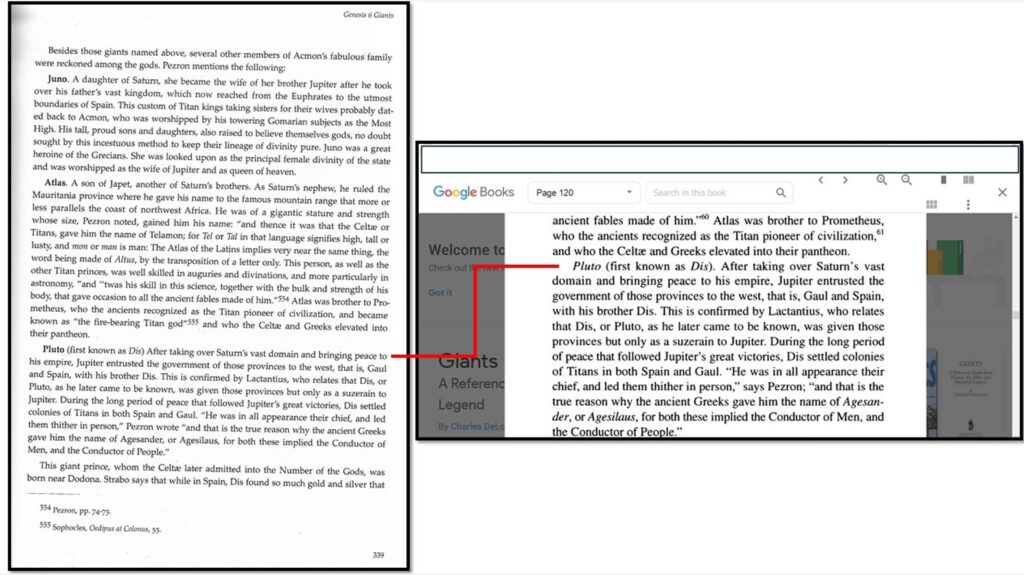
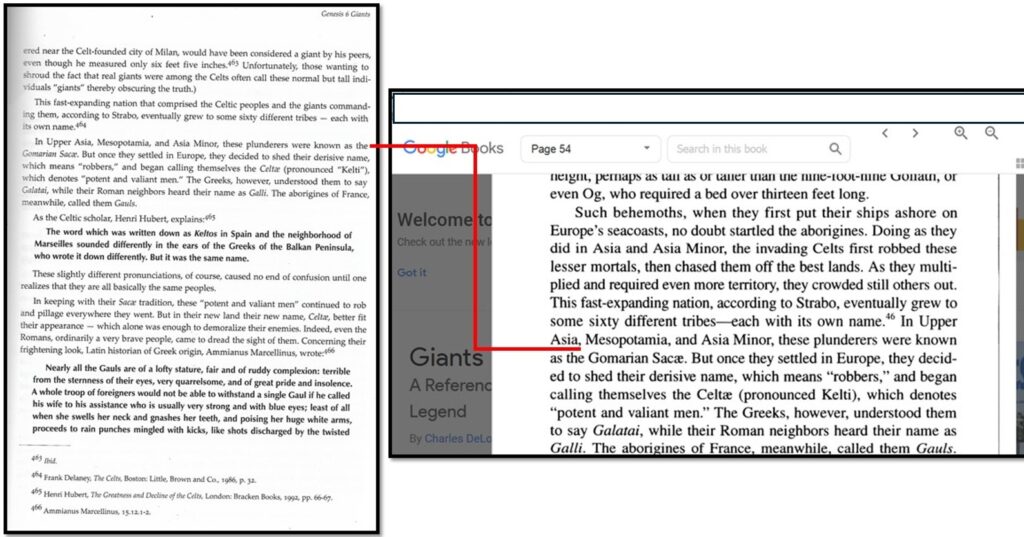
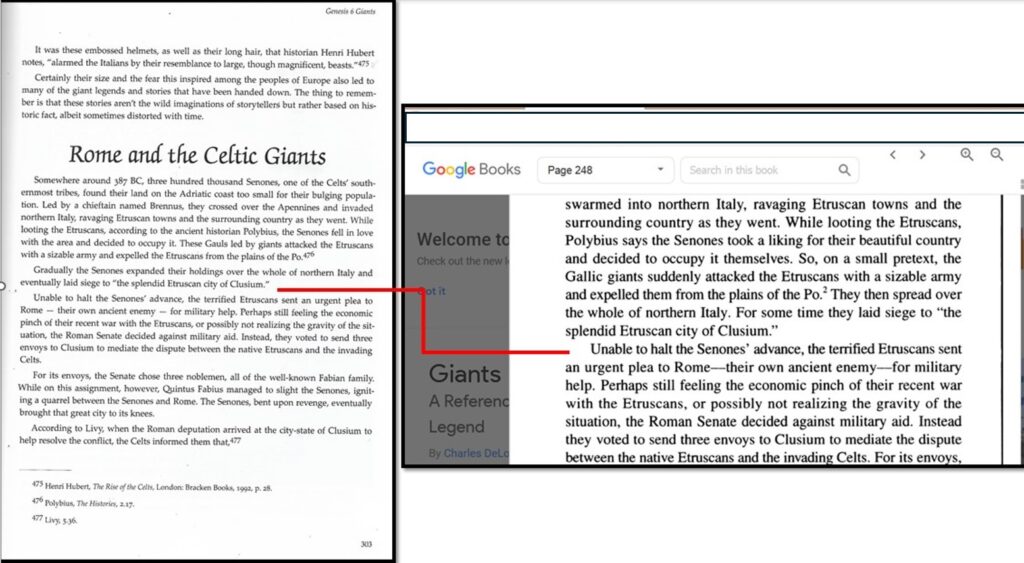
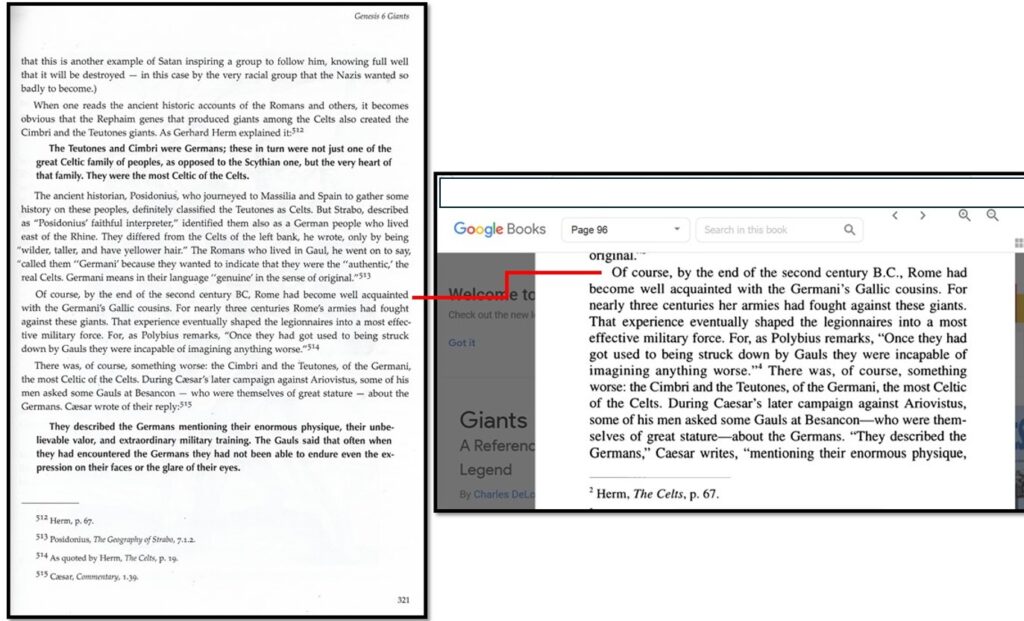
Steve Quayle published the 1st ed in 2005. Charles DeLoach published his book “Giants: A Reference Guide from History, the Bible, and Recorded Legend” in 1995 (by Scarecrow Press which was eventually taken over by University Press of America and/or Rowman). Quayle’s website and 2nd ed, published 2015, contains extended sections from DeLoach’s book without attribution and are therefore plagiarized.

Now, Quayle quote and otherwise references various authors and does refer to and footnote DeLoach.

slide1-1663298

Yet, there is no indication that various chapters of Quayle’s book are copied and pasted from DeLoach’s.

There are times when Quayle’s copying and pasting fail him, on a technical level: the level of the usage of technology, such as when he has it that “at the time of Israel’s invasion, the Anakim, Awim” while DeLoach has the transliteration correctly as “Avvim.”

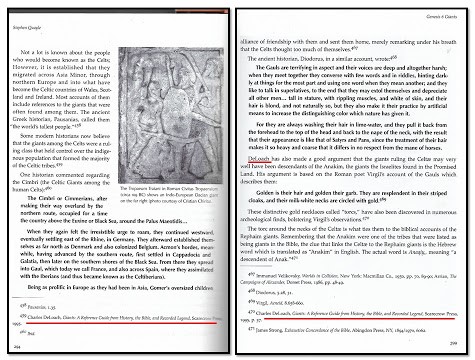
A least on one occasion, Quayle took a footnote by DeLoach and inserted into the text:

slide2-7012699

As you can see from the images, I do not have DeLoach’s book in hardcopy but only via Google books.

Google books are extended previews and do not display every single page thus, there are some sections I could not double check.
Moreover, that which follows are merely examples from entire chapters (plural).
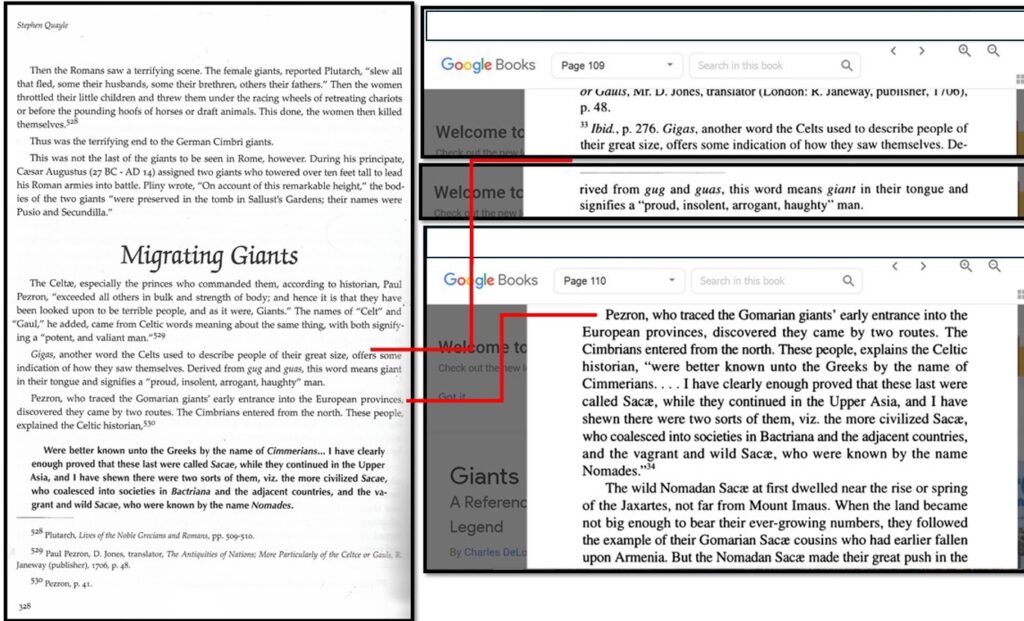
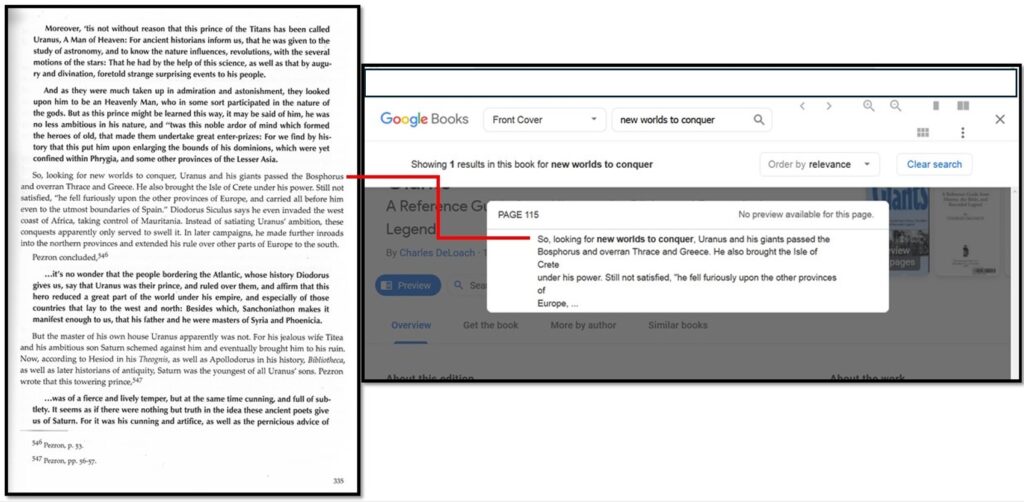
Also note that for any statement that I directly point to between the books, that which comes before it and that which follows are also DeLoach’s words pasted into Quayle’s books so there is much more than meets the eye.

Steve Quayle’s book is on the left, DeLoach’s on the right (you can click on the images to enlarge them).

slide3-5096197
slide4-6837234
slide5-1602655
slide6-4360059
slide7-9584461

I pondered what some responses may be and thought to note a few:

I am violating the New Testament principle of going to my brother first, then bringing someone with me, and then going to the church if the brother does not repent. Well, that is of primary use for a local church. As noted, I attempted the first step, attempted the second via contacting Prophecy Watchers, and have no idea how to attempt the third step since I have no idea where Quayle attends services. Also, it is acceptable for me to attempt to confront him much as Paul did to Peter—with the exception that I know not where to do it face to face.

But perhaps I am making this public due to well, fill in the blank: envy, hatred, inability to deal with Quayle’s facts-based views, etc. I also noted that this is about our both supposedly being Christians and authors and the integrity which is supposed to come therewith. My book and articles on my site contain the details of why the most problematic portions of Quayle’s book are the part he himself (as far as I know) wrote since they contain many non-biblical claims.

I just want to sell my books. Well, of course authors want to sell their books (and I have also given many away) since a “worker is worth his wages” and I never met anyone who made such a complain who worked for free at their own job.

Overall, any such objections would be to distract from the issue that the ball is in Steve Quayle’s court—even if it is not to me to whom he must give account. If you are disturbed by this information, then please contact him and he may reply. In other words, do not shoot the messenger but attempt to take the New Testament steps and pray that Quayle will set thing aright—for his own sake and the sake of those who reply upon him for wisdom.

See my various books here.

~~~~~~~~~~~~~~~~~~~~~~~

A plea: I have to pay for server usage and have made all content on this website free and always will. I support my family on one income and do research, writing, videos, etc. as a hobby.

If you can even spare $1.00 as a donation, please do so: it may not seem like much but if each person reading this would do so, even every now and then, it would add up and really, really help out.

Here is my donate/paypal page.

You can comment here and/or on my Twitter/X page, on my Facebook page, or any of my other social network sites all which are available here.
Atheist Response to Matt Powell’s Christian Response to Atheism

Matt Powell OFFICIAL Youtube channel posted a video tilted “A Christian Response to Atheism” which led to me having to tutor Atheists on their worldview and even the linguistics that pertain to it.

@TickedOffPriest commented

I am just typing random letters on my keyboard with no plan as to what the end comment will say.

@jpsammy573 chimed in with

lkjie githe ssiige thoesee.

I, @kenammi355, noted

Just like 99% of online Atheists ;o)

@TestMeatDollSteak

Mass extinctions, congenital birth defects, predation, contagious diseases, parasites, floods, famines, droughts, wildfires, volcanic eruptions, earthquakes, reversals of the magnetic poles, tsunamis, pain and suffering in general…I’m just listing various aspects of the apparent “plan” laid out before us.

@TickedOffPriest

You can focus on the rose or the thorns.

@TestMeatDollSteak

No, if you’re going to claim that literally everything that exists came into existence through the deliberate creative act of an omniscient, omnipotent intelligence, then own that belief in full and give him full credit for the vicious thorns as well as the pretty petals.

@TickedOffPriest

Some of that is free will other parts of it are the result of the curse.

However, something tells me that even if I were to answer every single question that you had, you would just come up with more.

@TestMeatDollSteak

Because those are apologetics, not actual answers to anything. The apologetics just beg additional questions and create additional theological problems. Mainly, the problem/question of why your supposedly all powerful, all knowing deity didn’t simply choose to create a world that always fully accords with his own will and intentions. “The fall of man” begs the question that God either isn’t capable or doesn’t know how to create a world that doesn’t “fall”.

@kenammi355

I hate to interrupt but let’s back up since you began by merely jumping to merely asserted conclusions based on mere hidden assumptions so, two issues, at least, come before what you’re asserting:

1) your implying a demand to adhering to logic but on Atheism logic is accidental, as is our ability to discern it, there’s no universal imperative to adhere to it, nor to demand that others do so. Ergo, that discredits your emotively subjective and impotent demands of adhering to it and you disqualified yourself from complaining about it or basing arguments upon it.

2) you implied that those things you listed are condemnable but only as another emotively subjective personal preference du jour since you neglected the most important part: what, on your worldview, is condemnable about those things? Now, since the only accurate reply is, “Nothing” then that disqualifies you from complaining about them.

And since you disqualified yourself from adhering to logic and ethics (which is the bottom line of that part of the issue) you discredited your rejection of God.

@thesc0tsm4n9 to me

yet again [since I posted on a few threads in that comments section], you’re presupposing nonsense and relying on non-sequitors to infer them as valid. 

you’re making ad hoc assertions without any substantiation for them.

@kenammi355

So then, you’re demanding adherence to logic (which is odd since you merely asserted) but then step one if for you to justify demanding adherence to logic, on your worldview. Without that, you’re just subjectively emoting about that your favorite ice-cream flavor is THE only good one and so everyone must only eat that one.

@TestMeatDollSteak

Wrong. Logic, like mathematics, is a formal description of the way that things appear to operate in the world around us. I am simply pointing out that you can’t make truth claims about things that aren’t at least comprehensible to you.

You’re also wrong about morality. All moral statements, even if they are made by some deity, are ultimately subjective judgment calls. Objective truths are true regardless of what ANY thinking, feeling being thinks or feels about them. Therefore, if there are such things as “objective moral truths”, theists have no better way to account for the existence of those objective moral facts than atheists or naturalists do. Consider the following trilemma:

Is “goodness” defined as anything that God commands? If so, then “goodness” is arbitrarily dictated by God’s subjective whims. Or, is there some standard of “goodness” that God must conform his commands and actions to? If so, then God cannot be the ultimate source of that standard, and he would instead be acting more as a messenger and/or enforcer of that standard. Or, is God himself the standard of “goodness”, such that his character or being is identical to “goodness”? If so, then the statement that “God is good” is rendered meaninglessly circular and tautological, like saying that “God is godly”, or “goodness is good”. From God’s perspective, he would just be doing what he wants to do and giving us arbitrary commands, and people such as yourself would be calling all of that “good” (which itself would just be a synonym for “God”).

No matter how you slice or dice it, the very idea of “objective morality” does not make sense.

@kenammi355

It appears that you bypassed my point by jumping right over it to where you feel comfortable—which is somewhere down the line, where you don’t belong yet since you haven’t worked your way there yet.

“Logic…is a formal description of the way that things appear to operate in the world around us” but you neglected THE key issue: “on Atheism logic is accidental, as is our ability to discern it, there’s no universal imperative to adhere to it, nor to demand that others do so.” So, you’ve done nothing but double down on a mere assertion.

“you can’t make truth claims about things that aren’t at least comprehensible to you” you first merely assume their incomprehensible to me and then make universal imperative demands about what I can’t do but that only bring us back to the issue you conveniently sidestepped.

Indeed, “Objective truths are true regardless of what ANY thinking, feeling being thinks or feels about them” but, here we go again, on Atheism objective truths are accidental, as is our ability to discern them, there’s no universal imperative to adhere to them, nor to demand that others do so. See, it all goes back to the same problem.

In fact, “there are such things as ‘objective moral truths’” and you prove it since you think it’s objectively immoral to claim to know objective morals and/or to claim “theists” have a better way to account for their existence.

Yes, I’m aware of your parroting of the Euthyphro dilemma but it’s not a dilemma, it’s a false dichotomy. But that’s a down the line discussion since you haven’t yet taken the very first step: justify demanding adhere to logic (and “morals”), on your worldview.

But hey, since you deny “objective morality” you utterly discredited yourself from ever condemning anything so what does it matter?—especially on a worldview according to which nothing objectively matters anyhow.

That brought the discussion to and end as no more replies were forthcoming.

See my various books here.

~~~~~~~~~~~~~~~~~~~~~~~

A plea: I have to pay for server usage and have made all content on this website free and always will. I support my family on one income and do research, writing, videos, etc. as a hobby.

If you can even spare $1.00 as a donation, please do so: it may not seem like much but if each person reading this would do so, even every now and then, it would add up and really, really help out.

Here is my donate/paypal page.

You can comment here and/or on my Twitter/X page, on my Facebook page, or any of my other social network sites all which are available here.
The Think Theology site on Nephilim, Anakim, and Why We Care

Andrew Wilson, “Teaching Pastor at King’s Church London, and has degrees in history and theology from Cambridge (MA) and King’s College London (PhD),” wrote an article titled Nephilim, Anakim, and Why We Care for the Think Theology site that I thought to review when it was brought to my attention by someone who had trouble evidencing post-flood Nephilim.

Wilson lays out a view that, “Nephilim (Gen 6:1-4) were the results of sexual relations between angels and women.” The original, traditional, and majority view among the earliest Jewish and Christians commentators, starting in BC days, was the “Angel view” as I proved in my book, On the Genesis 6 Affair’s Sons of God: Angels or Not? A Survey of Early Jewish and Christian Commentaries Including Notes on Giants and the Nephilim.

He notes, “Many don’t” hold that view and, “the best counterargument is that Jesus says in Matthew 22:30 that it is impossible for angels to have sex.” That is a very common manner in which to put it, a reference to all, “angels” in general. Yet, Jesus’ statement was very detailed, very nuanced, He employed qualifying terms, “the angels of God in heaven.” So, not all Angels at all times in all places but the loyal ones, “in heaven” and, “of God” (see various versions here) which is why those who did marry are considered sinners since they, “left their first estate,” as Jude put it, in order to do so.

Unfortunately, he then makes a fundamental error by writing:

I also take it as read that the Anakim, the sons of Anak whom we meet in the book of Numbers, Deuteronomy and Joshua, are descended from the Nephilim: “And there we saw the Nephilim (the sons of Anak, who come from the Nephilim), and we seemed to ourselves like grasshoppers, and so we seemed to them” (Num 13:33).

Which is to say that, when Israel first spied out and then conquered the Land, there were very large individuals milling around, who could trace their lineage back to sexual relations between angels and women. Bizarre, admittedly. But biblical.”

Let’s ask ourselves what it means that something is, “biblical.” If it means recorded in the Bible well, sure: so are Satan’s deceptions. If it means biblical doctrine then no, it’s not, “biblical” and neither are Satan’s deceptions.

But there’s a reason why Pastor Andrew Wilson was forced to only quote that one single verse and it’s because 100% of post-flood Nephilology is based on that one single sentence. Yet, he didn’t bother elucidating that he’s appealing to one sentence from an, “evil report” by 10 unreliable guys whom God rebuked. He didn’t even mention that he’s forced to rely on non-LXX versions, since that version lacks reference to Anakim in that verse, nor that Moses relates that event in Deut 1 but doesn’t mention Nephilim—on and on and on the problems go by uncritically relying on that one vrse, see my post Chapter sample: On the Post Flood Nephilim Proposal.

As for that, “The question is: why do we care?” he notes, “they provide a biblical basis for biological continuity between antediluvians and postdiluvians” but we’re told five times how that happened and it’s due to the 8 people on the ark: Nephilim aren’t mentioned in any of those lists (Genesis 7:7, 23; Hebrews 11:7; 1 Peter 3:20; and 2 Peter 2:5).

Wilson’s biology has biological corruption continuing right past the flood as if God missed that loophole. He merely asserts, “some people on earth, besides Noah’s family, survived the flood” which, again, contradicts the Bible five times.

He asserts that due to misreading, misunderstanding, misinterpreting, and misapplying one single post-flood sentence and making a rookie pop-Nephilology error: reading all the way to Num 13:33 (ignoring the narrative but just reading one single sentence, uncritically picking it up, running with it, and applying it) which then becomes a worldview, a hermeneutic whereby to then misread, misunderstand, misinterpret, and misapply other single verses or even fragments of verses.

See, he asserts, “If everyone on earth apart from Noah’s family had died, then there would be nobody left who was descended from (min) the Nephilim—but the Anakim show that this is not the case.” Indeed, biblical doctrine is, “everyone on earth apart from Noah’s family had died” but then it’s: period, full stop. Yet, centuries post-flood 10 unfaithful, disloyal, unreliable guys just made up a fear-mongering, scare-tactic, “evil report” wherein they made five assertions unbacked by even one single other verse in the whole Bible and contradicted Moses, Joshua, Caleb, God, and the rest of the whole entire Bible. But this pastor tells us that if the biblical doctrine is the case, “then there would be nobody left who was descended from (min) the Nephilim—but the Anakim show that this is not the case.”

Again, no, it’s not, “the Anakim show” but that a non-LXX view of Anakim in one single sentence from an utterly unreliable source.

Now, even though, again, we’re told five times—five—who survived the flood and Nephilim aren’t on any list, the pastor tells us, “even from the perspective of Israelites in the Bronze Age, the cataclysmic flood did not wipe out every single person on planet earth outside the ark.” Yet, the logical, bio-logical, the theo-logical conclusion would really be, “even from the perspective of merely 10 unreliable guys whom God rebuked (and undiscerning people who actually believe them to this date), the cataclysmic flood did not wipe out every single person on planet earth outside the ark.”

Andrew Wilson then gets into attempting to poke holes not in the, “evil report” but in the reliable Gen 6-7 records since the apparently infallible evil report, “suggests that the scope of phrases like ‘the whole land’ (qol erets) and ‘all mankind’ (qol adam) is limited to the ancient Near East…” etc. Yet, the scope of the flood is irrelevant to Nephilology since they either didn’t make it past the flood because it was global or because they lived in the flooded region: either way, they didn’t make it past the flood in any way, shape, or form.

~~~~~~~~~~~~~~~~~~~~~~~~~~~

See my books:

Noah’s Flood, the Deluge, Global or Local?, Vol I: A Historical Survey of Views from BC to AD

And:

Noah’s Flood, the Deluge, Global or Local?, Vol II: A Historical Survey of Commentaries from the 1500s to the 2000s

~~~~~~~~~~~~~~~~~~~~~~~~~~~

Now, the moment that my eyes alighted on the term kherem in the article I knew what, at least, part of the problem was, he continued by writing that (supposedly alleged) post-flood Nephilim, by any other name, I suppose:

…provide vital context for the kherem warfare that took place in Canaan under Joshua. This is a point I had never seen until I read Michael Heiser’s The Unseen Realm recently, and in particular his description of the “Deuteronomy 32 worldview,” in which Yahweh has disinherited the nations and assigned them to the rule of lesser gods (Deut 32:8 etc). Heiser explains:

Israel is Yahweh’s elect portion of humanity, and the land of Canaan is the geography that Yahweh, as owner, specifically allotted to his people. In the view of the biblical writers, Israel is at war with enemies spawned by rival divine beings. The Nephilim bloodlines were not like the peoples of the disinherited nations … the target of kherem was the Anakim.

Well, the pastor really should have read the Bible rather than Heiser, on this point. Dr. Heiser was credentialed and experienced but not infallible, his Nephilology wasn’t biblical, and he tended to create more problems than he solved—search online for these articles for examples:

Review of Amy Richter and Michael Heiser on four Enochian Watcher related women in Jesus’ genealogy

Rebuttal to Dr. Michael Heiser’s “All I Want for Christmas is Another Flawed Nephilim Rebuttal”

I also featured Heiser in my book, The Scholarly Academic Nephilim and Giants: What do Scholarly Academics Say About Nephilim Giants?

In my book What Does the Bible Say About Giants and Nephilim? A Styled Giantology and NephilologyI included an entire chapter just on this issues and quoted the many times that God told us why He commanded such things and, hint, He never said one single word about Nephilim, nor relation to them, not biological/genetics/bloodline issues—never, ever.

Andrew Wilson then reviews some of Heiser’s points, “Heiser offers a number of clues that he is right about this. (1) The emphasis on giantism in the initial spying mission (for all that this has since been domesticated in contemporary preaching, the point is not just that the people are large, but that they are descended from rival deities).”

I trow not. 1) there is no, “emphasis on giantism” which is a genetic disorder and 2) the only emphasis on subjectively unusual height for Nephilim is well, guess where: in one sentence form an evil report by 10 unreliable guys whom God rebuked.

Let’s succinctly review. We’re told that Rephaim, by any of their a.k.a., were, “tall” in general and with that being a vague, generic, subjective, and multi-usage term which, in this case, means taller than the average Israelite male who was 5.0-5.3 ft. in those days.

Then the more to the point issue is that the 10 unreliable guys where part of the 12 spies who reconnoitered the land of Cannan before moving into it. The original report in the narrative of Num 13 has the problem being various, “strong” people groups (living in large, well-fortified cities). The 10 chimed in to dissuade the Israelites from doing that God commanded them and agreed that the problem was that the peoples were, “stronger.” Yet, since Caleb went on to encourage the Israelites (with Joshua siding with him), the 10 took it up a notch—many tall-tale notches, actually—and only then did they embellish the original report and contradicted it.

Only then did they merely assert something that’s unknown in the whole entire rest of the whole Bible: that Nephilim somehow made it past the flood, that (in non-LXX versions) Anakim were related to them (in some impossible way), and that Nephilim were very, very, very tall.

Wilson complains that, “this has since been domesticated in contemporary preaching” but any and all biblical-doctrine preaching must include that conclude that Nephilim didn’t make it past the flood in any way, shape, or form but centuries post-flood some guys merely asserted seeing them and were rebuked, to death.

Wilsons’ next Heiserian point is, “The explicit statement that the Israelite spies had seen the Nephilim in the Land (Num 13:33).” Yet, one reason for having written the Rebuttal to Dr. Michael Heiser’s “All I Want for Christmas is Another Flawed Nephilim Rebuttal” article was that Heiser admitted that he only reluctantly interacted with that verse due to critical pressure to do so. Think about it, there are only two sentences in the Bible about Nephilim and a scholar who specialized on such issues admitted that he ignored a full 50% of the data only until enough people noticed and critiqued him about it.

In any case, Heiser committed the post-flood Nephilologists 101 level error: he merely picked up that one sentence, ran with it, force-fitted other sentences or fragments of sentences into the mess that one sentence makes, and applied it as if it’s reliable.

And note how this was presented to us, in a generic manner of that it was stated as, “the Israelite spies” in general. Thus, this was really as case of the statement that is explicitly told to us to be a statement within an evil report that 10 of the Israelite spies, the unreliable ones who were rebuked, had seen the Nephilim in the Land when it’s literally impossible that they had.

This point continued with, “The giant-like descriptions of enemies of God who live in the land, from Og (Deut 3:11) to Goliath (1 Sam 17) and beyond (2 Sam 21; 1 Chr 20).” It would appear that rather than sussing out biblical doctrine, the pastor read Heiser, liked it, and uncritically repeated it.

How could there be, “giant-like descriptions of…Og” when we’ve no physical description of him?

Also, just what is, “giant-like” when the term, “giant” is just as vague, generic, subjective, and multi-usage as, “tall”?

For Goliath, we actually have a measurement yet, the pastor fails to inform us that the Masoretic text has him at just shy of 10 ft. Yet, the earlier LXX and the earlier Dead Sea Scrolls and the earlier Flavius Josephus all have him at just shy of 7 ft.: so that’s the preponderance of the earliest data.

As for, “beyond” well, the cited texts speak about Rephaim.

So, we have zero reliable correlation to Nephilim and the only reason to even imagine that tall or, “giant-like” has anything whatsoever to do with Nephilim is one single unreliable sentence.

The next point is, “Joshua’s kherem conquests (Josh 11:21-23) focuses on the obliteration of the Anakim.” Indeed, and we know they’re named after Anak who was Arba’s son with zero reliable indication that it’s even possible Arba has related to Nephilim in any way, shape, or form.

The next point is, “the ongoing presence of giants in the land of the Philistines.” Now, notice what has happened here: he has jumped from the specific and ancient Hebrew terms Nephilim and Anakim to the vague, generic, subjective, multi-usage and modern English word “giants.” When one does that, they can then chase that English word around a Hebrew Bible and think they made connections between text that actually have no correlation whatsoever.

The key questions are:

What’s the usage of the vague, generic, subjective, multi-usage and modern English word “giants” in English Bibles?

What’s Wilsons’ and/or Heiser’s usage of the vague, generic, subjective, multi-usage and modern English word “giants”?

Do those two usages agree?

Well, biblically contextually, “the ongoing presence of giants in the land of the Philistines” reads as, “the ongoing presence of Rephaim in the land of the Philistines.” Nephilim were strictly pre-flood hybrids, Rephaim were strictly post-flood humans, and there’s zero correlation between them.

Wilsons’ conclusion is, “why should we care about the Nephilim and the Anakim? Partly because they help us think through the question of the global/local flood” and we see that he opted for a local flood due to reading all the way to Num 13, exclusively verse 33, and turning that into an infallible hermeneutic—when it is really just eisegesis.

Also, “they provide crucial context for our understanding of kherem warfare” yet, his and Heiser’s assertions about that fail in every possible way.

Plus, “we should care about things that are in the Bible. There’s always that” and what’s in the Bible is that God didn’t fail, He didn’t miss a loophole, the flood wasn’t much of a waste, He revealed five time who survived, and He rebuked the guys who merely asserted what Wilson and Hesier take as being infallibly true.

See my various books here.

~~~~~~~~~~~~~~~~~~~~~~~

A plea: I have to pay for server usage and have made all content on this website free and always will. I support my family on one income and do research, writing, videos, etc. as a hobby.

If you can even spare $1.00 as a donation, please do so: it may not seem like much but if each person reading this would do so, even every now and then, it would add up and really, really help out.

Here is my donate/paypal page.

You can comment here and/or on my Twitter/X page, on my Facebook page, or any of my other social network sites all which are available here.
Discussing Atheist Jaclyn Glenn’s 10 Shocking Myths About Atheism – DEBUNKED

Such is the title of a YouTube video and a certain @irrelevant_noob was kind enough to time-stamp the supposed myths that were allegedly debunked:

0:26 1. Atheism is a belief system

1:39 2. Atheists have no morals

2:00 3. Atheists think that everything is random

4:07 4. Atheism makes people feel like life is meaningless, and may even lead to Nihilism

4:37 5. Atheists are unhappy people

6:29 6. Atheists hate God

7:25 7. Atheism is just another religion

8:16 8. Atheists can’t explain miracles

8:43 9. Atheists are closed-minded

9:07 10. Atheists don’t exist

I, @user-oq9hn7qk4j, replied

Atheism is a belief system: indeed, even Richard Dawkins references an Atheistic world-view since Atheism is a core and infects all which it touches so it becomes a “belief system.”

Atheists have no morals: all they have is morals since morals refers to the mores which are mere descriptions of whatever accidentally existing apes just so happen to be doing.

Atheists think that everything is random: “everything” in terms of that everything is a byproduct of an accident so that, for example, even if an individual Atheist makes a decision, that decision is just the byproduct of an accidental mixture of accidental chemicals within an accidentally existing brain functioning as per the accidental laws of accidental physics.

“Atheism makes people feel like life is meaningless, and may even lead to Nihilism”: indeed, such is why Atheists adhere to the consoling delusion of subjective meaning in an objectively meaningless existence.

“Atheists are unhappy people”: I guess happy is as happy does so, what does that even mean?

“Atheists hate God”: well, of course, just listen to them for five minutes.

“Atheism is just another religion”: indeed, according to some Atheists such as Micheal Newdow.

“Atheists can’t explain miracles”: well, they could explain actual ones as the work of God but there are many levels of, sorts of, explanations.

“Atheists are closed-minded”: individual Atheist may not be but their dogmatheism is thought restricting by definition.

“Atheists don’t exist”: well, they exist but have to work hard at it.

@ChixieMary commented

My life as an atheist is exponentially better than my life as a Christian.

“Better” is entirely subjective.

My life is better by my own experiences. That’s all that matters.

My life, is not spent being miserable, depressed, suicidal or mired in self loathing and hypocrisy.

That’s “better” .

Atheism only speaks to not be leaving in any gods, nothing else.

We all make meaning and purpose in our lives. We all have capacities to judge what is better for ourselves and for the people around us with standards that we choose.

We don’t have to have them imposed upon us from an ancient book of fables or a group of authoritarians.

@user-oq9hn7qk4j

Perfectly said, “‘Better’ is entirely subjective” on your world-view so you just make up stuff, slap the label “better” on it and then emotively subjectively merely authoritatively assert, “My life is better” which collapses your entire point.

So, when you come to merely asserting, “That’s ‘better'” I have to tap you on the shoulder and remind you that, “Better’ is entirely subjective.”

As for, “Atheism only speaks to not be leaving in any gods, nothing else” well, that’s tragically jejune since it’s a world-view–as Richard Dawkins has noted.

I also see you’ve taken on one of Atheisms’ consoling delusions: the delusion of subjective meaning in an objectively meaningless existence. But isn’t it that case that “meaning” is entirely subjective? Well, sure since you asserted, “We all make meaning and purpose in our lives.”

Indeed, on your view, “We all have capacities to judge what is better for ourselves and for the people around us with standards that we choose” and so Joseph Stalin made that emotively subjective judgment and those Atheist like him decided to wipe out some 200,000,000 people in mere decades–and on Atheism, there’s literally nothing wrong with that and, in fact, it was a good thing since it rid us of less fit people and feed up lots of resources for the more fit.

“ancient book”: genetic fallacy. Is there anything wrong with committing logical fallacies, on your world-view?

“of fables”: merely asserted positive affirmation.

 a group of authoritarians”: but on your world-view, that group (which group?) judged what is better for themselves and for the people around them and since all is subjective then you disqualified yourself from complaining about it since you debunked yourself.

That brought the discussion to an end as no more replies were forthcoming.

See my various books here.

~~~~~~~~~~~~~~~~~~~~~~~

A plea: I have to pay for server usage and have made all content on this website free and always will. I support my family on one income and do research, writing, videos, etc. as a hobby.

If you can even spare $1.00 as a donation, please do so: it may not seem like much but if each person reading this would do so, even every now and then, it would add up and really, really help out.

Here is my donate/paypal page.

You can comment here and/or on my Twitter/X page, on my Facebook page, or any of my other social network sites all which are available here.
Hope Bolinger answers Who Was Anak and Did He Spawn Giants?

I am reviewing Hope Bolinger’s (“an acquisitions editor…author of almost 30 books…”) Christianity.com article Who Was Anak and Did He Spawn Giants? due to the portion of a longer discussion I had with a certain William Uchtman which follows, since he asserted, “Numbers 13:33 mentions King Anak/Arak, a cruel king who is said to be a descendant of the Nephilim, and ancestor of the Anakim who go to war with the Israelites.”

I replied, “There’s no such thing as, ‘King Anak/Arak’ anywhere. ‘said’ by whom ‘to be a descendant of the Nephilim’?”

William replied, “Maybe the name was edited out of whatever version of the Bible you’ve read. The name IS mentioned in several books on Biblical history.”

I, in turn, noted, “Cool, in that case: just quote and cite the book, chapter, and verse(s) and the version.”

He replied, “Here’s a link with all the history on Anak. Who Was Anak and Did He Spawn Giants?”

I commented, “So, you asserted but you don’t know. And now, even though I wrote a whole chapter about Anakim and another whole chapter about Rephaim in my book ‘What Does the Bible Say About Giants and Nephilim? A Styled Giantology and Nephilology’ I have to read an article because you can’t back your assertions. I’ve familiarized myself with over two millennia worth of relevant data that I used to write my dozen or so Nephilology books but whenever someone realizes they can’t support their assertions they think the answer is to do one internet search and tell me to go read an article or watch a video.”

William Uchtman relied, “Can you please be more specific? You’re not explaining anything. You’re doing a commercial for your book.”

I noted, “That’s a tragically unfriendly thing to say to someone who has interacted with you on three threads: makes me think I’m wasting my time. I’ve already noted various times that you believe what you do about Anakim based on:

one single sentence from an ‘evil report.’

one single sentence by unfaithful, disloyal, unreliable guys.

Guys whom God rebuked.

Who merely made assertions unbacked by even one single other verse in the entire Bible.

Guys who contradicted Moses, Caleb, Joshua, God, and the rest of the whole Bible.

You’re only looking at exclusively non-LXX versions of that one single sentence.

Do you want me to keep going?”

And while that discussion is ongoing, I will tackle his go-to source of info—which, BTW, does not affirm a, “King Anak/Arak” since not such personage is known to history.

The first question she asks, and answers, is, “Who Was Anak and Did He Spawn Giants?” due to the wording of the question and the wording on the answer which includes, “it appears he fathered giants,” the key questions are:

What’s the usage of the vague, generic, subjective, multi-usage and modern English word “giants” in English Bibles?

What’s Bolinger’s usage of the vague, generic, subjective, multi-usage and modern English word “giants”?

Do those two usages agree?

We will have to see if she gives us enough data to discern those answers along the way.

She dives into the answer by also asking, “Did he have something to do with the Nephilim—the demon-human hybrids that appeared before (and maybe after) the time of the flood?” Well, it wasn’t, “demon-human” but, “Angel-human and never after the flood: since God didn’t fail and the flood wasn’t much of a waste.

She notes, “Anak…was a descendant of a man named Arba (Joshua 15:13)…Anak…was considered a ‘great man,’” such that the Anakim clan of the Rephaim tribe were named after him. Hope Bolinger notes that he wasn’t, “great…by moral standards. Most likely, he was considered great for his appearance—his physical prowess.” Yet, three’s no indication of any of those things since, as she goes on to say, “We’re not given many explicit details about him.”

The key questions are key because, for example, when she follows directly with, “We know many giants descended from Anak (we get this detail from passages such as Deuteronomy 2:19-21 and Numbers 13:1-2)” that reads as, “We know many _________ descended from Anak.”

I discern that by, “giants” she means something vaguely generic about subjectively unusual height: which is not helpful since it’s unspecific and only begs questions. If that’s the case, then the answer to the third question is, “No.” That’s because the usage of the word “giants” in English Bibles is that it merely renders (doesn’t even translate) “Nephilim” in 2 verses or “Repha/im” in 98% of all others and so never even hints at anything to do with any sort of height whatsoever.

Deuteronomy 2 tells us that Rephaim had some a.k.a.s such as Emim and Zamzummim and that, on average, they were, “tall.” Yet, of course, that’s just as vague, generic, subjective, and multi-usage as the modern English word “giants.” And it’s subjective to the average Israelite male who was 5.0-5.3 ft. in those days.

Numbers 13:1-2 notes, “The Lord spoke to Moses, saying, ‘Send men to spy out the land of Canaan, which I am giving to the people of Israel. From each tribe of their fathers you shall send a man, every one a chief among them’” so I’m unsure what relevance that has—at least at this point.

Hope Bolinger notes, “We know before Anak was born, ‘the sons of God went to the daughters of humans and had children by them’ (Genesis 6:4)” indeed, many centuries before.

She refers to, “giants called the Nephilim” but biblically contextually, that means, “Nephilim called the Nephilim” and she follows directly with, “We also know that God wiped out most of humanity through the flood, presumably killing off the original race of giants.” So, she’s jumping from the specific ancient Hebrew term, “Nephilim” to the vague, generic, subjective, multi-usage modern English word “giants” which makes things more confusing and hard to follow. Yet, we know by now that she’s just misusing the English word.

As for, “presumably” well, since biblically contextually those, “giants” were Nephilim then they 100% didn’t make it past the flood—in any way, shape, or form—since God didn’t fail and the flood wasn’t much of a waste.

Now, she refers to, “other giants, such as Goliath, appearing on the scene after the flood” but since by, “giants” she means something about unusual height then since she hasn’t written a single word about why we should think that Nephilim were even subjectively unusually tall so there’s nothing to which to add, “other.”

She wrote that Goliath, “was ‘six cubits and a span’ (1 Samuel 17:4), somewhere six and a half feet tall and 10 feet tall—we can imagine the Anakim could boast tall statures.” Yet, she didn’t inform us that it’s a myopic statement since the Masoretic text has him at just shy of 10 ft. Yet, the earlier LXX and the earlier Dead Sea Scrolls and the earlier Flavius Josephus all have him at just shy of 7 ft. (compared to the average Israelite male who was 5.0-5.3 ft. in those days) so that’s the preponderance of the earliest data. So, “we can imagine the Anakim could boast tall statures” taller than 5.0-5.3 ft.

She notes that Anak, “Fathered a Race of War-like People (Deuteronomy 9:2)” about which I will say, sure. Yet, Hope Bulinger wrote that, “Numbers 1[3]:33 says that Anak’s race was descended from the Nephilim, which may explain why they were big.” Well, “big” is just as vague, generic, subjective, and multi-usage as, “giants” and we’ve still no reason to think that Nephilim were even whatever, “big” means.

She didn’t elucidate that she’s directing us to an “evil report” by 10 unreliable guys whom God rebuked. They just made up a fear-mongering scare-tactic tall-tale that’s unsupported by even one single other verse in the whole entire Bible. And, if she, for some odd reason, actually believes guys whom God rebuked then she needs to tell us how Nephilim made it past the flood, past God, which made the flood much of a waste. Moreover, she also didn’t tell her readers that the key fragment of the unreliable verse upon which she’s relying can only come from non-LXX versions since the LXX lacks any reference to Anakim in that verse.

She speculates, “Given that the Numbers passage” which is utterly unreliable, “describes Anak’s people as descended from the Nephilim, we may wonder how Anak connects to this race of giants spawned by demons” again, Angels, “Perhaps after the original Nephilim died in the flood, demons got involved in human affairs again and bred more giants.” Well, there’s zero indication of any such thing, the Angels who did that pre-flood were locked away (Jude and 2 Peter 2) and there’s only a one-time fall of Angels in the Bible, God didn’t miss that loophole, etc.

Hope Bolinger actually wrote, “Scripture isn’t clear on whether Anak was born before or after the flood” but Anakim didn’t exist until centuries post-flood and we know the names of all of the males who survived the flood and Anak isn’t one of them and she hits this point, “it’s hard to imagine how he could have descendants if he died in the flood, given that he wasn’t one of Noah’s sons (Shem, Ham, Japeth) who was in the ark” so why even speculate in that dead-end direction?

Yet, she just shifts the speculation in another direction, “Anak was probably born after the flood, perhaps fathered by demons trying to breed more Nephilim with sons of Canaan” for which there’s literally zero indication whatsoever. Again, we don’t even know if Anak was personally even a jerk—even if his descendants were trouble.

She firmly asserts, “By the time Joshua and the Israelites arrived in Canaan, some Nephilim were still around (Numbers 13:33-34)” and, “The Israelite spies stated that next to the Nephilim, they felt like grasshoppers (Numbers 13:34)…Nephilim (and presumably their descendants like the Anakim) were huge.” Note that for those assertions she could only rely on that one infamous sentence: without it, we have no post-flood Nephilim nor, “huge” (just as vague, generic, subjective, and multi-usage as, “big,” “tall” and, “giants”).

And note the vague manner in which that’s misrepresented: recall the verse about, “Send men to spy out the land of Canaan” well, there were 12 of them but she wrote an all-encompassing term, “The Israelite spies” rather than specifying that she’s actually appealing to the 10 unreliable ones.

She notes, “Since demons,” Angels, “fathering children with humans would go against God’s holy order of creation, it would make sense that the Nephilim and Anakim had to be destroyed. This happened years later, in the Promised Land” but that’s an anachronistic category error since the last of Nephilim were destroyed in the flood and centuries later the utterly unrelated Anakim were destroyed for different reasons.

Hope Bolinger goes on to circle back to Goliath and notes he, “was tall. To the point where no one—but a shepherd boy from Israel—would fight him” but that’s myopic since the text also specified that he was a, “champion.” She also notes, “He seems to have many giant characteristics” which she seems to conclude based on, “Gath…the city was huge…built for huge people…a tall breed of people” with, “huge…tall” being vague, generic, subjective, and multi-usage.

She also circles back to the flood in the conclusion wherein she noted, “Satan…tried to make human-demon hybrids…When God wiped them out, he decided to start over with the line of Anak” for which there’s literally zero indication—except, perhaps, one single non-LXX version’s worth of one line from an evil report by unreliable guys whom God rebuked.

Bottom line is that by employing vaguely generic terminology, not defining terms, misusing terms, and failing to elucidate the complexities of certain issues by being myopic (purposefully or due to lack of awareness) we can certainly concoct fascinating tall-tales and speculate in various directions. Yet, such is why modern, especially pop, Nephology is the unreliable and un-biblical thing which it currently is.

See my various books here.

~~~~~~~~~~~~~~~~~~~~~~~

A plea: I have to pay for server usage and have made all content on this website free and always will. I support my family on one income and do research, writing, videos, etc. as a hobby.

If you can even spare $1.00 as a donation, please do so: it may not seem like much but if each person reading this would do so, even every now and then, it would add up and really, really help out.

Here is my donate/paypal page.

You can comment here and/or on my Twitter/X page, on my Facebook page, or any of my other social network sites all which are available here.
Review of Nephilim: Who are the giants of the Bible, Jewish lore?

Aaron Reich wrote an article titled Nephilim: Who are the giants of the Bible, Jewish lore?

Since he beings by asserting, “Nephilim are giants” we need to be on the lookout for whether, in one way or another, he will answer these key questions:

What’s the usage of the vague, generic, subjective, multi-usage and modern English word “giants” in English Bibles?

What’s Reich’s usage of the vague, generic, subjective, multi-usage and modern English word “giants”?

Do those two usages agree?

Reich oddly claims that they, “appears in three locations in the Bible…Genesis…Numbers and…Ezekiel.” Most sources list the first two so let’s work our way through them.

First, “The Nephilim were on the earth in those days, and also afterward, when the sons of the nobles would come to the daughters of man, and they would bear for them; they are the mighty men, who were of old, the men of renown” since, “in Genesis 6:2, it says the following verse: ‘That the sons of the nobles saw the daughters of man when they were beautifying themselves, and they took for themselves wives from whomever they chose.’

Reich notes, “the phrase ‘sons of the nobles’ is a translation of ‘bnei elohim,’ which can be translated as ‘sons of God’” yet, “According to the biblical commentator Rashi, the phrase refers to the sons of princes and judges” while, “Others have posited that the sons of God were angels who had children with humans.”

Rashi—Rabbi Shlomo ben Yitzchaki or Salomon son of Isaac—lived  1040-1105 AD which is after centuries of commentary upon that text. The original, traditional, and majority view among the earliest Jewish and Christians commentators, starting in BC days, was the “Angel view” as I proved in my book, On the Genesis 6 Affair’s Sons of God: Angels or Not? A Survey of Early Jewish and Christian Commentaries Including Notes on Giants and the Nephilim.

The princes or judges or nobles view is actually one of the earliest ones but was held by about 1% of the sources. That claim is that it pertained to polygamy—which would have apparently become too rampant since Lamech was a polygamist but no flood resulted from that.

Reich notes, “this theory is especially popular among Christians, it is present in Judaism too, specifically in the Midrash[im]…in the Talmud [Bavli], in Nidah 61a and Yoma 67b.”

As a side note, he notes, “Satan is but another angel” but he’s actually a Cherub (Ezek 28:14).

Continuing, “The next mention of Nephilim in the Bible is in the Book of Numbers, regarding the tale of the spies…‘They spread an [evil] report about the land which they had scouted, telling the children of Israel, ‘The land we passed through to explore is a land that consumes its inhabitants, and all the people we saw in it are men of stature. There we saw the giants, the sons of Anak, descended from the giants. In our eyes, we seemed like grasshoppers, and so we were in their eyes” (brackets by Reich).

Let’s slow down a sec since reference was made to, “the spies…They” but 12 spies were dispatched but it was the 10 unfaithful, disloyal, unreliable ones who presented that within the evil report and were rebuked by God: there’s literally no reason to believe their mere assertions—see my post Chapter sample: On the Post Flood Nephilim Proposal.

He notes, “the word ‘Nephilim’ translated as giant” but technically that’s a rendering, not a translation. In fact, he noted, “Rashi says that the word Nephilim is actually derived from the word ‘naflu,’” typically transliterated as naphal, “itself a root of the verb ‘to fall.’” Aaron Reich notes, “The inconsistency regarding the translation of this word is a recurring issue here” and it is, it’s a HUGE issue which leads to all sort of assertions and problems such as word-concept fallacies.

Now, he points out, “Here, the verse identifies the giants as the sons of Anak” and note that he’s surely consulting a Masoretic version while the LXX version lacks any reference to Anakim in that text. Bottom line is that since there’s never been any such thing as post-flood Nephilim, in any way, shape, or form, then no one post-flood could have come from them, be in any way related to them, etc., and that’s because God didn’t fail, didn’t miss a loophole, the flood wasn’t much of a waste, etc.

Reich concludes, “The question of angelic descent isn’t really an issue here” since Nephilim weren’t really there and Anakim aren’t related to them and, “In this case, these Nephilim seem to simply be giants” but we still don’t know to what the word, “giants” refers.

We then come to, “the Book of Ezekiel…‘But they will not lie with the mighty men, [for they are] inferior to the uncircumcised who descended to the Grave with their weapons, and they laid their swords under their heads and their iniquities were upon their bones, for the destruction of the mighty was in the land of the living’…the phrase ‘mighty men’ in Hebrew is either ‘Gibborim noflim’ or ‘Gibborim Nephilim.’”

Well, it’s more like naphal gibborim as in a mere reference to once mighty men who have fallen, dead which is actually Aaron Reich’s point, “If the case is the former, which seems likely, then it simply means ‘fallen heroes’ or ‘fallen warriors.’”

Regarding, “other giants in the Bible” I would ask, “other” besides whom? He notes, “aside from the Anakim, there were also the Repha’im…though whether they are physical giants or ghosts or deified ancestors is another debate altogether…Amorites…the Bible describes them as massive, gigantic figures…Among specific giants in the Bible, however, two stand tall above the rest: Og and Goliath…”

Let’s unpack that:

It would appear that by, “giants” Reich means something vague generic about subjectively unusual height. Thus, the answer to the third key question is, “no” since that’s not the English Bible’s usage since therein, it merely renders (doesn’t even translate) “Nephilim” in 2 verses or “Repha/im” in 98% of all others and so never even hints at anything to do with any sort of height whatsoever.

Now, since the only physical description we have of Nephilim is from an unreliable evil report then we’ve no reliable physical description of them.

Anakim were a clan of the Rephaim tribe and, on average, they were, “tall” yet, “tall” is just as vague, generic, subjective, multi-usage as the word “giants.” So, they were, “tall” subjective to the average Israelite male who was 5.0-5.3 ft. in those days.

As for being ghosts well, that’s just based on (un-contextual) linguistics and Pagan mythology. The root rapha ranges in meaning and usage from healing to dead. Ugaritic literature has it that when kings or heroes died, they were referred to as kings and heroes. Yet, when they had been dead for some time they were called Rephaim and could be summoned form the grave to attend rituals, etc.—see Dead Kings and Rephaim The Patrons of the Ugaritic Dynasty. Biblically, they are a 100% alive people group.

As for, “Amorites…as massive, gigantic figures” well, that’s based on one single sentence, “Amorite…whose height was like the height of the cedars.” Yet, we can’t just take that one statement and run with it. Amos when on to directly quote God as stating, “I destroyed his fruit above and his roots beneath” but I’ve yet to encounter anyone who thinks that Amorites had literal fruits and roots growing out of their bodies. Amos was just telling us they were big and strong.

As for Goliath, sure, the Masoretic text has him at just shy of 10 ft. Yet, the earlier LXX and the earlier Dead Sea Scrolls and the earlier Flavius Josephus all have him at just shy of 7 ft. As Reich put it, “oldest texts, including the Dead Sea Scrolls and the writing of Josephus, and are at a much more conservative estimate.”

When it comes to Og, we’ve no biblical physical description of him at all. Yet, as Aaron Reich notes, “Midrashic and rabbinic commentaries” from millennia later, “describe him in greater detail….Og was a survivor of the biblical Flood, either being too tall for the Flood or clinging to Noah’s Ark” even though he wasn’t even born until centuries post-flood and he was a Repha, not a Nephil. Also, “Og picked up a massive mountain to throw at the Israelites” and on and on goes that folklore about him—see my book The King, Og of Bashan, is Dead: The Man, the Myth, the Legend—of a Nephilim Giant?

He then notes, “giants in…apocrypha, such as the Book of Enoch, Book of Jubilees and so on” about which you can consult my books The Apocryphal Nephilim and Giants: Encountering Nephilim and Giants in Extra-Biblical Texts and In Consideration of the Book(s) of Enoch.

Bottom line is that there’s no indication that such are anything but folklore from centuries, if not millennia, after the Torah: see my article How Nephilim Absconded from the Tanakh and Invaded Folkloric Territory.

Aaron Reich closes with, “these texts are still apocryphal and have not been accepted in the Jewish canon…Dead Sea Scrolls are believed to be the work of the Essenes, a known Jewish mystic sect that not all Jews took much stock in. As such, the validity of any of them as legitimate Jewish religious writing is the subject of debate.”

Overall, having produces a ridiculous amount of output, in various formats (article, books, and videos) as what I style myself, a Systematic Biblical Paranormologists, with much of that output being on Nephilology, I must say that Reich’s article is much better than 99% of what’s out there: it has some shortcomings but he overall hit various key points and included various very important qualifiers.

See my various books here.

~~~~~~~~~~~~~~~~~~~~~~~

A plea: I have to pay for server usage and have made all content on this website free and always will. I support my family on one income and do research, writing, videos, etc. as a hobby.

If you can even spare $1.00 as a donation, please do so: it may not seem like much but if each person reading this would do so, even every now and then, it would add up and really, really help out.

Here is my donate/paypal page.

You can comment here and/or on my Twitter/X page, on my Facebook page, or any of my other social network sites all which are available here.

Reviewing Leroy Birney’s Journal of the Evangelical Theological Society paper “An Exegetical Study of Genesis 6:1-4”

Undergoing review is a paper by Leroy Birney, M.A., M.Div., titled, “An Exegetical Study of Genesis 6:1-4,” Journal of the Evangelical Theological Society, Vol: JETS 13:1 (Winter 1970).

He quotes the Gen 6 affair text, as I term it, first verse thusly, “And it came to pass when mankind began to become too numerous upon the face of the land and daughters were born to them that sons of God saw daughters of mankind that they were fair.”

Leroy Birney notes, “Those who take the term bene ha Elohim, ‘sons of god,’ to mean the chosen portion of mankind, the Sethites, usually consider ‘daughters of men’ by contrast to be the unbelieving Cainite women.”

That’s known as the Sethite view and is a late-comber of a view based on myth, prejudice, and which only creates more problems than it solves (so, more than zero).

And you can surely see whey since well, consider the qualifying term used of each lineage, “chosen portion…Sethites…unbelieving Cainite” and he further asserts, “godly Sethite lineage…ungodly Cainite…godly line…godly line” of Sethites, “degeneracy of the line of Cain” vs., “righteous family” of Sethites.

To give you an idea of how they attempt to support a view that is so foreign to any text, note that, “Sethite line appears as a distinct entity in the context of this portion of Genesis ( as angels do not).” Yet, what could be a more distinct entity than Angels? Yet, the point is that a sudden appearance of Angels in the text seems out of context. Yet, by definition, any one or thing that makes a sudden appearance into the text is a distinct entity.

Gen 1 is about God and His creation but then, “man…male and female” are distinct entities.

Gen 2 is about Adam and Eve but then, “the serpent” is a distinct entity.

Gen 3 is about Adam, Eve, and the serpent but then the Cherubim are distinct entities—well, only sort of since the serpent was really the Cherub Satan.

And so, distinct entities in Gen 6 is actually in keeping with hermeneutics, with reading comprehension since such is how chronological texts are written, after all: someone/something does not appear in a text until it does—with or without special introduction.

Note that Leroy Birney’s argumentation is, “It is in the context of the Sethite line that it says, ‘began men” in general, actually, “to call upon the name of Jehovah’ (Gen. 4:25-26), and Enoch who ‘walked with God’ (Gen. 5:24) was in the line of Seth. Then, ‘Quite naturally the title ‘sons of God’ can be taken as another specification of the discrimination already established’” exclusively Sethites—because, “men” did that and one was uniquely related to God.

Yet, while we’re supposed to think that, “the ‘sons of god’ are” especially Godly, “Sethite men” well then, they weren’t so especially Godly after all since, “we see a progression of corruption leading to the Flood.” Yet, it’s blamed on, “the degeneracy of the line of Cain in chap. 4” which is a chapter that only lists one or two sins by one single member of that line, Lamech—plus, add on one sin by Cain—so that’s utterly ungracious to condemn an entire line based on two or three, on record, sins.

We’re then told, “only Noah’s family, of all the line of Seth, was saved” but we’ve no genealogies for any of the four, “saved” women so that’s an unsupportable assertion.

We’re told, “says [Meredith G.] Kline of his view that the ‘sons of god’ are dynastic rulers in the Cainite line. On this view, Genesis 6:1-4 is seen to pick up the themes of city-building, tyranny, and polygamy found in the description of Cain’s line in chapter 4.” So, apparently, building a city is as sinful as tyranny, of which there’s none in that chap and polygamy, for which we only have one example therein.

Thus, by hyperbolizing the Sethites (before throwing them under the bus) and Canites, the theory has the former as a, “righteous family” and, “Cainite tyrants as represented by Lamech in Genesis 4:19-24” even though his, so called, tyranny is described in those verses as:

19 And Lamech took two wives. The name of the one was Adah, and the name of the other Zillah. 20 Adah bore Jabal; he was the father of those who dwell in tents and have livestock. 21 His brother’s name was Jubal; he was the father of all those who play the lyre and pipe. 22 Zillah also bore Tubal-cain; he was the forger of all instruments of bronze and iron. The sister of Tubal-cain was Naamah.

23 Lamech said to his wives:

“Adah and Zillah, hear my voice; you wives of Lamech, listen to what I say: I have killed a man for wounding me, a young man for striking me. 24 If Cain’s revenge is sevenfold, then Lamech’s is seventy-sevenfold.”

So, “took two wives” counts as one sin. Perhaps to, “dwell in tents and have livestock…play the lyre and pipe…forger of all instruments of bronze and iron” was pure evil, I don’t know.

And, “wounding me…striking me” means it may have been self-defense.

So, I unsure how any of that equals tyranny.

Leroy Birney then notes, “The view that the ‘sons of God’ means angels has been held by many” since the original, traditional, and majority view among the earliest Jewish and Christians commentators, starting in BC days, was the “Angel view” as I proved in my book, On the Genesis 6 Affair’s Sons of God: Angels or Not? A Survey of Early Jewish and Christian Commentaries Including Notes on Giants and the Nephilim.

He then wrote, “The pseudopigraphal Book of Enoch, compiled during the last two centuries B.C. says that 200 angels in heaven saw the beautiful daughters of men, lusted after them, and took them for wives with the result that they became pregnant and bore great giants” about which the key questions are:

What’s the usage of the vague, generic, subjective, multi-usage and modern English word “giants” in English Bibles?

What’s Birney’s and 1 Enoch’s usage of the vague, generic, subjective, multi-usage and modern English word “giants”?

Do those two usages agree?

In 1 Enoch the term Nephilim is rendered by such as “giants” and they are described as being MILES tall: great folklore, but poor reality form that Bible contradicting folklore from centuries, if not millennia, after the Torah, see my book, “In Consideration of the Book(s) of Enoch.”

Leroy Birney elucidates:

Two lines of support are adduced. One is the assertion that the books of II Peter and Jude accept the story in the Book of Enoch, and the other is that the usage of the term “sons of god” in the Bible favors this meaning.

II Peter 2:4 says, “But if God spared not the angels when they sinned….”

Jude 6-7 says, “The angels that kept not their own principality, but left their proper habitation, he hath kept in everlasting bonds under darkness unto the judgment of the great day. Even as Sodom and Gomorrah, and the cities about them, having in like manner with these given themselves over to fornication… “

[Franz] Delitzsch says. that this supports Enoch’s sinning angel interpretation of Genesis 6:1-4, “for toutois, [“with these”] ver. 7, refers back to angels.”

Keil however notes concerning the passage in Jude, “There is nothing here about marriages with the daughters of men or the begetting of children, even if we refer the word toutois [“with these”] … in verse 7 to the angels mentioned in verse 6,” because Jude speaks of fornication while Genesis 6 speaks of actual marriage…

Yet, that’s myopic since Jude’s emphasis was, “just as Sodom and Gomorrah and the surrounding cities, which likewise indulged in sexual immorality and pursued unnatural desire” and the Gen 6 affair pertains to, “sexual immorality” since it wasn’t meant to be and so it was a case of, “unnatural desire” by definition: fornication or copulation.

He continued thusly:

Actually, toutois, “with these,” can better be referred back to Sodom and Gomorrah, or to the inhabitants in them.

Concerning the passage in Peter, Keil says, “Peter is merely speaking of sinning angels in general whom God did not spare, and not of any particular sin on the part of a small number of angels. Besides, the Bible does not speak of more than one defection by angels, and that took place before the fall of man, since Satan tempted man in Eden.

Indeed, Peter doesn’t specify, “any particular sin” but places it pre-flood, “God did not spare angels when they sinned” and then, “but preserved Noah” then references, “a flood upon the world” then, “Sodom and Gomorrah” then, “rescued righteous Lot” along with a reference to, “the sensual conduct of the wicked.”

Indeed, “the Bible does not speak of more than one defection by angels” and Jude and Peter combined place their sin to pre-flood days and correlate it to sexual sin.

As for, “the Bible does not speak of” a, “defection by angels…that took place before the fall of man” that’s because their defection took place during the Gen 6 timeline. As for, “since Satan tempted man in Eden” well, he’s not an Angel, he’s a Cherub and his defection took place during the Gen 3 timeline.

Leroy Birney went on to write of, “the chief objections to interpreting ‘sons of god’ as angels” as including, “the whole conception of sexual life, as connected with God or angels, is absolutely foreign to Hebrew thought…there is no analogy in the Bible for the idea of inter-marriage of angels and men…Keil notes that there is no other reference to angels in the context and that Christ specifically stated that angels cannot marry (Matt. 22:30, Mark 12:25, cf. Luke 20:34-35)” so that, “The lack of any analogy in Scripture for the idea of angels having sexual functions or being able to cross-breed with the human race makes that interpretation of Genesis 6:1-4 untenable.”

It’s tricky to generically reference, “Hebrew thought” since we know not if that refers to the time of Abraham, Moses, et al., all the way until the advent of Rabbinic Judaism many millennia later.

I’m unsure why that there’s no analogy is some point against it: why should there be. Also, such inter-marriages are non-issues post-flood since, again, those Angels were incarcerated and there’s only a one-time sinful fall of Angels in the Bible.

To merely assert that, “Christ specifically stated that angels cannot marry” followed by unquoted citations is a great way to make a point but it invalid. See, “angels cannot marry” is a very specific and all-encompassing statement. Note that in Matt 22:30 Jesus was more specific and included qualifying terms, “in the resurrection they neither marry nor are given in marriage, but are like angels in heaven.”

See, it’s not, “angels” in general, “cannot marry” but is specifically about, “angels in heaven,” “in the resurrection” ergo, the loyal ones. Such is why those who did marry are considered sinners, having, “left their first estate” in order to do so, as Jude put it.

We’re also told, “Perhaps an even greater objection to the view that ‘sons of god’ means angels is that the judgment fell upon men alone, and it is the ‘sons of god’ who were the initiators of the wrong.”

That is too myopic an assertion since 1) “the judgment fell upon men” and humans, Angels, and Nephilim are all referred to as man/men, 2) “the judgment fell upon” Nephilim since they didn’t make it past the flood, and 3) “the judgment fell upon” Angels as per Jude and Peter, “the angels who did not stay within their own position of authority, but left their proper dwelling, he has kept in eternal chains under gloomy darkness until the judgment of the great day” and, “God did not spare angels when they sinned, but cast them into hell [Tartarus] and committed them to chains of gloomy darkness to be kept until the judgment.”

Leroy Birney reviews, “the interpretation that the ‘sons of god’ were angels must be considered untenable because it is not supported by II Peter or Jude, it is contrary to the Biblical view of the nature of angels, and the punishment for their crime fell upon men rather than upon angels” yet, as we have seen, what’s untenable are all of those objections.

He then moves on more directly to the Nephilim, quoting, “The nephilim were in the earth in those days and also after ·that the sons of god went in to daughters of mankind and they bore to them those the mighty ones which were of old, men of renown” and noting, “There is a difference of opinion over whether the nephilim were contemporary with the marriages or were the product of the marriages…they were already in the earth when these marriages took place….There is no suggestion of genetic connection between the nephilim and the marriages concerned.”

Yet, there ought not to be any difference since the Gen 6 affair narrative’s contextual focus is the sons of God and daughters of men: their attraction, their marriage, and their offspring. Thus, it would violate that narrative’s contextual focus to artificially insert a mere passing reference to some unrelated Nephilim guys who just happened to be around at the time, are mentioned for no apparent reason, and about whom nothing more is said in relation to the narrative’s contextual focus.

We’re told that Kline wrote, “This reference to the conjugal act and to child-bearing finds justification only if he is describing the origin of the Nephilim-Gibborim” which is exactly what it’s describing.

It’s noted, “A disadvantage is that it leaves only 120 years for the nephilim to have gained such renown.” I’m unsure why a century plus two decades is, “only.” Gen 6:1’s timeline is, “When man began to multiply on the face of the land and daughters were born to them” is when “the sons of God saw that the daughters of man were attractive. And they took as their wives any they chose.”

When that was isn’t specified (could have been as early as when Adam and Eve’s children began having children) but it is thereafter that, “Then the Lord said, ‘My Spirit shall not abide in man forever, for he is flesh: his days shall be 120 years.’” We also don’t know how long a timespan traversed between, “When man began to multiply…” and, “Then…” but the issue is that if the flood took place at the 120 mark then, “man began to multiply…” only 120 years prior to that yet, the genealogies in Gen chaps 4-5 won’t allow for such short a timespan.

Thus, on point, Leroy Birney opines, “it is prob ably better to accept the interpretation that the nephilim were in the earth throughout this period of corruption, not just during the last 120 years.”

I would imagine that it’s due to a peculiar version that he was consulting that he wrote, “The word ‘nephilim’ occurs only here and in Numbers 13:33. In Numbers it is used of the Anakim, who were of great stature.”

Well, 1) that’s from an “evil report” by 10 unreliable guys whom God rebuked so there’s zero reason to believe them, 2) it’s Nephilim is used of Nephilim therein, “we saw the Nephilim (the sons of Anak, who come from the Nephilim)” thus, the incoherent (illogical, ill-biological, and ill-theological) assertion was that Anakim are related to Nephilim—yet, not in real life, of course, and not in the LXX version which lacks reference to Anakim), and 3) “great stature” is attributed to Nephilim, “we saw the Nephilim (the sons of Anak, who come from the Nephilim), and we seemed to ourselves like grasshoppers, and so we seemed to them” but since that’s the only physical description we have of Nephilim then we’ve no reliable physical description of them and the only relevant thing we’re told about Anakim is that they were, “tall” (Deut 2) subjective to the average Israelite male who was 5.0-5.3 ft. in those days.

See my various books here.

~~~~~~~~~~~~~~~~~~~~~~~

A plea: I have to pay for server usage and have made all content on this website free and always will. I support my family on one income and do research, writing, videos, etc. as a hobby.

If you can even spare $1.00 as a donation, please do so: it may not seem like much but if each person reading this would do so, even every now and then, it would add up and really, really help out.

Here is my donate/paypal page.

You can comment here and/or on my Twitter/X page, on my Facebook page, or any of my other social network sites all which are available here.