VIDEO: Planned Parenthood’s Pro-Abortion “Dr.” Deborah Nucatola Sell Dismembered Babies

Planned Parenthood is paid to murder babies and they make even more money selling the mutilated corpse in parts. This “doctor” makes a living by dismembering beautiful, innocent and defenseless human babies to death: what could be expected from her? From childhood, she has been taught that life, the universe and everything is the result of accidents, that there are no absolute ethics, no judgement after death and only a short time to live.

Her actions are 100% consistent with such a worldview: the very same worldview being taught to 99% of American children.

The worship of Moloch is still alive and well.

“I don’t want them punished with a baby” “Thank you, Planned Parenthood. God bless you.”

—Barack Obama

“all who hate me love death”
—Proverbs 8:36

Huffington Post

Social networks:
My Amazon author’s page
Facebook
Twitter
YouTube
Archive video site
Ken Ammi’s Product Reviews
My CafePress shop
Google +

Norm Geisler references TrueFreethinker.com:
Apologeticspress.com’s Kyle Butt references TrueFreethinker.com:

Read the article about which Gary Habermas, PhD (Distinguished Research Professor & Chair of the Department of Philosophy at Liberty Baptist Theological Seminary) said, “I have hung on to it since you sent it, & plan to keep doing so”: Historical Jesus – Two Centuries Worth of Citations.

atheist20nothing-cam-4292332

cisgender

We continue, from part 1, part 2 and part 3, considering an article by Jack Drescher, M.D., who is a psychiatrist and psychoanalyst, wherein he complied some interesting data with regards to, as he states it within his relevant paper’s title, “

On Michael Heiser’s “Serpentine/Reptilian Divine Beings in the Hebrew Bible”

Michael Heiser is currently the Academic Editor of Logos Bible Software. He received a Ph.D. from the University of Wisconsin-Madison ‘s Department of Hebrew and Semitic Studies and has a minor in Classical Studies, an M.A. from the same U of W-M’s Department of Hebrew and Semitic Studies and an M.A. from the University of Pennsylvania, Philadelphia’s Department of Ancient History; Major Areas: Ancient Egypt and Syria-Palestine (Israel).

Let us begin by noting that the text with which we are dealing is described by Heiser as “A Preliminary Investigation” a “brief overview” and contains some “very tentative” conclusions and some things about which he is “still thinking…and my views may change.” With that in mind, let us consider that which he has to say (or, had to say at the time of the writing) as a “brief overview into the matter of serpentine / reptilian beings in the Hebrew Bible”:

Traditionally, the word seraphim has been understood to derive from the Hebrew verb…(saraph; “to burn” – hence, seraphim would mean “burning ones” or “fiery ones”). While this is certainly possible, there is another very plausible (and I would say more likely) possibility that either eliminates seraph as the root, or co-exists and overlaps with it (I think the latter). This alternative root would mean there are clear, unmistakable references to serpentine / reptilian beings in the Hebrew text of the Old Testament.

FYI: Michael Heiser has, during his online presence, managed various sites and has thus changed things around or, otherwise, reposted them etc. The basic text of Serpentine / Reptilian Divine Beings in the Hebrew Bible: A Preliminary Investigation may now be part of a book or more official paper of his. We will employ the version that was, at least once upon a time, commonly found online as a pdf doc (we will employ ellipses for their normal purpose and also when Hebrew font was used; which is un-reproducible within this format).

We are interested, within our context, on focusing on a particular claim within Heiser’s text:

It is plain from the contents of the Hebrew Bible that a saraph is a serpent. The word (as a singular or plural noun) occurs seven times. During the desert wanderings of the Israelites under the leadership of Moses, God judges the people (Numbers 21:6) by sending…(hannechashim hasseraphim; “seraph serpents”) to bite them. The translation “seraph serpents” is more accurate than “fiery serpents” (KJV)…When the people prayed (Numbers 21:7) that the “serpents” (there, nachash) be taken away, Moses intercedes for the people. God then instructs Moses to make a seraph…and to put it on a pole, so that all who would look at it would be healed from the bites (Numbers 21:8).

He further notes:

…the Hebrew words nachash and saraph are used interchangeably. This points to the fact that a saraph is not a “fiery thing” but simply a serpent. As further proof of this interchangeability, in Deuteronomy 8:15 Yahweh is praised twice for bringing Israel through the desert with its notorious nachash saraph. With this interchange as backdrop, the prophet Isaiah’s use of saraph / seraphim sets up the issue of reptilian / serpentine divine beings. In Isa. 14: 29 and 30:6, Isaiah mentions the…(saraph me(opheph; literally, “flying serpent”)…in the throne room of Yahweh there were seraphim – serpentine beings. These beings also had wings and could fly, and had human features as well (hands, face, feet):

Isa 6:1 In the year that king Uzziah died I saw also the Lord sitting upon a throne, high and lifted up, and his train filled the temple. 2 Above it stood the seraphim: each one had six wings; with two he covered his face, and with two he covered his feet, and with two he did fly. 3 And one cried unto another, and said, Holy, holy, holy, [is] the Lord of hosts: the whole earth [is] full of his glory. 4 And the posts of the door moved at the voice of him that cried, and the house was filled with smoke. 5 Then said I, Woe [is] me! for I am undone; because I [am] a man of unclean lips, and I dwell in the midst of a people of unclean lips: for mine eyes have seen the King, the Lord of hosts. Then flew one of the seraphim unto me, having a live coal in his hand, [which] he had taken with the tongs from off the altar: 7 And he laid [it] upon my mouth, and said, Lo, this hath touched thy lips; and your iniquity is taken away, and thy sin purged. 8 Also I heard the voice of the Lord, saying, Whom shall I send, and who will go for us? Then said I, Here [am] I; send me.

Actually, we do not really know if they “had human features as well (hands, face, feet)” as hands, face, feet are things that many creatures have. And yet, perhaps they are humanoid; a human form with six wings.

Michael Heiser continues by noting:

Isa 14:29 Rejoice not, O Philistia, because the rod of him that smote you is broken: for out of the serpent’s (nachash) root shall come forth an asp, and his fruit shall be a flying serpent (saraph me(opheph)…This passage is noteworthy on several levels. Three times the enemy of Israel, the “chosen seed” (cf. Genesis 3:15ff.) is described in serpentine terms. The “root” or “seed” (offspring, in Hebrew idiom) is described as the root of the nachash.

This root, Heiser notes, is identifiable with “the one in the garden of Eden who seduced Adam and Eve”:

I argue that the “serpent” (Hebrew, nachash) in the Eden story of Genesis 3 was not a snake – it was a divine being, a rebel of the divine council, which met in Eden, the garden of God…. In general (preliminary) terms, it seems to me that “flying seraph” would be a better translation of Isaiah 14:29 – his fruit shall be a flying seraph (saraph me(opheph). The meaning behind this, as I see it, is that Israel’s enemies would be descendants of the reptilian / serpentine beings who seduced human women in Genesis 6. These beings are called Watchers in the book of 1 Enoch, and are described as reptilian in the Dead Sea fragment, 4QAmram. It is clear from several passages in 1 Enoch that the writer there considered the seraphim to be serpentine beings (cf. 1 Enoch 20:7, 71:7; 61:10 – a description of the cherubim and the serpentine beings who guard God’s throne –cf. Isaiah 6).

Seraphim, then, are reptilian / serpentine beings – they are the Watchers (the “watchful ones” who diligently guard God’s throne, which is carried [cf. Ezekiel 1, 10] by the cherubim, who may also serve as guardians).

With this as a preliminary, we will consider the Dead Sea Scroll fragment and 1 Enoch within the next segment.

~~~~~~~~~~~~~~~~~~~~~~

Here are links to Michael S. Heiser’s books:
The Façade (The Façade Saga) Volume 1

The Portent (The Façade Saga) Volume 2

I Dare You Not to Bore Me with the Bible

When Giants Were Upon the Earth: The Watchers, the Nephilim, and the Biblical Cosmic
War of the Seed

The Bible Code Myth

~~~~~~~~~~~~~~~~~~~~~~~~

A plea: I have to pay for server usage and have made all content on this website free and always will. I support my family on one income and do research, writing, videos, etc. as a hobby. If you can even spare $1.00 as a donation, please do so: it may not seem like much but if each person reading this would do so, even every now and then, it would add up and really, really help. Here is my donate/paypal page.

Due to robo-spaming, I had to close the comment sections. However, you can comment on my Facebook page and/or on my Google+ page.

The Gift Of Death – Planned Parenthood's Idea of Joy to the World

At a time of worldwide recession and during the upcoming holidays who thought that anyone would out due the atheists of the UK and USA. They are collecting hundreds of thousands of dollars and pounds in donations not in order to help anyone in any way but in order to fund ads to be displayed on busses to demonstrate just how cleaver atheists are.Read all about it:

Atheist Charity – A Huge SuccessAnother Atheist Charity – A Huge SuccessCharity – Secular Liberals vs. Religious Conservatives
American Humanist Association (AHA) and Purity in Charity
Dan Barker and Neo-Pagan Atheism (and the addendum)

Well, Planned Parenthood has managed to out do the atheists and themselves.

This holiday season whether you are celebrating the birth of Jesus, Hanukah, Ramadan, Kwanza, Solstice, Festivus, or nothing at all, why not help pay for the taking of a baby’s life?

plannedparenthood-5804226
Planned Parenthood of Indiana is selling gift certificates (or death certificate, you know, whatever).
I must admit that I am an unashamed supporter of planned parenthood. Yes indeed, I strongly believe that parenthood ought to be planned. Before you copulate, before you become pregnant you should plan ahead so that when you are with child you become a parent.

What does Planned Parenthood have to say?:

“‘Birth control is the best way to avoid unintended pregnancy. Avoiding unintended pregnancy is the best way to reduce abortion,’ she said. Chrystal Struben-Hall, vice president of Planned Parenthood-Indiana.”1

“Planned Parenthood said the gift cards were also redeemable to terminate an unborn child_’We decided not to put restrictions on the gift certificates so it’s for whatever people feel they need the services for most,’ Chrystal Struben-Hall, vice president of Planned Parenthood of Indiana told WISH-TV.”2

“‘Why not buy a loved one a gift this holiday season that they really need and one that will contribute to their health throughout the year?’ asked PPIN [Planned Parenthood of Indiana] President and CEO Betty Cockrum. ‘The gift certificates are also a wonderful idea for that person in your life who puts everyone else first and has been putting off taking care of her or his own health. Now, there’s no excuse for those people in your life not to get the basic health care that they need.'”3

Some interesting commentary on this issue:

“girls and women will be given another means and economic incentive to choose death rather than to choose life_Shame on Planned Parenthood for granting death certificates. The organization fails to grasp the meaning of life, let alone the spirit of the holiday season.” 4

“critics of Planned Parenthood argue the abortion provider is making a mockery of the Christmas, trivializing the plight of the unborn and continuing to denigrate people of faith, just as the organization’s various ‘Choice on Earth’ programs did in the past. ‘The tragedy is that almost 6,000 fewer children will be celebrating a first Christmas this year because they were aborted in Planned Parenthood’s Indiana clinics,’ Mike Fichter, president and CEO of Indiana Right to Life, told the Associated Press.”5

“Yes, nothing celebrates the birth of our Savior more than giving an abortion in the name of a loved one. ‘I didn’t know what to get you, honey so I sponsored a woman’s abortion in your name.’ Why give money to the Salvation Army to feed and clothe the poor, when you can give it to Planned Parenthood so that they can maximize their profits (yeah, I know they’re a nonprofit organization that makes millions of dollars and gets millions more in grants from the federal government)?”6

Planned Parenthood is a money machine that is second to none. Abortion costs range from $300 to $600 or so. Multiply that by tens of millions per year and you start getting the idea.

abortion-7811626 Obviously, her parent’s chose life

What Planned Parenthood is presenting to us is not charity, it is not a gift, it is not a contribution at all since they are not lifting a single finger to help anyone. If they wanted to help they could have embraced the spirit of the unholidays and would have provided free services or substantial discounts. This would give Black Friday a whole new meaning.

They are not helping at all but are merely claiming to do so. What they are doing is, in effect, is saying, “During a time of worldwide recession and the celebration of holidays we are telling other people to help you.” They are not helping, they are not handing out gift certificates like so much Hanukah gelt. Rather, they are saying, “The way we will help is to sit around and wait for other people to buy gift certificated for you.”

1, 2, 3 Books of Enoch and Methuselah

Let us consider some information about the authorship, sectioning and dating game regarding what is generically known as The Book of Enoch. Below you will find some info on 1 Enoch, 2 Enoch, 3 Enoch and the part played by Methuselah. Also, see my previous Did the prophet Enoch write the Book of Enoch?

1 ENOCH

That which is generally referred to as the (singular) Book of Enoch is more specifically 1 Enoch which is aka Ethiopic Enoch.

A clue as to when the Book of Enoch was written (at least the portions containing chapters 12-16) can be found in 13:7 which states, “I went off and sat down at the waters of Dan, in the land of Dan, to the south of the west of Hermon.”

The issue is that Enoch lived pre-flood but it was centuries after the flood that there was any such Biblically known person such as Dan and thus, there was certainly no tribe of Dan. This chronologically places the writing of this text to very much after the flood, after Enoch and thus not written by Enoch, the seventh from Adam.

Emil Schürer, in his work The Literature of the Jewish People in the Time of Jesus, relates the emergence of the once lost Book of Enoch:

Originally, an Ethiopic version was found in an Abyssinian Church.

1773 AD: James Bruce acquired three manuscripts.

1821 AD: Richard Laurence’s translation was published “which, from chap. i. to lv. (1833), was based upon the English version of Laurence, and from chap. lvi. to the end (1838) on the Ethiopic version collated with a new manuscript.”

1838 AD: Laurence published the Ethiopic text.

1851 AD: August Dillmann also published the Ethiopic text, “after having collated it with five manuscripts.”

1853 AD: Dillmann published a German translation “in which there were material emendations, and on which all disquisitions connected with this book have been based ever since.”

Schürer notes, “It seemed as though there were reason to hope that more light would be thrown upon this book when a small fragment of it in Greek (extending from ver. 42 to ver. 49 of chap. lxxxix.), taken from a Codex Vaticanus (cod. gr. 1809), written in tachygraphic characters, was published in facsimile by Mai (Patrum Nova Biblioth. vol. ii), and deciphered by Gildmeister (Zeitschr. der DMG. 1855, pp. 621-624).”
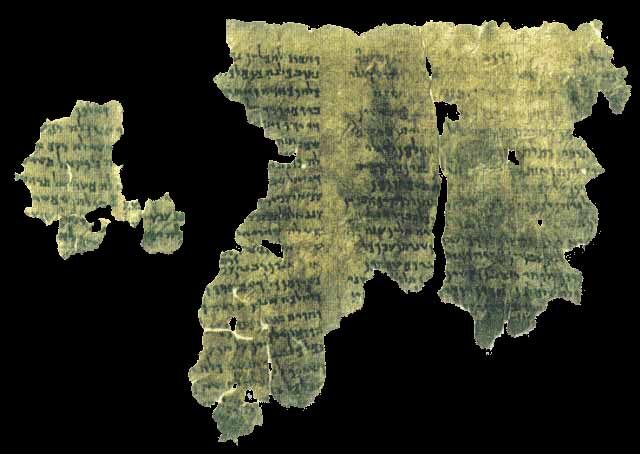
book20of20enoch-5889555
Dead Sea Scroll 1 Book of Enoch fragment

James Charlesworth’s The Pseudepigrapha and Modern Research p. 98 states, “…today there is a consensus that the book is a composite, portions of which are clearly pre-Christian as demonstrated by the discovery of Aramaic and Hebrew fragments from four of the five sections of the book among the Dead Sea Scrolls.”

Charlesworth states that fragment Hena (that is “Hen” with a superscripted “a”) “was copied in the second half of the second century B.C.”

Enoch’s chaps 37-71, its second section, contains “Son of Man” sayings and Charlesworth relates that Józef Tadeusz Milik speculates is probably a later accretion which is in the corpus of the early fragments and may have been written circa 270 AD.

The early portions are generally thought to date to the first half of the second century BC with chaps 37-71 being added during the range from first century BC to the first century AD.

Albert Schweitzer, The Quest of the Historical Jesus XVII:

[Gustaf] Dalman gives a number of examples of works written in Hebrew in the century which witnessed the birth of Christ: “A Hebrew original,” he says, “must be assumed in the case of the main part of the Aethiopic book of Enoch…” [emphasis added for emphasis]

British Museum, “MSS. from the Egyptian Monasteries,” Quarterly Review, 77: Nos. 153-4 (Dec. 1845-Mar. 1846), pp.39-69

The Book of Enoch, first made known to Europe by the translation of the late Archbishop Laurence, shows that something has been already recovered from the Aethiopic: and the Coptic too may yet make us better acquainted with writings hitherto only known to us by the tradition that they once existed.

In her 1888 AD book The Secret Doctrine, the occultist and founder of Theosophy, H. P. Blavatsky (1831-1891 AD), referenced the Book of Enoch within, of course, the context of her weaving tales regarding her concept of root races, etc.

Sections by chapter ranges:

1-36) The Book of the Watchers

37-7l) The Book of the Similitudes aka Parables

72-82) The Book of Astronomical Writings
83-90) The Book of Dream Visions

91-107) The Book of the Epistle of Enoch

Moreover, the Book of the Watchers itself appears to have been pieced together in stages and in fact, five segments may be discernible and have been segmented as follows by James Vanderkam (see his Enoch: A Man For All Generations):

1-5 theophany and eschatological admonition

6-11 stories of angels

12-16 fallen angels want Enoch to present their petition to YHVH

17-19 Enoch’s first journeys

20-36 Enoch’s second journey

Michael A. Knibb notes that amongst the Dead Sea Scrolls, “No fragments were discovered corresponding to the second section of the Ethiopic book (chapters 37-71), the Parables” (Outside the Old Testament, p. 27).

Leonhard Rost (Intertestamental Literature) dates chaps 1-5 and 108 to the first century BC. James C. VanderKam (An Introduction to Early Judaism) dates chaps 1-36 via the latest date of the oldest Dead Sea Scroll fragment 200-150 BC thus, “it may be another third-century text.” Leonhard Rost (Judaism Outside the Hebrew Canon) dates chaps 12-16 date it to the first half of the second century BC and specifies that chaps 17-19 and 20-36 “probably belong” to the second century BC.

Martin McNamara (Intertestamental Literature) quotes Józef Tadeusz Milik to the effect that “from the first half of the second century B.C. onwards the Book of Watchers had essentially the same form as that in which it is known through the Greek and Ethiopic versions.” He then states that it may be “presumed that it circulated in this form already by 200 B.C.” and that “Certain sections of it can be presumed to be older still, e.g., the section on the fall of the angels (chs. 6-11, or even 6-19).” He also references G. W. Nickelsburg who dated chaps 6-11 to the fourth century BC.

Rost notes that the section known as the Similitudes aka Parables of Enoch (which are specifically found in chaps 38-44, 45-47 and 58-69) “contain various traditions dating from earlier ages but in their present recension cannot be designated earlier than the first century B.C.” J.T. Milik dates them as late as the second or third century AD.”

Rost specifies that the late dates are reckoned for this section are due to there being “no trace of them at Qumran” with which McNamara agrees, “No fragment of any part of Parables has been found in Qumran. For this, and for other reasons besides, some scholars doubt its pre-Christian and Jewish character.” However, he further notes that “contemporary scholarship tends to reckon the parables Jewish, and to assign their composition to the first century of the Christian era.”

VanderKam and Rost date 1 Enoch 72-82, the Astronomical Book, to 200 BC with Martin McNamara specifying the first quarter of the second century BC.

Rost dates chaps 85-90 “Depending on whether it concludes with Judas Maccabeus or ends with John Hyrcanus or even Alexander Jannaeus, it belongs to the middle or end of the second century, or to the first quarter of the first century B.C.”

VanderKam dates chaps 83-90 in accordance to “the last historical allusions in the vision” vision as that section is known as the Book of Dreams which “has led scholars to date it to the late 160s BC” and he dates chaps 91:11-17 and 93:1-10 to “approximately” 170 BC.

Rost dates chaps 91:12-17 and 93 as being “at least as early as the Book of Noah and possibly even earlier…around 170 B.C.” and he dates chaps 94-105 to the first century BC.

Rost notes that the section known as the Similitudes aka Parables of Enoch (which are specifically found in chaps 38-44, 45-47 and 58-69) “contain various traditions dating from earlier ages but in their present recension cannot be designated earlier than the first century B.C.” J.T. Milik dates them as late as the second century C.E., above all because there is no trace of them at Qumran.” (Judaism Outside the Hebrew Canon, pp. 138-139)

McNamara specifies that the late dates are reckoned for this section

VanderKam notes that chaps 91-107 (the Epistle of Enoch which contains the Apocalypse of Weeks) “is difficult to classify…under any single rubric” but that “The Epistle may date to roughly the same time as the Apocalypse of Weeks, that is, not far from 170 BC.”

SECTIONING AND THE DATING GAME – 2 ENOCH

Second Book of Enoch aka 2 Enoch aka Slavonic Enoch aka The Secrets of Enoch.

Translated and published in 1892 AD and was found to be an altogether different text than 1 Enoch aka Ethiopic Enoch. Seventh century AD Byzantine chronicler and ecclesiastic, George Syncellus, had preserved a few chapters in Greek. W.R. Morfill originally translated the text from Slavonic. R.H. Charles edited it and included intro notes.

Craig A. Evans (Noncanonical Writings and New Testament Interpretation) notes that 2 Enoch “was written late first century C.E. [AD] in Egypt by a Jew…Major theological themes include: (1) God created the world out of nothing (24:2); (2) seven heavens (30:2-3) and angelic hosts; (3) God created the souls of men before the foundation of the earth (23:5); (4) abodes of heaven and hell are already prepared for righteous and sinners; and

(5) ethical teachings, which at times parallel those of the NT and Proverbs.”

McNamara notes that 1917 AD translator of the Book of Enoch, R. H. Charles, dated it to “the period before A.D. 70” as early as a 1896 AD statement. Józef Tadeusz Milik dated it to the ninth century AD, a date that has not gained much backing.

Rost dates chaps 51, 59, 61, 62, 68 to the first half of the first century AD.

SECTIONING AND THE DATING GAME – 3 ENOCH

Third Book of Enoch aka 3 Enoch aka The Book of the Palaces aka The Book of Rabbi Ishmael the High Priest aka The Revelation of Metatron.

Sections by chapter ranges:

1-2) Rabbi Ishmael ben Elisha’s ascension and vision of the Merkabah

3-16) Concerning Metatron, the Prince of the Presence, who is also Enoch

17-28:6) Angelology

28:7-33:2) Divine judgment and the heavenly tribunal

33:3-40) The Merkabah phenomena

41-48a) Metatron reveals secrets to R. Ishmael

48b) Divine names

48c) Enoch-Metatron section

48d) Names of Metatron

James Charlesworth (The Pseudepigrapha and Modern Research) dates “at least portions of it” to pre 200 AD. Charlesworth references P. Alexander (The Old Testament Pseudepigrapha, vol. 1) who noted that “It is impossible to reach a very firm conclusion as to the date of 3 Enoch…Certain rough chronological limits can, however, be established” and he tentatively dates it to after the tenth century AD.” Hugo Odeberg dated chaps 3-48a to the second half of the third century AD, chaps 48b and c, 1-2, 3-15 to the second or first century AD.

International Standard Bible Encyclopaedia:

Slavonic Enoch…proved it not to be a version of the book before us [Ethiopic Enoch], but another and later pseudepigraphic book, taking, as the earlier had done, the name of Enoch. It is totally independent of the Ethiopic Enoch Book…the independence of the Slavonic Enoch is clear…the writer of the Slavonic Enoch had before him the book which has come down to us in Ethiopic, but the relationship is not by any means so close as to be called dependence.

METHUSELAH

Enoch’s son Methuselah plays a big role within the Book of Enoch as a chronicler of sorts.

Enoch 76, “I shown to thee, my son Methuselah.”

Enoch 81, “…those seven holy ones…said to me: ‘Declare everything to thy son Methuselah…’…that thou mayest teach thy children and record (it)…”

Enoch 82, “And now, my son Methuselah, all these things I am recounting to thee and writing down for thee, and I have revealed to thee everything, and given thee books concerning all these: so preserve, my son Methuselah, the books from thy father’s hand, and (see) that thou deliver them to the generations of the world.”

Enoch 83, “And now, my son Methuselah, I will show thee all my visions which I have seen, recounting them before thee…[I] wrote down my prayer for the generations of the world, and I will show everything to thee, my son Methuselah.”

Enoch 85 Enoch had a dream and stated, “I will show the whole dream to thee, my son. And Enoch lifted up (his voice) and spake to his son Methuselah.”

Enoch 91, “And now, my son Methuselah…the word calls me, and the spirit is poured out upon me, that I may show you everything…”

Enoch 107, “…Methuselah had heard the words of his father Enoch—for he had shown to him everything in secret.”

Enoch 108 notes refers to “Another book which Enoch wrote for his son Methuselah and for those who will come after him, and keep the law in the last days.”

~~~~~~~~~~~~~~~~~~~~~~~~

A plea: I have to pay for server usage and have made all content on this website free and always will. I support my family on one income and do research, writing, videos, etc. as a hobby. If you can even spare $1.00 as a donation, please do so: it may not seem like much but if each person reading this would do so, even every now and then, it would add up and really, really help out. Here is my donate/paypal page.

Due to robo-spaming, I had to close the comment sections. However, you can comment on my Twitter page, on my Facebook page and/or on my Google+ page.

Twitter: #BookofEnoch, #Apocrypha, #Enoch
Facebook: #BookofEnoch, #Apocrypha, #Enoch

LBGTQ

Social networks:
My Amazon author’s page
Facebook
Twitter
YouTube
Archive video site
Ken Ammi’s Product Reviews
My CafePress shop
Google +

Norm Geisler references TrueFreethinker.com:
Apologeticspress.com’s Kyle Butt references TrueFreethinker.com:

Read the article about which Gary Habermas, PhD (Distinguished Research Professor & Chair of the Department of Philosophy at Liberty Baptist Theological Seminary) said, “I have hung on to it since you sent it, & plan to keep doing so”: Historical Jesus – Two Centuries Worth of Citations.

atheist20nothing-cam-5230069

Lizette Alvarez

Social networks:
My Amazon author’s page
Facebook
Twitter
YouTube
Archive video site
Ken Ammi’s Product Reviews
My CafePress shop
Google +

Norm Geisler references TrueFreethinker.com:
Apologeticspress.com’s Kyle Butt references TrueFreethinker.com:

Read the article about which Gary Habermas, PhD (Distinguished Research Professor & Chair of the Department of Philosophy at Liberty Baptist Theological Seminary) said, “I have hung on to it since you sent it, & plan to keep doing so”: Historical Jesus – Two Centuries Worth of Citations.

atheist20nothing-cam-9423728

National Center for Transgender Equality

Social networks:
My Amazon author’s page
Facebook
Twitter
YouTube
Archive video site
Ken Ammi’s Product Reviews
My CafePress shop
Google +

Norm Geisler references TrueFreethinker.com:
Apologeticspress.com’s Kyle Butt references TrueFreethinker.com:

Read the article about which Gary Habermas, PhD (Distinguished Research Professor & Chair of the Department of Philosophy at Liberty Baptist Theological Seminary) said, “I have hung on to it since you sent it, & plan to keep doing so”: Historical Jesus – Two Centuries Worth of Citations.

atheist20nothing-cam-3398358

Abortion

It is easy to take a position and proclaim oneself Pro-Choice and/or Pro-Abortion. But such a person should be made to specify precisely what they support. No, not reproductive choice, not supporting women’s health but what is “abortion”? No, not the termination of a byproduct of conception, not a civil right. Exactly what is it, what is the procedure, what is the actual activity, the action which is abortion which you support?

Let us consider Abortion Fact’s article, How Are Abortions Done?:

RU-486