Nephilim in Peter Pett’s Commentary on the Bible for 2 Peter

From Peter Pett’s (1610-1672 AD) Commentary on the Bible.

Considering that Pett wrote in the 1600s AD it is nice to see that he holds the ancient Angel view of the Genesis 6 affair since as time went by pop-opinion shifted from the traditional Angel view to the Sethite view or other similar views.

Pett writes:

For if God did not spare not angels when they sinned, but cast them down to Tartarus, and committed them to pits of darkness, to be reserved for judgment;

The first example is the angels who sinned before the Flood (Genesis 6:1-4). They had followed ‘lascivious ways’. They ‘saw that the daughters of men were fair, and took all whom they chose’ (Genesis 6:2). While, apart from the Flood, we are not told of their fate in Scripture, it is well documented in Jewish literature (see below). And it is confirmed in 1 Peter 3:19 (where they were disobedient in the days of Noah); Jude 1:6 (where it is the angels who did not keep to their proper sphere) and supported in Revelation 9:1-11.

That is about a succinct combo of relevant points as you will find. He seems to begin, at least this section, by presupposing that “angels…sinned before the Flood” due to Peter’s reference to Angels that sinned and following with reference to the timeline of Noah and the flood: plus based on that which he discerns from the other texts which he notes.

He continues thusly:

These angels were cast down into Tartarus, which according to the Greeks was the worst place in Hell. The word is used to signify the worst possible fate, and to distinguish it from the place of the dead. And there in pits of darkness they were reserved for judgment. The words are figurative. Spirit beings could not be kept in physical pits, and it is questionable whether literal darkness affects them. The point is simply that they are safely restrained and away from the true light, and are awaiting judgment and destruction (just as the false teachers are).
It will be noted that in contrast with what follows there were no exceptions among these angels. All were doomed. In the same way there will be no exceptions among the false teachers. (An alternative possibility is to take the text as ‘chains of darkness’, but the earlier manuscripts favour ‘pits’ (Aleph, A, B)).

For the Greeks to refer to Tartarus as the worst place in Hell may not be correlative to the Bible as the Greek’s hell and the Bible’s hell could be of diverse descriptions. However, it is accurate that biblically Tartarus and hell are different (even though many translate Tartarus as hell in this text).

Peter Pett then falls into error in concluding that the pits (most translate as “chains”) of darkness in which the Angels are reserved for judgment “are figurative.” He bases this on the common (yet erroneous) knowledge that Angels are “Spirit beings” and so they “could not be kept in physical pits (or chains).
Biblically, there is no indication that they are spirits but there is every indication that they are as physical as was Jesus after His resurrection: physical enough to the touched, to walk, to eat, etc. and yet able to walk though closed doors, appear and disappear, etc.

He follows this by circling back to the succinct points noted above:

It is clear that these are the angels described as ‘sons of God’ in Genesis 6:1-2 for a number of reasons. Firstly because Peter appears to be listing his illustrations in Biblical order, thus · Angels that were imprisoned because of their sin (2 Peter 2:4 compare Genesis 6:1-2). There is no other mention in Genesis of angels sinning. Note also in respect to this how it is emphasised that both the past destruction of the Flood and the coming destruction by fire will affect ‘the heavens’ as well as the earth (2 Peter 3:5; 2Pe_3:7). · Noah and the Flood of water that destroyed the earth (2 Peter 2:5 compare Genesis 6:5 to Genesis 8:22). Note also in respect to this 2 Peter 3:5-6. · Lot and the Destruction by fire of Sodom and Gomorrah (2 Peter 2:6-8 compare Genesis 18-19). Note also in respect to this 2 Peter 3:7; 2Pe_3:10. Thus three incidents in Genesis are given in order, and in Genesis there is only one reference to angels sinning. Jude 1:6 describes God’s dealings with these angels as follows, ‘and the angels who kept not their own principality, but left their proper habitation, He has kept in everlasting bonds under darkness unto the judgment of the great day.’

Furthermore a comparison of 2 Peter and Jude makes it quite clear that 1). 2 Peter used Jude in constructing his own account. Or 2). Jude used 2 Peter in constructing his account. Or 3). Both used a common source. There are too many coincidences of thought and grammar for it not to be so.

Note the important point made which is applicable to those who claim that though history Angels fell again and again and copulated with women so as to produce Nephilim again and again, “There is no other mention in Genesis of angels sinning” nor, I would add, anywhere else in the entire Bible.

Certainly, 1) and 2) are possible and 3) could be also if they both appealed to the common knowledge of the manner in which the apocryphal Book of Enoch deals with the Genesis 6 affair which is to take (and greatly accrete) the Angel view (see here) and one to which Pett draws our attention as he adds:

But whichever it may be we must now ask, what was the source from which this extra information was initially obtained? And Jude in fact gives us the clue. For he describes an incident from The Assumption of Moses (Jude 1:9) and cites words from the Book of Enoch (Jude 1:14-15). And both these books were examples of Jewish apocalyptic literature. What then can we learn from such Jewish apocalyptic literature? In fact the story of the fall of these angels and the story of Noah and the Flood are both commonly dealt with in this literature.

In the Book of Enoch (1 Enoch) we have the following description of the fall of these angels:

“And it came about, when the children of men had multiplied, that in those days were born unto them beautiful and comely daughters. And the angels, the children of the heaven, saw and lusted after them, and said to one another: ‘Come, let us choose us wives from among the children of men and beget us children (6:1-3) — And all the others together with them took unto themselves wives, and each chose for himself one, and they began to go in to them and to defile themselves with them (7:1). —And again the Lord said to Raphael: ‘Bind Azazel hand and foot, and cast him into the darkness (10:4) — bind them fast for seventy generations in the valleys of the earth, till the day of their judgment and of their consummation, till the judgment that is for ever and ever is consummated. In those days they shall be led off to the abyss of fire: and to the torment and the prison in which they will be confined for ever. And whoever shall be condemned and destroyed will from thenceforth be bound together with them to the end of all generations. And destroy all the spirits of the reprobate and the children of the Watchers, because they have wronged mankind. (10:12-15) — And then will the whole earth be tilled in righteousness, and will all be planted with trees and be full of blessing (10:18-19) — . ‘Enoch, you scribe of righteousness, go, declare to the Watchers of the heaven who have left the high heaven, the holy eternal place, and have defiled themselves with women, and have done as the children of earth do, and have taken to themselves wives: “You have wrought great destruction on the earth, and you will have no peace nor forgiveness of sin, and inasmuch as they delight themselves in their children, the murder of their beloved ones shall they see, and over the destruction of their children shall they lament, and will make supplication unto eternity, but mercy and peace shall you not attain.” (12:4-6). [emphasis in Pett’s version]

As for The Assumption of Moses, it appears to be this apocryphal work from which Jude relates that “Michael the archangel, when contending with the devil he disputed about the body of Moses, durst not bring against him a railing accusation, but said, The Lord rebuke thee.” For my notes on this apocryphal text with regards to Satan, Angels, etc. see here.

Peter Pett further correlates Enoch to Peter and Jude thusly:

It will be noted that in comparison with Peter we have the ‘spirits in prison’ (3:19), the ‘committing to pits of darkness to be reserved to judgment’ (2:5) and ‘the new earth in which dwells righteousness’ (3:13), and in comparison with Jude we have ‘the angels who left their first principality’ and the ‘everlasting bonds’ (Jude 1:6). Furthermore in 60:8 we have mention of ‘the seventh from Adam’ (Jude 1:14).

Lastly, Pett notes that “The same incidents are described more briefly in Jubilees 4:15; 5:1ff.; Testament of Reuben 5:6-7; Testament of Naphtali 3:5; Enoch 18; etc.” which, he noted, “undoubtedly have reference…to the events described in Genesis 6:1-2.”
For what those texts have to say on the issue, see my section on the Nephilim.

~~~~~~~~~~~~~~~~~~~~~~~~

A plea: I have to pay for server usage and have made all content on this website free and always will. I support my family on one income and do research, writing, videos, etc. as a hobby. If you can even spare $1.00 as a donation, please do so: it may not seem like much but if each person reading this would do so, even every now and then, it would add up and really, really help. Here is my donate/paypal page.

Due to robo-spaming, I had to close the comment sections. However, you can comment on my Facebook page and/or on my Google+ page. You can also use the “Share / Save” button below this post.
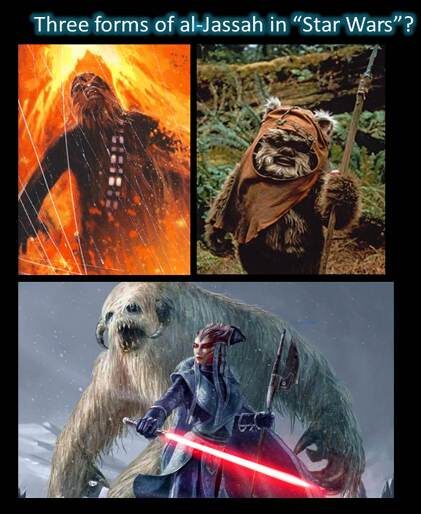
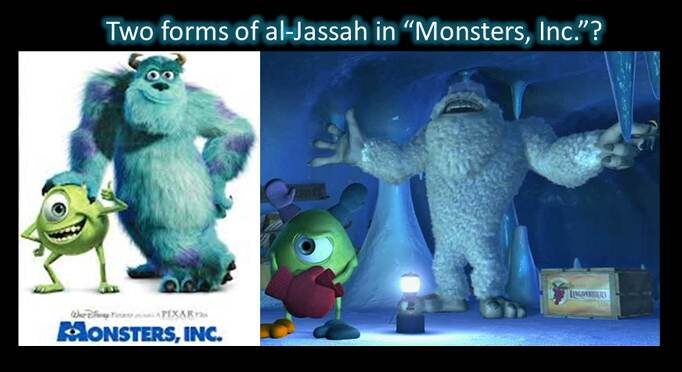
The Islamic “Beast” al-Jassah

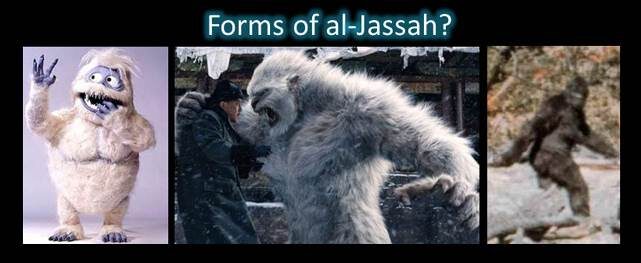
The Islamic Hadith of Fatima, chronicled by Muslim, tells of al-Jassah who is “a beast who was so hairy that they could not tell its front from its back” and those who saw al-Jassah “were afraid lest it be a devil.” When asked who/what he/it is, al-Jassah replies, “go to this man in the monastery.” The man was “a huge man with his hands tied up to his neck and with iron shackles between his legs up to the ankles” who stated, “I am the Dajjal.” According to Islamic eschatology the Dajjal, aka Al-Masih ad-Dajjal (“deceiving,” “the Placebo” or “impostor”), is to appear and pretend that he is the Masih/Messiah.

The Dajjal is basically like an anti-Christ figure (or, anti-Muhammad figure which, well, of course, would actually be a pro-anti-Christ figure) and the hairy creature, al-Jassah, appears to be a “the beast” figure.

al2-1851382

al3-9428439

al4-8381454

al5-4138926

al6-3267655

The Creation of Adam

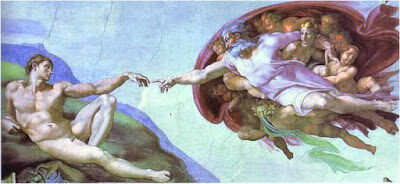
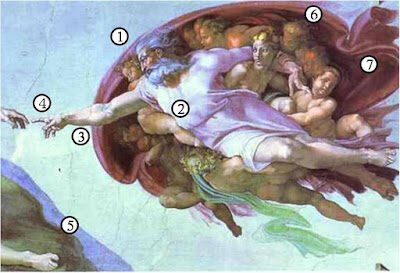
thecreationofadam1-3919467The purpose of this contemplation is not to literally conclude whether or not the Holy Spirit of God actually inspired Michelangelo Bouonarotti in his rendition of “The creation of Adam,” which he painted on the ceiling of the Sistine Chapel in Rome. However, we have noticed aspects of this fresco that seem to illustrate certain truths about the nature of man and the nature of God as revealed in the Word of God.
thecreationofadam2-7776651
God

1-God is literally flying to meet with Adam2-Body purposefully extended3-Arm actively extended, the right hand of His power4-Even His finger is stretching out5-God descends to His creation6-God already has all of creation on His back, relying on Him

7-Clothed in His robe

“In the Beginning GOD_”
God, being our Father, is always ready and willing to run to our defense, run to our comfort, and run to forgive us. Just as He is represented in the story of the prodigal son. The sinful, wasteful, arrogant son returns home in shame to confess his sin to his father, yet “when he was still a long ways off his father saw him and had compassion and ran and fell on his neck and kissed him” (Luke 15:20). The father not only forgives his son but he goes on to clothe him, feed him, and celebrates his safe return and repentance (Luke 15:22-23). God is “Not willing that any should perish, but that all should come to repentance” (2nd Peter 3:9). “There is joy in the presence of the angels of God over one sinner who repents” (Luke 15:10). “And He has made from one blood every nation of men to dwell on all the face of the earth, and has determined their preappointed times and the boundaries of their dwellings, so that they should seek the Lord, in the hope that they might grope for Him and find Him, though He is not far from each one of us” (Acts 17:26-27).

God is the one in action. He created all things, He provides all things, and He seeks all mankind in hopes that they will respond to His offer of salvation. “Thus says God the LORD, who created the heavens and stretched them out, who spread forth the earth and that which comes from it, who gives breath to the people on it, and spirit to those who walk on it” (Isaiah 42:5). “For I know the thoughts that I think towards you, says the LORD, thoughts of peace not of evil, to give you a future and a hope (Jeremiah 29:11). “But the hour is coming, and now is, when the true worshipers will worship the Father in spirit and in truth; for the Father is seeking such to worship Him” (John 4:23). “No one can come to me [Jesus] unless the Father who sent me draws him; I will raise him up at the last day” (John 6:44). “No one can say that Jesus is Lord except by the Holy Spirit” (1st Corinthians 12:3).

There are many references in the scripture to God’s hand, which signifies His power, strength, and ability to deliver. “Him [Christ] God has exalted to His right hand to be Prince and Savior, to give repentance to Israel and forgiveness of sins” (Acts 5:31). “Therefore [Christ] being exalted to the right hand of God, and having received from the Father the promise of the Holy Spirit, He poured out this which you now see and hear” (Acts 2:33). “O LORD God, you have begun to show your servant your greatness and your mighty hand, for what god is there in heaven or on earth who can do anything like your works and your mighty deeds?” (Deuteronomy 3:24). “And remember that you were a slave in the land of Egypt, and the LORD your God brought you out from there by a mighty hand and by an outstretched arm” (Deuteronomy 5:15). “Now I know that the LORD saves His anointed; He will answer him from His holy heaven with the saving strength of His right hand” (Psalm 20:6).

God does not expect Adam or humanity to become exalted, righteous, or godlike in order to extend His blessings. God does not expect us to ascend to Him, in fact God always descends humbly to us to clearly demonstrate His love and provision. God descends to the Garden of Eden to be with Adam (Genesis 2:21-3:8). He descends, as the Angel of the LORD to reveal His will to Moses (Exodus 3:2). He descends to lead His people from Egypt (Exodus 16:10, 14:24). He descends in order to be present in the tabernacle and the temple (Exodus 33:9-11, 1st Kings 8:10). He descends, as the Commander of the army of the LORD (Joshua 5:13-14). He descends and incarnates to atone for our sins (Matthew 2:1). The Holy Spirit descends to the disciples at Pentecost, and in order to alight on Jesus (Acts 2:2-4 Matthew 3:16). He descends to the New Jerusalem to live with His children (Revelation 3:12, 21:2-3).

God is clothed, in the scripture robes are symbolic of protection, righteousness, and spotless purity. “He has clothed me with the garments of salvation, He has covered me with the robe of righteousness” (Isaiah 61:10). “In the year king Uzziah died, I saw the LORD sitting on a throne, high and lifted up, and the train of His robe filled the temple” (Isaiah 6:1).
“Now she had on a robe of many colors, for the king’s virgin daughters wore such apparel” (2nd Samuel 13:18). “I will clothe him with your robe and strengthen him with your belt; I will commit your responsibility into his hand. He shall be a father to the inhabitants of Jerusalem and to the house of Judah” (Isaiah 22:21). “I put on righteousness, and it clothed me; my justice was like a robe and a turban” (Job 29:14).

thecreationofadam3-8639402
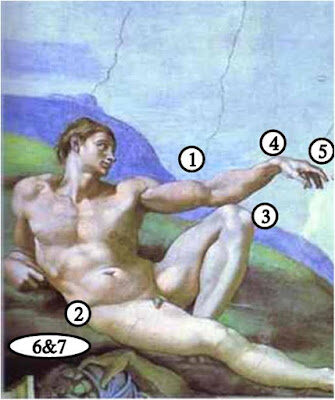
Adam

1-Not seeking after God, barely reaching out to him2-Sitting, slouched3-Arm extended only due to it resting on his knee, therefore, he is not holding it up4-Limp wrist5-Limp finger6-Resting on God’s creation, resting on God’s provision7-Not at work but resting

8-Naked

“In the beginning God CREATED_”
Adam is at rest, not yet a laborer. God does assign Adam a task, however, it is clear that before the fall Adam enjoys the seemingly simple tasks of tending the garden and naming animals. “Then the LORD God took the man and put him in the Garden of Eden to tend and keep it” (Genesis 2:15). “Out of the ground the LORD God formed every beast of the field and every bird of the air, and brought them to Adam to see what he would call them. And whatever Adam called each living creature, that was its name” (Genesis 2:19). After the fall however Adam’s workload is significantly increased and handed down to all humanity as a curse. “Cursed is the ground for your sake; in toil you shall eat of it all the days of your life” (Genesis 3:17). “In the sweat of your face you shall eat bread till you return to the ground” (Genesis 3:19).

Adam is only facing God due to the physics of his posture. Adam and humanity do not seek after God. We do not take it upon ourselves by our own strength and will to seek after righteousness or forgiveness. “The LORD looks down from heaven upon the children of men, to see if there are any who understand, who seek God. They have all turned aside, they have together become corrupt; there is none who does good, no, not one” (Psalm 14:2-3).

“And they were both naked, the man and his wife, and were not ashamed” (Genesis 2:25). “Naked I came from my mother’s womb, and naked shall I return there” (Job 1:21). Adam is naked yet not shamefully. He is not clothed with the fig leaves that he and Eve made, representing a human attempt to cover sin (Genesis 3:7). He is not yet clothed in the tunics of skin that God made for them, representing not only a true covering of sin but pointing out that it is God Himself who provides atonement for sin (Genesis 3:21). In this case by the sacrifice of an animal, which is in itself symbolic, as is the whole sacrificial system, of the ultimate atonement that was made by the Messiah Jesus.

Adam is resting on God’s creation and provision. God plants the garden, provides food, and water for the garden, He creates the man and the woman to be partners.
“See I have given you every herb that yields seed which is on the face of all the earth, and every tree whose fruit yields seed; to you it shall be for food” (Genesis 1:29). “The LORD God planted a garden eastward in Eden, and there He put the man whom He had formed” (Genesis 2:8). “And out of the ground the LORD God made every tree grow that is pleasant to the sight and good for food” (Genesis 2:9). “Now a river went out of Eden to water the garden” (Genesis 2:10). “And the LORD God said ‘It is not good that man should be alone; I will make him a helper comparable to him'” (Genesis 2:18).

thecreationofadam4-3598407

“Good and upright is the LORDtherefore He teaches sinners in the way” Psalm 25:8

Friedrich Nietzsche Nails Richard Dawkins

Friedrich Nietzsche is at it again as he continues nailing inconsistent atheists.
First, he all but predicted that which would come about due to the death of God and he was vindicated with a vengeance during the most secular and bloodies century in human history: The Deicidal and Misanthropic Prophecies

Then he nailed atheists who put on the garb of religion: Nietzsche Nails Atheism, Again

He also nailed the FFRF for their neo-Paganism and constant claims to freedom of speech: Friedrich Nietzsche Nails the Freedom From Religion Foundation

Hereinafter I will reproduce an article by American Vision’s Joel McDurmon who has written various interesting books including:
Manifested in the Flesh: How the Historical Evidence of Jesus Refutes Modern Mystics and Skeptics

Biblical Logic: In Theory & Practice

Zeitgeist The Movie Exposed: Is Jesus An Astrological Myth?

Presuppositional Apologetics: Stated and Defended

And let us not forget; The Return of the Village Atheist

Joel McDurmon’s article is titled, “Atheism’s Moral Swindle.”[1]

~~~~~~~~~~~~~~~~~~~~~~~~~~~~

atheismmoralitymoralsfriedrichnietzschericharddawkinsjoelmcdurmonthereturnofthevillageatheist-3206099

I long since stopped blogging on atheism, deeming it often a waste of time and occasionally counterproductive. Sometimes, however, the issue merits revisiting. After rereading some old classics, I find the following quotation worth sharing:

When one gives up the Christian faith, one pulls the right to Christian morality out from under one’s feet. This morality is by no means self-evident: this point has to be exhibited again and again, despite the English flatheads. Christianity is a system, a whole view of things thought out together. By breaking one main concept out of it, the faith in God, one breaks the whole: nothing necessary remains in one’s hands. Christianity presupposes that man does not know, cannot know, what is good for him, what evil: he believes in God, who alone knows it. Christian morality is a command; its origin is transcendent; it is beyond all criticism, all right to criticism; it has truth only if God has truth—it stands or falls with faith in God.

In this quotation, many of my readers will immediately detect the echo of Van Til, or Bahnsen, or some other related apologist infused with “worldview,” or presuppositional thinking. Such a guess comes close in content, but misses widely. The surprise: this quotation flows candidly—and insightfully!—from arch-atheist Friedrich Nietzsche.[2] This is not, of course, to say that Van Til derived his ideas from reading Nietzsche—highly unlikely. The point—completely lost on modern atheists—is that when you strike down Christianity, Christian morality necessarily goes with it. Nietzsche candidly professed this, as did his earlier French counterpart Marquis de Sade: no God, no moral imperatives; no “thou shalt,” and no “thou shalt not.” Only, “I will.”

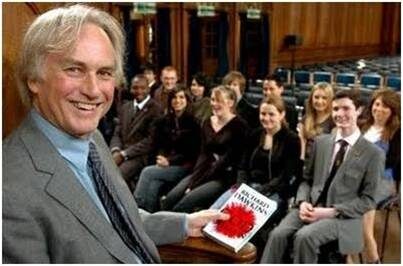
But modern atheists have not only ignored this logical conclusion, they have actually attempted to attack Christianity in the name of Christian morality, calling the Christian God cruel, bloodthirsty, racist, sadomasochistic, etc.[3] Richard Dawkins’ now famous book begins an early chapter with such accusations and much more. Whence the moral outrage?

Nietzsche’s honesty above grows all the more relevant (and this is what sparked me to write this article) when we read his context: he wrote the above as a commentary on the English writer George Eliot, decrying her clinging to morality despite her rejection of God. In fact, according to some accounts, and just as Dawkins, she attacked Christianity in the name of morality, calling the faith “immoral.” Nietzsche spies the “English” inconsistency and condemns her (and thus Dawkins) as a weak, effeminate, and illogical atheist. He writes:

G. Elliot: They are rid of the Christian God and now believe all the more firmly that they must cling to Christian morality. This is an English inconsistency: we do not wish to hold it against little moralistic females à la Eliot. In England [then and now, apparently] one must rehabilitate oneself after ever little emancipation from theology by showing in a veritably awe-inspiring manner what a moral fanatic one is. That is the penance they pay there.
We others hold otherwise.… [then follows the earlier quotation][4]

Upon reading this again, I could not help but think of today’s little rosy-cheeked moralist, Dawkins, preaching against the cosmic bully of the Old Testament, and denouncing the extremes of religion—all the while unaware that he must have the morality of Christendom under his feet (and his audience’s feet) in order to denounce those extremes. Still English, yes, and still inconsistent.

Nietzsche blows up the charade:

When the English actually believe that they know “intuitively” what is good and evil, when they therefore suppose that they no longer require Christianity as the guarantee of morality, we merely witness the effects of the dominion of the Christian value judgment and an expression of the strength and depth of this dominion: such that the origin of English morality has been forgotten, such that the very conditional character of its right to existence is no longer felt. For the English, morality is not yet a problem.[5]

For this reason—for his fearless and relentless consistency—I love reading Nietzsche. The arch-atheist—the honest, consistent atheist—foils all the prominent modern atheists. He knows and admits that Dawkins’ moral indignation arises from the very God he denounces. Nietzsche knows that such moral fire only expresses the prior power and dominion of Christianity. Nietzsche knows that moral indignation itself is borrowed capital from Christendom.
Unlike Dawkins, however, Nietzsche refused to keep pretending. Nietzsche had the intellect to see the connection, and the guts to admit the outcome of his worldview. Modern atheism, apparently, has neither. For them, Christian society provides them enough comfort to enjoy the peace and tolerance of Christian rules while denying the existence of the Rule-giver. For them, morality is not yet a problem—simply because they refuse to admit it. Well, despite the “flatheads,” “this point has to be exhibited again and again,” and I don’t mind letting Nietzsche do so for us.

[1] Joel McDurmon, “Atheism’s Moral Swindle,” American Vision, May 01, 2009, © 2008 The American Vision, Inc. All rights reserved.
[2] Friedrich Nietzsche, “Twilight of the Idols,” The Portable Nietzsche, ed. and trans. Walter Kaufman (New York: Penguin Books, 1976), 515–6
[3] See Richard Dawkins, The God Delusion (Boston and New York: Houghton Mifflin, 2006), 31
[4] Friedrich Nietzsche, “Twilight of the Idols,” The Portable Nietzsche, 515
[5] Friedrich Nietzsche, “Twilight of the Idols,” The Portable Nietzsche, 516

“Seed” the TV series

Rob Skiba is a writer, director, producer, actor and artist who’s new project is to produce a TV series titled, “Seed.”

It is readily discernible from the description alone that Seed promises a lot and it is evident from reading the script for the first two episodes that it delivers:

SEED is a brand new science fiction series unlike anything you have ever seen before. It has the mystery and intrigue of Lost combined with the political commentary and sci-fi appeal of shows like Star Trek and Battlestar Galactica, mixed with the paranormal/alien themes explored in The X-Files.

This series will have all of that and much, much more!

In 72 amazing episodes, SEED will tell the epic story of a war that has raged since the dawn of time. Forces of good and evil are fighting for the souls of men and the final battle is fast approaching. A potent, and very dangerous plan was set in motion thousands of years ago. Something terrifying and very real has been actively weaving its way into the very DNA of mankind ever since.

It is now here among us, just waiting for the signal… to activate. SEED “The keys to the future lie buried in the past.” [ellipses in original]

One point of interest with regards to this planned series is the tangled web which is the “industry.” That is, how do you take a concept, an idea such as Seed, and end up will an adequately funded project which makes it to the TV screen?

You see, one can sell, or sell out, ones idea to the industry giant and that is how you end up with so very many TV shows in which you get interested and which are then pulled, dropped, due to what have you: internal corporate conflicts, funding issues, lack of viewership, etc. The problem is that when you sell your project you sell the rights to the project and so if the project is canceled you essentially lose the ability to resurrect it, as it were, to do it all again on another network.

This writer is not an insider and so this was just a basic outsider’s understanding of some of the issues involved in getting project from paper (or, computer) to screen.

Rob Skiba has certainly weaved a tale for the ages which ranges from the ancient past to the present and on into the future:

The Rosetta Stone for Understanding Everything
From the Pyramids of Giza to the Nasca Lines in Peru, you will find an abundance of evidence revealing the fact that in the distant past, this planet has been visited by highly advanced beings from other worlds….Megalithic monuments and structures that defy modern attempts to understand or duplicate are all that remain of these ancient cultures. And within their relics we find prophecies revealing that these gods of antiquity will return!

But who were they? As it was, so it will be again.

Today, we are seeing a lot of books, movies and television shows coming out that depict stories and god-like characters from mythology. But how and where did it all begin? The answer to those questions is the Rosetta Stone for understanding everything – past, present and future.

What Rob Skiba brings to the table is years’ worth of research and he has combined his points of interest into an intriguing story that will include, “ancient facts, universal and religious themes, symbols, secret societies, conspiracies, legends and myths.”

In order to help get this amazingly engaging project to the screen you can do various things: Spread the word about it via your various social networks.

Post about it, including the attached video trailer, to your website, blog, video channel, etc.—you can get various banners at this link.

Help fund the project via Rob Skiba very, very frugal plan of donating $3.33 per MONTH (there are various plans at the link). And if you have friends in the industry, see what you can do—capiche?!

In fact, if you have a radio, TV show, podcast, etc. you can have Rob on a guest—contact him via this link.

Rob notes:

We estimate each episode of SEED will cost $1 million to produce (here in Dallas). Shows like V, The Event and Fringe have a $2 million to $3 million budget. But those are Hollywood numbers.
We have determined that based on our industry relationships here in Dallas, we feel confident that we can produce the series with a perceived $3 million “production value” but at a third that cost.

But there is more to Seed than attempting to make it to a TV screen:

…we have adopted an Internet based, self-distribution model for SEED. By self-distributing, we can maintain total control over our content, which means no one can censor us, manipulate our “message” or cancel us prematurely….we intend to produce all 72 of those episodes, airing them on our SEED web site(s). The trick to self-distribution online is therefore contingent on the marketing campaign.
Our goal is to raise $4 million in initial working capital to “seed” SEED. This will fund the first three episodes (to be shot all at once) and will provide for the necessary advertising and marketing campaign to launch the series on-line… On the web site, we will provide three free episodes of viewing on-line at all times. Once a fourth episode posts to the site, the first episode will drop into a “download bin” where it will cost users $1.11 to view.

This pattern will continue as more episodes are added, thus the pay-per-view episodes will provide an additional source of revenue for the series as we move forward…

Also, in keeping with Rob Skiba multimedia campaigning for the show or, actually, for the storyline in general he is also working with VoxHouse Studio of Sweden to produce Seed as a graphic novel.

Jack Desroches, President of Strawberry Productions has noted:

Rob is among the most creative individuals that I have ever worked with. He is always striving to be the best in his field. Rob dreams big and then follows those dreams with unbridled passion. His goal is excellence and his imagination seems infinite. Any project that Rob is part of will be an award winner because of his skill, passion and heart. I am glad to highly recommend Rob Skiba.

Find more info and watch more videos at Seed the Series’ homepage.

~~~~~~~~~~~~~~~~~~~~~~~~

A plea: I have to pay for server usage and have made all content on this website free and always will. I support my family on one income and do research, writing, videos, etc. as a hobby. If you can even spare $1.00 as a donation, please do so: it may not seem like much but if each person reading this would do so, even every now and then, it would add up and really, really help. Here is my donate/paypal page.

Due to robo-spaming, I had to close the comment sections. However, you can comment on my Facebook page and/or on my Google+ page.

G. K. Chesterton nails Richard Dawkins

The talent, erudition and style of G. K. Chesterton is such that to name him in the same sentence as Richard Dawkins does violence to his memory.

Yet, he so rightly elucidated the position of, the fallacious folly of, personages such as Richard Dawkins that it seemed worthwhile to point out the following. Richard Dawkins is most certainly not the only one to whom the following applies but he is rather exemplary.

In his book Heretics G. K. Chesterton writes—in addition to noting that “Atheism itself is too theological”—the following:

In the opening pages of that excellent book MANKIND IN THE MAKING, he [H. G. Wells] dismisses the ideals of art, religion, abstract morality, and the rest, and says that he is going to consider men in their chief function, the function of parenthood. He is going to discuss life as a “tissue of births.”

He is not going to ask what will produce satisfactory saints or satisfactory heroes, but what will produce satisfactory fathers and mothers. The whole is set forward so sensibly that it is a few moments at least before the reader realises that it is another example of unconscious shirking.

What is the good of begetting a man until we have settled what is the good of being a man? You are merely handing on to him a problem you dare not settle yourself.

It is as if a man were asked, “What is the use of a hammer?” and answered, “To make hammers”; and when asked, “And of those hammers, what is the use?” answered, “To make hammers again”. Just as such a man would be perpetually putting off the question of the ultimate use of carpentry, so Mr. Wells and all the rest of us are by these phrases successfully putting off the question of the ultimate value of the human life.

Believing that naturalistic/atheistic/materialistic leads to conclude that life is an accidental occurrence atheists know that they cannot declare any sort of objective or transcendent meaning to life. This is why one of atheism’s consoling delusions is the delusion of subjective meaning in an objectively meaningless existence.

When Richard Dawkins presented his “Royal Institution Christmas Lectures” aka “The Royal Institution Lectures for Children” (which I reviewed here) he told the little children the following:

We are machines built by DNA whose purpose is to make more copies of the same DNA…It is every living object’s sole reason for living.1

That is right kids; your life’s purpose is copulation, have at it!
He has elaborated thusly:

that the purpose of all life is to pass on their DNA means that all living things are descended from a long line of successful ancestors…which can best be understood as fulfilling a purpose of propagating DNA…There is no purpose other than that.2

For a consideration of meaning and purpose see this link.

atheism2c20bus20ads2c20children2c20apologetics2c20american20atheists2c20internet20infidels2c20don27t20label20me202-1182913

Therefore, Richard Dawkins has gone as logically far as he can considering his adherence to meta-Darwinism, meta-materialism, etc.

“What is the use of a human?” “To make humans” “And of those humans, what is the use?”

“To make humans again”

Indeed, Dawkins, et al, are attempting to perpetually put off the question of the ultimate use of humanity—not merely their purpose, their use, but also their meaning. The Dawkinsians, by these phrases, seek, yet fail, to successfully put off the question of the ultimate value of the human life.