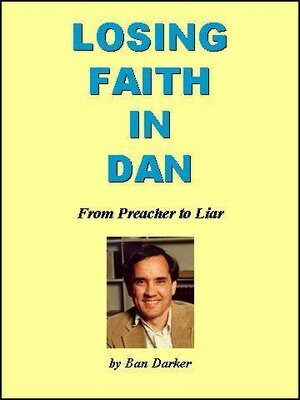
Thou Shalt Lie (on Dan Barker's new book)

Thou Shalt Not Lie

Dan Barker is due to publish a new book entitled, “Godless: How an Evangelical Preacher Became One of America’s Leading Atheists.”
godlesshowanevangelicalpreacherbecameoneofamericae28099sleadingatheists-7260398I have not read the book, not run across any reviews, nor any pull-quotes, nor anything to the likes, but I can tell you that we would all do well to consider it to be full of lies.First let me state that I hope that one of these days Dan Barker’s far too oft repeated arguments from authority cease and desist. We find it again in the title of the new book, “Evangelical Preacher.” I would imagine that, at least with the uninformed and too apathetic to become informed, he probably carries a lot of weight to the effect of, “Well, Dan Barker says that the Bible says. And he is an ex-preacher don’t ya know. So he must know what he is talking about. Now he is an atheist, one of America’s leading, so he must really know what the Bible says and why it should be rejected. I’ll take his word for it.”

At least this is the sense that I get. How many atheists who hate the Bible and its God take the time and energy to check what Dan Barker is stating about the Bible and its contents? How many even notice that in one single statement he complains that Jesus “did nothing to alleviate poverty” and then also complains that Jesus said, “Sell everything and give it to the poor”1 (at any rate he is mistaken).

Generally speaking, in order to correct Dan Barker’s statements about the Bible it requires little more than looking up the text, reading it, perhaps reading a few verses above and below the cited text for the sake of context and his errors become obvious. That is reading for grammatical context, some historical and cultural context is also helpful but I am not here referring to esoteric minutia but to very, very basic misunderstandings, misapplications and misinterpretations.If you are actually interested in getting a sense of Dan Barker’s lack of biblical knowledge please see my following essays:

Dan Barker’s Scriptural Misinterpretations and Misapplications

Why Freethought?

Dan Barker’s Agnosis

But why do I, in admitted total ignorance of the content of Dan Barker’s new book, suggest considering it to be saturated with lies? No, not inaccuracies, not mistakes, not errors, but straight out lies. Please understand that I am not in the habit of referring to anyone as a liar. This is because to lie is not merely to state something that is not true but knowing that you are stating something that is not true. In order to know, for certain, the a person is purposefully stating something which they know is not true requires more than mere guess work, you would have to know their thoughts and motivation (unless, for example, your corrected someone and they kept repeating a falsehood or something of the sort).

Yet, in this case I made the claim because Dan Barker’s “ethics” force me to make the claim as a logical conclusion. How so? I personally appreciate the manner in which Kyle Butt has so succinctly stated it in his article, What “We All Know” About a Lie. In it he makes the following point regarding the relative morals for which Dan Barker argues:

“Putting Dan Barker’s statements together in logical form:(1) he considers it moral to lie in order to ‘protect someone from harm;'(2) he considers religion to be harmful;

(3) then it must follow that Dan Barker would lie in order to dissuade a person from believing in God or religion.”

barkerbook2-3953521Do you know what the Talmud states is the punishment for a liar?

“The punishment of the liar is that even when he tells the truth he is not believed.”2

Also see, To Lie, or Not To Lie: That is the Question The Dan Barker-Reginald Finley-Matthew Davis Fiasco

~~~~~~~~~~~~~~~~~~~~~~~~

A plea: I have to pay for server usage and have made all content on this website free and always will. I support my family on one income and do research, writing, videos, etc. as a hobby. If you can even spare $1.00 as a donation, please do so: it may not seem like much but if each person reading this would do so, even every now and then, it would add up and really, really help. Here is my donate/paypal page.

Due to robo-spaming, I had to close the comment sections. However, you can comment on my Facebook page and/or on my Google+ page.

Bill Maher's Errata

This essay consists of the following sections:
Superior-Inferiority-ComplexAbsolute AgnosticismApatheism

Oh My (Selfish) Goodness!

In this essay I enumerate the various logical and theological fallacies that were uttered my Bill Maher whilst appearing on Joe Scarborough’s news show “Scarborough Country” for April 24, 2007 AD (manuscript here).

Superior-Inferiority-Complex

JOE SCARBOROUGH: No holds Mahered. Controversial comedian Bill Maher attacks God, Jesus and Christianity. Now, he’s working on a new documentary on religion with the producer of “Borat.” And I talked to him about why Jesus, Christianity and faith scares him so much.

Here they play a clip of a conversation on Bill Maher’s show (for info on Religulous see here, here and here):

BILL MAHER: I mean, you really think that I’m lost because I don’t accept Jesus Christ as my savior. You think I’m your inferior. Be honest.UNIDENTIFIED FEMALE (UF): Oh, no, not inferior.BILL MAHER: Come on!UF: That’s very different.BILL MAHER: But wait. You think you have a truth…UF: I don’t-I don’t think you’re inferior, but I…BILL MAHER: But do you think you have a truth that I do not see?UF: Yes.BILL MAHER: Then aren’t I not, by logical means…UF: No. No, you’re where I was…BILL MAHER: … inferior?UF: … once because I was all confused myself.(CROSSTALK)

BILL MAHER: That’s condescending.

Bill Maher appears to be an example of a person who is not strictly expressing their opinions on the subject at hand but are expressing what is deep within the recesses of their hearts, souls and minds. A form of what psychology refers to as “transference.” For instance, on the topic of fathers who take their little daughters to father-daughter dances or “purity balls” Bill Maher had quite a laugh about pedophilic-incest. On the topic of a mother breast feeding her little baby in public Bill Maher likened it to public masturbation (see here and here for details). These are various aspects of the ongoing Bill Maher controversy.Transference certainly seems to be the case in this instance. Bill Maher is equating a person who possesses a certain bit of information with a superiority complex and infers that they look down upon a person who does not possess that bit of information as being inferior. This is certainly a fallacious inference due to the following options:

1. A person who possesses a certain bit of information may very well hoard it with good reason and rightly look down on others who do not possess it as inferior. For example, an inventor may patent a new devise from which he will become rich himself and give a business of his choosing, to whom he sells his invention, an advantage over another business which may even become obsolete and go out of business due to the competitor’s technological-superiority and their technological-inferiority.2. A person who possesses a certain bit of information may hoard it with a much more selfish reason and capriciously look down on others who do not possess it as inferior. Such would be the case in a “I have a secret” (read in a whiny voice) scenario.

3. A person who possesses a certain bit of information that another person lacks is under no moral or logical obligation to feel superior to anyone, may even feel unworthy, and may feel it to be their life’s purpose to share that information with as many people who lack it as possible.

Note that Bill Maher, appearing to be more interested in instigation and belittlement than in rational discourse, did not ask the logical question, “Do you think I’m your inferior?” Rather, he makes a fallacious assertion, “You think I’m your inferior.” Note that he then turns from insisting that he is being considered “inferior” to insisting that it is “condescending” to be considered “confused.” The fact is that some people are confused and there is nothing condescending about it nor about pointing that out.It appears to me that the bottom line, at this point, is that Bill Maher considers her worldview to be exclusivist and arrogant. Yet, her claim to have absolute knowledge to the effect of someone being lost because they do not accept Jesus Christ as their savior is matched by Bill Maher’s negation which is just as absolutist, exclusivist and arrogant.

Moreover, it should be noted that if something is true and another thing false, it is not arrogant to assert the true in negation of the false. For instance, if someone stated, “1+1=2 and 1+1 does not =152” would they be considered arrogant for making such a truth claim? Granted truth claims about mathematics and truth claims about theology are of separate categories but the general concept is important to point out: if something is true and another thing false it is not arrogant to make the truth claim and therefore negate the false. I drew out this issue a bit in two essays: Exclusivism, Part I – Is only one worldview true? and Exclusivism, Part II – Is there only one way of salvation?

Absolute Agnosticism

MAHER: As you know, Joe, I’ve always had it out for religion for very good reasons. It’s mostly destructive. I don’t know what happens after you die, but to believe what another person tells me just makes me want to say to that person, How do you know? So that’s what I would ask you. How do you know what happens after you die?
It’s only, Joe, because somebody in this long game of telephone from 2,000 years ago told you what it was. But if some person hadn’t told you and a person just came up to you on the street and says, Yes, there’s a God and he had a son and he sent him on a suicide mission to earth, and then on Easter, he flies bodily up to heaven, I mean, what would you think of a person in the 21st century who believed that someone could fly bodily up to heaven?

The statement that religion is “mostly destructive” is stunningly exaggerated. Let us consider, for example, the topic of war. The Encyclopedia of Wars (New York: Facts on File, 2005) was compiled by nine history professors who specifically conducted research for the text for a decade in order to chronicle 1,763 wars. The survey of wars covers a time span from 8000 BC to 2003 AD. From over 10,000 years of war 123, which is 6.98 percent, are considered to have been religious wars. Let us consider the number of religious people who have ever lived and let us balance on one side of the scale those who have engaged in religious war and those who have lived out their entire lives in virtual benevolence. The scale would surely break under the weight of the benevolent side. Yet, we are getting ahead of ourselves since Bill Maher did not provide any standards by which to make an absolute claim to religion being “mostly destructive” but merely made an argument for embarrassment assertion.It is somewhat logical to think that if you do not know what happens after we die no one else does either. However, this is actually an agnostic logical fallacy since it is illogical to think that since I do not know something then no one else, in the history of the universe, knows it either.To the issue of a “long game of telephone.” This is a fallacy which betrays knowledge of how oral cultures maintained their information and assured its accuracy. This also fails to recognize that far from being a game of telephone, the purpose which is to fail and have a good laugh about it, there are over 24,000 New Testament manuscripts and proof of at least 2,000 year of accurate Old Testament transmission.Dr. Craig Blomberg, Ph.D., while interviewed by Lee Strobel, explains why the game of telephone is not a good analogy for how oral traditions are passed down:

“When you’re carefully memorizing something and taking care not to pass it along until you’re sure you’ve got it right, you’re doing something very different from playing the game of telephone. In telephone half the fun is that the person may not have got it right or even heard it right the first time, and they cannot ask the person to repeat it. Then you immediately pass it along, also in whispered tones that make it more likely the next person will goof something up even more. So yes, by the time it has circulated through a room of thirty people, the results can be hilarious.””Then why,” I asked, “Isn’t that a good analogy for passing along ancient oral traditions?”_

“If you really want to develop that analogy in light of the checks and balances of the first-century community, you’d have to say that every third person, out loud in a very clear voice, would have to ask the first person; ‘Do I still have it right?’ and change it if he didn’t. The community would constantly be monitoring what was said and intervening to make corrections along the way. That would preserve the integrity of the message,” he said. “And the result would be very different from that of the childish game of telephone.”1

But what of the statement about things that would be unbelievable in the 21st century? The fact is that, much to Bill Maher’s dismay, millions of people believe it today. Moreover, consider other things that we are supposed to believe in the 21st century:That the universe came into being when an eternal uncaused dot of matter exploded.That life on earth originated when lightning struck a swamp (abiogenesis). Ergo, that the argument from contingency regresses us back to ethereal clouds that rained down upon an amorphous concoction of minerals, etc.That we cannot detect or observe 96% of the universe.That there are invisible subatomic particles.That light is both a wave and a particle.That Keanu Reeves can act.Etc.

As Prof. Richard Lewontin has stated it (see here for the full text):

What seems absurd depends on one’s prejudice. Carl Sagan accepts, as I do, the duality of light, which is at the same time wave and particle, but he thinks that the consubstantiality of Father, Son, and Holy Ghost puts the mystery of the Holy Trinity ‘in deep trouble.’ Two’s company, but three’s a crowd.

Apatheism

JOE SCARBOROUGH: So let me ask you, do you belief in God?
MAHER: I call myself an “apatheist.” I’m apathetic about God. In other words, there could be a God. There could be something. I don’t know. I don’t-I certainly don’t think it’s a human God. But there could be some force that we can’t understand on earth.

Bill Maher has apparently established another sect of atheism/agnosticism namely: apatheism. Yet, we should wonder just how apathetic he is about God’s existence. He devotes comedy routines, portions of his show, interviews and a documentary to the issue of God and religion. Perhaps God is only important enough to mock. Well Bill Maher, it’s been done, done to death in fact, to death.While it is true that “there could be some force that we can’t understand on earth” one ought to be careful about the usage, and usefulness, of this argument. This argument can all too easily become an excuse for believing in an absolutely materialistic universe and denying any evidence to the contrary.According, to this argument any evidence for the supernatural can be shrugged off as natural phenomena that we do not yet understand but that we will surely someday understand as mere materialism after all. Yet, upon what do we base such assertions? How do we logically claim to know what future discoveries will be? Because this argument and the worldview which it informs are presuppositionally materialistic. Ergo: there is no evidence for the supernatural because the supernatural does not exist and we know that the supernatural does not exist because we never allow anything to count as evidence for the supernatural because the supernatural does not exist because there is no evidence for the supernatural, ad infinitum.

Oh My (Selfish) Goodness!

At this point the discussion involves at least two main topics: the question of why someone does “good” and the alleged selfishness of Christians.After claiming apatheism Bill Maher continued by stating the following about God’s existence:

It doesn’t matter. You should be a good person for the sake of being a good person, not because there is some reward in heaven.

This is highly presuppositional on various levels:He is referring to “good” without defining what “good” is-what is “good”?Without providing any standards of goodness, he asserts the importance of goodness anyway.He is setting up goodness as a moral standard without establishing why we ought to do “good.”Rather, he mere makes various assertion, “You should be a good person” – why, remains unstated.Moreover, “for the sake of being a good person” – why, remains unstated.Furthermore, “not because there is some reward in heaven” – why, remains unstated.At this point I would consider arguing that if I set out to “be a good person for the sake of being a good person” then my primary purpose for being good is so that I can be thought of, and think of myself, as being a good person. In this sense, “being a good person” is a reward that I sought. In fact, Dan Barker enumerates certain reasons why we should be good during his debate with Peter Payne:

“if you wish to be…a healthy person” [meaning mentally healthy], “if you wish to be labeled ‘ethical’ by other people,” “if you wish to be viewed by your society as ‘a good person,'” “if that’s something you wish.”

True Freethinker has detailed this atheist sentiment in the following essays: A Good Person, Does God Prefer Atheism?, Do Any Atheists Have Pure Motives?At this point Bill Maher gets to the alleged selfishness of Christianity.

One of the things that bothers me about religion is that it masquerades as humility, and it’s really arrogant. And it masquerades as self-sacrificing, and it’s really about saving your own hide. Ask any Christian, they’ll tell you it’s about salvation through Jesus Christ. This is how I am going to achieve happiness for all eternity after I die. But it’s mostly about saving my own behind.

At this point Joe Scarborough asks:

But how in the world can you even-how can you draw-listen, how can you assume I’m a Christian because I want to save my hide?

Some back and forth occurs at this point the gist of which Bill Maher states thusly:

BILL MAHER: OK, the reason-the reason I say this is because I just got done from interviewing many, many people about this. This is what I was doing on this documentary. And most Christians…
JOE SCARBOROUGH: Many, many people-I mean, you sound like-you sound like Katie Couric-Some people say-you didn’t talk to me.

Joe Scarborough’s point is more understandable this way: “Many, many people”? “Some people say”? Well, “you didn’t talk to me.” I certainly do not know what that reference to Katie Couric was but I thought that Bill Maher sounded like Richard Dawkins he was interviewed by Ben Stein for the movie Expelled. Richard Dawkins asserts that people feel liberated and relieved when they realize that God does not exist. Ben Stein asks him how he knows that, he is after all speaking with an empirical scientist. Richard Dawkins responds that he receives letters from people to that effect. To which Ben Stein states that there are some 8 billion people in the world and asks, “How many letters do you get?” (see here for more examples of goosbump-atheism).The conversation continues thusly:

BILL MAHER: OK, but I would bet, Joe, if you talk to most Christians, what they would say the most important part of the religion is, salvation, salvation through Jesus Christ. It’s in the Bible. It’s what he says. You can only…JOE SCARBOROUGH: Now, you know what Jesus says the most important part of being a Christian is? And he tells his disciplines when they ask him. He says it’s about feeding the poor, clothing those that have no clothes, visiting people who are sick, visiting people in jails. Just because Christianity has been perverted by televangelists during your lifetime and my lifetime doesn’t mean that they’re using the words of Jesus. Jesus said, This is how you’re judged. You’re judged on how you treat the poor. You’re judged on how you give hope to the hopeless. I am shocked you didn’t talk to a single person…BILL MAHER: Yes, but…JOE SCARBOROUGH: … that didn’t tell you that.

BILL MAHER: Yes, they talk about that, and that is important. But of course, you can do those things without believing in those kind of myths. You don’t have to personalize a God. OK, but Joe, I mean, let’s get real. I’ve read the New Testament. I’ve read it recently. It is a lot about achieving eternal life through Jesus Christ, OK? Yes, helping the poor and all that stuff is in there, but mostly it’s about saving yourself through this one method, through this one man. God sent his son to earth to die for your sins, yada, yada, yada. That’s what it’s about.

With that, this segment comes to an end.Certainly, “you can do those things without believing in those kind of myths.” Although, there may be something to be said for the fact that it is not exactly atheist who establish, fund and manage charities, homeless shelters, soup kitchens, disaster relief organizations, hospitals, universities, adoption agencies, foster homes, etc., etc., etc.As much as I know that Bill Maher has built a career based on bombast, belittling and vile displays of prejudice I get the feeling that he may actually be honestly confused on this point. Or would that be condescending? I am trying to give him some credit, even while believing that he deserves very, very little, if any. I wonder if he missed the point when he was interviewing many, many people.

I would not doubt that many, many of them stated that the point of Christianity is salvation. The issue is that it was at that very point that they, many, many of them were, and this is a crucial point, sharing this message with Bill Maher. It may be this very simple, yet crucial, point that Bill Maher missed. Would not the experience of salvation be a prerequisite for telling others about salvation? Would Bill Maher refer to volunteers at a homeless shelter’s soup kitchen as “selfish” because they also ate, and ate in order to have enough energy to feed others?

Thus, it may be perfectly accurate to assert that “if you talk to most Christians, what they would say the most important part of the religion is, salvation, salvation through Jesus Christ.” And it is from this premise that Christianity is not selfish since it is not, or not solely, about “saving your own hide” or “mostly about saving my own behind” (“mostly” being a very telling qualifier) but is about attempting to save everyone’s hides and behinds. Bill Maher appears to be missing the cause and effect that is at work in the New Testament and in today’s 21st century Christianity.

~~~~~~~~~~~~~~~~~~~~~~~~

A plea: I have to pay for server usage and have made all content on this website free and always will. I support my family on one income and do research, writing, videos, etc. as a hobby. If you can even spare $1.00 as a donation, please do so: it may not seem like much but if each person reading this would do so, even every now and then, it would add up and really, really help. Here is my donate/paypal page.

Due to robo-spaming, I had to close the comment sections. However, you can comment on my Facebook page and/or on my Google+ page. You can also use the “Share / Save” button below this post.

Atheist Neo-Paganism…In Other Words

Ruth Gledhill wrote an article which presents an interview with Richard Dawkins. It is entitled “God . . . in other words” and is subtitled “Richard Dawkins may be Britain’s foremost atheist, but he is willing to be inspired and uplifted. Is he a believer after all?” (The Times, May 10, 2007).

Ruth Gledhill notes:

Richard Dawkins believes that children should grow up reading the Bible and has a “soft spot” for the Church of England. He also believes some of the historic atrocities of human behaviour were not inspired by religion, but were a result of our “ruthless Darwinian past”. And he believes in the possibility of a transcendent “intelligence” existing beyond the range of present human experience. It is just that he refuses to call it God. These are just some of the more surprising confessions to come from the man variously described as Britain’s angriest atheist and the self-appointed Devil’s chaplain…

“You’d be rightly written off as uncultivated if you knew nothing of the Bible. You need the Bible to understand literary allusions,”….

With regards to the Devil’s Chaplain I will direct the interested reader to my essay Darwin’s Chaplain.
As for being Bible literate; I do often wonder about the atheists who ask questions to the affect of “Who cares what the Bible says?” When the answer is certainly, “The majority of the world’s population.” Indeed, in The God Delusion Richard Dawkins provides a large list of commonly employed literary and vernacular Bible phrases and allusions-that book’s only high point, to be sure.

Ruth Gledhill asks Richard Dawkins,

how he is getting on with his friend Lord Winston, the fertility pioneer, who last last month condemned Dawkins for his “patronising” and “insulting” attitude to religion, which he said was in danger of damaging the public’s trust in science.
“He’s a dear friend and I have enormous regard for him. He either is religious, as he claims, or he believes in beliefs. He claims to be an observant Jew and I’m sure he does go to synagogue. I sometimes wonder whether he really believes it. He is offended by strong criticism of religion. I believe that what appears to be strong criticism of religion is not as strong as people think. Criticism that in any other field – theatre, book or restaurants – would be comparatively mild. It sounds outspoken and strident because we are not used to religion being criticised.”

Understand that, in Richard Dawkins mind, since Lord Winston is a scientist he cannot possibly take all of that God stuff seriously, can he? I would disagree that criticism of religion merely appears to be strong because we are not used to religion being criticized. Religious criticism has existed since the time that there were more than one religion or more than one practitioner of the same religion. In fact, the Bible has been criticizing religion for millennia.
I would argue that when people set out to criticize theatre, book or restaurants they generally do not compare the play’s director, the author and the chef to Adolf Hitler, as Richard Dawkins has done to just about every Christian, Moses and even a Rabbi (see Hitler’s Rabbi). Or his correlations between religion and viruses as he does later in the interview,

“short of vaccination, a weakened strain of the virus should protect against the virulent strain.” For a moment, I had forgotten I was talking to a biologist.

Actually, Ruth Gledhill forgot that she is talking to a militant activist atheist who, within the interview, claims that “I would criticise the brutality of Stalin and Hitler” and yet is flummoxed as to Nazism’s ethical standing but not about raising children according to one’s faith:

What’s to prevent us from saying Hitler wasn’t right? I mean, that is a genuinely difficult question.1

It is evil to describe a child as a Muslim child or a Christian child. I think labelling children is child abuse and I think there is a very heavy issue.2

Hitler: who knows?
Merely describing children as Muslim or Christian: evil!

Sam Harris prefers rape to religion and stated,

If I could wave a magic wand and get rid of either rape or religion…I would not hesitate to get rid of religion.3

Would he criticize a theatre, book or restaurant by stating,

If I could wave a magic wand and get rid of either rape or Spamalot…I would not hesitate to get rid of Spamalot.

Or,

If I could wave a magic wand and get rid of either rape or The Da Vinci Code…I would not hesitate to get rid of The Da Vinci Code.

Or,

If I could wave a magic wand and get rid of either rape or Carl Jr’s…I would not hesitate to get rid of Carl Jr’s

Further, examples from Richard Dawkins, Sam Harris and other atheists are legion.

Now we come to what I covered in essays such as History of Atheism and Dan Barker’s Neo-Pagan Atheism see here and here; as Richard Dawkins states:

…”under the banner of religion you can write about what I call Einsteinian religion, which I subscribe to and so do many scientists as a sort of reverence for the Universe and life, which has nothing to do with anything supernatural”… “If that’s what you call religion then I’m religious.” But when I suggest that, in this case, he is in touch with the transcendent, he accuses me of “playing with words”.

He says: “If by transcendent you mean what Einstein believed then yes, but what I think, to come back on your statement that more intelligent and sophisticated religious people believe something close to what Einstein and I believe, that may be true, but they are a tiny minority of religious people in the world. It’s the majority of religious people in the world that we have to worry about.”

FYI: the majority of religious people in the world have never engaged in malice against those with whom they disagree.

As was pointed out in the post From Zeitgeist to Poltergeist, Part 4 of 13 while Albert Einstein was no strict theist he most certainly stated:

“I’m not an atheist. I don’t think I can call myself a pantheist. The problem involved is too vast for our limited minds. We are in the position of a little child entering a huge library filled with books in many languages. The child knows someone must have written those books. It does not know how.
It does not understand the languages in which they are written. The child dimly suspects a mysterious order in the arrangement of the books but doesn’t know what it is. That, it seems to me, is the attitude of even the most intelligent human being toward God.”4

Next, Richard Dawkins, predictably, reduces love to a “manifestation of brain stuff”-can you imagine that Valentine’s Day card?

atheismandvalentine27sday-3093562

Ruth Gledhill notes that Richard Dawkins, “denies that he is setting up an alternative religion, an atheistic lack-of-belief system.” Yet, as part of the Alluminati he is certainly been in the forefront of considering an atheistic co-option of science as neo Pagan nature worship-by whatever name. Mover, the other Alluminati, the other influential celebrity atheists, are most certainly attempting to establish a one world atheist religion: a Novus Ordo Saecularis.

We have previously argued that many atheists look forward to a mythological future time when humanity will posses omniscience (see Omni-Science)-the fallacy of validation by projection: imagining validation of absolute materialism by projecting to a time when it will be validated. Only then, it is claimed, will we be able to either affirm or deny the existence of the supernatural. Some atheists consider this a fallacious statement about atheist beliefs yet consider Richard Dawkins’ claim,

I am a scientist. It is my business to understand and help others to understand the nature of life in my case, or generally, as a scientist, the nature of the Universe. At the beginning of the 21st century, humanity is approaching a staggeringly impressively near-to-complete understanding. It’s hugely exciting to be a member of this elite species at this time when our understanding of physics, biology and cosmology are so exciting and near complete.[emphasis added]

He concludes by, of course, appealing to his bread and butter: besmirching “religion”,

It’s tragic that people are deprived of this not by misfortunes or lack of education, but by deliberate distortion, by organised of misinformation.

Indeed, if only those meddlesome religionists would abscond we would all know that we know just about everything about everything.

As part of the Darwinismdidit catechism Richard Dawkins states,

“A lot of what is good about human history has been an emancipation, a weaning, of humanity away from our ruthless Darwinian past,” he says. “As a Darwinian, I see that.”

Whatever the case, the claim, the observation, the speculation may be: Darwinismdidit.

No wonder that Philip S. Skell wrote the following (“the father of carbene chemistry,” member of the National Academy of Sciences and Emeritus Evan Pugh Professor at Pennsylvania State University):

Natural selection makes humans self-centered and aggressive – except when it makes them altruistic and peaceable. Or natural selection produces virile men who eagerly spread their seed – except when it prefers men who are faithful protectors and providers.

When an explanation is so supple that it can explain any behavior, it is difficult to test it experimentally, much less use it as a catalyst for scientific discovery.5

Benjamin Wiker seconds that observation by noting the following in his consideration of “Game Theory”,

By using games with fewer rules than Candy Land, the Darwinian game theorists are claiming “to uncover the fundamental principles governing our decision-making mechanisms.” We’d better take a closer look, starting with their presuppositions… The answer seems to be that whatever has survived must be the most fit; therefore whatever exists must have been the result of natural selection. Fairness exists; therefore, it must be the result of natural selection. Q.E.D.

It is always convenient to have a theory that cannot possibly be proved wrong.6

Philosopher Paul Feyerabend points out (emphasis added for emphasis):

The stability achieved, the semblance of absolute truth is nothing but the result of an absolute conformism. For how can we possibly test, or improve upon, the truth of a theory if it is built in such a manner that any conceivable event can be described, and explained, in terms of its principles?
The only way of investigating such all-embracing principles is to compare them with a different set of equally all-embracing principles—but this way has been excluded from the very beginning. The myth is therefore of no objective relevance, it continues to exist solely as the result of the effort of the community of believers and of their leaders, be these now priests or Nobel prize winners.7

Note what Birch and Ehrlich wrote in the journal Nature,

Our theory of evolution has become…one which cannot be refuted by any possible observations. Every conceivable observation can be fitted into it.8

In the interview Richard Dawkins also makes a well-within-the-atheist-group-think-box statements about how the Golden Rule did not come from Christianity but that “Christianity is one belief system that has adopted it.” I have considered this in the section entitled “1. Do not do to others what you would not want them to do to you” of the post Ecce Homo’s Commandments in which we consider the “New Ten commandments” of which there are fifteen.

As for further hopes for the future: Richard Dawkins seems very certain that his chosen worldview will be validated:

Well, I’m convinced that future physicists will discover something at least as wonderful as any god you could ever imagine…I think that all theological conceptions will be seen as parochial and petty by comparison…

Moreover, in Atheism Spirituality we noted that Richard Dawkins offers goose-bumpy-feel-good descriptions of atheism. He add to these in the interview in describing how such future finds will augment his atheism,

…awe-inspiring. Also, aesthetically appealing, uplifting…Maybe transcendent would be a good word to adopt.

Well, just because something is awe-inspiring, aesthetically appealing, uplifting and transcendent does not mean that it is true.

Lastly, Ruth Gledhill states that Richard Dawkins’ website sent out emails advertizing his DVD series “Growing up in the Universe” and that “It looked superb and I will buy a set for my young son.” Big mistake.
“Growing up in the Universe” does target children as it is an indoctrination session which reviewed as Richard Dawkins – Children in the Atheist’s Den.

Michael Shermer – The Neglected New Atheist

This, unfortunately, comes to us from the “Nice try but no cigar” and or “Aw shucks, what about me guys?” files.

Back in 2007 AD Michael Shermer, pseudo-skeptic extraordinaire, made an obviously failed attempt to reason with the four celebrity New Atheists. In Scientific American Magazine of all places, yeah I know you thought that Scientific American Magazine was about science (apparently their online version is not exactly a peer-reviewed science journal), Michael Shermer wrote an article entitled, “Rational Atheism – An open letter to Messrs. Dawkins, Dennett, Harris and Hitchens.”

Sam Harris, Daniel Dennett, Christopher Hitchens and Richard Dawkins are the celebrity New Atheists, the so called “Four Horsemen,” who are really more akin to “My Little Ponies.” Sure, when you first get a toy you are really excited and your purchase all of the accessories but after a while you grow up.
In the case of the big four et al, at first they are exciting they are vociferous, they play the part of the underdog, they make emotionally charged statements, the make arguments from outrage, arguments form embarrassment, they take on Christianity, they encourage and insight reactions of ridicule, and elbowing your buddy in the ribs to the point that atheists think that laughing at someone is tantamount to the discrediting of their argument.

Michael Shermer quotes and comments on Prof. Richard Dawkins’s “always poignant prose, ‘raise consciousness to the fact that to be an atheist is a realistic aspiration, and a brave and splendid one. You can be an atheist who is happy, balanced, moral and intellectually fulfilled.’ Amen, brother” (religious reference in original).
Who would argue that it is not a good thing to raise consciousnesses, be brave, happy, balanced, moral and intellectually fulfilled?

But how do these things play out in the lives of atheist, particularly the New Atheists, specifically the celeb-four? What is having your consciousness raised realizing that you are one of the most intelligent people in the history of the planet? Is being brave becoming the most recent in a 2,000 yr old line of people who besmirch Christianity? Is being happy, balanced and moral making a living by expressing personal prejudice and inspiring others to do likewise? Is being intellectually fulfilled inventing quaint tall tales about how things just happen to happen?

Ultimately, atheism is consoling delusion, which manifest themselves in various ways such as:The consoling delusion of lack of ultimate accountability.The consoling delusion of absolute autonomy.The consoling delusion of considering yourself to be the highest being in creation.

The consoling delusion of erudite elitism.

atheism-3660309
In any case, Michael Shermer made an obviously failed attempt to reason with the supposed champions of reason.

Some of the obviously ignored advice went as follows:

we should be cautious about irrational exuberance…

Anti-something movements by themselves will fail. Atheists cannot simply define themselves by what they do not believe…

Positive assertions are necessary. Champion science and reason…

It is irrational to take a hostile or condescending attitude toward religion because by doing so we virtually guarantee that religious people will respond in kind…

As Carl Sagan cautioned…’You can get into a habit of thought in which you enjoy making fun of all those other people who don’t see things as clearly as you do. We have to guard carefully against it’…

In the words of…Martin Luther King, Jr…’…Let us not seek to satisfy our thirst for freedom by drinking from the cup of bitterness and hatred…

If atheists do not want theists to prejudge them in a negative light, then they must not do unto theists the same…

As long as religion does not threaten science and freedom, we should be respectful and tolerant…

One may be tempted to state that at least the four follow the advice about champion science and reason. However, gone are the days when scientists in a lab coat were virtually considered infallible in their pronouncements. Modern day people are too well informed and can readily parse a scientist’s statements into actual observation on the one side and pure worldview biased interpretation on the other.
As far as reason, this is also an area in which the top four fail miserably having had their attempts at reason exposed for the emotive assertions that they really are.

Atheism – Bus Ads Minus One

A letter to the editor of the Indiana Daily Student presents a wonderful poster boy example of atheist “logic” and the disparity between their attempts at putting a public relations happy face on atheism on the one hand and what they are really about on the other.

The hoopla revolves around yet another atheist group, Indiana Atheist Bus Campaign, who are collecting donations, “Help us reach a goal of $50,000!,” during a time of worldwide recession not in order to help anyone but in order to attempt to demonstrative just how clever they think themselves to be.

The letter claimed that the ads, which are to read “You can be good without God,” say “nothing about the virtues of religious people”? Really? It means that, in this regard, their religion, not to mention their God, is irrelevant.

Moreover, “You can be good without God” is an answer to an argument that no one has made, in a manner of speaking. This is because theists, let us speak of Christians, would argue that people who think themselves to be “without God” are not so, since God still motivates them to do good through having placed His laws in their hearts. Thus, the argument is not that atheists cannot be good without God.

The letter claims that “You can be good without God” is a “a positive message about atheism”? This message, as usual, defines atheism strictly as a negative position; it is atheism as anti-theism. Why can they not make a statement that does not besmirch theism?

Note that morality describes what is; whatever people, a society, agree upon while ethics prescribes what should be; the ethos. Atheist can certainly make assertions about morals based on subjective personal preferences and arguments from outrage but cannot provide an absolute ethic: they can make epistemic statements but not provide ontological foundations.

indianaatheistbuscampaignandyoucanbegoodwithoutgod-4540495

The atheists and their bulldog, the ACLU, should certainly advertize as much as they please for at least two reasons:1) Their claims should be heard as much as possible since they discredit themselves.2) Atheists from the UK to the USA have wasted hundreds of thousands of dollars/pounds of donated money during a time of worldwide recession not in order to help anyone in need but in order to attempt to demonstrate just how clever they think themselves to be: need any more be said?

As it turns out; these bus ads were not only a look how clever we are ploy but where meant to be an in your face display,

_in advance of President Barack Obama’s visit Sunday to the University of Notre Dame.But Transpo – the bus authority for Mishawaka and South Bend – is waiting for its board to approve the posters.
The board meets Monday, after Obama’s visit, which doesn’t do much for the ads, said Charlie Sitzes, spokesman for the Indiana Atheist Bus Campaign.”That would be like us buying a 1972 Sears catalog,” Sitzes said. “They’re worthless now.”1

Well, the ads are not exactly worthless as the ads which are to be posted on 20 buses cost $3,895.80.Thus saith the Charlie Sitzes, spokesman for the Indiana Atheist Bus Campaign yet the unnamed author of the letter claimed the following motivations for the ads:

_encourage non-believers to “come out” of the atheist closet. Another goal of the bus campaign is to start a thoughtful discussion about atheism and morality_

our slogan is a call for atheists and other non-religious people to be included in these conversations_
demand our constitutional rights to freedom of speech against government censorship_

we are standing up for all who value freedom of expression and personal liberty_

support our goals of fostering open discussion and ending the stigma against voicing atheist views.

Again, and again and again we find the disparity between atheism as PR happy face and in reality.

Transpo board Chairman Chip Lewis explained that the ads were considered controversial,blockquote>not because of its content, said, but because of the media attention it got in Bloomington_”I want to make sure we have a thorough discussion and that everybody gets a chance to feel comfortable with what we decide,” Lewis said. “It’s just business as usual for us.”

And so we have yet another example of wasted money, failed atheist happy face publicity, examples of atheistic illogic and yet much benefit from painting atheism as woe-are-we-underdog-victim-status-give-us-more-money-for-ACLU-lawsuites.

Want a Better World? American Humanist Association Not Required

Just like any atheist organization’s website the first thing you notice as close to the top of the page as possible of the American Humanist Association website are the words “donate now”-actually, it is written thusly, “DONATE NOW.”

With their mind on their money and their money on their mind the American Humanist Association are the next atheist organization that has nothing better to do with donated money during a time of worldwide recession but waste it attempt to demonstrative just how clever they think themselves to be.

The new billboards are to read,

Want a Better World? Prayer not Required

And another anti-Christian support group rears its ugly head in the form of the American Humanist Association.

The Communications and Policy Manager of the American Humanist Association, Karen Frantz, affirmed,

We have really upped the ante with this ad_

In the past our message has reached out to atheists, agnostics and other nontheists already in the community. This ad, however, goes a little farther and says faith is not a necessity for a better world_

humanismandatheismandamericanhumanistassociation-5534087

On their website, under “Planned Giving” it states that “The Humanist Foundation,”

_offers members exceptional opportunities to ensure the advancement of Humanism’s life-affirming message to countless future generations_This effort is the culmination of a dream among AHA members, who have been providing for the future of Humanism through their wills, life insurance plans, trusts and annuities_to further enhance the AHA’s mission-to reach as many people as possible through well-developed outreach programs, advertising, conferences, the printed word, media and electronic communications.

Reach deep into your pockets and see if you come up with a figure that matches your lack of faith in order to fund atheist missionaries; a-amen!

I love their stated benefits for giving:

Enjoy.
The pleasure and security of knowing your gift will continue throughout the century and beyond, supporting the advancement of Humanism.

Name.
The Humanist Foundation of the American Humanist Association in your estate plans, and the principal will be kept in perpetuity, earning vital interest and dividends forever.

The Humanist Foundation Offers You:
Recognition
When you give to the Humanist Foundation, your name will be permanently etched in The Honor Roll of the Humanist Foundation.

humanismandatheismandamericanhumanistassociation-5890963

These billboards are to waste space in Moscow, Idaho. It is a good thing that these billboards are not going up in Moscow, Russia as they know very, very, very well what a world without prayer, without regard for God, is like and it is most certainly not “Better.”

Aleksandr I. Solzhenitsyn, “Men Have Forgotten God” – The Templeton Address

It was Dostoevsky, once again, who drew from the French Revolution and its seeming hatred of the Church the lesson that “revolution must necessarily begin with atheism.” That is absolutely true. But the world had never before known a godlessness as organized, militarized, and tenaciously malevolent as that practiced by Marxism. Within the philosophical system of Marx and Lenin, and at the heart of their psychology, hatred of God is the principal driving force, more fundamental than all their political and economic pretensions. Militant atheism is not merely incidental or marginal to Communist policy; it is not a side effect, but the central pivot_

But there is something they did not expect: that in a land where churches have been leveled, where a triumphant atheism has rampaged uncontrolled for two-thirds of a century, where the clergy is utterly humiliated and deprived of all independence, where what remains of the Church as an institution is tolerated only for the sake of propaganda directed at the West, where even today people are sent to the labor camps for their faith, and where, within the camps themselves, those who gather to pray at Easter are clapped in punishment cells–they could not suppose that beneath this Communist steamroller the Christian tradition would survive in Russia. It is true that millions of our countrymen have been corrupted and spiritually devastated by an officially imposed atheism, yet there remain many millions of believers: it is only external pressures that keep them from speaking out, but, as is always the case in times of persecution and suffering, the awareness of God in my country has attained great acuteness and profundity_

The concepts of good and evil have been ridiculed for several centuries; banished from common use, they have been replaced by political or class considerations of short lived value. It has become embarrassing to state that evil makes its home in the individual human heart before it enters a political system_
Western societies are losing more and more of their religious essence as they thoughtlessly yield up their younger generation to atheism_

Atheist teachers in the West are bringing up a younger generation in a spirit of hatred of their own society_

All attempts to find a way out of the plight of today’s world are fruitless unless we redirect our consciousness, in repentance, to the Creator of all: without this, no exit will be illumined, and we shall seek it in vain.

A. J. Jacobs – Night at the Royal Ontario Museum

We will now consider A. J. Jacobs’ lecture.1

Of all three lecturers A. J. Jacobs is, in a manner of speaking, the most qualified by a vast, vast margin to speak on God’s Ten Commandments. This is because as part of a literary project he “spent one year living the Bible as literally as one human being could” and wrote of his experiences in his book “The Year of Living Biblically: One Man’s Humble Quest to Follow the Bible as Literally as Possible.”

a-j-jacobsandtheyearoflivingbiblically-9670720

One caveat is that A. J. Jacobs appears to be a well humored guy. I do not mean well humored in the Michael Shermer sort of way; particularly during debates he insists on telling what are supposed to be jokes but since they are really meant to demonstrate just how pleased he is with his own pseudo-cleverness they just tank time and time again. As to A. J. Jacobs’ humor,

…he once wrote a story called “My Outsourced Life” in which a team in India “read bedtime stories to my son and argued with my wife.” He also wrote a piece on “radical honesty” in which his brain filtered nothing. It was called, “I Think You’re Fat.”

So it seems that he is genuinely well humored although this makes it so that sometimes it is hard to tell when he is being serious and when he is not. For example, it was reported, as quoted above, that he “spent one year living the Bible as literally as one human being could…” but the sentence ended thusly, “…even taking time out to stone a passerby.” This may be cute but utterly unbiblical since in order to stone someone the committing of a stone-able offence would have had to have been witnessed by at least two eyewitnesses and then they would have had to have gone to the judges to have the case heard, etc. this was no spur of the moment rock concert but part of a very careful judicious, litigious system. A. J. Jacobs also,

…painted lambs blood on his apartment door…did not cut his hair or beard. He said the Bible tells men not to cut the corners of their beards. Mr. Jacobs said he could not figure out where the corners were so he just let it grow like crazy.

A mighty beard! My kind of guy!

a-j-jacobsandtheyearoflivingbiblically-2854820

Again, funny but fallacious. Whence did he get the idea that he had to painted lambs blood on his apartment door? Unless his apartment was in the Egypt of millennia ago the onetime event, the original Passover in Egypt, has come and gone and there is no need for him to do that.Why did he not cut his hair or beard? There is no biblical mandate against cutting hair; unless he took the vow of a Nazarite and then it would be until the vow was fulfilled. As for the beard; again, nothing about not cutting the beard itself but about not cutting the corners which Jew traditionally interpreted as being just behind the temples what they call the “payos.”In any regard, what came of his year of living biblically?

His biggest challenges? “That’d be no coveting, no lying, no gossiping. They’re little sins, but they’re killers. My year made me realize just how many of these sins I committed every day. And refraining from them for a year was really hard but completely transforming.”

Biggest lesson? “Your behavior shapes your beliefs. If you act like a good person, you eventually become a better person. I wasn’t allowed to gossip, so eventually I started to have fewer petty thoughts to gossip about. I had to help the less fortunate, so I started to become less self-absorbed. I am not Gandhi or Angelina Jolie, but I made some progress.”2

He explained that living in New York and being a journalist meant that following the proscriptions against lying and gossiping (You shall not bear false witness against your neighbour) was particularly difficult…He reduced his gossiping by 35%, he said.Mr. Jacobs said that keeping the Sabbath holy was the one of the 10 that he found the most profound. He described his life – weekdays and weekends, night and day – as a giant blur.”The Bible says you have to have the boundary at least one day a week. Someone described it as ‘sanctuary in time.’ Whatever your belief, even if you’re an atheist, the Sabbath deserves a comeback.”

Gratitude: “[My experience] changed my view on that.” He said saying constant prayers of thanksgiving gave him a change of perspective.”3

He also offered a few mixed compliments/putdowns in enjoining:

Thou shall not stereotype. Whatever group I went to was more complicated than the preconceived notions – I thought every evangelical was like Sarah Palin.

And,

Thou shall pick and choose. “I tried to follow everything in the Bible and I failed. Fundamentalists will say anything less than following everything is cafeteria religion. What’s wrong with cafeterias? I’ve had delicious meals in cafeterias.”

Again, clever but…I would love to meet any fundamentalists who claims that anyone needs to follow everything: did A. J. Jacobs sacrifice animals in the Temple? No. This is no longer enjoined.And just what is wrong with cafeterias? Nothing. But we are not discussing cafeterias or food. Perhaps he will take his concept of delicious cafeteria meals to skydiving whilst repairing a refrigerator with a rabid mongoose-what is wrong with that?A. J. Jacobs is an agnostic and has stated,

I’m Jewish in the same way the Olive Garden Restaurant is Italian.

Moreover,

I started the year as an agnostic. I sometimes believed strongly in God; other times I didn’t believe at all. At the end of the year I was still an agnostic but a reverent agnostic.”

He said he and his wife even joined a synagogue. “We never go but we send in our dues.”

Sadly, if this is true, he has gotten himself stuck in the letter of the law while missing the spirit. This is the true treachery of “religion”: you scratch our financial backs and we’ll scratch your soul’s-capiche?!I could not help but being reminded of a friend I met while attending private Jewish school: he ended up owning a deli called “Heavenly Ham”!!!!!!!!

A Jew owning “Heavenly Ham”-oi vey!!!!!!!!

Materialism Spirituality? “The Science Of Spirituality – Is This Your Brain On God?”

National Public Radio (NPR) has produced a little ditty on “The Science Of Spirituality – Is This Your Brain On God?
True Freethinkerhas previously considered neuroscientific issues in the post Love the Lord Your God With All of Your Mind.Some of their musing on the subject is as follows:

Part 1: The God Chemical

The bottom line issue posed in the form of the question, “is God a delusion created by brain chemistry, or is brain chemistry a necessary conduit for people to reach God?”

Part 2: The God Spot
States that “Some epileptologists believe that many of the great religious figures, such as Moses and St. Paul, had epilepsy. Now neurologists believe they’ve found the sweet spot for spiritual experience…the seat of spirituality. It’s also where epileptic activity takes place.” Interesting, apparently only Jewish and Christian religious figures were epileptic; I suppose that “many” means “Those whom we are afraid to offend.”

atheismandbrainandneuroscience-8987748

Part 3: Spiritual Virtuosos
Neurotheologians think that prayer has an effect on sculpting the brain in that it produces increased activity in the frontal lobe (involved in concentration) and decreased activity in the parietal lobe (involved in a sense of orientation in time and space).
In that case Neuroillogican such as Sam Harris are those who already have their minds made up and are becoming “scientists” aka militant activist atheists and in Sam Harris’ case mystic Buddhist atheists who seek to erect a facade of scientific respectability around their atheist presuppositions.Sam Harris has stated:

What I believe, though cannot yet prove, is that belief is a content-independent process. Which is to say that beliefs about God-to the degree that they are really believed-are the same as beliefs about numbers, penguins, tofu, or anything else…What I do believe, however, is that the neural processes that govern the final acceptance of a statement as ‘true’ rely on more fundamental, reward-related circuitry in our frontal lobes-probably the same regions that judge the pleasantness of tastes and odors…Once the neurology of belief becomes clear, and it stands revealed as an all-purpose emotion arising in a wide variety of contexts (often without warrant), religious faith will be exposed for what it is: a humble species of terrestrial credulity. We will then have additional, scientific reasons to declare that mere feelings of conviction are not enough when it comes time to talk about the way the world is. The only thing that guarantees that (sufficiently complex) beliefs actually represent the world, are chains of evidence and argument linking them to the world…

Understanding belief at the level of the brain may hold the key to new insights into the nature of our minds, to new rules of discourse, and to new frontiers of human cooperation…1

Note the future-hopes qualifiers, “…yet…Once…will be…We will then…”Notice his staked deck: religious faith is a humble species of terrestrial credulity and once the neurology of belief becomes clear religious faith will be exposed for what it is: a humble species of terrestrial credulity.Sam Harris is clearly setting out to prove what he already believes to be true-no doubt, he will prove his beliefs even by gyrations that will strain the very neurons upon which he will be experimenting. It appears that his goal is not to become an unbiased scientist who merely reports conclusions and is prepared to throw away a lifetime of research if it happens to be disproved.

atheismandbrainandneuroscience-6110125

Part 4: The Biology Of Belief
Psychoneuroimmunology is “the idea is that thoughts affect your body” and “New research suggests that spiritual thoughts and prayers have an enormous effect on a person’s ability to heal or stave off disease.”

Part 5: Near-Death Experiences

Materialists say the visions that people report experiencing when they come close to death are hallucinations. But a small but increasing number of scientists posit that consciousness is related to, but not dependent on, the material brain. One scientist has found that the brains of people who have near-death experiences closely mirror those of nuns and monks, who are considered spiritual adepts.

I recall that Ann Coulter proposed a TV show wherein liberals would be hooked up to lie detector and question about their views: I wonder if the same can be done with atheists.

atheismandbrainandneuroscience-3787876

Now a truly brilliant scientist has actually found the God spot:

~~~~~~~~~~~~~~~~~~~~~~~~

A plea: I have to pay for server usage and have made all content on this website free and always will. I support my family on one income and do research, writing, videos, etc. as a hobby. If you can even spare $1.00 as a donation, please do so: it may not seem like much but if each person reading this would do so, even every now and then, it would add up and really, really help. Here is my donate/paypal page.

Due to robo-spaming, I had to close the comment sections. However, you can comment on my Facebook page and/or on my Google+ page. You can also use the “Share / Save” button below this post.

Atheism Camp: “Camp Quest” – Freethought Camp of Child Indoctrination

A particularly revealing article about an Atheism / Freethought summer camp for children was published in 2008 AD that seemed relevant to our recent consideration of Camp Quest and the likes.1 While the article painted a favorable picture of the Camp Quest it ended up revealing Freethought precisely for what it is: a politically correct facade for a very restricted, well within the box, system of atheist group think.
In this regard, see Freethought Without Forethought as I critiqued “Freethought” as dogmatized by Dan Barker: the Barkerian sect.

Camp Quest has “Beyond Belief” as its motto and was established in 1996 AD. It “is a non-profit backed by the Albany, N.Y.-based Institute for Humanist Studies.” It is described in the article as “a niche getaway for children who are agnostic, atheist, or just not sure what to believe.” The camp is currently in 5 states and accommodates kids between the ages of 8-17. The article was a bit confusing in stating that in 2007 AD “the camps accommodated 150 kids”: from the wording it was difficult to discern if 150 kids were divided amongst the 5 camps or if there were 150 in each camp.

Let us consider the camp and its purpose from both sides: the politically correct side and the side of reality.

The politically correct side paints a picture of the Atheism / Freethought Camp Quest as a being neutral on the issue of religion, theism or lack thereof. It paints a picture of Camp Quest as teaching children how to think critically for themselves and make their own decisions about what to believe or not believe.

Kids who attend the camp are not required to be atheists, or anything at all.

“We really try not to label the kids,” she [Amanda Metskas, president of Camp Quest Inc.] said, “When a kid is 8 of 10, asking them to say, ‘I’m an atheist’ or ‘I’m a Catholic’ – at 8 or 10 we don’t think that kids are able to make a decision about their worldview.”

There we have it: there are no requirements and the kids are too young to label themselves and by extension, be labeled.

An interesting aspect of the Atheism / Freethought Camp Quest is that “Campers are exposed to science and learn about evolution.” This seems rather odd, certainly there are science camp where the focus is science for kids who are excelling in and are interested in that field of study. But why teach “science” and particularly “evolution” at Camp Quest? After all, the average American (the overwhelming majority of the population by a long shot) study science and evolution for a minimum of a dozen years (and in public schools classrooms where atheism is smuggled in through the backdoor in the guise of science; or actually it is brought in right through the front ensconced in textbooks).

atheismandpinkflyodandthewall-3699006

Here we appear to get a hint at the underbelly of the Atheism / Freethought Camp Quest’s reality. Many absolute materialists of every sect claim to rely on science and evolution as not only favoring their worldviews but disproving supernaturalism. However, science and evolution actually have absolutely nothing to offer absolutely materialistic worldviews (see Omni-Science). I believe that it would not be too much of an inference to deduce that Camp Quest misapplies “science” and “evolution” and manipulate the speculations inherent within “science” and “evolution” to confuse the children with regards to what has been observed and can be reproducibly experimented upon, on the one hand, and what is pure worldview based speculation with a faa&#a7;ade of “science” and “evolution,” on the other.

Whilst speculating about the Atheism / Freethought Camp Quest’s misappropriation of “science” and “evolution” let us consider Camp Quest’s other side. The side of reality is what the Camp Quest’s obvious purpose is as may be readily discerned from the description of the camp, its activities and the reasons that parents offer for sending their children there.

At mealtime, kids learn about what the camp calls “free-thinkers” through history-defining them as people who questioned or rejected religion. Examples include people who believed in some version of a higher power, but held ideas conflicting with the social norm.

From the outset, let us note that “Freethough” is a system of thought whose aim is particularly to “question or reject religion.” Who was both a “free-thinker” and also “believed in some version of a higher power” is not stated in the article. However, it must be kept in mind that believing in “in some version of a higher power” does not necessarily amount to theism. In fact, Arthur Schopenhauer referred to pantheism, “some version of a higher power,” as a “polite form of atheism.”2

In one exercise, counselors tell the kids about different invisible creatures that live in the camp and then challenge the campers to prove that they don’t exist_In each instance, the campers are told they can’t see, touch or taste the creatures.

Before consider why they would conduct such as exercise please note that they are, yet again, presenting a very restrictive form of thought: if you cannot “see, touch or taste,” i.e. experience through the senses it must be impossible to prove. I wonder what the camp’s leadership would say about, for example, wind: you cannot see it (you only see its effects), you cannot touch it (you only feel it, or feel the particles which it is pushing aloft) and you cannot taste it (air pollution being particles being pushed aloft). Or black holes or subatomic particles or abiogenesis or thoughts, etc.

But why bother discussion invisible creatures? We touched upon this question in here but will consider it again here as the article states,

The point is that a belief isn’t automatically valid just because it can’t be proven wrong. The exercise is supposed to help kids who don’t believe in God prepare for questions from their peers who ask them to prove a higher power doesn’t exist.

Clearly, this is nothing but a catechism of atheistic polemics. That is to say that the children as specifically being told what to say when their belief in absolute materialism is questioned: when you are asked ___________(fill in the blank) you just say this ___________(fill in the blank).

Moreover,

If campers manage to prove the creatures don’t exist, the prize is a $100 bill from before 1954 – when the government put “In God We Trust” on U.S. currency.

$100 would certainly be a nice award for an 8-17 year old but why a bill from when the government put “In God We Trust” on U.S. currency? This is yet another clear window into the Atheism / Freethought Camp Quest’s purpose: not actual Freethought but very, very restricted worldview biased catechized polemical thought. Moreover, in our previous consideration we also learned that they gift the successful children with glorifications of Charles Darwin and Richard Dawkins.

Lastly, we will hear from the parents. They do not even make an attempt to prop up the politically correct faa&#a7;ade but make it clear that they send their kids to the camp in order to restrict them. They are being sent to be amongst people who think exactly like parents do and who will not question their kid’s beliefs but reinforce in the kids that which the parents want to indoctrinate them into believing. Camp Quest is an Atheism / Freethought support group:

When Joe Fox sends his daughters away to summer camp, he’s confident they’ll be surrounded by kids who share his family’s beliefs and values.

Another family sends their 14 year old son and 9 year old daughter because they want them “to have a sense of belonging.”
Their father states,

Camp Quest has helped his family, especially his children, become more confident about their own disbelief.

And stated,

it’s extremely nice to find similarly minded people with the same worldview.

While the Atheism / Freethought Camp Quest’s president may believe that the kids are unable to make decisions “about their worldview” the camp certainly appears to push them in one single direction. They are part of the reason for the rise of atheism in America.

But what is wrong with wanting your very own children to believe like you do and to purposefully place them in environments in which their beliefs will not only not be challenged but be reinforced by adults in authority over them?
That is certainly understandable but is only part of the issue. The point is that if that is what you are doing then be as honest as the parents and not as politically correct as the newspaper article or the Atheism / Freethought Camp Quest’s leadership who pretend otherwise.

~~~~~~~~~~~~~~~~~~~~~~~~

A plea: I have to pay for server usage and have made all content on this website free and always will. I support my family on one income and do research, writing, videos, etc. as a hobby. If you can even spare $1.00 as a donation, please do so: it may not seem like much but if each person reading this would do so, even every now and then, it would add up and really, really help. Here is my donate/paypal page.

Due to robo-spaming, I had to close the comment sections. However, you can comment on my Facebook page and/or on my Google+ page.

Scientific Cenobites – Some notes on Skepticism, part 2 of 6

This segment will consider:

“Debate Closed” MentalityOverreaching and Armchair QuarterbackingAssuming False Scientific Authority

Double Standards of Acceptable Proof and Ad-Hoc Hypotheses

“Debate Closed” Mentality

Since Pseudoskeptics have by their nature made up their minds on any question long before the evidence is in, they are not interested in participating in what could become an involved, drawn-out debate. On the contrary, their concern is with preserving their own understanding of how nature works, so discordant evidence has to be disposed of as quickly as possible. When sound evidence to that end is unavailable, anything that sufficiently resembles it will suffice. Pseudoskeptics like to jump to conclusions quickly – when the conclusion is their own, preconceived one. Once the pseudoskeptical community has agreed on an “explanation” that is thought to debunk claim X, that explanation then becomes enshrined in pseudoskeptical lore and is repeated ad infinitum and ad nauseam in the pseudoskeptical literature. Subsequent rebuttals are ignored, as is new data that support claims X. Examples are legion.

– Gurwich’s 1932 discovery of mitogenetic radiation is still derided by pseudoskeptics as a classical example of “pathological science” (Irving Langmuir, who coined the term, used it as an example), even though it has been vindicated by three decades of biophoton research.- Pseudoskeptics continue their ridicule of Cold Fusion as a mistake, even use “cold fusion” as a metaphor to refer to what they deem pathological science in general, ignoring a full decade of successful replication of the effect.- Parapsychology continues to be attacked by the hard-core pseudoskeptics with criticisms that were addressed and resolved long ago, leading Radin to remark that

(..) skeptics who continue to repeat the same old assertions that parapsychology is a pseudoscience, or that there are no repeatable experiments, are uninformed not only about the state of parapsychology, but also about the current state of skepticism!

atheism_atheist_tesla_coldfusion-9878957

Overreaching and Armchair Quarterbacking
Faced with contradictory or inconclusive evidence, the skeptic will only say that the claim has not been proved at this time, and give the claimant the benefit of the doubt. The pseudoskeptic will make the (incorrect) counter-claim that the original claim has been disproved by the evidence (and usually follow up with generous amounts of name-calling and other extra-scientific arguments discussed below).This distinction between simply not accepting a claim and making a counter-claim is important because it shifts the burden of proof. The true skeptic does not have to prove anything, because she is simply unconvinced of the validity of an extraordinary claim. Pseudoskeptics, on the other hand, making the claim that the extraordinary phenomenon only appears to be extraordinary, and has a conventional explanation, have to bear a burden of proof of their own. Do they? The general answer is no. Most of the professional pseudoskeptics engage in mere ‘armchair quarterbacking’, conducting no research of their own. As far as parapsychology is concerned, Radin sums this situation up as follows:

The fact that most skeptics do not conduct counter studies to prove their claims is often ignored. For example, in 1983 the well-known skeptic Martin Gardner wrote:

How can the public know that for fifty years skeptical psychologists have been trying their best to replicate classic psi experiments, and with notable unsuccess [sic]? It is this fact more than any other that has led to parapsychology’s perpetual stagnation. Positive evidence keeps coming in from a tiny group of enthusiasts, while negative evidence keeps coming in from a much larger group of skeptics.

As Honorton points out, “Gardner does not attempt to document this assertion, nor could he. It is pure fiction. Look for the skeptic’s experiments and see what you find.” In addition, there is no “larger group of skeptics.” Perhaps ten or fifteen skeptics have accounted for the vast bulk of the published criticisms.

Assuming False Scientific Authority

Many high-profile pseudoskeptics pass judgement based on scientific expertise they don’t have. James Randi, for example, shares the following tirade in a July 13, 2001 commentary on his web site:

Just so that you can see how pseudoscience and ignorance have taken over the Internet merchandising business, I suggest that you visit www.hydrateforlife.com and try to follow the totally false and misleading pitch that the vendors make for this product, magically-prepared “Penta” water that will “hydrate” your body miraculously. A grade-school education will equip you to recognize the falsity of this claim, but it’s obvious that the purveyors are cashing in on ignorance and carelessness. Just read this as an example of pure techno-claptrap:

Normally, the water you drink is in large clusters of H20 [sic] molecules. That’s because its [sic] been affected by air, heat, and modern civilization. PentaTM is water that, through physics, has been reduced to its purest state in nature – smaller clusters of H2O [sic] molecules. These smaller clusters move through your body more quickly than other water, penetrating your cell membranes more easily. This means PentaTM is absorbed into your system faster and more completely. When you drink PentaTM, you’re drinking the essence of water. You get hydrated faster, more efficiently, and more completely than with any other water on earth.

Folks, water is water. It’s burned hydrogen, no more, no less. The molecules of H2O – not “H2O” as these quacks write – do not “cluster,” under any influence of the dreadful “air, heat, and modern civilization” that you’re cautioned to fear. True, water exhibits surface tension, and the molecules do “line up” to an extent, though almost any foreign substance in there disturbs this effect – soap/detergent “wets” it readily. But water molecules in “clusters”? No way!The illustrations you see here are totally wrong and fictitious. There’s no such thing as “essence of water,” by any stretch of scientific reasoning, or imagination. This is total, unmitigated nonsense, a pack of lies designed to swindle and cheat, to steal money, and to rob the consumer. And “through physics” has nothing to do with it. I await objections to the above statements. There will be none, because the sellers of “Penta” know they’re lying, they do it purposefully, and they know they can get away with it because of the incredible inertia of the Federal agencies that should be protecting us against such deception and thievery. Those agencies just can’t do the job, and they bumble about endlessly while the public continues to pay through the nose.But notice: the Penta people, on their web page, beneath a family picture of the founders, clearly assert that: At first, [the Penta engineers] tested Penta on plants. They discovered that test seeds would germinate in half the time as the control seeds. Bingo! Hallelujah! We have the means for a test! A simple, inexpensive, clearly demonstrative, test! Such a demonstration would clearly establish the claim these folks are making. Ah, but will PentaTM apply for the million-dollar prize?

Dear reader, with your experience of Tice, DKL, Quadro, Josephson, Edward, and all the parade of others who have declined to be tested, I think that you expect, as I do, that PentaTM will apply as promptly as Sylvia Browne did. The PentaTM page advises us to “Penta-hydrate – be fluid.” Translation: “Believe this – be stupid.”

Randi could not be more wrong. Water is not simply “water- burned hydrogen, no more no less”. It is a highly anomalous substance, and its fundamental properties are still the subject of basic research. Admittedly, the claims made for “Penta-Water” are scientifically extravagant. But can they be dismissed out of hand? Contrary to what Randi asserts with such rhetoric force and finality, water clusters are discussed in the peer-reviewed scientific literature. The interested reader may want to visit Martin Chaplin’s web site for an overview of scientific work on water clustering. Chaplin is not a stage magician, but a Professor of Applied Science at South Bank University, London and holds a degree in chemistry. He is also an active researcher in the field of water clustering, and concludes that

(..) there is a sufficient and broad evidential base for it’s [sic] existence [the existence of the icosahedral water cluster], including the ability to explain all the ‘anomalous’ properties of water.

The existence of scientific evidence for water clusters does of course not imply that “Penta” and similar products have any merit, but it does caution against outright dismissal of these kinds of product. Randi’s sweeping negative statements betray lack of knowledge on the subject and qualify him as a blundering pseudo-scientist. His petty, adolescent criticism of a simple typographic inaccuracy on the “Hydrate for Life” web site and his use of ridicule (he asserts that “Penta” is “magically-prepared” and works “miraculously” while the manufacturer simply states that the process is “proprietary”) support that impression. And yet, Randi rhetorically assumes an air of scientific authority, even infallibility.

[see True Freethinker‘s posts on James Randi]

jamesrandiandtheamazingrandiandatheism-8823321

Pseudoskeptic Michael Shermer makes the following ignorant argument in “Baloney Detection” (Scientific American 11/2001, p. 36):

The biggest problem with the cold fusion debacle, for instance, was not that Stanley Pons and Martin Fleischman were wrong. It was that they announced their spectacular discovery at a press conference before other laboratories verified it. Worse, when cold fusion was not replicated, they continued to cling to their claim. Outside verification is crucial to good science.

The argument against “science by press conference” is a good one, but it would be more credible if Shermer applied it to accepted science too. A prime example is Robert Gallo’s announcement of the discovery of the “probable cause of AIDS” in a press conference in 1984 that preceeded [sic] publication of his research in Science and secured a political commitment to his alleged facts before critical scientific discussion could take place.

michaelshermerandatheism-3860674

What makes Shermer’s argument ignorant is his use of cold fusion as an example. Real scientists who have actually studied the evidence for cold fusion have come to very different conclusions. In February 2002, the Space and Naval Warfare Systems Center of the United State Navy in San Diego released a 310 page report titled Thermal and Nuclear Aspects of the Pd/D2O System that discusses the overwhelming experimental evidence that the cold fusion effect indeed exists. Dr. Frank E. Gordon, the head of the center’s Navigation and Applied Sciences Department, writes in the foreword:

We do not know if Cold Fusion will be the answer to future energy needs, but we do know the existence of Cold Fusion phenomenon through repeated observations by scientists throughout the world. It is time that this phenomenon be investigated so that we can reap whatever benefits accrue from additional scientific understanding. It is time for government funding organizations to invest in this research.

Yet Shermer, a psychologist by trade, feels called upon to pass summary negative judgment on this field of research.

[for more on Michael Shermer see here]

Double Standards of Acceptable Proof and Ad-Hoc Hypotheses
The true skeptic will apply her skepticism equally to conventional and unconventional claims, and even to skepticism itself. In particular, the true skeptic recognizes an ad-hoc hypothesis regardless of the source. The pseudoskeptic, on the other hand, reserves her critical facilities for unconventional claims only.

William R. Corliss, the author of The Sourcebook Project (a comprehensive collection of anomalies and unexplained phenomena reported in scientific journals) gives a salient example of that kind of behavior in the Journal of Scientific Exploration (Vol. 16, 3 p. 446):

One would expect a lively interface between the Sourcebook Project and the several groups of skeptics, as typified by the Committee for the [Scientific] Investigation of Claims of the Paranormal (CSICOP). After all, my catalogs do challenge those paradigms the skeptics defend so ferociously. Actually, there has been no traffic whatsoever. While mainstream Nature has reviewed five of my books, the skeptics have shown no interest in evaluating any of the Sourcebook publications. The skeptics, it seems, are never skeptical of established paradigms, only those observations that threaten to disestablish them.

The Skeptic’s Dictionary, a leading pseudoskeptical online resource, gives us a great example of this selective blindness. Under the heading “ad hoc hypothesis”, we find the following definition:

An ad hoc hypothesis is one created to explain away facts that seem to refute one’s theory. Ad hoc hypotheses are common in paranormal research and in the work of pseudoscientists.

What Todd Caroll, the author of the Skeptic’s Dictionary does not see fit to share with his readers is that some of the most celebrated “discoveries” of mainstream science are mere ad hoc hypotheses designed to cover the failure of theories to agree with observational evidence. Some of these ad hoc hypotheses, such as the hypothesis that almost all of the matter and energy of the universe exists in a form undetectable by the instruments of science, that there is a particle that causes mass (the Higgs Boson), and that people who fail to improve on AIDS drugs must be infected with a resistant mutation of HIV, are then taken as facts, with the strongest evidence for the existence being that accepted theory requires them! And yet, you will search skeptical publications in vain for truly skeptical discussion of these subjects (as opposed to ones that agree with the mainstream consensus). “The Mainstream Consensus Is Always Right” seems to be the motto.The following is an anecdotal example of an ad-hoc theory in established science. In its June 2002 issue, Scientific American ran an article on AIDS that contained a chart titled “World AIDS Snapshot” (p. 41). Combining the absolute numbers of people who are HIV positive with population figures from the CIA world factbook, I found that in Australia/New Zealand, only one person in 1548 was HIV positive, while in North America (Mexico counts under Latin America, according to the UNAIDS website), 1 person in 329 was. Given that the predominant strain of HIV is the same in both regions (clade B), how can the rate of infection be almost 5 times higher in North America than in Australia/New Zealand? Sexual (mis)behavior in both regions is comparable, as evidenced by the fact that incidence rates for classical STDs are virtually identical (according to WHO figures for 1999):

scientificamerican-6623460

I emailed Sciam staff writer Carol Ezzell and inquired what the cause of this discrepancy could be. I received the following reply:

Our statistics come from the UNAIDS (see the website at www.unaids.org). Australia/New Zealand has a 0.1 percent adult prevalence rate, whereas North America has a rate of 0.6 percent. Most of the cases of HIV infection in Australia/New Zealand occur in men who have sex with men. A key tipping point in the broadening of HIV infection occurs when the virus rages through IV drug abusers and then enters people (men and women) who have sex with those drug abusers. For whatever reason, this hasn’t happened in A./N.Z.

Actually, the alleged broadening of HIV infection into a general epidemic that effects large numbers of heterosexuals has not happened anywhere in the developed world, even though it was widely predicted by experts in the 1980s. The claim that it somehow exists nonetheless, and, for some unknown reason, more so in North America than in Australia/New Zealand, is a perfect example of “a hypothesis created to explain away facts that seem to refute one’s theory”. Skepticism towards the prevailing view of “HIV/AIDS” seems to be called for, but you will find none in the pages of the Skeptical Inquirer and other “skeptical” publications.

~~~~~~~~~~~~~~~~~~~~~~~~

A plea: I have to pay for server usage and have made all content on this website free and always will. I support my family on one income and do research, writing, videos, etc. as a hobby. If you can even spare $1.00 as a donation, please do so: it may not seem like much but if each person reading this would do so, even every now and then, it would add up and really, really help. Here is my donate/paypal page.

Due to robo-spaming, I had to close the comment sections. However, you can comment on my Facebook page and/or on my Google+ page.