Charles Welch and Fredk Brininger on Nephilim Giants in the Berean Expositor

Charles Welch and Fredk Brininger wrote of Nephilim Giants in The Berean Expositor, Vol. VIII, 1918 AD. The publication is said to be, “the organ of  NO SOCIETY,  the property of  NO SECT, the exponent of NO CREED” yet, of course, it presents teachings from a certain perspective.

They quote an odd version that has the Gen 6 affair as:

And it came to pass, when Adam began to multiply on the face of the ground, and daughters were born unto them, that the sons of God saw the daughters of Adam, that they were fair: and they took them wives of all which they chose.  And the Lord said, My spirit shall not always remain in Adam (the article is not used here, even as it is omitted in the words ‘in the earth’ in verse 4) for that he also is flesh: yet his days shall be an hundred and twenty years.”

They note, “We know that angels fell, for Jude 6 speaks of the angels which kept not their first estate, but left their own habitation…Their sin is likened to that of Sodom and Gomorrah…The time of their fall is not given in Jude, but Peter links the “angels that sinned” with the time of Noah (II Pet. ii. 4, 5).” In short, Jude and 2 Peter 2 combined refer to a sin of Angels, place that sin to pre-flood days and correlate it to sexual sin which occurred after the Angels, “left their first estate,” after which they were incarcerated, and there’s only a one-time fall/sin of Angels in the Bible.

It’s also noted, “angels are always spoken of as men” since indeed, Angels are always described as looking like human males, performing physical actions, and without indication that such isn’t their ontology. See my book, What Does the Bible Say About Angels? A Styled Angelology.

Focusing on Gen 6:4, they note the following—since they’re reading what’s typically translated as, “When man [or men] began to multiply” as referring to the singular hu-man Adam—“Of Adam the Lord said, ‘My spirit shall not always remain in Adam, for that he also is flesh’” and from somewhere abouts they get, “Adam differed nothing in this respect from his children, his days were numbered” from which they conclude, “and it is revealed to us that from this point ‘his days’ were to be ‘an hundred and twenty years.’”

In a manner of speaking, whether v. 1 specifically refers to the individual person Adam or to men in general, it’s still roughly the same timeframe since if it’s read as when man/men began to multiply that could be as early as when Adam and Eve’s children first began having children which was still within Adam’s lifespan, of course.

In any wase, based on the above, they continue, “‘There were giants in the earth IN THOSE DAYS’, so continues verse 4, and the only days that can be meant are those which refer to the last 120 years of Adam’s life. Not only were they in the earth then, but ‘after that’, after Adam had died, and after the flood had destroyed the giants that were in the earth during Adam’s closing years.”

It’s challenging to discern to what they’re referring by, “after the flood had destroyed the giants that were in the earth during Adam’s closing years” since, of course, they didn’t make it past the flood in any way, shape, or form.

They then get into linguistics by noting, “The word ‘giants’ comes from the Greek gigantes, which did not originally mean only greatness of size, but is derived for gegenes, ‘earth born,’” Indeed, the usage of the vague, generic, subjective, multi-usage and modern English word “giants” in English Bibles is that it merely renders (doesn’t even translate) Nephilim in 2 verses or Repha/im in 98% of all others and so never even hints at anything to do with any sort of height whatsoever.

It’s then noted, “The Hebrew word is Nephilim, or ‘the fallen ones’; these were the Gibbor, the ‘mighty’…Nimrod was ‘a mighty one in the earth’…These mighty ones are also called ‘men of renown’, or literally, ‘men of name’; this again is a prominent feature in the rebellion that originated Babel, for the builders said, ‘Let us make us a name.’” Fair enough if we leave it at that yet, be aware that virtually all pop-Nephiologists—who, by definition, make a living by selling un-biblical tall-tales to Christians—merely assert that Nimrod was a Nephil.

It’s generically asserted, “That the Nephilim numbered among them literal giants, the Scriptures clearly testify” which is the same ol’ problem of communicating vaguely.

Charles Welch and Fredk Brininger also generically wrote, “The spies sent by Moses into the land of promise spoke of the ‘men of great stature’ that they saw, saying, ‘and there we saw the giants (Nephilim) the sons of Anak which come of the giants.’” Well, that wasn’t vaguely, “The spies” since those were 12, rather the ones who stated that with an, “evil report” were the 10 unreliable ones who just made up a tall-tale and were rebuked by God: unsure why such key facts were not noted. Also, they’re quoting a non-LXX version since it doesn’t mention Anakim therein and those are two of the five mere assertions by the 10—see my post Chapter sample: On the Post Flood Nephilim Proposal.

Now, not defining giant leads to other unknowns such as what they mean by writing, “All however were not of necessity gigantic in size” since that’s fundamentally meaningless. Likewise with, “the giant cities of Bashan still bear testimony to the existence of a race of literal giants.”

Yet, as support they appeal to, “the iron bedstead of Og, king of Bashan (over 15 feet long) bears its witness also” but that’s just piling assertions atop assumptions: that bedstead was not something upon which Og slept, it was a ritual object—see my book The King, Og of Bashan, is Dead: The Man, the Myth, the Legend—of a Nephilim Giant?

They conclude, “hence although the A.V. gives ‘giants’ as a translation of Nephilim” but 1) that’s not a translation, it’s a rendering, 2) that’s not why, and 3) that’s a non-sequitur after referring to a Repha—who’s height is unknown.

And even though we’re warned, “let us not hastily come to the conclusion that these Nephilim were not, nevertheless, literal giants, for Scripture most definitely tells us that many of them were” well, speaking for myself, mine wasn’t a hasty conclusion but one based on that 1) I would need to know their usage of giants and 2) note that their only reason for that assertion is misreading one vague, generic, subjective, multi-usage and modern English word (which is a word-concept fallacy) and one sentence from an unreliably impossible evil report.

They argue, “The intermarrying of one section of Adam’s children with another does not supply a reasonable argument for ‘giants’ as a result” or, as a confused assertion, “If the sons of God were fallen angels, the abnormal consequences are what may be expected” but all indications are that Nephilim looked just like regular humans since both sides of their parentage looked just like regular humans.

Charles Welch and Fredk Brininger continued with that, “such a drastic and universal destruction as the flood becomes a necessity” but, I will add, wasteful since they just taught us post-flood Nephilim so the flood was a waste since God missed a loophole—let’s see if they tell us just how Nephilim made it past the flood, past God.

They throw in that, “Satan himself in the form of a serpent sought by the temptation in the garden to thwart the Most High” but there’s no indication of the form of a serpent but merely being referred to as such—just as with that in Rev 12 it’s not a case of Satan himself in the form of a dragon—beyond in visionary symbolism, that is—see my book What Does the Bible Say About the Devil Satan? A Styled Satanology.

See my various books here.

~~~~~~~~~~~~~~~~~~~~~~~

A plea: I have to pay for server usage and have made all content on this website free and always will. I support my family on one income and do research, writing, videos, etc. as a hobby.

If you can even spare $1.00 as a donation, please do so: it may not seem like much but if each person reading this would do so, even every now and then, it would add up and really, really help out.

Here is my donate/paypal page.

You can comment here and/or on my Twitter/X page, on my Facebook page, or any of my other social network sites all which are available here.

Rabbi on the position of Mainstream Judaism on the identity of the Nephilim

Undergoing consideration is an Ask the Rabbi segment from yeshiva.co with Rabbi David Sperling answering, “the position of Mainstream Judaism on the identity of the Nephilim.”

He notes that, “In Berashit the Torah writes…” wait, hold on: I can’t believe some people transliterate the Hebrew word for Genesis like that—oi vey—it’s typically something like Beresheeth or something less four-letter-word looking—capiche?!

In any case, he quotes it as:

“1 And it came to pass, when men began to multiply on the face of the earth, and daughters were born unto them, 2 that the sons of God saw the daughters of men that they were fair; and they took them wives, whomsoever they chose. 3 And the LORD said: ‘My spirit shall not abide in man for ever, for that he also is flesh; therefore shall his days be a hundred and twenty years.’ 4 The Nephilim were in the earth in those days, and also after that, when the sons of God came in unto the daughters of men, and they bore children to them; the same were the mighty men that were of old, the men of renown.”

He then notes, “In Bamidbar,” Numbers, “it writes about the spies report on the land of Israel ‘33 And there we saw the Nephilim, the sons of Anak, who come of the Nephilim; and we were in our own sight as grasshoppers, and so we were in their sight.’”

Well, “the spies report on the land” is tragically generic since it wasn’t, “the spies” since there were 12 of them, he’s quoting the 10 unreliable ones whom God rebuked.

It also wasn’t, “report” generically but what’s specifically told to us was a, “bad” or, “evil” report.

Rabbi David Sperling notes:

One of the classic medievil commentators (the Tur) sums up the opinions as follows “ “the Nephilim were on earth at that time.” According to Rashi these creatures had fallen from heaven (in disgrace) and had in turn caused people on earth to fall from their spiritual level to a spiritually still lower level [the hebrew root of nephil means to fall]. The name Nephilim corresponds to the Hebrew word Anakim, “giants” [brackets in original]

FYI: Rashi refers to Rabbi Shlomo Ben Itzaki or Rabbi Solomon ben Isaac.

The one and also indication that, “The name Nephilim corresponds to the Hebrew word Anakim, ‘giants’” is that one single sentence from an evil report—and that’s only from non-LXX versions since Anakim aren’t mentioned in that verse in that version.

There’s literally zero reliable indication Anakim had anything to do with Nephilim nor that they could have since, of course, Nephilim didn’t make it past the flood in any way, shape, or form.

As for, “the Hebrew word Anakim, ‘giants’” well, that begs the questions:

What’s the usage of the vague, generic, subjective, multi-usage and modern English word “giants” in English Bibles?

What’s Rabbi David Sperling’s usage?

Do those two usages agree?

He seems to imply that his usage is something about subjectively unusual height but that’s not the English Bible’s usage since in those versions, “giants” it merely renders (doesn’t even translate) Nephilim in 2 verses or Repha/im in 98% of all others and so never even hints at anything to do with any sort of height whatsoever.

Also, Anakim doesn’t imply what he means by giants but means something like long-necked: and having a subjectively longer neck than average doesn’t necessarily make one subjectively taller.

Rabbi David Sperling continued thusly:

At any rate, ordinary people were frightened of these “giants.” Other commentators simply understand the term Nephilim as representing human beings who, due to their imposing stature, made everyone fall down before them in a state of fear.

Rabbi Joseph Kimchi explains the word Nephilim as meaning “great men, giants.” He quotes Job 14,18 as a parallel, i.e. that even the most powerful and great phenomena (such a tall mountains) on earth will ultimately fall, collapse.”

Dealing with the vague, generic, subjective, and multi-usage word giants leads to problems such as having to attempt to figure out what an author means when they’re that vague.

So, is it, “ordinary people were frightened of these” subjectively unusually taller than average by some unknown margin personages? Does it mean frightened of Nephilim? Or frightened of Anakim?

Based on the context, I’ll guess he means that the Numbers 13 narrative has it that the evil report by the 10 caused fear since they made up a “don’t go in the woods” style of fear-mongering scare-tactic tall-tale.

Since that one unreliable sentence is the only physical description we have of Nephilim then there’s no such data upon which to even assert, “human beings…imposing stature.” The dirty little secret is that since we’ve no reliable physical description of Nephilim then their height is a non-issue and that alone debunks 99% of un-biblical Nephilology–the modern branch of which is just un-biblical neo-theo sci-fi tall-tales—even if they were written in BC days or the medieval period.

And so, if, “the word Nephilim as meaning ‘great men, giants’” that only begs the question: what does giants mean—or, more to the point, what’s the usage?

Rabbi Sperling also noted:

Another commentator (Shadal – Samuele Davide Luzzatto 1800 – 1865) writes “The giants (ha-nefilim) – We know that the nefilim were tall from Numbers 13:33, “And there we saw the Nefilim, the giant race, of the Nefilim; and we seemed to our own eyes as so many grasshoppers, and so we must have seemed to their eyes”.

Do you see the compounding problems due to vague terminology and accepting the unreliable? Now, “nefilim were” subjectively unusually, “tall” by some unknown margin, “from Numbers 13:33” which is utterly unreliable (see Chapter sample: On the Post Flood Nephilim Proposal) and an odd version that renders Anakim as giants so it reads, “Nefilim, the giant race, of the Nefilim.”

Next, Rabbi Sperling wrote:

This verse also shows that there were nefilim after the Flood, and so, in my opinion, the phrase “and also afterwards” is connected with the preceding phrase. After the Flood, too, when society was reorganizing, there were tall, wild men who kept company with the daughters of society. …

Well, “nefilim after the Flood” has to be explained: just who was it that God failed, He missed a loophole, the flood was much of a waste, etc., etc., etc.

Also, there’s literally zero indication that, “the phrase ‘and also afterwards’” pertains to, “After the Flood”—I’m unsure what he meant by, “is connected with the preceding phrase.”

Firstly, the flood’s not even mentioned for the very first time until a full 13 verses after the one from which he merely quoted three words, which is v. 4.

Secondly, it can’t mean anything about the flood since Gen 6:4 states, “Nephilim were on the earth in those days, and also afterward, when the sons of God came in to the daughters of man and they bore children to them. These were the mighty men who were of old, the men of renown.”

The question becomes: when were those days?

Well, Gen 6:1 told us, “When man began to multiply on the face of the land and daughters were born to them, the sons of God saw that the daughters of man were attractive. And they took as their wives any they chose.”

The next question becomes: when was afterward?

Since it was after those days then it was simply after, “When man began to multiply on the face of the land and daughters were born to them…”

Thus, the began doing it then and they continued to do it but that’s all pre-flood.

Rabbi David Sperling adds, “The existence of a few giants or abnormally tall men cannot be denied: Moses mentions Og, [Joshua’s] spies mention Ahiman, Sheshai, and Talmai; in Samuel we find Goliath and others.”

What of those, “giants or” subjectively, “abnormally tall men”?

Og: we’ve no physical description of him in the Bible but utterly wild folklore from millennia after the Torah tells tall-tales about him—including anachronistically placing his birth in pre-flood days, having him surviving the flood by hanging on to the side of the ark whilst being fed by Noah and other fictional tales.

We’ve also no physical description of Ahiman, Sheshai, and Talmai at all.

The Masoretic text has Goliath at just shy of 10 ft. Yet, the earlier LXX and the earlier Dead Sea Scrolls and the earlier Flavius Josephus all have him at just shy of 7 ft. (compared to the average Israelite male who was 5.0-5.3 ft. in those days) so that’s the preponderance of the earliest data.

I’ve no idea who the “others,” plural, are but will add THE tallest person in the Bible: an Egyptian was 7.5ft. (2 Sam 23).

Thus, what we got as a reply after an Ask the Rabbi session is vague terminology, an appeal to an unreliable single verse, and arguments from silence.

See my various books here.

~~~~~~~~~~~~~~~~~~~~~~~

A plea: I have to pay for server usage and have made all content on this website free and always will. I support my family on one income and do research, writing, videos, etc. as a hobby.

If you can even spare $1.00 as a donation, please do so: it may not seem like much but if each person reading this would do so, even every now and then, it would add up and really, really help out.

Here is my donate/paypal page.

You can comment here and/or on my Twitter/X page, on my Facebook page, or any of my other social network sites all which are available here.

TJ Steadman on Samson: giant or not?

You can find all of my articles regarding TJ Steadman here.

I once wrote an article titled Was Samson buff? since he is generally depicted as looking like a pro-bodybuilder even though we have no physical description of him—besides that he wore long hair.

Thus, I was fascinated to read TJ Steadman discussing Samson from the angle of whether he was a “giant” (whatever that means—something about unusual height).

In his book “Answers to Giant Questions” TJ Steadman made matters very clear by noting, “Of the fact that Samson was not actually a giant, there is no doubt” (p. 247).

Clear enough.

He even went on to address “The suggestion by some, supported by rabbinic musings from the medieval period” that Samson “must have been an enormous giant,” and he is “sorry to burst that bubble, but there is solid archeological evidence to disprove” this on the basis on that he need not have been an enormous giant to push the dual pillars in the Pagan temple (p. 249)—which archeology has proved need not have been the case as the such twin pillars were close to each other.
Clear enough.

Yet, he then writes:

In case there was any doubt that the writer of Judges was really casting Samson as a giant, consider the evidence from archeology.
Recently (in 2013), excavations of the ruins of a fifth-century AD Jewish synagogue in Galilee uncovered elaborate mosaics of colored tiles on the synagogue floor…
One shows a very large man lifting upon his shoulders the complete assembly of a city gate structure. It is a depiction of Samson making off with the gates of Gaza…
The particular significance of this mosaic artwork is the fact that it preserves evidence of a tradition of portraying Samson as a giant – a tradition stretching back at least as far as the authorship of Judges.
Thus, there is evidence set in story (or ceramic, if you must!) that the stories of the actual giants must have been circulation for that whole time, otherwise, the caricature would have been confusing and meaningless. (p. 250)

So, “there is no doubt” that he “was not actually a giant.”
And, “rabbinic musings from the medieval period” (5th-15th centuries) are mistaken in claiming he “must have been an enormous giant” due to “solid archeological evidence.”

Yet, we can know that “the writer of Judges as really casting Samson as a giant” not because therein, Samson was physically described but we can know this due to “evidence from archeology” which dates to “a fifth-century AD…synagogue floor,” of the same medieval period whence such claims were rejected.

This seems like a contradictory manner in which to argue.
Moreover, what “whole time”? From the writing of Judges, written circa 1045-1000 BC, until the fifth century AD?

But why confusing and meaningless unless Samson was physically large (which is never once stated about him) since anyone could see the depiction and get the idea of power, strength, God’s victory being accomplished, etc.?

Lastly, this seems to all be premised upon the assertion “the stories of the actual giants must have been circulation for that whole time”—circa one and a half millennia—but that is a non-sequitur since it does not consider that such a depiction could have come about spontaneously, especially if it proceeded forth from the fertile imagination of an artist.
Now, if a medieval period synagogue floor is to be accounted as solid archeological evidence then why refer to rabbinic musings from that very same period as being disproved by other solid archeological evidence when it all dates from the that whole time period?

Moreover, he wrote—and it is riotous when an author knows they are saying (at the very least) unusual things:

Wait a minute – isn’t that supposed to be “Samson and Delilah?” No, you read it right. Before you even flip the Bible open to Judges and refresh your memory on Samson, you will probably already be aware that Samson’s most obvious trait was his superhuman strength. This is the most in-your-face connection to the giants that you are likely to encounter, but what if there was a lot more to that story than we previously realized?
We don’t have space to recount the entire story of Samson, but you can find it in Judges 13-16. Samson’s father Manoah (sounds like Noah) came from a place called Zorah, near Eshtaol. That area which became the tribal homeland of Dan, has all kinds of Biblical associations with supernatural evil, as we noted earlier when we looked at the Biblical use of “the hornet.” So, the author has given us a hint that we are reading something about a bad person, and yet he reminds us of Noah to get us thinking in the right frame of reference. When we think “Noah,” we think of two things: giants and deliverance.

Yes, “his superhuman strength” and while Samson had his bouts of unethical behavior, he always seems to have repented and was made a judge by God Himself as announced by an Angel so that his “supernatural” power was Godly, not in “connection to the giants”—whatever TJ Steadman may mean by “giants” in this case, it certainly cannot be anything good.

I wonder if it is supernatural that men who are right around 6 ft tall can lift 1,000 lbs? I ask because you can watch strong-man or power-lifting competitions any day and witness that.

In fact, one of the reasons for writing my article Was Samson buff? was to point out that if Samson looked like a pro-bodybuilder—much less (or much more) if he was a “giant”—then his feats of strength may have been a sight to behold but would not exactly be surprising.

I would love to see a movie depict Samson like a scrawny, skinny, little pencil-necked geek—now that would make his feats of strength surprising. His strength did not come from his muscles, did not come from his height, did not come from his hair, but came from God—period.

Again, I find it distasteful, to say the least, to prejudiciously declare that someone is “a bad person” to be associated with “all kinds of…supernatural evil” just because they were born in an “area” that is generally associated with such.

There is not the slightest little tiny hint in the whole Bible that Samson’s parents were of any sort of ill character. The exact opposite is the case, actually, in that they are very, very concerned about ensuring they are loyal to and thus, obedient to God.

Yet, TJ Steadman argues that Samson—and his parents—exhibit, “Two associations with giants, a supernatural birth with suspicion around the fatherhood (grammatically speaking, the text is intentionally ambiguous about whether it was the angel or Manoach who caused the conception of Samson), and now a forbidden intermarriage should be telling us loud and clear that some familiar themes are coming to haunt young Samson.”

If “a supernatural birth” is an “associations with giants” then the same goes for Isaac and Samuel and others including Jesus.

In fact, “a supernatural birth with suspicion around the fatherhood” doubly denotes “associations with giants” in Jesus’ case.

About the text being intentionally ambiguous: it is not.

Judges 13 notes that “the Angel of the Lord appeared to the woman [Manoah’s wife who became Samson’s mother] and said to her, ‘Indeed now, you are barren and have borne no children, but you shall conceive and bear a son…the child shall be a Nazirite to God from the womb; and he shall begin to deliver Israel out of the hand of the Philistines.”
She informs Manoah, “A Man of God came to me, and His countenance was like the countenance of the Angel of God” and what he said.
Then “Manoah prayed to the Lord, and said, ‘O my Lord, please let the Man of God whom You sent come to us again and teach us what we shall do for the child who will be born.’”

“And God listened to the voice of Manoah, and the Angel of God came to the woman again” and again she told Manoah what happened, he went with her and said, “let Your words come to pass!” the Angel reiterated the situation, Manoah offers to prepare a meal, the Angel of the Lord replied, “I will not eat your food. But if you offer a burnt offering, you must offer it to the Lord” which is what was done, and “it happened as the flame went up toward heaven from the altar—the Angel of the Lord ascended in the flame of the altar!”

Now Manoah was certain that it was the Angel of the Lord and is afraid because “We shall surely die, because we have seen God!” but his wise and holy wife notes, “If the Lord had desired to kill us, He would not have accepted a burnt offering and a grain offering from our hands, nor would He have shown us all these things, nor would He have told us such things as these at this time.”

Is this a story about bad people involved in “all kinds of…supernatural evil” or of loyal people to whom God sends a messenger and from whom God accepts a sacrifice?

Right after I stopped quoting, it is stated, “So the woman bore a son and called his name Samson.”

So could it be that the Angel impregnated her? The actual key question is why even bother imagining such a thing? It is actually because TJ Steadman wants to build a narrative so if it is not there, he will insert is therein even if by just implying it.

Now, there is only a one time sin of Angels in the Bible and the sentence was incarceration (see Jude and 2 Peter 2) so what TJ Steadman is implying, or outright suggesting, is that “the Angel of the Lord,” mind you, may have been a sinner—even if he was sent on a specific mission by God Himself—so that this would be a second instance of a sin of at least one Angel in that it would have been “a forbidden intermarriage.”
In short, where TJ Steadman not seeking to weave a tall tale, he would never even imagine imagining proposing any such thing.

And now we know why it is that—as I quoted him in Intro to TJ Steadman’s book “Answers to Giant Questions”—when he claims that his book “will draw out some of the more interesting and theologically significant messages that are regularly overlooked in your average church setting” many of his claims are not overlooked. Rather, they are looked at very carefully and are rightly rejected or are instantly dismissed by those who know that which the Bible states about such issues.

TJ Steadman has written something that I appreciate, “I don’t buy into the modern ‘science fiction view’ of ancient texts. There are no ancient inscriptions that really depict ancient aliens, UFO’s and all that kind of thing” (p. 429).

Yes, he does seem to buy into, and perpetuate, the modern (that which I term) theo-sci-fi view of ancient texts wherein “giants” (whatever that means) are peppered everywhere you look.

And if you look and do not see one, then you invent one—especially if you can use the vague, generic, subjective and undefined English word “giants” to water-down and paint various very different ancient terms in different languages with a broom.

See my various books here.

~~~~~~~~~~~~~~~~~~~~~~~

A plea: I have to pay for server usage and have made all content on this website free and always will. I support my family on one income and do research, writing, videos, etc. as a hobby.

If you can even spare $1.00 as a donation, please do so: it may not seem like much but if each person reading this would do so, even every now and then, it would add up and really, really help out.

Here is my donate/paypal page.

You can comment here and/or on my Twitter/X page, on my Facebook page, or any of my other social network sites all which are available here.
VIDEO: Systematic Biblical Paranormology lessons sessions

Systematic Biblical Paranormology: Angelssession by Ken Ammi

Systematic Biblical Paranormology: Seraphim,Cherubim, Satan and demons session by Ken Ammi

Systematic Biblical Paranormology: Nephilim and “Giants” session by Ken Ammi

Three helpful posts:

Chapter sample: On the Post Flood Nephilim Proposal

The Apocalypse of the Hidden Hand: The Bible’s teaching on the spiritual sovereign behind the human sovereign

Demons Ex Machina: What are Demons?

Moreover, see my various books here

~~~~~~~~~~~~~~~~~~~~~~~

A plea: I have to pay for server usage and have made all content on this website free and always will. I support my family on one income and do research, writing, videos, etc. as a hobby.

If you can even spare $1.00 as a donation, please do so: it may not seem like much but if each person reading this would do so, even every now and then, it would add up and really, really help out.

Here is my donate/paypal page.

You can comment here and/or on my Twitter/X page, on my Facebook page, or any of my other social network sites all which are available here.

Claim: Over 40 giant nephilim skeletons found in Nevada cave

On Facebook, a certain Jason abadi1 posted, “Over 40 giant nephilim skeletons found in Nevada cave” which, for some odd reason, included the following hashtags, “#anunnaki #nephilim #giant #nibiru #conspiracytok #fyp #shots #tiktok #viral #comedy #prank #harryporter #superhero.”

I, True Freethinker, noted

What makes you think they were “giant nephilim” skeletons (FYI: biblically contextually, “giant nephilim” means “nephilim nephilim”).

Julie Hoselton commented

pictures of the skulls when you could find them had the double row of teeth and the massive size common to the giants.

True Freethinker

Friend, I’m unsure how you can reply that way to the question, “What makes you think they were ‘giant nephilim’ skeletons” since you failed to answer the question.

Matthew J Carson chimed in with

nephilim means “fallen ones” from the Hebrew root word, “nephal”. “Ghibor,” which means “mighty man of renown” is the Hebrew word used to describe giants.

“Anakim” (sons of Anak) is another Hebrew word for giants. Nephilim are any progeny between the watchers and mortal creatures. Those produced by human women were said to be hundreds of feet tall.

However, Scripture says that they began to sin against all of creation. That means that not all nephilim were born of human women. You can be quite certain that Zeus did not appear as a bull to seduce Europa, but [******] a cow; and Greeks couldn’t have that in their mythology. Nords on the other hand…

True Freethinker

Please mind your manners.

Thanks friend, I literally wrote the book on the linguistics, Bible Encyclopedias and Dictionaries on Angels, Demons, Nephilim, and Giants: From 1851 to 2010

To say, “Ghibor[im]…is the Hebrew word used to describe giants” is myopic since it’s a generic term and used to described Nephilim and Angels and some of David’s soldiers and Giddon and Boaz and God, etc.

But as for, “to describe giants” and the unsupportable assertion, “‘Anakim’ (sons of Anak) is another Hebrew word for giants” the key questions are:

What’s the usage of the vague, generic, subjective, multi-usage and modern English word “giants” in English Bibles?

What’s your usage of the vague, generic, subjective, multi-usage and modern English word “giants”?

Do those two usages agree?

As for, “said to be hundreds of feet tall” said by whom where and when?

It’s a non sequitur to conclude that “not all nephilim were born of human women” based on “Scripture says that they began to sin against all of creation” and, besides, it doesn’t say that.

That brought the discussion to an end as no more replies were forthcoming.

See my various books here.

~~~~~~~~~~~~~~~~~~~~~~~

A plea: I have to pay for server usage and have made all content on this website free and always will. I support my family on one income and do research, writing, videos, etc. as a hobby.

If you can even spare $1.00 as a donation, please do so: it may not seem like much but if each person reading this would do so, even every now and then, it would add up and really, really help out.

Here is my donate/paypal page.

You can comment here and/or on my Twitter/X page, on my Facebook page, or any of my other social network sites all which are available here.

Rick Renner on Nephilim Cannibals! Unmasking the Pre-Flood Giants That Terrorized the Ancient World

Due to his new book, Rick Renner wrote an article titled Nephilim Cannibals! Unmasking the Pre-Flood Giants That Terrorized the Ancient World for his publisher’s website—which actually seems to be a chapter sample from his book.

He begins by noting issues related to the location of Noah’s ark, “the lower slopes of the Ararat mountains near the border of Iran and eastern Turkiye [sic.], you could visibly see what many believe are the ruins of Noah’s Ark protruding from the ground. I have spent many days on location researching this site for myself, and along with others who have investigated it, I am personally convinced the ship-shaped object is indeed the remains of Noah’s Ark.”

He notes

In almost every ancient civilization, there are legends regarding the days preceding this momentous event — retellings of celestial beings that came down to earth and sexually comingled with earthly women, who then gave birth to demigods or giants. Likewise, these same ancient civilizations have stories of monsters, besides the giants, that also roamed the earth in the pre-Flood world. Some allege these creatures were produced when the giants — otherwise known as the Nephilim — began to sexually defile the animals, who then birthed hideous, hybrid creatures referred to, in general, as monsters. Although they had different names in various parts of the world, these creatures were basically the same in their descriptions from culture to culture.

The key questions are:

What’s the usage of the vague, generic, subjective, multi-usage and modern English word “giants” in English Bibles?

What’s Rick Renner’s usage of the vague, generic, subjective, multi-usage and modern English word “giants”?

Do those two usages agree?

Well, we get (at least) one of his usages due to, “giants — otherwise known as the Nephilim” yet, it’s actually the 100% opposite, it’s Nephilim — otherwise known as the giants (in some modern English versions) since Hebrew came first.

It’d be nice to get some sort of quotations and citations regarding, “began to sexually defile the animals” since that’s certainly not biblical nor within the mythos of Bible related apocrypha or pseudepigrapha—merely asserted tall-tales sold to Christians by pop-Nephilologists not withstanding.

As for almost every ancient civilization, there are legends that are similar: that’s likely due to that pre-Tower of Babel humanity lived in relative proximity but thereafter, we spread abroad and took what was commonly known and shared history which with time, telling, and augmentation, came to be called myth and legend.

A subsection titled, “The Source of The Problem and The Purpose for The Flood” has Rick Renner quoting and noting

…the sons of God saw the daughters of men that they were fair; and they took them wives…they bare children to them, the same became mighty men which were of old, men of renown (Genesis 6:1,2,4)…“sons of God” actually refer to mutinous angels who abandoned their God-assigned posts in order to engage in illicit sexual relations with mortal women. And from those women, giants were born…

It would behoove such authors to stop using the useless term giants and just tell us to what they’re referring so that an elucidating re-write would be, “…from those women, Nephilim were born…”

He emphasizes, “the source of the problems in Noah’s day was the mutinous actions of the fallen angels and the actions of the giants they produced through forbidden unions with mortal women.”

Thus, “God chose to bring the Flood to cleanse the earth of the infestation of giants, monstrous creatures, and all the wickedness that was rampant at that time among man and beast (see Genesis 6:12)” so as to start over, “free of these evil contaminants.”

Rick Renner than commits a category error that violates the law of identity by writing, “Second Corinthians 11:14 states that Satan has the ability to transform himself into an ‘angel of light’…rebellious angels were entering the physical realm of earth, they outwardly appeared as glorious, celestial beings — angels of light.”

1) Satan isn’t an Angel, he’s a Cherub (Ezek 18).

2) “transform” refers to pretending to be, not morphing, since that text actually notes, “those who would like to claim that in their boasted mission they work on the same terms as we do. For such men are false apostles, deceitful workmen, disguising themselves as apostles of Christ. And no wonder, for even Satan disguises himself as an angel of light.” Thus, contextually, since those humans don’t morph, but pretend to me apostles, likewise Satan pretends to be a messenger of God but isn’t.

3) as for, “outwardly appeared as glorious, celestial beings — angels of light” well, such is what they were until they fell—and, FYI, Angels are always described as looking like human males, performing physical actions, and without indication that such isn’t their ontology. See my book, What Does the Bible Say About Angels? A Styled Angelology.

As for, “the kind of violence the giants brought to the earth,” Rick Renner included a subsection titled, “The Ban on Blood Consumption Was the First Post-Flood Law Established by God.” Of course, this is playing in to that he’s building an argument resulting in evidencing cannibalism. Yet, “the First Post-Flood Law” has nothing to do with that.

The original God-ordained diet did not include consuming animals. The post-flood Gen 9 states:

…every beast of the earth and upon every bird of the heavens, upon everything that creeps on the ground and all the fish of the sea…Every moving thing that lives shall be food for you. And as I gave you the green plants, I give you everything. But you shall not eat flesh with its life, that is, its blood. 5 And for your lifeblood I will require a reckoning: from every beast I will require it and from man. From his fellow man I will require a reckoning for the life of man.

Thus, this was about eating birds, creeping things, fish and not about cannibalism.

Yet, Rick Renner notes that, “From Eusebius to Josephus, ancient sources seem to agree that giants were murderous cannibals that not only ate other giants, but also ate human beings and drank human blood.” Well, perhaps they did yet, that’s folklore that, contextually, appears to have started with 1 Enoch (which is Bible contradicting folklore from centuries, if not millennia, after the Torah, see my book, In Consideration of the Book(s) of Enoch).

The two sources he appealed to lived 36-100 AD and 260/265-339 AD which is millennia after the Torah.

He then jumps all the way to Leviticus to quote, “whatsoever man there be of the house of Israel, or of the strangers that sojourn among you, that eateth any manner of blood; I will even set my face against that soul that eateth blood, and will cut him off from among his people. For the life of the flesh is in the blood.”

Then concludes, “Without question, the ‘eating of blood’ was one of the atrocities committed by the giants before the Flood” but the only indication he gave of that is one appeal to a text that didn’t even imply any such thing. He goes are far as noting that such was, “a contributing factor as to why God brought the Flood…When God saw that the earth was filled with violence through the activities of fallen angels and giants, He decided to cleanse the earth through a flood.”

That’s all for the chapter sample/article.

Now, I noted the various reasons Rick Renner noted for God to flood the Earth—“Purpose for The Flood” was the doings of fallen Angels and Nephilim.

Solution one: the Angels were incarcerated as per Jude and 2 Peter 2. They don’t specify when they were incarcerated but around the time of the flood would make sense since such is when God was cleaning house, as it were.

Solution two was to be rid of Nephilim.

Yet, in teachings such as on the video Giants After the Flood? — Rick Renner, he teaches:

…let’s see what Amos 2 verse 9 and 10 says about the giants that appeared after the flood. Here’s what it says it says, they were so huge, the giants after the flood that, their height was to be compared to the great cedar trees of, of Leban, Lebanon and those trees were enormous.

The giants after the flood so thickly populated the land of Canaan that when Moses sent the 12 spies in to search out the land, they returned with an evil report and said the giants they saw were so enormous that they fell like grasshoppers in comparison to them: that’s what we read in Numbers 13:32-33.

Listen to this, “and they brought up an evil report of the land which they had searched and they so told the children of Israel the land through which we have gone to search it is a land that eats up the inhabitants thereof and all the people that we saw in it are men of great stature and there we saw the giants, the sons of Anak which come of the giants, and we were in our own sight as grasshoppers and so we were in their sight.”

But notice they said it’s a place that eats up the land and just eats everything. Well, that’s what giants were known for, they were known for consuming everything including people and drinking blood.

We are told of giants throughout the entire early Old Testament but it seems the most famous of all the giants were the Anakim. In Deuteronomy 1:28 the Bible says, “wither shall we go up? Our Brethren have discouraged our heart saying, “The people is greater and taller than we, the cities are great and walled up to heaven and moreover, we have seen the sons of the Anakim there.”

These were terrifically large giants. Then we read in Deuteronomy 2…

Firstly, the terms, “huge…enormous…large” are just as vague, generic, subjective, and multi-usage as, “giants” so they’re useless.

Since he’s being vague in generically referring to giants he can water everything down and mash together impressive sounding stuff.

Amos 2 is about Amorites, not Nephilim, Amos 2:9 says, “the Amorite…whose height was like the height of the cedars and who was as strong as the oaks; I destroyed his fruit above and his roots beneath.” He was clearly just saying they were big and strong and not implying conducting a one-to-one ratio based mathematical calculation. In fact, people who do measure cedars and claim Amorites were that tall never get around to a calculation correlating the strength of oaks—since they’re only interested in tall-tales. Plus, if they take it that incoherently literal then they have to conclude that Amorites had fruits and roots growing right out of their bodies.

He also manipulated Num 13 since he generically asserted, “12 spies…they returned with an evil report” and then he actually believes the evil report, mind you. Yet, the narrative of the chapter is about 12 spies, the reporting of an original report that’s accepted as is, then 10 of those spies prove themselves to be unreliable (with Joshua and Cabel siding tother) since it’s those 10 that present an incoherent evil report and are rebuked by God: Rick Renner didn’t mention these relevant an utterly key facts).

He also quoted a rather odd version which makes it seem like they asserted that by, “Nephilim” they were referring to, “Anakim” but it’s normative to have it read that they asserted that they saw Nephilim and that Anakim were related to them—both of which are impossible since Nephilim didn’t make it past the flood in any way, shape, or form.

He also didn’t bother mentioning the key fact that, “the land through which we have gone to search it is a land that eats up the inhabitants thereof” was a straight up contradiction of the original/as is report which had it as a good land flowing with milk and honey.

Yet, Rick Renner wants to go with the deception since he can force it to play into his fascination with cannibalism—even though there’s none in the entire Bible.

He also fails to mention the key fact that in Deut 1 when Moses is relating that event, he mentions Anakim but not Nephilim: he seems to be being practical, he’s concerned about what the real dangers were on the ground, such as the infamous Anakim, and not about some tall-tale about Nephilim.

Then, to butters, “terrifically large giants” he goes to Deut 2 which doesn’t correlate Nephilim with Anakim and only tell us that on average, Anakim were, “tall” which is subjective to the average Israelite male who was 5.0-5.3 ft. in those days.

Thus, we got non-data about cannibals, non-data about giants and an implication that God failed: and that’s what passes for Nephilology now-a-days.

See my various books here.

~~~~~~~~~~~~~~~~~~~~~~~

A plea: I have to pay for server usage and have made all content on this website free and always will. I support my family on one income and do research, writing, videos, etc. as a hobby.

If you can even spare $1.00 as a donation, please do so: it may not seem like much but if each person reading this would do so, even every now and then, it would add up and really, really help out.

Here is my donate/paypal page.

You can comment here and/or on my Twitter/X page, on my Facebook page, or any of my other social network sites all which are available here.

TJ Steadman on Apkallu as “big man from before (or out of) the waters”

You can find all of my articles regarding TJ Steadman here.

In his book Answers to Giant Questions, he tells us “Where the Mesopotamians used the symbol of the fish to indicate the survival of the Apkallu spirits through the Deluge, the Biblical account is mysteriously silent.” Yet, it is not mysterious since there are no Apkallu in the Bible—and we must first determine to what/whom he is referring by Apkallu.

Since my book What Does the Bible Say About Giants and Nephilim? A Styled Giantology and Nephilology contains, “Appendix: On the Apkallu as per Amar Annus,” I know that it is not as simple as going cross cultural with a Nephilim mindset, picking up Apkallu, and brining them back over and putting them into the Bible.

Much like Greek mythology about Titans, there are various mythologies, plural, which weave various tall tales which do not necessarily form a cogent tale.

Estonia’s University of Tartu’s Amar Annus thinks, Apkallu were “very probable predecessors and a source of origin for the Jewish Watchers” so the “sons of God,” not the Nephilim.

As per his reckoning Apkallu were “primordial sages” whose images could “avert evil from the house” and so were “protective spirits” who could “perform purifying and exorcising functions” and “had strong ties to…demonology” and were “occasionally counted as evil beings, capable of witchcraft” and “sometimes viewed negatively as malicious creatures” also “occasionally depicted as malevolent beings” who “practiced witchcraft…wicked acts” and reference to them “occur at least twice in the anti-witchcraft series Maqlu as witches” so that they “were punished by a flood” yet, “were able to survive the flood by assuming a different form” and also “post-flood apkallus were ‘of human descent’” so there are various tall tales and since there were also “fish-apkallu,” there were also tall-tales.

Thus, just like when the vague, generic, subjective and undefined English term “giants” is used, one cannot simply refer to “Apkallu” and move on without being specific about what one is referring: pre-flood Apkallu, post-flood Apkallu, spirit Apkallu, fish Apkallu, sage Apkallu, protective Apkallu, malevolent Apkallu, etc., etc., etc.

Thus, when TJ Steadman refers to Apkallu and tells us “Their children (the Biblical Nephilim) were also called Apkallu but were considered only partly divine, as they were also part human. Thus, the Nephilim were thought of as lesser Apkallu” we get another example of vagaries.
He also tells us “the connection to the giants in even seen in the name – ‘Apkallu’ comes from Sumerian ‘ab’ (which means ‘water’), ‘gal’ (literally, ‘big’), and ‘lu’ (man). Thus ‘apkallu’ means, ‘big man from before (or out of) the waters.’”

But, again, that is only the description of a certain variety of Apkallu—which makes whether that etymology is accurate questionable.
Actually, the transliteration from Akkadian is Apkallu and from Sumerian is Abgal.

Also, how could “big man from before (or out of) the waters” be a “connection to the giants” since well, such vague writing is problematic since he is referring to pre-flood times and also post-flood times and referring to everyone as giants.

If pre-flood then we have no reliable physical description of Nephilim and thus, cannot claim to know if they were even on inch taller than average.

If post-flood then all we are told about the 100% human Rephaim is that some of them, such as the Anakim, were tall (which is subjective).

Actually, it would be interesting to know if ab gal lu means big water-man (whatever that would mean) or big-water man (such as from a large body of water) or any other options.

TJ Steadman refers to “The Apkallu fish with their ever-watchful eyes,” which, again, is only pulling from some of the Apkallu tales/tails but it is interesting that ANE cultures would sometimes depict, such as in this case “fish-apkallu,” as indicative of being ever watchful (watchers) since fish do not have eyelids and thus, are viewed as ever watching.

See my various books here.

~~~~~~~~~~~~~~~~~~~~~~~

A plea: I have to pay for server usage and have made all content on this website free and always will. I support my family on one income and do research, writing, videos, etc. as a hobby.

If you can even spare $1.00 as a donation, please do so: it may not seem like much but if each person reading this would do so, even every now and then, it would add up and really, really help out.

Here is my donate/paypal page.

You can comment here and/or on my Twitter/X page, on my Facebook page, or any of my other social network sites all which are available here.

The Unexplained Collective Unexplains Nephilim Giants

The Unexplained Collective posted

…my new video and I think you will really like it. The first in a new series I plan to do on the Giants known as The Nephilim and the fact that they were here in Mississippi before the Choctaw Indians arrived!!!

I, True Freethinker, thought to note

Rather than “Giants known as The Nephilim” you mean “Nephilim known as The Giants.” “Nephilim Giants” contextually means “Nephilim Nephilim”: “Giants” isn’t a description, it’s just a rendering of “earth-born.”

The Unexplained Collective

As the origins of these beings is not proven, much less their existence, I won’t assume every gian was a nephilim ore that nephilim even existed. I won’t make a conclusion about who they were or what they were.

True Freethinker

That actually has nothing to do with my comment. Note that I noted, “‘Nephilim Giants’ contextually means ‘Nephilim Nephilim’” so that should have alerted you that when you write something like, “I won’t assume every gian[t] was a nephilim” that means, “I won’t assume every nephilim was a nephilim.”

So, the key question are:

What’s the usage of the vague, generic, subjective, multi-usage and modern English word “giants” in English Bibles?

What’s your usage of the vague, generic, subjective, multi-usage and modern English word “giants”?

Do those two usages agree?

The Unexplained Collective

If I went without a name or this prior culture, it would not make any sense. We don’t know who they were. We don’t know what they called themselves. We simply know from uncovered bodies there was a culture of very large humans associated with locations of advanced cultures. As a collective of inquiring minds, we need to have a term usage that will describe what culture we are discussing. As mucdh a vaguary as “giants” may be to your viewpoint, I will continue to use it to describe the aforementioned culture until a better more accurate name can be given.

True Freethinker

Fascinatingly, I’ve asked those key questions to dozens and dozens and dozens upon dozens of people who go on and on and on and on about “giants” and literally zero have replied.

We know who they were, that’s why we can discuss them.

It’s actually not an issue of, “We don’t know what they called themselves” since we have enough data to be able to determine that when we discuss it, “Rather than ‘Giants known as The Nephilim’ you mean ‘Nephilim known as The Giants.’ ‘Nephilim Giants’ contextually means ‘Nephilim Nephilim’: ‘Giants’ isn’t a description, it’s just a rendering of ‘earth-born.’”

“uncovered bodies” of what and where?

“large” is just as vague, generic, subjective, and multi-usage as the other modern English word “giants.”

By definition you’re not describing anything by the word “giants” especially when you’re asked about it and can’t reply as to what you mean by it, what the Bible means by it, and if those agree.

That brought the discussion to an end as no more replies were forthcoming.

See my various books here.

~~~~~~~~~~~~~~~~~~~~~~~

A plea: I have to pay for server usage and have made all content on this website free and always will. I support my family on one income and do research, writing, videos, etc. as a hobby.

If you can even spare $1.00 as a donation, please do so: it may not seem like much but if each person reading this would do so, even every now and then, it would add up and really, really help out.

Here is my donate/paypal page.

You can comment here and/or on my Twitter/X page, on my Facebook page, or any of my other social network sites all which are available here.

Two points about the Satanic movie Apartment 7a

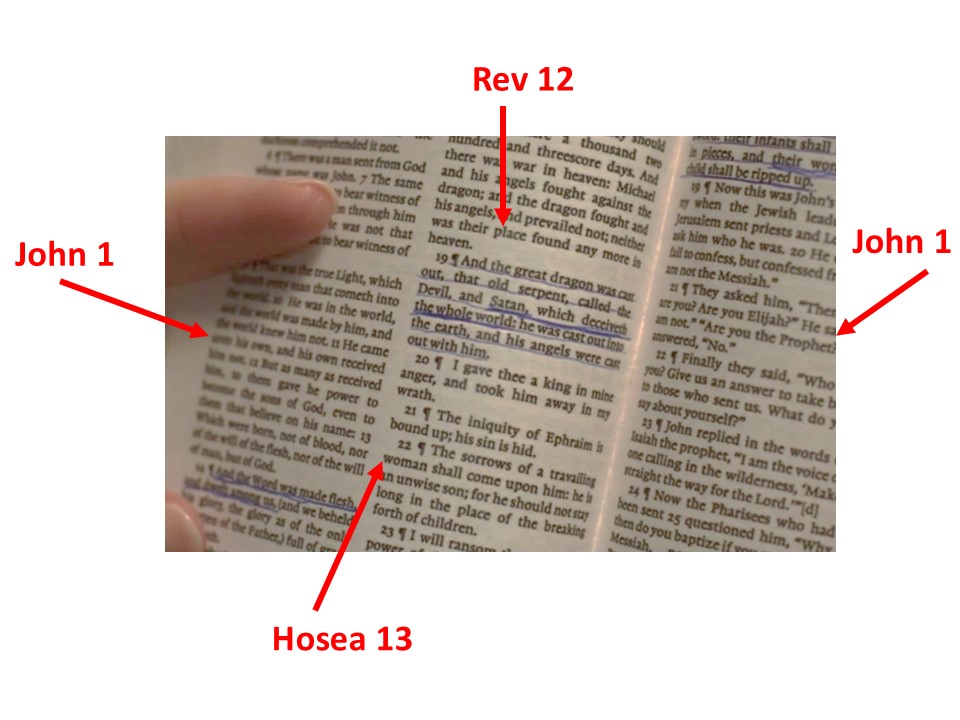
I thought two note two things about the movie Apartment 7a which is a styled third version of Rosemary’s Baby which is about a women who gets impregnated by Satan so as to the birth the anti-Christ.

It’s oft said to be a prequel but it’s really just a new origins story.

In any case, I noted that when the protagonist opens a Bible but when the camera view pans in on it, I noticed that someone mashed together different portions of the Bible into what’s only supposed to be one text—for whatever unknown reason.

slide1

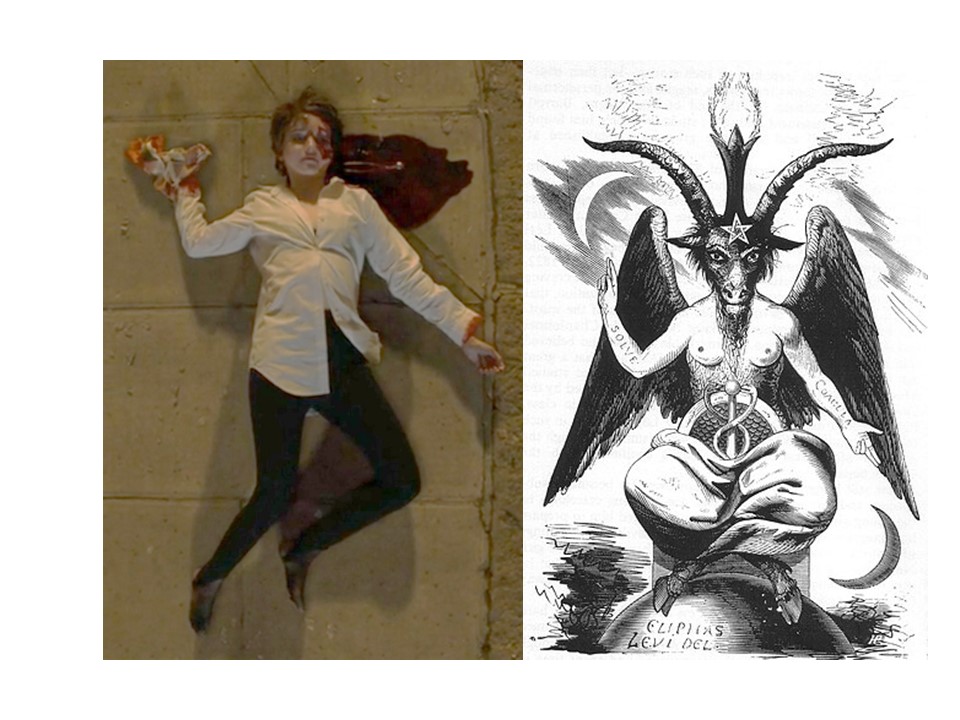
Also, when she ends up splattered on a street, she splatters in a Baphomet pose.

slide2

See my various movie review books here.

~~~~~~~~~~~~~~~~~~~~~~~

A plea: I have to pay for server usage and have made all content on this website free and always will. I support my family on one income and do research, writing, videos, etc. as a hobby.

If you can even spare $1.00 as a donation, please do so: it may not seem like much but if each person reading this would do so, even every now and then, it would add up and really, really help out.

Here is my donate/paypal page.

You can comment here and/or on my Twitter/X page, on my Facebook page, or any of my other social network sites all which are available here.

TJ Steadman on the flood and Rephaim as Nephilim 2.0

Undergoing consideration is that which TJ Steadman wrote about the flood and Rephaim as Nephilim 2.0.

You can find all of my articles regarding TJ Steadman here.

In his book Answers to Giant Questions, he claims “Now, while the Canaanites venerated El as head of the pantheon, we know as Christians that their god is not, in reality, the top dog” indeed, and that “Only Yahweh has the power to animate the spirits of the Rephaim.”

Now, this is because he takes a particular, and peculiar, view of Rephaim as Nephilim 2.0 which Nimrod somehow manufactured via occult means—see my article TJ Steadman on the rise and fall and rise of Nimrod aka Enmerkar, Giant, Nephil, Repha, Assyrian, Rahab, Leviathan.

Biblically, the root word repha is used to reference healing, the dead, a people group (the Rephaim), etc. so that, as always, context is king since context always determines meaning.

TJ Steadman continues thusly, “Only He can command Leviathan to release His ‘treasures of darkness’ upon the earth” whatever that means.

He then refers to “the hidden purpose of the Flood” and asks, “What could God have been doing with a world filled with giants” Nephilim, actually, “knowing that their spirits would not perish in the Flood?” but who said so or, who said not?

He is getting that idea from pseudopigraphical texts from millennia after the Torah was written, two of which claim that demons are Nephilim spirits (Jubilees and Ethiopic Enoch)—for my biblical view of who/what demons are, see the article Demons Ex Machina: What Are Demons?
Now, it is true that spirits would not perish due to the bodies they inhabited being covered by water but that does not mean that they became demons.

TJ Steadman asks, “Could those spirits have escaped judgment for so long, having been reserved for a time such as this?” there is zero biblical indication of any such thing.

He noted, “While the Canaanites falsely attributed this power to their usurping deity who was really a fallen son of God, the truth is that there was nobody in Canaanite religion who had the power to set the demons loose, so people who believe that they might be able to summon the Rephaim on their own are sorely mistaken,” good to know.

He states, “We can become so fixated on the idea of the Flood being a global event that was survived by nobody except Noah’s family” let us pause: Bible believers are “so fixated” because that is what we are so very clearly told.

Setting aside the issue of global vs. local flood for now, note that regarding who survived: it was Noah, his wife, their three sons, the three sons’ wives, and some animals (Gen 6 and 1 Peter 3:20).

He is, in part, stating that because, as he continues directly from where I paused quoting, “that we flatly refuse to think about the fact that the Scripture states that the giants that came after the Flood came from those that existed before it.”

This ranges from misguided to vague to wrong.

It is not enough to make statements such as “the Scripture states” because that is a reification fallacy: the Scriptures is not a person and so states nothing. Rather, God inspired words written in Scripture including many that we should not believe such as those statements made by Satan, the father of lies, that are recorded in Scripture.

Thus, “the Scripture states” or “the Bible says” or “it’s in the Bible” or “God inspired…” or “Moses wrote” or any such things are vague.
More accurately, “the Scripture” record a claim that “states that the giants” Nephilim, “that came after the Flood came from those that existed before it.”

So, the key questions are who said it, in what context was it said, was is accurate, how was it received, what was the reply, etc.?

TJ Steadman claims and also denies post-flood Nephilim and builds his entire case upon one single verse, as all post-flood Nephilim believers are forced to do, which then becomes a worldview hermeneutic via which they then misread and misinterpret other verses.

He is actually telling us that “the Scripture states” that but that was stated by unfaithful, disloyal, contradictory, embellishing, rebuked spies who made four claims about which the whole rest of the Bible knows nothing within an “evil report” and were rebuked for it by God Himself.

For my detailed interaction with the relevant portion of Num 13, which is to what he is referring, see the opening statement I made in my debate with TJ Steadman, here.

Since the one and also post-flood Nephilim text is utterly unreliable—for many reasons—then the logical and theological conclusion is that the last of the Nephilim died in the flood, did not return, and never will in any way, shape or form.

So now, contextual to Nephilim discussion: whether the flood was global or local matters not. If global then the Nephilim died in the flood since only eight people and some animals survived. If local then the Nephilim were living in the locality that was flooded since there is no such thing as post-flood Nephilim.

TJ Steadman further writes, “Naturally, this will result in the text being forced to fit concepts that it plainly doesn’t support, to defend certain theological systems. This is the point at which for many, the literalism dissolves, and words like ‘giant’ are explained as being references to power, royalty, influence or pride.”

Ironically, it is he who is expecting us to take his preferred late-comer English word “giant” to mean something unspecific about unusual height literally.

Biblically, the English term “giant” is not a “references to power, royalty, influence or pride” but is used to render (no, not even translate) either “Nephilim” or “Rephaim.”

He offers this:

A common example is the interpretation of the Numbers 13 account which draws particular attention to the phrase “we were in our own sight as grasshoppers, and so we were in their sight,” which is taken to mean that the spies considered themselves diminutive compared to their supposedly normally-proportioned enemies. It might read well as a moral lesson on selfesteem, but the direct mention of giants (” … and there we saw the giants, the sons of Anak, which come of the giants”) throws that idea out – unless you transliterate, and then you are left with “Nephilim” left happily unexplained and unquestioned.

Note that it was not “the spies” who said that since there were twelves spies who were all “the spies.” Rather, that was stated by the unfaithful, disloyal, rebuked ones who concocted that tall tale.

Thus, it was not “a moral lesson on selfesteem” nor a “direct mention of giants,” Nephilim actually, and since “Nephilim” does not mean what TJ Steadman sometimes thinks of when he uses the term “giants” then it also has nothing to do with a “happily unexplained and unquestioned.”
I have dealt with this issue in every book I have written about Nephilim related issues.

He notes:

However, avoidance of these questions and their associated issues will lead to other problems. We have already seen that the avoidance of giants in the pre-Flood world raises the question of how God might justify the destruction of that world and its inhabitants.
Similarly, writing off the post-Flood accounts of giants causes further problems, notably the issue of the apparent genocides committed by the Israelites at the command of God in the conquest of Canaan.

Indeed, avoidance leads to other problems as much as does turning them into theo-sci-fi.

The “giants in the pre-Flood world” were Nephilim and the “post-Flood accounts of giants” are accounts of Rephaim.

We should not chase the English word “giants” around a Hebrew Bible: Nephilim were strictly pre-flood hybrids, the Rephaim were strictly post-flood humans and there is no relation between them.

But what of “the apparent genocides”? Well, I have a whole chapter, titled “Herem: Were Post-Flood Nephilim Dedicated to Destruction?,” just on that issue in my book What Does the Bible Say About Giants and Nephilim?: the bottom line is that God tells us many times why He is commanding such things and never states one single word about Nephilim nor relation to them—never, ever.

TJ Steadman seeks the escape-clause-loophole of asserting that Rephaim are Nephilim 2.0 who were all but manufactured by Nimrod but such is the stuff of which theo-sci-fi is made.

The deeper problem is what will happen when TJ Steadman—and essentially all pop-researchers (see my book Nephilim and Giants As Per Pop-Researchers) tell people that it is okay, since they were just wiping out post-flood Nephilim (because, apparently, the flood did not do that) but anyone can see that such is not the case. Thus, this is a case of creating problems under the semblance of solving them.

He goes on to note:

If we take the responsible approach, we are forced to take the Biblical account in its entirety quite seriously. That implies thinking about by what possible means these difficult passages might be reconciled after we have done the Word of God the simple dignity of seeking the best translation.
Then we must consider any possible explanation of the existence of giants after the Flood, and the relationship they might have to those mentioned prior to the Flood. As ignorance tends to create more problems than it solves, the hope is that by carefully expounding the Scriptures we may arrive at a solution.
The idea of the floodwaters coming from the “fountains of the great deep” is meant to indicate that the Flood was of supernatural origin, and that the power responsible for releasing such destructive force may have been a malevolent entity compelled by God to carry out His will. It does not mean that we should expect to find vast reserves of water deep in the core of a supposedly hollow earth.

Indeed, the responsible approach is that which he noted. I am not aiming this, as it were, at him specifically but be careful since sometimes, “seeking the best translation” is used to mean seeking the ones that already state what one wants to hear—such as one that peppers the word “giant” through the Bible and leaves one to pour preconceived, fairytale spiked, meaning(s) into it.

As for “the existence of giants after the Flood”: the first question is “What do you mean by ‘giants’?”

Nephilim did not exist post-flood and Rephaim did because of well, the birds and the bees.

Again, he thinks that Rephaim are a post-flood name for Nephilim but he actually argues that the one and only verse that refers to Nephilim post-flood—the rebuked evil report—was actually edited by a redactor during the Babylonian captivity (even though there is no manuscript evidence of such a claim)—centuries after the Torah was written—so, apparently, we do not and cannot actually know what the rebuked spies stated.

As for “the relationship they might have to those mentioned prior to the Flood”:

1) there is no relationship between Rephaim and Nephilim (and no, you cannot even get that if you actually believe the rebuked evil report).
2) the relationship is one of reference, the rebuked spies referred to Nephilim and claimed to have seen them (the Israelites did not) so the relation is one in name only like conjuring up a boogey man in order to concoct a “Don’t go in the woods” style fear mongering scare tactic tall tale.

As for “may have been a malevolent entity compelled by God,” what we are told is, “I will destroy…I will destroy…I Myself am bringing floodwaters…I will cause it to rain…He destroyed” (Gen 6:7, 13, 17, 7:4, 23).

Ironic that he refers to creating more problems than one is solving.
The issue of floodwaters is fascinating as it serves as a very telling example of how TJ Steadman appears to cross the line into actually accepting Pagan mythology as is and then using it to interpret or re-interpret or mis-interpret the Bible—I know that he is cautious about not doing any such thing and I am just offering word of caution to a brother.
You see, in the ANE the abyss/absu was the watery chaos. Thus, he is reading the biblical reference to water coming from the fountains of the great deep as maybe coming from a malevolent entity who would dwell in that chaos and brought chaos to Earth.

Now, note the well, what I will call manipulation whereby he refers to “a supposedly hollow earth” which I also noticed when he refers to that “The Greeks described Tartarus as being under the earth, but that is not meant to be understood in terms of literal ‘flat earth’ geography” and “The Abyss is no more a physical place than the earth is flat” so that the trigger is to get us to think that since we do not want to be associated with a hollow or flat Earth then we must reject water coming from the fountains of the great deep and Tartarus being under the Earth (in the Earth, actually)— I would pay cash money to hear a debate between an hollow-Earther and a flat-Earther!!!

So, we should not expect to find vast reserves of water deep in the core of a supposedly hollow earth but why qualify that statement with “core” and “hollow”? Why not tells us to not expect to find vast reserves of water deep beneath the Earth’s surface?

The simple fact, that we now know more that it ever was in the past, is that there are, in very point of fact, many reserves of water deep beneath the Earth’s surface.

Thus, perhaps at sometime in the past someone, maybe even a Bible believers, thought that water coming from the fountains of the great deep must have been symbolic but we know that it is as literal as it gets: the floodwaters were a combination of rain and water coming from the fountains of the great deep.

Under the heading “Judgment on Evil Powers, Not Sin,” TJ Steadman wrote:

The Flood was not a judgment on sinful humans, or an eradication program directed toward God’s image-bearers, but a means of preserving the remnant of our species so that humanity could start over again.
Had it not been for the Flood, Noah’s family would certainly have been killed by the Nephilim, and the last hope of humanity would have been lost. The Flood was God’s means of saving His people from the trouble that was otherwise going to befall them.
There is an amazing irony in the work of God seen in the Flood though – the God of order bringing non-order upon an already chaotic world to set everything right again.

Part of this is attempting to understand the precious little we are told about Nephilim: which is merely their parentage and that they became mighty and well known—period.

He claims, “The Flood was not a judgment on sinful humans” but Gen 6:5-7 note, “the wickedness of man was great…every intent of the thoughts of his heart was only evil continually…the LORD was sorry that He had made man…So the LORD said, ‘I will destroy man…’”

And no, I have no problem with “man” referring to humans and to Nephilim and even to Angels since the former is obvious, Nephilim were half “man” so can be referred to as such (like Barak Obama is the “first Black President” even though he is half Black), and Angles look just like human males and thus, are referred to as such.

Now, he claims “The Flood was not a judgment on sinful humans” but during our debate he stated, “we don’t have in scripture any account of the purpose of the flood being for eliminating the Nephilim.” So, if it was not to contra humans nor contra Nephilim then God must have flooded the Earth not for the reasons He stated but to judge Angels.

The issue of ending “an eradication program” so that “humanity could start over again” is made difficult since he denies and also accepts that there were post-flood Nephilim. On the post-flood Nephilim view, the “eradication program” did not end with the flood and “humanity could” not just “start over again” since Nephilim were still running amok doing whatever they were doing.

Now, if “The Flood was God’s means of saving His people” then any concept of post-flood Nephilim means that God flooded the Earth only to, somehow and contradictory to His Word, have Nephilim survive or return and continue going at it.

TJ Steadman then asks, “What do we make of this?” and replies:

During the Flood, God opened the spiritual portals through our material world. In 40 days and nights, He passed judgment on all flesh. He sealed the fate of those wicked giants, detaching them from the powerful bodies they once had. He closed the gateway between the material world and the spiritual so that the spirits became trapped in their disembodied state.
After 150 days of disembodied existence, the Nephilim changed. They became the next iteration – unclean spirits seeking an opportunity for embodiment. We have no evidence to suggest that these spirits were able to achieve embodiment by their own power. Thus, the iniquity of Azazel had resulted in the “offspring of the goat” – the elohim (spirits) later referred to as Rephaim…
There is another way to view the cryptic “150 days” along similar lines. This time instead of goats, we will look at locusts. In an agrarian society, it was common knowledge that the life cycle of a locust averages 150 days. In that time, locusts undergo metamorphosis. Later we will see how important this illustration is, in describing the same thing that we just learned regarding the dead Nephilim and their subsequent form.

If you are thinking that most of that is unbiblical, even if it appears reasonable, then you are correct.

As far as I know, that “God opened the spiritual portals” is made up stuff but he makes if up in order to then claim “He closed the gateway” and so Nephilim spirits, “became trapped in their disembodied state” which he is arguing based not on the Bible but, again, based on folklore from centuries after the Torah was written.

Now, that he assets that precisely “After 150 days…Nephilim changed” into their “next iteration,” hence my term Nephilim 2.0 is part of his post-flood Nephilim view.

Yet, I state Nephilim 2.0 for another reason: because he also claim we can know how tall they were via Num 13:33, the rebuked evil report, and one cannot measure the height of a spirit so he claims they were actually alive and embodied at the time—yet, he also claims a redactor inserted the tern Nephilim into that verse centuries after it was written.

Yet, he also, also thinks that Rephaim are embodies Nephilim 2.0.
If you are having a hard time tracking all of this, welcome to the club.
By appealing to “the iniquity of Azazel” he is denoting that he is creating a problem—that of “unclean spirits seeking an opportunity for embodiment”—and supposing to solving it by, again, quoting pseudepigraphical folklore from centuries after the Torah was written, this time in the form of Ethiopic Enoch/1 Enoch—see my book In Consideration of the Book(s) of Enoch.

There is absolute zero biblical indication that Rephaim were “offspring of the goat,” whatever that means (I actually know he is erroneously playing off of the scapegoat issue). So, “Nephilim” were “elohim (spirits)” and “later referred to as Rephaim” and such watering down and playing with words either means that TJ Steadman is the greatest contextually relevant scholars in history—since, as far as I know, no one else in history has ever claimed any such thing—(which may be), or he is mistaken.

Yes, there are texts wherein locusts are symbolic of, say, a destructive army but to study the life cycle of insects to correlate them to a tale about “dead Nephilim and their subsequent form” does not end up working out.

Under the title, “There is a Hidden Purpose of God at Work,” TJ Steadman wrote:

As we are going to find out, there was another purpose of God at work in the Flood.
This one is not referred to explicitly, but in the light of what we have just seen, and as we continue, it will become apparent that the death of the Nephilim was not the end of them, and it was never supposed to be.
Our omniscient God always has a plan, and the disembodied giants would soon be part of it, whether they liked it or not.

So, the flood was our omniscient God’s “means of saving His people” so that “humanity could start over again” but “another purpose” that “is not referred to explicitly” results in that “the death of the Nephilim was not the end of them” which is rather odd.

See my various books here.

~~~~~~~~~~~~~~~~~~~~~~~

A plea: I have to pay for server usage and have made all content on this website free and always will. I support my family on one income and do research, writing, videos, etc. as a hobby.

If you can even spare $1.00 as a donation, please do so: it may not seem like much but if each person reading this would do so, even every now and then, it would add up and really, really help out.

Here is my donate/paypal page.

You can comment here and/or on my Twitter/X page, on my Facebook page, or any of my other social network sites all which are available here.