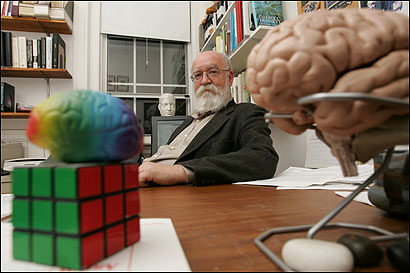
Christopher Hitchens and Daniel Dennett The Dynamic Duo of Demonstrably Deleterious Delusion, part 3 of 3

What About Atheism?

I know, I know, some of you are chomping at the bit to ask Christopher Hitchens and Daniel Dennett a question. So, please, release your death-grip on the bit and ask away, “What about atheism?”
Indeed, do atheists have to accept, and be held similarly responsible for the wicked deeds done by atheists, in the name of atheism, premised upon atheism? According to the New Atheists the answer is clearly that atheism gets a pass and is not responsible. They claim this for a variety of reasons, the primary one being that the 20th century was the bloodiest century in human history and it was largely so due to atheism spiked regimes. Other evasions include the claim that athe“ism” is not a particular belief system and that thus, atheist are not bound to any particular tenet. Yet, in this view atheism, meaning individual atheists, is in reality as diverse as any religious group (consider the inversion of this and you will see that the argument for religious violence is fallacious).

christopher20hitchens2c20daniel20dennett2c20atheism2c20true20freethinker-4260750

Yet, of all of the passes that have been recommended for atheism’s account not being charged for the wicked things done in its name, with it as a premise, Prof. Daniel Dennett has certainly conceived of the most, shall we say, interesting. During his debate with Dinesh D’Souza (Is God (and Religion) a man-made invention? ) he stated:

“…it occurred to me – let’s think about Stalin for a moment. Was he an atheist? You might say well of course he was an atheist. No, on the contrary. In a certain sense, he wasn’t an atheist at all. He believed in god. Not only that, he believe in a god whose will determined what right and wrong was. And he was sure of the existence of this god, and the god’s name was Stalin.”

Simply fascinating. Since Joseph Stalin was not an atheist (even though he was) but was in reality a theist (even though he was an atheist) the responsibility of his wicked deeds are charged to, you guessed it, theism.

christopher20hitchens2c20daniel20dennett2c20atheism2c20true20freethinker-7553662

In a manner of speaking, it is true that atheist are theists since they see god in the mirror. Whether it is Joseph Stalin or Pekka-Eric Auvinen who referred to himself as a “god-like atheist”1 and stated, “I am the law, judge and executioner. There is no higher authority than me”2 before committing a massacre at his high school (consider more likewise examples at this link).

Yet, claiming that atheists are not responsible for the atrocities committed by atheists or with atheism as a premise and claiming that theism is responsible instead is no way for anyone to argue much less a professor of philosophy.

from Apologetics315 on Mon, 04/12/2010 – 11:25pm

Today begins a series of 23 essays contributed by various apologetics bloggers from across the web. This

Recommendations for the Moment

Website/Blog:
What Had Happen’ Was…..
Great blog for a taste of interesting apologetics related material from all around the www.

Article:
Are Atheists Healthy, Happy, Moral, etc.?
Let the facts answer this question via polls and studies.

Audio:
The Problem of Evil and Suffering by William Lane Craig

Book:
Philip J. Sampson, 6 Modern Myths About Christianity and Western Civilization
The 6 myths pertain to: 1) Galileo, 2) Darwinism, 3) supposed malicious Christian missionaries, 4) the body and sexuality, 5) the environment, 6) persecution of witches.

Quote:
From the movie prequel of Silence of the Lambs; the 2002 AD Red Dragon

Will Graham: I thought you might enjoy the challenge. Find out if you’re smarter than the person I’m looking for.
Hannibal Lector: Then by implication, you think you are smarter than I am, since it was you who caught me.
Will Graham: No, I know I’m not smarter than you.
Hannibal Lector: Then, how did you catch me?
Will Graham: You had… disadvantages.
Hannibal Lector: What disadvantages?
Will Graham You’re insane.

Video:
John Cleese’s The Scientist

Sacred Sites

There are many belief systems in which sacred sites play a big part. A sacred site is a geographical location. As a concept it can range from a place where an event occurred, to a place thought of as auspicious; such as in the concept of geomancy, sacred geography, Feng Shui, energy centers, etc. These places are said to have a positive effect on the visitor; such as visions and messages from Mary, in regards to Roman Catholic sites, to healing energy in regards to New Age concepts.

One thing to note about sacred sites is that you are said to gain benefits from being present at a particular location. This seems to denotes randomness since the benefit comes from finding yourself at a certain location. What this means is that some people will gain benefit, and other be denied it, purely based on abilities such as the financial ability to travel to a sacred site.

In Christianity there are no magic tricks, no secrets and no sacred sites. Don’t misunderstand; yes there are Christians who believe in sacred sites, for example there are numerous Roman Catholic sites, but in reality and Biblically, there is no such thing. True, it may be exiting or even inspiring to visit the Western, or Wailing Wall, the empty tomb, or a grand old church. However, there is nothing intrinsically special or sacred about these locations.

Indeed, sometimes sacred sites are invented out of thin air such as when a relic is placed in a Roman Catholic church. In Chimayo, New Mexico, there is said to be healing dirt. There is a hole in a side room of the church and people gather it up and take it with them for various practices. Legend has it that the dirt never runs out but the priest of the parish has plainly said that they fill it back up (from a mound of dirt that is out back by the restrooms) whether it has miraculous healing properties is another matter.

A few years back there was some fighting in Jerusalem and some priests would not leave the Church of the Nativity. They risked their lives in order to protect a sacred site, which might seem courageous or even romantic. But keep in mind that when the services are over the church leaves the building, the building is not the church, rather, the people are. Therefore, in reality these men risked their lives for a nicely arranged pile of bricks and that’s all.

The Roman Catholic Church has made their position very clear regarding this issue at The Council of Trent in the Twenty-Fifth Session – Dec. 3-4, 1563 – On the Invocation, Veneration, and Relics of Saints, and on Sacred Images,

“_they who affirm that veneration and honor are not due to relics of the saints, or that these and other sacred monuments are uselessly honored by the faithful, and that the places dedicated to the memory of the saints are in vain visited with the view of obtaining their aid, are wholly to be condemned.”

It is true that God told Moses, “Pull off your sandals from your feet, for the place on which you stand is holy ground” (Exodus 3:5). This seems to be one particular occasion when and where God’s presence was. There is no indication that if we could somehow identify this location today it would somehow be a sacred site.

Jesus specifically spoke regarding the issue of sacred sites in His encounter with the Samaritan woman,

“The woman said to Him, ‘Sir, I perceive that You are a prophet. Our fathers worshiped on this mountain, and you Jews say that in Jerusalem is the place where one ought to worship.’ Jesus said to her, ‘Woman, believe Me, the hour is coming when you will neither on this mountain, nor in Jerusalem, worship the Father. You worship what you do not know; we know what we worship, for salvation is of the Jews. But the hour is coming, and now is, when the true worshipers will worship the Father in spirit and truth; for the Father is seeking such to worship Him. God is Spirit, and those who worship Him must worship in spirit and truth‘” (John 4:19-24).

See the point? Should we worship here or there? The point is crystal clear; geographical location is utterly irrelevant. God’s blessings are not bestowed based upon our ability to visit particular geographic locations. Rather, they are based on His grace, which is omnipresent.

OH, MY GOODNESS !!!

What is Good?
Good is a relative term. It is the standards by which we judge that determine what goodness is. When we judge ourselves according to the standards of the world it is easy to label ourselves as good. We can watch the news any day and compare our deeds to those of the world. No matter what we’ve done we can say, “At least I’m not as bad as him or her and at least I don’t do this or that.” We can read history and compare our country to the worse that the ages had to offer and feel comforted, proving to ourselves that we are not that bad. The thing we learn from history is that we never learn from history. “All a man’s ways are pure in his own view, but the LORD weighs the spirit” (Proverbs 16:2).

When we honestly judge ourselves by God’s standards we fall infinitely short. “The heart is deceitful above all things, and desperately wicked; who can know it? I the Lord, search the heart, I test the mind. Even to give every man according to his ways, according to the fruit of his doings” (Jeremiah 17:9-10). We can determine God’s standards by looking at the one who is considered by Him to be perfect, He who knew no sin (see 2nd Corinthians 5:21). Jesus is the Lamb of God who took away the sins of the world (see John 1:29). According to God such a sacrifice must be unblemished (Exodus 12:5). Besides the Messiah, every person in the history of creation has fallen far short of God’s standards. “Who can say, ‘I have made my heart clean, I am pure from my sin?'” (Proverbs 20:9).

The realization of not just our sinful nature, but the fact that we make plans to sin, we carry out sin, and we do it all again will cause the unsaved to cry out, “_to the mountains and rocks, ‘fall on us and hide us from the face of Him that sits on the throne, and from the wrath of the Lamb for the great day of His wrath has come, and who shall be able to stand.'” (Revelation 6:16).

Consider how even Isaiah, a holy prophet of God reacts as he sees God, “In the year that King Uzziah died, I saw the Lord sitting on a throne, high and lifted up, and the train of His robe filled the temple_So I said, ‘Woe is me, for I am undone! Because I am a man of unclean lips, and I dwell in the midst of a people of unclean lips; for my eyes have seen the King, the LORD of hosts.'” (Isaiah 6:1 & 6:5).

Who is Good?
We say, “I am a good person and that should be enough. Why would God send a good person to hell?” This all goes back to our definition of good. Actually, people condemn themselves to eternal separation from God by choosing to deny the salvation that He offers. If we stand before God relying on our own goodness, we cannot measure up to His standards for entry into His eternal kingdom. We are weighed on the scale and found wanting. Such would be the case with an unsaved person, one who has denied the salvation that God offers as a gift.

“‘Do I have pleasure at all that the wicked should die?’ says the Lord God, ‘and not that he should turn from his ways and live?'” (Ezekiel 18:23). God is so loving that as much as He wants us to do His will, He will allow us to do our own will if that is what we really want. Therefore, if we live our whole lives proving by thought, deed, and word that we want nothing to do with God then when we come before Him after death He will not force us to spend eternity with Him. If He did then He would be unfair and unjust. Be careful what you wish for you just might get it. So, who is truly good? Good enough that is, to stand before the judge on our own merits. “no one is good but One, that is God” (Matthew 19:17). “For there is no one who does not sin” (1st Kings 8:46).

I wonder about people who say that as long as a person is good, everything is fine and heaven awaits. What, I wonder, about all the people who are not good? How could it be possible for a good person to say only those good people like themselves will gain heaven. The Christian life begins with a bad person realizing that they are bad. Therefore, we reach to the bad people so that not just the good will be saved. Christians honestly believe that we are going to heaven, not due to our own goodness but through the salvation that God offers through the sacrifice of Jesus Christ. We honestly believe that we are going to heaven and we are not content to go there alone. This is why Christians proselytize.

Who does Good?
Is a good person one who does good? Since good is a relative term, then so is doing good. “But if you love those who love you, what credit is that to you? For even sinners love those who love them. And if you do good to those who do good to you, what credit is that to you? For even sinners do the same” (Luke 6:32-33). “For if you love those who love you, what reward have you? Do not even the tax collectors do the same? And if you greet your brethren only, what do you do more than others? Do not even the tax collectors do so?” (Matthew 5:46-47). How often is our wish to do good no more than an intention? The road to hell is paved with good intentions.

To intend is not necessarily to fulfill. “If a brother or sister is naked and destitute of daily food, and one of you says to them, ‘depart in peace, be warmed and filled,’ but you do not give them the things which are needed for the body, what does it profit?” (James 2:15-16). “But whoever has this world’s goods, and sees his brother in need, and shuts up his heart for him, how does the love of God abide in him?” (1st John 3:17). No matter what ideals, standards, philosophy, or religion we follow we will at some point act against that which we believe and what is to happen when we do this non-goodness? Or politically incorrect but honestly speaking what should our payment be for our evil doing? God is so Holy and righteous that He cannot look upon sin (see Habakkuk 1:13). The thing that a saved person has going for them is the assurance of forgiveness.

So who truly does good? The Messiah’s life proves that doing good is a full time job. He fed the hungry to nurture them, because He cared for them. Jesus said, “I have compassion for the multitudes, because they have now continued with me three days and have nothing to eat, and I do not want to send them away hungry, lest they faint on they way” (Matthew 15:38). He rebuked hypocrites to save them from damnation. “For God did not send His son into the world to condemn the world, But that the world through Him might be saved” (John 3:17). He became a servant of men. Putting Himself not first but last. “_if anyone desires to be first, he shall be last of all and servant to all” (Mark 9:35). Ultimately He gave His life to save us filthy dirt clots. This giving, servitude, goodness was one hundred percent of the time. No one else comes remotely close to that.
“There is none who seeks God. They have all turned aside; They have become unprofitable; There is none who does good, no, not one” (Romans 3:12). “For there is not a just man on the earth who does good and does not sin” (Ecclesiastes 7:20).

Why do Good?
This is all pretty depressing. If no one truly does good, if the good that we do (our own righteousness) is as filthy rags, if good deeds do not gain us salvation, then why bother? We might ask, greatly astonished as the disciples did, “‘Who then can be saved?’ But Jesus looked at them and said to them, ‘With men this is impossible, but with God all things are possible‘” (Matthew 19:25-26).

We are obsessed with the concept of goodness. Some truly believe it to be the way to heaven. Most people who seek the unification of all religions focus solely on good deeds as an assumed tie that binds. These points would be valid if good works or deeds gained salvation. If good gains salvation, then what do bad deeds gain us? Maybe, if our good deeds outweigh our bad, then we will go to heaven. Where is this cosmic scale? We wouldn’t know the outcome until in death we faced judgment. Imagine living with such spiritual paranoia. To believe that our own righteousness would outweigh our sin is to demonstrate a tremendous amount of ignorance as to what sin is.

If goodness is enough then why (literally) in God’s name did Jesus Christ humble Himself? Why did He dwell among us, to become, “A man of sorrows and acquainted with grief.”? (Isaiah 53:3). Why did He come to be betrayed, mocked, beaten, and killed? Because “when the kindness and love of God our Savior toward man appeared, not by works of righteousness which we have done, but according to His mercy He saved us, through the washing of regeneration and renewing of the Holy Spirit” (Titus 3:4-5).

It’s hard to believe people when they claim to believe in working for salvation. I always wonder why they are wasting time talking with me instead of doing good works since their eternal destiny hangs in the balance. The point is that if you believe that you can walk a 100-mile pilgrimage to gain merit with God, then why aren’t you walking 500 or 1,000-miles? If you believe that 1-hour of chanting will harmonize your karma, then why aren’t you chanting 10 or 24-hours a day? If you believe that you can gain indulgences by walking through the doors of a cathedral then why aren’t you stepping in and out, in and out that you may pass through the door over and over? “But we are all like an unclean thing, and all our righteousness are like filthy rags.” (Isaiah 64:6).

“‘The righteousness of the righteous man shall not deliver him in the day of his transgression; as for the wickedness of the wicked, he shall not fall because of it in the day he turns from his wickedness; nor shall the righteous be able to live because of his righteousness in the day that he sins.’ When I say to the righteous that he shall surely live, but he trusts in his own righteousness and commits iniquity, none of his righteous works shall be remembered” (Ezekiel 33:12).

Dan Brown – The Da Vinci Code, part 3 of 4 : Cat's Got Your Tongue? No, But He Wishes He Did

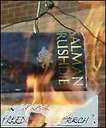
The book that is worth killing people
and burning flags for is not the book that I wrote

—Salmon Rushdie1

versesburn-4914490
Cat’s Got Your Tongue? No, But He Wishes He Did

Cat Stevens a.k.a. Yusuf Islam received the “Man of Peace” award from Nobel Peace Prize laureates.

When Salman Rushdie’s novel was published this man of peace stated that instead of attending a demonstration where Rushdie’s effigy would be burned, “I would have hoped that it’d be the real thing.” And that If Rushdie came to his doorstep, “I might ring somebody who might do more damage to him than he would like.” “I’d try to phone the Ayatollah Khomeini and tell him exactly where this man is.”
yusufii-6669950
A fellow lover of peace, author Fay Weldon, stated, “Burn the book today, kill the writer tomorrow.”

Another fellow flower child, Dr. Kalim Siddiqui (director of the Muslim Institute in London) stated, “We are not a pacifist religion. We don’t turn the other cheek. We hit back,” he also complained that a broadcast of A Satanic Scenario, courtroom-style program in which he participated, was cut and omitted the Muslim justification for punishment of blasphemy.

In 2000 Cat Stevens / Yusuf Islam was deported from Israel due to allegations that he backed the militant Islamic group Hamas and was denied entry into the US. Although he has “consistently denounced the acts of terrorists as being directly contradictory to the peaceful teachings of Islam,” and has “never knowingly supported any terrorist group.”2

On the CBS’s Sunday Morning (12-03-06) Cat Stevens / Yusuf Islam was interviewed and asked about the good old days. Footage was shown of him at the time of the Rushdie fiasco in which he said, “Any writer who abuses the prophet, or indeed any prophet, under Islamic Law the sentence for that is actually death.” Clear enough isn’t it? At a time when the issue was whether it was right to support the murder of Rushdie, Cat Stevens / Yusuf Islam explains to the world that it is perfectly in keeping with Islamic Law.

Except that in the year 2006 he further explains, “I certainly never supported the Fatwa. But when I was asked about, you know, the actual principle of blasphemy and capital punishment, well, like the Bible, I said, yeah, its there in the Qur’an. I couldn’t deny that.”

Does this strike you as convolution? I did not support the call for Rushdie’s murder (the Fatwa) but I support the Qur’an and Islamic Law upon which the Fatwa is based?!? Moreover, what on Earth does the Bible have to do with it? Except, of course, the fact that its mention is a diversionary tactic.

yusuf-8299905
The New Testament teaches:

“But I say to you who hear: Love your enemies, do good to those who hate you, bless those who curse you, and pray for those who despitefully use you. And to him who strikes you on the one cheek, also offer the other. And to him who takes away your garment, do not forbid your tunic also…

For if you love those who love you, what thanks do you have? For sinners also love those who love them. And if you do good to those who do good to you, what thanks do you have? For sinners also do the same. And if you lend to those of whom you hope to receive, what thanks do you have?

For sinners also lend to sinners, to receive as much again. But love your enemies, and do good, and lend, hoping for nothing in return. And your reward shall be great, and you shall be the sons of the Highest. For He is kind to the unthankful and to the evil” (Luke 6:27-29, 32-35).

Cat Stevens / Yusuf Islam said that “Any writer who abuses…any prophet, under Islamic Law the sentence for that is actually death.”
But Jesus taught the following in referring to Himself as the Son of Man, “whoever speaks a word against the Son of Man, it shall be forgiven him” (Matthew 12:32).

Cat Stevens / Yusuf Islam further stated, “I needed to go through a whole period of learning and to understand the politics of, you know, of life in the big world.”
Sure, there were murders, maiming, riots, bombings and Rushdie has to live his life in fear but it was a good lesson for Cat Stevens / Yusuf Islam.

But what is the ultimate bottom line here, why was Cat Stevens / Yusuf Islam on “Sunday Morning”? Well, the crazy Cat is back, he is recording a new album and, apparently, wants the filthy lucre of the great satan – America.

Comments by Charles Krauthammer
From The Washington Post Company, © 2006, 9-22-06, p. A17
Tolerance: A Two-Way Street

Excerpt:

“The pope makes a reference to a 14th-century Byzantine emperor’s remark about Islam imposing itself by the sword, and to protest this linking of Islam and violence…’How dare you say Islam is a violent religion? I’ll kill you for it’ is not exactly the best way to go about refuting the charge.

But of course, refuting is not the point here. The point is intimidation. First Salman Rushdie. Then the false Newsweek report about Koran-flushing at Guantanamo Bay. Then the Danish cartoons…And the intimidation succeeds: politicians bowing and scraping to the mob over the cartoons;

Saturday’s craven New York Times editorial telling the pope to apologize; the plague of self-censorship about anything remotely controversial about Islam – this in a culture in which a half-naked pop star blithely stages a mock crucifixion as the highlight of her latest concert tour.”

Roman Catholic Church: Our Lady of Guadalupe – Officially or Unofficially the Goddess of the Americas?

I ran across a very interesting, refreshingly honest and theologically bankrupt story about a December 15, 2009 AD art exhibit about “Our Lady of Guadalupe” which the article also calls “the Virgin of Guadalupe.”1 This exhibit, which will take place at the National Hispanic Cultural Center in Albuquerque, New Mexico was announced in a local newspaper as a “Feast, exhibit” since the “art show will be joined by the Feast of Guadalupe Celebration.”

Why “refreshingly honest and theologically bankrupt”? Because of the feast/exhibit’s title and its explanation.The title of the exhibit is “Guadalupe: Goddess of the Americas.” Theresa Avila, the curator of the feast/exhibit, made the generic and incomplete statement that, “The title was set already.”

Set or not (whatever that may mean) Roman Catholics will surely, at the very least, call into question referring to Our Lady of Guadalupe/the Virgin of Guadalupe as a “Goddess.” The article refers to the apparition as being that of Mary “Jesus’ mother.” Granted, the apparition has always been treated as a goddess by many, including some Roman Catholics. In fact, during the Vatican II the Bishop of Cuernavaca, Mexico stated, “Devotion to Mary and the saints, especially in our countries, at times obscures devotion to Christ.”2 Yet, the fact is that Roman Catholicism remains monotheistic.

I have researched and written much about the issue of Marian doctrine and dogma in Roman Catholicism and will direct the interested reader to MARY in Roman Catholicism and the essay therein which touches upon the Guadalupe incident, Examples of Extreme Deception. Also of interested may be the consideration of the image itself, On the Treatment of Images, part I of II

The article states:

It all started in 1531 when the Virgin came to local peasant Juan Diego on a hill outside of Mexico City. He told the local priests what he saw and they didn’t believe him until he showed them a miracle she’d performed. The local Catholic bishop Commissioned a church in her honor and she became an icon and powerful symbol.

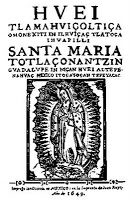
Let us note that the event occurred in 1531 AD and that the earliest written narration of this event dates from 1649 AD.3 The apparition actually told Juan Diego:

I wish that a temple be erected here quickly, so I may therein exhibit and give all my love, compassion, help, and protection, because I am your merciful mother, to you, and to all the inhabitants on this land and all the rest who love me, invoke and confide in me; listen there to their lamentations, and remedy all their miseries, afflictions and sorrows. And to accomplish what my clemency pretends_that here on this plain a temple be built to me_Be assured that I will be most grateful and will reward you, because I will make you happy and worthy of recompense for the effort and fatigue in what you will obtain of what I have entrusted_.[fourth apparition] Am I not here, who is your Mother? Are you not under my protection? Am I not your health? Are you not happily within my fold?

The theologically/biblically discerning reader will instantly note that whatever this apparition was, if it did take place, it was attempting to set itself up as a replacement of Jesus. The apparition specified that “here on this plain a temple be built to me”; firstly, Juan Diego should have asked “And just who are you that at temple is to be built for you?” or better yet, “The LORD rebuke you!” For, where was “this plain”? “The apparitions occurred at Tepeyac, a small hill and a former sanctuary to the Aztec goddess Tonanzin [or, Tonantzin]. Mary asked Juan Diego to request that the local bishop build a church on that site.”4
At the time, Fray Bernardino de Sahagun referred to the apparitions as a “‘satanic invention,’ because of his fear that the indigenous would return to their old idols.”5 How wise was he? Not only have the indigenous return to their old idols, the Aztec goddess, (or found a new one) but the new world followed the old and today we have the Goddess of the Americas. This is how it has been since the beginning as any act of devotion to whatever this apparition was takes away from Jesus.Consider, for good measure, three Vatican approved translations of the Apostle Paul’s warning in 2nd Corinthians 11:3.

The New Testament Rendered from the Original Greek with Explanatory Notes (Kleist-Lilly translation),

But I fear lest, as the serpent seduced Eve by his cleverness, so your thoughts may be corrupted and fall from the single-minded devotion and purity you owe to Christ.

The New Testament of Our Lord and Savior Jesus Christ (trans. from the Latin Vulgate Challoner-Rhemis version),

But I fear lest, as the serpent seduced Eve by his guile, so your minds may be corrupted and fall from a single devotion to Christ.

The New American Bible,

But I am afraid that as the serpent deceived Eve by his cunning, your thoughts may be corrupted from a sincere [and pure] commitment to Christ.

The article announcing the Feast/exhibit states, “She’s the protector of the New World_the Virgin permeates art from the Americas because of her power_the Virgin is more powerful because of who she is, and who she’d become.”
Even if we accept the Roman Catholic concept of “to Jesus through Mary” we find that people such as Theresa Avila are all too pleased to redirect the line which hopefully leads to Jesus through Mary and repaves a road that now goes from Mary, away from Jesus, away from Roman Catholic monotheistic theology and back towards polytheistic Pagan idolatry.

Chuy Martinez, who organized the musical aspect event, stated:

It’s important to those of us in New Mexico_She’s an international icon. In Mexico, it’s more because she’s a uniter, you know, for this time, for the Guadalupe, everybody from all social backgrounds and classes get together and they believe in this Virgin. They adopted it. It goes beyond the faith.

Indeed, it goes beyond the Christian Roman Catholic faith and directly into polytheistic idolatry as it no longer has any relevance to Jesus.

Avila stated, “She’s universal. She ties into the ideas of the mother goddess and the origin myths, and there’s links to pre-Colombian stories_She’s a woman. She was accepting of her role.”
Indeed, and part of her role was to urge us to “Do whatever He [Jesus] tells you” (John 2:5) and not to demand that a temple be erected in her honor, not to tie into the ideas of the mother goddess and origin myths, not to exhibit and give love, compassion, help, and protection, not for us to invoke and confide in her, not to protect us, to heal us or anything of the sort. The true Mary knew of no such things and each of these, and more, specifically removes Jesus from these roles, roles which belong to Him alone, and replace Him with a Mary whom Jesus would never recognize as His blessed mother.

Moreover, Avilar states, “She’s nonjudgmental. She’s not on a cross. She’s not looking down from heaven.”Yet, the gospel is about judgment, judgment for sin and Jesus salvation which He purchased for us on the cross.This is actually a Roman Catholic concept that is as popular as it is fallaciously un-biblical. It is viewing Jesus as the stern and uncompromising judge whom we must fear and Mary as the friendly helper who intercedes for us. Consider the words of a very popular Marian devotion in the form of “Our Mother of Perpetual Help”:

O Mother of Perpetual Help, thou art the dispenser of all the goods which God grants to us miserable sinners, and for this reason he has made thee so powerful, so rich, and so bountiful, that thou mayest help us in our misery. Thou art the advocate of the most wretched and abandoned sinners who have recourse to thee.Come then, to my help, dearest Mother, for I recommend myself to thee. In thy hands I place my eternal salvation and to thee do I entrust my soul. Count me among thy most devoted servants; take me under thy protection, and it is enough for me.For, if thou protect me, dear Mother, I fear nothing; not from my sins, because thou wilt obtain for me the pardon of them; nor from the devils, because thou art more powerful than all hell together; nor even from Jesus, my Judge himself, because by one prayer from thee he will be appeased.

But one thing I fear, that in the hour of temptation I may neglect to call on thee and thus perish miserably. Obtain for me, then, the pardon of my sins, love for Jesus, final perseverance, and the grace always to have recourse to thee, O Mother of Perpetual Help.

Note the highlights (or lowlights); it is Mary who dispenses God’s goods, she is our advocate, we may pray to her, our salvation is in her hands, we must devote ourselves to her, but why?Because she protects us from-note the correlation here-our sins, devils, hell and Jesus. “And what communion has light with darkness?” (2nd Corinthians 6:14).

Consider Everything the Bible Says About Mary and you could not even dream of any such role being fulfilled by her-she most certainly never did.

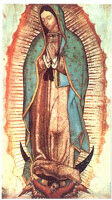
Lastly, note the claim that “She’s not looking down from heaven”; while I certainly do not know where she is supposed to be, the fact is that she appears to be hovering in heaven as she is held aloft by an angel and stands on a black crescent moon. This image allegedly miraculously appeared on Juan Diego’s clothing.That she has the moon under her feet means that the apparition is being identified with the woman in Revelation 12. Note vss. 1-2:

Now a great sign appeared in heaven: a woman clothed with the sun, with the moon under her feet, and on her head a garland of twelve stars. Then being with child, she cried out in labor and in pain to give birth.

The woman in this text is suffering from the stain of original sin, pain in childbirth, which contradicts traditions about Mary. This leads to contradictions in official Roman Catholic teachings because either Mary was born immaculate (without original sin) but is not the woman in Revelation 12 or she is the woman in Revelation 12 but was not born immaculate; Catholic dogma cannot have it both ways.
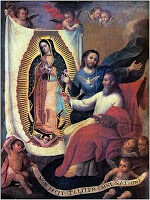
ourladyofguadalupe3-7491828
ourladyofguadalupe1-7323766

ourladyofguadalupe2-4798893

God the Father painting the allegedly miraculous image of Our Lady of Guadalupe

Mary, the woman, with the moon under her feet

Earliest rendition of the apparition story, from 118 years after the event

~~~~~~~~~~~~~

PS: I wrote to the Archdiocese of Santa Fe four times in order to inquire and received no reponse.

This is what I wrote to them:

To whom it may concern,
My name is Mariano Grinbank, I am a researcher who occasionally writes articles about local issues/events.

I had a question about the Dec. 15th National Hispanic Cultural Center exhibit featuring various forms of artwork depicting “Our Lady of Guadalupe.”

I was wondering firstly, whether the Archdiocese of Santa Fe was in any way involved, officially or unofficially, with the exhibit-which the Albuquerque Journal reported as a “Feast, exhibit” [on Dec. 13]?

Secondly, I am curious about the Archdiocese of Santa Fe’s opinion of the title of the Feast/exhibit which is “Guadalupe: Goddess of the Americas.”
Is this considered theologically sound? In keeping with Roman Catholic theology? I ask this particularly in light of the fact that the Virgin Mary is the mother of the one and only God?

Thank you for your time and attention,

Mariano Grinbank
Personal Experience

Ironically, it is from personal experience that I learned that personal experience and feelings are not the standard by which all things are to be judged. They are not to be relied on to define our worldview, and not the things that we should depend on for our eternal destiny.

Why? Maybe I’m an incredibly weak person, but I’m honest. I used to search for the God according to me, anything that I didn’t agree with could not possibly be of God. I was the one who decided right from wrong, truth from falsehood. I decided who God was and the things He would and would not do. I had placed myself in the place of ultimate authority, yet I was honest enough to know that I did not belong there.

Besides, when my feelings, mind, and experience changed so did my standards and worldview. In other words, there was no absolute truth, which by definition cannot be absolutely true. After a while I could no longer live with such uncertainty in all things.

At school one day I listened to a conversation between a painfully depressed woman and some students, finally the instructor told her that the Buddha said that desire is the cause of all suffering, “Rid yourself of desire and you will rid yourself of suffering.” When she asked how to go about doing this, the instructor admitted that he didn’t know, having not yet reached that stage himself. Sadly, all that these enlightened people could offer a hurting soul was an idealistic theory of a state of being they had not experienced themselves. Besides, what are you to do with the desire that you must have to rid yourself of those desires???

What personal experience has taught me is that experiences are always changing, therefore, I cannot trust my eternal destiny on such subjective experiences.

Oprah Winfrey – Priestess of Spirituality and Preacher of Strict Exclusivism, part 1

Does “strict exclusivism” sound like overkill? After all, exclusivism implies strictness. The point is to emphasize that in attempting to promulgate inclusivism it is exclusivism that ends up at the forefront as it comes across as that which it is; the only logical conclusion.

Consider, for example, that Oprah Winfrey stated, “I am a Christian who believes that there are certainly many more paths to God other than Christianity.”1Part 1: From Inclusivism to ExclusivismPart 2: Conflicts Between Winfrey/Tolle Spirituality and ChristianityPart 3: Conflicts Between Winfrey/Tolle Spirituality and Christianity (concluded)Part 4: Oprah Winfrey Gets and Gives Bad AdvicePart 5: Oprah Winfrey Gets and Gives Bad Advice (concluded)Part 6: Eckhart Tolle-Savior of the Earth and Humanity

From Inclusivism to Exclusivism:

While she may think that she is being tolerant and inclusivistic, and many consider her as being just that, what she is doing is stating, “I am right and if you disagree, you are wrong.” In other words, “I am a Christian who believes that there are certainly many more paths to God other than Christianity and any Christian, throughout the last 2,000 millennia including millions of martyrs, who think otherwise, including Jesus Christ, are wrong.” In her attempts at inclusivism she is excluding the exclusivists thereby making herself an exclusivist and thus, contradicting herself by becoming the very thing that she condemns.

oprahwinfreychristianitygodspirituality-9933985

“Inclusivism” is a mere empty word that those who cannot admit, or do not understand, that they themselves are exclusivists apply to themselves for politically correct or otherwise psychological reasons.Likewise, with the term “relativism” as self-proclaimed relativists are absolutely certain that relativism is absolute true.Likewise, with being “tolerant” as the tolerant do not tolerate the intolerant and thus become intolerant themselves.And on it goes.The bottom line is that exclusivism is the only logical option and if you disagree, you have succeeded only in proving the point.Let us delve into the heart of Oprah Winfrey’s and Eckhart Tolle’s contradictory hypocrisy as they, preaching the one true way, claim to not preach the one true way while condemning anyone that does not follow their one true way:

Oprah Winfrey: _one of the things that Eckhart says in the beginning of this book on page six is this book’s main purpose is not to add information or beliefs to your mind, or to try to convince you of anything, but to bring about a shift in consciousness. That is to say, to awaken_The important thing is that religion doesn’t become an ideology_the moment you say “only my belief” or “our belief” is true, and you deny other people’s beliefs, then you’ve adopted an ideology. And then religion becomes a closed door_Elizabeth Lesser_talks about old spirituality versus the new spirituality and she says the old was – the old way is the hierarchy has the authority. Church authorities tell you how to worship in church and how to behave outside of church. The new spirituality is that you are your own best authority as you work to know and love yourself, you discover how to live a more spiritual life.The old is God and the path to worship him have already been defined and all you need to do is follow the directions. The new is being able to listen within for your own definition of spirituality, your deeper longings are under search_

That there’s only one path it’s the right way and all other ways are wrong. And the spirituality says that many paths lead to spiritual freedom and peace.

This is the exclusivity that we defined at the beginning of this essay; note the constant exclusivism in their pseudo-inclusivism; it amounts to we are right and anyone who disagrees is wrong.Firstly, Eckhart Tolle says the he is not attempting to “convince you of anything, but to bring about a shift in consciousness. That is to say, to awaken” but read it this way: Eckhart is not attempting “convince you of anything” except that he is attempting to “bring about a shift in consciousness_to awaken.”This awakened shift in consciousness necessitates that “religion doesn’t become an ideology”-this is an ideology as it straightforward demands that “religion doesn’t become an ideology.”What they are stating is that “only my belief” or “our belief”-Oprah’s and Eckhart’s-“is true” and thereby they “deny other people’s beliefs” and so they have “adopted an ideology” which means that their neo-spirituality is “a closed door.”

oprahwinfreychristianitygodspirituality-8804837

Note that the “old spirituality” is juxtaposed with the “new spirituality”-the old is bad and only the new is good. What the church tells you is wrong and what is right is to place yourself in the ultimate place of authority. Fine, but what if I accept that I am my authority but have concluded that the very best and only way is that the church authorities should tell us how to worship in church and how to behave outside of church? All of a sudden, my neo-spiritual way is wrong.Moreover, “The old” which is wrong is that “God and the path to worship him have already been defined and all you need to do is follow the directions.” This seems a good time to correct two common misconceptions: Christianity is not a religion and the church does not mean an authoritative hierarchy such as a man-made bishopric, rabbinate, imamate, or guruship.

Christianity is about developing a close and personal relationship with God thought Jesus and the church refers to those who are engaged in such a relationship (in fact, the Bible is the most anti-religion book ever published).

But you see the point? The old church way is wrong and only the neo-spiritual is right.Note that they are stating that the view that “there’s only one path it’s the right way and all other ways are wrong” is wrong. In fact, note that the statement was that “the spirituality says that many paths lead to spiritual freedom and peace”; did you catch it? “many paths lead to_” they say “many” and not “all” and so they restrict the true path to that with which they agree.

Thus, their way is that “there’s only one path it’s the right way” their way “and all other ways are wrong.”

John 3 and Conflict

Be aware: this article does not offer medial advice and does not call for the cessation of the taking of medicines.

While speaking to Nicodemus, Jesus stated the following:

“Light has come into the world, and men loved darkness rather than the Light, because their deeds were evil. For everyone who does evil hates the Light, and does not come to the Light, lest his deeds should be exposed” (John 3:19-20).

Understanding this statement will give you a clear insight into virtually any and every conflict, it may save you hundreds of hours and hundreds of dollars for therapy.

Notice the claim that there is light, which means that lack thereof is not the problem. The problem is that humankind loves darkness but why? Because their deeds are evil and they do not want those deeds to be exposed. Imaging sleeping in a dark room when someone suddenly comes in and turns the light on, what would be your instant reaction? You would instantly cover your eyes in order to keep the light out and say, “Turn that light off!” Since you were in darkness, and were accustomed to it, you hide from the light because it is irritating to you.

Have you ever told someone that what they are doing is wrong? What was the reaction? Did they say, “Thank you so very much for pointing out my wrongdoing.” Or did they say, “Just who do you think that you are to tell me that I’m doing wrong?” A common reaction is the latter, since at that point the person would be in darkness and you would be shedding light on them. Instead of coming into the light they prefer to put your lights out. Consider salt (since Christians are called to be salt and light), salt can be very irritating. If you have ever been in the ocean you know that if you have a cut on your skin mere seconds after entering the water it will start to sting. But while this is irritating it is, at the same time, cleansing to the cut.

There is a common misconception that claims that if a person would merely have an experience with God they would instantly become saintly. Some people think that if God would appear to them, or if they could see a miracle, they would follow God. But this common misconception goes against the text of John 3 and others. This is because if this person was living in darkness and the light would shine on them, the light of God-the miraculous, they would sink further into the darkness in order to hide form that light. Since God would represent the pure light and you would represent darkness you would not want your dark deeds exposed by His glorious light. Is a drastic turnaround possible? Certainly, this is the first step in being born again. This turnaround would necessitate facing the light that is at first irritating and becoming accustomed to it.

Thus, virtually all human conflicts center around a wrongdoer who will not have the light shone on their evil deeds and who instead lashes out at the light bringer-they will become angry at the light bringer instead of admitting their own evil deed.

Yet, shine on!

HYPOCRITES

Hypocrisy:
1. The feigning of beliefs, feelings, or virtues that one does not hold or possess; insincerity.
2. Pretense of goodness.

Hupokrisis (Greek):
Playing a part on the stage.

How many times have you heard, “The church is full of hypocrites!” Partially we deserve this sort of put down because there are some people in our churches who seem to think that God takes attendance and accounts it to them as righteousness. Maybe they are a full-fledged sinner all week and then on Sunday put on their Christian face and use their Christian language and think that they have done their duty. Some might think that as long as they fulfill the traditions, sacraments, or rituals of their denomination they have likewise fulfilled their obligations to God.

This is a dangerous aspect of religion. Some think that they have no need to attend services and gather with other believers. This is convenient because having no other Christians around they can place themselves at the top of sainthood having no one but the late night news to compare themselves to, they can look in the mirror and say, “Not too shabby.”
Yet, the Bible states,

“And let us consider one another in order to stir up love and good works, not forsaking the assembling of ourselves together, as is the manner of some, but exhorting one another, and so much the more as you see the Day approaching” (Hebrews 10:24-25).

God wants relation not religion. Religion without a relationship with God is very empty and meaningless in its rituals. Often these rituals are accepted as tradition yet, not understood nor questioned by the participant.
Relation is putting God first in all things. It is to know that a life lived for God is more important than outward appearances or ritual.

“_Has the LORD as great delight in burnt offerings and sacrifices, as in obeying the voice of the LORD? Behold, to obey is better than sacrifice, and to heed than the fat of rams” (1st Samuel 15:22).

However, doesn’t a relationship to God naturally turn into a religion? Generally, or naturally, it often does. But it should be one that follows the precepts as laid down by God and not merely the traditions of men. This then would still be relation and not religion, although the word religion is very generalized and used generically.

“This people draws near with words only and honors me with their lips alone, though their hearts are far from me, and their reverence for me has become routine observances of the precepts of men” (Isaiah 29:13).

Having considered all of the above, note that the statement “The church is full of hypocrites” is usually used as an excuse to not live for God and to not go to church. It is another log that an unbeliever, or a lukewarm believer, can toss into the fire of their rebellion. We are to be salt and light to the lost and not bad examples. Our lives should not be able to be used as an excuse for the unbelievers to stay the way they are. Rather, we are to bring them to the shepherd that they may be fed like lambs. God loves us just the way we are, but He loves us way too much to let us stay that way.

“As obedient children, not conforming yourselves to the former lusts, as in your ignorance; but as He called you is holy, you also be holy in all your conduct, for it is written, ‘Be holy, for I am holy'” (1st Peter 1:14-16).

“You shall not take the name of the LORD your God in vain, for the LORD will not hold him guiltless who takes His name in vain” (Exodus 20:7). This commandment is not necessarily speaking of cussing, it is speaking of calling ourselves by God’s name i.e. Jewish or Christian and continuing to live our lives according to our own wills. When we claim to be holy, godly people but we live as sinners we damage the holy name of God. When King David slept with another man’s wife, and then had her husband killed so that he could be with her, Nathan the prophet told him, “by this deed you have given great occasion to the enemies of the LORD to blaspheme” (2nd Samuel 12:14).

A hypocrite is usually viewed as a person who says one thing and does another. Is the church full of hypocrites? There are two parts to the answer.

First, we’ll make an odd admission, which is that we cannot help but be hypocrites. In choosing to live our lives for God we have agreed to take on a task that is impossible for any human being to fulfill. God’s standard is one hundred percent perfection one hundred percent of the time and we realize that no one can live up to those standards.

No one that is, but the Messiah Jesus who alone lived up to perfection, which is why we rely fully upon Him. While most of us would have no problem with keeping to the commandment that prohibits murder, fewer people keep from committing adultery, yet fewer can keep themselves from lying, fewer still can keep from coveting things in general. It appears that we all fall short at some point.

Consider the following statements made by Jesus,

“You have heard that it was said to those of old, ‘You shall not murder, and whoever murders will be in danger of the judgment.’ But I say to you that whoever is angry with his brother without a cause shall be in danger of the judgment” (Matthew 5:21-22).

“You have heard that it was said to those of old, ‘You shall not commit adultery.’ But I say to you that whoever looks at a woman to lust for her has already committed adultery with her in his heart” (Matthew 5:27-28).

“If anyone wants to sue you and take away your tunic, let him have your cloak also” (Matthew 5:40).

“But I say to you that for every idle word men speak, they will give an account of it in the day of judgment” (Matthew 12:36).

And what about gluttony or sloth? So you see it is literally impossible for us to keep from hypocrisy.

Now to the second aspect, which is that we are not at all hypocrites because no Christian preaches that they are perfect and sinless (admittedly there is a fringe Christian groups do claim sinless perfection but their semantic technicality is to say that they do not sin but they do make mistakes!?!).
In fact, true and honest Christians will be the first to call themselves sinners. Sinners who found themselves to be so repulsive, so weak, so lost that they literally gave up their life. We put ourselves to death to be born again by the work of the only one that could save us from this body of death. The only one who lived the perfect life in our place and once and for all pleased God and quenched His righteous anger due to the sins of the ages. Jesus the Messiah the unblemished sacrificial Lamb of God took away the sins of the world. It has been written of Jesus,

“Here was the greatest soul of the sons of men; a man of genius of religion; one before whom the majestic mind of Grecian sages and of Hebrew seers must veil its face. What man, what sect, what church has mastered His noblest thought!”

1

A hypocrite then is not one who preaches perfection if along with that preaching comes an admission that the task is impossible to complete. We realize that while we are in this fallen world, in these perishing bodies, surrounded by wolves, in a universe of entropy, we will still be tempted every day and will not be perfect. Yet, the Lamb of God paid the price for sin and took away our slavery to it. We have chosen to follow God and to accept His word because therein we find the highest possible moral standard.

“No temptation has overtaken you except such as is common to man; but God is faithful, who will not allow you to be tempted beyond what you are able, but with the temptation will also make the way of escape, that you may be able to bear it” (1st Corinthians 19:13).

For those of us who have given our lives over to Jesus life is not a bowl of cherries, in fact in some ways it is harder than ever. Before salvation we did whatever we wanted, whenever we wanted, however we wanted and we were not really spiritually attacked because the devil had us on his side right where he wanted us.
Now we are tempted in every area of life, we are more sensitive to every sin. We are cautious of what we say, what we think, what we feel and how we act and react. We close our minds as much as possible to all filth, lies, evil and sin yet; we open our minds to all love, truth and righteousness. Now we go against everything that the world considers right, true and fun. We go against our own sin nature that urges us to give in to sin all the time.

“For you, brethren have been called to liberty; only do not use liberty as an opportunity for the flesh, but through love serve one another” (Galatians 5:13).

Yet, this is no loss to us who have an eternal perspective; we know that the worse suffering the world has to offer is only for a little while compared to eternity.Paul wrote,

“For I consider that the sufferings of this present time are not worthy to be compared with the glory which shall be revealed in us” (Romans 8:18).

Also,

“But what things were gain to me, these I have counted loss for Christ. Yet indeed I also count all things loss for the excellence of the knowledge of Christ Jesus my Lord, for whom I have suffered the loss of all things, and count them rubbish, that I may gain Christ” (Philippians 3:7-8).

We know that God approves the suffering we endure so that we may learn something from it. Job had lost all he had in the world; all his riches, all his animals and all his children had been killed, and his body was covered with soars, all in one day. Then his own dear wife said to him, “Do you still hold fast to your integrity? Curse God and die!” (Job 2:9).
Job responds, “You speak as a foolish woman speaks. Shall we indeed accept good from God, and shall we not accept adversity?” (Job 2:10). Job later says, “Though He slay me, yet will I trust Him” (Job 13:15). Job’s story is an illustration of the honesty of the Bible and the reality of walking according to God’s will. Having stated all that he did does not mean that he did not mourn, grieve and get angry. But he had eternal perspective and does not end up giving up on God.

If Christianity is to be discredited for being hypocritical because some Christians are hypocrites then all religions are to be discredited because some adherents of all the religions are hypocrites. Parenthood is to be discredited because some parents are hypocrites. Schools are to be discredited because some teachers are hypocrites.
Sports are to be discredited because some athletes are hypocrites. All the races are to be discredited because some people of each race are hypocrites. Both genders are to be discredited because people of both genders are hypocrites.
The world is full of hypocrites, so why should it be surprising if there are hypocrites in the church. Why pick on us? It is a compliment of sorts to say that the church is full of hypocrites because it shows that even non-Christians expect more from us.
They know we preach a high standard and therefore, it is only right that we are called to live up to those standards. As my own dear wife often says, “If I know that someone is a Christian, I expect more from them.” Christians should expect our own brothers and sisters to not only preach the gospel but to live it, to demonstrate it by example.

If you really think that the church is full of hypocrites then take up the challenge. Accept the salvation that God offers as a free gift through Jesus and I guarantee that you will only go but a few minutes before discovering that now you too are a hypocrite. One who is absolutely, unquestionably, unable, no matter how hard you try to live up to perfection. This is in no way an excuse to not even try or to cheapen God’s grace by sinning because God will forgive.

Sounds pretty discouraging doesn’t it? Why bother then if we strive for the impossible? Because

“God so loved the world that He gave His only begotten Son, that whoever believes in Him should not perish but have everlasting life” (John 3:16). Because faced with impossibility we turn to the Lord God Almighty who saves us from a life of sin. “Who then can be saved?_With men this is impossible, but with God all things are possible” (Matthew 19:25-26).

“For we do not have a high priest whocannot sympathize with our weakness, butwas in all points tempted as we are, yet,without sin. Let us therefore come boldlyto the throne of grace, that we may obtainmercy and find grace to help in time of need”

Hebrews 4:15-16