In Consideration of, “Who Were The Nephilim: The Creepy, Fallen Giants Mentioned Throughout The Bible?”

Under consideration is an article by James Felton, Senior Staff Writer for the IFL Science site, by the title of Who Were The Nephilim: The Creepy, Fallen Giants Mentioned Throughout The Bible? (November 21, 2022), he is said to specialize in, “history, strange science, and anything out of the ordinary.”

Let us begin with the title, “Who Were The Nephilim: The Creepy, Fallen Giants Mentioned Throughout The Bible?” which is accurate only if “Mentioned Throughout” refers to twice.

Felton begins with merely asserted conclusions by simply stating, “The Bible is filled with impossible events and characters, from leprosy being cured by touch rather than a course of antibiotics right back to a talking snake apple vendor pushing the forbidden fruit.”

It was a case of beginning with merely asserted conclusions since he did not bother elucidating how or why, on his worldview (not his emotively subjective personal preference du jour based on hidden assumptions) anyone should think that, “leprosy being cured by touch rather than a course of antibiotics” is impossible.

As for, “a talking snake apple vendor” well, there is no indication that it was an apple nor a reptile snake—as per Rev chaps. 12 and 20, serpent was just an a.k.a. for Satan—by any other name, “the great dragon was cast out, that old serpent, called the Devil, and Satan.”

Felton goes on to write of another supposed impossibility, “One particularly odd tale, which people have claimed (wrongly, of course) to have backed up with archaeological evidence, is of the ‘Nephilim’: a group of giants who are claimed to be the sons of angels or God according to the holy texts” for which he gets partial points.

If by the vague, generic, subjective, multi-usage, modern, English word giants he implies unusual height then Nephilim cannot be categorized as such since we do not have a reliable physical description of them.

And that is actually why he would seem to be correct in writing, “claimed (wrongly, of course) to have backed up with archaeological evidence.” That is because such archeological evidence generally consists of appeals to megalithic sites which are appealed to due to a non sequitur which is that large things must have been built for and by large people—the hidden assumption being that Nephilim were giants so we have come full circle, a vicious circle.

Moreover, since Nephilim did not make it past the flood—in any way, shape, or form (lest God failed)—then any such archeological evidence would, by definition, date to pre-flood days.

Felton notes, “Nephilim have been described in Genesis as ‘mighty men’, but more explicitly in Numbers as making us regular humans look teeny tiny in comparison.” Yet, he fails to interact with the narrative of Numbers, 13 to be exact, and so misleads his readers by not informing them that he is appealing to the mere recording, in vss. 32-33, of an evil report stated by utterly unreliable, unfaithful, disloyal, contradictory, embellishers whom God rebuked: no one should believe them.

And since their tall-tale is the only physical description we have of Nephilim then, again, we have no reliable physical description of them.

He also tells us, “The Nephilim are described more extensively in the Book of Enoch, a text purported to be the work of Noah’s grandfather.” Purported is an important qualifier since there is no indication that Enoch ever wrote anything, there is no history of any such book, it merely appeared on the scene in the Second Temple Era—millennia after the Torah—and without indication that it contains any reliable data not found in Genesis.

Felton quotes 1 Enoch/Ethiopic Enoch to the effect that it as Nephilim being, “three thousand ells” and tells us that this equals 3,429 meters which is 2.1 miles: great folklore, poor reality. Yet, in reality 3,000 ells amounts to circa 15-25 miles/24-40 kilometers—see my book In Consideration of the Book(s) of Enoch.

He further asserts, “some religious groups (who interpret the bible literally) think that the Nephilim were not wiped out by the great flood on account of being too tall, most think nothing survived Earth being engulfed in water but Noah’s big boat.”

Let us unpack this statement:

It cannot be a literal interpretation to, “think that the Nephilim were not wiped out by the great flood” for at least three reasons: 1) again, Nephilim did not make it past the flood, 2) the one and only indication of post-flood Nephilim is the utterly unreliable evil report, and 3) an actually literal interpretation is that a survival of Nephilim contradicts the Bible five times: Genesis 7:7, 23; Hebrews 11:7; 1 Peter 3:20, and 2 Peter 2:5.

As for, “on account of being too tall” I can only imagine that Felton is referring to folklore from many, many millennia after the Torah which, by definition, implies that God failed: He meant to be rid of them but could not get the job done, the flood was much of a waste, He missed a loophole, etc.

He notes that, “people…believing they have found Nephilim remains” which are all irrelevant since it pertains to, “a collection of bones…thought to be those of a giant…did not exceed 19 feet [5.8 meters]…” yet, which, “was actually that of a mammoth” and another set of bones that, “turned out to be from a mastodon.” I included many such examples in my books What Does the Bible Say About Giants and Nephilim? A Styled Giantology and Nephilology and Nephilim and Giants: Believe It or Not! Ancient and Neo-Theo-Sci-Fi Tall Tales.

Felton asserts, “Let’s get to the point: Nephilim, as they are portrayed as giants, cannot exist in real life, before or after a flood.” He does not bother telling us how or why he positively affirms that, but the key issue is the faulty assumption that, “Nephilim, as they are portrayed as giants” has ever had anything to do with reality. Since it has not then, he is correct by definition.

Now, he does assure us that one way we can be, “sure that the Nephilim did not exist, as they are portrayed as giants” is that, “‘extraordinary claims require extraordinary evidence’ as Carl Sagan put it” but that is fallacious and generic: the fact is that extraordinary claims only require adequate evidence and there is not standard of extraordinariness so it is an utterly subjective pseudo-standard.

He does hit upon why it is that the fantasy-tall-tale Nephilim of the evil report and 1 Enoch could not have been due to, “the square-cube law,” or inverse square law, “which states that as the size of any object grows (be it a cube or an accountant) its volume grows faster than its surface area. The area grows in proportion to the square of your size, whereas your volume scales up in proportion to the cube of your size.”

In short, such Nephilim would have shattered their own bones just attempting to walk.

In the end, Felton only stumbled onto a correct conclusion even if via fallacious data.

See my various books here.

~~~~~~~~~~~~~~~~~~~~~~~
A plea: I have to pay for server usage and have made all content on this website free and always will. I support my family on one income and do research, writing, videos, etc. as a hobby. If you can even spare $1.00 as a donation, please do so: it may not seem like much but if each person reading this would do so, even every now and then, it would add up and really, really help out. Here is my donate/paypal page.

Due to robo-spaming, I had to close the comment sections. However, you can comment on my Twitter page, on my Facebook page, or any of my other social network sites all which are available here.
Pastor Duke Taber answers What is Nephilim in the Bible?

Under consideration is the article What is Nephilim in the Bible? by Pastor Duke Taber (“alumnus of Life Pacific University and Multnomah Biblical Seminary…currently starting a brand new church in Mesquite NV called Mesquite Worship Center”).

He notes, “Nephilim are mentioned only a few times in the Bible, primarily in the Old Testament” which is accurate if, “a few” means twice and, “primarily” means exclusively.

Taber notes, “The term ‘Nephilim’ is often translated as ‘giants,’ but its exact meaning is a subject of debate among scholars” which I will nitpick on a technical level so as to note that such is not a translation but a rendering.

He adds, “it is clear that the Nephilim were a race of beings distinct from ordinary humans, described as ‘giants’ or ‘mighty men’ who lived both before and after the great flood” yet, giants is not a description: that denotes a word-concept fallacy.

Yet, he actually thinks it is a description due to actually believing Num 13:33 and such is also way he believes they live post-flood.

He reviews, “Theories on the Origins and Nature of the Nephilim,” the first of which is the Angel view.

Duke Taber thinks that it, “is supported by other biblical passages such as Job 1:6 and 2:1” yet, as far as Job is concerned, 38:7 is a stronger reference since it, at the very least, elucidates that they are not human.

Yet, he notes, “this theory is controversial, as it raises questions about the ability of spiritual beings like angels to engage in physical relationships with humans” the solution to which is quite simple: he confused spiritual for spirit and that they are spirit is a faulty premise since they are always described as looking just like human males, performing physical actions, and without any indication whatsoever that such is not their ontology.

His next option is, “The Sethite Theory” which, “suggests that the ‘sons of God’ were the godly descendants of Seth, the third son of Adam and Eve, while the ‘daughters of men’ were the ungodly descendants of Cain…This theory…has been criticized for not fully explaining the description of the Nephilim as ‘giants’ or ‘mighty men.’”

I will note that this theory only creates more problems than it solves: for example, why was it only exclusively male Sethites and only exclusively female Cainites?

Yet, one of the biggest problems with this theory is that it is premised on a myth since there is no indication that there were a wholly, “godly descendants of Seth” and wholly, “ungodly descendants of Cain.”

But if the comeback is to be that this is not about wholly then the question becomes why only exclusively godly male Sethites were exclusively interested in wedding only exclusively female Cainites.

Incidentally, that Seth was the third born son is an assumption: yes, he is third listed but that does not necessarily mean he was the third born nor even necessarily the third born male.

In any case, the third option is, “The Hybrid Theory” as per which, “Nephilim were the offspring of fallen angels who possessed or manipulated the human genetic code to create a hybrid race of beings. This theory seeks to reconcile the difficulties of angels engaging in physical relationships with humans by suggesting that the process was more akin to genetic manipulation than traditional reproduction. While intriguing, this theory is highly speculative and lacks direct biblical support.”

Intriguing indeed, and the stuff of which very lucrative neo-theo-sci-fi-tall-tales are made yet, the premise is faulty since there is no indication that Angels could possess humans. Now, if one were to argue that demons can possess humans and demons are fallen Angels, that view would be anachronistic since they became demons post-sin and likely, post-flood—see my article Demons Ex Machina: What Are Demons?

As for, “manipulated the human genetic code” well, the text is clear that it was done the good ol’ fashioned—birds and the bees—way.

Duke Taber then lists, “Christian Interpretations and Understandings of the Nephilim” including, “The Apocalyptic Interpretation” whereby Nephilim are viewed, “as a symbol of the spiritual warfare between good and evil” which is as escapist as it sounds.

Then there is, “The Allegorical Interpretation” which is akin to symbolic and so is just as escapist, “Nephilim as an allegory for the moral and spiritual decay of humanity…a metaphor.”

Then, “The Historical Interpretation” which treats, “Nephilim as real, historical beings who lived during the antediluvian period, serving as a testament to the reality of supernatural beings and events described in the Bible. According to this interpretation, the Nephilim were a race of giant or exceptionally powerful beings whose existence demonstrates the truth of biblical accounts and the active presence of God and supernatural forces in human history.”

He does not interact with the two texts which mention Nephilim and so we are left without knowing why he could actually believe the evil report recorded in Num 13:32-33, the utterly unreliable speakers of which were rebuked by God.

And so, we do not know how it is that he proposes Nephilim made it past the flood—which, depending on his tall-tale, may contradict the Bible five times and certainly implies that God failed: He meant to be rid of them but could not get the job done, He must have missed a loophole, the flood was much of a waste, etc.

Lastly, I was curious about the article’s title since it appears to be asking What is the Meaning of the Word Nephilim in the Bible? but may be a case of no understanding that the im ending of Hebrew words makes them male plural in which case the title ought to have been either What Are Nephilim in the Bible? or Who Were Nephilim in the Bible?

See my various books here.

~~~~~~~~~~~~~~~~~~~~~~~
A plea: I have to pay for server usage and have made all content on this website free and always will. I support my family on one income and do research, writing, videos, etc. as a hobby. If you can even spare $1.00 as a donation, please do so: it may not seem like much but if each person reading this would do so, even every now and then, it would add up and really, really help out. Here is my donate/paypal page.

Due to robo-spaming, I had to close the comment sections. However, you can comment on my Twitter page, on my Facebook page, or any of my other social network sites all which are available here.

Herein is a discussion that took place regarding the video “WHO ARE THE NEPHILIM in GENESIS 6 || Demons? Watchers? Giants?”

A certain MyTwoCents commented:

The 120 years was referring to how long humanity had left before the great flood would occur. This was God, as usual, allowing a grace period for people to repent and get right before their destruction.

The particular sin was humanity’s wilful invocation of fallen angels to enter mens’ bodies in order to impregnate their women, thinking they would achieve divinity in this way, and the abominable offspring these unions created. Noah’s bloodline was pure of this corruption.

Those Nephilim existed before the flood, and after the flood, because — although those which existed in Noah’s day were indeed drowned — such unions between fallen angels and humans did not cease to happen, as referenced by such later peoples as the Sons of Anak, Emim and Rephaim.

These inherently wicked and unredeemable people were later concentrated in the land of Canaan and threatened to corrupt the bloodlines of the rest of humanity, and this goes a long way toward explaining the otherwise hard-to-accept massacres of the inhabitants of that territory.

I, Ken Ammi, replied:

Friend, there’s zero indication of anything even like, “humanity’s wilful invocation of fallen angels to enter mens’ bodies”: in fact, Angels are described as looking like human males doing physical things without indication that such isn’t their ontology.

You say, “Noah’s bloodline was pure of this corruption” but that seems inaccurate since his wife and his sons’ wives were unlikely from his bloodline.

In any case, that seems to imply such is why God only preserved those eight people.

Yet, you assert, “Nephilim existed…after the flood” which implies that God failed. He meant to be rid of them but, “such unions between fallen angels and humans did not cease to happen” so the flood was much of a waste and they found a loophole that God missed, right?

But you think the evidence is, “as referenced by such later peoples as the Sons of Anak, Emim and Rephaim” but indeed, it was Anakim, Emim, and Rephaim: not Nephilim.

In fact, you don’t seem to realize that those three are Rephaim: Anakim were a clan of Rephaim and Emim is just an a.k.a. for Rephaim.

Indeed, those, “people were later concentrated in the land of Canaan” but not Nephilim.

You say, “this goes a long way toward explaining the otherwise hard-to-accept massacres of the inhabitants of that territory” but God told us many, many times why He commanded such, “massacres” but never said one single word about Nephilim.

MyTwoCents replied:

>Friend, there’s zero indication of anything even like, “humanity’s wilful invocation of fallen angels to enter mens’ bodies”: in fact, Angels are described as looking like human males doing physical things without indication that such isn’t their ontology.

In looking at Genesis 6:1 through 5, given that the very next verse after the statement that those Sons of God took wives of whomever they chose says that God declared that he would only tolerate humanity for another 120 years, it demonstrates that God was laying blame (not only on those angels, but also) on mankind for those unnatural unions, which could only mean that mankind willfully participated in them. This is plausible, from the standpoint that the angels took “wives”, and not concubines.

Now, although the word translated as “wives” (nā·šîm) in Genesis 6:2 is not really any more specific than “female”, clarification on this point seems to be made, in hindsight, in passages such as Luke 17:27 which emphasize how mankind continued feasting and marrying and being given (i.e. the daughters by their parents) in marriage right up until Noah stepped into the ark; which does seem to emphasize the precise transgression that the people wantonly continued to commit (agreeing to marry and the conceive offspring of angels, possibly in exchange for promised hidden knowledge from them) which resulted in their destruction.

Otherwise, it would seem peculiar, would it not, for Luke and Matthew to focus on the event of MARRIAGE as the important-to-mention life activity of the people that led up to their demise rather than some more daily routine activity, e.g. kept tending their flocks, kept buying and selling, or perhaps, some more obviously evil activity, e.g. murdering and thieving, or the like.

>You say, “Noah’s bloodline was pure of this corruption” but that seems inaccurate since his wife and his sons’ wives were unlikely from his bloodline.

In Genesis 6:9, where it says that these are the “generations (tō·wl·dōt)” of Noah, the word can be translated as “geneology”. Naturally, we can assume that this referred at least to his ancestry and, perhaps also, at most, included his sons who were alive at the time (Noah’s wives being excluded from his geneology, albeit part of his sons’).

It is then stated that he was “blameless (tā·mîm) in his generations”, which word conveys the sense of “healthy”, “wholesome”, “sound”, and “unimpaired”. The fact that this is pointed out using this choice of phrasing tends to support that the major sin did concern genetics.

>In any case, that seems to imply such is why God only preserved those eight people.

Yet, you assert, “Nephilim existed…after the flood” which implies that God failed. He meant to be rid of them but, “such unions between fallen angels and humans did not cease to happen” so the flood was much of a waste and they found a loophole that God missed, right?

God preserved only those eight people so as to eliminate the supernaturally-corrupted human bloodline. The Bible asserts that the Nephilim existed in those days and afterward. This is not a supposition of my own (cf. Genesis 6:4). God is infallible, lest He might choose not to fully succeed.

Taking this as an absolute, it can only be understood that it was not God’s intention through the flood to prevent any future such transgressions between angels and men; that would probably have required permanent termination of humanity, as angels like men — have free will to sin and might do so again after the flood; and did, it seems.

The flood was a sweeping solution at the time to remedy a problem that had reached a level that God found unacceptable.

>But you think the evidence is, “as referenced by such later peoples as the Sons of Anak, Emim and Rephaim” but indeed, it was Anakim, Emim, and Rephaim: not Nephilim.

In fact, you don’t seem to realize that those three are Rephaim: Anakim were a clan of Rephaim and Emim is just an a.k.a. for Rephaim.

What I realize from Numbers 13:33 is that Anakim were, according to scripture, descended from the Nephilim, although they were also called Rephaim, just as were the Emites who were “as tall as the Amakites” (cf. Deuteronomy 2:10). So, these passages support that they were all Nephilim stock.

>Indeed, those, “people were later concentrated in the land of Canaan” but not Nephilim.

You say, “this goes a long way toward explaining the otherwise hard-to-accept massacres of the inhabitants of that territory” but God told us many, many times why He commanded such, “massacres” but never said one single word about Nephilim.

Yes, not every aspect of the history given in the bible is stated outright. It’s a relatively compact volume; it tends to support its deeper statements by relying on the reasonable inferences of the reader.

Ken Ammi:

Hey MyTwoCents, the comedian Stephen Wright said, “If it’s a penny for your thoughts and you put in your two cents worth, then someone, somewhere is making a penny” ;o)

Of course, “mankind willfully participated in them” since the daughters of men married them.

But you skipped the point that there’s, “zero indication of anything even like, “…invocation of fallen angels to enter mens’ bodies.”

You say, “The Bible asserts that the Nephilim existed in those days and afterward” but afterwards of when?

As for, “future…transgressions between angels and men” He took care of that by incarcerating the sinful Angels and there’s only a one-time sin of Angels in the Bible besides that there’s zero indication of any such a thing reoccurring post-flood.

When you say, “I realize from Numbers 13:33” you’re appealing exclusively to one sentence from an “evil report” by utterly unreliable guys whom God rebuked: why do you believe them?

As for, “Anakim were, according to scripture, descended from the Nephilim” that’s doubly problematic: 1) “according to scripture” is generic since you have to ask who said it, whey did they say it, was it accurate, what was the reaction to it, etc. so, what scripture is telling you is that you should NOT believe them because they just made it up and 2) check the LXX for that verse, it utterly lacks reference to Anakim plus, in Deut 1 Moses relates that event and his retelling lacks reference to Nephilim—he’s concerned about the real problems on the ground, not concerned about some tall-tale.

It’s not just a simple case of dismissing facts by stating, “not every aspect of the history given in the bible is stated outright” since, again, the fact is, “God told us many, many times why He commanded such, ‘massacres’ but never said one single word about Nephilim.”

And that was the end of it since no more replies were forthcoming.

See my various books here.

~~~~~~~~~~~~~~~~~~~~~~~
A plea: I have to pay for server usage and have made all content on this website free and always will. I support my family on one income and do research, writing, videos, etc. as a hobby. If you can even spare $1.00 as a donation, please do so: it may not seem like much but if each person reading this would do so, even every now and then, it would add up and really, really help out. Here is my donate/paypal page.

Due to robo-spaming, I had to close the comment sections. However, you can comment on my Twitter page, on my Facebook page, or any of my other social network sites all which are available here.

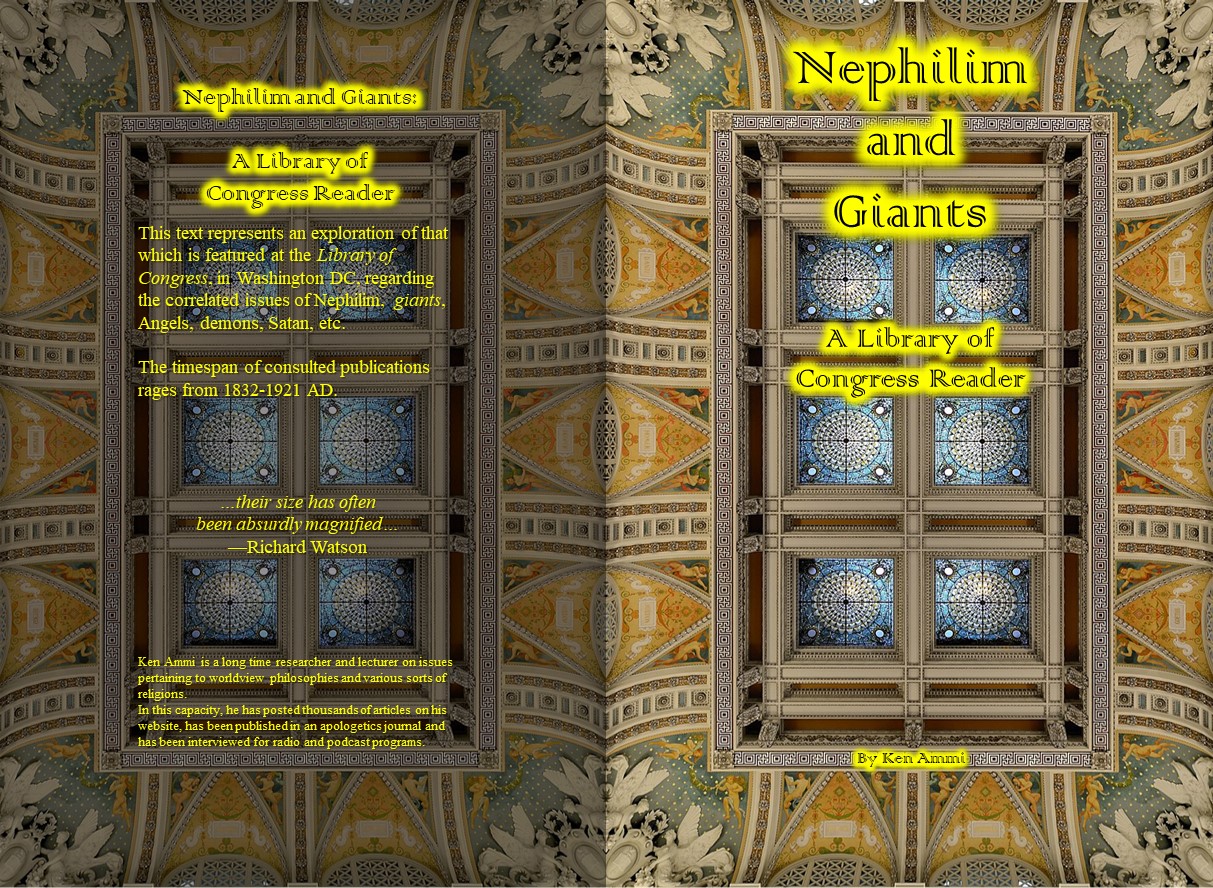
New book: “Nephilim and Giants: A Library of Congress Reader” by Ken Ammi

My latest book, available at Amazon and elsewhere–preferably purchased directly from me since it is better to support independent authors that way–features the following chapter titles:

1832: A Biblical And Theological Dictionary: Explanatory Of The History, Manners, And Customs Of The Jews, And Neighboring Nations

1835: Theological, Biblical, And Ecclesiastical Dictionary

1840: History Celtic Language

1843: A Complete Concordance To The Holy Scriptures Of The Old And New Testament

1851: The Natural History Of The Human Species

1853: The Daily Republic

1865: Notes, Critical And Explanatory. On The Book Of Genesis: From The Creation To The Covenant

1872: The Treasury Of Bible Knowledge

1877: The Patriarchal Dynasties From Adam To Abraham

1877: The Story Of Creation

1881: The Comprehensive, Critical And Explanatory Bible Encyclopedia

1882: The Beginnings of History According to the Bible and the Traditions of Oriental Peoples

1884: A Dictionary Of The Bible: Comprising Its Antiquities, Biography, Geography, Natural History And Literature

1888: Hebrew Mythology Or, The Rationale Of The Bible

1893: Illustrated Bible Dictionary And Treasury Of Biblical History, Biography, Biography, Doctrine, And Literature

1899: The New Cabinet Cyclopedia And Treasury Of Knowledge, Vol. IV

1901: Smith’s Comprehensive Dictionary Of The Bible

1901: The Book Of Genesis In The Light Of Modern Knowledge

1902: The Indexed Bible VI

1906: Studies On The Book Of Genesis

1907: Historical And Expository Notes

1908: An American Commentary On The Old Testament

1909: A Commentary On The Holy Bible By Various Writers

1909: The Biblical Account of the Creation

1910: The Temple Dictionary Of The Bible

1914: 555 Difficult Bible Questions Answered

1916: Israel’s Account Of The Beginnings

1920: Spiritism And The Fallen Angels In The Light Of The Old And New Testaments

1921: Prophecy Explained Past, Present And Future

Appendix: Chapter sample, “On the Post-Flood Nephilim Proposal”

full-loc

See my various books here.

~~~~~~~~~~~~~~~~~~~~~~~
A plea: I have to pay for server usage and have made all content on this website free and always will. I support my family on one income and do research, writing, videos, etc. as a hobby. If you can even spare $1.00 as a donation, please do so: it may not seem like much but if each person reading this would do so, even every now and then, it would add up and really, really help out. Here is my donate/paypal page.

Due to robo-spaming, I had to close the comment sections. However, you can comment on my Twitter page, on my Facebook page, or any of my other social network sites all which are available here.

Considering Edward Lamar’s Medium article, What are the Nephilim?

Considering Edward Lamar’s article, What are the Nephilim?, Jan, 2023. His self-description is, “My goal is to Spread Gods word!”

It was posted to the Medium site which self-identifies as, “Medium is where those ideas take shape, take off, and spark powerful conversations. We’re an open platform..” and, FYI, as it turns out, “The author deleted this Medium story.”

He begins by asking and answering, “what are these Nephilim? Well, they are giants. Yes, you heard me right” yet, what did we hear right since he employs the vague, generic, subjective, and multi-usage modern English word giants without defining it. One issue is what he means by it and the other, more importantly is what the usage of it is in English Bibles.

Edward Lamar notes that they are mentioned in two texts, two mere verses actually, which he quotes thusly:

Genesis 6:4– “4 The Nephilim were on the earth in those days-and also afterward-when the sons of God went to the daughters of humans and had children by them. They were the heroes of old, men of renown.

Numbers 13:33– “33 We saw the Nephilim there (the descendants of Anak come from the Nephilim). We seemed like grasshoppers in our own eyes, and we looked the same to them.”

Yet, he adds, “There is potentially one more story. David and Goliath. Goliath was a giant man that stood at nine feet nine inches according to 1 Samuel 17:4. 1 Samuel 17:4: ‘4 And there came out from the camp of the Philistines a champion named Goliath of Gath, whose height was six cubits’” and he neglected to quote the, “and a span” part.

Three issues, at least:

1) it appears as if by giants he is referring unusual height.

2) since he was referring to Nephilim then that would not be one more since Goliath was an Anakite Repha, not a Nephil—stand by for more on this.

3) He is myopically appealing to the Masoretic version of that verse without informing his reads that the earlier Septuagint/LXX and the earlier Dead Sea Scrolls and the earlier Flavius Josephus all have him at four cubits and a span which is just shy of 7 ft.

I noted more on point 2) since Goliath was an Anakite and Num 13:33 correlates them with Nephilim. Now, Edward Lamar tells us, “It is even more evidence of these creatures’ actual sizes: Numbers 13:32: ‘32And they spread among the Israelites a bad report about the land they had explored. They said, ‘The land we explored devours those living in it. All the people we saw there are of great size.’”

Note the oddity of quoting the part that 99% of pop-researchers do not bother quoting, that it was a bad a.k.a. evil report but prefaced by that this provides us, “actual sizes.”

The issue is that he is appealing to an unreliable report by utterly unreliable guys whom God rebuked: they just made up a fear-mongering scare-tactic tall-tale—and Lamar will literally have to invent a manner whereby to get Nephilim past the flood. In short, claiming post-flood Nephilim, in any way, shape, or form, implies God failed: He meant to be rid of them but couldn’t get the job done, the flood was much of a waste, He missed a loophole whereby they survived or just came right back (and then one will have to literally just invent a story about how they survived or came back).

Thus, Goliath was not a Nephil and was not related to Nephil (be sure to check the LXX version of that verse) and since Num 13:33 is the only physical description we have of Nephilim, that means that we do not have a reliable physical description of them so that correlating them to unusual height—of any level of subjective unusualness—is not viable.

Lamar then directs us to, “one of my favorite characters in the Bible, Enoch” and makes his way to that, “The apocrypha I am referring to is the Book of Enoch.” Yet, the only thing that Bible contradicting folkloric text from millennia after the Torah has to do with the Bible is that every indication is that someone borrowed his name and made up a bunch of stuff—see my book In Consideration of the Book(s) of Enoch.

He notes, “In this book he talked about how Nephilim grew up to 3000 cubic feet tall” which is MILES tall, which is great folklore but poor reality. At least Lamar notes, “As Christians, if your going to read that book. Read it for entertainment purposes only. it is important to read that book for entertainment purposes because it does not belong in the biblical canon for several reasons.”

See my various books here.

~~~~~~~~~~~~~~~~~~~~~~~
A plea: I have to pay for server usage and have made all content on this website free and always will. I support my family on one income and do research, writing, videos, etc. as a hobby. If you can even spare $1.00 as a donation, please do so: it may not seem like much but if each person reading this would do so, even every now and then, it would add up and really, really help out. Here is my donate/paypal page.

Due to robo-spaming, I had to close the comment sections. However, you can comment on my Twitter page, on my Facebook page, or any of my other social network sites all which are available here.

The Biblestudy site answers Who Are the Nephilim?

BibleStudy.org posted an answer to the question Who Are the Nephilim?

The answer notes, “the word Nephilim…appears once in the book of Genesis and once in the book of Numbers.”

It’s noted, “The original Hebrew word” is defined by Strong’s Concordance “as someone who is a feller, meaning a person who is a tyrant or bully.”

Also, Brown-Driver-Briggs “simply translates the word as ‘giants.’” Well, that’s actually not a translation but is a rendering and it begs these questions:

What’s the usage of the vague, generic, subjective, multi-usage and modern English word “giants” in English Bibles?

What’s Brown-Driver-Briggs’ usage of the vague, generic, subjective, multi-usage and modern English word “giants”?

Do those usages agree?

Actually, we must also ask what’s BibleStudy.org’s usage of the vague, generic, subjective, multi-usage and modern English word “giants”?

We at least get a styled answer to the latter question since we’re told, “The land of giants! Giants did indeed exist before and after Noah’s flood. These large people…”

Thus, BibleStudy.org’s usage is subjectively unusual height—and “large” is just as vague, generic, subjective, multi-usage as “giants” (and I’m inferring that the implication if that they were vertically large and not horizontally large—or, what it both?).

But we must ask what makes BibleStudy.org’s author think they were “large.” If it is because some modern version use “giants” then that would be a word-concept fallacy.

The next section deals with the “sons of God” thusly, “there is a giant (pardon the pun) problem with the belief that angels and women were able to produce a race of supersized humans called Nephilim” indeed, because there’s no reliable indication that Nephilim were “supersized” and they were only half-human.

For some odd reason, that statement was followed by, “Scripture says the sons of God took wives for themselves, meaning they were married, and together they produced such children (Genesis 6:2). It does not say these women were somehow raped by angels which subsequently led to them giving birth to giants.”

That’s at least two non sequiturs: who said anything about rape, what would rape have to do with the size of their offspring, etc.?

Additionally, “There is not even a hint in scripture that He ever spoke about or approved of angelic beings somehow marrying humans and then allowing them to create the Nephilim.” Indeed, such is why those who did so are considered sinners, having “left their first estate” as Jude put it.

But we’re told that “Jesus reveals the truth” in that “The possibility of angels and humans marrying and producing giant humans was also indirectly addressed by Jesus. He stated that marriage was a human institution that will not exist after people are resurrected and changed into spirit like the angels (Matthew 22:30). Angelic beings are incapable of marriage and cannot reproduce through procreation.”

That is a list of fallacies.

“Jesus reveals the truth” but was taken out of context. His words, His emphasis, His context, His teaching had nothing to do with the un-biblical assertion that Angles are “spirits.” Yet, more importantly, He never said anything about that “Angelic beings are incapable of marriage and cannot reproduce through procreation.” Rather, Matthew 22:30 records Him being very specific in that He stated “in the resurrection” which is physical, by the way “they neither marry, nor are given in marriage, but are as the angels of God in heaven”: thus, He was speaking of the Angels who are of God and are in heaven—again, such is why those who did so are considered sinners, having “left their first estate”: they were no longer “of God” and no longer “in heaven.”

We end up finding out that all of that was to push the later comer Sethite view which is based on myths and only causes more problems than it solves.

We’re told “The nephilim or giants were produced by righteous men who foolishly married worldly women (see Genesis 6:2).” Yes, see Gen 6:2 which, actually, states no such thing. And note that those righteous men were so utterly righteous that they married worldly women. Oh, and those marriages were the premise for the flood, for some reason, but have never since resulted in floods.

See my various books here.

~~~~~~~~~~~~~~~~~~~~~~~
A plea: I have to pay for server usage and have made all content on this website free and always will. I support my family on one income and do research, writing, videos, etc. as a hobby. If you can even spare $1.00 as a donation, please do so: it may not seem like much but if each person reading this would do so, even every now and then, it would add up and really, really help out. Here is my donate/paypal page.

Due to robo-spaming, I had to close the comment sections. However, you can comment on my Twitter page, on my Facebook page, or any of my other social network sites all which are available here.