Suni

Social networks:
My Amazon author’s page
Facebook
Twitter
YouTube
Archive video site
Ken Ammi’s Product Reviews
My CafePress shop
Google +

Norm Geisler references TrueFreethinker.com:
Apologeticspress.com’s Kyle Butt references TrueFreethinker.com:

Read the article about which Gary Habermas, PhD (Distinguished Research Professor & Chair of the Department of Philosophy at Liberty Baptist Theological Seminary) said, “I have hung on to it since you sent it, & plan to keep doing so”: Historical Jesus – Two Centuries Worth of Citations.

atheist20nothing-cam-2398637

Jewish / Judaism : The Suffering of the Servant, part 1 of 7

Are There Any Indications That The Messiah
Will Suffer and or Die For Our Sin?

There will be a companion piece to this parsed essay that will be titled, “The Suffering Servant According to Isaiah” which will specifically deal with Isaiah ch. 53. In that essay I will provide pages worth of quotes from authoritative Rabbinic writings as well as the writings of Jewish scholars, that Isaiah 52:13-53:12 has, from ancient to modern times, been understood to be a Messianic text. Here I will present instances of the Messiah being called servant and described as a sufferer.

In this series I will consider the issue of the suffering servant, the suffering Messiah, more generally.
The Babylonian Talmud-Sanhedrin 99a states, “All the prophets prophesied only of the days of the Messiah.” This does two things for us: one is that it leaves a lot of room for speculation and two is that it makes rather difficult to draw out and tie together a proper Messianic doctrine. Judaism does not hold to one single Messianic concept but leaves a lot of room for possibilities-as evidenced in my post Jewish Messianic Concepts.

What then is the contention between the Jewish and Christian concepts of vicarious atonement? The whole sacrificial system that was given through Moses depends on vicarious atonement. However, the contention is that within the law; animals, fruits and grains were offered for the atonement of humans. Animals, fruits and grains-not other humans. Although, in the Old Testament there are instances of occurrences in which, while a human sacrifice was not made, we do find one person paying the price for the sins of another.

A couple of examples are when God said to Ezekiel,

“Then lie on your left side and put the sin of the house of Israel upon yourself. You are to bear their sin for the number of days you lie on your side. I have assigned you the same number of days as the years of their sin. So for 390 days you will bear the sin of the house of Israel. After you have finished this, lie down again, this time on your right side, and bear the sin of the house of Judah. I have assigned you 40 days, a day for each year” (Ezekiel 4:4-6). Also, the infant son of King David and Bethsheeva died due to the sin of his parents (see 2nd Samuel 11:14).

exodus_marc_chagallandjewishjudaismmessianicjudaismmessiahjesustorahtanakhbible-7212504

Perhaps the most clear and telling scripture that speaks prophetically of the fact that the Messiah would die for our sins is Isaiah 52:13-53:12. The ancient sages, the Rabbis of old, affirmed that this passage of scripture refers to the Messiah. The modernistic concept is that this passage refers to the nation of Israel is incorrect.
Consider this, if the passage refers to the nation of Israel then it may deny that Jesus is the Messiah. However, since a nation is a group of people then this passage is teaching that the suffering and death of the Jewish people will atone for sin and therefore, would affirming human vicarious atonement.

When John the Baptist saw Jesus he said, “Behold the Lamb of God who takes away the sin of the world” (John 1:29). This statement continues a long-standing tradition amongst God’s people and our Scripture of utilizing symbolism. The lamb that took sin away was the Passover lamb.The Lamb had to be unblemished, male, it was to be killed, eaten and not a bone of it was to be broken. At the very first Passover the lamb’s blood was to be smeared on the door post in order to mark the occupants of the home as saved, saved from the angel of death who would see the blood of the lamb and pass over that home.

Jesus was sinless (unblemished), male, he was killed during Passover and He instituted what is referred to as communion wherein we symbolically consume the Lamb of God.

Exodus 29:33 states, “They are to eat these offerings by which atonement was made for their ordination and consecration.”
Regarding the sin offering Leviticus 6:29 states, “Any male in a priest’s family may eat it; it is most holy.”
Leviticus 7:6-7 regarding the guilt offering states, “Any male in a priest’s family may eat it, but it must be eaten in a holy place; it is most holy.
The same law applies to both the sin offering and the guilt offering: They belong to the priest who makes atonement with them.”

Jesus’ bones were not broken (because He was already dead when the Romans came to take him off the cross). We are marked for salvation by his blood.
Referring to Jesus we are told, “Jesus Christ, who is the faithful witness, the firstborn from the dead, and the ruler of the kings of the earth. To him who loves us and has freed us from our sins by his blood, and has made us to be a kingdom and priests to serve his God and Father-to him be glory and power forever and ever! Amen” (Revelation 1:5-6). Believers, the kingdom of priests, are to eat that which made atonement for them.

Partaking of the Passover lamb was absolutely essential,

“But if a man who is ceremonially clean and not on a journey fails to celebrate the Passover, that person must be cut off from his people because he did not present the LORD’s offering at the appointed time. That man will bear the consequences of his sin” (Numbers 9:13).

Regarding Isaiah 53:5, Rabbi Elijah De Vidas (16th c.) stated,

“The meaning of ‘He was wounded for our transgressions, bruised for our iniquities,’ is, that since the Messiah bears our iniquities, which produce the effect of his being bruised, it follows that who so will not admit that the Messiah thus suffers for our iniquities must endure and suffer them for himself.”

Jewish / Judaism : The Suffering Servant According to Isaiah, part 1

There are a few points to the Jewish and Christian polemic over, the mother of all disputed texts, Isaiah 52:13-53:12 (succinctly referred to as Isaiah 53). The following parsed essay is a basic rundown of the charges made against Christianity and some responses from the context of the text and from rabbinic writings.

The charges are made by what I will term Modern Rabbinic Judaism; meaning that the Rabbis decide the authoritative interpretations.

This essay is parsed thusly:

Part 1: Introduction and Context Part 2: Various Rabbis and Jewish Scholars Part 3: Various Rabbis and Jewish Scholars (continued) Part 4: Various Rabbis and Jewish Scholars (continued) Part 5: Various Rabbis and Jewish Scholars (continued) Part 6: Various Rabbis and Jewish Scholars (continued) Part 7: Various Rabbis and Jewish Scholars (continued) Part 8: Various Rabbis and Jewish Scholars (continued) Part 9: Various Rabbis and Jewish Scholars (concluded) Part 10: Miscellaneous Jewish Writings Part 11: Miscellaneous Jewish Writings (continued) Part 12: Miscellaneous Jewish Writings (continued)

Part 13: Miscellaneous Jewish Writings (concluded) and From Miscellaneous Sources

Part 14: From Miscellaneous Sources (concluded)

The contention is succinctly stated by Larry Levey who describes himself as a “Former Hebrew-Christian,”

“Now that most non-Jewish scholars concede that Isaiah 53 refers to the Jewish people…Some Christians have tried to find support for their beliefs in Rabbinic writings…Isaiah 53 was understood as referring to the Jewish people all along.”1

This is the sort of statement that this essay seeks to answer (see also our essay The Suffering of the Servant).

Some Claims and New Interpretations by Modern Rabbinic Judaism:

1. Modern Rabbinic Judaism holds that the Servant in Isaiah 53 is the Nation of Israel. They claim to have always believed this and that later on Christianity corrupted the interpretation and applied it to the Messiah and therefore to Jesus.

2. Since the Nation of Israel is the Servant; it is the Jews who suffer and die for sin.

3. The Gentile nations are the ones speaking in verses such as 53:4,
“Surely our diseases he did bear, and our pains he carried; whereas we did esteem him stricken, smitten of G-d, and afflicted.”
They were recognizing that Israel was suffering for the sins of the ungodly Gentiles.

Context: Letting the Text Speak for Itself:

1. Yes, several times in scripture the Servant is the Nation of Israel. Just like Messiah means anointed and can refer to a priest, a king or the ultimate redeemer; likewise, Servant can mean more than one thing.
Remember that context determines meaning (historical, cultural, grammatical, etc.). Judaism most certainly has not always believed that Isaiah 53 was speaking of the Nation of Israel. Bellow we provide numerous quotes from ancient and modern Rabbinic writings that will prove this.

2. Sometimes a charge is made by Modern Rabbinic Judaism that Christianity is wrong (or blasphemous) for claiming that Jesus died for our sins because the law does not allow for human vicarious atonement. Yet, what is a nation but a group of human beings.
Therefore, if the Servant is the Nation of Israel then Modern Rabbinic Judaism admits to believing that Jews are suffering and will die for sin thereby affirming human vicarious atonement.
Within the plain context of the passage we can see that the Nation of Israel is not the Servant; This is why it is not:

2.1 vss. 53:5, 6, 10-12 state:
“But he was pierced for our transgressions.”
“the LORD has laid on him the iniquity of us all.”
“the LORD makes his life a guilt offering
“my righteous servant will justify many, and he will bear their iniquities.”
“For he bore the sin of many, and made intercession for the transgressors.”
A sin sacrifice must be 100% unblemished; neither Jews as individuals nor as a Nation are now nor have ever been unblemished. This disqualified the Nation of Israel.

2.2 verse 53:9 states,
“he had done no violence, neither was any deceit in his mouth.” Obviously, this disqualified the Nation of Israel.

verse 53:7 states, “he humbled himself and opened not his mouth; as a lamb that is led to the slaughter, and as a sheep that before her shearers is dumb; yea, he opened not his mouth.”

This disqualified the Nation of Israel; they have not accepted their very many persecutions without complaint.

2.3 vss. 53:12 states, “he bared his soul unto death.”
This disqualified Nation of Israel. The servant willingly suffered and was killed; the Nation of Israel certainly have not and do not willingly suffer and are killed.

2.4 vss. 53:8 & 12 states, “For he was cut off out of the land of the living…because he bared his soul unto death.”
This disqualified the Nation of Israel. God has promised that He would not wipe out His people, there will always be a remnant. The Nation of Israel has never been completely exterminated.

3. It is also very clear that in the Old Testament—the Tanakh—God says many times that His people would suffer for their own sin (such as captivity in Babylon for forsaking that Sabbath of the land) but not for the sin of Gentiles. Rabbi Naphtali ben Asher Altschuler disagrees that is was the Gentile nations who were speaking in verses such as 53:4,

“Surely our diseases he did bear, and our pains he carried; whereas we did esteem him stricken, smitten of God, and afflicted.”

Rabbi Naphtali stated, “‘And yet we’—it is Israel who are speaking—thought that he had been hated of God. But it was not so: he was wounded for our transgressions, bruised for our iniquities, and ‘the chastisement’ which was afterwards to secure our peace was upon him.” 2

These quotes come from Isaiah 52:13-53:12 according to the Jewish Publication Society 1917.3

Jewish Affirmation that Isaiah 53 is Messianic:
Jewish writings affirm that the ancient sages, the Rabbis of old, over and over interpreted Isaiah 53 as a messianic prophecy and some Rabbis strongly disapprove of the national Israel interpretation—let us begin our survey.

Jewish / Judaism : The Suffering Servant According to Isaiah, part 10 ›

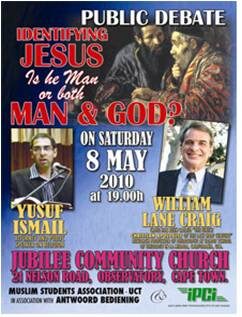
William Lane Craig – South Africa Debates, part 1: vs. Yusuf Islam on “Identifying Jesus: Is He Man or both God and Man?”

William Lane Craig – South Africa Debates, part 1: vs. Yusuf Islam on “Identifying Jesus: Is He Man or both God and Man?”

William Lane Craig recently engaged in two notable debates in South Africa: Capetown and Pretoria. He states that, “Professional recordings of all the debates and conference talks were made and will be disseminated throughout South Africa”; hopefully they will find their way into cyberspace.

As for the Islam vs. Christianity debate:

…about a thousand people crowded the auditorium that night. The debate was anything but dull! What Ismail (who is a lawyer by profession) may lack in substance he makes up in a robustious delivery, with lots of grandstanding and theatrics. By the time we reached the rebuttals, he had pretty much exhausted what substance he had, and so he began to throw out lots of red meat to his partisans in the crowd, offering the usual Muslim talking points like the inauthenticity of 1 John 5.7, at which they began to shout Islamic slogans.

In my rebuttal I rebuked them, saying that they ought to be ashamed of themselves for cheering for such irrelevant and fallacious arguments. I hammered home my positive case for Jesus’ deity, which Ismail could not answer, and in my closing speech gave a strong evangelistic appeal to the Muslims in the crowd. It was a great evening and a strong witness for Christ.1

william20lane20craig2c20yusuf20ismail2c20south20africa2c20debates2c20true20freethinker-1676863

Moreover,

In preparation for the debate I discovered that Ismail will use any argument he can find against Christianity, even if it also implies the falsity of Islam. For example, he uses all the drivel popular on the internet about Jesus’ being a mythological figure drawn from pagan religions of antiquity. Never mind that the Qur’an itself teaches that that Jesus was the greatest of all the prophets who had ever lived, that he was miraculously conceived and born of the Virgin Mary, that he himself performed miracles, and that he was indeed the Messiah!

In order to pre-empt any such appeal to pagan mythology to dismiss the deity of Jesus, I explained in my opening speech that contemporary studies of the historical Jesus have come to recognize that pagan mythology is simply the wrong interpretive context for understanding Jesus…

when you do read the original myths, you find that they’re not really parallel to the Gospels at all and that all the supposed parallels are concocted and spurious….based upon pseudo-scholarship which is more than 100 years out of date…

With nothing much of relevance to say, Ismail then turned to doling out the red meat!2

Of interest may be the Avatar based metaphor that William Lane Craig employed:

I explained the doctrine of Christ’s being one person who has two natures and used the movie Avatar to illustrate the doctrine. (“Avatar” is another word for incarnation.) The movie tells the story of Jake Sully, a disabled marine who becomes an avatar among a race of extra-terrestrials called the Na’vi. He becomes physically incarnated among them as one of them. At the same time he doesn’t cease to be human. So Jake has both a human nature and a Na’vi nature. In the movie these two natures have strikingly different powers. If you were to ask, “Can Jake Sully run?” the answer would have to be, “Yes and no: yes, in his Na’vi nature but no, in his human nature.”

I told the audience that if you can make sense of Avatar, you can make sense of Christ’s incarnation. For in a similar way, Christ has both a divine nature and a human nature. These natures have different powers. In his human nature Christ experienced all the limitations intrinsic to human nature. But in his divine nature he had supernatural powers. Just as Jake Sully in his Na’vi nature became the Savior of the Na’vi people, so Christ in his human nature becomes the Savior of mankind.

Atheist evolutionist Michael Ruse on arguments for God

Herein, we conclude, from part 1, part 2, part 3, part 4 and part 5 considering a discussion between Gary Gutting (professor of philosophy at the University of Notre Dame) and Michael Ruse (philosopher of science who specializes in the philosophy of biology of Florida State University) that was published as “Does Evolution Explain Religious Beliefs?,” New York Times, July 8, 2014 AD

GARY GUTTING: There seems to be a tension in your thinking about religion. You aren’t yourself a believer, but you spend a great deal of time defending belief against its critics.

MICHAEL RUSE: People often accuse me of being contradictory, if not of outright hypocrisy. I won’t say I accept the ontological argument for the existence of God — the argument that derives God’s existence from his essence — but I do like it (it is so clever) and I am prepared to stand up for it when Dawkins dismisses it with scorn rather than good reasons. In part this is a turf war. I am a professional philosopher. I admire immensely thinkers like Anselm and Descartes and am proud to be one of them, however minor and inadequate in comparison.

I am standing up for my own. In part, this is political. Religion is a big thing in America, and often not a very good big thing. I don’t think you are going to counter the bad just by going over the top, like in the Battle of the Somme. I think you have to reach out over no-man’s land to the trenches on the other side and see where we can agree and hope to move forward.

I should say that my Quaker childhood — as in everything I do and think — is tremendously important here. I grew up surrounded by gentle, loving (and very intelligent) Christians. I never forget that. Finally, I just don’t like bad arguments. In my case, I think I can offer good arguments against the existence of the Christian God. I don’t need the inadequate and faulty. In “Murder in the Cathedral,” T.S. Eliot has Thomas à Becket say, “The last temptation is the greatest treason: To do the right deed for the wrong reason.” Amen.

People accuse Michael Ruse of “being contradictory, if not of outright hypocrisy” why, because he claims to be “an ardent Darwinian evolutionist” and also an “evolutionary skeptic”?
Well, in part 2, I noted that Ruse likened Richard Dawkins to a “first-year undergraduate in philosophy” student. Ruse references him again as exemplary of the shrug off tactic as Dawkins thinks he can bypass great philosophical argument with Twitter sized pseudo-arguments.

Illuminati? D'Angelo on Lucifer, forces and energy used by musicians

Michael Eugene Archer aka D’Angelo is an R&B and neo-soul musician and producer.

Note the GQ magazine (“Amen! (D’Angelo’s Back),” June 2012 AD) intro to the interview between Amy Wallace and D’Angelo (from the angels):

He was once hailed as the next Marvin Gaye. Then, after his ripped body threatened to overshadow his music, he vanished into addiction. So what the hell was he doing recently singing his heart out in a Pentecostal church in Stockholm? And how are his abs? Amy Wallace witnessed D’Angelo’s ecstatic return to the stage—and hung out with the master of the sacred and the profane as he finishes his first album in a dozen years.

Wallace wrote:

Shame, guilt, repentance—D’Angelo knows them well. To say that he was raised religious doesn’t begin to capture it. He’s the son and the grandson of Pentecostal preachers. To D’Angelo, good and evil are not abstract concepts but tangible forces he reckons with every day. In his life and in his music, he has always felt the tension between the sacred and the profane, the darkness and the light.

Here are some interesting remarks by D’Angelo:

“You know what they say about Lucifer, right, before he was cast out?” D’Angelo asks me now. “Every angel has their specialty, and his was praise. They say that he could play every instrument with one finger and that the music was just awesome. And he was exceptionally beautiful, Lucifer—as an angel, he was.”

But after he descended into hell, Lucifer was fearsome, he tells me. “There’s forces that are going on that I don’t think a lot of [expletive removed] that make music today are aware of,” he says. “It’s deep. I’ve felt it. I’ve felt other forces pulling at me.” He stubs out his cigarette and leans toward me, taking my hand. “This is a very powerful medium that we are involved in,” he says gravely. “I learned at an early age that what we were doing in the choir was just as important as the preacher. It was a ministry in itself. We could stir the pot, you know? The stage is our pulpit, and you can use all of that energy and that music and the lights and the colors and the sound. But you know, you’ve got to be careful.”

It is unclear what he means by “what they say” but whoever “they” are, they are inaccurate; let us take this point by point.

“Lucifer” is a Latinized construction of the Hebrew heylel which appear in Isaiah 14.

Lucifer was fired, as it were, from his original job as a throne guardian but still had to report to YHVH. Revelation 12 notes when he was “cast out” which appears to have been during Jesus’ lifetime; this means that he was then permanently kept out of heaven and on the Earth.

“Every angel” may have a specialty but Lucifer is not an Angel, he is a Cherub (see Ezekiel 28).

Again, “They say” but they are clearly just inventing things as the Bible nowhere states that “he could play every instrument with one finger,” etc.

Lucifer did not and has not “descended into hell” but will be condemned to go there in the future—not as king or tormentor but as tormented, see Revelation 20.

D’Angelo does seem to hit the nail on the head in that “There’s forces that are going on…This is a very powerful medium that we are involved in.”

Indeed, all you have to do is listen to the lyrics, watch the videos and concerts of most popular groups and you will hear sex, drugs, violence, the occult, immorality, etc.

Something that D’Angelo realized is also being realized by many other musicians: they are preaching and doing so in a behind the scenes, that is; unrealized by most.

For example, Kanye West stated:

People have their own religion. Hip hop is a religion to a certain extent and the rappers are the preachers. And the music is the scripture. You know, it’s just like church because you go to a concert, you, you, you, raise your hands in the air, you get dressed up, you sing songs and you definitely pay some money. It’s just like church.

In fact, KRS-One has taken this to an extreme or, rather, its logical conclusion and actually founded his own religion and wrote his own “bible,” see: KRS-One’s Hip Hop new world order one world religion

Indeed, “you’ve got to be careful.”

~~~~~~~~~~~~~~~~~~~~~~~~

A plea: I have to pay for server usage and have made all content on this website free and always will. I support my family on one income and do research, writing, videos, etc. as a hobby. If you can even spare $1.00 as a donation, please do so: it may not seem like much but if each person reading this would do so, even every now and then, it would add up and really, really help. Here is my donate/paypal page.

Due to robo-spaming, I had to close the comment sections. However, you can comment on my Facebook page and/or on my Google+ page.

Atheist evolutionist Michael Ruse on ultimate explanations

Gary Gutting (professor of philosophy at the University of Notre Dame) interviewing Michael Ruse (philosopher of science who specializes in the philosophy of biology of Florida State University), “Does Evolution Explain Religious Beliefs?,” New York Times, July 8, 2014 AD

GARY GUTTING: What do you think of the claim that scientific accounts provide all the explanations needed to understand the existence and nature of the world, so that there’s no need to posit God as the ultimate explanation?

MICHAEL RUSE: Let me start at a more general level by saying that I don’t think science as such can explain everything. Therefore, assuming that the existence and nature of the world can be fully understood (I’m not sure it can!), this is going to require something more than science. As far as I am concerned, if you want God to have a crack at the job, go right ahead!

Gutting may be relating that which is popularly conceptualized yet, the premise if faulty. By definition, God created the material realm so as to be a time, space, matter continuum:
In the beginning [time], God created the heavens [space] and the Earth [matter]—Genesis 1:1
Moreover, within the continuum linear time means that cause is followed by effect—linear time, I tell ya, it’s just one thing after another!

The history of science is that, mostly, Bible believers reasoned that God is a rational being who created a rational creation and populated it with rational humans who could therefore rationally discern the rational creation. This is the premise upon which scientific method was established (that is, the rigors of the scientific method and not mere curiosity, mere observation or even mere experimentation).

Thus, we could scientifically explain all of creation but that would only be explaining creation, the within the box continuum—the universe, since science was specifically designed to perform such a task. Science is blind to anything else because it is a tool that was designed for a specific job; the discernment of the material realm. Since the universe had a beginning then by definition that which caused it would be outside of, beyond, not subject to, the continuum’s time, space, matter and investigative procedures; science.

It is folly to apply a tool designed for discerning the material realm, applying towards the discernment of immaterial entities and conclude that immaterial entities do not exist. It would be like wearing glasses with red lenses, seeing only shades of red and concluding that no other color exists. And yet, via the scientifically verified fine tuning for life of the universe; we can discern things about its originator even whilst not directly observing the immaterial realm. Consider Genesis 1:1 again and recall that above we derived a basic cosmology therefrom, now we will derive a basic theology:

In the beginning God [a transcendent being existing outside of, beyond, the continuum and thus not subject to the universe’s constraints; laws of thermodynamics, laws of nature, etc.] created [conceived of a plan and volitionally brought it about] the heavens and the earth.

Moreover:
In the beginning [time – thus, God is timeless or eternal] God created [infused creation with energy; is omnipotent and fine-tuned it; is omniscient] the heavens [space – thus, God is not subject to locality; is omnipresent] and the earth [matter – thus, God is immaterial or spirit].

GARY GUTTING: Could you say a bit more about why you think that science can’t fully explain everything? MICHAEL RUSE: In my view, none of our knowledge, including science, just “tells it like it is.” Knowledge, even the best scientific knowledge, interprets experience through human cultural understanding and experience, and above all (just as it is for poets and preachers) metaphor is the key to the whole enterprise.

As I developed my own career path, as a historian and philosopher of evolutionary biology, this insight grew and grew. Everything was metaphorical — struggle for existence, natural selection, division of labor, genetic code, arms races and more.

Ruse make a point I have been emphasizing for some time, “none of our knowledge…‘tells it like it is’…interprets experience…metaphor is the key.” In the Scientific Cenobites series I evidenced that much which passes for science is, in reality, interpretations of evidence based on schools of thought, worldview philosophies, professional rivalries, bias for preferred theories and seeking to protect them, assuring grants/funding, etc.
Then the Atheist and Darwinian Science and Story Telling series compiles evidence of narrative story telling passed off as science.

GARY GUTTING: It’s clear that metaphors are useful when scientists try to explain complex ideas in terms that nonscientists can understand, but why do you think metaphors have an essential role in the development of scientific knowledge?
MICHAEL RUSE: Because metaphor helps you move forward. It is heuristic, forcing you to ask new questions. If your love is like a rose, what color is the rose? But note that it does so at a cost. A metaphor puts blinkers on us. Some questions are unanswerable within the context of the metaphor. “My love is a rose” tells me about her beauty. It does not tell me about her mathematical abilities. Now combine this fact with history. Since the scientific revolution, one metaphor above all — the root metaphor — has dictated the nature and progress of science. This is the metaphor of the world as a machine, the mechanical metaphor. What questions are ruled out by this metaphor? One is about ultimate origins. Of course you can ask about the origins of the metal and plastics in your automobile, but ultimately the questions must end and you must take the materials as given. So with the world. I think the machine metaphor rules out an answer to what Martin Heidegger called the “fundamental question of metaphysics”: Why is there something rather than nothing? Unlike Wittgenstein, I think it is a genuine question, but not one answerable by modern science.

Coming now to my own field of evolutionary biology, I see some questions that it simply doesn’t ask but that can be asked and answered by other areas of science. I think here about the natural origins of the universe and the Big Bang theory. I see some questions that it doesn’t ask and that neither it nor any other science can answer. One such question is why there is something rather than nothing, or if you like why ultimately there are material substances from which organisms are formed.

The issue is that metaphor may help us move forward, etc. and yet, metaphor is premised on worldview philosophy and this is where, for example, the theory of evolution becomes a template via which all subsequent evidence is interpreted. Therefore, any evidence is forced to fit into the temple, the theory, the metaphor.

Since, ultimate origins, why is there something rather than nothing, is answerable by modern science some, such as Richard Dawkins, have simply shrugged off the most important questions humanity has ever asked. When asked “What about the old adage that science deals with the ‘how’ questions and religion deals with the ‘why’ questions?” Richard Dawkins responded:

I think that’s remarkably stupid, if I may say so. What on earth is a “why” question?…They mean “why” in a deliberate, purposeful sense…Those of us who don’t believe in religion — supernatural religion — would say there is no such thing as a “why” question in that sense. Now, the mere fact that you can frame an English sentence beginning with the word “why” does not mean that English sentence should receive an answer…

—Steve Paulson, “The Flying Spaghetti Monster,” Salon, Oct 13, 2006 AD; see Atheism and Science – Is There a Relation?, part 3 – On the Difference Between Science and Philosophy: Richard Dawkins

As for origins, he is just as unhelpful as he appeals to, get this, “luck”—keep in mind that this is a scientist speaking:
It is as though, in our theory of how we came to exist, we are allowed to postulate a certain ration of luck.
—Richard Dawkins, The Blind Watchmaker—Why the Evidence of Evolution Reveals a Universe Without Design (New York: W.W. Norton & Co., 1986 AD), p. 139

He even applies this to the universe’s existence as a whole:
Some kind of multiverse theory could in principle do for physics the same explanatory work as Darwinism does for biology. This kind of explanation is superficially less satisfying than the biological version of Darwinism, because it makes heavier demands on luck. But the anthropic principle entitles us to postulate far more luck than our limited human intuition is comfortable with.
—Richard Dawkins, The God Delusion (Boston & New York: Houghton Mifflin Co., 2006 AD), p. 158; see here for this book in free e-book format.

GARY GUTTING: So do you think that we need religion to answer the ultimate question of the world’s origin?

MICHAEL RUSE: If the person of faith wants to say that God created the world, I don’t think you can deny this on scientific grounds. But you can go after the theist on other grounds. I would raise philosophical objections: for example, about the notion of a necessary being. I would also fault Christian theology: I don’t think you can mesh the ancient Greek philosophers’ notion of a god outside time and space with the Jewish notion of a god as a person. But these are not scientific objections.

This is rather odd as he abandons science in order to tackle God but appeals to a most unusual objection that we cannot mesh Greek notions of a god with Jewish ones. But why not seek to mesh Hindu with Islam or Zoroastrian with Flying Spaghetti Monsterism?
Well, in any case there is no issue except that which Ruse sees as some unanswerable question and yet, one that is arbitrary being based, as of course it is, his presuppositions.

The supposed contradiction between “a god outside time and space” and “a god as a person” within Jewish theology would refer to the more specific and accurate question of “a god outside time and space” and “a god as a” personal being that is, one exhibiting characteristics of personhood. But how is this problematic?
Personhood primarily denotes, in one way or another, the activity of mind (such as per the exercise of volition, etc.). The fact is that there is a difference between mind and brain as mind is immaterial whilst brain is material. This is tantamount to a computer’s software being immaterial but the hardware being material. Thus, an eternal mind not only could but would exist “outside time and space” and this eternal mind is that which we call God.

The supposed contradiction between “a god outside time and space” and “a god as a person” within Christian theology would refer to the more specific and accurate question of “a god outside time and space” and “a god as a” personal being that is, one exhibiting characteristics of personhood as well as God becoming incarnated that is, taking on human form. But how is this problematic?
There is no reason to think that “a god outside time and space” cannot incarnate that is, cannot enter into “time and space” particularly if, as per Genesis 1:1 above, the “god outside time and space” created “time and space.”

In the next segment we will consider Michael Ruse’s statements regarding Richard Dawkins tantamount to a first-year undergraduate student in philosophy—clearly, Ruse is being very generous!

Atheist evolutionist Michael Ruse on Richard Dawkins’ jejune philosophy

Herein, we continue, from part 1, considering a discussion between Gary Gutting (professor of philosophy at the University of Notre Dame) and Michael Ruse (philosopher of science who specializes in the philosophy of biology of Florida State University) that was published as “Does Evolution Explain Religious Beliefs?,” New York Times, July 8, 2014 AD

GARY GUTTING: What do you think of Richard Dawkins’s argument that, in any case, God won’t do as an ultimate explanation of the universe? His point is that complexity requires explanation — the whole idea of evolution by natural selection is to explain the origin of complex life-forms from less complex life-forms. But a creator God — with enormous knowledge and power — would have to be at least as complex as the universe he creates. Such a creator would require explanation by something else and so couldn’t explain, for example, why there’s something rather than nothing.

MICHAEL RUSE: Like every first-year undergraduate in philosophy, Dawkins thinks he can put to rest the causal argument for God’s existence. If God caused the world, then what caused God? Of course the great philosophers, Anselm and Aquinas particularly, are way ahead of him here. They know that the only way to stop the regression is by making God something that needs no cause. He must be a necessary being. This means that God is not part of the regular causal chain but in some sense orthogonal to it. He is what keeps the whole business going, past, present and future, and is the explanation of why there is something rather than nothing. Also God is totally simple, and I don’t see why complexity should not arise out of this, just as it does in mathematics and science from very simple premises. Traditionally, God’s necessity is not logical necessity but some kind of metaphysical necessity, or aseity. Unlike Hume, I don’t think this is a silly or incoherent idea, any more than I think mathematical Platonism is silly or incoherent. As it happens, I am not a mathematical Platonist, and I do have conceptual difficulties with the idea of metaphysical necessity.

So in the end, I am not sure that the Christian God idea flies, but I want to extend to Christians the courtesy of arguing against what they actually believe, rather than begin and end with the polemical parody of what Dawkins calls “the God delusion.”

As noted in part 1, Dawkins thinks that “God won’t do as an ultimate explanation of the universe” but that “luck” does. Also as noted in part 1, ultimately, God has been thought of a as a mind and a mind can conceptualize very complex ideas while the mind itself is a simple entity. For example, a human baby’s mind is very simple and yet, it performs an incredible series of very complex calculations in order to do something as simple as putting her hand to her mouth.

What Ruse hit upon is that Dawkins is turning the concept of an infinite regress into an infinite digress. That is, he takes and runs with the concept of an infinite regression (an endless series of events that are necessary to explain, for example) and make of it an infinite digression from the logical conclusion of an infinite or, eternal God.

For many pseudo-skeptics (who do not say “I will not believe until” but, rather, “I will not believe”—period) simply noting that Dawkins proposes his first-year undergraduate assertion will be enough and they will never follow though and make it to “Anselm, Aquinas, etc.

The next section will consider “the atheistic argument from evil.”

Michael Ruse

Social networks:
My Amazon author’s page
Facebook
Twitter
YouTube
Archive video site
Ken Ammi’s Product Reviews
My CafePress shop
Google +

Norm Geisler references TrueFreethinker.com:
Apologeticspress.com’s Kyle Butt references TrueFreethinker.com:

Read the article about which Gary Habermas, PhD (Distinguished Research Professor & Chair of the Department of Philosophy at Liberty Baptist Theological Seminary) said, “I have hung on to it since you sent it, & plan to keep doing so”: Historical Jesus – Two Centuries Worth of Citations.

atheist20nothing-cam-5194632