Blind Men and the Elephant parable and Jesus

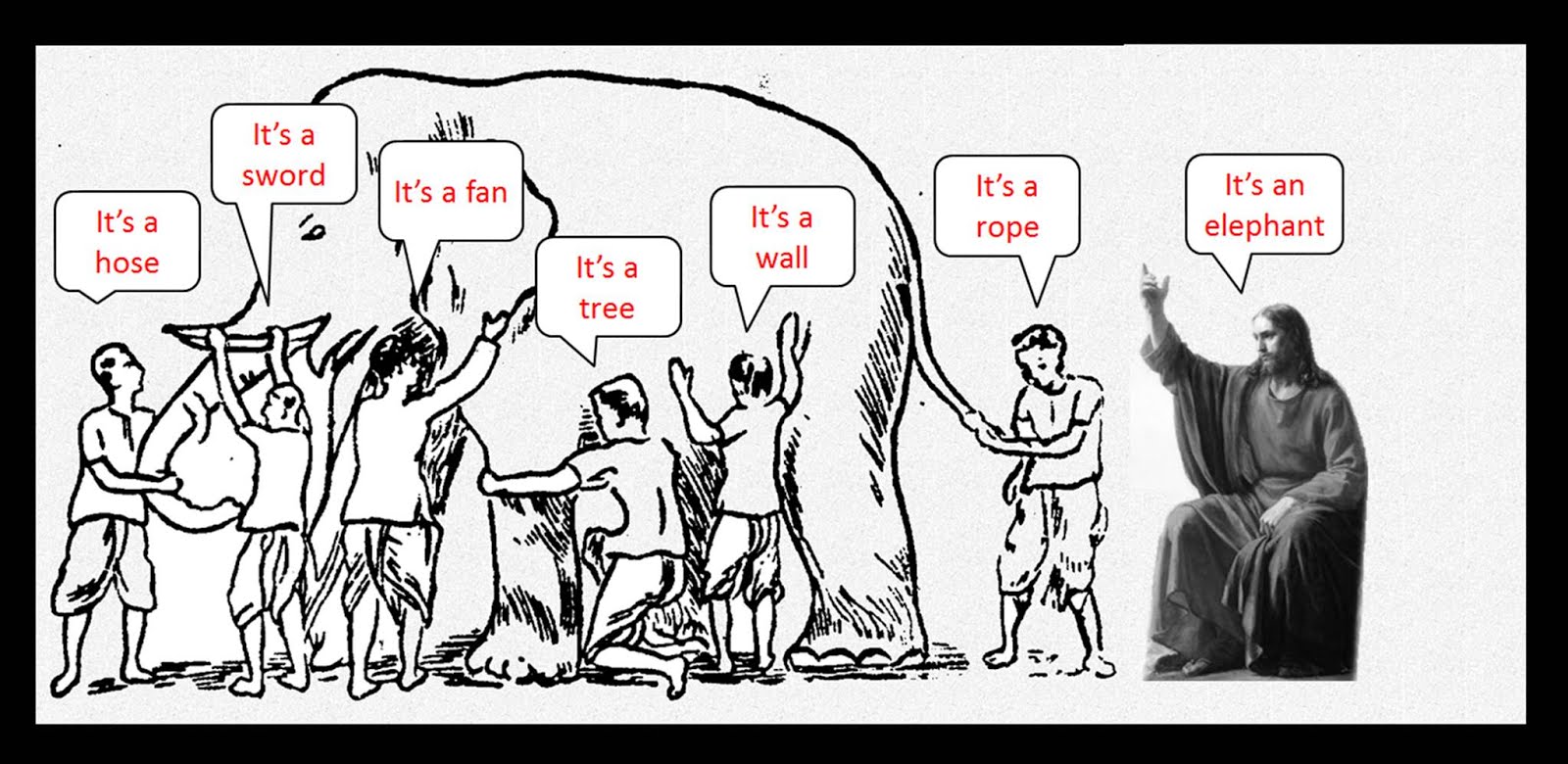
You may have heard of the parable of the “Blind Men and the Elephant” with the exact opposite emphasis as that of the original.

If you have heard of it the emphasis was that just like blind men touching different parts of an elephant all come to different conclusions. This means, or so we are told, is meant to denote that there is no absolute truth, that everyone has their own equally valid opinion, that exclusivism is therefore wrong, etc., etc., etc.

One issue is that the parable has gone through various versions. Apparently, it originated in India and perhaps it did have the above noted connotation.

However, regardless of the original intention the fact is that reality is that which it is regardless. In fact, the concept of absolute truth is precisely this: reality is that which it is regardless of whether we agree with it or not, regardless of whether we like it or not, regardless of whether we prefer it be different or not, even regardless of whether we are aware of it or not.

Thus, John Godfrey Saxe’s (1816-1887 AD) version hits the nail on the heard:

It was six men of Indostan, To learning much inclined, Who went to see the Elephant (Though all of them were blind), That each by observation

Might satisfy his mind.

The First approach’d the Elephant, And happening to fall Against his broad and sturdy side, At once began to bawl: “God bless me! but the Elephant

Is very like a wall!”

The Second, feeling of the tusk, Cried, -“Ho! what have we here So very round and smooth and sharp? To me ’tis mighty clear, This wonder of an Elephant

Is very like a spear!”

The Third approach’d the animal, And happening to take The squirming trunk within his hands, Thus boldly up and spake: “I see,” -quoth he- “the Elephant

Is very like a snake!”

The Fourth reached out an eager hand, And felt about the knee: “What most this wondrous beast is like Is mighty plain,” -quoth he,- “‘Tis clear enough the Elephant

Is very like a tree!”

The Fifth, who chanced to touch the ear, Said- “E’en the blindest man Can tell what this resembles most; Deny the fact who can, This marvel of an Elephant

Is very like a fan!”

The Sixth no sooner had begun About the beast to grope, Then, seizing on the swinging tail That fell within his scope, “I see,” -quoth he,- “the Elephant Is very like a rope!” And so these men of Indostan Disputed loud and long, Each in his own opinion Exceeding stiff and strong, Though each was partly in the right,

And all were in the wrong!

MORAL,

So, oft in theologic wars The disputants, I ween, Rail on in utter ignorance Of what each other mean; And prate about an Elephant

Not one of them has seen!

Thus, of course it cannot be a parable about how there is no absolute truth, that everyone has their own equally valid opinion, that exclusivism is therefore wrong, etc., etc., etc. since the fact is that the elephant is an elephant and the blind men are basing their opinion of not having seen it and on not even feeling the entire elephant to which they had access, after all.

blind2bmen2band2bthe2belephant-4897583

Angels in the apocryphal texts Apocryphon of John & Gospel of Truth

Herein we continued, from part 1, part 2, part 3, part 4, part 5, part 6, part 7, part 8, part 9, part 10, part 11, a series regarding paranormal entities in text generally termed the Apocrypha, Deutero Canonical, Pseudepigrapha, Gnostic Texts, etc. (see my article on the Apocrypha here). The quotations are of those sections within the text that refer to Angels, Cherubim, Seraphim, Devil, Satan, demons, serpent and dragon. The point is not to elucidate these references but to provide relevant partial quotations and citations.

Angels in the apocryphal texts Apocryphon of John & Gospel of Truth.

Apocryphon of John – 120-180 AD
For from the light, which is the Christ, and the indestructibility, through the gift of the Spirit the four lights (appeared) from the divine Autogenes. He expected that they might attend him. And the three (are) will, thought, and life. And the four powers (are) understanding, grace, perception, and prudence. And grace belongs to the light-aeon Armozel, which is the first Angel…And the archons created seven powers for themselves, and the powers created for themselves six Angels for each one until they became 365 Angels. And these are the bodies belonging with the names: the first is Athoth, a he has a sheep’s face; the second is Eloaiou, he has a donkey’s face; the third is Astaphaios, he has a hyena’s face; the fourth is Yao, he has a serpent’s face with seven heads; the fifth is Sabaoth, he has a dragon’s face; the sixth is Adonin, he had a monkey’s face; the seventh is Sabbede, he has a shining fire-face. This is the sevenness of the week…

…the power in him, which he had taken from his mother, produced in him the likeness of the cosmos. And when he saw the creation which surrounds him, and the multitude of the Angels around him which had come forth from him, he said to them, ‘I am a jealous God, and there is no other God beside me.’ But by announcing this he indicated to the Angels who attended him that there exists another God. For if there were no other one, of whom would he be jealous?…[see note for a reply to this claim]…And the arrogant one took a power from his mother. For he was ignorant, thinking that there existed no other except his mother alone. And when he saw the multitude of the Angels which he had created, then he exalted himself above them…And the multitude of the Angels attended him and they received from the powers the seven substances of the natural (form) in order to create the proportions of the limbs and the proportion of the rump and the proper working together of each of the parts…

This is the number of the Angels: together they are 365. They all worked on it until, limb for limb, the natural and the material body was completed by them. Now there are other ones in charge over the remaining passions whom I did not mention to you. But if you wish to know them, it is written in the book of Zoroaster. And all the Angels and demons worked until they had constructed the natural body…the Mother-Father of the All…sent, by means of the holy decree, the five lights down upon the place of the Angels of the chief archon…[The aforementioned “natural body” was a man, Adam, whose] thinking was superior to all those who had made him. When they looked up, they saw that his thinking was superior. And they took counsel with the whole array of archons and Angels…And they brought him (Adam) into the shadow of death, in order that they might form (him) again…and he became a mortal man…He [Yaltabaoth, who “called himself God”] was lord over her, though he did not know the mystery which had come to pass through the holy decree. And they were afraid to blame him. And he showed his Angels his ignorance which is in him…

And I said, “Lord, these also who did not know, but have turned away, where will their souls go?” Then he said to me, “To that place where the Angels of poverty go they will be taken, the place where there is no repentance…”…

He made a plan with his authorities, which are his powers, and they committed together adultery with Sophia, and bitter fate was begotten through them, which is the last of the changeable bonds. And it is of a sort that is interchangeable. And it is harder and stronger than she with whom the gods united, and the Angels and the demons and all the generations until this day…

And he made a plan with his powers. He sent his Angels to the daughters of men, that they might take some of them for themselves and raise offspring for their enjoyment…And the Angels changed themselves in their likeness into the likeness of their mates (the daughters of men), filling them with the spirit of darkness, which they had mixed for them, and with evil…

…guard yourself against the Angels of poverty and the demons of chaos and all those who ensnare you, and beware of the deep sleep and the enclosure of the inside of Hades.

Within the, clearly, Gnostic text of Apocryphon of John the creator God, stated “I am a jealous God, and there is no other God beside me.” It is fascinating how some will take such a clear statement meant to convey such a clear concept and conclude the exact opposite such as that “by announcing this he indicated to the Angels who attended him that there exists another God” and here is the reasoning behind the exact opposite conclusion, “For if there were no other one, of whom would he be jealous?” From ancient time until this very day, some have not understood what jealousy means and have also confused it with envy. Envy is ill thoughts and/or actions due to someone having something that you do not have, something that you want. Jealousy has been much misunderstood because someone can be jealous of and/but also jealous for. Being jealous of is very much like envy. However, being jealous for can be well understood via the illustration of a wife who is straying from her husband and he, rightly, feels jealous for her.

In every biblical instance of wherein God’s jealousy is specified, God is always jealous for and never jealous of. That is to say that God is jealous for, for example, His people whom He likens to a wife straying from her husband (for examples see, Joel 2:18; Zechariah 1:14, 8:2; Ezekiel 39:25). Yet, He is never jealous of anyone or anything.

Gospel of Truth – 140-180 AD
Do not return to what you have vomited, to eat it. Do not be moths. Do not be worms, for you have already cast it off. Do not become a (dwelling) place for the devil, for you have already destroyed him. Do not strengthen (those who are) obstacles to you, who are collapsing, as though (you were) a support (for them). For the lawless one is someone to treat ill, rather than the just one. For the former does his work as a lawless person; the latter as a righteous person does his work among others. So you, do the will of the Father, for you are from him.

In the next segment, we will consider the Sibylline Oracles and the Latin Life of Adam and Eve aka Vita Adae et Evae.

Angels in the apocryphal texts Apocryphon of James, Preaching of Peter, Letter of Clement of Alexandria & Trimorphic Protennoia

Herein we continued, from part 1, part 2, part 3, part 4, part 5, part 6, part 7, part 8, part 9, part 10, a series regarding paranormal entities in text generally termed the Apocrypha, Deutero Canonical, Pseudepigrapha, Gnostic Texts, etc. (see my article on the Apocrypha here). The quotations are of those sections within the text that refer to Angels, Cherubim, Seraphim, Devil, Satan, demons, serpent and dragon. The point is not to elucidate these references but to provide relevant partial quotations and citations.

Angels in the apocryphal texts Secret Book of James aka Apocryphon of James, Preaching of Peter, Letter of Clement of Alexandria on Secret Mark & Trimorphic Protennoia.

Secret Book of James aka Apocryphon of James – 100-150 AD
Invoke the Father, implore God often, and he will give to you. Blessed is he who has seen you with Him when He was proclaimed among the Angels, and glorified among the saints; yours is life…And when we had passed beyond that place, we sent our mind(s) farther upwards, and saw with our eyes and heard with our ears hymns, and Angelic benedictions, and Angelic rejoicing. And heavenly majesties were singing praise, and we, too, rejoiced…

Preaching of Peter – 100-150 AD
This God worship ye, not after the manner of the Greeks…Neither worship ye him as do the Jews, for they, who suppose that they alone know God, do not know him, serving Angels and Archangels…

Letter of Clement of Alexandria on Secret Mark – 70-255 AD
You did well in silencing the unspeakable teachings of the Carpocrations. For these are the “wandering stars” referred to in the prophecy, who wander from the narrow road of the commandments into a boundless abyss of the carnal and bodily sins. For, priding themselves in knowledge, as they say, “of the deep things of Satan”…

Trimorphic Protennoia – 120-180 AD
I am the life of my Epinoia that dwells within every Power and every eternal movement, and (in) invisible Lights and within the Archons and Angels and Demons, and every soul dwelling in Tartaros, and (in) every material soul…I dwell within all the Sovereignties and Powers, and within the Angels, and in every movement that exists in all matter…among the Angels I revealed myself in their likeness, and among the Powers, as if I were one of them; but among the Sons of Man, as if I were a Son of Man, even though I am Father of everyone.

In the next segment, we will consider Gospel of Truth & Apocryphon of John.

Memetic Mesmerism and Eumemics

On the DHDH Meme

When Richard Dawkins wrote, “faith is one of the world’s great evils, comparable to the smallpox virus but harder to eradicate” he was not, merely, being emotive and belligerent.

To the New Atheists the battle ground of ideas is not only a batter ground of ideas but is tantamount to each human brain being a petri dish which can either remain sterile when in quarantine or be infected by the contents of another dish.

FYI: this essay serves as a companion to The Desperation of the Deicidal, Memetic Eugenics and the Evolutionary Watchmen, part 1 & part 2

This view towards the infectious nature of ideas may be why the New Atheists are so taken with the tactic of emotionally charged arguments which rely on outrage, ridicule, superiority complexes, rebellion, gross fallacious and inaccurate generalizations, etc. This is also why they are generally so lacking in accurate retellings of or reliance upon logic, history, biblical knowledge, etc. If I may borrow Richard Dawkins’ manner of addressing the issue: since they are interested in infection they are not very concerned about via which entryway the infection attacks the organism—your brain—so long as it becomes a parasite.

Via unnatural selection / via human directed selection, they seek to establish themselves as arbiters of ideas, of memes. They will determine which are acceptable and which are to be eradicated.

danieldennettatheismatheistnewatheistschristianitychristianapologeticsgodbiblejesus-5550519

John Gray noticed this tendency whilst considering Daniel Dennett’s book “Breaking the Spell – Religion as a Natural Phenomenon”:

The explanation [“a naturalistic explanation of religion”] turns out to be a variation on Richard Dawkins’s theory of memes – units of information whose competition somehow explains the development of thought. One problem with memes is that, unlike genes, they are not identifiable physical structures. Ideas are elusive things…It shows a sorry lack of cultural understanding to imagine that the baroque, say, can be reduced to a few simple structures.

In a postscript, Dennett defends memes against the criticism that they lack the clear identity of genes, but the real objection is that it is not a theory at all, as it fails to identify anything like a mechanism of cultural evolution. This is hardly surprising, given that there is nothing in the history of ideas that resembles natural selection in biology. Some ideas seem to be more contagious than others, but those which prevail are often the ones that have power on their side…Like other evolutionist ideologies, the theory of memes passes over the role of power in history.

The appeal of the theory is that it reduces the fertile chaos of human thought to objects that can be manipulated, and seems to open up the prospect of memetic engineering – consciously directing the intellectual evolution of the species by disseminating some memes and discouraging others. In previous books Dennett has hinted that human evolution could be directed in this way, with his own ideas helping to guide the process…

This humanist faith in progress is a myth no different in kind from the stories that are repeated in churches and temples. Myths are not primitive scientific theories that belong in the infancy of the species. They are symbolic narratives that give meaning to the lives of those who accept them. The chief difference between religious and secular believers is that, while the former have long known their myths to be extremely questionable, the latter imagine their own to be literally true.[1]

I understand that in his field of expertise the professor of philosophy Daniel Dennett is highly regarded. However, it is unfortunate for him that he hitched his wagon to the New Atheist star. This is because he tends to compromise his philosophic integrity in order to defend atheism.
For example, he argues that the atheist Joseph Stalin was, in reality, a theist since Stalin believed in a god that defined morality for Stalin and that god was Stalin (find his statements here). He argued this in order to maintain atheism’s self-professed spotless innocence while blaming “religion” even when the atrocities where performed by an atheist who premised their atrocities on atheism. The fact that by this “logic” every atheist is a theist seems to have been overlooked.

In any regard, Daniel Dennett hopes to, in the style of a mesmerist or by employing the old Jedi mind trick, to coin time released bullet-like memes (bullets in the grammatical “dot” sense) which will burrow their way into the brains of “religious” people and will activate upon the theist considering anything which does not accord to the particular atheist worldview which Dennett promulgates.

madscientistatheismatheistnewatheistschristianitychristianapologeticsgodbiblejesusdanieldennettbreakingthespellmemericharddawkins-7222483

Note the following strategizing session between Richard Dawkins and Daniel Dennett (et al.):

Daniel Dennett: I think it may be easier than we’re supposing to shake peoples’ faith. There’s been a moratorium on this for a long time. We’re just the beginning of a new wave of explicit attempts to shake peoples’ faith. And it’s bearing fruit…

I think it’s a good thing to encourage and I don’t think we should assume that we can’t do this. I think we can.

Richard Dawkins: Yes, it’s almost patronising to suggest that we couldn’t and to suggest that it shouldn’t…

Daniel Dennett: …I would love to do is to invent a memorable catchphrase or term that would rise unbidden in their minds when they caught themselves doing it, and then they would think oh, this is one of those cosmic shifts that Dennett and Dawkins and Harris and Hitchens are talking about. Oh! right! and they think this is somehow illicit, just to create a little more awareness in them of what a strange thing it is that they’re doing.

Now, let us be careful and fair in dealing with the specific context of this particular snippet of their strategizing. The statement referenced people catching themselves “doing it” referred to cognitive dissonance:

Richard Dawkins: I think we all know people who seem to manage this kind of split brain feat of, as Sam [Harris] said, believing one thing on a Sunday and then something totally contradictory or, incompatible the rest of the week. And there’s nothing I suppose neurologically wrong with that, I mean there is no reason why one shouldn’t have a brain that’s split in that kind of way …

Daniel Dennett: But it is unstable in a certain way but, and I’m sure you’re right, that people do this and they’re very good at it, and they do it by deflecting attention from it. Let’s start focusing attention … [ellipses in original transcript]

danieldennettatheismathiestnewatheistschristianitychristianapologeticsbiblegodjesusstarwarsobiwankenobidroids-7421087

danieldennettatheismathiestnewatheistschristianitychristianapologeticsbiblegodjesusstarwarsobiwankenobidroids-7932704

I can certainly agree with them that there are such people and that it should be pointed out to them. From the person who amens “Thou shall not murder” on Sunday but votes for abortion on Monday to the philosopher and scientists who define people as nothing but happenstantial bio-organisms who are DNA reproducing machines but still claim (baselessly) human dignity (and this is pushing it as many of them do not even do this much). Yet, note that this concept is applicable to the manner in which they view ideas: infections, eradications, etc.

They want to implant brain bugs, via memes, that will rise unbidden and begin a struggle to survive as the fittest idea (while giving “Dennett and Dawkins and Harris and Hitchens” credit no less).

They are just beginning and it may be easier than supposed to shake peoples’ “faith” (whatever that is; to the atheist it is generally “belief without evidence” to the Bible it is trust as a result of a syllogism).

This is not only to be encouraged but to suggest otherwise (to propose a contradictory meme) is almost patronizing.

They seek to concoct succinct meme packages in the form of catchphrases which would alert them to the fact that “Dennett and Dawkins and Harris and Hitchens” have bequeathed something to be “illicit”—they are the authority on all things philosophic, scientific, etc.

Their movement is premised upon the viral battle of ideas, not the idea’s contents but the very concept of ideas. Now, when Richard Dawkins states something like, “let me plant one idea in your head”[2] it should make you think twice.

In short, and if I may again borrow Richard Dawkins’ manner of addressing the issue: they are carriers of the DHDH Meme (Dawkins, Harris, Dennett, Hitchens) and seek to infect the world.

[1] John Gray, “Atheists Are Irrational Too,” New Statesman, 20 March 2006
[2] Lisa Miller, “Darwin’s Rottweiler,” Newsweek, Sept 26, 2009

AskELM’s Ernest L. Martin on the idolatrous Tent and Tabernacle

We continue, from part 1, part 2, part 3, part 4, part 5, part 6, part 7, considering Ernest L. Martin, Ph.D.’s article titled, “Lingering Idolatry in the Temple of God,” AskELM (as in Ask Ernest L. Martin about whom I previously wrote Nightmare on AskElm Street – angelic “Sons of God”?), September 1, 2000 AD which contains some interesting point, some thought provoking speculations and some very serious errors.

Within the Bible ‘ohel (Strong’s H168) simply refers to a tent and was used of that which is translated both as tent and tabernacle for the portable structure in which services were held after the Exodus wilderness wandering. Within the Amos 5 text the term tabernacle consists of the only biblical usage of the Hebrew term cikkuwth (or sikkuth: Strong’s H5522) which is another word for tent.

Thus, at some point in the wilderness for forty years, Israel borne the tent/tabernacle of melek simply king (Strong’s H4428) and kiyuwn meaning an image or a pillar (Strong’s H3594) or/for their images, the star of their ‘elohiym as in authoritative, mighty, etc., (Strong’s H430) which they made.

Now, there is a specific Moloch or Molech which in Hebrew is Molek (Strong’s H4432) which was an Ammonite and Phoenician god to whom rebellious Israelites sacrificed children.

askelm2c20ernest20l-20martin-4716691

Acts 7:42-44 reiterates this by noting, “Then God turned, and gave them up to worship the host of heaven…Yea, ye took up the tabernacle of Moloch, and the star of your god Remphan, figures which ye made to worship them: and I will carry you away beyond Babylon.”
Moloch is the straight transliteration form the Greek (Strong’s G3434), Remphan is from a Greek Rhaiphan (Strong’s G4481) “the shrunken (as lifeless)” and is a Greek version of Chiun/cikkuwth with both the Hebrew and Greek appearing to refer, in part, to Saturn. Remphan is how the Septuagint/LXX translates the Amos 5 text.

Now, Martin takes the Amos and Acts statement to refer to the God commanded ark, tent, etc. and thus, turns the God commanded ark, tent, etc. into an idolatrous aspect of the “odious and bad commands given by God” as Martin put it. The Jamieson-Fausset-Brown Bible Commentary has the hilarious statement that it was a “tabernacle: small enough not to be detected by Moses” and yet, the point is that we do not seem to learn of this within records of the Exodus’ wilderness travels, etc.

Joshua 24:15 contains the famous statement that “if it seem evil unto you to serve the LORD, choose you this day whom ye will serve; whether the gods which your fathers served that were on the other side of the flood, or the gods of the Amorites, in whose land ye dwell: but as for me and my house, we will serve the LORD.” Judges 5:8 relates that “They chose new gods.”
Deuteronomy 31:21 referred to “their imagination which they go about, even now, before I have brought them into the land which I sware” with verse 27 stating, “For I know thy rebellion, and thy stiff neck: behold, while I am yet alive with you this day, ye have been rebellious against the LORD.”

Perhaps this was a case of an Ezekiel 8 incident wherein the Temple appeared to be functioning as intended and yet, God reveals the following about what was really occurring therein:

…brought me [Ezekiel] in the visions of God to Jerusalem, to the door of the inner gate that looketh toward the north; where was the seat of the image of jealousy, which provoketh to jealousy…the great abominations that the house of Israel committeth…I went in and saw; and behold every form of creeping things, and abominable beasts, and all the idols of the house of Israel…every man his censer in his hand; and a thick cloud of incense went up…what the ancients of the house of Israel do in the dark, every man in the chambers of his imagery?…women weeping for Tammuz…men, with their backs toward the temple of the LORD, and their faces toward the east; and they worshipped the sun…they put the branch to their nose…

To reiterate, Amos records God as asking “Have ye offered unto me sacrifices and offerings in the wilderness forty years, O house of Israel?” with the next statement beginning in the Hebrew with a simple reference to lifting, bearing up, carrying, taking, etc. the tabernacle of your king/Moloch and Chiun your images, the star of your god, which ye made to yourselves.
God seems to be asking, “Have ye offered unto me sacrifices and offerings in the wilderness forty years, O house of Israel? Or was it to false gods?” in the sense of “Have ye offered unto me sacrifices and offerings or was it to other gods; did you bare my tabernacle or that of your Moloch and Chiun…,” etc.
In other words, Martin claims that God’s tabernacle and images were actually of false gods, it may be that they carried God’s but also another to false gods but it seems to be that God is either asking the rhetorical question as I noted above and/or making the point that it was an Ezekiel 8 situation whereby they carried His outwardly but inwardly were rebelling against Him and serving false gods.

Lingering Idolatry in the Temple of God

CHRISTIANITY
Christianity

Christian Apologetics

Bible

God – Theology

Problem of Evil – Theodicy

Jesus

Nephilim – Giants

Book of Enoch

Serpent Seed

Satanic Serpent & Dragon

Angels

Cherubim & Seraphim

Satan / Devil

Demons

Miracles

Inspirational

Unbelievers Compliment Christianity

Da Vinci Code / Angels and Demons / Templars, etc.

Gospel of Judas

The Lost Tomb of Jesus

————-
ATHEISM
Atheism

New Atheists

Project-Answering Atheism

Richard Dawkins

Sam Harris

Christopher Hitchens

Dan Barker

Daniel Dennett

Bart Ehrman

Bill Maher

PZ Myers

Quentin Smith

Michael Shermer

John Loftus

Ricky Gervais

Raphael Lataster

Carl Sagan

Atheism’s Public Relations Problems

Atheist Bus Ads and Billboards

Atheist Child Rearing

Atheist Charity

American Atheists

American Humanist Association

The Skeptic Arena

ExChristian.Net

PositiveAtheism.org

Evilbible.com

Science Club of Long Island

Skeptic’s Annotated Bible

Capella’s Guide to Atheism

The BOBA Digest

————-
RELIGIONS
Judaism (Rabbinic, Messianic, etc.)

Baha’i

Islam

Jehovah’s Witnesses

Mormonism

Catholicism

Scientology – Dianetics – L. Ron Hubbard

Unitarian Universalism

Misc. Religions

————-
FRINGE-OLOGY
Transhumanism

UFOs and Aliens

Billy Meier

Whitley Strieber

Robert Temple-Sirius Mystery

Conspiracy theories, Illuminati, New World Order (NWO), etc.

Occult, Witchcraft, Magick, satanism, etc.

Satanic Crime

————-
SCIENCE
Science

Creation Science

Intelligent Design

Cosmology

Evolution

The Wedgie Document

————-
MOVIES & TV SHOWS

Movies

Alchemical Hollywood

Transhuman Hollywood

————-
MISC.
Adolf Hitler / Nazism / Communism

The Crusades

Morality / Ethics

Abortion

Rape

Meaning and Purpose

Homosexuality

Postgender Androgyny, Hermaphroditism & Beyond

Debates

Pop Culture and Politics

————-
RESOURCES
Fitness

Audio

Books

TFT essay “Books”

Debate

Links

Video

Find it Fast – Fast Facts

Visuals – Illustrations and Photos

~~~~~~~~~~~~~~~~

Richard Dawkins Elucidates, Yet Again, Why He Will Not Debate William Lane Craig

CHRISTIANITY
Christianity

Christian Apologetics

Bible

God – Theology

Problem of Evil – Theodicy

Jesus

Nephilim – Giants

Book of Enoch

Serpent Seed

Satanic Serpent & Dragon

Angels

Cherubim & Seraphim

Satan / Devil

Demons

Miracles

Inspirational

Unbelievers Compliment Christianity

Da Vinci Code / Angels and Demons / Templars, etc.

Gospel of Judas

The Lost Tomb of Jesus

————-
ATHEISM
Atheism

New Atheists

Project-Answering Atheism

Richard Dawkins

Sam Harris

Christopher Hitchens

Dan Barker

Daniel Dennett

Bart Ehrman

Bill Maher

PZ Myers

Quentin Smith

Michael Shermer

John Loftus

Ricky Gervais

Raphael Lataster

Carl Sagan

Atheism’s Public Relations Problems

Atheist Bus Ads and Billboards

Atheist Child Rearing

Atheist Charity

American Atheists

American Humanist Association

The Skeptic Arena

ExChristian.Net

PositiveAtheism.org

Evilbible.com

Science Club of Long Island

Skeptic’s Annotated Bible

Capella’s Guide to Atheism

The BOBA Digest

————-
RELIGIONS
Judaism (Rabbinic, Messianic, etc.)

Baha’i

Islam

Jehovah’s Witnesses

Mormonism

Catholicism

Scientology – Dianetics – L. Ron Hubbard

Unitarian Universalism

Misc. Religions

————-
FRINGE-OLOGY
Transhumanism

UFOs and Aliens

Billy Meier

Whitley Strieber

Robert Temple-Sirius Mystery

Conspiracy theories, Illuminati, New World Order (NWO), etc.

Occult, Witchcraft, Magick, satanism, etc.

Satanic Crime

————-
SCIENCE
Science

Creation Science

Intelligent Design

Cosmology

Evolution

The Wedgie Document

————-
MOVIES & TV SHOWS

Movies

Alchemical Hollywood

Transhuman Hollywood

————-
MISC.
Adolf Hitler / Nazism / Communism

The Crusades

Morality / Ethics

Abortion

Rape

Meaning and Purpose

Homosexuality

Postgender Androgyny, Hermaphroditism & Beyond

Debates

Pop Culture and Politics

————-
RESOURCES
Fitness

Audio

Books

TFT essay “Books”

Debate

Links

Video

Find it Fast – Fast Facts

Visuals – Illustrations and Photos

~~~~~~~~~~~~~~~~

Richard Dawkins’ Debate Delusion

Enough with the erudite pretensions already; it is simply time to state that Richard Dawkins simply cannot defend his assertions—period.

Richard Dawkins has brought it upon himself by first claiming that he will not debate “creationists” (a category into which he places everyone from young Earth creationists to Intelligent Design theorists) and then going on to debate “creationists.” As an aside: I wonder if he would consider Francis Crick a creationists because, although an atheist, believes that aliens created life or David Berlinski who, although an agnostic, is also an Intelligent Design proponent.

I will surely miss some but let us quickly review his taking leave from debating creationists, those whom he has specifically refused to debate and those whom he has debated.

Dawkins Begs Leave
Dawkins worded a self-satisfying excuse in, Why I Won’t Debate Creationists. Therein, he breaks one of his very own New Ten Commandments (of which he lists fifteen) as #8 reads, “Never seek to censor or cut yourself off from dissent.”

In his excuse making he restricts thought and blocks us from following evidence were it leads by asserting that only science premised on atheism is “real science.” As to his specific reason for not debating creationists, he mockingly states it this way as he plays the part of the creationist, “Look at me, I’m having a debate with one of the big boys. Doesn’t that just prove that creationism is being taken seriously in the universities?” He further states, “we don’t do debates with creationists, and encouraging other scientists to refuse for the same reason.”

It seems ironic that while he initially thought oh, so very highly of himself that he thought that creationists would gain notoriety by debating him we are to the point at which, by now, people are gaining notoriety by not debating him, “Look at me, one of the big boys refuses to debate me”—as it were.

atheismandricharddawkins-1282975

Dawkins Debate Denials
He has refused to debate Stephen Meyer:

I will have a discussion with somebody who has a genuinely different scientific point of view. I have never come across any kind of creationism, whether you call it intelligent design or not, which has a serious scientific case to put. The objection to having debates with people like that is that it gives them a kind of respectability. If a real scientist goes onto a debating platform with a creationist, it gives them a respectability, which I do not think your people have earned.

He has refused to debate William Lane Craig:

I’ve never heard of William Craig. A debate with him might look good on his resume, but it wouldn’t look good on mine!

Logically, if he never heard of Craig how can he know whose resume their debate would enhance? That he has never heard of Craig shows just how far out of the loop Dawkins is as Craig has been studying, teaching, lecturing, publishing and debating in the USA and UK for decades. Craig even debated one of the most famous and influential atheists of the 20th century; Anthony Flew. Ok, ok, why should Dawkins be aware of Craig who is outside of Dawkins’s own field of biology? Exactly, he should remain within his field and debate zoology/biology.

He has refused to debate Dinesh D’Souza:
He did so basically by correlating D’Souza’s cadence to that of Adolf Hitler in a comments that was wrong on various levels. For his part, Dinesh D’Souza nails him for it in stating the following in his article, Richard Dawkins Compares Me to Hitler:

I suspect that Dawkins has come up with this pathetic reductio ad Hitlerum in order to justify his cowardice in not debating me…Isn’t the real problem that Dawkins has used his zoologist’s credentials in order to wander into fields (physics, astronomy, history, philosophy, anthropology, theology) where his knowledge is embarrassingly limited? I suspect he’s worried that in a debate I will exposure his ignorance and make him an international object of ridicule. Why not prove me wrong, Richard? Come out from under your desk and take me up on my invitation to debate.

Terry Eagleton wrote:

Imagine someone holding forth on biology whose only knowledge of the subject is the Book of British Birds, and you have a rough idea of what it feels like to read Richard Dawkins on theology. Card-carrying rationalists like Dawkins, who is the nearest thing to a professional atheist we have had since Bertrand Russell, are in one sense the least well-equipped to understand what they castigate, since they don’t believe there is anything there to be understood, or at least anything worth understanding. This is why they invariably come up with vulgar caricatures of religious faith that would make a first-year theology student wince….
The more they detest religion, the more ill-informed their criticisms of it tend to be. If they were asked to pass judgment on phenomenology or the geopolitics of South Asia, they would no doubt bone up on the question as assiduously as they could. When it comes to theology, however, any shoddy old travesty will pass muster.[1]

Dawkins Debate Acceptances
Well, of course Richard Dawkins can come up with whatever excuse he pleases—no matter how illogical, obviously evasive or maliciously ad hominous—and his adherents will applaud him as they excuse his every deed and word. Yet, why then does he break his own refusal to debate creationists and goes ahead to debates some of those people?

He has debated Francis Collins in a TIME Magazine forum/interview.

He has debated Rabbi Shmuley Boteach whom, along with D’Souza, he compared to Adolf Hitler (a debate which Dawkins denied ever took place).

He has debated John Lennox (Has Science Buried God?) and even had a follow up conversation.

He “debated”/was interviewed by, Ben Stein (whom I believe to be an agnostic yet who’s discussion consisted of question Dawkins about God related issues).

He has also had a public conversation/interview with Alister McGrath who wrote:

…But when I debated these points with him, Dawkins seemed uncomfortable. I was not surprised to be told that my contribution was to be cut. The Root Of All Evil? was subsequently panned for its blatant unfairness. Where, the critics asked, was a responsible, informed Christian response to Dawkins? The answer: on the cutting-room floor.

This has since become available in video form here and audio here.

Some have attributed the extinguishing of the fire for debate in Dawkins’ belly to the late Arthur Ernest Wilder-Smith who was an organic chemist and pharmacologist who also taught Chemotherapy and earned three doctorates (amongst his very many accomplishments). He and Edgar Andrews debated Richard Dawkins and John Maynard Smith in 1986 at the Oxford Union (the audio of which is found on Dawkins’ web site). Much controversy has resulted from the debate and its mysterious outcome (some background can be found here, here and here). This is another debate that Dawkins claimed never occurred.

Also of note, with regards to his utterly running out of steam in taking on creationists, may be Richard Dawkins utterly pathetic review, critique or whatever it was supposed to be of the Atlas of Creation written by the Muslim creationist Harun Yahya. Here we had the masterful zoologist and biologist, the champion of atheism and Darwinism taking on a creationist book and he failed so very badly that I ran across his review/critique on one website, ran across it on another and finally had to check Dawkins’ own website. I honestly thought that I had only read excerpts since it was so very, very poor. It is no wonder that in his latest book The Greatest Show on Earth (see here, here and here) he is left to stating that if you doubt, even doubt, that humans are related to “bananas and turnips” you are to be likened to a Holocaust denier.
In fact, he has stated that in his new book he is “not trying to do is convert any real, dyed-in-the-wool young Earth creationists” and do you know why? Because, “That’s probably a lost cause, because those people don’t read much anyway.”[2] In other words; besmirch them and then claim to not be addressing them.

No wonder that most of his career as an activist atheist has consisted of bringing important and complex arguments to the level of a school yard spat with age appropriate taunts in place.
Bruce Chapman notes:

Dawkins doesn’t address his real adversaries. He simply ignores Stephen Meyer, whose Signature in the Cell is now leading the science book parade in several Amazon categories. He just dubs opponents creationist reactionaries and assumes that his haughty air will delight his claque and daunt everyone else. He has plenty of ringmaster bluster left, but nothing much to say.
Reviewer Olson, a relentless Darwinist himself, has to complain of Dawkins, “Implying that your audience is stupid does not qualify as a great new angle.[3]

Richard Dawkins: … It would be unseemly for me to enter in except to suggest that he’d save himself an awful lot of trouble if he just simply ceased to give them the time of day. Why bother with these clowns? [referring to YECists]

Francis Collins: Richard, I think we don’t do a service to dialogue between science and faith to characterize sincere people by calling them names. That inspires an even more dug-in position. Atheists sometimes come across as a bit arrogant in this regard, and characterizing faith as something only an idiot would attach themselves to is not likely to help your case.[4]

Steve Paulson: I’ve heard this from various scientists — hardcore evolutionists — who wish you would tone down your rhetoric, quite frankly.

Richard Dawkins:That is absolutely true.

Steve Paulson:They say this hurts the cause of teaching evolution. It just gives fire to the creationists.

Richard Dawkins: Exactly right. And they could be right, in a political sense…So what the scientists you’ve been talking to are asking me to do is to shut my mouth. Because for the sake of what I see as the war, I’m in danger of losing this particular battle. And that’s a worthwhile political point for them to make.[5]

Obviously, likewise statements about Dawkins’ childish belligerence could be multiplied ad infinitum. Luke Savage and Alixandra Gould note, “Yes, to the evolutionary thinker creationists seem ignorant, dogmatic, and small-minded, but calling them so won’t do any good.”[6]
In fact, Richard Dawkins has stated, “I would be glad if you didn’t use the word “strident.” I’m getting a little bit tired of it.”[7] Perhaps the lesson is; do not be strident and you will not be referred to as such.

Ultimately, he has dug his own hole and in refusing and then accepting debates with creationists it is becoming clear that he is merely being selective in not wanting to debate those who would challenge him on his own zoological/biological/Darwinian ground.

Add to this that Dawkins believes that science equals atheism and evolution equals atheism and it is no wonder that he all but remains cloistered in his imitation-ivory tower coming down only rare occasion to impress the college crowd or even younger children.

[1] Terry Eagleton, “Lunging, Flailing, Mispunshing,” London Review of Books, Oct 19, 2006
[2] Stuart Laidlaw, “Author pits evolution against creationism – Long-held disdain for Bible-based view surfaces in his new book,” TheStar.com, Sep 22, 2009

[3] Bruce Chapman, “The Greatest Show on Earth – Another Circus Comes to Town,” Evolution News, September 22, 2009
[4] Dan Cray, “God vs. Science,” TIME, Nov. 05, 2006
[5] Steve Paulson, “The Flying Spaghetti Monster,” Salon, Oct 13, 2006
[6] Luke Savage and Alixandra Gould, “Oh my Richard Dawkins!,” The Varsity, Sep 28, 2009
[7] Lisa Miller, “Darwin’s Rottweiler – Richard Dawkins on his tense relations with those who believe in God,” Newsweek, Sep 26, 2009

The Wizard of Biomorph Land

This essay consists of the Professor Richard Dawkins portions of a more encompassing essay entitled Look Both Ways Two Atheistic Logical Fallacies. The point of the original essay is that it is very common to find atheists committing twin logical fallacies that we have termed: the fallacy of validation by projection and the fallacy of validation by regression. In order to validate their beliefs atheist look both ways, up and down, the corridors of time-to the inaccessible past and future. They can imagine a time, long, long ago in the Earth’s past, when everything happened just so and abiogenesis was possible. Likewise, they can imagine a time in the distant future when their beliefs will be proven true.

In our essay The Gap Filler we deal, in some detail, with the following statement from an interview of Prof. Richard Dawkins by Jonathan Miller.1

“Um, there’s got to be a series of advantages all the way in the feather. If you can’t think of one then that’s your problem, not natural selection’s problem. Natural selection, um, well, I suppose that is a sort of matter of faith on my, on my part since the theory is so coherent and so powerful. You might mentioned feathers. I mean it’s perfectly possible that feathers began as fluffy, um, extensions of reptilian scales to act as heat insulators. And so the final perfection of the sort of, wing feathers that we see in flying birds might have come very much later. And the earliest feathers might have been a different approach to hairiness among reptiles keeping them warm.”

Prof. Richard Dawkins fills the gaps in his knowledge with his faith. Since there is no evidence, we can appeal to our imagination (in the guise of respectable science). It is “perfectly possible” it “might have” and again, it “might have”-and that is proof enough.

Prof. Richard Dawkins wrote:

“Human thoughts and emotions emerge from exceedingly complex interconnections of physical entities within the brain. An atheist in this sense of philosophical naturalist is somebody who believes there is nothing beyond the natural, physical world, no supernatural creative intelligence lurking behind the observable universe, no soul that outlasts the body and no miracles – except in the sense of natural phenomena that we don’t yet understand. If there is something that appears to lie beyond the natural world as it is now imperfectly understood, we hope eventually to understand it and embrace it within the natural.”2

Note the presupposition: we know that absolute materialism is true and so the supernatural is disqualified a priori. If we ever encounter a miracle, if we are exposed to evidence of a miracle, we are do disregard it as being the outworking of some materialistic phenomena that “we don’t yet understand.” But we can project and so “we hope” to “eventually” be able to explain all things according to the worldview of materialism.

Prof. Richard Dawkins wrote:

“Chance, luck, coincidence, miracle_events that we commonly call miracles are not supernatural, but are part of a spectrum of more-or-less improbable natural events. A miracle, in other words, if it occurs at all, is a tremendous stoke of luck.”3

But what of his own view of origins?:

“It is as though, in our theory of how we came to exist, we are allowed to postulate a certain ration of luck.”4

He also wrote:

“If I saw a man levitating himself, before rejecting the whole of physics I would suspect that I was the victim of a hallucination or a conjuring trick.”5

Certainly, it could be a trick and one aught to investigate but it is fascinating that his reaction to being an eyewitness to something that violates his worldview, that violates absolute materialism, would be to prefer the explanation of it being a hallucination (see our essay: What Would Atheists Do If God Appeared To Them?).

Prof. Richard Dawkins wrote:

“My guess is that both bats and birds evolved flight by gliding downwards from the trees. Their ancestors might have looked a little like colugos. Birds could be another matter…. Here’s one guess as to how flying got started in birds_.Perhaps birds began by leaping off the ground while bats began gliding out of trees. Or perhaps birds too began by gliding out of trees_The beauty of this theory is that the same nervous circuits that were used to control the centre of gravity in the jumping ancestor would, rather effortlessly, have lent themselves to controlling the flight surfaces later in the evolutionary story.”6

More of the same, “_guess_might have_could be_guess_Perhaps_perhaps_The beauty of this theory is_the evolutionary story.”

Prof. Richard Dawkins begins the third chapter of River Out of Eden – A Darwinian View of Life by referencing a letter that he received from a former atheist who is now a Minister. The Minister became a believer in God while reading an article regarding a particular Orchid whose flowers mimic a wasp. It does not merely mimic a wasp, but a particular kind of wasp. Not merely a particular kind but the female of that particular kind. Yet, this is not simple the case of someone who “found faith through a wasp,”7 as Prof. Richard Dawkins puts it. The Minister was captivate by thought that “No incremental steps could account for it…”8 This is because the mimicry includes at least three aspects: morphology, chemistry and anatomy. The Minister’s reasoning went on to state “_if the orchid did not look like and smell like the female wasp, and have an opening suitable for copulation with the pollen within perfect reach of the male wasp’s reproductive organ, the strategy would have been a complete failure.” Prof. Richard Dawkins then proceeds to explain his indignation for the sort of argument that would state “that complicated contrivances have to be perfect if they are to work at all.”9 Prof. Richard Dawkins’ tactic is to claim that the Orchid does not actually have to look very much like a wasp (he does not actually assert that it does not, he merely claims that it does not have to).
Prof. Richard Dawkins writes:

“Perhaps a fleeting view of a female is all a fast-flying wasp can expect to get before attempting to copulate with her. Perhaps male wasps notice only a few key stimuli anyway. There is every reason to think that wasps might be even easier to fool than humans.”

Note the qualifying terms “Perhaps_Perhaps.”
He then expends six pages offering examples of apparently poor eyesight in certain birds and insects and points out:

“The world as seen through an insect’s eyes is so alien to us that to make statements based on our own experience when discussing how ‘perfectly’ an orchid needs to mimic a female wasp’s body is human presumption.”

Interesting point, although there seems to be a bit of logical conclusion missing here: he seems to be overlooking the fact that the reason we know that an Orchid produces a flower that mimics a wasp is that it is us human beings who observe that the flower looks like a wasp (not merely in basic shape but anatomically). Why would an Orchid produce a flower that looks, to a human being, like a wasp but not so much to a wasp?
Yet, Prof. Richard Dawkins then does a 180 degree turn in stating:

“I may have done my work too well in persuading you that wasps are likely to be easy to fool_If insect eyesight is so poor, and if wasps are so easy to fool, why does the orchid bother to make its flower as wasp-like as it is? Well, wasp eyesight is not always so poor. There are situations in which wasps seem to see quite well.”10

He then provides two pages worth of examples and then concludes be regressing to his earlier point:

“a crude resemblance between orchid and female might well be sufficient. The general lesson we should learn is never to use human judgment in assessing such matters.”11

Please note that in his six pages of poor, and two of good, eyesight he never once discussed the Orchid, its flower, the wasp, or the mating/pollination. He merely made assertions based on long-shot circuitous assertions.He most certainly did not touch upon another aspect of the issue:Somehow, a plant knows what a particular kind of wasp looks like.It knows the wasp’s matting habits.It knows that it needs to attract males.It somehow wills itself to produce a flower that looks like the female so that the male will land on the flower and assist in pollination.It produces pheromones that attract the particular kind of male wasp.It mimics the female wasps’ anatomy.It places its pollen in the right place.

Nevertheless, Prof. Richard Dawkins states:

“Never say, and never take seriously anybody who says, ‘I cannot believe that so-and-so could have evolved by gradual selection.'”12

He does not offer one single example of how the process actually took place.Just how does a plant have such a detailed understanding of the world that exists around it-the creatures, their anatomy, their mating habits, etc.? How does a plant conceive of, and carry out, a plan to produce a mimic of such a creature?

Not to worry, knowing something about the atheistic/materialistic cooption of science, all that is necessary is to concoct a story about how it could have happened and that is good enough. In the same chapter we have been discussing, Prof. Richard Dawkins tackles how the honeybee’s dance evolved. The dance in question is performed by a bee that has found food. Upon returning to the nest it performs a dance that is, in fact, a coded message that informs other bees in which direction and to what distance they are to travel in order to retrieve the food. We will provide the qualifying terms that are peppered throughout his story:

“plausible_suggests_would have_Perhaps_plausible_plausibility_plausible_might have_would have_It is not difficult to imagine_probably_plausible_ plausible_ plausible.”13

He finally states:

“The story as I have told it_may not actually be the right one. But something a bit like it surely did happen.”14

Before continuing, please take a moment to contemplate the following illustrations.
12bdaw5b15d-5107373Chapter 3 of Prof. Richard Dawkins’ book The Blind Watchmaker-Why the Evidence of Evolution Reveals a Universe Without Design is entitled Accumulating Small Changes. In this chapter he, unwittingly, proves that a creator, an intelligent designer, is required to even merely conceive of biological entities reproducing/evolving.He begins by stating:

“We have seens that living things are too improbable and too beautifully ‘designed’ to have come into existance by chance. How, then, did they come into existance? The answer, Darwin’s answer, is by gradual, step-by-step transformation from simple beginnings, from primordial entities sufficiently simple to have come into existence by chance.”15

Prof. Richard Dawkins’ view is that life began by pure chance and then evolved but not by chance because natural selection selects in a nonrandom manner, even though it has no foresight, no goal to which it is aiming its selections.
Prof. Richard Dawkins set out to create a world with which to test his theory of evolution. His intelligent design came in the form of a computer program that, instead of letters, would “draw pictures instead” to the end that, “Maybe we shall even see animal-like shapes evolving in the computer, by cumulative selection of mutant forms.”16 Keep in mind this prediction of seeing animal-like shapes. Prof. Richard Dawkins begins his experiment by relying on a tremendous amount of intelligence, not just his own personal education but by relying on a computer-a machine that was specifically designed by intelligent beings. Consider the millennia that was required for humanity to compile enough knowledge to build a computer, from the manipulation of the substances that make up its hardware to the foresight that makes up its software. Prof. Richard Dawkins comes to the task with “20 years’ experience of programming computers”17 under his belt.

Let us quickly survey the experiment, the intelligently designed world that Prof. Richard Dawkins calls Biomorph Land.

“_we must have_I chose one and wrote a program_what drawing rule shall we choose_are allowed to grow_when you tell the computer_rule for drawing_we wrap it up in a little computer procedure_first step towards writing this larger program_we shall modestly limit our computer model_How shall we make these genes influence development_I made_a constraint that I imposed on the DEVELOPMENT procedure. I did it partly for aesthetic reasons, partly to economize_I was hoping to evolve animal-like shapes_my mutations are all constrained_These are arbitrary conventions_two procedures called DEVELOPMENT and REPRODUCTION are written as two watertight compartments_We have assembled our two programs_bring the two modules together in the big program called EVOLUTION_This very high mutation rate is a distinctly unbiological feature of the computer model_The human eye has an active role to play in the story. It is the selecting agent_The human tells the computer which one of the current litter of progeny to breed from_I began to breed, generation after generation, form whichever child looked most like an insect_the monsters that one encounters are undersigned and unpredictable_”18

Apparently, at some point Prof. Richard Dawkins became aware of his creative actions as an intelligent designer. These include unbiological input and purposeful selection of shapes that he thought looked like what he wanted to see due to his foresight-planning and executing of a strategy in order to reach a desired goal. Thus, he attempts to deny doing what he has been admitting all along:

“I programmed EVOLUTION into the computer, but I did not plan ‘my’ insects_Yes I am piling on the drama a bit, but there is a serious point being made. The point of the story is that even though it was I that programmed the computer, telling it in great detail what to do, nevertheless I didn’t plan the animals that evolved.”19

Even so, he concludes:

“Does the powerlessness of the programmer to control or predict the course of evolution in the computer seem paradoxical? Does it mean that something mysterious, even mystical was going on inside the computer? Of course not. Nor is there anything mystical going on in the evolution of real animals and plants.”20

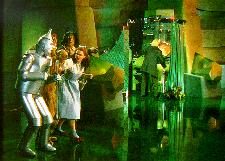
Pay no attention to that man behind the curtain: Prof. Richard Dawkins is indeed the creator god of his biomorphs, “my” he calls them, he created a world, its laws/rules, and its life. His chosen ones were selected for further evolution, a process that the creator manipulated towards his ends since he knows the beginning and the end. He even admits that the biomorphs were predestined, “There is a definite set of biomorphs, each permanently sitting in its own unique place in a mathematical space.”21
wizard10-9305708
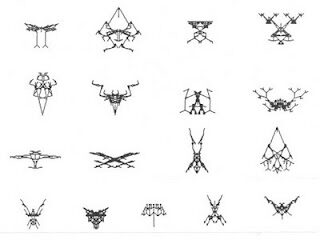
But what is it exactly that Prof. Richard Dawkins created? Animals? Insects? No. He created Rorschachs. He created several intersecting lines that then became more intersecting lines. Then he, the selector, the intelligent agent, interpreted what these lines look like to him. Recall that he stated, “I was hoping to evolve animal-like shapes” and that “The human eye_is the selecting agent.” Thus, he created and manipulated a world that produced Rorschachs-perhaps a psychiatrist would have more to say about the outcome than a biologist. But Prof. Richard Dawkins did not merely “see” insects and animals in his biomorphic Rorschachs, he also saw a Lunar Lander, a man in a hat, an upside-down menorah, a precision balance, crossed sabers, a lamp, etc. He does not bother explaining how a biological entity evolves into a saber or the Lunar Lander-he miraculously intervened upon biomorph land.
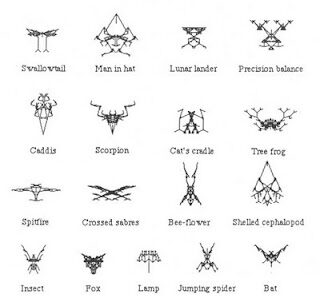
22bdaw5b15d-7158673

Example of Prof. Richard Dawkins’ creations with his subjective descriptions: fig 5 p. 61

Prof. Richard Dawkins concludes the chapter by writing:

“_when we are prevented form making a journey in reality, the imagination is not a bad substitute. For those, like me, who are not mathematicians, the computer can be a powerful friend to the imagination. Like mathematics, it doesn’t only stretch the imagination. It also disciplines and controls it.”22

This has been our point all along-escape reality and invent advantageous fictions: when the real world will not accommodate our world-view we can invent one that will. Why can we know that there is nothing mystical going on? Because nothing mystical is going on in our imaginary world.

Ultimately, the only thing that Prof. Richard Dawkins has accomplished engaging in tautology: he proposed a theory and then concocted an experiment that allowed him to manipulate the process from beginning to end so that in the end his theory was proven true.
PZ Myers’ Dogmatheism Catechism

PZ Myers continues to: 1) Positively affirm God’s non-existence without evidence. 2) Refuse to debate God’s existence.

3) Speak dogmatheistically for all atheists.

Just when an atheist has a conniption at the mere thought that you are generalizing about what atheists are, do, believe, etc. atheists such as PZ Myers come along and generalize about what atheists are, do, believe, etc.

As part of his defining atheism as anti-Christianity PZ Myers posed the following “Sunday Sacrilege” subtitled “That other thing we don’t believe in”—note the “we” as he presumes to speak for thee.

Atheists don’t believe in God. We deny the Holy Spirit.

Now, I love it when an atheist makes a very, very, very rare attempt at criticizing any religion besides Christianity and only succeeds in demonstrating a lack of knowledge of that which they speak.

Jesus was just a man, at best, as were Buddha, Mohammed, and every other prophet and religious figure in history.

The “at best” statement may mean that PZ Myers is an adherent of the radical and fringe school of thought that asserts that Jesus never existed—that He is not even an historical figure. Now, “Jesus was just a man” therefore not God or anything but human “as were Buddha, Mohammed.” But there is no claim within Buddhism or Islam that Buddha or Muhammad were anything but men. Siddhartha Gautama became the Buddha when he reached enlightenment whilst meditating but Buddhism is atheistic (see Buddhist Missionaries Proselytize and Buddha and Jesus). By the way PZ; did Siddhartha Gautama/Buddha ever exist? Muhammad is certainly seen as no more than being Allah’s human prophet. He was not even born of a virgin nor did he perform miracles as the Qur′an affirm Jesus did (see Muhammad and Jesus and Misconceptions in Reason and History). By the way PZ; did Muhammad ever exist?

pz20myers2c20true20freethinker2c20atheism-8796354

PZ Myers continues speaking for all atheists:

We don’t believe in souls…There is no immortal, constant part of any of us that will survive after death — our minds are the product of a material brain. We are literally soulless machines made of meat, honed by millions of years of ruthless, pitiless evolution…When we die, there is no paradise, no hell…Everyone who has ever lived has or will simply end, and become nonexistent. That should be the scariest, most depressing part about being an atheist. No future? How awful.

But it isn’t.

Just how does he know these things? One may wish to answer something to the likes of “Science” (that magical catch all term) but science only deals with the material and yet, it is being appealed to in order to disprove that which it cannot and does not consider—the supernatural.

But there is more,

I have several replies to believers who think we should be miserable because we don’t have an afterlife to look forward to; they usually can’t comprehend any one of them, which is far more depressing than mere death. One answer is that a lie is not reassuring at all — telling me that I’ll get to go to heaven when I die is about as believable as telling me that I’ll be rewarded with beer volcanoes and strippers for my irreverence. I’d rather be honest and aware then deluded and oblivious.

Another answer is that we are alive right now — I simply do not worry about what will happen after I’m dead. Life is for the living of it, it’s wasteful to spend it fretting over what you’ll do when it’s gone. One reasonable response to mortality is to enjoy life now.

Here PZ Myers falls into popular well-within-the-box-atheist-group-think-talking-points. Atheist tend to claim that they live life now whilst Christians await the life to come. Yet, atheist live life now—along with which can come the concept of getting what you want when you want it as soon it will all be over—whilst Christians live life now and also look forward to the next.
Note also that this is an argument from personal incredulity as that which is or is not believable to PZ Myers has nothing to do with what is and is not true.

But atheists have a future as well…or do they?

We do have hope for the future, too. Think for a moment about your community a century from now. Does it make you feel good to think that there will still be people living there then? That they will be talking about things that you find interesting, that they will be doing activities you also enjoy? Do you hope that life will be better for them? Even though we will be gone, we can still aspire to perpetuate our culture, and find satisfaction while we are alive in advancing that cause.

Do they? No, not even a grim gray afterlife.

…every work of art and technology produced by people whose names have been lost to us, every child, every dream, has been created by us, mere mortal flesh unled by a magic puppeteer in the sky, unaided by angels or spirits. I find that wonderful.

In the place of a “magic puppeteer” he places magic evolution.

we can throw away the irrelevant crutches of god-belief. We’ve walked successfully without them — cast them away, stand as a proud human being and meet fate without the wishful delusions of faith. That’s why this thought is a sacrilege — it says that we have no need of priests or gods or persistent ghosthood, ideas that have only hobbled us.

With this, PZ Myers makes it clear that he is one of the self appointed Evolutionary Watchmen who determine for all of humanity where evolution is to lead via their unnatural selection. From way up high in his imitation ivory tower he has bequeathed that it is about time that we all evolved to his lofty state. Also, why would he bother writing a list of that which atheists believe and or do not believe? It is a catechism; come all yea and adhere to PZ’s dogmatheism lest yea be besmirched as less evolved than he.

What PZ Myers, as dogmatheist who here calls for converts, should throw away is the irrelevant crutches of atheism as atheism is the consoling delusion of absolute autonomy and lack of ultimate accountability. It is a facade of intellectual superiority that very thinly veneers an emotional rejection of God—this much is peppered throughout Myers’ article.

Thus, as for the crutch, he clearly has his and we all have our: see My Crutch.