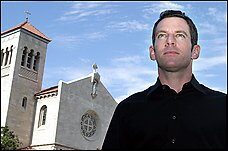
Dan Barker – Scriptural Misinterpretations and Misapplications, part 3 of 14

Babylon’s Raze

Dan Barker and many New Atheist attempt to demonstrate that the Bible is an immoral work from which we subjectively glean what scant good morals are found within it, they claim that we pick and choose. Dan Barker makes reference to Psalm 137 but quotes only the text which states, “Happy the one who takes and dashes your little ones against the rock!”

With that he assumes that he has demonstrated what macabre books the Bible is since, at least in his mind, it commands us to dashes little ones against the rocks. He also appears to think that this statement is a commandment for all people in all times and all places.

Dan Barker is committing a fallacy that is surprisingly and sadly very common amongst his brand of New Atheist pseudo-skeptics. So much so is this true that we have had to write on this matter with regards to Sam Harris (Sam Harris’ Mythunderstandings particularly the “Back Talking” section) and Richard Dawkins (Planting God More Firmly on His Throne).

The primary fallacy is quite simple to both identify and to correct. I do not seek to denigrate the intellectual prowess of the New Atheists. Yet, it must be pointed out that the fact that they so often commit such fallacies forces one to consider why they are doing so. Are they purposefully doing so or are they so outside of their field of knowledge that they simply cannot handle the process of reading a text for what it is without eisegetically injecting their emotionally spiked personal prejudices? While they quite often besmirch their opponent’s thoughts and motivation, we cannot do the same. We cannot know, unless they freely admit it, whether they are purposefully deceptive propagandists or simply not as erudite as we may think. The only thing that we can do is to consider their statements and, as the Bible praises the Bereans for doing whenever Paul preached to them, “see if those things were so” (Acts 17:11).

But what is the primary fallacy which is so simple to correct? They appear to function on the faulty premise that just because the Bible states something it is tantamount to an endorsement. In other words, the Bible describes and prescribes. For example, the Ten Commandments clearly prescribe, “Thou shall…Thou shall not…” On the other hand, statements such as was made by the devil to Jesus were clearly not something that Jesus should do and clearly not for us to do, “Then the Devil took Him up into the holy city and set Him upon a pinnacle of the Temple. And he said to Him, If you are the Son of God, cast yourself down” (Matthew 4:5-5).

Judaism and Christianity have never believed that everything written in the Bible is a prescription. New Atheists ought to reclaim their dignity and cease from constantly putting forth such unscholarly and un-commonsensical concepts. To besmirch the Bible for having printed within it pages, “Happy the one who takes and dashes your little ones against the rock!” Is tantamount to besmirching a newspaper for reporting rape and murder or, as is more precise in this case, for reporting the thoughts and feelings or someone thinking to themselves, “I hope that you are overthrown.”

Let us read the whole text of Psalm 137 which consists of 9 verses. Keep in mind that the important thing to do here is to just read what the text states and not consider what Dan Barker tell you it means nor what we think as we read along-what does the text state?

atheismandbabylon-1980475

By the rivers of Babylon, There we sat down, yea, we wept When we remembered Zion. We hung our harps Upon the willows in the midst of it. For there those who carried us away captive asked of us a song, And those who plundered us requested mirth, Saying, ‘Sing us one of the songs of Zion!’ How shall we sing the LORD’s song In a foreign land? If I forget you, O Jerusalem, Let my right hand forget its skill! If I do not remember you, Let my tongue cling to the roof of my mouth— If I do not exalt Jerusalem Above my chief joy. Remember, O LORD, against the sons of Edom The day of Jerusalem, Who said, ‘Raze it, raze it, To its very foundation!’ O daughter of Babylon, who are to be destroyed, Happy the one who repays you as you have served us! Happy the one who takes and dashes

Your little ones against the rock!

Ultimately, what we have here are the thoughts and emotions of people who have just been utterly crushed under the iron rod of brutally oppressive aggressors. For many of us living in first world cultures where there is an overabundance of food, money, healthcare and freedom it is very difficult to empathize with people in those circumstances. Imagine that someone is utilizing wireless-high-speed-internet service on their laptop computers while sitting in the temperature controlled comfort of a coffee house sipping their double-mocha-latte with whipped cream and cinnamon sprinkled on the top when they run across references to Psalm 137 (and usually an un-contextual citation of verse 9 alone). Can such circumstances as those portrayed in the Psalm even be imagined? Even seeing images of war and oppression in the news broadcast on a daily basis I find it very difficult to even begin to image the realities on the ground and in the minds and hearts of those experiencing them.

atheismandbabylon-4582640

With that in mind, let us consider what the Psalm is and is not stating.

By the rivers of Babylon, There we sat down, yea, we wept

When we remembered Zion.

We are introduced to the Psalm with an understanding that it is not God speaking to men but it is men who are speaking, “we sat…we wept…we remembered” and ultimately, we wrote. Why were Jews at by the rivers of Babylon? Because they had been forcefully taken captive. They find themselves overcome with sorrow for their true and former home-Zion. “Zion” being a mountain in Jerusalem and a term that is sometimes indicative of Jerusalem as a whole.

We hung our harps
Upon the willows in the midst of it.

We hung our harps sound like our common idiom, “We hung it up.” In other words, in the midst of Babylon, we were done for-our harps which had brought us songs of praise and merriment were hung up as useless things.

For there those who carried us away captive asked of us a song,
And those who plundered us requested mirth

Not only were they taken captive, having had their city and Temple destroyed, but now in the depths of their sorrow and despair their oppressors are taunting them by asking them to liven it up and sing happy songs to them-they demand entertainment.

Saying, ‘Sing us one of the songs of Zion!’ How shall we sing the LORD’s song

In a foreign land?

They do not merely request to be entertained with happy songs though, they request songs of the glory of Zion. They are asking the captives to recall the joys of Zion after having seen it destroyed and after imagining that they would likely dies in captivity having never again seeing Zion. This verse denotes Judaism’s concerns for geography, religion and culture-how can we sing the LORD’s song about Zion in a Gentile pagan land and after being brutally devastated?

If I forget you, O Jerusalem, Let my right hand forget its skill! If I do not remember you, Let my tongue cling to the roof of my mouth- If I do not exalt Jerusalem

Above my chief joy.

While captive outside of Jerusalem the Psalmist would prefer to lose his ability to perform music than to forget the land for which he weeps and from which he has been taken by force.

Remember, O LORD, against the sons of Edom The day of Jerusalem, Who said, ‘Raze it, raze it,

To its very foundation!’

This is not a command from God but is what men are requesting of God, a prayer of enmity. Keep in mind that God is not bound to answer anything that we ask in prayer if we pray amiss (James 4:3). What is being asked is that the actions of the Edomites be recalled. Apparently, while the Babylonians were attacking Jerusalem the Edomites were encouraging them, cheering them on, to raze the city. To “raze” means to subvert from the foundation, overthrow, destroy, demolish, erase, efface, obliterate, extirpate.

O daughter of Babylon, who are to be destroyed, Happy the one who repays you as you have served us! Happy the one who takes and dashes

Your little ones against the rock!

The Psalmist is now addressing Babylon itself: the daughter of Babylon-its inhabitants and descendants. This is the human heart speaking. The heart of men who had not merely taken captive but had endures witnessing their cities and Temple being destroyed and their countrymen, friends and families murdered. The statement is an accentuation of a desire to see the overthrow of the oppressors. It is in the common manner of brutal destruction and captivation that the Babylonians had conquered the then known world.
The Psalmist is stating that whoever manages to overthrow the might Babylon will be happy in accomplishing their victory. That little ones will be taken and dashed against stones is idiomatic of the final cessation of a brutal regime by eliminating any future generations that may continue oppression and destruction. Even if it is meant quite literally that little ones will be murdered in this way there is no particular prescription to be found. The point is clear and has already been stated: whoever causes Babylon to fall will be happy that they have done so and so, apparently, will be those whom the Babylonians had razed in the past.

There appears to be another issue. I claimed that what the Psalm stated were the thoughts and emotions of men. Yet, Judaism and Christianity claim that the Bible, including Psalm 137, is divinely inspired. “There you have it,” I can imagine the skeptic stating, “God commands little one to be dashed against the rock.” Yes, the Bible, including Psalm 137, is divinely inspired yet, the point is the same. In this case, it is the thoughts of men that God wants us to understand. The Bible is extremely honest in presenting a full orbed view of humanity which includes pointing out the flaws and shortcomings of the Bibles heroes.

Atheism and Christian Apologetics – Athanatos Opens Its Gates

Nice guy extraordinaire and more than capable apologist Anthony Horvath is once again opening the gates of the online apologetics courses he offers at Athanatos.

He has been kind enough to include me as an instructor this time around.

The course descriptions and other info is found here.

Some courses are free and the others cost less than most people spend on coffee any given week:

atheismatheistnewatheistschristianitychristianapologeticsgodbibleathanatosacademyofapologetics-2072731

I will be teaching Studies in Atheism

4 weeks. Begins Nov 4th.
Before there were the ‘New Atheists’ there were the old ones. This investigation into the atheism of Dawkins, Harris, etc, looks into the foundations of modern day atheism and its pervasive hostility to theism and Christianity. This course ends before Christmas. (Just in case the FFRF had any ideas…)

I will also teach Jesus According to…

3 Weeks. Begins Nov 30th.
How do different cultures, cults, and world religions view Jesus? How are these similar and different to the Christian view, which is rooted in the New Testament? Why does it matter?

Other courses are as follows:
Joe Keysor, Hitler and Christianity:

3 weeks. Begins Nov 23.
A free, three week course exploring the charge that Christianity is to blame for the Nazis and the Holocaust. This course is taught by Joe Keysor, the author of Hitler, the Holocaust, and the Bible. This book is strongly recommended if you are taking the course but not absolutely required.

I reviewed Hitler, the Holocaust, and the Bible here.

Josh Davis, Christ Promised in the Old Testament:

2 Weeks. Begins Nov 16th. Strongly Suggested Materials: The Bible.
Could you demonstrate that Jesus was the Christ from the Old Testament alone as the apostles did? (Acts 17:11, 18:28, 1 Cor 15:3). This survey of major OT evidences for Jesus as the Christ will help you see how Christianity and Judaism were related why Jews found it compelling at the time. This is an introduction that will help in personal growth and evangelism efforts.

atheismatheistnewatheistschristianitychristianapologeticsgodbibleathanatosacademyofapologetics-7876878

Anthony Horvath, Reliability of the New Testament Documents:

2 Weeks. Begins Nov 2nd. Strongly Suggested Materials: The New Testament Documents: Are they Reliable by F.F. Bruce.
This class surveys the development of the New Testament documents and the formation of the canon in a basic, introductory fashion.

Anthony Horvath and Terry Hollifield, Study in Alleged Bible Contradictions:

2 Weeks. Begins Nov 30th. Strongly Suggested Materials: The Bible.
Principles for resolving alleged contradictions in the Bible are introduced and applied to a small set of famous ‘contradictions.’

Anthony Horvath, The Death of Christianity:

3 weeks. Begins Nov 9th. FREE. Suggested Materials: Internet readings, guided tour.
Christianity is demonstrably on the decline in America. This course documents that decline, probes the causes, and suggests solutions. Based on the content found at http://www.deathofchristianity.com/, this course is centered heavily on discussion between the participants.

atheismatheistnewatheistschristianitychristianapologeticsgodbibleathanatosacademyofapologetics-2878884

Glenn Jones, Basic New Testament Greek Part 1

3 weeks. Begins Nov 2nd. Strongly Suggested (but not required) Materials: Basic Greek In 30 Minutes a Day by Jim Found.
Learn the Greek alphabet, how to sound out Greek words, how to identify nouns, verbs, definite articles, and how to use such information to use resources like a Bible interlinear or lexicon.

Glenn Jones, Basic New Testament Greek Part 2

3 weeks. Begins Nov 30th. Strongly Suggested (but not required) Materials: Basic Greek In 30 Minutes a Day by Jim Found.
Building on Part 1, the student will learn more vocabulary as well as parts of speech such as the definite article, etc.

Terry Hollifield, Origins: A Survey:

4 Weeks. Begins Nov 2nd.
Is evolutionary theory true? What does the Bible say? What does the science say? Is there scientific evidence for a young earth creation? Or is it just something the Bible says? In this survey of the issues, the participant will explore the critical issues involved in the Creation-Evolution-Intelligent Design Debate so they can make their own, informed, decisions. This course lays important groundwork for future study.

Sam Harris – The Seriously Funny Project

On July 14, 2008 AD the homepage of Sam Harris’ website made one of the funnies statements you will ever read.

The homepage was describing a project to transfer Steve Wells’ “Skeptic’s Annotated Bible Qur’an, and Book of Mormon” to the Reason Project.

It is stated,

Steve spent the better part of a decade annotating these holy books and highlighted all passages notable for their historical inaccuracy, internal contradictions, scientific errors, absurdity, injustice, cruelty, sexism, intolerance, etc. (he also flagged the good parts).

The bottom line is described thusly,

to refine Steve’s work in a section of our website entitled “The Scripture Project” where we will have religious scholars, historians, scientists, and other qualified people continue to annotate these texts on a Wiki.

And now comes the knee slapping, bent over in convulsions, comedy,

With the input of the right scholars, we are confident that the Reason Project website will quickly become the preeminent place for scriptural criticism on the internet.

Yes, ladies and gentlemen this project can only succeed “With the input of the right scholars.”

Obviously, the logical questions are: “Who are the ‘right scholars’?” and “How is it determined who are the ‘right scholars’?”

These questions were not answered but I believe that an educated guess would be something to the likes of…

If you hold to a materialistic worldview – you might be the “right scholar.”

If your purpose in reading/studying the Bible is to cherry pick the bad and the ugly (ok, and perhaps the occasional rare good [according to whom?]) – you might be the “right scholar.”

If you would not know grammatical, historical or cultural context if your title as “scholar” or “skeptic” depended on it – you might be the “right scholar.”

If you make a living by expressing your personal prejudice against “religion” – you might be the “right scholar.”

If you believe that the standard for ascertaining the accurate history of the Bible text you are dealing with is anything that will contradict the Bible – you might be the “right scholar.”

If you believe that the church and the rabbinate were the last institution who could accurately establish their own cannon of scripture – you might be the “right scholar.”

If you believe that you, yes you, have finally uncovered the true meaning of the Bible – you might be the “right scholar.”

And just for further fun, I will borrow a few from the “Bible criticism” section of Tektonics’ “You may be a fundamentalist atheist if….

If “You dislike how liberal theists try to interpret the Bible for themselves, while you create your own interpretations of the Bible for yourself” – you might be the “right scholar.”

If “You can quote from the bible better than most missionaries…at least the parts where someone dies” – you might be the “right scholar.”

If “You label all scholars that actually believe the Bible as ‘biased fundies’ while those who don’t believe it are known as ‘honest’ and ‘accepted scholarship'” – you might be the “right scholar.”

If “You think that Isaac Asimov was a world-class authority in Biblical Studies” – you might be the “right scholar.”

If you believe that “When a Christian’s interpretation of a passage (based on the social/literary context) solves one of your favorite contradictions, it is only their personal interpretation, and can be dismissed as such. But your interpretation (based on a ‘plain’ reading of the text) to arrive at the contradiction in the first place is entirely objective, and is obviously THE correct interpretation” – you might be the “right scholar.”

If “Your only knowledge of The Bible comes from searching ‘bible contradictions’ in Google” or from your future searches of “The Scripture Project” – you might be the “right scholar.”

If “You consistently appear on discussion lists demanding that Christians accept your literal interpretation of various scriptural passages just so you can then launch into the usual ‘argument by outrage’ – despite being told over and over that no Bible scholar or school of Christianity shares your particular bizarre literal interpretation” – you might be the “right scholar.”

If “You pontificate about the Bible as if you are an expert in theology, textual criticism, ancient languages & cultures and much more besides, when your knowledge of the Bible is just cut and paste from atheist discussion lists which cut and paste it from atheist websites which cut and paste it from embarrassingly unscholarly rantings by the likes of Messer’s Freke & Gandy and Acharya S, etc.” – you might be the “right scholar.”

If “Archaeology continually frustrates your attempts to find errors and contradictions in the Bible, but you continually use the same outdated accusations anyway since you’re running out of material” – you might be the “right scholar.”

Yes, ladies and gentlemen this project can only succeed “With the input of the right scholars.” Just send in your application along with a video showing you ripping a page out of a Bible, following in the footsteps of PZ Myers, and will instantly be deemed the “right scholar.”

If you are interested in seeing how the New Atheists fare as “right scholars” please consult my following essays (and these are a mere sampling):

st-samharris26

Sam Harris:
Sam Harris’ Mythunderstandings
Sam Harris: Instigator At Large
Let Him Who is Without Faith Cast the First Stone

dawkins-4940558

Richard Dawkins:
The Apostle Thomas: Patron Saint of Scientists?
Planting God More Firmly on His Throne

barker-7136293

Dan Barker:
Dan Barker and Bertrand Russell: The Dynamic Duo of Demonstrably Deleterious Delusion
Why Freethought?
Dan Barker’s Scriptural Misinterpretations and Misapplications

christopher20hitchens_2-3825077

Christopher Hitchens:
Is Christianity Loved to Death?
Jesus, the god of War?
Theological Fallacies and Miscomprehensions, part I of III
The Challenges, part I of III