Evilbible – the Polemical Saga Continues, part 4 of 5

The questioner continued by stating,

evilbible.com had lots of valid points. Some are invalid as you pointed out. But remember it is a work of a single individual. You ignored the valid points in the website, and accused the author of ignoring things from the bible. Very typical behavior expected from a theist.

So evilbible.com had lots of valid points and of the “lots” not one single one is referenced. Yet, they also have some invalid ones as I pointed out. Fair enough.
That it is the “work of a single individual” is not accurate, it may have one administrator but not one author. For example, my parsed essay Atheism, EvilBible.com, “Theists Suck” and Christians are Hypocrites responds to an evilbible.com page that was not authored by the administrator. But be that as it may; the main point is the claim that I “ignored the valid points in the website, and accused the author of ignoring things from the bible.” I am not certain that this is “Very typical behavior expected from a theist” but alas. At the beginning of the essay on Christians are Hypocrites I stated,

If she wants to charge Christians with hypocrisy we could merely say, “Right you are, shame on us”

Within that parsed essay I actually gave quite a bit of props to evilbile.com’s points about Christian hypocrisy (is “props” still a hip common parlance thing?). But no, overall I did not find much validity at evilbible.com and the questioner did not provide any of the “lots” of examples. Moreover, the claim that I “ignored the valid points in the website, and accused the author of ignoring things from the bible” is fallacious for, at least, four reasons: 1) I did, in fact, admit to some valid points (as I just stated above).

2) I did not simply ignore the further valid points but simply did not find many.

3) I never claimed to have responded to the entire text of the entire evilbible.com website: in fact in my comment at the Q&A website I stated “Large portions of evilbible.com have been considered, dissected and declared fallacious on very many levels.”
4) The correlation between my supposed ignoring of valid points and my valid accusation that evilbible.com “ignoring things from the bible” is faulty: this is because I was much more specific than that in stating that the evilbible.com page that deals with rape,

…neglects to mention the most relevant biblical text related to the biblical view of and law about rape. Why this omission? Who knows, but it would certainly have gotten in the way of a good session of emotive expression of prejudice—it would have discredited evilbible.com to reference this most important text.

In any case, perhaps I am not a typical theist.

The questioner continued by stating,

why [sic] should we worship god if he exists? is he that vain?

Why should we worship God? Why not?
Is He that vain? No.

If God is then God is the only appropriate being to worship. We humans also have a propensity towards worship: we have worshipped everything from nature to other human beings. These two are, in fact, both of atheism’s preferred objects of worship in the form of replacing awe in God with awe in nature in the form of Neo-Pagan-Atheism and in the form of self-worship. Professor of philosophy Daniel Dennett argued that the atheist Joseph Stalin was, in reality, a theist since he believed in a god who told him what was right and wrong and that god was Stalin. The problem with the self-made man is that he worships his creator. As the philosopher Bob Dylan stated it,

But you’re gonna have to serve somebody, yes indeedYou’re gonna have to serve somebody,It may be the devil or it may be the LordBut you’re gonna have to serve somebody.

But is God that vain? There is no reason to equate vanity with the appropriate object of our worship pointing out that He is the appropriate object of our worship (this issue was discussed further in the post James Randi – the Amazing Atheist, part 2 of 2).

The questioner continued by stating,

isnt [sic] it enough if i [sic] just didnt [sic] cause harm to anyone. isnt [sic] just behaving as a moral citizen enough. but [sic] no, the bible and christians [sic] claim not believing in ‘their ‘God as [sic] sin. What a bigoted ***** ** *** ****. [expletives removed]

This question represents the very premise upon which man-made religion is based: works based salvation. What I did, what I do, I make the rules, I referee the game, I declare myself the winner—and God better agree because I have made myself God’s god. Let us parse the questions:

isnt it enough if i just didnt cause harm to anyone.

The questioner did not define “harm” and so responding is very difficult. Perhaps it is not harm to stick it to those typical theists. Perhaps harm is only physical but not psychological. Perhaps…, perhaps…, who knows? I have found that such people define harm as “Nothing that I have ever done.” Whatever the definition of “harm” is the questioner claim to have caused no harm and to have caused no harm to anyone—this is certainly impressive. It actually impresses upon me that their definition of “harm” is very, very loose and very, very allowing of excuses. In fact, what if I state that the questioner has harmed me by besmirching me and my God. There you have it; they are now guilty of harm causing.

But granting that they have actually lived an entire lifetime of causing no harm to anyone (and apparently expects to continue doing so) why is this not enough? We will come to that.

isnt just behaving as a moral citizen enough.
The questioner did not define “moral” and so responding is very difficult. Perhaps it is moral to stick it to those typical theists. Perhaps morality only relates to physical acts but not to the psychology, the thoughts, behind the acts (see My Evil Thoughts). Perhaps…, perhaps…, who knows? I have found that such people define moral as “Whatever I do.” Whatever the definition of “moral” is the questioner claim to be moral—period, this is certainly impressive. It actually impresses upon me that their definition of “moral” is very, very loose and very, very allowing of excuses. In fact, what if I state that the questioner is immoral because they besmirched me and my God. There you have it, they are now immoral.

But granting that they actually are moral (and apparently expects to continue being so) why is this not enough? We will come to that.

but no, the bible and christians claim not believing in ‘their ‘God as sin.
As I noted above this is fallacious since the issue is sin itself and the rejection of salvation. In fact, the Bible is little impressed by theism in general, or even monotheism in particular, as it states,

You believe that there is one God. You do well. Even the demons believe—and tremble! (James 2:19).

My un-authorized paraphrase is “You believe in God? You are a monotheist? Mazel tov! That’s just super! You share the same theology as demons.” This is because the discussion is the question of “What does it profit, my brethren, if someone says he has faith but does not have works? Can faith save him?…faith without works is dead?”—you believe, good, now act like it.

What a bigoted…
The questioner did not define “bigoted” and so responding is very difficult…you get the idea. Let us imagine that it is true that it is no enough to not cause “harm” and not enough to be “moral” and that it is a sin to not believe in God—if it is true it is not bigoted but a mere fact. Facts are, by definition, restrictive or bigoted/intolerant, if you will. If it is a fact that 2+2=4 then it is bigoted/intolerant that 2+2=5 is wrong but it is nonetheless true that 2+2=4 and false that 2+2=5.

But why is this not enough? Let us begin by stating that as we saw from James; good works are very important for at least two reasons: 1) people need good works done to and for them 2) good works go some way towards demonstrate that you are not merely claiming to be something that you are not: “But be doers of the word, and not hearers only, deceiving yourselves” (James 1:22), “You will know them by their fruits” (Matthew 7:16), etc.

Yet, while very many atheists argue for a works based model of salvation we should thank God that such is not His higher ways. Imagine getting to the judgment very pleased with your self-professed morality and lack of causing harm. Yet, next to you is Mother Theresa. How do you add up now? How does Mother Theresa add up to Jesus? Imagine God stating, “Oh boy; you are just five helping little old ladies crossing the street short of salvation—sorry, bye!” No indeed, God has not established a good works contest for salvation. Note that this man-made soteriology one considers the good and disregards the bad and the ugly (to employ a little Hollywood lingo). What about the person who only near the date of their death comes to their senses, repents and realizes that they have lived a wretched life? Are they condemned because they only recently began to store up for themselves good works? Why do good things happened to bad people?

No indeed, God’s salvation is by grace,

And if by grace, then it is no longer of works; otherwise grace is no longer grace.
But if it is of works, it is no longer grace; otherwise work is no longer work (Romans 11:6).

~~~~~~~~~~~~~~~~~~~~~~~~

A plea: I have to pay for server usage and have made all content on this website free and always will. I support my family on one income and do research, writing, videos, etc. as a hobby. If you can even spare $1.00 as a donation, please do so: it may not seem like much but if each person reading this would do so, even every now and then, it would add up and really, really help. Here is my donate/paypal page.

Due to robo-spaming, I had to close the comment sections. However, you can comment on my Facebook page and/or on my Google+ page.

Evilbible – the Polemical Saga Continues, part 3 of 5

The comment continues,

Hate of other-god-believers: Deuteronomy-13:1-18, Leviticus-20:1-5

Just to clarify: Deuteronomy 13 does not reference other God believers—other people who likewise believe in the God of the Bible—but to other gods believers—other people who believe in false gods. These other people would come to Israel and urged them to,

go after other gods…and let us serve them…Let us go and serve other gods…of the gods of the people which are all around you, near to you or far off from you, from one end of the earth to the other end of the earth…Let us go and serve other gods.

But God is a god, are gods, it is all the same right? So what is the problem? Well, the commentator was kind enough to, apparently unknowingly, provide the answer by referencing Leviticus 20:1-5 which condemns the worship of Moloch which consisted of human/child sacrifices (which atheist do not condemn—just get back to condemning Jews!).

The comment continues,

Stone disobedient son to death: Deuteronomy-21:18-21, Leviticus-20:9

Considering that two references were provided one can only assume that this is a purposeful attempt to manipulate via emotionally charged assertions. This charge is ubiquitous in atheist circles and the more that this atheist talking point is expressed the more that it discredits that the one making it.
This is a very popular atheist talking point: note that the comment reference to a “disobedient son,” Dan Barker referenced “a stubborn and rebellious son,” Richard Dawkins referenced “disobedient children,” Sam Harris referenced children that “talk back to us,” but the Bible references stubborn, rebellious, disobedient, gluttonous, drunkards who “smiteth” and curse their parents and have already been chastened (Exodus 21:15, Leviticus 20:9 and Deuteronomy 21:18). The Talmud (Sandedrin 71a) basically makes the point that such severe restrictions are placed on the commandments that “There never was, and never will be, a wayward and defiant son” (or “stubborn and rebellious son”).
Also, as with any stoneable offense; at least two witnesses were required and the matter had to be litigated by the judges. This is all part of a very carefully regulated judicious system.

The comment continues,

Kill man, woman, child, livestock-Siege of Jericho-Joshua-6:21, 26

One thing that is not mentioned is that any war-like action by Israel was to begin with an offer of peace as, for example, is stated in Deuteronomy 20:10 states, “When you march up to attack a city, make its people an offer of peace.” Moreover, Jeremiah 18:8 states, “If that nation, against whom I have pronounced, turn from their evil, I will repent of the evil that I thought to do unto them.” Also, God performed stupendous miracles, such as the events during the exodus from Egypt, in order to get the attention of the Gentile Pagan nations so that they would repent and give up worshipping their false gods with their human/child sacrifices—God gave them centuries to repent.

Note that the commentator provided no absolute premise upon which to condemn any killing whatsoever.

The comment continues,

Divine plunder: Joshua-6:19, 24 Divine plunder by espionage & with assistance of prostitute[s]: Joshua-2:1, 6:25 Divine terror: Song of Moses-Deuteronomy-32:23-27.

The response here is much the same as the one above. The “Divine terror” is in reference to, as we have considered above, “foreign gods…They sacrificed to demons, not to God, to gods they did not know, to new gods, new arrivals” the very gods who demanded human/child sacrifice—now that is terror.
Note that the commentator provided no absolute premise upon which to condemn plunder, divine plunder, espionage, prostitution, or divine terror.

The comment continues,

Leviticus 20 (page174-75) has sentences for all sexual-genital acts. [Gays at 20:13].

I do not know what “sexual-genital acts” are except that perhaps it means “sexual” acts performed with one’s “genitals”—or something. I am even less sure that “page174-75” is supposed to be referencing (maybe they actually have a Bible and think that all Bibles are similarly paginated regardless of size, shape, font, font size, etc.—just in case: these are not divinely inspired).
To begin with, note that Leviticus 20 begins with a condemnation of human/child sacrifice with specific reference to Moloch. The text forbids sexual relations with the following (Leviticus 18:6-23):

Adultery in general. A man who lies with his father’s wife. A man who lies with his daughter-in-law. A man who lies with a male as he lies with a woman. A man who marries a woman and her mother. A man or woman who mates with an animal. A man who takes his sister, his father’s daughter or his mother’s daughter. A man who lies with a woman during her sickness…exposed her [menstrual] flow. Not to uncover the nakedness of one’s mother’s sister nor of your father’s sister. A man who lies with his uncle’s wife.

A man who takes his brother’s wife.

Not only is this good advice but much with which atheists could agree. The most shocking aspect of these commandments is that each and every one of these had to be stated because they were being practiced in Gentile Pagan nations. Thus, God states, “you shall not walk in the statutes of the nation which I am casting out before you; for they commit all these things, and therefore I abhor them.”

This particular litany of assertions and fallacies ends thusly,

And this is a very very small sample just the beginning!
And Revelation is the most absurd and hilarious of all!

This is an argument to ridicule. Also, just because something (such as abiogenesis for example) is “absurd and hilarious” does not mean that it is not true.

This commentator seems to be a pars pro toto whereby one seeks to define the whole by referencing a mere part. It is the fallacy of it’s in the Bible so it must be true or it’s in the Bible so God must approve of it. This is not the case, is illogical, is not in keeping with the Bible’s grammatical context, has never been claimed by Judeo-Christian doctrine. For example, when the Bible records lies told by people it is true that they lied but their lies where not true. Bottom line is that this objection disregards the fact that that the Bible both: prescribes and describes. Some actions are merely described and some are prescribed: examples of what to do and what not to do, examples of things that people have done in either case, etc.

Next, someone proposed “Some questions for you (edit)?” I am not sure what “(edit)” means but here are the questions:

Why does a benevolent and forgiving God condemn people in Hell for eternity for finite sins?

This question is premised upon a tel of misconceptions. Firstly, I assume that this person has a misconception as to what hell is and what it is all about in the first place. Secondly, the reason that hell is eternal is that the sin of the unrepentant is eternal which is to say that they have chosen to continue in, to live with and by, their sin by not accepting God’s offer of forgiveness. Thus, they choose to reject God and choose to live according to their sin.
Therefore, God has provided a place where they can go to get exactly what they want: to get away from God forever. Now, there is an interesting point to be made here: the Bible states that hell was not created for humans but for the devil and his angels (Matthew 25:41), humans can go there if that is what they want. This is interesting as hell was exclusively created for creatures for whom God’s existence was a non-issue—they rejected God and chose to hound humanity.

Thus, a benevolent and forgiving God condemns people in hell—they actually condemn themselves—because they reject His offer of forgiveness. Let us imagine that someone has fallen for the sorts of atheist talking points, fallacies and misconceptions that we have been considering (yes, even the ones with book, chapter and verse next to them) and they simply hate the God of the Bible—for whatever reason. If God forced them into heaven to live with Him for all of eternity that would be like hell for them and this would be unrighteous. Thus, they are given what they really want—eternal separation from God.

But what about the point of eternal hell for finite sins? That is just the point: they chose eternal separation from the God whom they reject. However and/or moreover, no one believes that the time of, let us employ the term “punishment” for metaphorical easy, is to be commensurate to the amount of time that it took to perform the crime. For example, how long does it take to shoot someone to death? Fractions of a second. Thus, we ought to throw them into prison for fractions of a second—right? No.

The questioner continued by stating,

And for the matter why would he condemn us if we dont [sic] believe in him. If he does that he must be a helluva ****** [expletive removed].

A lot of the above response applies to this one as well. There is some confusion here in that people are not condemned for not believing in God but because they choose to sin and choose to not be forgiven. But how can they choose to be forgiven by God if they do not believe in God? Good question but do not forget that the primary response is to clear up the confusion as I just did. I believe that a large part of it is that there is within human beings knowledge that we must be forgiven for our sins and that this is prima facie. It is likewise self-evident that with regards to past wrongdoings: we cannot keep track of them all but have also lost track of the people whom we have wronged. In this case, we cannot gain even finite human forgiveness. Furthermore, what if they refuse to forgive us? Well too bad, now it is their fault!? But we are not talking about skirting forgiveness or ignoring it. There is also the concept of forgiving ourselves which is a consoling delusion and more akin to making excuses since we could do as we please and simply declare ourselves forgiven by ourselves according to our own standards our own regulations and our own litigation.

Thus, it seems as if the ultimate answer, beyond psychological band-aids, is that transcendent forgiveness exists and is available.

~~~~~~~~~~~~~~~~~~~~~~~~

A plea: I have to pay for server usage and have made all content on this website free and always will. I support my family on one income and do research, writing, videos, etc. as a hobby. If you can even spare $1.00 as a donation, please do so: it may not seem like much but if each person reading this would do so, even every now and then, it would add up and really, really help. Here is my donate/paypal page.

Due to robo-spaming, I had to close the comment sections. However, you can comment on my Facebook page and/or on my Google+ page.

The Quadripartite Equine Riders, part 8 of 11

On Cosmology, Theology and Eternal Regress
With cosmology in mind let us note the following exchange as Sam Harris poses the following question,

Is there any argument for faith, any challenge to your atheism that has given you pause, that has set you back on your heels where you felt you didn’t have a ready answer, etc?

Daniel Dennett responds thusly, “Actually I can’t think of anything.”

Richard Dawkins answers:

I mean, I think the closest is the idea that the fundamental constants of the universe are too good to be true. And that does seem to me to need some kind of explanation. If it’s true. I mean, Victor Stenger doesn’t think it is true but many physicists do. I mean, it certainly doesn’t in any way suggest to me creative intelligence because you’re still left with the problem of explaining where that came from. And a creative intelligence who is sufficiently creative and intelligent enough to fine-tune the constants of the universe to give rise to us has, to got to be a lot more fine-tuned himself than…

It is interesting, having just discussed authoritative claims in science that he sides with the one physicist versus the “many” (whatever that may mean).

Then he basically makes a point about eternal regresses whereby the universe is contingent upon a fine-tuner but that fine-tuner must have been fine-tuned by a finer-tuner, which in turn must have been more finely-tuned by an even finer-tune, etc., etc., etc. and there is no finest-tuner of them all in view. Surely, there are various ways to respond to this.
I am personally always taken aback by the fact that Richard Dawkins’ view is that what is an impossible, or improbable, or illogical claim about God suddenly turns into a possible, probable and logical claim about matter, which I will state thusly:

It is ignorant and superstitious to believe that God made everything out of nothing.
It is logical and scientific to believe that nothing made everything out of nothing.

It is ignorant and superstitious to believe that God is eternal.
It is logical and scientific to believe that matter is eternal.

God is an effect and must have had a cause.
Matter is the uncaused first cause.

If God made everything, then who made God?
Matter made everything and nothing made matter.

Atheist Wisdom?

NOTE: This was written by IrishFarmer and originally posted on Atheism is Dead (True Freethinker‘s predesesor).

Hello again. I’ve been away for a while, but I’ve been anxious to get back to the “amateur blog” crowd and so here I am.

I always thought my biggest strength in writing was as a commentator, because I’m no philosopher myself. I prefer to dissect, or critically examine (if you will), other people’s thoughts for the entertainment of my readers (really, for my own entertainment). So, with that in mind…

I stumbled across this blog, inappropriately titled “Atheist Wisdom”, and went from intrigued to disappointed. No offense to the author, but any blog calling itself “Atheist Wisdom” should probably live up to the name, and this blog definitely doesn’t. Instead, from what I can tell, the blog contains random quotes like, “Prayer has no place in the public schools, just like facts have no place in organized religion.” Or, “Give a man a fish, and you’ll feed him for a day. Give him a religion, and he’ll starve to death while praying for a fish.” Quotes which are notable possibly for their wit, but not exactly for the depth of rational thought put into them. In fact, these quotes are nothing more than expressions of prejudice against religion or the religious.

From there, it only gets worse. The author seems to respect the intellectual black hole known as Religulous by Bill Maher, not to mention that he thinks Sam Harris is a serious player in the God Controversy.

Should I even bother mentioning that he links to the Skeptic’s Annotated Bible?

Of course, it’s easy to criticize the shallow aspects of Joe Anybody’s blog, what I’d rather do with this post is get to one of his/her(?) more thoughtful pieces. Namely, this one, entitled “Questions from Believers”.

Here, he attempts to give answers to common questions that theists might ask of athiests, and succeeds. Succeeds, that is, at answering the questions. The content of the answers is another story.

These answers exemplify some of the common mistakes in reasoning that atheists make, and being the nice guy that I am I thought I might help atheists out by showing them where they go wrong.

Questions #1: Utilizing each of the historical facts conceded by virtually all contemporary scholars, please produce a comprehensive natural explanation of Jesus’ resurrection that makes better sense than the event itself.

Answer #1: Well here are four that spring immediately to mind, and I’m confident I could think up at least a dozen more. The witnesses lied. The resurrection was faked by someone. The event was entirely made up after the fact by the authors of the gospels. Jesus wasn’t really dead. Each of these explanations make much more sense than a guy coming back from the dead after three days, which is something that we all know is physically impossible.

Where to start… First off, the author hasn’t lived up to the questioner’s requirement to provide an alternative that “makes better sense”[sic]. I could claim that aliens stole the body, replaced it with an aged clone, and perpetrated one of the biggest hoaxes in history. This is an alternative, but I don’t think anyone would argue that it “makes more sense”.

Fact is, each alternative demands to be weighed against one another to see which is most likely. None can be written off as unreasonable (or declared reasonable) until this is done. The author doesn’t do this, he simply assumes that as long as he has a logically coherent, naturalistic alternative, he has the right answer (or is at least able to rule out the “miraculous” answer). He does this by assuming that any possible answer has to comply with his naturalistic philosophy (read: unproven assumptions).

Each of these explanations make much more sense than a guy coming back from the dead after three days, which is something that we all know is physically impossible.

In other words, he assumes that naturalism is true – and so by extension, so-called “miracles” don’t happen – and so some sort of naturalistic explanation must be true. It doesn’t work this way, unless he can provide some outside reasoning to explain why we should just accept that these sorts of things really don’t happen.

Notice he calls a resurrection “physically impossible”. This would only matter if you assume that physical forces are never bypassed, overridden, or changed (whatever you want to call a miracle), however that begs the very question at hand. His response is basically that this miracle can’t happen because according to him this miracle can’t happen. That sort of statement is useless to the discussion.

Furthermore, no one (Christian or otherwise) argues that the resurrection happened “naturally”, whatever it really means for an event to occur naturally. Instead, Christians would probably argue that it was an Act of God that brought Jesus back from the dead. So, the Christian can agree that it is physically impossible, that without God’s intervention it won’t happen. That doesn’t mean that it didn’t happen, nor does it make any alternative that contradicts the Bible more likely – at least not on those grounds alone.

Question #2: Given the commonly recognized and scientifically supported belief that the universe (all matter, energy, space, time) began to exist a finite time ago and that the universe is remarkably finely tuned for life, does this not (strongly) suggest that the universe is ontologically haunted and that this fact should require further exploration, given the metaphysically staggering implications?

Answer #2: Nobody knows whether or not the matter and energy began to exist a finite amount of time ago. We think it existed as a singularity, a region of infinite density and infinite space-time curvature. What happened before that is potentially a meaningless question given that the big bang (i.e. the expansion of this singularity) is when we think time, as we know it, began.

The problem with this answer is in the answer itself. If the the universe has its origin in a singularity, and the big bang is what we call the event that marks the start of time, then without any elaboration we’re forced to conclude that the universe began to exist a finite time ago. Whether or not the universe exploded from a singularity is neither here nor there, since even according to this particular atheist, time has a definite beginning.

Note:

What happened before that is potentially a meaningless question given that the big bang (i.e. the expansion of this singularity) is when we think time, as we know it, began.

Notice that the original question never mentioned a “before” the big bang. The atheist answer is reading too much into the question.

Of course, since the original question never mentioned a “before the big bang”, the atheist is obviously reading into the question what they expect the question actually means.

Then, the author ends his answer with:

And “the universe is fine-tuned for life”? No. Life is fine-tuned for the universe, or at least our tiny corner of it.

I’d answer this, but since he didn’t actually provide a tangible response (only a bald assertion, much like the original question did – to be fair), I have nothing to go on. By comparison, this reminds me of two children arguing:

“Yes you are!””No I’m not!”

“Yes you are!”

And so on…

It’s out of the scope of this post to discuss fine-tuning, anyway.

Question #3: Granted that the major objection to belief in God is the problem of evil, does the concept of evil itself not suggest a standard of goodness or a design plan from which things deviate, so that if things ought to be a certain way (rather than just happening to be the way they are in nature), don’t such ‘injustices’ or ‘evils’ seem to suggest a moral/design plan independent of nature?

Answer #3: I don’t accept that “the problem of evil” is the main objection to the belief in God. There are many other factors, and every atheist has come to his or her conclusions via different thoughts and concepts. For me in particular, it’s the complete lack of any evidence. And no, I don’t believe that the fact that we can recognize an act as “evil” means that there must be an objective standard for “good”. This is like saying that because I find olives to taste bad, there must exist somewhere a food that tastes absolutely perfect.

It’s interesting to me that this atheist doesn’t think that the Problem of Evil is a good objection to theism. That might have something to do with him being a moral nihilist.

In this case, the atheist is right. Simply because we have a moral sense, does not mean that our minds are apprehending a realm of objective moral values. However, simply because the atheist is a moral nihilist, doesn’t mean that our moral sense does NOT apprehend a objective moral values.

Please explain how something can come from nothing, how life can come from non-life, how mind can come from brain, and how our moral senses developed from an amoral source.

Open-ended questions like these prompt nothing more than simple responses. Making the problem worse is that it only asks for an explanation. Any explanation will do, no matter how plausible or substantial.

That said, there are some things in the atheist response that are worth thinking about.

The details [about scientific explanations for our morals and so on] are being fleshed out more and more each day by scientists and experts the world over. The amount of evidence for the truth of these ideas is growing. And they require no god or supernatural elements to work.

The thing to note is the last line. What the atheist is essentially saying here is that these scientific theories are (approximately) true, and don’t depend on God’s existence for their truth. Of course, these theories also don’t depend on atheism either. So what that ultimately has to do with God’s existence is beyond me.

It seems to me that too many atheists assume that because a scientific theory doesn’t imply God’s existence, it implies God’s non-existence (or at least implies that God’s existence is irrelevant). I’m not seeing a logical chain leading to this conclusion, so if any atheist can explain this for me without referencing their own personal assumptions, I’d appreciate it. Fact is, there is no logical connection between scientific inquiry and atheism.

Question #5: Why is something here rather than nothing here? Clearly, the physical universe is not eternal (Second Law of Thermodynamics, Big Bang cosmology). Either everything came from something outside the material universe, or everything came from nothing (Law of Excluded Middle). Which of those two is the most reasonable alternative? As an atheist, you seem to have opted for the latter. Why?

Answer #5: This question seems to be built on several unfounded assumptions. The idea that “the physical universe is not eternal” is not “clear” to me. Then, “everything came from outside the universe” or “everything came from nothing”? These are not the only options. How about “everything was always here, in some form of other”? The big bang theory does not refute this, and if something had to have always existed, it might as well be the universe than God. And an atheist is a person lacking belief in a god. The descriptor “atheist” says nothing about a persons belief regarding the origins of the universe any more than about their taste in music.

This answer is contradictory and confused, at best. What the question involved was the idea that the universe had a definite beginning in time, which the atheist even conceded in a previous question. So when the atheist claims it isn’t “clear” to him/her, then s/he simply can’t seem to keep their answers straight on this issue.

How about “everything was always here, in some form of other”?

To say something was “always” here, is rather vague. If, for instance, I want to assume that “always” means “since the beginning of time”, then the universe has always been around whether or not God created it ‘out of thin air’. However, it occurs to me that the question implies that the universe is not infinitely old. I could go on and on about this issue at some length, but for now it’s sufficient to say that the universe is not infinitely old. If you want to ignore the scientific evidence, then you still have the seemingly endless amount of logical contradictions involved in an infinitely old universe. It simply isn’t possible.

Fact of the matter is, time (in any form) must terminate in the past with some kind of origin. So the atheist has not dodged the dilemma stated in the question.

And an atheist is a person lacking belief in a god. The descriptor “atheist” says nothing about a persons belief regarding the origins of the universe any more than about their taste in music.

Atheists really think we theists are suckers. We watch them fight tooth-and-nail against theism, and then turn around and claim that they’re incredibly militant because they just lack a belief in God.

Actually, I can identify with the fact that atheists simply lack a belief in God. As it turns out I don’t actually believe in God, I just lack a belief in an atheistic universe. :\

When are atheists going to drop this pathetic defense for their beliefs?

Question #6: If our cognitive faculties were selected for survival, not for truth, then how can we have any confidence, for example, that our beliefs about the reality of physical objects are true or that naturalism itself is true?

Answer #6: Much of this question can be discarded. It boils down to “How can we believe in anything?”. This question should be more unsettling to the theist than the atheist. The answer is that, philosophically, we can never be certain about anything, but we can test ideas by repeat measurements, theories, models and verification of predictions. God fails these tests, whereas my hypothesis that “if I drop a brick on my foot, it will hurt” is based on past experience and my knowledge of the world. Science works.

This is actually the best question in the whole blog post. It’s a devastating argument against metaphysical naturalism (and by extension, atheism)and it was entertaining for me to watch the atheist respondant trip all over himself trying to answer it. This sort of response is typical of atheists when this question is brought up (in my own experience, of course).

First off, why should this question be more unsettling for theists than atheists? In traditional theism, God is the ultimate measure for truth, and has endowed us with self-awareness and the ability to comprehend Him – and thus Truth. Theists shouldn’t be concerned at all.

The answer is that, philosophically, we can never be certain about anything, but we can test ideas by repeat measurements, theories, models and verification of predictions. God fails these tests, whereas my hypothesis that “if I drop a brick on my foot, it will hurt” is based on past experience and my knowledge of the world. Science works.

This flimsy response basically amounts to the atheist saying, “God fails the test of scientific inquiry, and therefore all beliefs regarding God are useless at best.” When atheists make this sort of accusation, they don’t see the three fingers pointing right back at them. That is, atheists don’t realize that they themselves have pre-scientific philosophical beliefs, which don’t pass scientific inquiry (obviously, since they’re pre-scientific), but without which their worldview would crumble (not to mention, science would be impossible). One such belief is the simple assumption that the outside world actually exists and isn’t just a sense illusion. This can’t be scientifically verified, and so by this author’s own narrow epistemology we can know that he is – in fact – wrong. Or at least, his supposedly scientific worldview is incorrect based on his own worldview.

Positive/strong atheist beliefs like what you see above are the reason it’s become memetic for atheists to retreat into their shells and claim, “I don’t believe that God is nonexistent, I just lack a belief in God.” If you critically examine any of their beliefs, they crumble like so much dry leaf [sic].

So, since we can see that theists have nothing to worry about epistemologically speaking, and this atheist’s own epistemology is self-defeating, I think this question requires a bit more examination than the atheist is willing to give it.

The answer is that, philosophically, we can never be certain about anything, but we can test ideas by repeat measurements, theories, models and verification of predictions. God fails these tests, whereas my hypothesis that “if I drop a brick on my foot, it will hurt” is based on past experience and my knowledge of the world. Science works.

I’m sure by this point, everyone is so used to hearing this response that it doesn’t need to even be put into e-ink, but if the author is so sure we can’t be sure about anything, then why is he so sure about what he’s saying?

It’s like s/he’s only paying lip-service to the philosophical ramifications of his own beliefs, and then ignoring them to continue believing in mutually exclusive things. Doublethink, if you will.

Board to Tears

I certainly wish that I could stop posting about such things but as long as Dan Barker and the Freedom From Religion Foundation (hereinafter FFRF) are joining the ranks of the sorts of atheist who spend hundreds of thousands of dollars, time and energy during a time of worldwide recession not in order to help anyone but in order to advertise just how clever they think themselves to be, it must be noted-yet again.

Atheism bus ads, atheism and morality
Indeed bumper sticker level atheist adds are back in the form of billboards, “compliments of the Freedom From Religion Foundation”; read as compliments of donated money, compliments of the FFRF is tantamount to stating that the government is funding ___________ (fill in the blank) the government does not fund anything, we do through our taxes. Likewise, people are donating money to spend on adds, yet again.
Atheism bus ads, atheism and morality
One add will feature a quote from Prof. Richard Dawkins who from the safety and comfort of countries whose societies are based on Christian principles made the narrowly prejudicial comment, “The God of the Old Testament is arguably the most unpleasant character in all fiction.”
Atheism bus ads, atheism and morality
From the with friends like these, who needs enemies? files the following quotation was selected from Clarence Darrow, “I don’t believe in God, because I don’t believe in Mother Goose.” Imagine making such a statement and having the FFRF plaster it in billboards. This statement registers as not even qualifying for the label Sunday School Atheism in its lack of erudition even in an area as generic as natural theology.
Atheism bus ads, atheism and morality
Emily Dickinson weighs in with a typical, typically fallacious, falsely dichotomous statement, “‘Faith’ is a fine invention, When gentlemen can see, But microscopes are prudent, In an emergency!”Butterfly McQueen, made a statement that, at least as quoted, is just generic enough that I do not know any Christians who would disagree with it, “As my ancestors are free from slavery, I am free from the slavery of religion.” Being the ancestor of slaves myself and having witnessed the scourge that is “religion” I offer a hearty AMEN!!!Mark Twain’s quote is as clever as he ever was but very, very short on accuracy, “Faith is believing what you know ain’t so.”
Atheism bus ads, atheism and morality
Katharine Hepburn’s quote is succinct enough and offers a baseless, yet admirable, moral assertion, “I’m an atheist, and that’s it. I believe that there’s nothing we can know except that we should be kind to each other and do what we can for other people.”Thus, there you have it, good money, time and energy gone to waste, yet again.

Co-founder of the FFRF, Annie Laurie Gaylor, stated “We’ll need to see the same outpouring of support from U.S. freethinkers, because to make an impact in the United States is a lot more challenging.”

It must be very difficult to make an impact in the US where atheist can make their living by filing lawsuits, giving lectures, writing prejudicial books, becoming celebrity activists, give interviews on the radio and TV, found organizations that spend money on themselves, etc., etc.

Atheism bus ads, atheism and morality
By “the same outpouring of support” she means the UK atheists who wasted money, time and energy on bus adds. The FFRF actually has quite a history of wasting money on expressing prejudice. Their first add was placed in 1983 and read, “The Bible: A Grim Fairy Tale.” The next year they placed another, exclusively anti-Christian, add depicting the mother of Jesus running out of the stable stating, “It’s a Girl!”

Perhaps, just perhaps, someday they will be able to consider the annals of atheist statements and come up with something, anything, that is positive, something, anything, besides “‘religion’ is bad, bad, bad!” Yet, such does not appear to be within the scope of the personality of the FFRF founders or members.
Atheism bus ads, atheism and morality
I recall that when I was first getting interested in atheism I would watch the American Atheists‘ TV show and episode after episode after episode after episode thinking “Surely, one of these days they will talk about atheism.” Yet, that day never seemed to come. Rather, every episode was a prejudicial rant by very angry people.

Sadly, controversy and prejudice sell and are attention getters and people who crave attention do not seem to care if that attention is positive or negative. Dan Barker, Annie Laurie Gaylor, et al, make their living from outrage and so, as odd as it may seem, it seems to work for them.1

~~~~~~~~~~~~~~~~

Gleaning from my previous posts on likewise subjects regarding Dan Barker-

Dan Barker and Neo-Pagan Atheism

Addendum to “Dan Barker and Neo-Pagan Atheism

-it seem appropriate to revisit what the billboards would look like if they quoted Dan Barker:

danbarker-freedomfromreligionfoundation1-3853663

danbarker-freedomfromreligionfoundation2-2582523

danbarker-freedomfromreligionfoundation3-2489876

~~~~~~~~~~~~~~~~~~~~~~~~

A plea: I have to pay for server usage and have made all content on this website free and always will. I support my family on one income and do research, writing, videos, etc. as a hobby. If you can even spare $1.00 as a donation, please do so: it may not seem like much but if each person reading this would do so, even every now and then, it would add up and really, really help. Here is my donate/paypal page.

Due to robo-spaming, I had to close the comment sections. However, you can comment on my Facebook page and/or on my Google+ page.
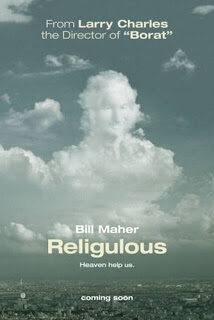
Bill Maher's Cinematic Endeavor

“…we interview God…”

Thus states Larry Charles about his new documentary starring Bill Maher.

Let us face the facts, now is the time for any and all atheists who are so inclined to join the ranks of the Neo sect of atheism and let it all hang out. This sect is rude, crude, belligerent, belittling and let us not forget illogically fallacious, historically ignorant, committed to the “science” de jour and as good old fashioned wrong as ever. Seriously, if you are an atheist of this sect and you have not made at least a few million denarius ranting against “religion” then you are doing something wrong.

If you are an atheist who is not an adherent of this sect then I am sorry to break it to you but another very, very poor example of “atheism” is on its way.

DISCLAIMER: I have not viewed the documentary that I am about to mention. Thus, I will only be commenting on the actual contents in as much as they have been revealed by the director and star.

Bill Maher is the star of a new documentary entitled “Religulous,” which was due to be released on Easter for maximum controversy. Bill Maher and Mr. Charles have teamed up in order to travel the world and answer questions such as:

“What do you believe, why do you believe it, and why do you need to believe it? Can we be good without God? Is religion a calling or a mental illness? Were Jesus, Moses and Mohammed prophets and visionaries, or crackpot nut cases who today would be put away? Is religion an obsessive-compulsive disorder?”1

Mr. Charles refers to the documentary as, surprise I know,

“_a raunchy, rude, irreverent, outrageous, and shocking nonfiction film about the greatest fiction ever told. Set to the rhythms of ‘Sympathy for the Devil’_”2

sky-4167810
The New York Post referred to Religulous as “_the most sacrilegious movie ever made.”3 And one which “_is poised to void on every faith. Any faith.”4 Of course, one can only wonder, although a good guess may suffice, if Bill Maher will tackle his own religion, atheism. This would have been most interesting when you consider that, for instance, the documentary intends on besmirching the concept of a virgin birth. I freely admit to taking some license here since I do not know Bill Maher’s particular views on the origins of life and so I will attribute to him a view that is likely to be accurate of a generic atheist view. Picture this if you will: Bill Maher will belittle the concept of a virgin birth while, at the same time, believing that all life on earth was uncaused by spontaneous abiogenesis. How is the concept of a virgin birth any more preposterous than the concept of life coming from a swamp being struck by lightning? At least with a virgin birth you have a woman, an egg and a womb involved, this is half of the equation. Bill Maher could choose any of the utterly failed materialistic theories regarding life’s origins and the conclusion is the same (see here for a variety of examples). On the one hand you have the claim of a divine miracle and on the other, the claim of a materialistic miracle, which Prof. Richard Dawkins prefers to term “luck.”
Prof. Dawkins has written:

“Chance, luck, coincidence, miracle_events that we commonly call miracles are not supernatural, but are part of a spectrum of more-or-less improbable natural events. A miracle, in other words, if it occurs at all, is a tremendous stoke of luck.”5

And what of his view of origins?:

“It is as though, in our theory of how we came to exist, we are allowed to postulate a certain ration of luck.”6

See my essay The Gap Filler where I provide examples of how atheist, scientists and atheist scientists fill the gaps in our knowledge with time, chance, matter and even imagination, luck and yes, even faith.

Well, there is something to be said about pandering to the tastes and intellectual capacity of your audience. I wonder if he is aware that Mick Jagger, of the Rolling Stones who wrote the song “Sympathy for the Devil,” has stated that whenever they play that song something odd always happens. Such was the case when the Rolling Stones hired the Hell’s Angels motorcycle gang to do security for their Altamont Speedway concert in 1969 where a Hell’s Angels stabbed a young African American to death. In fact, while the original song was being recorded a lamp in the studio caught fire.

But this is a mere aside. Mr. Charles refers to the God of the Bible as living “in space” and “in the sky” and states that after Jesus dies, “_he rises from the dead and flies into space to be with his father (who is also him.)”7 Of course, such stunning ignorance of the very subject about which he will be releasing a documentary may not be at all surprising. The neo-atheist sect is not concerned with accuracy but with detonation of emotionally charged grenades. After all what is one to expect from “raunchy, rude, irreverent, outrageous, and shocking”? Absolutely nothing but millions of dollars for him, laughs from the neos and retorts from the “religious.”

I was not at all surprised that Mr. Charles directed the documentary since he is most recently known for the movie “Borat.” “Religulous” is really Borat part II since Borat was a movie about a man pretending to be interested in learning new things about other cultures (the USA in this case) but was really only interested in pure mockery.

borat-5653888
Bill Maher has stated:

“Since starting on Politically Incorrect in 1993, it has been my pleasure over the last decade and a half to make organized religion one of my favorite targets. I often explained to people, ‘I don’t need to make fun of religion, it makes fun of itself.’ And, then I go ahead and make fun of it too, just for laughs.”8

Bill Maher refers to himself as an apatheist in that he is apathetic about God’s existence. Although how apathetic can he be? He devotes comedy routines, portions of his show, interviews and a documentary about God and religion. Perhaps God is only important enough to mock. Well Bill Maher, it’s been done, done to death in fact, to death.

It is interesting to note that he commits an utterly typical fallacy. For example, he states that he does not know what happens after we die and then extrapolates from himself to everyone of the 8 billion people on earth. He fallaciously reasons thusly: I do not know and since I do not know no one knows and anyone who claims to know is somehow in error.

toast-1979286
This will certainly be an interesting project. The difficulty will be to take this documentary seriously. I realize that it is meant to be “funny” and that is precisely what is so neo-atheist about it. They want to score points against religion while being funny. Therefore, on the one hand they can claim to have scored point yet, on the other hand they can get away with fallacies by stating that they set out to be funny. This reminds me of Dan Brown who claimed that “The Da Vinci Code” was historically accurate but then decided to leave it to the scholars when people came out of the woodworks proving him inaccurate in every conceivable way. Hit and run_all the way to the bank.

I could also see people committing the ad hominen based on the fact that even if we grant that religious faith is fallacious, if the alternative is to be like Bill Maher then, “No thanks.”
Let us imagine that it is proved beyond doubt that any and all belief in God and the supernatural is nothing but a consoling delusion. If the alternative is to take of the worldview that characterizes the neo-atheists then I think that I would choose the consoling delusion. Why would I give up my perfectly good morals and love for my neighbor to become a belligerent, belittling and arrogant bully who makes a living by besmirching people?

Let us face it, he is certainly not the best, or even mediocre, example of anything that could even be imagined to be decent. He thinks that incestuous pedophilia is hilarious (see here), he rejoices when people such as Jerry Falwell die (as did Sam Harris and Christopher Hitchens), he likens public breast feeing to public masturbation, etc., etc., etc.
My heart truly does go out to Bill Maher because he is obviously a very, very troubled man. He is an example of a person who is so twisted and perverse that everything that he sees, hears or thinks about becomes mangled. The reality of what he is seeing, hearing or thinking about becomes distorted when it is filtered through the darkness of his worldview. This is evidenced by the fact that when he considers fathers who are so concerned about their own little daughter’s purity, mental and physical wellbeing that they take them to purity balls, father daughter dances, etc. he perverts it and claims that “then dad has sex with her in the car” (this is followed by roaring laughter and applause from his audience). He sees a woman nourishing her beautiful little baby and he thinks about people manipulating their very own genitalia public-wise. How sad it must be to be so blinded and consumed by such darkness.

There are three interesting videos that I would recommend you watch in the order that I place them here:

Maher Making New Documentary Movie, “Religulous”

Bill Maher – APATHEIST – on Scarborough Country – 1 of 2

Bill Maher – APATHEIST – on Scarborough Country – 2 of 2

The reason that I recommend this order is that it makes a point, it shows Bill Maher going from a confident and witty man who knows what he it talking about to a child who falls apart upon being asked the most basic question. The first link is an interview with Larry King where Bill Maher has his say, a virtual monologue. However, when being interviewed by Joe Scarborough Bill Maher is asked questions which stop him dead in his tracks and causes him to spout out clearly fallacious statements which only go to demonstrate his ignorance of Christian theology and the contents and purpose of the New Testament.

I must say that I was reminded of watching Ben Stein’s “Expelled-No Intelligence Allowed” (which I reviewed here) because various interviewees are seen expounding their materialistic-Darwinian theories very confidently and authoritatively only to stop dead in their tracks when simply asked how they actually know that what they are saying is accurate. Likewise, Bill Maher comes across as pretty bright and sharp when he is on script in front of an audience that is there to adore him. Yet, when simply asked, “How do you know?” he falls apart and grasps at straws and only succeeds in discrediting himself further.

Maher has two difficult mountains to climb:He is a clown trying to make a serious, yet funny point, while wearing his big nose and floppy shoes. Everything that he states could be perfectly accurate but you are just thinking, “I just know that at any moment water is going to come squirting out of that plastic flower on his lapel.” Thus, Bill Maher does a disservice by not giving himself an opportunity for a substantive contribution. Although, this is my take while Bill Maher’s take is to be abusive, laugh and bank on it “just for laughs.”

Secondly, he is sadly of very, very poor character even while trying to belittle others.

What is one to do about such outpourings of raunch, rudeness, etc. the same as ever: give it a fair hearing/viewing and make informed decisions at that time and criticize the content if need be.

ANNOUCEMENT: To our atheist readership,

I am calling upon you to assist me in getting the scoop on this Bill Maher’s endeavor.

I want to know who is funding the documentary.I want to know who is funding the advertising.I want to know what music they used and whether they violated copyright laws.I want to know under what pretenses people were interviewed.I want to know if any of the interviewees have complained about being mislead.I want to know if the documentary was creatively edited.

I want to know everything that can possibly be known, dirt and all.

Thank you so very much for your cooperation.

~~~~~~~~~~~~~~~~~~~~~~~~

A plea: I have to pay for server usage and have made all content on this website free and always will. I support my family on one income and do research, writing, videos, etc. as a hobby. If you can even spare $1.00 as a donation, please do so: it may not seem like much but if each person reading this would do so, even every now and then, it would add up and really, really help. Here is my donate/paypal page.

Due to robo-spaming, I had to close the comment sections. However, you can comment on my Facebook page and/or on my Google+ page.

Evilbible – the Polemical Saga Continues, part 2 of 5

Let us begin this segment by considering a litany of red herrings which are prefaced by the statement,

In any event (whether included in evilbible website or not)

This seems to mean, “I also am not considering the evidence that you have presented and will simply ignore the discussion upon which I am supposed to be engaging. Instead, I will pull out my smoke and mirrors and ask, “Oh yeah, what about this? And this? And this? And this?…” etc.

‘Gods Word of Bible’ has Ezekiel:16 shows up God as a dirty old man grooming an orphan for sex and later an impotent jealous husband who can neither ‘satisfy’ nor punish his adulterous wife:sexy Jerusalem, who slept for FREE with practically the whole of the known world!

She also bestowed presents on the ‘passerby’s who graced her bed and fired her loins! [sic: for the whole thing]

Obviously the reference to “dirty old man” etc. is fallacious and emotive. Within Ezekiel ch.16 God employs various metaphors in order to explain that while He liberated Israel from 400 years of slavery in Egypt (slavery which atheist do not condemn; no books, no lectures, no interviews, no videos-just get back to condemning Jews!) and raised them into a nation they turned away from God much like a wife who turns away from her loving husband and commits fornication.Here is a taste of the various metaphors in that chapter:

on the day you were born,,,

I made you thrive like a plant in the field,,,

I spread My wing over you,,,

I washed you in water,,,

I anointed you with oil,,,

I clothed you,,,

Yet, later on when Israel rejected God,

But you trusted in your own beauty, played the harlot because of your fame, and poured out your harlotry on everyone passing by who would have it,,,

You took some of your garments and adorned multicolored high places for yourself, and played the harlot on them,,,

Moreover you took your sons and your daughters, whom you bore to Me, and these you sacrificed to them to be devoured. Were your acts of harlotry a small matter, that you have slain My children and offered them up to them by causing them to pass through the fire?…

You erected your shrine at the head of every road, and built your high place in every street…

You are an adulterous wife, who takes strangers instead of her husband…

The reference to high places and shrines are a reference to rejecting God and worshipping false gods instead. Part of these worship systems was human/child sacrifices (the sort of Gentile Pagan human/child sacrifices which atheist do not condemn-just get back to condemning Jews!).
Yes God presents us with a very understandable way of considering our relationship to Him. Thus, it is not the unbeliever who is condemning “sexy” Israel “who slept for FREE with practically the whole of the known world!” and because they “bestowed presents on the ‘passerby’s who graced her bed and fired her loins!” but God Himself.

The comment continues,

Bible-authors have a fetish for incest between older men and teenage girls / young women:e.g., Lot’s 2 daughters plying him with wine and sleeping with him in turns, simply to get pregnant [Genesis:19: 31-38]

Tamar seducing Judah, her lecherous father-in-law, using a veil (!), which was the uniform of prostitutes in those days, simply because Judah wouldnt [sic] let his youngest son take Tamar as wife-widow of his 2 elder brothers, whom hot Tamar had probably ****** to death. [Genesis: 38: 13-19] [expletive removed]

Note how exaggerated this claim is; the claim is that “Bible-authors have a fetish for incest” and out of the 66 books that make up the Bible and the 40 authors who wrote them the commentator provides precisely two examples.
Of course, this is fallacious from the get go-emotive certainly, but fallacious nonetheless-since I could likewise make the same claim of newspapers: reporters and journalists have a fetish for incest since they report on it. Since the Bible authors are likewise reporting what occurred then it is fallacious to claim that they “have a fetish for incest.” Again this is emotionally charged, exciting, adrenaline spiked but clearly fallacious.

Note also that this commentator did not bother providing an absolute standard by which to condemn incest of even having a fetish for incest by merely writing about incest. They merely launch into condemnation via an argument from outrage without even providing a premise for their outrage and thus leaving their condemnation baseless.

Just read ‘Job’ and see how evil God acts like a demented servant of Satan/Devil.Bible also describes prosperous places on (flat!)earth without Gods presence!

(e.g., The city of Enoch, Nod, east of Eden!) Genesis-4:16-18.

Just how is God the servant of Satan/Devil when the book of Job makes it clear that Satan/Devil cannot make a move without God’s allowance?
“Bible also describes prosperous places on (flat!)earth”? Firstly, the flat earth is an atheist myth. Secondly, Isaiah 40:22 refers to the circle/sphere of the Earth.
As for Genesis-4:16-18, simply too much is being read into it: this is a classic case of taking a text out of context and making a pretext for a prooftext. The context is that Cain was having a conversation with God in a particular locality and then departed that locality and traveled to another locality.

The comment continues thusly,

Bible-God is a non-vegetarian with fetish for slaughter of first-born over fruit of soil from toil: He prefers non-vegetarian over vegetarian (offerings), herders over farmers, Genesis-4:3-7. Fostering inter-brother hate: Genesis-4:8-9 God is protector of brother-murderer! Genesis-4:10-15 (+ safe exile: Genesis-4:16-18)

I am not certainly if that “God is a non-vegetarian” is supposed to be a condemnation. If it is; the commentator did not provide an absolute premise upon which to condemn carnivorism. That God prefers non-vegetarian over vegetarian (offerings) and herders over farmers is clearly fallacious as the very text which is referenced, Genesis-4:3-7, makes it clear that this was not about the contents of the offering but the contents of the heart, the attitude, etc.

And in the process of time it came to pass that Cain brought an offering of the fruit of the ground to the LORD. Abel also brought of the firstborn of his flock and of their fat.
And the LORD respected Abel and his offering, but He did not respect Cain and his offering. And Cain was very angry, and his countenance fell.So the LORD said to Cain, “Why are you angry? And why has your countenance fallen? If you do well, will you not be accepted? And if you do not do well, sin lies at the door. And its desire is for you, but you should rule over it.”

Does God foster inter-brother hate? No, Cain took it upon himself to choose hate, and murder.Did God protect the brother-murderer? Atheists cannot seem to decide on whether God is not forgiving enough or is too forgiving: I suppose they use which ever club is closer at hand when they seek to condemn and beat upon the Bible.In any regard, primarily God states that Cain is now cursed, that he will have to toil in order to have the ground produce for him, and will be a fugitive and a vagabond. Let me guess; now God is too harsh right?

Then God basically states that it is not for other human beings to take the life of the murderer in this case. Note that the commentator provided no absolute premise upon which to condemn murder or, for that matter, protecting a murderer.

The comment continues,

God & Noah foster inter-brother hate & sanction of hereditary slavery: Genesis-9:18-27

There is absolutely no indication that God fostered inter-brother hate. As for Noah, simply stated: Cannan, one of his sons, acted wrongly while two of his sons, Shem and Hapheth, acted rightly. If this causes jealously or “hate” it is indicative of a personal choice (yet, of course this is a mere assertion on the part of the commentator). Moreover, stating that “God & Noah…sanction of hereditary slavery: Genesis-9:18-27” is fallacious since, for one, God is not in view since the speaker is Noah. So what of Noah? He pronounced a curse to the effect of that Canaan “shall be to his brethren” a “servant of servants.” He also states “Blessed be the LORD, the God of Shem…May God enlarge Japheth, and may he dwell in the tents of Shem.” Noah is clearly praising the two who did rightly and condemning the one who did wrongly.
Note that the commentator provided no absolute premise upon which to condemn inter-brother hate, or even fostering inter-brother hate or slavery.

~~~~~~~~~~~~~~~~~~~~~~~~

A plea: I have to pay for server usage and have made all content on this website free and always will. I support my family on one income and do research, writing, videos, etc. as a hobby. If you can even spare $1.00 as a donation, please do so: it may not seem like much but if each person reading this would do so, even every now and then, it would add up and really, really help. Here is my donate/paypal page.

Due to robo-spaming, I had to close the comment sections. However, you can comment on my Facebook page and/or on my Google+ page. You can also use the “Share / Save” button below this post.
‹ Evilbible – the Polemical Saga Continues, part 5 of 5 up

A Murder of Atheists, part 2

We now continue considering the group effort by Robert Greg Cavin, Michael Martin, Theodore Drange, Robert Price, Richard Carrier, Peter Kirby, Jeffery Lowder, Evan Fales, Duncan Derrett and Keith Parsons to discredit Jesus’ resurrection?

This group, referred to as a “murder”-a term in this sense is taken from referring to a group of crows a “a murder of crows”-is refuted by one single solitary Christian, Norman L. Geisler, in his article A Critical Review of The Empty Tomb: Jesus Beyond the Grave which I have parsed.

Chapter Two: “The Resurrection as Initially Improbable.” By Michael Martin

Summary of the Argument:

Martin argues that “Bayes theorem indicates that if the initial probability of the resurrection is very low, the historical evidence must be extremely strong to make rational belief in the resurrection possible” (53). Further, he insists that even on the assumption of supernaturalism it is low because “there is good reason to expect God would not perform miracles” (53). And “even if some miracles could be expected, there is good reason to suppose they would be rare and thus a priori unlikely in any given case” (53).What is more, even suppose God has a good purpose for redeeming humanity, “given the many alternative ways that this could have been achieved, it is a priori unlikely that he would have chosen to do this in the manner, time, and place depicted in scripture” (53).

His argument is summarized thus: “1. A miracle is initially improbable relative to our background knowledge. 2. If a claim is initially improbable relative to our background knowledge and the evidence for it is not strong, then it should be disbelieved. 3. The Resurrection of Jesus is a miracle claim. 4. The evidence for the Resurrection is not strong. 5. Therefore, the Resurrection of Jesus should be disbelieved” (46).

Martin rejects the free will objection that whatever the probabilities are, a person is free to chose otherwise. He insists that the improbabilities for the resurrection of Christ remain low since we do not know God’s mind.He also rejects the argument that if God exists, there is a high probability that God wants to redeem mankind. He insists that, even granting this, it is still low because we do not know when or where God will chose to resurrect Christ, nor even whether He will since he could redeem mankind some other way.

Response to the Argument:

Martin’s argument is particularly weak for several reasons. First, it admits that given God’s existence, a miracle is possible. If so, then he cannot eliminate the possibility of miracles without disproving God’s existence which no one has succeeded in doing.1

Second, his argument does not eliminate the probability of miracles since if God exists and if He wants to intervene supernaturally, then it is it more than probable that a miracle will happen – it is certain. This in spite of all alleged a priori probabilities to the contrary.

Third, whether a miracle has occurred is not determined by a priori probabilities but by a posteriori facts. Even from a purely experiential perspective, even though the a priori probability is 216 to 1 against getting three sixes on the first toss of three die, it does happen sometimes. And when it does happen, then all probabilities as to whether it would happen are irrelevant. All that is relevant is the evidence as to whether indeed this event did happen.

Fourth, when the free will of God is concerned, the only antecedent factor that is relevant for a miracle is whether He wills for a miracle to happen. And from the empirical side, the only relevant factor as to whether someone came back from the dead is the evidence that he was dead and that he later was alive again. Thus, Martin misses the point on his answer to both proposed objections. For if God wills a resurrection to occur, then there is a 100% chance it will occur. Hence, contrary to the anti-supernaturalist’s claim, given God’s existence, the entire issue boils down to a factual one, namely, what is the evidence that Jesus of Nazareth died and then came back to life some time later.2

Evilbible – the Polemical Saga Continues, part 5 of 5

Another commentator proposed the following dilemma:

A logic The Paradox of Omnipotence 1. Either God can create a stone which he cannot lift, or he cannot create a stone which he cannot lift. 2. If God can create a stone which he cannot lift, then he is not omnipotent (since he cannot lift the stone in question). 3. If God cannot create a stone which he cannot lift, then he is not omnipotent (since he cannot create the stone in question).

4. Therefore God is not omnipotent.

Note that if we grant that God is not omnipotent this would not disprove God’s existence but demonstrate that human beings have been mistaken regarding one of His attributes.
Now, can God create a stone which He cannot lift (or create a square circle, or a burrito so hot that He cannot eat it, etc.). Restricting the answer to only the word “Yes” or the word “No” is a false dichotomy—this is A logic.
The syllogism is not valid and therefore the conclusion “Therefore God is not omnipotent” is false.

Yet, note that strictly speaking God is not omnipotent since the Bible states, for example, that God cannot lie (Titus 1:2). But we appear to be considering a faulty definition of omnipotence.
I begin by asserting that God cannot create a stone which He cannot lift because God is a rational being who does not do anything that violated His nature. Omnipotence should perhaps be thought of as being the ability to do that which is rational and not be thought of as the ability or to do anything and everything—even things that are contradictory. God cannot create a stone which He cannot lift because such illogic, irrationality, is contrary to His very nature and character.

The commentator continued by stating,

And for other fun info use google.

Alrighty then! If you consider Atheist-Pre-Sunday-School to be fun then, by all means.

They also wrote,

Why should i worship God, even if he does exist. Do you worship Bill Gates because he is richer than you? Or force others to worship him?

I have not had a gander at God’s bank account. In any case, this is tantamount to a Q&A I already provided above.

They also wrote,

Does God require us to worship him? Vain!(which incidentally is one of the seven sins) I would also say sc rew [sic] you God. May you rot with your ****** creations in the forsaken ‘heaven’ forever. And I pray to God that he ‘forgives’ me for saying that.

(Hey what is heaven? Do we get to indulge in good food, sex doing nothing else? Why couldnt [sic] he have allowed to do this without being born in earth in the first place).

The issue of referring to God as vain is tantamount to a Q&A I already provided above. I too pray that God forgives the commentator of whatever they need forgiven.
Heaven is a temporary environment that is inhabited by the deceased who chose to live with God forever. Eternal life will be lived in the “new heavens” and “new Earth” in the “new Jerusalem.” There will be food in the eternal abode but no sexual relations but there will be much else: the eternally abiding with God will be the ultimate heuristic experience as in the personal presence of God Himself and in a creation unstained by sin the possibilities are limitless (metaphorically speaking).

The question about why we could not be “allowed to do this without being born in earth in the first place” is rather odd: can you not “indulge in good food, sex doing nothing else”? But I think that the question is why, if we can do that in the here in now why does the Bible assert a heaven in which to do the same? It is not the same and we do not have a very detailed picture of what eternity will be like; such a description would require the Bible to be eternally written as it would be constantly updated with eternal descriptions. But let us grant that in the New Jerusalem we will do the same as we do here; even in such a scenario it will be done in a sin free environment. For example, food will be for enjoyment and sustenance and not for comforting psychologically challenging reasons, as food addiction, towards deleterious health related effects, etc.

The Biblical scenario is that of an initial prefect creation populated by human beings who posses free will and caused the fall into sin which has a deleterious effect upon the creation as a whole. Next comes the offer of forgiveness. Next comes the solidification of the free will choice as those who chose forgiveness—a rejection of sin—are provided with an abode in which to live out this eternal choice. Likewise, those who chose not to have their sins forgiven—who chose, as it were, to keep their sin—likewise are provided with an abode in which to live out this eternal choice.

They also wrote,

And Adam was created in the image of God, how could he be imperfect?

The Bible makes clear that both Adam and Eve, both male and female, were created in the image of God (Genesis 1:27). They were created with the ability to choose—free will. They chose imperfection. God knows that true love requires choice and so free will was necessary. Free will requires choice for and against. They chose against.
But if they were perfect they would never have chosen against. This is a misunderstanding of what it means to be created in the image of God which appears to mean that they possessed certain likewise attributes such as personhood, volition, rationale, etc. There is no indication that they were perfect or that it follows that “in the image of God” means perfect; after all, an image is not the thing itself.

They also wrote,

Also, Ken(edit) are you a sexist? A follower of the bible must be so. You know Eve and the original sin, all that crap.

No, Ken(edited or unedited) is not a sexist and neither must a follower of the Bible. Let us imagine that, what I take the statement to be, Eve was the cause of the original sin: if this is a fact then stating it is not sexist but merely a factual statement (the comment section to my post Biblical Women is saturated with misconceptions such as that made in the question/assertion). Moreover, this betrays a misunderstanding of the Biblical position on the original sin’s cause as the Bible states,

…If I covered my transgressions as Adam… (Job 31:33)

…For as in Adam all die, even so in Christ shall all be made alive… (1st Corinthians 15:22)

…through one man sin entered the world…death reigned from Adam……the transgression of Adam… (Romans 5:12, 14).

Oh, the Biblical emphasis, the fault for original sin, is placed on Adam and not on Eve—well then Ken(edit) must be a sexist? A follower of the bible must be so. You know Adam and the original sin, all that…stuff. If a mollusk had caused the original sin then I would be asked if I am engaging in specism, I must be, etc.

They also wrote,

You know brian [sic] you lose the right to reason as you are [bold]trying[/bold] now since knowledge is the original sin right. Shouldn’t you strive to remove all knowledge from your mind? And grovel, praise, grovel more at the feet of God? What a fascinating life! [[bold]…[/bold] in original]

Apparently, they think that since knowledge was the original sin we should be attempting to rid ourselves or knowledge. It would require knowledge to acquire the knowledge to rid ourselves of knowledge. In any case, this assertion is saturated with fallacies. The original sin was not knowledge but was—you guessed it—sin.

God told Adam and Eve, “Of every tree of the garden you may freely eat; but of the tree of the knowledge of good and evil you shall not eat” (Genesis 2:16-17). Ah, there it is; knowledge was the sin—hit the delete button of your brains everyone. We will get back to that.

In order for free will to be truly free there had to be something in the garden which allowed for the possibility of choosing against God—it had to, it must, be there.

The original sin was choosing against that which God had stated, for when Eve is asked “Has God indeed said, ‘You shall not eat of every tree of the garden’?” she explains that they could eat the fruit of the trees of the garden with the exception of one. Hereafter she is encouraged to rebel by the offer of a specific contradiction of that which God had stated. Satan’s primary seed of doubt was the question “Has God indeed said…” and this has been the very same seed of doubt that he has used ever since. In fact, atheism is premised upon the question “Has God indeed said” and they respond “No, as there is no God to say anything.” Well, let us go back to the sexism issue for a moment as it is clear that it was Eve’s fault—right? Not so. Note that, “when the woman saw that the tree was good for food, that it was pleasant to the eyes, and a tree desirable to make one wise, she took of its fruit and ate. She also gave to her husband with her, and he ate.” This is why the Bible goes on to state, “And Adam was not deceived, but the woman being deceived was in the transgression” (1st Timothy 2:14). Thus, the reason that sin came into the world via the man-male-Adam is that, apparently, while Eve was a victim of deception he chose to sin.

Adam chose the knowledge of good and evil: his eyes where thereafter opened to all of the possibilities of evildoing; all of the evil choices he could make in all situations that would arise. Thus, there is quite a lot wrapped up in an apparently simple act of eating a forbidden fruit.

They also wrote,

Most religions(yes there are other religions all with their own gods,prophets,incarnates,etc,e tc… [sic] if you didnt [sic] know that) atleast [sic] try to define sins properly. But, christianity [sic] fails even at that.

Yes, I have heard rumors that there are other religions (even though, strictly speaking, Christianity is not a religion). This is obviously a reductio ad absurdum whereby it is being implied, or so I infer, that there is no taxonomy, as it where, of sin within Christian theology. This is clearly fallacious. In fact, one of the important benefits and elucidations of the Christian conception of sin is that it identifies that sin begins with a thought. Be vigilant of the thought and you will avoid many a sin. I wrote an entire essay on this point entitled On the Life of Our Thoughts.
What would you rather do? Would you rather fight a forest or city fire? Or would you rather wet your finger tips and put out that little tiny match with that little tiny flame which would turn into a forest or city fire? Put out that little tiny flame and you will not have to fight a forest or city fire.

They also wrote,

Also, some of the faults you pointed out Ken(edit) are themself [sic] faulty.
evilbible.com didnt [sic] deny that Bible didnt [sic] condemn rape. evilbible.com just said God asked men to commit these hideneous [sic] actions inspite [sic] of that.

If this is a fault of mine a quote or two from evilbible.com should be provided. Evilbible.com claims that God not only does not condemn rape but that God commands rape the evidence is in my parsed post Atheism, the Bible, Rape and EvilBible.com.

Lastly, I would like to point out that for all of the questions, comments, assertions, fallacies, personal besmirchments, etc. I would be surprised if any of the commentators actually read anything that I wrote discrediting evilbible.com beyond the basic text that I provided at the Q&A website.

Rather, instead of meeting the argument on the argument’s own grounds they seemed very pleased to serve up undercooked red herrings of every sort. They seemed to pull out their old bag of tricks in order to provide themselves an excuse for not engaging in actual skepticism and matching up what evilbible.com claimed versus the reality of the Bible’s text.

They replaced reasoned discourse with belligerence, replaced scholarship with emotionally charged assertions, replaced intellectual integrity with ad homenims and peppered it all with arguments from outrage, arguments from partial information, arguments to ridicule, arguments to embarrass, etc.

The only thing in which they succeeded was in discrediting themselves by openly displaying their lack of knowledge of various subjects.

May this essay will be heuristic.

~~~~~~~~~~~~~~~~~~~~~~~~

A plea: I have to pay for server usage and have made all content on this website free and always will. I support my family on one income and do research, writing, videos, etc. as a hobby. If you can even spare $1.00 as a donation, please do so: it may not seem like much but if each person reading this would do so, even every now and then, it would add up and really, really help. Here is my donate/paypal page.

Due to robo-spaming, I had to close the comment sections. However, you can comment on my Facebook page and/or on my Google+ page.

A Murder of Atheists, part 10

We now continue considering the group effort by Robert Greg Cavin, Michael Martin, Theodore Drange, Robert Price, Richard Carrier, Peter Kirby, Jeffery Lowder, Evan Fales, Duncan Derrett and Keith Parsons to discredit Jesus’ resurrection?

This group, referred to as a “murder”-a term in this sense is taken from referring to a group of crows a “a murder of crows”-is refuted by one single solitary Christian, Norman L. Geisler, in his article A Critical Review of The Empty Tomb: Jesus Beyond the Grave which I have parsed.

Chapter 8: “Taming the Tehom: the Sign of Jonah in Matthew” by Evan Fales

Summary of the Argument:

Fales claims that “it is a familiar feature of the Gospel passion narrative that virtually every major element of the story, in each of its differing versions, is anticipated in the Hebrew Bible” (307). He notes his dependence on “Durkeim and Levi-Strauss which I draw heavily upon” (309) “with some significant divergences” (317).
“Levi-Strauss, influenced by Hegelian dialectic, by the structural semantics of Ferdinand de Saussure, and by information-processing theory, analyzes myths as being comprised of layers of ‘contradicting’ or contrasting themes, each layer somehow resolving itself in or reducing to the next . . . thereby defusing the dissonance caused by the original difficulty” (317). He asserts that “Matthew’s passion narrative offers, as we shall see, some sterling examples for structural analysis . . .” (319). “I presuppose two hypotheses that are clearly controversial – that Matthew is myth, and that myths are (primarily) engaged in the business of social/political theorizing (and not speculations about ‘spooky stuff’)” (320).

As for miracles, he adds, “I think Hume was correct in arguing that no sensible person will accept a miracle report as veridical, except possibly on the basis of massive verifiable independent testimony from verifiably competent witnesses” (311).
The basic steps of his reasoning are as follows: First, Jesus was not in the grave 72 hours as “three days and three nights imply.” Second, Fales finds the explanation in Hebrew mythology about Jonah (322) and Greek myths (323) which depicts Israel’s deliverance from Assyria and Jesus’ resurrection the Israel’s deliverance from the powers that be (325).

Fales admits that “there is no logical incompatibility between accepting my analysis of Matthew’s chronology, and a literalist conception of Jesus’ death and resurrection. Most readers will, of course, recognize the profound distance between the interpretive methodology I have employed and that favored by fundamentalists” (331). He argues that “the hypothesis that Matthew’s project is to propose a serious political program allows the approach taken here to escape other stock objections regularly raised against ‘liberal’ and skeptical interpretations of the Gospels” (332).
For example, the resurrection was not necessary to the survival of Christianity and the courage of early Christians. Rather, it survived because “it was able to formulate a political theory, strategy, and program that spoke powerfully to the condition of many people, rich and poor, Jewish and Gentile, in Judea and across the Roman Empire” (333). “There is, therefore, no reason to assume (though also no particular reason to deny) that Peter, Paul, or any other Christian leader may have had some subjective religious experience, whether involving an apparition of Jesus or some more inwardly directed ecstatic state” (333).

As to whether Matthew has a “historical core,” Fales says “it does not matter very much to the project I have undertaken here” (334 emphasis in original). For “once one adopts the theoretical framework proposed here, one can proceed without knowing how to answer these particular historical questions, interesting as they might be in their own right” (334). “There is nothing in my reading of Matthew’s Gospel that excludes the possibility of a historical founder of Christianity who taught in Galilee, went to Jerusalem, and courted execution at the hands of the authorities” (334).”On the other hand, we can see clearly from the theoretical perspective I am recommending how artificial is the project of trying to separate history from legend, by ‘peeling away’ putatively apocryphal accretions to an unvarnished historical memory so as to reveal a mundane core upon which to confer the mantle of truth. For the ‘realistic’ elements of the plot are just as integral to the message of the narrative as are the fantastical ones. If some of them are historical, that is a lucky accident; if it had served Matthew’s purpose to make up realistic episodes, he would not have hesitated to do so” (334).

“Was Jesus bodily raised from the tomb after a day and two nights? Anyone who accepts the interpretation offered here will recognize this question is profoundly misguided, but not because the answer must surely be no” (334). Why? “. . . because to entertain it is to reveal a complete incomprehension of Matthew’s purpose, a misunderstanding so fundamental as virtually to preclude recognition of the truths Matthew means to convey” (334).

Response to the Argument:

First of all, Fales admitted that “there is nothing in my reading of Matthew’s Gospel that excludes the possibility of a historical founder of Christianity who taught in Galilee, went to Jerusalem, and courted execution at the hands of the authorities” (334). Further, he does not rule out the possibility of a literal resurrection of Christ. Indeed, he admits that “there is no logical incompatibility between accepting my analysis of Matthew’s chronology, and a literalist conception of Jesus’ death and resurrection” (331).

Second, his rejection of miracles in based on Hume’s faulty argument (see Geisler, Miracles and the Modern Mind) against them (311) and does not allow for the resurrection to be a historical event (334). But if God exists, miracles are possible. And if the evidence shows one has occurred – as the evidence for the resurrection does – then no prior probability against them can counter the fact that one has occurred. Further, extraordinary events do not need extraordinary evidence (unless one is biased against miracles); they just need good evidence. There is no extraordinary evidence for the “Big Bang” origin of the universe; there is just such good evidence that even some agnostics accept that the universe had a beginning (and thus by logical implication, must have had a Beginner).1 (see Jastrow).