
Dr. Jason Lisle (“double-majored in physics and astronomy with a minor in mathematics at Ohio Wesleyan University. He then went on to obtain a Master’s degree and Ph.D. in astrophysics at the University of Colorado in Boulder. There, he used the SOHO spacecraft to analyze the surface of the sun, and made a number of interesting discoveries, including the detection of giant cell boundaries”) wrote a (thus far?) two part answer to who the Nephilim were starting with Who Were the Nephilim? Part 1.
Regarding that which I term the Gen 6 affair, Gen 6:1-4, he reviewed, “Three Common Positions”:
First, some Christians have argued that the “sons of God” are believers. The implication is that the daughters of men were unbelievers. These unequally yoked marriages resulted in children who fell away from faith in the Living God. In this view, the Nephilim were probably not giants at all, but ordinary people who rejected the faith of their fathers due to their unbelieving mothers.
As a sub-category of this position, some Christians believe that the believing sons of God were descended from Seth, the son of Adam, and that the unbelieving daughters of men were descended from Cain – the first murderer. The idea is that the descendants of Seth were generally believers, whereas the descendants of Cain were not. This undoubtedly has been the most common position throughout the history of the church.
Second, some people have claimed that the “sons of God” were men of power, perhaps tyrants. The implication is that they took for themselves the daughters of men (common women) and produced children. As with the former view, these children would be fully human, and probably not giants.
Third, some people have proposed that the “sons of God” were fallen angels who lusted after women (the “daughters of men”) and married them. The offspring would possibly be an angel-human hybrid, resulting in giants. Advocates of this position sometimes further postulate that this extraordinary evil was the reason God sent the global Flood – to destroy these abominations.
The first and it’s sub-category are a general and specific form of the Sethite view which is a late-comer based on myth and prejudice. It’s also an oddity to have it that, “‘sons of God’ are believers” since they weren’t believers but such terrible sinners that their sin served as a premise for the flood.
As for, “Nephilim were probably not giants” since biblically contextually that would mean, “Nephilim were probably not Nephilim” we have to ask these key questions: What’s the usage of the vague, generic, subjective, multi-usage and modern English word “giants” in English Bibles? What’s Dr. Lisle’s usage? Do those two usages agree?
As for, “This undoubtedly has been the most common position throughout the history of the church” well, it only eventually became that, in certain circles, but the undoubted demonstrable fact is that the original, traditional, and majority view among the earliest Jewish and Christian commentators, starting in BC days, was the Angel view as I proved in my book On the Genesis 6 Affair’s Sons of God: Angels or Not?: A Survey of Early Jewish and Christian Commentaries Including Notes on Giants and the Nephilim.
The second option is among the earliest but barely made a blip on the rada of historical interpretation—and we have the same issue of to what, “probably not giants” means.
He rightly notes:
Genesis 6:1-4 does not give a lot of details on who the sons of God were. But the rest of Scripture does. The term “sons of God” is found ten times in the NASB95 translation,[“Genesis 6:2, 4; Job 1:6; 2:1; 38:7; Matthew 5:9; Luke 20:36; Romans 8:14, 19; Galatians 3:26”] and the similar phrase “children of God” is found eleven times.[“John 1:12; 11:52; Acts 17:29; Romans 8:16, 21; 9:8; Philippians 2:15; 1 John 3:1, 2, 10; 5:2”] Other variations also exist, such as “sons of the living God”[“Hosea 1:10; Romans 9:26”] or “sons and daughters to Me.”[“2 Corinthians 6:18”]
He then reviews, “the Son of God (singular), which refers to Christ…the plural term ‘sons of God’…nearly always refers to believers – those who have trusted in Christ for salvation…In the Old Testament, the sons of God (believers) [“Deuteronomy 14:1a…Exodus 4:22…Isaiah 63:16…64:8…Deuteronomy 7:6”]…Gentiles would also be adopted as sons of God. Hosea 1:10…Therefore, unless there is compelling contextual evidence to the contrary, it is hermeneutically appropriate to understand the ‘sons of God’ as believers.”
Dr. Jason Lisle went on to write:
The context of Genesis 6:1-4 is historical narrative; it describes the conditions that led up to the events of Noah and the global Flood. Therefore, we conclude that the “sons of God” were believers in the Living God. The fact that they married “daughters of men” rather than “daughters of God” strongly suggests that these men married non-believing women. God does not condone this type of marriage because the husband and wife are “unequally yoked.” In 2 Corinthians 6:14, Paul says to believers, “Do not be bound together with unbelievers; for what partnership have righteousness and lawlessness, or what fellowship has light with darkness?”
God was also concerned about unequally yoked marriages in the Old Testament…Deuteronomy 7:3-4.
God was also concerned about unequally yoked marriages in the Old Testament…Deuteronomy 7:3-4.
So, his view is that of believers in the Living God who weren’t. And yes, we get indications of unequally yoked marriage with non-believers centuries and millennia later. This makes me wonder why there weren’t any attractive female believers in the Living God nor attractive male non-believers.
The Angel view explains why there’s a gender binary divided right down the middle: Angels are always described as looking like human males, performing physical actions, and without indication that such isn’t their ontology—see my book What Does the Bible Say About Angels? A Styled Angelology—thus, only strictly male Angels, by definition, had to mate with only strictly female humans.
His view on the sons of God results in, “Nephilim were the children of these unbiblical marriages between believers and non-believers. These children fell away from the faith of their fathers on account of their unbelieving mothers.”
Linguistically, he notes:
Could Nephilim mean “giants”? Since there is no similarity between the word “Nephilim” and Hebrew words for stature (middah) or height (qowmah), this seems very unlikely. Perhaps the reason for such a belief is because some of the Nephilim after the global Flood were apparently giants. Let’s explore this.
The word Nephilim is used only three times in Scripture: in Genesis 6:4 and twice in Numbers 13:33. Numbers 13:17-33 is the report of the twelve spies that Moses had sent into the land of Canan. These spies reported that they saw Nephilim, the sons of Anak, and that they were giants. It is probable that Goliath was descended from these sons of Anak. But that doesn’t mean that the Nephilim of Genesis 6:4 were giants, nor that the word itself means “giants.” It only means that these particular examples of Nephilim were giants.
What the Nephilim of Numbers 13:33 and those of Genesis 6:4 have in common is that both groups had fallen away from faith in the living God. So again the possible meaning is that these were fallen ones. But we should be cautious about drawing conclusions about the meaning of a word that is used only three times in Scripture and whose meaning is not explicitly stated. In any case, there is no contextual reason to believe that the Nephilim of Genesis 6:1-4 were giants. The text only states that they were well known at the time before the Flood. The Bible describes them as “mighty men who were of old, men of renown.”
Clearly, his usage of giants is well, something vaguely generic about subjectively unusual height of some unknown level above the parochial average (and yes, that is how useless the common parlance usage of that modern English word is).
Thus, the answer to the third key question is no, his usage doesn’t agree with the English Bibles’ usage and that is because the usage of the vague, generic, subjective, multi-usage and modern English word giants in English Bibles is that it merely renders (doesn’t even translate) Nephilim in 2 verses or Repha/im in 98% of all others and so never even hints at anything to do with any sort of height whatsoever.
Also, there’s never been any such thing as, “Nephilim after the global Flood” especially since God didn’t fail, didn’t miss a loophole, the flood wasn’t much of a waste, etc., etc., etc. Yet, since to him Nephilim merely refers to any and all children of unbiblical marriages between believers and non-believers then that has referred to many, many, many people throughout all history—and ongoing today. One may wonder why, then, there’s literally only one single sentence that refers to Nephilim post-flood.
It’s a misrepresentation of the narrative to assert, “Numbers 13:17-33 is the report of the twelve spies that Moses had sent into the land of Canan.” What he has done is to mash together two utterly different reports and mashed all spies into one. There were 12 spies who were one, originally, upon their return a report is presented, then a bifurcation occurs.
Caleb (with Joshua siding with him) encourage Israelites to obey God and conquer the land, the 10 others show themselves to be unfaithful, disloyal, contradictory, embellishers since they discourage that from being done, are said to go on to present an evil report and that’s what vss. 32-33 merely record.
Thus, it was a case of, “These” 10 unreliable, “spies” whom God rebuked, “reported” an evil report wherein they merely asserted, “that they saw Nephilim.”
As for, “the sons of Anak” that’s no in the LXX version.
As for, “they were giants,” as per his (mis)usage, sure and that is why the dirty little secret is that since we’ve no reliable physical description of Nephilim then their height is a non-issue and that alone debunks 99% of un-biblical pop-Nephilology—the modern branch of which is just un-biblical neo-theo sci-fi tall-tales.
Anyone appealing to Num 13:33 needs to mention that they’re relying on:
1. One single unreliable sentence
2. From strictly non-LXX versions (since that version’s version of that verse doesn’t even mention Anakim)
3. Of an unreliable “evil report”
4. By 10 unreliable guys
5. Whom God rebuked—to death
6. Who made five mere assertions unbacked by even one single other verse in the whole Bible
7. Who contradicted Moses, Cable, Joshua, God, and the rest of the whole entire Bible
8. Then post-flood Nephilologists have to invent un-biblical fantasy tall-tales about how Nephilim got past the flood, past God.
I could go on but see my post Chapter sample: On the Post Flood Nephilim Proposal—which I’m currently updating.
Yet, mashing together repots and spies plus myopically only considering non-LXX sources, Dr. Lisle uncritically picks up, runs with, and applies one single unreliable non-LXX sentence from one single unreliable evil report spoken by 10 unreliable guys whom God rebuked.
As for, “probable that Goliath was descended from these sons of Anak” yes, he was of the Anakim clan of the Rephaim tribe but not from, “these” since those non-LXX Anakim were fictionally related to Nephilim—in some unknown manner so those were fictional characters.
He adds, “The Lord knew in advance what the result of such unbiblical marriages would be…The Lord specified that He would therefore destroy mankind in 120 years (Genesis 6:3)…Notice that this exegetical interpretation flows very naturally” which also works for the Angel view since those too were unbiblical marriages.
As for, “Sethites and Cainites?” he noted, “There is some evidence that the line of Seth through Noah consisted of many believers. They tended to have God-honoring names” but myopically ignores that Sethites and Cainites shared some names:
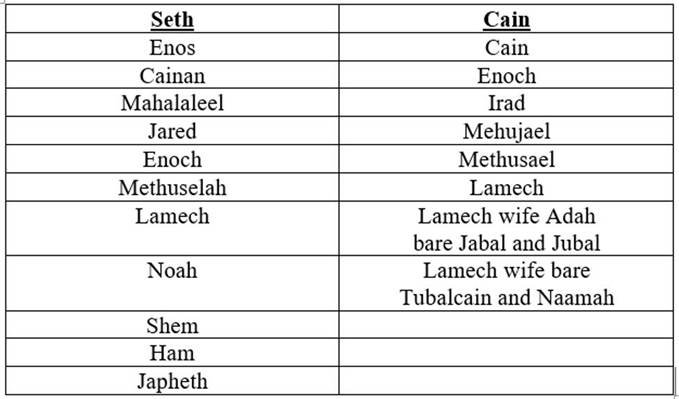
He notes, “there is some merit to the belief that the descendants of Seth were godly believers and that the descendants of Cain were not” but there’s not—for more, see Are there a godly line of Seth and a wicked line of Cain?
Let’s move onto Who Were the Nephilim? Part 2 wherein Dr. Jason Lisle gets into Job:
Presumably, “sons of God” in this context cannot refer to believers since there were no humans early in the creation week, and there were only two humans by the close of day six. Although technically accurate, it would seem odd to refer to just Adam and Eve as “all the sons of God.” But to assume “therefore, it must be angels” is a bifurcation fallacy. Again, I must point out that the text doesn’t mention angels at all. Those who assume that sons of God are angels here are reading into the text something that is not present. (That doesn’t automatically make the interpretation wrong; it is simply the case that it cannot be read out of the text itself.)
This section of Job is highly poetic, and so we might expect non-literal imagery as is typical in poetry…
But let us assume for the sake of argument that the “sons of God” in this poetic passage really are angels. After all, many conservative commentators take this position. Would that give us license to read that meaning into Genesis 6:1-4? Not at all. It would be a hermeneutical fallacy. If angels are non-literally referred to as sons of God in poetic literature like Job 38:7, it would not be appropriate to insert this meaning into a literal historical passage like Genesis 6:1-4. We interpret literal passages like Genesis 6:1-4 in light of other literal passages like Deuteronomy 14:1 or Galatians 3:26.
It’s anachronistic to state, “only two humans by the close of day six…odd to refer to just Adam and Eve as ‘all the sons of God’” since Adam and Eve aren’t relevant, they didn’t witness the creation of the Earth, they were created upon the already created Earth.
As for the bifurcation fallacy, such is why I, personally, only go as far as noting that Job 38:7, as one example, shows us that sons of God can refer to non-human beings since they, at the very least, witnessed the creation of the Earth—which some LXX editions have as Angeloi: plural of Angelos.
Indeed, there are genre in the Bible that are non-literal imagery as is typical in poetry but we can’t just appeal to that in order to get us out of uncomfortable texts.
As for the hermeneutical fallacy, it’s not fallacious in the least bit to appeal to greater context. After all, “it is precept upon precept, precept upon precept, line upon line, line upon line, here a little, there a little” (Isa 28:10) just like any other doctrine.
He follows that with:
However, there is yet another reason to believe that angels are never literally referred to as “sons of God.” It is found in the book of Hebrews.
Angels Are Not Sons of God
The central theme of the book of Hebrews is the superiority of Christ over the Old Testament administration…he argues that Christ is superior to the angels…Christ is superior to Moses, and so on…Christ is superior to the angels on the basis that He has a more excellent name than they do…
Hebrew 1:5 states, “For to which of the angels did He ever say, ‘You are my son, today I have begotten you’? And again, ‘I will be a Father to Him and He shall be a Son to Me’?” The implied answer to this rhetorical question is: “None. God never calls His angels sons. Only Christ and His adopted brothers have such a title.” Notice that the text is not trying to prove that angels are not sons of God. Rather, the text presupposes that angels are not sons of God. It takes that as a given and uses it to prove something else, namely, that Christ is superior to angels because He is a Son of God and they are not.
It’s odd that he got the context correct but then came to a non-sequitur: the text isn’t about Angelology, it’s about Jesus and no one is God’s son in the self-same manner that Jesus is His Son due to the reasons Dr. Lisle mentioned. Or, will he argue that believers in God, Christians, aren’t sons of God since, after all, Jesus is God’s only begotten Son?
Thus, as he also noted, the answer to the rhetorical question of if God ever called Angels His sons isn’t yes, many times but rather never, not in the manner in which that term is being defined: as only referring to Jesus for the given reasons.
He added, “It should be obvious that angels could never literally be called sons of God because angels are not sons at all. They are created beings” but some humans are sons of God even though they were created so that was a poor argument.
He goes on to argue:
Terminology aside, the problems with the fallen-angel view of Genesis 6 are legion.[“See what I did there? 😊 Luke 8:30” indeed and that was a good one] Many of these may stem from a misunderstanding of the nature of angels and of their abilities. I am concerned that many Christians have an unbiblical view of angels…the term “angel” is most often used of spiritual beings…
According to Hebrews 1:14, angels are “ministering spirits, sent out to render service for the sake of those who will inherit salvation”…About one third of them rebelled against God and fell with Satan (Revelation 12:4; Jude 1:6). This must have happened very shortly after the creation week and before the fall of Eve.[“Since Satan’s temptation of Eve was wicked, this must have happened after he had rebelled. And since Eve had not yet conceived any children, most theologians believed this happened shortly after Creation, perhaps before Eve’s first menstrual cycle. The fall of Satan must have happened after day 6, since all of creation was still ‘very good’ according to God (Genesis 1:31), and probably after day 7 since God blessed and sanctified the sabbath day (Genesis 2:3).”]
A fallen angel is usually referred to in Scripture as an evil spirit (Acts 19:16), unclean spirit (Matthew 12:43), demon (Matthew 17:18), or an angel of the devil (Matthew 25:41).
A spirit is a nonmaterial intelligence; it is not made up of atoms that have a specific location in space…Angels are spirits, and are therefore nonmaterial beings (Hebrews 1:14). As such, they do not (normally) have a physical body. We will see biblically that angels are sometimes temporarily given physical form so that they can interact with humans, but this is not their natural state. Jesus taught that a spirit does not have flesh and bones (Luke 24:39).
As they are spirits, we would expect the abilities of angels (whether righteous or fallen) to be mainly in the spiritual world, rather than the physical world, except in cases where God temporarily allows it (e.g., Job 1:12). Thus, Satan has the power to tempt us (Matthew 4:3-11). Under certain circumstances, an unclean spirit can “possess” a person or animal, controlling their physical body to some extent and inflicting harm (e.g., Matthew 8:28-32; Mark 5:1-13). Even in such cases, there is evidence that they must first ask permission from the Lord (Mark 5:12-13). So we ought not to think of angels as physical or biological beings like ourselves with physical desires.
It’s tragically ironic to complain about a misunderstanding of the nature of angels followed by a demonstration of his own a misunderstanding of the nature of Angels.
Note that he jumped from, “spiritual beings” to, “spirits.” That’s a very common swap by, for example, humans can be spiritual but a reference to a disembodied being, proper, is spirit.
His premise was faulty and so were his arguments and so were his conclusions. And that began with a myopic appeal to only one single poorly translated modern English word, “According to Hebrews 1:14, angels are ‘ministering spirits…’”
Ironically, if you search the BibleGateway site specifically for Heb 1:7, then click on, “Hebrews 1:7 in all English translations” just below the verse, and you’ll find that 43 out of 64 versions rightly have Angels as, “winds” rather than, “spirits.” And looking at v 7 first is key since v. 14 plays off of it and must also be translated as, “winds” to be consistent.
Now, the difference is translation is not because translators just flipped a coin, it’s because Heb is quoting (and then playing off of) Psalm 104:4 (do the same in BibleGateway for that one: the stats for which are 46 having, “winds” out of 58) and the entire context of the Psalm demands that we translate as, “winds” and not, “spirits.”
He wrote, “About one third of them rebelled against God and fell with Satan” but neither of the cited texts state that.
Rev 12:4 notes, “His,” Satan symbolized as a dragon, “tail swept down a third of the stars of heaven and cast them to the earth. And the dragon stood before the woman who was about to give birth, so that when she bore her child he might devour it”: thus, nothing about, “About” nor, “fell with Satan” but were cast down by him.
Jude 1:6 notes, “And the angels who did not stay within their own position of authority, but left their proper dwelling, he has kept in eternal chains under gloomy darkness until the judgment of the great day”: thus, nothing about, “About” nor, “fell with Satan.”
As for, “very shortly after the creation week and before the fall of Eve” well, Satan fell during the Gen 3 timeline and/but Angels fell during the Gen 6 timeline: he fell and later, “after he had rebelled,” tempted Even and cast Angels.
His appeals to, “evil spirit…unclean spirit…demon” and even, “angel of the devil” (with Matt 25:41 stating, “When he will say to those on his left, ‘Depart from me, you cursed, into the eternal fire prepared for the devil and his angels”) is a technical category error since that’s about spirits/demons and not about Angels.
Now, spirits/demons are Angels but the reason they’re technically different is that they are the disembodied spirits of physically incarcerated Angels. And as for, “devil and his angels” that is why those disembodies spirits will reinhabit their bodies as per the highly symbolized Rev 9 when they are released from their incarceration—for that biblical view, please see my article Demons Ex Machina: What are Demons?
Since literally every time their described physically they’re described physically—again, looking like human males, performing physical actions, and without indication that such isn’t their ontology—then it’s not the case that they’re, “nonmaterial…not made up of atoms that have a specific location in space.”
Yet, note the qualifying terms he brings into this problem, “do not (normally) have a physical body…angels are sometimes temporarily given physical form…this is not their natural state” for which there’s literally zero indication: that’s the sort of thing that un-biblical Angelology causes people to have to invent.
What they do is read about Angels looking like human males, performing physical actions, but their fallacious Angelology demands that one single poorly translated modern English word outweighs literally every physical description of Angels, so they invent a story about that Angels are spirits but are allowed to manifest physically—for which, again, there’s literally zero indication.
For examples, “in cases where God temporarily allows it (e.g., Job 1:12)” but that verse doesn’t even hint at any such thing, it merely states, “And the LORD said to Satan, ‘Behold, all that he has is in your hand. Only against him do not stretch out your hand.’ So Satan went out from the presence of the LORD” so that’s not about an Angel (since Satan’s a Cherub, Ezek 28) nor about temporarily allows a spirit to inhabit a body.
Yes, “an unclean spirit can ‘possess’ a person or animal” but that’s demons and they desire possession since they were once embodied.
He then argues:
Angels Cannot Marry
One of the many problems with interpreting Genesis 6:1-4 as fallen angels marrying human women is that angels cannot marry at all. Of course, Jesus said that resurrected believers will be like angels in the sense that they do not marry (Matthew 22:30; Mark 12:25; Luke 20:35-36).[“These passages may be where people get the misconception that people become angels when they die. But that’s not what the text says. Rather, resurrected believers will be like angels in two ways: they do not marry and they do not die (Luke 20:35-36).”] But maybe this only applies to the righteous angels “in heaven.” Is it possible that fallen angels marry? Well, no.
Angels cannot marry for the same reason cats cannot marry; they are not humans. A marriage is a covenant bond between a human man and a human woman (Genesis 2:22-24). It is because the woman (Eve) was made from the man that she is again united with man in marriage. The Bible specifically teaches that “for this reason” (the way in which God created and united Adam and Eve) that “a man” (not an angel) “shall leave his father and his mother, and be joined to his wife; and they shall become one flesh” (Genesis 2:24). Because all men and women today are descended from Adam and Eve, a man and a woman can unite in the marriage covenant.
The mere assertion, “Angels Cannot Marry” comes from first rejecting the Angel view of Gen 6 and then misreading and misapplying some of Jesus’ statements.
Since he didn’t quote any of the cited verses, he got away with, “But maybe” but there’s no maybe about it, it’s literally what Jesus said.
Matt 22:30, “For in the resurrection they neither marry nor are given in marriage, but are like angels in heaven.”
Mark 12:25, “For when they rise from the dead, they neither marry nor are given in marriage, but are like angels in heaven.”
Now that I actually quoted Jesus, note how His statement was very detailed, very nuanced, He employed qualifying terms, “angels in heaven.”
So, not all Angels at all times in all places at in all circumstances but the loyal ones, which is why those who did marry are considered sinners since they, “left their first estate,” as Jude put it, in order to do so.
And note that because he didn’t quote any of the verses, he also missed that, “resurrected believers will be like angels in” actually three, “ways: they do not marry and they do not die” and Luke 20:35-36, “But those who are considered worthy to attain to that age and to the resurrection from the dead neither marry nor are given in marriage, for they cannot die anymore, because they are equal to angels and are sons of God, being sons of the resurrection” so to be equal to Angels is to be sons of God: isn’t that fascinating?
As for why even fallen Angels cannot marry he misstates the issue since it’s God approved marriages that are, “a covenant bond between a human man and a human woman” so that doesn’t apply to un-Godly Angel with human marriages—and he went on to refer to, “Of course, there are marriages that God does not condone, but they still involve a man and a woman” or woman to woman or man to man or, Angel to human. He calls same sex marriages as, “civil union” but that’s the point, they’re considered marriages by corrupt culture but aren’t Godly.
Likewise, he argues, “How can a Christian claim that a homosexual “wedding” is not actually a marriage because it isn’t a man and a woman, and then argue that angels married human women?” well, in the same way: they’re both illegitimate.
The next objection is, “God created every plant and animal ‘according to its kind’…What happens when you try to cross two fundamentally different kinds of organisms? Nothing…Angels are an entirely different created order from humans. They are not the same kind.”
Yet, Angels and humans aren’t fundamentally different kinds of organisms although they have some differences:
1) Angels are always described as looking like human males
2) performing physical actions
3) without indication that such isn’t their ontology
4) we were created, “a little lower” (Psa 8:5) than them
5) and we can reproduce with them
6) so, by definition, we’re of the same basic “kind.”
It was wrong for two organisms belonging to the same kind since they weren’t supposed to do it just like I’m of the same kind as literally millions of women alive today but it’d be sinfully wrong for me to marry and mate with any of them since I’m already married to one.
Moreover:
Hypothetically, if angels could also somehow supernaturally produce their own offspring in women, then the resulting offspring would be both human and angel.[“Of course, there is no biblical evidence that angels have such power”] But this creates a theological problem. Humans are eligible for salvation and angels are not. Thus, a human-angel would be both eligible for salvation and not eligible for salvation at the same time and in the same sense. This is of course contradictory. Whether God actually chooses to save such a creature is not relevant to the fact that we have a contradiction. That which leads to a contradiction is false. Therefore, the notion that humans and angels can interbreed is false. I also note that the text of Genesis refers to the Nephilim as men (Genesis 6:4).[17]
He can only assert, “produce their own offspring…there is no biblical evidence that angels have such power” after rejecting the Angel view which he does based on un-biblical Angleology.
As for, “eligible for salvation” that’s God’s problem and not Dr. Lisle asserting, “a human-angel would be both eligible for salvation and not eligible for salvation” since he’s mashing together two categories when Nephilim were a special case. Of course, on the Angel view such may be a non-issue since they lived in the utterly corrupt pre-flood world and didn’t make it past it, just like everyone outside of the ark. They then would have ended up in sheol, just like everyone else, and would have eventually heard Jesus proclaiming His victory.
Dr. Jason Lisle concluded by doing as I predicted, he read about physical Angels, inserted his fallacious Angelology, and read into texts that which none of them even hint.
~~~~~~~~~~~~~~~~~~~~~~~
A plea: I have to pay for server usage and have made all content on this website free and always will. I support my family on one income and do research, writing, videos, etc. as a hobby.
If you can even spare $1.00 as a donation, please do so: it may not seem like much but if each person reading this would do so, even every now and then, it would add up and really, really help out.
Here is my donate/paypal page.
You can comment here and/or on my Twitter/X page, on my Facebook page, or any of my other social network sites all which are available here.
Leave a Reply