
The Giants Codex site includes a section titled Giants in the Bible: Nephilim, Goliath and Og which is a landing page for the four articles undergoing review in that which follows.
I couldn’t find a reference to who wrote the articles and the site styles itself as, “A codex of giants from mythology, folklore, and modern legend. Modern military accounts are unverified oral tradition, not fact.”
Due to the title’s reference to Giants we will have to keep an eye out on whether the articles answer these key questions: What’s the usage of the vague, generic, subjective, multi-usage and modern English word “giants” in English Bibles? What’s the site’s author’s usage? Do those two usages agree?
We get close to getting into the linguistics issue since the landing page notes, “The Hebrew Bible has no single word for giant, and its tall figures are not one people” so it seems that by giants the author is referring to something vaguely generic about subjectively unusual height of some unknown level above the parochial average (and yes, that is how useless the common parlance usage of that modern English word is)—and tall is just as vague, generic, subjective, and multi-usage as giants.
The article Nephilim: what Genesis actually says notes:
Genesis 6:1-4…The sons of God see that the daughters of men are fair and take wives from among them. The Nephilim are on the earth in those days, and also afterward. The verses sit immediately before God’s decision to destroy the world by flood, and the connection is implied but never stated.
Then the text moves on. No genealogy, no episode, no explanation of what the Nephilim were or what they did. The whole thing is four verses and it reads like a fragment of something much larger that the compiler either did not know or chose not to include.
Surely, there’s much more to tell so indeed, it’s, “like a fragment of something much larger” yet, we’re told that Nephilim’s parentage were sons of God and daughters of men, that they lived pre-flood, and note that, “those days, and also afterward” doesn’t tell us when those days were but the text does, “those days, and also afterward, when the sons of God came in to the daughters of man and they bore children to them” which points us back to v. 1, “those days, and also afterward, when the sons of God came in to the daughters of man and they bore children to them” and they were, “When man began to multiply on the face of the land and daughters were born to them” for unknown reasons.
It’s noted that, “The word…is usually connected to the Hebrew root n-p-l, to fall, giving ‘the fallen ones’…The Septuagint translators rendered it gigantes, giants…The Septuagint’s choice of gigantes carried the giant reading into Greek and then Latin Christianity.” but there’s no indication of gigantes, something vaguely generic about subjectively unusual height of some unknown level above the parochial average (and yes, that is how useless the common parlance usage of that modern English word is).
And we weren’t told that gigantes means earth-born. Thus, it’s not a case of, “gigantes carried the giant reading” in the way the site misuses that word and as for Latin, by definition since gigantes has nothing to do with any size then neither does it have anything to do with size when it’s written the same was in Latin. These are forms of a word-concept fallacy.
We’re then told, “They reappear once, in Numbers 13:33, when the spies sent into Canaan report seeing the Nephilim and say that they seemed like grasshoppers beside them. This is a bad report given by frightened men, and the text frames it as such, but it establishes the image that stuck.” Granted, the image stuck in terms of a tradition that was either played off of or made up on the spot.
Note that, “They reappear once, in Numbers 13:33” refers to a word in a text, not living Nephilim.
And it wasn’t, “the spies” since there were 12 but that was the 10 unreliable ones who presented an evil report and ere rebuked by God—“a bad report given by frightened men, and the text frames it as such” thus: we’ve no reliable indication of post-flood Nephilim nor of their size.
We’re told, “Genesis 6:1-4 and Numbers 13:33 are the whole of the biblical material” with the former being the historical record and the latter being on one single unreliable sentence from one single unreliable evil report spoken by 10 unreliable guys whom God rebuked.
We’re also told, “Josephus, in Antiquities of the Jews I.3.1, refers to the tradition of angels who consorted with women and begat unjust sons, comparing them to those ‘whom the Grecians call Giants.’ The bones ‘still shown to this very day’ are elsewhere: Antiquities V.2.3 (5.125), on the taking of Hebron, where he describes the race of giants and their remains.” Yet, Josephus wasn’t writing in English so now we have to ask about the usage by the translator of Josephus. Josephus used gigantos which is just another form of earth-born. As for bones, we have no idea if he saw bones and certainly don’t know bones of what.
We eventually come to, “‘And also afterward’ in Genesis 6:4 is a genuine problem, since it appears to place them after a flood that killed everything. Explanations range from a second incursion to an editorial insertion harmonising with Numbers 13.”
The only time and way that, “‘And also afterward’ in Genesis 6:4 is a genuine problem” is if one cuts three words out of it—cutting off the key portion that tells us to what days it’s referring—and then opines what it, “appears to” do.
Well, it can’t mean anything about the flood since:
1) the flood’s not even mentioned for the very first time until a full 13 verses later.
2) the ONLY post-flood reference to Nephilim is from an “evil report” by 10 unreliable guys whom God rebuked.
3) God didn’t fail, He didn’t miss a loophole, the flood wasn’t much of a waste, etc.
Gen 6:4 states, “Nephilim were on the earth in those days, and also afterward, when the sons of God came in to the daughters of man and they bore children to them. These were the mighty men who were of old, the men of renown.”
The question becomes: when were those days?
Well, Gen 6:1 told us, “When man began to multiply on the face of the land and daughters were born to them, the sons of God saw that the daughters of man were attractive. And they took as their wives any they chose.”
The next question becomes: when was afterward?
Since it was after those days then it was simply after, “When man began to multiply on the face of the land and daughters were born to them…”
Thus, they began doing it then and they continued to do it but that’s all pre-flood.
As for, “a second incursion” that’s just an un-biblical fantasy tall-tale. And scholars merely assert, “an editorial insertion” at will—and always with zero manuscript evidence.
The whatever, “Chain of custody” section notes:
The nephilim of Genesis 6 were giants: enormous hybrid offspring born when the sons of God took human wives, whose kind the Israelite spies later saw and felt like grasshoppers beside.
The giant reading is genuinely ancient and continuously attested, but it travels on translation and on expansion literature rather than on the wording of the Hebrew verse.
There’s literally zero indication of, “giants: enormous” especially in Gen 6 nor, “whose kind the” 10 unreliable, “ Israelite spies later” merely asserted they, “saw and felt like grasshoppers beside” within an evil report and were rebuked by God.
It’s literally impossible that, “The giant reading is genuinely ancient” since English is a modern language.
The next article to consider is ʿUj ibn ʿAnāq: Og after five centuries of retelling yet, it’s pay to read so we only get a snipped:
ʿUj ibn ʿAnāq
Also known as: Uj ibn Anaq, Ogias
Basic account
He is the biblical Og, after five centuries of retelling. By the end he was standing knee-deep in the open ocean, catching whales and holding them up to the sun to cook.
Account
Uj ibn Anaq is not in the Qur’an and not in the canonical hadith. He comes into Arabic literature out of Jewish folklore and the Hebrew Bible, where he is Og, the Amorite king of Bashan whom Moses defeats at Edrei.
Apparently, Og and/or the Anakim opened a seafood restaurant, the site provides this illustration:
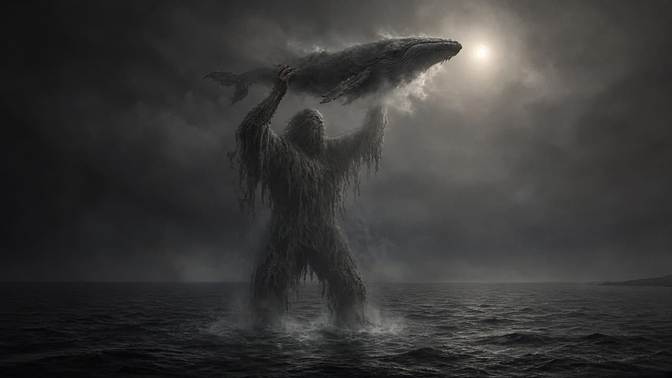
Indeed, millennia after the Torah, we get utterly wild folklore about Og.
That’s followed by Og of Bashan: the iron bed and the last of the Rephaim which notes:
Last of the Rephaim; king of Bashan whose iron bed was a wonder.
Account
Og, king of Bashan, is the last survivor of the Rephaim. Deuteronomy offers his iron bed as proof of his size, and notes that it can still be seen in Rabbah: a footnote that turns a king into an exhibit…
What is disputed
Whether the iron object was a bed or a basalt sarcophagus is a live question.
Another article Og’s iron bed in Deuteronomy 3:11 notes:
Deuteronomy 3:11 gives nine by four cubits for an iron object at Rabbah, not a height for Og’s body.
The verse that made Og famous measures a bed or similar object, not the king. Ancient versions read a bed (Greek kline, Latin lectus). Some modern notes prefer a basalt sarcophagus. Either way, the Hebrew text does not state Og’s stature. Later rabbinic stories enlarge him far beyond the bed. The finding exists so readers who meet ‘Og was thirteen feet tall’ online can see what the verse actually supplies.
Since we’ve no biblical physical description of Og, people suffering from that which I term Gigorexia Nervosa (an obsessive desire to see giants and just making them up where they’re nowhere to be seen) come to non sequiturs based on his bed: indications are that it wasn’t something on which he slept, but was a ritual object-see my book The King, Og of Bashan, is Dead: The Man, the Myth, the Legend—of a Nephilim Giant?
We then move onto How tall was Goliath? The manuscripts disagree which notes:
The textual situation is complicated and important. The Septuagint version of 1 Samuel 17 is substantially shorter than the Masoretic Hebrew, usually put at around forty to forty-five per cent shorter rather than a clean half, and the two appear to preserve different stages of the story’s development…
Goliath’s height differs between manuscripts. The Masoretic text gives six cubits and a span, around 2.9 metres. The Septuagint, the Dead Sea Scrolls fragment 4QSam-a and Josephus all give four cubits and a span, around 2 metres: tall but within human range.
The six-cubit figure is not only Masoretic: the Vulgate (around 400) and Targum Jonathan also read six, so the taller number was already in Hebrew exemplars centuries before the medieval codices. Whether the larger figure is the later reading is argued both ways: J. Daniel Hays has treated six as secondary; Gurry and Meade (2022) conclude the reverse. It is a live text-critical dispute, not a settled result.
Thus, the shorter height is the preponderance of the earliest data.
~~~~~~~~~~~~~~~~~~~~~~~
A plea: I have to pay for server usage and have made all content on this website free and always will. I support my family on one income and do research, writing, videos, etc. as a hobby.
If you can even spare $1.00 as a donation, please do so: it may not seem like much but if each person reading this would do so, even every now and then, it would add up and really, really help out.
Here is my donate/paypal page.
You can comment here and/or on my Twitter/X page, on my Facebook page, or any of my other social network sites all which are available here.
Leave a Reply