
A Field Guide to Biblically Accurate Angels (With Bible Verses) is an article written by Jacob Edson for the BibleGateway’s site: he’s identified as, “Editorial Director of Bible Gateway. He holds a Master of Theological Studies in Early Christian Thought from Harvard Divinity School, and a Bachelor of Arts in Religious History from Memorial University of Newfoundland, though with most of his coursework from the University of Hawai’i at Manoa.”
The article interested me since I’ve attempted to specialize in that which I term Systematic Biblical Paranormology and so I’ve written the following relevant books (some of my 70-ish books):
What Does the Bible Say About Angels? A Styled Angelology
Bible Encyclopedias and Dictionaries on Angels, Demons, Nephilim, and Giants: From 1851 to 2010.
On the Genesis 6 Affair’s Sons of God: Angels or Not?: A Survey of Early Jewish and Christian Commentaries Including Notes on Giants and the Nephilim
The Paranormal in Early Jewish and Christian Commentaries: Over a Millennia’s Worth of Comments on Angels, Cherubim, Seraphim, Satan, the Devil, Demons, the Serpent and the Dragon
For a taste of what’s to come below, the article begins with this image and none of those represent biblical Angelology: and the one in the middle isn’t a biblical character at all.
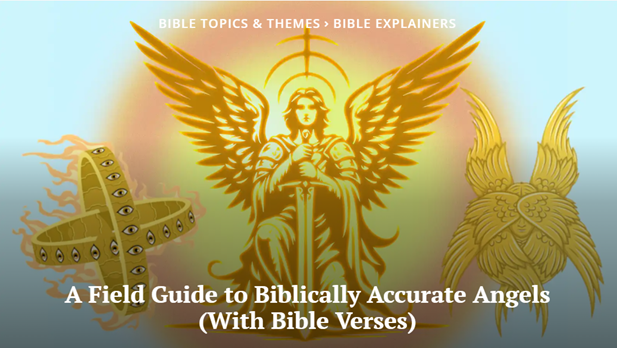
He begins by noting, “Angels today, more often than not, are depicted as sweet, gentle, benign, humanlike figures with illustrious wings, white robes, golden halos, and a soft glow. They offer comfort, soothe our worries, and sometimes provide protection from various troubles….there’s nothing in the Bible that says that image of angels is wrong” well, the Bible may not contain a statement that reads, “Angels have not wings and halos” but there’s no indication that they do so by definition, we can’t claim that they do.
He sought to elucidate, “the different types or ‘classes’ of angels mentioned in the Bible” starting with, “Archangels…means ‘first angels’ or ‘leader angels’ in Greek” keeping the, “Biblically Accurate Angels” context in mind: this is linguistically problematic since it has more than one, since he wrote in the plural, “first” and more than one, “leader.”
Yet, there’s only one first, by definition, and he’s the, singular, leader: that’s Michael (as per Jude).
Thus, when Edson went on to assert, “The only angels in the Bible with individual names are all archangels” there’s no indication of that.
He lists Michael, Gabriel, Raphael (via considering Tobit to add to the, “Biblically” info) and many more from apocrypha or pseudepigrapha, etc., Uriel, Selaphiel, Jegudiel, Barachiel, Jeremiel, and, “Metatron is also sometimes classified as an archangel” somewhere abouts.
He then lists Cherubim but that’s a category error since Cherubim aren’t Angels, they’re Cherubim.
He rightly notes, “They first appear in Genesis 3:24…They also adorn the cover of the ark of the covenant in Exodus 25, the curtains of the tabernacle in Ex. 36, and much later, Solomon’s temple (1Kg. 6)…God’s voice comes from between the two cherubim [in the tent of meeting] (Num. 7:89)…The cherubim take center stage in Ezekiel 10” and chapter 1.
Cheribim differ from Angels in at least three ways: different job titles, different job functions, and different morphologies:
Angels are always described as looking like human males, performing physical actions, and without indication that such isn’t their ontology—see my book What Does the Bible Say About Angels? A Styled Angelology.
Cherubim have four faces, four wings, feet like unto hooves, etc.
Thus, categorizing Cherubim as Angels also violates the law of identity.
He then lists Seraphim but that’s another category error that violates the law of identity since Seraphim are Seraphim, they’re not Angels, by various definitions.
As Jacob Edson noted, “Seraphim are described as fiery, six-winged beings…they appear explicitly only once in Scripture, in Isaiah 6” thus, not Angel-like.
There’s also, “‘Living Creatures’…particular angelic being described in Ezekiel 1…Ezekiel later identifies these ‘living creatures’ as cherubim” but while Edson has them as, “a separate class of angels” that’s not categorically nor logically nor biologically the case since they’re not Angels and due to their description in Rev 4, “they seem to more closely resemble seraphim, with six wings, covered with eyes.”
Thus, they’re either Cherubim with some sort of textual issue in Rev 4 regarding the number of their wings or not Cherubim, nor Seraphim, nor Angels.
He then notes, “Thrones are the name later given to the ophanim (‘wheels’) seen by Ezekiel…in Ez. 1:15-21 as a ‘wheel within a wheel,’ burning and ‘gleaming like beryl,’ and ‘full of eyes all around.’ Though totally inhuman in appearance, they are moved by a ‘living spirit.’” By definition, “totally inhuman in appearance” means non-Angels.
Also, Ezekiel doesn’t refer to them as, “Thrones” so the only indication that’s, “the name later given to the ophanim” isn’t, “Biblically” (as per the article’s title’s context) but based on how, “Some Christians later interpreted” centuries if not millennia after Ezekiel’s time.
Edson then notes, “Angels” the only categories of which are the angel of the Lord, regular Angels (I suppose we can call them), and perhaps others that we can categorize as, “of death,” etc., by application/extension.
He myopically wrote that Angels are, “‘ministering spirits’…(Heb. 1:14)” but that’s just one single poorly translated English version.
Ironically, if you search the BibleGateway site specifically for Heb 1:7, then click on, “Hebrews 1:7 in all English translations” just below the verse, and you’ll find that 43 out of 64 versions rightly have Angels as, “winds” rather than, “spirits.” And looking at v 7 first is key since v. 14 plays off of it and must also be translated as, “winds” to be consistent.
Now, the difference is translation is not because translators just flipped a coin, it’s because Heb is quoting (and then playing off of) Psalm 104:4 (do the same in BibleGateway for that one: the stats for which are 46 having, “winds” out of 58) and the entire context of the Psalm demands that we translate as, “winds” and not, “spirits.”
Yet, then again, that’s hyper-focusing on a single word, the fact that, again, Angels are always described as looking like human males, performing physical actions, and without indication that such isn’t their ontology is what really tells us what Angels are like since we’re weighing one single poorly translated modern English word against every single physical description of Angels.
And for those who’ll reply that Angels take on bodies when they interact with us well, that’s merely a rescue device that’s meant to solve a non-problem, it’s artificially inserting an un-biblical man-made tradition into the Bible.
See, someone will read that Angels are always describes looking as human males but will then myopically read the word, “spirits” and insert an un-biblical assertion between them yet, there’s no need to: we’re told what Angels look like even if some people don’t like what God revelated about them since it violates their faint memories from Sunday School, or their otherwise man-made tradition, etc.
Jacob Edson noted, “They often appear in dreams (Matt. 1:20, 2:13); when they don’t it can be frightening (Luke 1:29-30, 2:9-10)” about which you’ll note that when they are frightening, in terms of telling people, “fear not” (which happens very, very few times) it’s when a person knows they’re alone but someone else is suddenly there and it scares them.
In this case, Mary was alone in her home when an Angel was suddenly there and, “she was greatly troubled at the saying, and tried to discern what sort of greeting this might be. And the angel said to her, “‘Do not be afraid, Mary, for you have found favor with God.’”
Shepherds were keeping watch so they were well aware of their surroundings when suddenly, “an angel of the Lord appeared to them, and the glory of the Lord shone around them, and they were filled with great fear. And the angel said to them, ‘Fear not, for behold, I bring you good news of great joy that will be for all the people.’”
Within the context of Angels, he wrote, “There are good angels led by Michael and evil angels led by Satan…Christians have long debated whether Abaddon (Rev. 9:11) is Satan himself, or an avenging angel acting on the Lord’s behalf” but a key point is that he’s not an Angel, he’s a Cherub (Ezek 38).
He then asks and answers, “What Are Fallen Angels? Fallen angels are angels who fell from heaven due to immoral behavior or rebellion and now live either on earth or in hell.”
This is technically tricky due to what I noted in my article Demons Ex Machina: What are Demons?:
1) the physical bodies of fallen Angels are incarcerated in Tartarus (2 Peter 2) not, “hell.”
2) the disembodied spirits of fallen Angels, which are the demons, “live on earth.”
He noted, “Genesis 6:1-4 allude to the Nephilim, giants or ‘sons of God’ who procreated with human women” but the, “sons of God” were the fathers of Nephilim. Job 38:7, as one example, shows us that, “sons of God” can refer to non-human beings (which the LXX has as Angeloi: plural of Angelos) since they, at the very least, witnessed the creation of the Earth.
Edson added, “Daniel 4 mentions ‘holy watchers’ coming (not falling) down from heaven” about which note that Watchers is just a Second Temple Era aka for Angels.
Unfortunately, as Edson wrote it, “Most Christians believe Satan to have been an angel (perhaps a cherub or seraph).”
Thus, we saw a very typical error which is to violate the law of identity via category errors by arbitrarily mashing Angels, Cherubim, Seraphim, et al., into one.
But as long as we’re being arbitrary without a single example of the Bible referred to Cherubim nor Serphaim (et al.) as, “Angels” then by not mash Angels and Cherubim into the Seraphim category or Angels and Seraphim into the Cherubim category?
God is a God of order and created an orderly creation so Angels are Angels, Cherubim are Cherubim, Serphaim are Seraphim, et al.: they are different categories of being.
~~~~~~~~~~~~~~~~~~~~~~~
A plea: I have to pay for server usage and have made all content on this website free and always will. I support my family on one income and do research, writing, videos, etc. as a hobby.
If you can even spare $1.00 as a donation, please do so: it may not seem like much but if each person reading this would do so, even every now and then, it would add up and really, really help out.
Here is my donate/paypal page.
You can comment here and/or on my Twitter/X page, on my Facebook page, or any of my other social network sites all which are available here.