The New Atheism: A Quest of Confusion-Part I

NOTE: This essay was written for Atheism is Dead (True Freethinker‘s predecessor) by someone who was simply pseudonymed “M”—part 2 was never posted.

It has been a few years now since Richard Dawkins, Sam Harris, Christopher Hitchens, and Daniel Dennett began their ideological war against Theism. Those on the defense have already attempted their responses and some of them have been the height of excellent thinking, though many Atheists have claimed these rebuttals as mere annoyances and attempts at earning a quick buck off of their ideologues successes. The aspirations of these unholy prophets is to one day usher in a new utopia where religion is regarded as mere superstition, those who follow it as irrational fools, and science establishing itself as the foundation of truth and moral order with those who possess degrees in biology as its arbiters. In order for this goal to come about, however, it was first incumbent that revolutionary thinkers step into this world of ignorance and help guide the intellectually shallow sheep to the proper path of enlightenment. These men, who feel called to express what they consider new or forgotten ideas of brilliance are satirically called “New Atheists” and rightfully so; for they display not only old ideas, but further reason why they shouldn’t be listened to. Perhaps, a more formal label for these individuals would be “Anti-Theists” or “Anti-Supernaturalists”, but it might be too generous and rather insulting to my fellow philosophers out there if I were to make them similar.

In this article I wish to express all the things I find wrong with the New Atheist’s ideas by exposing them as mere myths and unsubstantiated claims. Being a theist and a philosopher and not an atheist and a scientist will most likely be justification enough for many of my intellectual opponents to regard me as someone not authoritative in speaking about issues of reality or logical arguments; I am, in fact, just a player of words who believes in a big invisible man in the sky who resembles the likes of fairies and gnomes. In the least case, I am a mere “flea” deriving some sort of fame from the true thinkers and successors of academia or fearful of their great influence on the few hundred or so high school students they are able to convert each year; pardon me for my insolent defiance. The myths I wish to expose are listed below by section. It is my aspiration to destroy this dream of a godless utopia and clarify exactly why the arguments being proposed by the New Atheists are no real arguments at all, but mere assertions of wishful thinking promoted, at best, by subjective negative experiences.

Myth #1: Atheism Is Not a Position

Perhaps the biggest confusion among this new band of outspoken Atheists who think they are on a mission to save the world is how they define exactly what they are. Among many of these new converts to rationality are their inability to agree (much less understand) on a definition of what atheism is or the purpose for the word to begin with. Atheism was typically viewed as a “rejection of belief in God”, but since this definition entails a sort of knowledge of whether or not God exist and Atheists do not wish to be as ignorant or stupid as their theistic cousins, they interpret atheism now as more a lack of belief. Now, while many people would simply view this as Agnosticism there is more to this claim than meets the eye. Rather than merely being a lack of belief, it is an affirmation of accepting that there is no God because it is more rational to do so. In order to understand this claim more in depth we need to understand the background to how Atheism has been argued within formal circles of philosophy.

There are two positions of Atheism: Positive and Negative [1]. In more popular terms these are called “Strong” and “Weak” Atheism. Positive/Strong Atheism is a claim that rests on positive ontological and epistemological grounds (thus the name) in reference to a supreme being. The position is that there is evidence to suggests that no God exist. The other position known as Negative/Weak Atheism rest on negative ontological, but positive epistemological grounds, which means there is no knowledge of whether there is a God, but since there is a lack of substantial evidence to prove that one exist it is more rational to believe that it doesn’t. The Negative/Weak position differs from Agnosticism insomuch as it makes a secondary move by assuming that it is more rational to adopt that God does not exist on the basis that there lacks evidence. Contrary to misconceptions of these terms, “positive” and “negative” do not automatically mean that one position is a positive claim and the other a negative claim; all that is mentioned in either of these contexts is whether one has knowledge to the existence of said thing.

Most Atheists today fall within the camp of Negative/Weak, preferring to be on the defensive all the while claiming that their lack of knowledge in whether or not a God exist justifies their criticisms of those who believe otherwise. The position that is usually held against Theists is that there is no evidence for their beliefs, but this claim rests on the positive assumption of what constitutes as evidence, much less if it is there or not.

Understanding the background to both these positions, we can now understand a little better what the New Atheist is proposing and how they go about doing it. The claim that “Atheism is merely a lack of belief in God” is false, insomuch as both sorts of Atheists carry a positive affirmation of something in regards to their rejection of a belief. Many Atheists today, taking after their idols who like to make rather silly examples, state that Atheism should not even be a word, much less a definition for anything at all. They reason that the lack of belief in God is the same as the lack of belief in such things as fairies, gnomes, invisible pink unicorns, and the satirical flying spaghetti monster. “We do not have terms for these beliefs, so why do we need one for Atheism”, they say. The common reason they are labeled as such is because they are the minority position. Besides that, the comparison between these common child-like inventions and the concept of God are completely different, other than the similarity that Atheists claim regarding the lack of evidences for both. Other examples (which they claim to be factual) refer to such things as people who reject racism or sexism. We as a society do not go around calling ourselves “non-racist” or “non-sexist” as a norm, but the reason for this is because we have no practical reason to do so. The New Atheists believe that by simply referring to their position as a “lack of belief” and mentioning child hood fairy-tales along side them as similarities, they will have redefined the term “Atheist” as “normal” regardless of the fact that they are still the minority position in the world. This disregards what normal means to begin with, much less how it is earned. Further, they seem to want to qualify the term “Atheist” as referring strictly to people who think or are scientists, as though the belief should hold a special status granted over those of a lesser mindset. This is the same tactic (though not as explicit) used by those who label themselves “brights” or “freethinkers”; they try to define their way into normalcy and intelligence rather than earning the title.

Another way that New Atheists abuse this definition is when it comes to defending themselves in arguments. Because Atheism is merely a “lack of belief” as they claim, the burden of proof rests on those that have positive claims; and since the definition of Theism automatically includes a positive affirmation for Gods existence they inherit the burden of proof. In this sharp move, all that is left for an Atheist to do is sit back and relax asking questions and saying “nu-uh” till he or she has nothing more to do other than go to their local community and brag about how they defeated another stupid Theist in a debate. These “debates”, however are nothing more than games of intellectual laziness based on ignorance and the abuse of definitions to suit that ignorance. Imagine going to a debate between an Atheist and a Theist and watching the Theist give their opening remarks. After this has happened and everyone claps, the Atheist pulls up a lounge chair, reclines and says “prove it” into the mic, only commenting when he or she pleases. It would seem silly to even call this a debate at all, much less a discussion. What is an Atheist doing going to a debate formatted by academia where both sides must defend their positions if he or she doesn’t believe there is one to defend? Even moreso, what is the point for Atheists writing books against Theists or badgering them about how irrational they are if there are no positive claims to make? As noted before, Atheists are not without their own positive claims, regardless if they choose to be Negative/Weak or not. Contrary to the comfortable definition that the New Atheists have created for themselves so that they need not have to do anything and can be perceived as the norm, the claim that it is more rational to believe there is no God based on lack of evidence is a positive position. First, we have a claim to what is regarded as “evidence”. Most New Atheists seem to be Core Empiricists of some sort and therefore see evidence as only that which can be observed by sensory experience (or that which can be verified by such). Many theists hold to Empiricism as well, but often fall more within a Concept Empiricists camp (a more balanced view that only states that concepts are derived from the material world rather than strictly being of the material world). Most Theists, it seems, are of the Rationalists sect of Epistemology and therefore have even more differing views of what constitutes as evidence. While I will not go into complete detail over what real evidence is since that is not the point of this particular section, I will state that it seems that most New Atheists do not notice that this claim is a positive one and that it must equally be defended within rational discourse. Similarly, the claim that there is a “lack of evidence” for the existence of X is another positive claim, as well as the assertion that people are irrational for believing in X even if there is no evidence to back that belief. Many Pragmatists would have a bone to pick with the last assertion.

While it may be fun and games for many New Atheists to go about finding Theists so as to scorn them for their beliefs and challenging them to discussions while doing nothing at all to add to the dialogue, this is clearly ridiculous and contrary to what is to be understood of definitions and philosophical claims. Further, the claims that Atheism is the default position does nothing more than raise the question (note the difference between begging the question, which is fancy way of saying “circular”) as to why this is the case. The common basis for this assumption is that because babies don’t believe in God (can’t for that matter) therefore we are born with this lack of belief first and therefore this is the basis from which we must work off. This is clearly ridiculous as well if we consider what is being said. A child is conditionally atheistic on the basis that they lack knowledge of the concept to begin with, much less if there is reason to reject it or not. There is a difference between being conditionally ignorant and willfully so; we make the distinction everyday. Similarly, if an Atheist wishes to use this argument they may as well claim that the lack of knowledge in mathematics, reading, writing, speaking, etc. are all similarly “default positions” and therefore more rational because babies do not possess them.

The final way that this redefining of Atheism as a mere “lack of belief” is used is in context to particular individuals that are claimed to have not been motivated by their Atheism to commit particular atrocious acts in history. Take for instance, Stalin, who killed millions. This claim is also absurd if we go back and examine what “Atheism” actually entails. We must remember that the rejection of something does not leave us with simply a rejection, but a reason or position behind that rejection (a positive claim). As another example, being a Theist I do not simply define my position as a “lack of belief in metaphysical naturalism”. While this is part of the definition it is not the whole story. It seems that when a New Atheist claims that “Stalin did not kill because of his atheism” he may very well be right, but not on the assumption that this is the case because Atheism is not a position. Stalin could have very well been a Positive/Strong Atheist going around thinking that Theists were inferior because they were too stupid to see the truth of this belief. He could have also been very much a Negative/Weak Atheist who believed that Theists were too irrational to live.

We even see today a group of atheist “activists” who use their negative atheism in such a way as to degrade and dehumanize their opposition. They’re called the Rational Response Squad and based on their epistemological beliefs regarding evidence and such evidence for God, they consider Theists to be mentally inadequate or mentally unstable.

To conclude, the first myth that New Atheists try to promote for their new found enthusiasm for anti-theism is simply an illogical and incoherent misunderstanding of clever rhetoric guised as intelligent discourse. The hypocrisy is that while many New Atheists like to blame Theists for being “conversation stoppers” when they pull out the faith card, they similarly are conversation stoppers when they try to redefine Atheism in this manner.

_____________

[1] Martin, Michael. The Cambridge Companion to Atheism. Cambridge University Press. 2006.

Dan Barker – Scriptural Misinterpretations and Misapplications, part 5 of 14

No Women or Christians Allowed?
Dan Barker wrote:

“What group of people will make it into the heavenly choir?”

He answers his own question thusly:

“144,000 male virgins who have not been defiled with women.-No women allowed! Notice the sexism: women ‘defile’ men.
‘And I looked, and, lo, a Lamb stood on the mount Sion, and with him an hundred forty and four thousand, having his Father’s name written in their foreheads…And they sung as it were a new song before the throne, and before the four beasts, and the elders: and no man could learn that song but the hundred and forty and four thousand, which were redeemed from the earth. These are they which were not defiled with women; for they are virgins. These are they which follow the Lamb withersoever he goeth.’ (Revelation 14:1-4)
No Christians allowed! These singers are made up of 12,000 from each of the 12 tribes of Israel (Revelation 7:4-8).”1

There you have it: “women ‘defile’ men,” “No women allowed!” and “No Christians allowed!” The quotations prove it right? Nay. As I pointed out in my essay To Lie, or Not To Lie: That is the Question
Dan Barker appears to have a propensity towards the logical fallacy of the false dichotomy. He is quick but not careful. His rapidity is in referring to males who have not been defiled with women. He quickly states concludes “No women allowed!” and even quicker to a charge of sexism. Yet, the text does not state that “Women defile men,” it states that these particular men have “not been defiled with women.” But does this not imply that women defile men? No, do not let Dan Barker lure you into his faulty inferences. An elucidating question is whether it is possible for men to be defiled “with” (not “by”) women and visa versa. What is the answer? “Yes.” Consider, adultery, prostitution, unmarried sex, etc. which the Bible considers defilement. The text is not making a blanket statement to the effect of “women ‘defile’ men,” but that these particular men had not engaged in any sort of act which would amount to defilement.

heavenlychoir-5878493 Moreover, notice the convenient citation of Revelation 7:4-8 in making the point “No Christians allowed! These singers are made up of 12,000 from each of the 12 tribes of Israel.” To begin with I should perhaps point out that I am a Jew who believes that Jesus is the Messiah and am therefore also a Christian who is “of Israel.” That one can only be Jewish or Christian is another false dichotomy that is both logically and theologically fallacious (even according to the Halakah: Judaism’s religious law). But most importantly, if Dan Barker were to have read all the way from verse 8 to verse 9-10 he would have fond the following statement:

“After these things I looked, and behold, a great multitude which no one could number, of all nations, tribes, peoples, and tongues, standing before the throne and before the Lamb, clothed with white robes, with palm branches in their hands, and crying out with a loud voice, saying, ‘Salvation belongs to our God who sits on the throne, and to the Lamb!'”

No women allowed!” and “No Christians allowed!” no, rather a great multitude which no one could number of all nations, tribes, peoples, and tongues. Simply stated, the 12,000 from each tribe are mentioned in particular and the diverse group in general.

Atheism is Anthropocentric – On Making Silence Illegal and Thought Crimes

Forget the issue of the Earth revolving around the Sun, some atheists think that the universe revolves around them. Enter Rob Sherman who sued to persecute thought crimes.

“‘It’s good, it’s what I wanted,’ Sherman said. He said the law was designed to unconstitutionally ‘proselytize Christianity to a captive audience’ of school children’_Sherman said Thursday he would work with ‘friendly legislators’ to reverse the law.”1

On his own website Rob Sherman posted an announcement that his daughter is “to receive prestigious John Peter Altgeld Award this Saturday from the Chicago Tribune McCormick Freedom Museum and the Newberry Library for her vigorous and successful defense of the First Amendment in the ‘Moment of Silence’ lawsuit.” [bold in original].

The Newberry Library posted the following announcement:

“In the spirit of courageous advocacy of freedom of speech, the John Peter Altgeld Award will be presented to **** Sherman, a student who challenged her high school’s implementation of the Illinois Silent Reflection and Student Prayer Act. Her initial lawsuit resulted in an injunction from U.S. District Judge Robert Gettleman prohibiting the law’s continued observation at Buffalo Grove High School, then expanded into a class-suit allowing other students and school districts statewide to participate. Ultimately, on May 29, 2008, Gettleman applied the injunction to the entire State of Illinois while the constitutionality of the law is considered.
‘This year’s Altgeld Award honors young people who stand up for their First Amendment freedoms in the schools they attend even when it is unpopular,’ said Shawn Healy, resident scholar, McCormick Freedom Musuem [sic]. ‘Sherman represents the noble cause of civic activism that will without doubt inspire students across Illinois to stand up for what they believe is right, and to be active participants in this constitutional democracy'” [I am not publishing her name since she is a 14 yr old child].

atheism-robsherman-6920741Rob Sherman

Perhaps the problem is that the law was entitled, “The Silent Reflection and Student Prayer Act.” This title is a big red flag that attracts atheist activists like so many rabid bulls. The latest measure sought to make the previously optional moment of silence required (not optional or required for individual students but for school districts). The new measure stated that “the period shall not be conducted as a religious exercise” and does not propose penalties for incompliant schools.

Please understand that Rob Sherman and the child whom he is indoctrinating into atheist activism “contend that the law providing for ‘silent prayer or for silent reflection on the anticipated activities of the day’ runs afoul of the constitutional separation of church and state.”2 Did you understand that? Allowing for prayer is unconstitutional. Allowing a student to pray silently and privately is illegal. But what is the bottom line of the atheist complaint? You guessed it to squeltch the vast right-wing-Christian-conspiracy. Rob Sheman stated, “What we object to is Christians passing a law that requires the public school teacher to stop teaching during instructional time, paid for by the taxpayers, so that Christians can pray.”3

The child stated that her intention was, “I just don’t want my education to be interrupted.”4 This is certainly a virtuous goal. But I wonder, will she sue to make lunch illegal? After all, it interrupts her education.

I heard Rob Sherman and his daughter on the Michael Medved radion program and she was virtually unable to answer the most basic questions surrounding the issue. “But she is a mere child,” you say? Indeed, the is being used as a hand pupper through which the father expresses his prejudice.

Rob Sherman, apparently utilizing some form of Vulcan mind-meld to determine the immaterial thoughts and motivations of others, stated, “The whole purpose for changing the law is to get more prayer in the public schools and everybody knows it.”5

Astonishingly, “The ACLU_has declined to participate because it believes the Illinois statute is not legally objectionable.” Sure, the ACLU generally too busy protecting terrorists and pedophiles while attacking the Boy Scouts and the Ten Commandments but if they are passing up a chance to silence silence, to silence silent private prayer in a public governmental facility, then you know that something is very wrong with the lawsuit. In fact, Rob Sherman has already filed lawsuits seeking to ban Boy Scout meetings at public schools.6 “[ACLU of Illinois] Spokesman Ed Yohnka declined to explain the reasoning beyond noting the statute’s dual focus on meditation or prayer. A moment of silence during the school day is not legally objectionable, Yohnka said. A moment of prayer is. The legal distinction, however thin, is significant.”

The reason for stating that atheism is anthropocentric is that in rejecting God atheist have placed themselves as the highest being in the universe. The individual atheist sees themselves as the very height of creation, not only because there is no higher being but because they consider humanity the very pinnacle of evolution. Thus, in cases such as Rob Sherman’s, we perceive that the atheists sees any and every expression of religiosity as a personal affront. Certainly, he would argue that kinds can be silently prayerful on their own time and away from government property. But the point is that the very concept of a moment of silence, in which the kids are free to pray, think about the day that is ahead of them, or listen to the crickets chirping in their heads, is unconstitutional because kids might be praying on public property.

Part of me is actually a lot more empathetic to his cause since the premise, “The Silent Reflection and Student Prayer Act” is just asking for trouble. Yet, the entire concept of prayer, private or group, being illegal/unconstitutional is a recent convention. Consider that Thomas Jefferson, Mr. Separation of Church and State himself, attended Christian church services in the Capitol building which is something he did this through his two terms as president. Apparently, modern day liberals understand Thomas Jefferson’s concept of Separation of Church and State better than Jefferson himself understood.

The bottom line is that Rob Sherman wants to ensure that, in the public schools, the Christian God (to whatever extent He is “there”) is replaced by nothing-the god of atheism.

Christopher Hitchens : The Challenges, part III of III

Let us now consider the next segment as Christopher Hitchens asks for:

“an example of a society which had fallen into slavery and bankruptcy and beggary and terror and misery because it had adopted the teachings and the precepts of Spinoza, and Einstein and Pierre Bayle and Thomas Jefferson and Thomas Paine…you will find no such example.”

I wish to propose a much simpler challenge: I would like an example of a society that adopted the teachings and the precepts of Spinoza, and Einstein and Pierre Bayle and Thomas Jefferson and Thomas Paine.” You will find no such example and so whatever such a mythical society may produce is irrelevant. What I mean is this: suppose that I could provide you an example of a society which had fallen into such things but they had adopted the teachings and the precepts Spinoza, Einstein, Bayle and Jefferson but not Paine, would the example not count? Or imagine any combination of inclusions and exclusions. Just how absolutist are Christopher Hitchens’ “and” statements?Thus, again I so not find the challenge unanswerable due to its force and correctness but due to its generic, fallacious and or straw man nature.Is Christopher Hitchens unaware that the USA, which adopted the teachings and the precepts Thomas Jefferson and Thomas Paine, did fall into slavery, etc.? Yes, but did the USA also adopt Spinoza, Einstein, Bayle? Well then, that does not count. Could we thank Einstein for the devastation of nuclear weapons? Thomas Jefferson, deist or not, attended Christian church services in the Capital building, something for which today he would be arrested or sued by the ACLU (apparently modernists understand Jefferson’s concept of separation between church and state better than Jefferson did).

The bottom line is that such arguments will go nowhere.

The last segment is a repeat of earlier ones:

“name an ethical statement made or action performed by a believer in the name of faith that couldn’t have been by an infidel. And name, if you can (this is easier) a wicked action that could only be mandated by faith.”

This has been answered already in part I.

I do not know if to state that I have answered any of the challenges or to simply state that Christopher Hitchens’ challenges are a confused concoction of generic statements, misunderstandings and qualified to a degree that they may be unanswerable merely due to their illogical nature.

~~~~~~~~~~~~~~~~~~~~~~~~

A plea: I have to pay for server usage and have made all content on this website free and always will. I support my family on one income and do research, writing, videos, etc. as a hobby. If you can even spare $1.00 as a donation, please do so: it may not seem like much but if each person reading this would do so, even every now and then, it would add up and really, really help. Here is my donate/paypal page.

Due to robo-spaming, I had to close the comment sections. However, you can comment on my Facebook page and/or on my Google+ page. You can also use the “Share / Save” button below this post.

‹ Christopher Hitchens : The Challenges, part II of III up

John Horgan and Francis Collins – The Scientist as Believer

John Horgan, who wrote the article which I reproduced here, had occasion to interview Francis Collins who headed the Human Genome Project.1 It was an interview from which some interesting, telling and typical statements came forth.

Interestingly, and or perhaps oddly, John Horgan mostly asked Francis Collins theological questions. I was not aware that scientists who were also believers were supposed to be instant theologians but apparently the atheist illogic is that believers should be all knowing because they claim that God is all knowing.

John Horgan stated,

“I must admit that I’ve become more concerned lately about the harmful effects of religion because of religious terrorism like 9/11 and the growing power of the religious right in the United States.”

This same sentiment has been expressed by virtually every new atheist activist type. Some were atheist activists before but where spurred on, many to stardom, by the attacks and some, such as Sam Harris, began his career as a professional atheist activist on the very eve of 9/11.

Yet, I do wonder if this was a reason or an excuse. Perhaps such an emotionally shocking event did cause them to be suddenly ceased upon by a specific concern about “religion,” “faith,” or-insert alternate term here. Yet, why religion, why faith, why God? Why not other motivating factors such as disputations over territory, struggles for power, fighting for resources, Darwinian struggle to survive as the fittest, etc.?
Had the failed to notice somewhat likewise events in the past? Had they not noticed that, for example, one of the many motivating factor behind Communism was, as explicitly claimed by its founders and leaders, atheism?

Why not make their living by writing, “The Atheism Delusion,” “Materialism is Not Great – How Atheism Spoils Everything,” “The End of Atheism,” “Breaking the Spell – Atheism as a Natural Phenomenon,” etc.

Why not make their living by writing, “The Politics Delusion,” “Territory is Not Great – How Resources Spoils Everything,” “The End of Darwinism,” “Breaking the Spell – Various Motivating Factor for Disputation as Natural Phenomena,” etc.

In any regard, Francis Collins point out the fallacy,

“What faith has not been used by demagogues as a club over somebody’s head?…we shouldn’t judge the pure truths of faith by the way they are applied any more than we should judge the pure truth of love by an abusive marriage_We shouldn’t blame faith for the ways people distort it and misuse it.”

John Horgan stated,

“Many people have a hard time believing in God because of the problem of evil. If God loves us, why is life filled with so much suffering?”

Francis Collins responds by stating,

“That is the most fundamental question that all seekers have to wrestle with.First of all, if our ultimate goal is to grow, learn, and discover things about ourselves and things about God, then unfortunately a life of ease is probably not the way to get there.

I know I have learned very little about myself or God when everything is going well. Also, a lot of the pain and suffering in the world we cannot lay at God’s feet. God gave us free will, and we may choose to exercise it in ways that end up hurting other people.”

Yet, John Horgan points out that,

“Physicist Steven Weinberg, who is an atheist, asks why six million Jews, including his relatives, had to die in the Holocaust so that the Nazis could exercise their free will.”

To which Francis Collins states,

“If God had to intervene miraculously every time one of us chose to do something evil, it would be a very strange, chaotic, unpredictable world. Free will leads to people doing terrible things to each other. Innocent people die as a result. You can’t blame anyone except the evildoers for that. So that’s not God’s fault.
The harder question is when suffering seems to have come about through no human ill action. A child with cancer, a natural disaster, a tornado or tsunami. Why would God not prevent those things from happening?”

I certainly do not know but I can suspect a few things about Steven Weinberg’s conclusions. Firstly, note the emotive level jumping from generic evil suffering to the Holocaust. I am not claiming that mentioning the Holocaust is somehow verboten and can also empathize having had some of my relatives murdered by Nazis.

Steven Weinberg actually stated,

“It seems a bit unfair to my relatives to be murdered in order to provide an opportunity for free will for Germans, but even putting that aside, how does free will account for cancer? Is it an opportunity of free will for tumors?”2

I do not know about a tumor’s free will but Darwinian mutations have provided tumors with the benefit of living by killing-once the host body dies the tumor dies too, just like us all.

I tend to argue that atheism does nothing about evil.That is actually makes it worse by guaranteeing that it is for nothing-no ultimate purpose or meaning.That it cannot be ultimately redeemed.And that, actually, it serves a very beneficial purpose and meaning since it is for the enjoyment of the evildoer.Moreover, if the evildoer gets away with it, they simply got to enjoy themselves, period.

However, now I will argue that, in a way, atheism is the ultimate answer to the problem of evil: atheism can simply make evil go away.

Steven Weinberg did not state whether he:

1) Outright rejects free will.2) Rejects it only when it is considered as part of theology.3) Accepts it within his particular atheistic worldview.4) Opts for a predeterminism of some sort-no free will.

5) Or, other.

Yet, the bottom line appears to be:If there is free will: evil is inevitable.If there is no free will: evil is inevitable.

Therefore: evil is inevitable.

Yet, atheism can simply make evil go away by appealing to absolutely materialistic processes: evil is merely a part of nature. Steven Weinberg stated that “a certain capacity for pleasure would readily have evolved through natural selection, as an incentive to animals who need to eat and breed in order to pass on their genes.”Likewise, evil is what we call suffering and suffering amounts to a particular bio-organism’s interpretation of certain sensations or bio-feedback. As Prof. Richard Dawkins stated when it was put to him this way, “your belief that rape is wrong is as arbitrary as the fact that we’ve evolved five fingers rather than six.”

His response was, “You could say that, yeah.”3

John Horgan further presses the point thusly,

“Some philosophers, such as Charles Hartshorne, have suggested that maybe God isn’t fully in control of his creation. The poet Annie Dillard expresses this idea in her phrase ‘God the semi-competent.'”

To which Francis Collins responds,

“That’s delightful-and probably blasphemous! An alternative is the notion of God being outside of nature and time and having a perspective of our blink-of-an-eye existence that goes both far back and far forward. In some admittedly metaphysical way, that allows me to say that the meaning of suffering may not always be apparent to me. There can be reasons for terrible things happening that I cannot know.”

This is a point that I will not belabor here since I will tackle it in the near future with regards to arguments made by Quentin Smith. Suffering comes up again later in the interview.

But what of the question of free will in an absolutely materialistic universe? John Horgan asked about that,

“Freewill is a very important concept to me, as it is to you. It’s the basis for our morality and search for meaning. Don’t you worry that science in general and genetics in particular and your work as head of the Genome Project-are undermining belief in free will?”

Francis Collins states,

“You’re talking about genetic determinism, which implies that we are helpless marionettes being controlled by strings made of double helices. That is so far away from what we know scientifically!Heredity does have an influence not only over medical risks but also over certain behaviors and personality traits. But look at identical twins, who have exactly the same DNA but often don’t behave alike or think alike. They show the importance of learning and experience-and free will.I think we all, whether we are religious or not, recognize that free will is a reality. There are some fringe

elements that say, ‘No, it’s all an illusion, we’re just pawns in some computer model.’ But I don’t think that carries you very far.”

John Horgan asked,

“What do you think about the field of neurotheology, which attempts to identify the neural basis of religious experiences?”

Francis Collins explains,

“I think it’s fascinating but not particularly surprising. We humans are flesh and blood. So it wouldn’t trouble me-if I were to have some mystical experience myself-to discover that my temporal lobe was lit up. That doesn’t mean that this doesn’t have genuine spiritual significance.
Those who come at this issue with the presumption that there is nothing outside the natural world will look at this data and say, ‘Ya see?’ Whereas those who come with the presumption that we are spiritual creatures will go, ‘Cool! There is a natural correlate to this mystical experience! How about that!'”

This is where the erudite elucidations of the preeminent jack of all trades, John Cleese, comes in to play:

This is where all of Sam Harris’ studies in neuroscience will bring him to naught. He is studying to become a neuroscientist not in order to become an unbiased researcher but in order to attempt to prove his particular brand of atheism (See the “Pseudo-Scientific Complex” section of The Sam Harris Trivector). It may one day be shown that God designed us with a receptor in our brains that allow us to perceive God, to perceive other dimensions and or non-physical entities.Back to, and ending with, suffering as John Horgan asks,

“I’m really asking, does religion require suffering?
Could we reduce suffering to the point where we just won’t need religion?”

Francis Collins retorts thusly,

“In spite of the fact that we have achieved all these wonderful medical advances and made it possible to live longer and eradicate diseases, we will probably still figure out ways to argue with each other and sometimes to kill each other, out of our self-righteousness and our determination that we have to be on top.So the death rate will continue to be one per person, whatever the means.

We may understand a lot about biology, we may understand a lot about how to prevent illness, and we may understand the life span. But I don’t think we’ll ever figure out how to stop humans from doing bad things to each other. That will always be our greatest and most distressing experience here on this planet, and that will make us long the most for something more.”

I would be interested in asking the following questions:Does atheism require suffering?Could we reduce suffering to the point where we just won’t need atheism?Atheist, to this very day in which the problem of evil is dead, still, in virtual ubiquity, claim that evil and suffering are the best evidence of God’s non-existence.What if they could no longer play upon our fears?What if they did not gain numbers by benefitting from human suffering?

What if they no more encouraged others to blame God for their suffering to the point of having them reject God only to keep on suffering but this time with the disadvantage of not having God to blame for it any longer?

For the reasons outlined above; the fact of evil and suffering in the world is one of the very best reasons for rejecting atheism.

Steven Weinberg stated:

“I have to admit that, even when physicists will have gone as far as they can go, when we have a final theory, we will not have a completely satisfying picture of the world, because we will still be left with the question ‘why?’Why this theory, rather than some other theory?For example, why is the world described by quantum mechanics? Quantum mechanics is the one part of our present physics that is likely to survive intact in any future theory, but there is nothing logically inevitable about quantum mechanics; I can imagine a universe governed by Newtonian mechanics instead. So there seems to be an irreducible mystery that science will not eliminate.

But religious theories of design have the same problem.”

~~~~~~~~~~~~~~~~~~~~~~~~

A plea: I have to pay for server usage and have made all content on this website free and always will. I support my family on one income and do research, writing, videos, etc. as a hobby. If you can even spare $1.00 as a donation, please do so: it may not seem like much but if each person reading this would do so, even every now and then, it would add up and really, really help. Here is my donate/paypal page.

Due to robo-spaming, I had to close the comment sections. However, you can comment on my Facebook page and/or on my Google+ page. You can also use the “Share / Save” button below this post.

Atheist Nip and Tuck: the Metroplex Atheists Try on the Friendly Atheist Mask

These just keep coming do they not? More and more atheists are claiming that it is their particular sect that will, finally, provide atheism a much needed facelift in the form of a happy face public image.

Of course, this is also a “happy” face.
atheismandnewatheistandmetroplexatheists-1276955
Well, as usual this is very simple: consider their claims when they are made to the media, consider how the media does not bother digging into what the group actually does and then consider the information that the group actually provides.

The Claims:Terry McDonald chairman of “Metroplex Atheists” stated,

When you tell someone you’re not a theist, it’s like saying I’m taking the issue that is closest to them and discrediting it.1

I think that this is a bit much but perhaps some people do feel that way. Then again, some atheist consider it a personal affront if they sneeze and you say “God bless you” (I cannot wait for that lawsuit).

This group has also done the le chique le cool atheist move de jour; they are accepting donations for the purchase of billboards. At least theirs are actually not obnoxious or, failed, attempts at being clever but simply reading, “Don’t believe in God? You are not alone” which is still atheism premised upon rejection of theism. Although, they are still wasting money, as they put it “substantial monetary contributions,” on themselves during a time of worldwide recession.

Terry McDonald stated,

We’d like to show Christians we don’t have horns and a tail_We’re just normal people.

He was invited to speak at a church that was having an atheist/Christian dialogue where he,

told the crowd that he rejected Catholicism in his late 30s because ‘when I looked for God, he wasn’t there.’

Unfortunately, that is the only part of his talk reported and it is just generic enough to be meaningless. As an equally generic observation; I have found that people most certainly do not find God when they look for Him because they are actually looking for the “God according to me.”

Mostly, the reportage offers examples of in-family disputation which, since they goes both ways, are a virtually mute point. I and others like me could regale you with tales of atheist family members treating us very, very badly for simply believing differently. Note, I do not here mean disagreeing in the form of discussions, disputations, arguments or debates but simply thinking and acting differently while not saying a word to them-it is the Holy Spirit of God convicting them and they taking it out on us (here I am presupposing that the believer is not being a jerk in which case; sure, blame the jerk).

One interesting point was made by Randy Word who,

noted that he had no problem with his wife taking their children to church when they were young. But now he regrets not exposing them to other beliefs – or lack of beliefs – as well.

Indeed, it is at this point that so many atheists quickly go from the notion that raising children in a “faith” is “child abuse” to I should do the same to my kids. This is why there are atheist Sunday Schools, atheist Summer Camps, etc.

Randy Word’s ultimate advice is, “Always question everything” and I may add to not forget to question being told to question everything. Meanwhile, as an atheist, Randy Word believes in a serendipitous chain of accidents that resulted in the Big Bang and, eventually, the formulation of the bio-chemical thought “Always question everything.”

Moreover,

Randy Word said the family works well because it shares positive morals and values.
‘I believe in the Golden Rule,’ he said. ‘I believe in tolerance and compassion. I don’t need religion to give me that.’

I am not certain that he would make specific reference to the “Golden Rule” if “religion” had not given that to him not to mention tolerance and compassion. The fact is that he did get that from “religion,” actually, he got it from God and certainly not from survival-of-the-fittest-atoms-in-motion.

The Horse Doeth Speak:
Thus, the claim of these reformers is that they are just normal, tolerance and compassion people who would also like to “show Christians we don’t have horns and a tail.” Mazel tov!

In this case it is a bit difficult to discern the inner workings of their sect, the “Metroplex Atheists,” since their website is either very new of very neglected-it is very sparse and basically consists of quite a few pages begging for money.

Upon arriving at their home page one is greeted by the Flying Spaghetti Monster and the “A” symbol of Prof. Richard Dawkins’ “Out Campaign” and on another page one finds the symbol of the Invisible Pink Unicorns.
This does not bode well from the outset since: Flying Spaghetti Monster and the Invisible Pink Unicorns are a mockery of all things theistic; not positive-happy-face-public-image-atheism but anti-theism. Moreover, the Prof. Richard Dawkins’ “Out Campaign” symbolizes the very opposite of positive-happy-face-public-image-atheism since it is a movement based not solely on opening the door and coming out of the atheist closet but then kicking in your neighbors door and shoving atheism down their throats.

atheismandnewatheistandinvisiblepinkunicornsandflyingspaghettimonsterandoutcampaign-1361371Under the title “Am I an Atheist?” we find the definition de jour “one who lacks belief in gods” and,

If you’re just not buying into this religion thing, then you’re one of us and you may as well come see us_

Interesting, because, and I am not exaggerating in the least bit, I could see the statement, “If you’re just not buying into this religion thing, then you’re one of us and you may as well come see us_” as a church advertisement.
In my, and many, many Christian, circles being referred to as “religious” is tantamount to a put down since “religion” being the scourge of the earth is something upon which Christianity and atheism can agree although for different reasons-“religion” is just about the very best way to drive a wedge between God and human.

In the “About Us” section they state,

We also seek to protect the constitutional rights of atheists and the First Amendment principle of the separation of church and state.

Ok, well, they do not know the difference between a letter written by Thomas Jefferson that has been co-opted by the ACLU types and the Establishment Clause-a common mistake but a mistake nonetheless.

Their website offers the typical array of anti-theistic propaganda:

I wonder if there is a correlation to be drawn between that upon which one muses and that which one finds amusing.

The Metroplex Atheists are rallying the troops to attend a show by “Sam Singleton Atheist Evangelist.” Surely, an “Atheist Evangelist” is the very model of normalcy, tolerance and compassion.

Well, Sam Singleton’s “comedy” tour is surely a family friendly non-anti-theistic and pro-happy-face-atheism fest particularly the “Patriarchs and Penises Tour.”His tours are advertised with the Bible mocking statement, “Gird your loins!”He urges others to “Alienate Your Friends! Become a Card-Carrying Atheist!”

And then there is this beauty:

samsingletonatheistevangelist-8253868
Then again, I refer to atheism as the valium of the people so perhaps I should not talk.

Well, look, I get it; it is all one big joke: the joke is on Christians, the joke is on the media that will not do its job and the joke is on anyone who takes these anti-theists to be the friendly atheists next door.

I suppose that I will continue saying it; if you believe that your sect of atheism will finally give atheism the nip and tuck it so obviously needs-mazel tov!

GUEST BLOGGER: Answering Easter Contradiction

Happy Easter!

He is risen!

Appropriately, our special guest blogger is Pastor Stephen Kingsley whose website and blog are foud at The Easter Answer.
Following is his contribution:

———————
When considering statements about things that are said to have happened, contradiction is a simple logical test for truth. Say you strike up a conversation with a man you meet at the coffee shop and he says, “I was in Chicago yesterday at noon.” But then a moment later he says, “I was in L.A. yesterday at noon.” You raise your eyebrows and start looking for an exit. One of his statements might be true, but one is certainly false. Not only that, his integrity is so diminished, you’re not likely to trust anything else he says.

Now what if this same truth-tester is applied to the Bible’s most important story? Dan Barker is the co-president of the Freedom From Religion Foundation. In his 1992 book, Losing Faith in Faith (FFRF, Inc.), he challenged Christians to assemble the various resurrection accounts in the Bible together as one consistent narrative. I was personally confronted with this in April of 2003 when a skeptic in a nearby university town published his own abbreviated version of Dan Barker’s “Easter Challenge” in the Letters to the Editor section of our regional paper.
Dan Barker and Nielsen’s ultimate hope is the de-conversion of Christians, or at the very least a de-spiriting of our Evangelical zeal. However, their challenge has had the opposite effect on this small town pastor-I am more persuaded than ever. Although I am not a scholar, I will add this claim too: I have succeeded in answering their challenge. This article contains a foundational piece of my argument.

The resurrection of Jesus is central to Christ, and Christ is central to Christianity. If indeed the details of the first century records surrounding the great claim Christianity is founded upon are contradictory, their reliability is tarnished. The thrust of this article is to introduce the reader to a unique way of reconciling what seems to be the most difficult problem concerning what happened on Easter morning. It is fair to examine the accounts of the post-resurrection appearances for contradiction, but given their importance, the charge of contradiction should not be leveled against these witnesses unless it can be proved with certainty. The prosecution has made its case. I’m writing to offer mine.

It should be clearly noted what Dan Barker is and is not asking for. Had his challenge limited a solver to a juxtaposition of the texts-laying them out side-by-side-and explaining the conflicts, it would be impossible to champion. Here is why. When each account is read as its own complete telling of the story, our natural assumptions are imposed upon the intended meaning of each writer’s timeline. The clearest example of this is found in Luke’s Gospel, near the end of chapter 24. Jesus appeared to the disciples on the afternoon of Easter, something no critic disputes.However, following the record of his speech to the group, in vs. 50 and 51, Luke writes, “And He led them out as far as Bethany, and He lifted up His hands and blessed them. While He was blessing them, He parted from them and was carried up into heaven.” If a rule were invented that required Luke’s narrative to be considered as its own complete story, as if it were indivisible and encased in steel, we would be bound to conclude that the ascension of Jesus happened on the afternoon of Easter, immediately after his appearance to the group. That puts Luke’s record in absolute contradiction to Acts 1, which states that Jesus appeared to the disciples over a forty-day period and then ascended to heaven.

Nevertheless, on this point and numerous others contradiction can only stand as long as a rule of indivisibility might be imposed. Were such constraints enforced it would be a violation to add the data from the accounts together to form a complete picture. There really is no such rule-not here or in any learning situation. It is only natural to gather information in pieces and make adjustments in our understanding as knowledge is added to knowledge, but critics, eager to prove contradiction in the Bible, would love to make this rule a requirement. This impossibly high standard, they might suggest is justified when it comes to the Bible because it is held to be divinely inspired. Even if inspired, it is yet of human speech with all its natural limitations and cultural norms.

Considered together, it is easily observed that the literary method of the Gospel writers was to list events according their interests without noting the passing of time in-between. Here, the writer of Luke jumped from the Easter afternoon group appearance of Jesus to his ascension forty days into the future. It is evident then that his interest was not when it happened, but that it did. It is dishonest to insist that Luke’s failure to specify when the ascension happened is equal to his having begun vs. 50 with the words, “And that same day _” He did not. The same weakness exists in trying to argue that because Matthew only mentions one resurrection appearance of Jesus to the eleven on a mountain in Galilee that it is equal to his having used words to the effect of: “Jesus only appeared to the disciples once _.”
Likewise, with trying to argue that because Paul failed to list the appearance of Jesus to Mary Magdalene, the other women, or the two men on the road to Emmaus in his list in 1 Corinthians 15:3-8 that this is equal to his having used the word “first” with his listing of the appearance of Jesus to Peter as the first one on his list. He did not. If he had, contradiction would be proved, case closed, and we would be left to deal with whatever that may be taken to mean. You can argue that the word “first” is implied, but contradiction is too serious an issue concerning something so important to allow the accusation to stand as valid where it cannot be proved.

When specifying the conditions of his Easter Challenge in his book Losing Faith in Faith (1992 FFRF, Inc.), Dan Barker places no restrictions which would limit the matter to one of a mere comparison of the accounts. It is as if he is saying: “Even if I allow you the greatest possible liberties, you still can not produce a successful answer.” His challenge is generous in its fairness. He writes:

The conditions of the challenge are simple and reasonable. In each of the four Gospels, begin at Easter morning and read to the end of the book- Matthew 28, Mark 16, Luke 24 and John 20-21. Also, read Acts 1:3-12 and Paul’s tiny version of the story in I Corinthians 15:3-8. These 165 verses can be read in a few moments. Then, without omitting a single detail from these separate accounts, write a simple, chronological narrative of the events between the resurrection and the ascension: what happened first, second, and so on; who said what, when; and where these things happened. (Dan Barker, Losing Faith in Faith, 1992 FFRF Inc., “Leave No Stone Unturned,” p. 178.)

The method Dan Barker requires takes us beyond wrestling with the assumptions we might be prone to impose upon the timeline of each account when read separately. We are to take all the data from all the accounts, all 165 verses, and bring it all together into one list-“a simple chronological narrative.” Beyond being fair, it is the only legitimate test for contradiction that could bypass suppositions about the intent of the writers and get down to the actual details, the exact words and specific phrases the five writers used in their compositions.

Dan Barker calls himself “your friendly neighborhood atheist,” and having worked on answering his challenge for several years, his fairness in issuing the Easter Challenge is something I’ve come to appreciate. Having answered his challenge, I sent him my solution in February of 2008, fourteen months ago as I am writing now (April 2009). He has not yet dealt with whether the pieces logically fit (in his judgment) as I put them together. I hope he’ll judge fairly according to the rules he made, but I’m not sure.
He was promising to get around to a serious response, but in his latest e-mail he said that he had read enough of my book to see I had done such great damage to the intended meaning of the text that he was not so excited as to make answering me a priority. When he does respond, I can hope he will deal with the one issue his challenge concerns, the “single chronological narrative” he asked for with all the details of all the events woven together consistently.

[I, Ken, must interrupt for a moment to note that the good pastor does not seems to realize that in the eyes of pseudo-skeptical atheists Dan Barker will be victorious if he does not bother responding seeing as lack of response would mean, for him, that Pastor Kingsley is simply to far beneath him to even dignify with a response]

While the previous example about the ascension of Jesus in Luke and Acts can be resolved with simple addition, there are more difficult contradiction issues to confront in the resurrection accounts. In this article, I will deal with what many would consider the most troublesome-the problem of Mary Magdalene. The resurrection is the subject of the Easter story, but Mary Magdalene is the protagonist and tracking her footprints through the breadth of the story is challenging. At the heart of the difficulty is the difference between John’s account and the Synoptics.
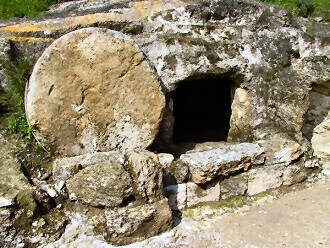
jesusandressurectionandempytomb-2228607

The conflicts begin to pile up in classic harmonies when John’s account of Mary is taken to somehow coincide with the other records of what the women did on Easter morning. Under this common view, the women begin their trip towards the tomb together at “as it began to dawn” (Mt. 28:1) and “early _ while it was still dark (Jn. 20:1).” The angel descends and rolls away the stone (Mt. 28:2-4) and by the time the full group of women arrive at sunrise (Mk. 16:1-4 and Lk. 24:1,2) they find the stone missing. So far, no real problem presents itself. However, it is at this point where the accounts diverge into two different stories. In nearly all exegesis through history the explanation is that Mary left the other women (either upon seeing the missing stone or having entered the tomb) and ran to tell Peter the alarming news that Jesus’ body was missing (Jn. 20:2). With this, John’s storyline contains a lengthy and detailed record of Mary’s solo adventure apart from the other women. Meanwhile, per Matthew, Mark and Luke the women encounter the angel(s) in the tomb, run from the tomb, etc.

At the very least, we’re confronted with the trouble of trying to excuse all three Synoptic writers for strongly implying Mary’s presence with the other women, when clearly, under the model commonly presented in telling the story, she fled the scene after they arrived at the tomb. Nevertheless, if we are to believe Matthew (as we should), Mary is clearly implicated as being present and accounted for in all he describes. This includes her listening to the angel’s speech, running from the tomb with great joy to go tell the disciples, and even seeing Jesus with the other women and holding him by the feet as they worshipped him. We cannot simply strip her from Matthew’s account unless we are willing to say his portrayal is inaccurate and his reporting careless. This problem pleads for a solution.

When the details are compared in each Gospel the standard sunrise Easter story clashes like our family cat pouncing on the keyboard of the piano. The complexity is not the problem; it is the difficulty of saying with certainty what exactly happened. And if there is any single place in the Bible we could wish for clarity, it is here. Among Christian scholars, the problem has been labeled as “notorious” and for many, impossible to reconcile. It does not leave the accounts absent of historical relevance, but casts a shadow nevertheless upon the reliability of the biblical record of what really happened on Easter, the day Christianity was born.

I would like to propose a new approach to the problem and a different model, one that appears to be unique to others and offers what may be a simple solution that is more fully developed in my book The Easter Answer. Rather than dealing with a tight knot of activities piled atop one another at the site of the tomb shortly after sunrise, reasons exist to support the view that John’s narrative of Mary Magdalene’s experiences (without the other women) happened before sunrise. Then, afterwards she later met up with the other women and went along as a full participant in their famous Easter sunrise epiphany. It requires the allowance of gaps of times between some of the events and a careful re-thinking of both temporal phrases supplied by the writer of Matthew in 28:1.
stephenkingsleyandtheeasteransweranddanbarker-6378636

The premise of The Easter Answer is that the resurrection event described in Matthew 28:2-4 happened between midnight and 3:00 a.m. on Easter morning. This position can be reasonably supported in Scripture from several angles. The exact time is not so important as is the fact that if the removal of the stone (indicative of the resurrection) by the angel happened earlier than is commonly held, it allows for John’s accounting of Mary’s Easter experience to commence, quite naturally, at the time he plainly describes in 20:1: “Now on the first day of the week [Easter Sunday] Mary Magdalene came early to the tomb, while it was still dark, and saw the stone already taken away from the tomb.”
Commonly, “while it was still dark” is bent towards sunrise. A common explanation might go like this: “Well it wasn’t really dark, but still somewhat dark when the women began their trip to the tomb. It was likely a long walk and it was more dark than light when they started out. By the time they arrived it was just after sunrise.” But notice John 20:1 is quite explicit in that it does not say Mary was starting her trip, but rather “came early to the tomb, while it was still dark _.” Let’s start here with a fresh view and consider that John means exactly what he says, that Mary was alone and came to the tomb early in the morning when there was no evidence of daylight in the sky. For the sake of discussion, let’s assign our modern timekeeping to the plainest meaning of the writer’s words and assign her arrival at the tomb at 4:00 a.m. and place sunrise at 6:00 a.m. This 4:00 a.m. guess is consistent with John’s temporal phrase in 20:1. The next step is to examine the other Gospels for agreement.

Initially, Matthew 28:1 seems to present a formidable obstacle to this view. Quite plainly it seems to state the women (Mary Magdalene and the other Mary) “came to see” the tomb just before daylight on Sunday morning. This is followed by vss. 2-4 which describe the angel’s appearance and his rolling away of the stone. We could try to solve this problem by rearranging the sequencing, moving vs. 1 below vss. 2-4 so that it follows the angel’s rolling away of the stone. However, such a move would invalidate the case we are trying to make in favor of the accounts. Such a maneuver is unnecessary anyway once we dig deeper into the temporal phrases of vs. 1. Here it is from the Updated NASB of 1995:

(Mt. 28:1) Now after the Sabbath, as it began to dawn toward the first day of the week, Mary Magdalene and the other Mary came to look at the grave.

We are going to take a careful look at the two back-to-back temporal phrases in verse one. First things first: “after the Sabbath,” and then the second: “as it began to dawn toward the first day of the week.” A review of various English translations reveals a problem with the first phrase. It is translated two very different ways. When I first began studying this, I started with my personal favorite, the King James Version. Here is how it begins the verse:

(Mt. 28:1 KJV) In the end of the Sabbath….

“In the end of the Sabbath” has a decidedly different meaning than the “after the Sabbath” from in the U-NASB. The Jewish Sabbath ended then with the setting of the sun; then “the first day of the week,” began. This is yet true for orthodox Jews. Rabbis teach that the switch from one 24-hour day to the next happens as soon as three stars can be counted in the evening sky. This is especially true for observant Jews marking the beginning and ending of the Sabbath day. “Sabbath” is a Jewish term and must be reckoned accordingly and the phrase “in the end of the Sabbath” must be taken to mean the closing moments of the Sabbath day, just before the sun dropped below the horizon.

If we reach far back into ancient English Bible translations, this first phrase in Mt. 28:1 was supplied as “in the evening of the Sabbath” by Wycliffe and in the Cloverdale Bible. There are others to consider. For example in the 1901 American Standard Version the first phrase is translated:

(Mt. 28:1 ASV) Now late on the Sabbath day….

The original source material for the NASB was the ASV. It is not too surprising then that when the NASB first hit the market in 1971 it too supplied the first temporal phrase of Mt. 28:1 as “Now late on the Sabbath….” However, by the time the Updated-NASB was published in 1995 the translation was changed to “Now after the Sabbath_.” This is also how the first phrase appears in the New King James Version and the New International Version. Which is right, “late on the Sabbath” or “after the Sabbath”? One certainly indicates the described event happened before sunset on the Sabbath, and the other some time after it ended.

At issue for translators in Mt. 28:1 is the Greek opse, used here as a preposition with the genitive. Upon discovering the translators of the NASB had changed opse here from “late” to “after” I wrote to the owners of the copyright, the Lockman Foundation, and asked its editorial board why the decision was made. I received permission to quote their answer and put it in my book. They say translators were attempting to find reasons to justify the change so that the phrase would be consistent with the other Gospel accounts. It is obvious then they were looking at the description made by Mark and Luke of the trip by the women to the tomb at sunrise, and trying to find a legitimate way from the Greek to make Matthew agree. This is understandable, and even commendable if such a change is warranted. In Mark 11:19 and 13:35, and in the Septuagint in Genesis 24:11 opse is used to indicate evening. According to the Lockman Foundation, Greek Lexicons allow it to be translated “after” when used as a preposition, but there is no evidence in Greek literature that this appeared until the second century. What is clear from their comment is there was nothing that required the change.

Clearly, deciding how opse should be translated in Mt. 28:1 is difficult. Given the lack of certainty, it is reasonable to allow exegetical considerations and the statements of other Gospel writers to influence the decision. “Late on the Sabbath” does not fit with Mark 16 and Luke 24 (the women arriving at the tomb after sunrise Sunday morning), but what if “late,” “in the end,” or “evening” is the right translation after all? What if Matthew really was writing about a different trip by the Marys “to see” the tomb just before the Sabbath ended; a similar kind of trip, but one distinctly independent and specifically unrelated to the trip at sunrise described by Mark and Luke?

As for the Aramaic, Murdock (1851) translated the first phrase: “And in the close [evening] of the Sabbath _” Lamsa (1940) has: “In the evening of the Sabbath _” And Murdock’s revised NT reads: “And in the evening of the Sabbath as it was dusk _”

Let’s now take a look at the second phrase and see if it is of any help in deciding between “late on the Sabbath” or “after the Sabbath” in the first phrase. In nearly all English Bibles, it reads the same: “as it began to dawn toward the first day of the week.” A casual reading certainly seems to be referencing Sunday morning just before sunrise. This is the meaning usually granted the phrase, but is that what it is really saying?

The five words, “as it began to dawn,” are from the Greek word epiphosko. In Mt. 28:1 as an active participle, it is epiphoskouse. The etymology of epiphosko is easily discerned: epi-upon, phosko-light, quite literally, “upon-light.” Knowing this, it is easy to see why translators chose “as it began to dawn.” The word “dawn” seems an excellent choice here, and it is, but do not jump to the conclusion that “just before daylight” is its required meaning. Amazingly, while epiphosko could easily be used of the approach of daylight in the morning, it turns out to be quite similar to our use of the word “dawn.” We use “dawn” for the rise of any new thing; even an idea as in “it dawned on me.” We speak of “the dawn of history,” or “the dawn of a new era.” None of these common uses for dawn have anything to do with the rising of the sun in the sky. In the only other use of epiphosko in the New Testament, like our use of the word “dawn” it is used idiomatically concerning the arrival of a new period of time, a 24-hour day. It appears in a temporal phrase in Luke 23:54. Here the writer is narrating the scene of two men hastily burying the body of Jesus. Since the Sabbath was approaching, it was important that they finished the job before sunset. Luke carefully indicates the day and time as follows:

(Luke 23:54) And it was the day of the Preparation [Friday] and the Sabbath drew on.

“Drew on” above is the Greek epiphosko, the same word translated “as it began to dawn” in Mt. 28:1. In Lk. 23:54 other translations provide it as “drew near.” Darby has it as “was coming on.” In Luke the subject of the verb epiphosko is the Sabbath. In Mt. 28:1 the subject of epiphosko is “the first day of the week [Sunday].” Both are important temporal phrases. In Luke the action being indicated is that the Sabbath was about to begin, which we know to be at sunset. What do we do then with Matthew? It seems consistent to allow it to influence its subject (the first day of the week) in the same way. “As it began to dawn” is quite appropriate. The 24-hour day, the new day, was beginning to “dawn” with the setting of the sun.

One other point is worth noting. Knowing the day ended at sunset, if the second temporal phrase of Mt. 28:1 was really a description of the moments just prior to daylight in the sky Sunday morning, it would not say “dawn toward the first day of the week,” it would say “dawn on the first day of the week.”

Still unconvinced? Let me tip the scales further by pointing out that the women’s purpose in going to the tomb at sunrise on Easter morning as described by Mark and Luke was to complete the task of spicing the body of Jesus. However, Matthew makes no mention of spices. He describes their purpose as “to see the grave.” A minor distinction, but worth noting.

So clearly, from the Greek text we have ample reason to see the two back-to-back temporal phrases of Mt. 28:1 as standing in agreement with one another in depicting, that near the end of the weekly Sabbath, the two Marys went “to see” the tomb, just before the beginning of the new 24 hour day, the “first day of the week,” was about to “dawn” with the setting of the sun.

Assigning that meaning to the timing of the trip by the Marys to see the tomb Sabbath evening, Matthew’s style emerges as overtly choppy in manner of reporting in the first several verses of the chapter 28. Comparing his account to the others, the arrangement is complex, but it can be shown he supplied no detail that cannot be suited to the facts of the other texts. In verses five through seven, Matthew records the speech of the angel to the women, but this can easily be shown to be the identical speech (with a few added words) spoken by the angel as recorded in Mark’s account (Mk. 16:6.7).
It’s complicated, but the details from both accounts compliment one another concerning this angelic being with the appearance of a young man. At some point (Matthew doesn’t say when) he rolled away the stone and sat on it; but by the time the women entered the tomb after sunrise, he was seen (likely less fearsome in appearance) sitting on the right side (Mk. 16:5) where the body of Jesus had laid. Any supposed conflict resolves with a recognition that several hours passed between Matthew 28:1 (just before sunset Sabbath evening) and the actual delivery of the angel’s speech to the women. Mark confirms the speech as identical to Matthew’s and that both Marys were present (with other women by that time) to hear it. Matthew’s facts may be seen as true, and so can Mark’s. Both compliment, confirm, and complete one another. There is no unbearable contradiction here, only the melody of orchestrated harmony.
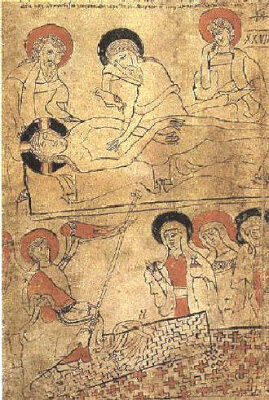
jesusandressurectionandempytomb-1081092

What was the writer of Matthew’s Gospel trying to accomplish with such a specific double-duty description of the day and time in 28:1? He is establishing an important fact-at the end of the Sabbath the women looked upon the tomb and without any reaction from them at that time we may safely infer that they found everything as expected. In 28:1, Matthew establishes the watchful concern of the women, certifies to us that they knew where the tomb was located; that they could make their way to it and identify it; and that it was sealed as the Sabbath day ended. In this way, in one verse, the writer dressed the stage for history’s most important day and the event that has affected the world as none other, the resurrection of Jesus.

As an aside, it is worth noting here that there are some Bible-studying groups around that, discerning the strong possibility that Mt. 28:1 depicts the closing moments of the Sabbath, take the position the resurrection happened then, as the two Marys walked to the tomb that evening. This theory breaks down for several reasons:

1) There is no tradition to support such a claim2) Mark 16:9 plainly states, “Jesus was risen early the first day of the week.”

3) Proponents of the Saturday afternoon resurrection theory believe Jesus died and was buried on Wednesday afternoon, but that does not square with the reckoning of the Emmaus witnesses who said: “Besides all this, it is now the third day since these things came to pass (Lk. 24:21).” Had Jesus been crucified on Wednesday, by the common reckoning of that day the witnesses would have said it was the fifth day since these things (the crucifixion of Jesus), not the third.

If it may be granted from what we know about Mt. 28:1 that Mary Magdalene visited the tomb (with the other Mary) and looked upon it at say 5:45 on the evening of the Sabbath just prior to sunset (6:00 p.m.), and from Jn. 20:1 that she returned to find the stone missing at 4:00 a.m. the next morning (Easter Sunday), when then did the angel of Mt. 28:2-4 make his earth-quaking entrance and bright showing? Matthew does not specify when this happened, only that it did. Granting that Mary found it open by 4:00 a.m. Sunday morning, there is more data to consider. Mark 16:9 plainly states: “Jesus was risen early the first day of the week_.” and this can be taken to have happened just before the angel rolled away the stone. Jewish reckoning allows that part of a day could count for a full day. Jesus died on Friday afternoon, was dead from about 3:00 p.m. until sunset (enough of the day to count as a whole), and in the grave the full 24 hours of the Sabbath, and rose “the third day.” (See: Mt. 16:21, Mt. 17:23, Mt. 20:19, Mt. 27:64, Mk. 9:31, Mk. 10:34, Lk. 9:22, Lk. 13:32, Lk. 18:33, Lk. 24:7, Lk. 24: 46, Jn. 2:1, Acts 10:40, Acts 27:19, and 1 Co. 15:4).
Pinning the angels’ rolling away of the stone to the resurrection event between midnight and 3:00 a.m. covers “early the first day of the week” of Mk. 16:9 and puts the event far enough into the first day of the week (Easter Sunday) to easily qualify for reckoning it as a day, i.e., “the third day.” If we are looking for the story to make the best sense possible (and why not?), it’s reasonable to allow that the Mt. 28:2-4 event happened long enough before Mary came to the tomb (proposed as 4:00 a.m.) for the soldiers to regain consciousness (having passed-out for fear of the angel) and to flee the scene. That too makes for a more plausible picture than if Matthew 28 is read as its own independent complete story. Doing so requires seeing the two women bravely walking through the midst of the fallen soldiers and up to the angel sitting on the rock he had just rolled away. Breaking Matthew’s narrative into pieces and weaving it in with the others, makes much more sense.

From the model I’m proposing, Mary Magdalene’s action-packed Easter morning began with her alarming discovery of the stone missing from the tomb when she came to it on Easter morning “early _ while it was still dark (20:1).” Then, all that John records of her down through vs. 18 (and confirmed in Mark 16:9-11) may easily be seen as happening before sunrise, before she joined the other women and made the journey with spices to the tomb, arriving after the sun had risen. There are other questions to be raised here and other complications to sort through, but, for now, suffice it to say that, by carefully noting the temporal phrases from the text, the greatest difficulty of the Easter story may be unraveled. The tight knot of complications under the traditional model with so many things happening among the women just after sunrise can be stretched out over a long period of time. From this beginning, it is possible, using the same approach, to ultimately bring all 165 verses from all five writers together and demonstrate the consistency that has always been there.

In closing, we would do well to remember that the ancients had no modern timekeeping devices, no easy way to measure hours or communicate the passing of time. Given our strictly regimented schedules, deadlines, and expectations for punctuality, it is difficult to imagine life without the modern 24 hour clock. However, such was their world and the writers dealt with it as best they could. As previously stated and reasonably observed, the writers listed the events that occurred to them (or that the Holy Spirit inspired) while jumping from one to a distant other without favoring the reader with any simple means of knowing such a leap through time was being made. As moderns, we expect more. We can easily criticize their style and express our disappointment, but is that really fair? Regardless of our bias, it seems our task is to honestly evaluate their words and try to understand their best meaning. Clearly, each writer gave us a partial report and each lacks specificity. The overall arrangement is extremely complex and puzzle-like. Personally, I find the complexity far more compelling and of stronger evidential value than if it was all quite simple and boring. The tension felt as the accounts seem to clash with one another when merely compared, finds resolution as they are carefully brought together into one narrative. I hope you find it as amazing as I do.

For more on reconciling the resurrection accounts visit http://www.easteranswer.com/. The “Solve It Yourself” page provides more help for Bible students, including a free PDF file with a chart from the book that lists all the resurrection appearances of Jesus, including times and Scripture references. “The Easter Answer” book is 81 pages. To see what readers of the book are saying about its success or failure in answering Dan Barker’s “Easter Challenge” see the page titled “Cast Your Vote.”

~~~~~~~~~~~~~~~~~~~~~~~~

A plea: I have to pay for server usage and have made all content on this website free and always will. I support my family on one income and do research, writing, videos, etc. as a hobby. If you can even spare $1.00 as a donation, please do so: it may not seem like much but if each person reading this would do so, even every now and then, it would add up and really, really help. Here is my donate/paypal page.

Due to robo-spaming, I had to close the comment sections. However, you can comment on my Facebook page and/or on my Google+ page.

Dan Barker and Michael Newdow's School of Job Security

With Barak Obama’s inauguration fast approaching it seemed a good time to mention the lawsuits filed by Dan Barker and Michael Newdow.

Dan Barker, of the Freedom From Religion Foundation, appears to spend his Decembers attempting to break the record for filing lawsuits. He has teamed up with Michael Newdow who is another contender for the record. You remember Michael Newdow, right? He is the atheist who claims that atheism is a religion?1 He is also a minister of the Universal Life Church and so am I, by the way, I sent five bucks in the mail and got a certificate.

freedomfromreligionfoundation-danbarker-2401326
Never at a loss for bizarre turns of phrases, Dan Barker stated that prayer at Presidential inaugurations and having the president state “So help me God” (a phrase that has been in the presidential oath for at least 128 years) amounts to “picking a winner between believers and those who don’t believe.”2

He further stated, “We’re challenging Inaugural Committee’s right to invite religious Christian ministers in, by the way, which is a new practice. It was not done early in our history.” No, early in our history President Thomas Jefferson attended Christian God worshipping services in the Capitol Building.

He also stated, “That is un-American. It is unfair. It marginalizes. It makes those of us good Americans who don’t believe in God second-class citizens. It’s unfair.” Yet, what is his response? He wants to turn those of us good Americans who believe in God into second-class citizens. It’s unfair.

Michael Newdow, who is up to three lawsuits on this issue alone, takes the same tactic,

“Interlarding those ceremonies with clergy who espouse sectarian religious dogma does not unite, but rather divides, our citizenry_Similarly, instead of instilling confidence in our governmental structure, it tears at the very foundation upon which that structure is built.”3

Being an adherent of a religious sect of atheism, Michel Newdow attempts to supplant clergy from the inauguration in order to preach the agospel of atheism. Yet, interlarding those ceremonies with nothing, Michael Newdow’s agospel does not unite, but rather divides, our citizenry. Similarly, by removing Christian references, instead of instilling confidence in our governmental structure, it tears at the very foundation upon which that structure is built.

Annie Laurie Gaylor employed her erudite ability to intellectually elucidate the issue at hand by stating, “We think we should win.”

freedomfromreligionfoundation-danbarker-anniegaylor-5433527She further demonstrated a trait which is, very sadly, typical of her ilk; a stunning lack of knowledge regarding the Bible’s contents, “The complaint points out that the Bible that is traditionally used in the inauguration, not only calls atheists fools, but says atheists as blasphemers should be put to death, Gaylor said.”

Firstly, in a way I cannot blame her since Christians are constantly and annoyingly quoting this to atheist. The verse “The fool has said in his heart, ‘There is no God'” (Psalm 14 and 53) is contextually about people who turn away from God yes, but they are specifically Psalms about morality. Thus, there are atheist fools, Christian fools and miscellaneous fools. “There is no God” in reference to atheism was likely not even an issue in Israel, this was about behaving as if “there is no God” to whom one is accountable (one of atheism’s consoling delusions).

Annie Laurie Gaylor’s main misstatement is that “blasphemers should be put to death.” Note that she is speaking in the present tens. Yet, the Bible states no such thing when we read it literally which means taking it as it is intended which employs context; grammatical, historical, cultural, literary, genre, etc.
It is as if these sorts of atheists do not even understand something as basic, simple, and elementary as why Christian Bibles consist of, note the terminology and tenses here, the “Old” and the “New” testaments, or covenants. But what would Jews say who do not refer to old and new but only have the “old,” the Tanakh, or Torah? The would actually point out the obvious and be in agreement with Christianity at this point: strictly speaking, the Old Testament law was given to, agreed upon, and administered amongst a particular people, in a particular geographical locality, at a particular time-the ancient Israeli Jews who lived in a theocratic kingdom. The Rabbinic tradition and Christianity deal with such conflicts by resorting to scholarship and debate.

michaelnewdow-6769597
Annie Laurie Gaylor also stated, “There is good reason for those of us who are nonreligious to be offended by the Bible, by God being brought up at an official inauguration.” And again I retort thusly, “There would be good reason for those of us who are ‘religious’ to be offended if the Bible were removed, by atheism pushing God out of official inaugurations.”

Ultimately, this is, as is obvious already, an emotive issue, “Gaylor takes great joy in naming Rev. Warren in the lawsuit, knowing that he will be served.”

And again, “‘that is exclusionary to those of us who aren’t Christian, to those of us who aren’t religious,’ she said.” Yet, what they seek is exclusionary to those of us who are Christian, to those of us who are religious.

The lawsuit itself makes reference to those “who explicitly reject the purely religious claims that will be endorsed, i.e., (a) there exists a God, and (b) the United States government should pay homage to that God.”Good point.

After all, who ever heard of a country which declared its independence whilst referencing our Creator and Nature’s God or that the government is being established for the very purpose of protecting the rights given us by our Creator?

~~~~~~~~~~~~~~~~

FYI: I posted an essay entitled, Bishop Gene Robinson, Rick Warren, Barak Obama and the Presidential Inauguration which combines the latest news with regards to the controversy surrounding the Barak Obama’s inauguration with some research I did on Bishop Gene Robinson when he first became a Bishop.

~~~~~~~~~~~~~~~~~~~~~~~~

A plea: I have to pay for server usage and have made all content on this website free and always will. I support my family on one income and do research, writing, videos, etc. as a hobby. If you can even spare $1.00 as a donation, please do so: it may not seem like much but if each person reading this would do so, even every now and then, it would add up and really, really help. Here is my donate/paypal page.

Due to robo-spaming, I had to close the comment sections. However, you can comment on my Facebook page and/or on my Google+ page. You can also use the “Share / Save” button below this post.

The Wedgie Document – Corroborating Documentation

One thing that True Freethinker has noted in our research of “The Wedgie” document is that scientists whose research conclusions go against the accepted orthodoxy de jour are being blacklisted. We noted that the peer review referees are more like goalies who are playing for their preferred team in purposefully stopping the other team’s balls from getting though; and then, self-servingly conveniently, triumphantly claiming other side has not scored any points.

Further confirmation of this comes to us from a portion of Rochus Boerner’s essay, “Some notes on Skepticism” as he considers the fallacy of “Accusations of Selective Reporting (the ‘File Drawer Effect’).”

Following are his observations:

~~~~~~~~~~~~~~~~~~~~~

One of the standard criticisms levered by pseudoskeptics against unconventional research that relies on statistics (primarily parapsychology) is that only successful experiments were reported and the unsuccessful ones were suppressed (by burring [sic] them in the “file drawer”). Unlike the previous criticisms, the file drawer criticism is valid in principle, but I mention it in this list anyway because pseudoskeptics obsess only about the (largely imaginary) file drawers of the parapsychologists while ignoring the large file drawers of suppressed conventional science.

To cite just a few examples of what has been buried in those file drawers: fundamental criticisms of relativity are a priori ineligible for publication in the mainstream scientific journals. That’s why most physicists are not aware of experimental evidence that apparently refutes special relativity. Positive results on cold fusion are similarly banned from publication, as are papers that radically question the accepted time line of human evolution. Cremo and Thompson’s Forbidden Archeology contains several hundred pages of archeological discoveries that have been left to be forgotten in that particular file drawer. Veteran astronomer Halton Arp, who has been made a persona non grata in astronomy due to his discovery that modern cosmology is catastrophically wrong, describes how most of his own papers ended up in the astronomical “file drawer” instead of the astronomical journals as follows (Arp, Seeing Red, 1998):

“In the beginning there was an unspoken covenant that observations were so important that they should be published and archived with only a minimum of interpretation at the end of the paper. Gradually this practice eroded as authors began making and reporting only observations which agreed with their starting premises. The next step was that these same authors, as referees, tried to force the conclusions to support their own and then finally, rejected the papers when they did not. As a result more and more important observational results are simply not being published at the journals in which one would habitually look for such results. The referees themselves, with the aid of compliant editors, have turned what was originally a helpful system into a chaotic and mostly unprincipled form of censorship.”

Anecdotal evidence suggests that the file-drawer of medical and other profit-oriented research that has been suppressed due to economic conflicts of interest is at least as thick as the body of published research. The tobacco industry had suppressed evidence that smoking causes cancer for decades, and the chemical industry has likewise suppressed evidence of public-health risks caused by its products. Examples of manipulated drug trials in medicine are legion. On July 25, 2002, The Nation published a special report titled Big Pharma, Bad Science that gives the following devastating assessment of the quality of modern medical research:

“In June, the New England Journal of Medicine, one of the most respected medical journals, made a startling announcement. The editors declared that they were dropping their policy stipulating that authors of review articles of medical studies could not have financial ties to drug companies whose medicines were being analyzed. The reason? The journal could no longer find enough independent experts. Drug company gifts and “consulting fees” are so pervasive that in any given field, you cannot find an expert who has not been paid off in some way by the industry. So the journal settled for a new standard: Their reviewers can have received no more than $10,000 from companies whose work they judge. Isn’t that comforting? This announcement by the New England Journal of Medicine is just the tip of the iceberg of a scientific establishment that has been pervasively corrupted by conflicts of interest and bias, throwing doubt on almost all scientific claims made in the biomedical field.””Unknown to many readers is the fact that the data being discussed was often collected and analyzed by the maker of the drug involved in the test. An independent 1996 study found that 98 percent of scientific papers based on research sponsored by corporations promoted the effectiveness of a company’s drug. By comparison, 79 percent of independent studies found that a new drug was effective. This corruption reaches from the doctors prescribing a drug to government review boards to university research centers.””Increasingly, the industry has converted academic research centers into subsidiaries of the companies. The billions of dollars of academic government funding essentially pays to flush out negative results, while private industry gets to profit from any successful result.”

“And the results are expensive and sometimes tragic for the public. Experimental clinical drug trials are hazardous to participants and, more broadly, critical to those with life threatening conditions who need to know which treatments are fruitless to pursue. Yet researchers on industry payrolls end up pressured to suppress negative results. At the most basic level, researchers who defy their corporate sponsors know they may lose their funding.”

Writer John Anthony West and geologist Robert M. Schoch have uncovered commanding geological evidence that the Egyptian Sphinx is thousands of years older than conventionally assumed, but their data has been, and is still being ignored by conventional Egyptology. When confronted with this research, Egyptologists have no explanation for it, but they insist that it cannot possibly be correct, because it contradicts their theories.This site contains many more examples of suppressed and ignored discoveries spanning virtually the entire spectrum of human sciences. By the standards set by the pseudoskeptics themselves, therefore, almost all of science would have to be invalid. Pseudoskeptic Michael Shermer writes in “Baloney Detection” (Scientific American 11/2001, p. 36)

Watch out for a pattern of fringe thinking that consistently ignores or distorts data.

But “Consistently ignoring and distorting data” is pervasive in physics, astronomy, biology, medicine, psychology, archeology and paleoanthropology. The “file drawer effect”, while not uncontrolled per se is therefore in practice an uncontrolled criticism. Due to the broken peer review system and massive conflicts of interest in commercial science, it applies to and invalidates much of accepted science.

Richard Dawkins – The Greatest Show on Earth: The Evidence for Evolution

Considering that Richard Dawkins’ new book is entitled “The Greatest Show on Earth: The Evidence for Evolution” which brings to mind Barnum and Bailey’s Circus one can only wonder if there is a correlation between P.T. Barnum’s statement “There’s a sucker born every minute” and Richard Dawkins’ modus operandi: perhaps a more apropos title would have been The Greatest Sham on Earth: The Evidence for the Evolution Delusion.

Yet, we will have to see what the book actually contains. Richard Dawkins has claimed that “it is not intended as an antireligious book” but what does “intended” mean? Is he even capable of positively affirming something that he believes without premising it on anti-theistic sentiments? These and other questions will hopefully soon be answered.

In an upcoming post we will see that Peter Williams wrote,

Dawkins makes the most compelling case against the truth of belief in God; but that’s partly because, despite being such a poor logician, he is a good rhetoritician, and partly because the other new atheists are even worse on this issue!

This reminded me that when reading those activists who wrap their particular worldviews, in this case Dawkins’ atheism, in the thin veneer of science, it is of the utmost important to constantly parse the text. In other words; one must distinguish between, in this case, mere observations of bio-organism’s that anyone could make-on the one hand-and accretions and interpretations based on worldview bias-on the other.
Richard Dawkins, the “good rhetoritician,” is as famous for weaving tales that make biology interesting (legitimate elucidations) as he is infamous for twisting biology into an anti-theistic campaign (atheist activism).

richarddawkinsthegreatestshowonearththeevidenceforevolutionatheismatheistnewatheistschristianitychristianapologeticsgodbiblejesustheoryofevolutioncharlesdarwin-1019200

Recall that Richard Dawkins accepted the Darwinian theory of evolution because he was taught it before he ever read it-or because of the manner in which he was taught it and because he recognized the, according to him, convenient byproduct of making God unnecessary:

Jonathan Miller: “So when, at the age of 16, you became acquainted with Darwin, was it because you were taught about Darwin, or you began reading The Origin of Species?”

Richard Dawkins: “No, it was because I was taught.” …

Jonathan Miller: “How soon in the lessons did you begin to see that it did have theological consequences – that it more or less knocked the idea of design on the head?”

Richard Dawkins: “I do remember that I understood the principle of Darwinism before I really believed it was big enough to do the job. So I understood the principle of it and realised that yes, that is a candidate explanation for doing this job but I still don’t think it’s a big enough one…it was only later that I decided yes – it is big enough.”1

One can only wonder what the child Dawkins was taught as evidence for evolution (whatever “evolution” may have meant at the time or what Dawkins means by it today) considering that one generation is taught that evidence for “evolution” is “A, B and C” then the next generation is taught that (if they even admit it-think peppered moths, human gill slits, etc.) “A, B and C” has been discredited and the real evidence for “evolution” is “D, E and F” then the next generation is taught that “D, E and F” has been discredited and the real evidence for “evolution” is “G, H and I,” etc.

Indeed, just what Richard Dawkins promulgates as “evolution” will have to be seen.

Is it in reference to the mythical creature: the common ancestor?

Is it as the textbook Biology defines “evolution”,

All the changes that have transformed life on Earth from its earliest beginnings to the diversity that characterizes it today.2

With which no one would disagree.

It is a neo-preemptive-evolution elucidated by Dalhousie University cell biologist Michael Gray,

“You look at cellular machines and say, why on earth would biology do anything like this? It’s too bizarre,” he said. “But when you think about it in a neutral evolutionary fashion, in which these machineries emerge before there’s a need for them, then it makes sense.”

Or, __________________ (fill in the blank).

In any regard: do be vigilant, discerning and aware of the concoction of scientific observations and atheist activism in anything that Richard Dawkins purports to be writing as a biologist even when he claims that it is not intended as an antireligious book.

As Libby Purves noted:

Talking about evolution, he is terrific. But every few minutes he spoils it by announcing that natural selection means there is, categorically, no God. Not needed as wildlife designer – ergo, non-existent…it is not fair to use Darwin’s beautifully evolved brain to bang the drum for your private conviction that there is nothing out there. Nobody knows. Not really. Teaching children real science is one thing, making them choose God or evolution is another.3

‹ Richard Dawkins’ New Book – The Evolution Delusion up